

 Buy with Prime



The most popular advice about 1-3 beta d glucan is also the least useful: “It boosts immunity, so it must be excellent for skin.” That conclusion collapses several different ingredients, delivery routes, and evidence types into one marketing story. A topical cosmetic, an oral supplement, and a laboratory biomarker can all involve the word beta-glucan, yet they don't make the same claims or behave the same way.
For skincare, the practical question is narrower and more useful: Does the chosen beta-glucan support a hydrated, comfortable, smoother-looking skin surface in the formula you're making? The answer depends on its source, molecular structure, concentration, processing, and the rest of the vehicle. It also depends on keeping cosmetic language within the boundaries set by the FDA and Etsy. Skin Perfection follows those boundaries, describing products as beautifying and conditioning rather than claiming that they fix, repair, heal, diagnose, or treat skin conditions.
Table of Contents
- Separating Skincare Reality from Diagnostic Hype
- How Polysaccharides Support the Skin Barrier
- Conditioning Benefits for Hair and Lash Appearance
- Formulation Parameters for Serums and Lotions
- Evaluating Sourcing and Molecular Weight
- Practical DIY Integration for Skin Perfection
- Frequently Asked Questions
Separating Skincare Reality from Diagnostic Hype
Beta-glucan is a broad family of glucose polymers. In cosmetic discussions, 1,3 beta-D-glucan usually refers to a structure containing glucose units connected through beta linkages, often sourced from yeast, fungi, mushrooms, or cereals. The source matters because branching, molecular size, purification, and solubility can change the way the material feels and performs in a serum, gel, or lotion.
The first boundary is between topical skincare and oral wellness. Oral beta-glucan products are discussed in relation to systemic immune effects, but evidence for an ingested ingredient doesn't automatically transfer to a leave-on cosmetic. A recent trial covered in the nutrition literature concerns dietary beta-1,3/1,6-glucan and upper respiratory mucosal immune health, not facial serum performance, so it shouldn't be used to justify a topical beauty claim the 2026 nutrition study on dietary beta-glucan.
The second boundary is clinical diagnostics. 1,3-beta-D-glucan is used as a fungal biomarker, and the Fungitell serum assay is FDA approved. A 2021 review reports a positive adult cutoff of at least 80 pg/mL, with meta-analyses reporting sensitivity from 75% to 83% and specificity from 63% to 87% for detecting invasive fungal disease in adults the diagnostic review of serum 1,3-beta-D-glucan. Those figures describe a medical test, not the ability of a cosmetic to moisturize or improve the look of dry skin.
Formulation boundary: A diagnostic biomarker isn't a skincare active, and an oral immune claim isn't evidence for a topical cosmetic result.
That distinction is central to responsible content. Beta-glucan research has a long history, with a 2008 review tracing polysaccharides used as immunomodulators back to the 1940s and noting 177 beta-glucan clinical trials listed on ClinicalTrials.gov at that time the historical review of beta-glucan research. This history explains why the ingredient attracts attention, but it doesn't remove the need to assess a specific cosmetic raw material. For a useful reality check on popular skincare assumptions, compare the ingredient's claims with common skincare myths and evidence.
How Polysaccharides Support the Skin Barrier
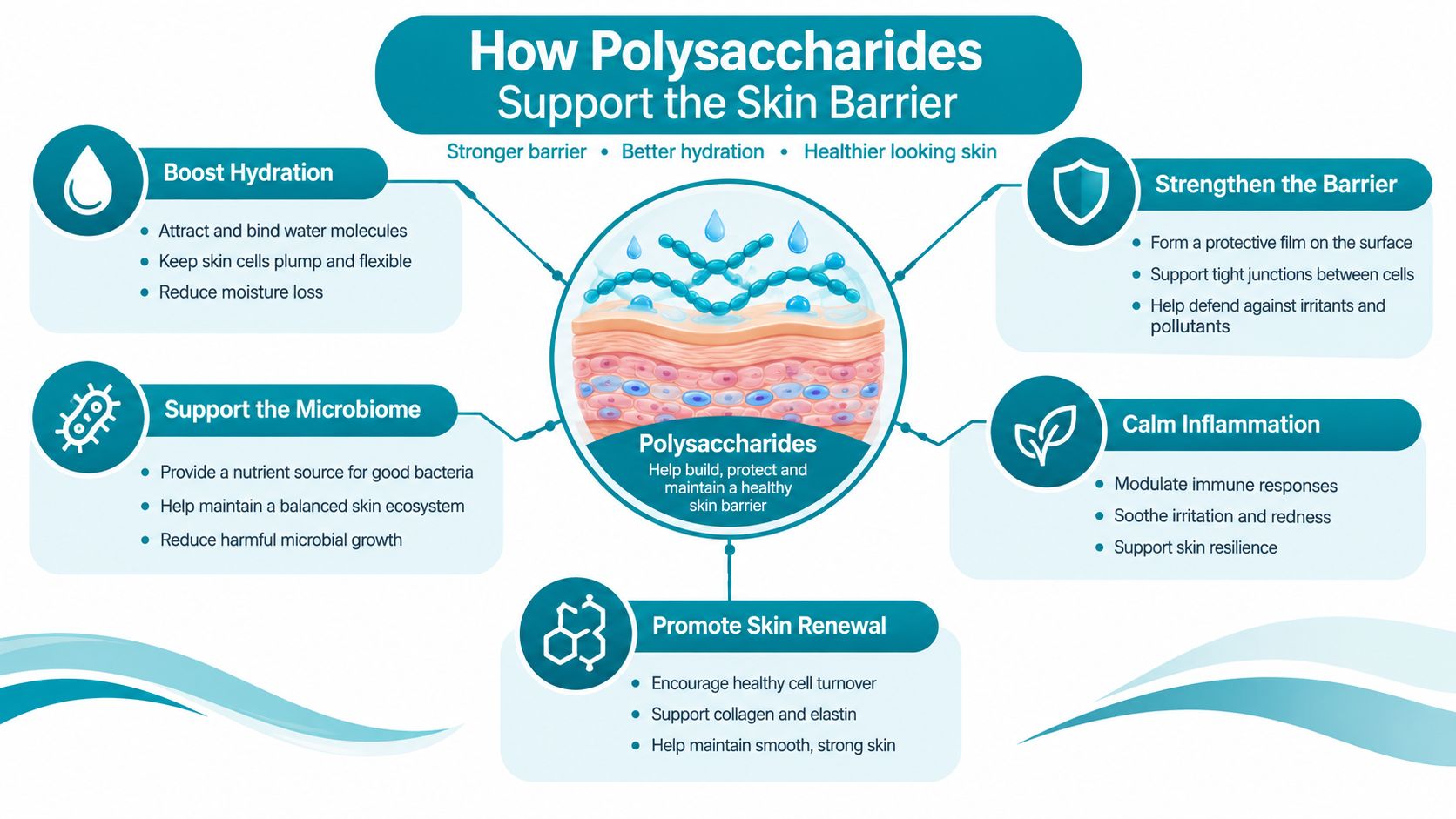
On the skin surface, a well-chosen beta-glucan behaves less like a dramatic treatment and more like a water-managing film former. Its long sugar chains hold water and leave a flexible layer that can ease the tight feel of surface dryness. The visible effect is usually softer texture, a more supple feel, and a temporarily plumper look.
That matters because barrier support is mostly about surface conditions. Beta-glucan does not replace the skin's own lipids, and it will not turn a thin watery base into a complete moisturizer on its own. It works best beside humectants, emollients, and occlusive ingredients that fill different roles in the formula.
Reviews describe topical beta-glucan activity through interactions involving Dectin-1 on keratinocytes and fibroblasts, along with effects on keratinocyte movement, epidermal differentiation, collagen deposition, and re-epithelialization in wound-repair research the review of topical beta-glucan and skin applications. For cosmetic formulation, the practical takeaway is narrower. The ingredient has mechanisms linked to surface conditioning and skin-supportive signaling, but a product claim should stay focused on appearance, hydration, and skin feel.
What the evidence tells formulators
A reviewed human and mouse evidence base reported that 2% Saccharomyces cerevisiae linear (1,3)-beta-glucan nanofibrous membranes reduced wound size to 83% by day 14, compared with 26% in controls the topical beta-glucan evidence review. That is a wound-healing result in a specific research setting, not a basis for claiming that a cosmetic heals or repairs skin. It does show why source, structure, delivery format, and study design matter.
A separate review reported that a beta-glucan hydrogel had a nominal water vapor transmission rate of 2000 to 2500 g/m²/day, a range described as ideal for wound dressings. The same review discussed reduced transepidermal water loss, increased epidermal and dermal thickness, and enhanced collagen production for carboxymethyl beta-glucan derivatives the review of beta-glucan hydrogels and modified derivatives. Those findings support careful discussion of hydration and surface conditioning, while also showing that the delivery matrix can be as important as the raw ingredient.
For a routine centered on barrier comfort, beta-glucan can sit beside familiar water-binding materials. Sodium Hyaluronate Powder Pure Hyaluronic Acid is a cosmetic-grade powder suitable for making water-based serums at the supplier-recommended use level, and the product page should be used for current specifications. Combining polymers can improve cushion and hydration, but too many film formers can also create tackiness or pilling.
For practical barrier-focused routine ideas, this guide to strengthening the skin barrier is more useful than broad immune-health messaging. The better result usually comes from a balanced formula, not from pushing one polysaccharide too far.
Conditioning Benefits for Hair and Lash Appearance
Hair and lashes respond to beta-glucan as fibers and surfaces, not as medical targets. A water-compatible polysaccharide can form a light conditioning film over the hair shaft, helping strands feel smoother and look more polished. That film may reduce the visual roughness associated with frizz and make fine strands appear slightly more substantial after styling.
The distinction matters for people concerned about shedding or thinning. A conditioning ingredient can improve manageability, softness, shine, and the appearance of fullness, but it isn't a treatment for hair loss and shouldn't be presented as one. A fuller-looking ponytail may result from better coating and less visible flyaway, while the underlying number of follicles remains unchanged.
Hair, brows, and lashes need different handling
For scalp and hair products, the main trade-off is film weight. A higher-viscosity polymer can give better slip and coating, but it may leave fine hair limp or create buildup when paired with heavy oils, waxes, or multiple styling polymers. A lighter format often feels cleaner in a leave-in spray or lash conditioner.
Brows and lashes need extra restraint because the eye area is less forgiving. Keep the finished product simple, avoid fragrance and unnecessary essential oils, and apply only with a clean applicator that prevents liquid from entering the eye. Consistent conditioning can help brittle-looking hairs appear more flexible and dense, but it won't change the growth cycle.
If you work with extensions, follow material-specific handling advice such as extensions conditioner protocols, because coating agents and oils can affect the feel, grip, or longevity of extension systems. For lash-serum application habits, this lash serum guide provides a more appropriate routine framework than borrowing scalp-treatment language.
A finished skincare product can also support an overall conditioning ritual. HydroGlow Anti-Aging Night Mask combines three types of hyaluronic acid, polyglutamic acid, jojoba, squalane, aloe, glycerin, triglycerides, sea silt ferment, and black algae extract for an overnight moisturizing experience. It's a facial product, not a lash or hair treatment, but its ingredient profile illustrates how several conditioning and water-binding materials can be designed to work together.
Formulation Parameters for Serums and Lotions
The hardest part of using beta-glucan isn't adding the powder. It's getting the polymer fully hydrated without creating fisheyes, stringy clumps, excessive drag, or an unstable preserved product. The raw material's supplier specification should take priority because beta-glucan isn't one standardized cosmetic material.
Start by identifying whether you have a powder, a pre-dissolved liquid, or a modified derivative. Powdered materials usually disperse more evenly when first blended into glycerin or another compatible humectant, then added gradually to the water phase. Dumping dry polymer directly into cold water often creates a swollen outer shell around dry material, leaving lumps that are difficult to break apart.
A practical starting framework
For a water-based serum, begin conservatively and adjust after evaluating viscosity, tack, clarity, and application. A low addition can provide a light film, while a higher addition may produce more cushion but can also increase stringiness and pilling. Because the supplied brief doesn't provide a verified universal use level, the correct concentration should come from the supplier's technical data rather than an invented industry standard.
Use a calibrated scale, not volume spoons. Hydrate with controlled mixing, allow sufficient time for the polymer to develop its final texture, and assess the batch again after resting. Heat can reduce processing time for some materials, but don't assume every beta-glucan grade tolerates high temperature. Follow the certificate of analysis and technical data sheet.
| Parameter | Recommended Range | Formulation Notes |
|---|---|---|
| Ingredient identity | Supplier-specific | Confirm source, structure, purity, and whether the material is powder or liquid |
| Addition level | Supplier specification | Start with a small pilot batch and adjust for viscosity, tack, and film feel |
| Dispersion | Gradual, controlled addition | Pre-wet powder in a compatible humectant to reduce clumping |
| pH | Supplier-validated range | Measure after full hydration and adjust gently |
| Water phase | Fully hydrated before final adjustment | Incomplete hydration creates graininess and uneven application |
| Preservation | Complete broad-spectrum system | Use a preservative compatible with the formula's pH and packaging |
| Compatibility | Test with the full formula | Check peptides, acids, retinoids, salts, and hyaluronic acid for texture changes |
Preservation is not optional
A homemade water-based serum can support microbial growth even when the ingredients look clean. Sanitized tools, treated water, suitable packaging, and a validated preservative system all matter. Don't rely on refrigeration, a “natural” label, or a fresh smell as proof of safety. If you can't verify preservation, make a non-water-containing product or use a professionally prepared base.
Beta-glucan can coexist with peptides and hyaluronic acid, but compatibility is a formulation question, not a guarantee. Test pH, viscosity, separation, odor, color, and application feel after combining them. Avoid adding several unfamiliar actives at once, because you won't know which component caused a change.
For a practical face-serum workflow, use this face serum making guide. A small, controlled workspace is also important. If your process involves powders or volatile materials, review fume hood selection for cosmetic laboratories and match the equipment to the actual hazards in your workspace.
Evaluating Sourcing and Molecular Weight
The label “beta-glucan” doesn't tell you enough. A reliable raw-material decision starts with the source and structure, then moves to purity, solubility, preservation compatibility, and documentation. Yeast-derived, fungal-derived, mushroom-derived, oat-derived, and modified derivatives can have different branching patterns and sensory behavior. One cannot be declared universally superior for every facial formula.
Ask a supplier for the ingredient's INCI name, source organism or material, processing method, molecular-weight information when available, recommended use level, solubility guidance, pH tolerance, microbiological specifications, heavy-metal information, and certificate of analysis. A dietary supplement powder may be acceptable for ingestion under its own specifications but unsuitable for a leave-on cosmetic. Cosmetic-grade documentation should match the intended application.
Molecular weight changes the experience
Larger polymers generally contribute more surface body, slip, and film character. They can make a serum feel cushioned, but they may also create drag, stringiness, or rolling when layered with other high-molecular-weight materials. Smaller or more modified structures may produce a lighter sensory profile, though their actual behavior depends on substitution, branching, purity, and the vehicle.
The literature emphasizes that topical outcomes vary with source and molecular structure, and a 2025 review describes promising topical effects across wound-healing, atopic dermatitis, photoaging, ultraviolet damage, antioxidant, inflammation-control, and moisturizing research while noting that the evidence remains dominated by mixed preclinical and small clinical studies rather than large product-comparison trials the 2025 review of topical beta-glucan. That means a supplier's technical sheet is more useful for formulation than a generic claim that all beta-glucans work alike.
Use a simple purchasing filter:
- Identity: Confirm the INCI name and intended cosmetic use.
- Structure: Look for molecular-weight or viscosity information, not just “high quality.”
- Testing: Request batch documentation and microbiological specifications.
- Performance: Ask whether the material dissolves, disperses, or requires neutralization.
- Traceability: Choose packaging that identifies the batch and supplier.
A lighter beta-glucan may suit a watery serum, while a more viscous grade may work better in a lotion or gel where the rest of the formula can absorb its body. Don't select by source mythology. Select by the sensory and stability requirements of the finished product. If you're comparing polymer systems, this resource on low-molecular-weight hyaluronic acid helps clarify why molecular size changes product feel and positioning.
Practical DIY Integration for Skin Perfection
A safe DIY process begins with the base, not the active. Decide whether you're modifying a lotion base or building a water-based serum, then confirm that the base supplier allows additions. Adding powder to a finished emulsion can disturb viscosity, pH, preservation, or emulsion stability, so a small pilot batch is the responsible starting point.
Adding beta-glucan to a water-based serum
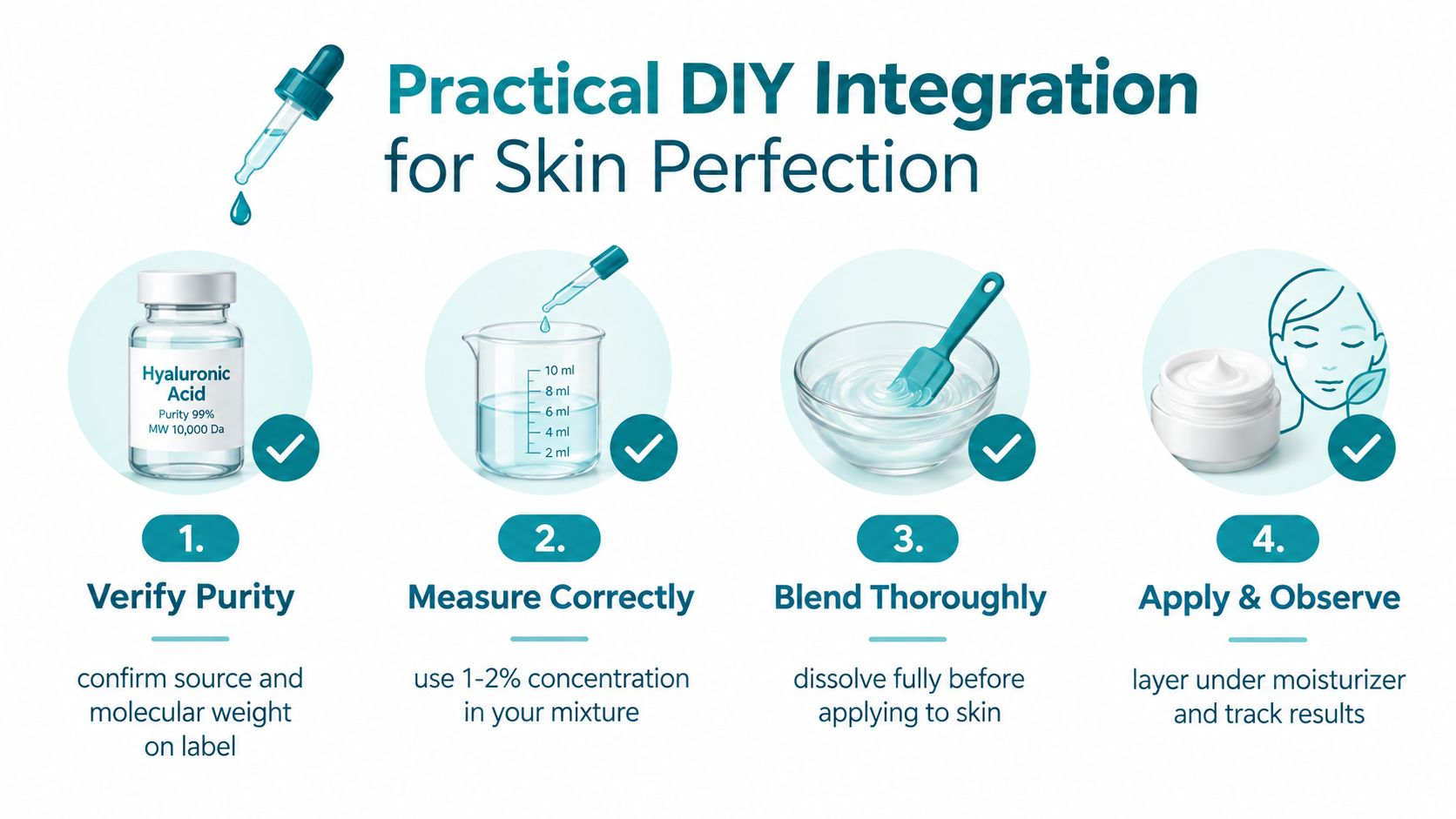
- Prepare the workspace. Clean and sanitize the work surface, vessels, spatula, scale, and packaging. Use distilled or otherwise suitable treated water, and keep the batch size small enough to measure accurately.
- Pre-disperse the powder. Blend the beta-glucan into a small amount of glycerin or another compatible humectant. This coats the particles and helps prevent the polymer from forming dry clumps when it enters the water phase.
- Add gradually. Introduce the pre-wet material into the water while mixing steadily. Don't whip air into the serum, because bubbles make it harder to judge clarity and final viscosity.
- Allow full hydration. Give the polymer time to develop its texture before changing pH or adding delicate ingredients. A serum that looks smooth immediately can become thicker or stringier as hydration progresses.
- Adjust the formula. Check pH, then add compatible ingredients such as humectants or selected peptides only after the beta-glucan is evenly dispersed. Hyaluronic acid can complement the film, but combining too many high-viscosity polymers may cause pilling.
- Preserve and package. Add a preservative according to its supplier instructions, verify the final pH, and use an airless or otherwise suitable container. Record the batch date, formula, ingredient lots, and observations.
Working with a lotion base
For a lotion, the safest option is usually to add beta-glucan during the phase specified by the raw-material supplier, often after the emulsion has formed and cooled enough for heat-sensitive components. Don't assume the same method works for every grade. Excess water, salts, acids, or active powders can thin an emulsion or create a grainy texture.
Pilling usually comes from a mismatch between film-forming layers, too much polymer, insufficient drying time, or rubbing too aggressively. Reduce the total polymer load, apply thinner layers, and allow each product to set before adding the next. Stickiness can improve when you balance beta-glucan with emollients and a properly structured lotion rather than adding more powder to chase hydration.
Mushroom-derived materials can vary considerably in preparation and composition. If you're researching a botanical source such as turkey tail, a background resource like this turkey tail tincture guide from Colorado Cultures can help you understand why an extract intended for one use shouldn't automatically be substituted into a cosmetic formula. Use only ingredients with cosmetic documentation for leave-on skincare.
Patch testing is sensible, especially for reactive users. Stop if persistent discomfort appears, and don't apply an unpreserved water-based DIY product near the eyes or to compromised skin.
Frequently Asked Questions
Can I layer beta-glucan with vitamin C or retinol?
Usually, the concern is formula compatibility and irritation potential, not a special conflict between the ingredients. Apply a well-preserved beta-glucan serum before a moisturizer, and introduce vitamin C or retinol according to the product's directions. If your skin is easily reactive, test the complete routine rather than assuming that each individual product will behave the same in combination.
How quickly should I expect visible hydration?
Hydration-related changes can feel noticeable sooner than changes in texture or the appearance of fine lines, but timing varies with the formula, application frequency, climate, and the rest of the routine. Judge the product by comfort, softness, surface smoothness, and whether it layers well. Don't use a short-term plumping effect as proof of a medical or permanent result.
Is it suitable for sensitive-looking skin?
A simple, fragrance-free formula may be easier to evaluate than a complex blend. Still, “sensitive skin” describes a broad range of experiences, so patch test the finished product and avoid introducing several new actives at once. A beta-glucan raw material can be well tolerated in one vehicle and unpleasant in another because preservatives, pH, solvents, and total film load all influence the experience.
Why did my serum become stringy?
The most likely causes are excessive polymer, incomplete dispersion, or the interaction of multiple high-molecular-weight ingredients. Let the batch hydrate fully, check the supplier's recommended process, and compare it with a simpler control batch. If the texture remains unpleasant, choose a lower-body grade or reduce the number of film-forming materials.
Can I use diagnostic beta-glucan information to market my serum?
No. Diagnostic data concerns clinical testing, not cosmetic beautification. Skin Perfection follows FDA rules and Etsy policies, which prohibit explicit or implied claims that a product treats, mitigates, diagnoses, or cures serious disease or medical conditions, acts as an analgesic, antibiotic, antiseptic, antiviral, anti-inflammatory, steroid, vaccine, decongestant, or prescription drug, or is FDA approved.
Skin Perfection offers beautifying skincare products and lotion-making supplies for people who want to work with ingredients such as beta-glucan, hyaluronic acid, and other conditioning materials. Visit Skin Perfection to explore ready-made products and DIY ingredients, then choose a documented formula approach that matches your skin goals and formulation experience.