

 Buy with Prime


When it comes to skincare, you're probably used to hearing about ingredients like peptides, stem cells, and antioxidants. But there's a new conversation starting, and it centers around something called exosomes. Think of them as the microscopic text messages your skin cells send to each other, carrying vital information that dictates how your skin looks and feels.
The New Buzz in Skincare What Are Exosomes?

The beauty world is always on the hunt for the next big thing, and right now, exosomes are getting all the attention. You're seeing the term pop up everywhere, from social media influencers to the menus at high-end aesthetic clinics. It's generating a ton of excitement, but what are these things really, and why is everyone suddenly talking about them?
At its core, the concept is pretty intuitive. Your skin cells are in a constant state of communication. This cellular chatter is what contributes to your skin's firm structure, smooth texture, and overall vibrant appearance. Exosomes are a critical part of making that conversation happen.
Cellular Messengers for Beautiful Skin
Imagine your skin as a bustling city full of tiny communities (your cells). For everything to run smoothly, these communities need to send messages back and forth. Exosomes are the specialized couriers that carry these important dispatches.
These tiny vesicles are packed with a precious cargo of proteins and lipids. When one cell releases an exosome, it travels to a nearby cell, docks, and delivers its contents and instructions. This is a fundamental process for how skin maintains its appearance of resilience and youthfulness.
Exosomes act as a natural information highway within the skin, facilitating the cell-to-cell communication that supports a firm, smooth, and radiant complexion.
This natural, biological function is precisely why the skincare world is so fascinated. The idea of using ingredients that can support or even mimic this cellular dialogue is a compelling new frontier for enhancing skin's beauty. If you're interested in the science behind cellular skincare, you might also want to explore our guides on creating a powerful stem cell serum.
To break it down even further, here's a quick cheat sheet on the key concepts.
Exosomes at a Glance Key Concepts
This table simplifies the main ideas we've covered, making it easy to understand the role these tiny messengers play.
| Concept | Simple Analogy | Relevance to Skin Appearance |
|---|---|---|
| Extracellular Vesicles (EVs) | The postal service for your cells. | The overall system responsible for transporting cellular materials. |
| Exosomes | Tiny delivery packages or text messages. | Carry specific instructions for maintaining the skin's beautiful appearance. |
| Cell-to-Cell Communication | Cells talking to each other. | This "talk" coordinates functions that contribute to a youthful look. |
| Bioactive Cargo | The contents of the package (proteins, lipids). | These are the components that tell other cells what to do. |
Understanding these basics helps clarify why there's so much excitement around harnessing this natural process for cosmetic benefit.
Why the Sudden Surge in Popularity?
The growing interest in exosomes isn't just hype; the numbers back it up. The global exosomes skincare market is projected to climb from USD 417.8 million in 2025 to USD 809.5 million by 2032, reflecting a compound annual growth rate of 9.9%.
This trend isn't just about a new ingredient. It points to a bigger shift in consumer demand—people are looking for advanced, science-backed products that work in harmony with the body's own natural processes. You can dig deeper into the expanding market for exosome skincare products by checking out recent industry reports.
How Exosomes Function as Cellular Messengers

To really get why everyone's talking about exosomes, we have to zoom in and see how they work inside our skin's complex world. Picture your skin cells as a massive, bustling city full of specialized workers. For this city to run smoothly—keeping everything looking good and holding its shape—those workers need a top-notch communication network.
Exosomes are a huge part of that network. They aren't the cells themselves, but tiny packages sent out by the cells. This is a critical distinction. They are nature's own high-tech couriers, built for one main job: delivering vital messages and materials from one cell to another.
This whole process of cell-to-cell communication is what keeps our skin looking healthy and vibrant. When cells can "talk" to each other effectively, they coordinate their efforts, which translates to a look of firmness, smoothness, and resilience.
The Ultimate Delivery Service
Let's stick with that delivery service idea for a moment. Imagine a central warehouse (the "parent" cell) needs to send a specific set of tools and instructions to a construction site (a "recipient" cell) across town. The warehouse packs these items into a tough, clearly addressed box.
That box is the exosome. It shields its precious cargo—proteins, lipids, and nucleic acids—from the outside world while it travels. When it reaches the construction site, it docks with the recipient cell and unloads its contents, providing the exact resources and blueprints needed for the job at hand.
This biological delivery system is running 24/7, supporting your skin's daily upkeep. The better this system works, the more youthful and vibrant your skin appears.
In short, exosomes are the carriers in the skin’s internal postal service. They make sure crucial biological information gets where it needs to go, supporting the cellular harmony that is the very foundation of beautiful-looking skin.
Differentiating the Cellular Packages
The term "exosome" is used frequently, but it's technically a specific type of package within a broader category. To be precise, exosomes belong to a family called extracellular vesicles (EVs). Think of EVs as the city's entire fleet of delivery vehicles.
This fleet has different kinds of vehicles for different jobs:
- Microvesicles: These are the bigger delivery trucks of the cellular world. They're larger than exosomes and form by budding right off the cell's outer membrane.
- Apoptotic Bodies: These are the largest vesicles, basically the "cleanup crew" packages sent out by cells that are in the process of self-destructing.
- Exosomes: These are the smallest, most specialized couriers, like nimble delivery drones. What makes them unique is that they form inside the cell first, within a structure called a multivesicular body, before being released.
While all EVs move materials around, exosomes are particularly fascinating in aesthetics because of their tiny size (typically 30-150 nanometers across) and the specific nature of what they carry. Their small stature helps them travel easily between cells, making them incredibly efficient messengers.
What Is Inside an Exosome?
The "cargo" an exosome carries is what makes it so powerful. It's not just random cellular junk; it’s a hand-picked collection of bioactive molecules that can directly influence the behavior of the cell that receives it. This is a lot like how other cellular communicators, like growth factors, work to support the skin's appearance. You can dive deeper into how these signals function in our in-depth guide to growth factors for skin.
An exosome's payload usually includes:
- Proteins: These could be structural proteins or enzymes that give a cell what it needs to function.
- Lipids: These help form the exosome's protective shell and can also act as signaling molecules themselves.
- Nucleic Acids (RNA): These are the "instruction manuals" that can tell the recipient cell which proteins to make.
When an exosome docks with a target cell, it delivers its cargo directly into the cell. This delivery changes the recipient cell’s state, giving it fresh materials and new instructions. This constant exchange is what helps maintain the skin’s dynamic balance, contributing to a complexion that looks refreshed and revitalized.
Comparing Exosomes, Stem Cells, and Peptides
In the world of advanced skincare, it’s easy to get lost in the terminology. You’ll often hear "exosomes," "stem cells," and "peptides" thrown around, sometimes as if they're all the same thing. They aren't. While they all play a part in promoting youthful-looking skin, they have fundamentally different jobs.
Think of it like building a house. You need the construction site, the architectural plans, and the crew that delivers the materials.
- Stem Cells are the Construction Site: They represent the potential—the raw capability and resources to build and beautify.
- Peptides are the Blueprints: These are the specific, detailed instructions that tell the workers what to do. "Build a wall here," "lay the foundation there."
- Exosomes are the Delivery Trucks: They are the vehicles that shuttle materials and messages from one part of the site to another, ensuring everything gets where it needs to go.
Each part is crucial. Blueprints are useless without a construction site, and a site can't function if the materials never arrive.
Stem Cells: The Production Powerhouse
When we talk about stem cells in skincare, let's be clear: we're talking about plant-derived stem cell extracts. These aren't live cells being put on your skin. Instead, they are extracts packed with valuable signaling molecules and antioxidants from the plant.
In our house analogy, these extracts are like a fully stocked supply yard. They don't become new skin cells themselves, but they provide your skin with a rich source of components that support its own natural processes, encouraging a more vibrant and resilient look.
Peptides: The Specific Instructions
Peptides are short chains of amino acids, which are the building blocks of essential proteins like collagen and elastin. Think of them as very precise, one-line commands. One peptide might carry the blueprint for "build more collagen," while another might say "relax the look of expression lines."
Peptides are targeted communicators. They send clear, specific signals to skin cells, encouraging them to perform tasks that lead to a firmer, smoother, and more youthful appearance.
Because they're so specific, different peptides can be combined to create powerful, multifaceted formulas. This targeted approach has made them a gold standard in modern skincare for years. If you're new to peptides, our guide on what a peptide serum is is a great place to start. For a deeper dive into the science, understanding topics like What Are Research Peptides can also be enlightening.
Exosomes: The Advanced Delivery System
Now, back to the delivery trucks. Exosomes don't build anything themselves, nor do they hold the original blueprints. What they do is carry a diverse cargo—proteins, lipids, and genetic material—that was packaged up inside their parent cell.
Their job is purely logistical: get the goods from point A to point B. This role in cell-to-cell communication is what has the beauty industry buzzing. However, the exosome market is still very new, with many regulatory and sourcing questions that remain unanswered. For those seeking reliable and well-established results, focusing on the "construction site" and the "blueprints" is still the most proven path.
To make this even clearer, let's break it all down in a simple table.
Comparing Skincare Actives: Exosomes vs. Stem Cells vs. Peptides
This table offers a quick, side-by-side look at these three technologies, helping you understand their unique roles and applications in your skincare routine.
| Feature | Exosomes | Stem Cells (Plant-Derived) | Peptides |
|---|---|---|---|
| Primary Role | Cellular messengers; deliver cargo. | Provide antioxidant support. | Signalers; give specific instructions. |
| Analogy | The delivery truck. | The construction site. | The blueprint or instruction code. |
| Function | Transport of bioactive molecules. | Supports the skin's natural functions. | Directs specific cellular activities. |
| Market Status | Emerging; largely unregulated. | Well-established and widely used. | A gold standard in cosmetic science. |
By focusing on high-quality peptides and plant-derived stem cell extracts, you're choosing ingredients with a long history of cosmetic use and a strong safety profile. At Skin Perfection, we prioritize these proven technologies. We believe in offering you a reliable path to achieving beautiful, youthful-looking skin without having to navigate the uncertain territory of today's exosome market.
Cosmetic Potential for Skin and Hair Appearance
It was only a matter of time before the intense scientific buzz around exosomes spilled over into the world of aesthetics. In professional settings, these tiny cellular messengers are now being explored for their potential to visibly upgrade the appearance of skin and hair. The focus here is purely on the cosmetic side of things—not medical treatments—all aimed at helping you achieve a more radiant and youthful look.
This is where complex cell biology meets the real-world, visible results that clients and estheticians are after. The idea is to support the skin's natural beauty, leading to a complexion that looks refreshed, smooth, and vibrant. It’s about working with the body's own communication systems to get those aesthetic improvements.
Enhancing Skin's Radiant Glow
When used in professional cosmetic treatments, exosomes are all about improving the skin's overall appearance. Estheticians are excited about their potential to support the look of skin firmness and elasticity, which in turn can help soften the appearance of fine lines and wrinkles.
The end game? A complexion that looks completely revitalized and glowing. By giving a helping hand to the skin’s natural communication lines, these treatments can help promote a more even skin tone and a smoother texture. This leads to skin that not only feels softer but also reflects light better, creating that luminous, healthy-looking glow we all crave.
To really get how different skincare actives play their parts, this diagram breaks down their unique roles in the beautification process.
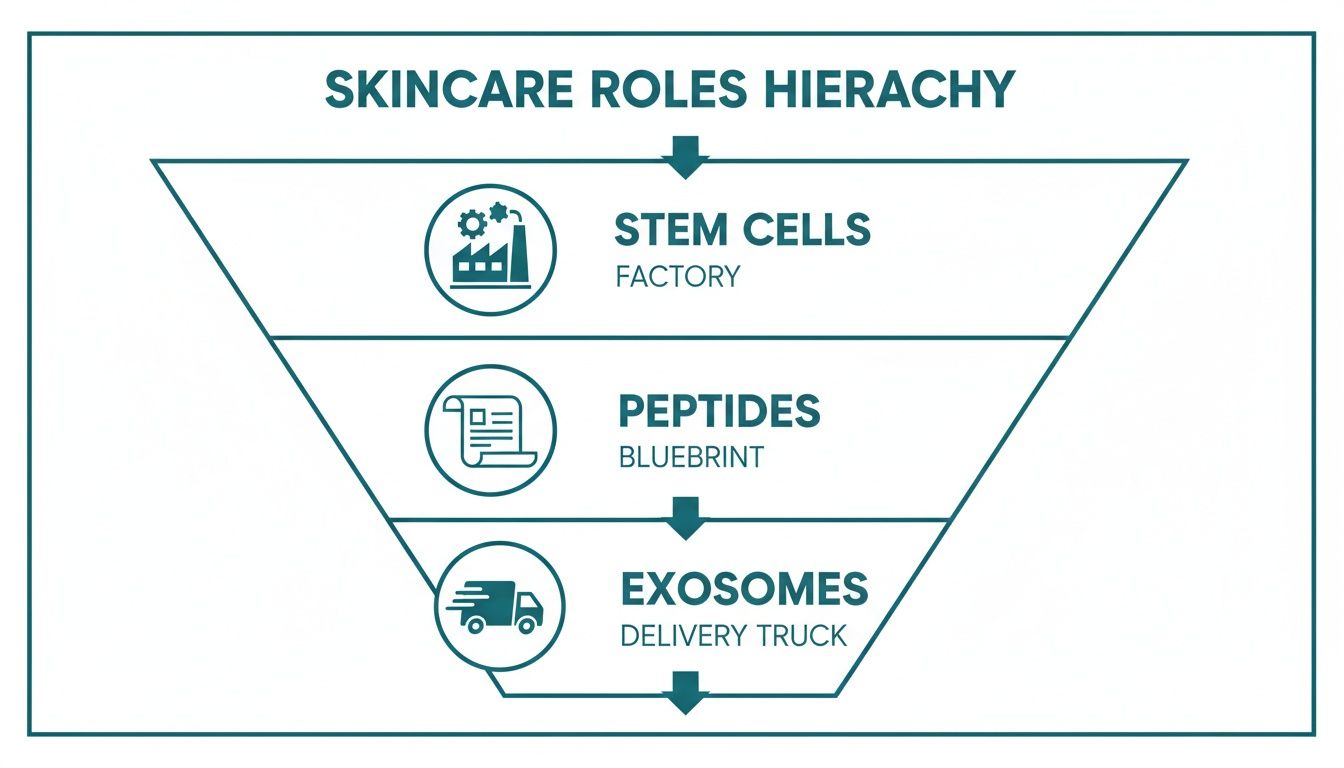
As you can see, if stem cells are the production factory and peptides are the instruction manual, then exosomes are the essential delivery trucks making sure all the messages and materials get where they need to go efficiently.
Promoting the Look of Thicker Hair
It doesn't stop with skin. Exosomes are also getting a lot of attention for their cosmetic use in hair care. Here, the goal is to improve the appearance of hair density and fullness. When used in scalp treatments, the idea is to create an environment that supports the look of stronger, healthier hair.
This approach is a big deal for anyone looking to enhance the appearance of thinning hair, whether it’s on the scalp or around the hairline. The visual payoff is hair that appears thicker and more voluminous, which can really contribute to a more youthful and confident vibe. It’s a method focused entirely on cosmetic improvement, helping restore the look of lush, full hair.
Exosomes in cosmetic applications are all about enhancing visual appeal. For skin, it's a quest for a radiant, smooth finish. For hair, it's about fostering an appearance of density, fullness, and vitality.
This growing interest is mirrored in the market's explosive growth. The bigger exosome market, which includes these aesthetic applications, was valued at USD 58.12 billion in 2025 and is projected to hit USD 307.04 billion by 2035. Within that, cosmetic therapies are the fastest-growing slice of the pie, thanks to the high demand for appearance-enhancing procedures. It's also worth noting that plant-derived exosomes have become a leading subsegment, showing a clear preference for natural, plant-based options in beauty routines. You can dig into the full exosome market research to see these trends for yourself.
Fuller-Looking Lashes and Brows
The same logic applies to amping up the appearance of eyelashes and eyebrows. Just like with scalp hair, cosmetic treatments using exosomes aim to create a fuller, denser look for lashes and brows. Sparse brows or thin lashes can get a visual boost, appearing more defined and lush.
This application is fantastic for framing the eyes beautifully, creating a more dramatic and expressive look without having to reach for makeup every single day. The focus stays right on the aesthetic result: helping people achieve the appearance of naturally thick, healthy lashes and brows that enhance their best features. By supporting the conditions for a fuller look, these treatments offer a promising new way to enhance one of the most visible parts of the face.
Navigating Safety, Sourcing, and Regulations
The buzz around exosomes is exciting, but it's created a fast-moving and often confusing market. Whether you're a consumer or a formulator, you absolutely need to understand the landscape—especially when it comes to safety, sourcing, and the current regulatory wild west. This knowledge is your best tool for making smart choices that put quality and transparency first.
Right now, topical skincare products with exosomes are in a largely unregulated gray area. The FDA has not approved any exosome products for cosmetic use. This complete lack of oversight means the quality, purity, and even the amount of active ingredient can vary wildly from one brand to another, creating potential risks.
This is exactly why being a savvy, cautious consumer is so important. For any advanced therapy, understanding why medical supervision in aesthetic treatments is a must-have is critical for your safety and results, especially with professional procedures.
Understanding Exosome Sources
A huge piece of the safety and ethics puzzle is where the exosomes come from. The exosomes used in skincare are typically pulled from one of three main sources, and each one comes with its own baggage.
- Human-Derived Exosomes: These are often sourced from mesenchymal stem cells (MSCs) taken from donated tissues like bone marrow or umbilical cords. This source brings up some pretty serious ethical and safety questions about donor screening and the risk of contamination.
- Animal-Derived Exosomes: Sourced from animals, like bovine milk. While they might be easier to get, they also carry risks related to cross-species reactions and ensuring purity.
- Plant-Derived Exosomes: Sourced from things like fruits, vegetables, or flowers. These are quickly becoming the popular choice because they're seen as an ethical and generally safer alternative, though the research is still pretty new.
The source directly shapes the product's quality and safety. Without clear rules and independent verification, it's nearly impossible for you to know what you’re really putting on your skin. You can get a better handle on ingredient transparency and labeling by checking out our resources on cosmetic regulations.
The Global Market and Its Challenges
The global hunger for exosome skincare is exploding, creating a complicated international market. This massive growth brings both amazing opportunities and big risks, since manufacturing standards can be worlds apart depending on where a product is made.
In an unregulated market, the responsibility falls on the consumer to demand transparency. Always question the source, purity, and manufacturing standards of any exosome-based product to protect your skin's well-being.
The growth is off the charts in certain regions. For example, the Asia-Pacific has become the fastest-growing region for the exosomes skincare market and is on track to snag 40-45% of the market share by 2026, thanks to a growing middle class with more to spend. North America currently holds 30-33% of the market, driven by high consumer spending on new skincare tech.
With all these complexities, our promise at Skin Perfection is to steer you toward proven, reliable ingredient technologies. We stick to actives like peptides and plant-derived stem cell extracts from reputable sources that make rigorous quality control a top priority. It's a safer, more transparent path to getting the beautiful skin you're after.
Smart Alternatives for Skincare Formulators
For the savvy DIY skincare creator or esthetician, the buzz around exosomes is definitely intriguing. But here’s the good news: you don't have to step into the murky waters of unregulated ingredients to get brilliant, youth-boosting results. You can achieve very similar aesthetic goals using well-researched, safe, and effective actives that support your skin’s own natural communication network. It’s all about working smarter, not riskier.
Instead of trying to introduce external "messengers" into your formulas, you can use ingredients that nudge your skin's own cells into sending the right signals for a beautiful appearance. This approach is grounded in proven cosmetic science, and it puts you in complete control over the quality and safety of your creations. The goal is simple: support the skin's natural functions to promote that coveted firm, youthful appearance.
Mimicking the Messenger Function
At its heart, the idea behind exosome skincare is all about improving cell-to-cell communication. Luckily for us, certain cosmetic actives are absolute masters at doing just that. They act as signals, prompting skin cells to kick into gear and perform specific actions that lead to a more vibrant and resilient look.
This strategy empowers you to formulate products that are both powerful and reliable. You shift from being a passive consumer of trends to an informed creator, armed with the tools to build beautiful, effective skincare from the ground up.
Here are some tried-and-true actives that can help you get there:
- Peptides: These are the gold standard for cellular signaling in skincare. Different peptides carry highly specific messages, like telling the skin to look firmer or to smooth out the appearance of fine lines.
- Plant Stem Cell Extracts: These extracts are packed with signaling molecules and antioxidants. They provide superb support for the skin's appearance, helping it look revitalized, refreshed, and ready to face the day.
- Growth Factors: These specialized proteins are excellent communicators that support the skin's look of firmness and elasticity.
High-Performance Actives for Your Formulations
At Skin Perfection, we’ve curated a selection of high-performance actives that let you tap into this science safely. By adding these ingredients to your formulas, you can create sophisticated products that rival the aesthetic goals of trending exosome treatments—without the uncertainty.
Your power as a formulator lies in your ability to choose proven ingredients that deliver consistent, visible results. By focusing on actives that support the skin's natural communication systems, you can create exceptional products with confidence.
Think of powerhouse peptides like Matrixyl 3000, which is famous for its ability to improve the look of skin firmness and dramatically reduce the appearance of wrinkles. Or consider plant-derived extracts from sources like apple stem cells, which provide robust antioxidant support to help maintain that youthful glow. To learn more about crafting your own custom products, check out our resources on professional cosmetic formulation.
By leveraging these kinds of ingredients, you can craft beautiful, effective skincare that works in harmony with the principles of cellular communication—all while keeping safety and transparency your top priorities.
Your Questions About Exosomes Answered
Diving into advanced skincare actives like exosomes can definitely bring up a lot of questions. Let's tackle some of the most common ones to help you feel confident and informed. Think of this as your straight-talk guide, framed in cosmetic language to keep things clear and compliant.
Are Topical Exosome Skincare Products Safe?
The safety of any topical exosome product ultimately depends on its source, purity, and manufacturing process. Since the market is largely unregulated right now, quality can be all over the place. This is a big deal, because products from sketchy sources could introduce risks you don't want to take.
For a much safer and more reliable way to get those skin-enhancing benefits, it's best to stick with ingredients that have a solid track record. Actives like peptides and plant-derived stem cell extracts offer fantastic aesthetic results and have a long, proven history of safe use in cosmetics.
Can I Make My Own DIY Exosome Serum?
Making a DIY serum with actual, functional exosomes just isn't something you can do at home. Isolating, purifying, and stabilizing these tiny messengers is a complex job that requires specialized lab equipment and completely sterile conditions to be safe and effective. Trying to do this in your kitchen is a non-starter and could be risky.
For the dedicated DIYer, the best way to get amazing results is to use high-quality, professional-grade actives that are specifically designed for home formulation. This way, you know you're getting both safety and real benefits in your custom creations.
Instead, at-home formulators can get incredible results using ingredients from trusted suppliers like Skin Perfection. Actives such as Matrixyl 3000 or various plant stem cells are made to be safely and effectively mixed into your own custom serums, helping you achieve a youthful, glowing complexion.
What's the Difference Between Human and Plant Exosomes?
Human-derived exosomes come from human cells (like stem cells) and are packed with biological messages meant for other human cells. On the other hand, plant-derived exosomes—often called plant-derived extracellular vesicles (PDEVs)—are sourced from botanicals like fruits and flowers.
While they both function as little couriers, their "cargo" and where they come from are completely different. Plant exosomes are quickly becoming popular in skincare as a natural and ethical option. They're loved for their antioxidant properties that help beautify the skin, neatly sidestepping all the regulatory and ethical headaches tied to human-derived ingredients.
How Soon Can I See Results From Exosome-Like Ingredients?
How long it takes to see visible improvements in your skin always depends on the specific product, the concentration of the actives, and your own unique skin.
When using products with ingredients that support the skin’s natural functions—like advanced peptides or plant stem cells—many people start to notice a smoother texture, better hydration, and a brighter look within 4 to 8 weeks of consistent, twice-daily use. Patience and sticking to a routine are your best friends for getting the best possible outcome.
Ready to create skincare that delivers visible results with proven ingredients? Explore the full range of high-performance peptides, plant stem cells, and other essential actives at Skin Perfection. Start formulating your path to radiant skin today by visiting our shop at https://www.naturalorganicskincare.com.