

 Buy with Prime



“Low pH” is often treated as a shortcut for “gentle.” That shortcut is unreliable. A cleanser can sit near the skin's natural acidity and still feel drying if its surfactant system removes too much oil, while a cleanser outside the popular target range may feel comfortable for a particular person.
The useful question isn't “What number is printed on the bottle?” It's “Which cleansing agents contact my skin, at what pH, and how does my face feel after rinsing?” This guide approaches low pH cleansers for face as a formulator would, using cosmetic chemistry, skin feel, ingredient lists, and the limits of current evidence.
Table of Contents
- Why Low pH Cleansers Deserve a Second Look
- The Skin Barrier and the Acid Mantle Explained Simply
- The pH Sweet Spot for Facial Cleansing
- Surfactants Matter More Than the pH Number
- How to Read a Cleanser Label Like a Formulator
- Matching Low pH Cleansers to Different Skin Profiles
- A Simple DIY Low pH Cleanser Formula to Try at Home
- Key Takeaways and Common Questions About Low pH Cleansers
Why Low pH Cleansers Deserve a Second Look
A low pH number can look reassuring, but it is not a complete gentleness score. The cleanser's surfactant system, meaning the ingredients that lift oil, sunscreen, and debris from the skin, often matters more than the digit printed on the bottle. A major review found that systems built mainly with anionic surfactants could increase dryness and irritation under skin-pH conditions compared with neutral-pH versions. The authors also cautioned that matching skin pH alone does not guarantee less dryness or better cleansing performance (International Journal of Cosmetic Science review).
Treat low pH as a useful starting filter, not a gentleness certificate. Surfactant charge, concentration, blend, foam profile, and interaction with the rest of the formula can change how cleansing feels. Two products with the same pH may behave differently, much like two soaps set to the same water temperature can still differ in how much oil they remove.
Some people tolerate a mildly alkaline cleanser without immediate discomfort. That response does not prove the formula suits every face, and tightness is not a dependable test of cleanliness. Skin condition, contact time, rinsing, and the formula's overall design all affect the result.
What the label leaves out
Front-label terms such as “pH balanced,” “mild,” or “clean” provide limited information. They do not reveal whether the formula uses an isethionate, betaine, glucoside, or stronger anionic detergent. They also do not show whether fragrance, essential oils, or a high-foam system affects comfort after rinsing.
A formulator reads past the headline:
- What cleans? Identify the primary surfactants and their families.
- What cushions the cleanse? Look for humectants, emollients, polymers, and a texture that limits friction.
- What happens after rinsing? Notice tightness, stinging, roughness, or comfortable softness.
- Can the pH claim be verified? Treat the advertised number as useful information, not proof of performance.
Formulator's rule: A gentle cleanser needs a suitable pH and a well-tolerated surfactant system. Either one alone leaves the formula difficult to judge.
The practical choice is straightforward. Shortlist products with a skin-compatible pH, then compare their cleansing agents and your skin's response instead of chasing the lowest number.
The Skin Barrier and the Acid Mantle Explained Simply
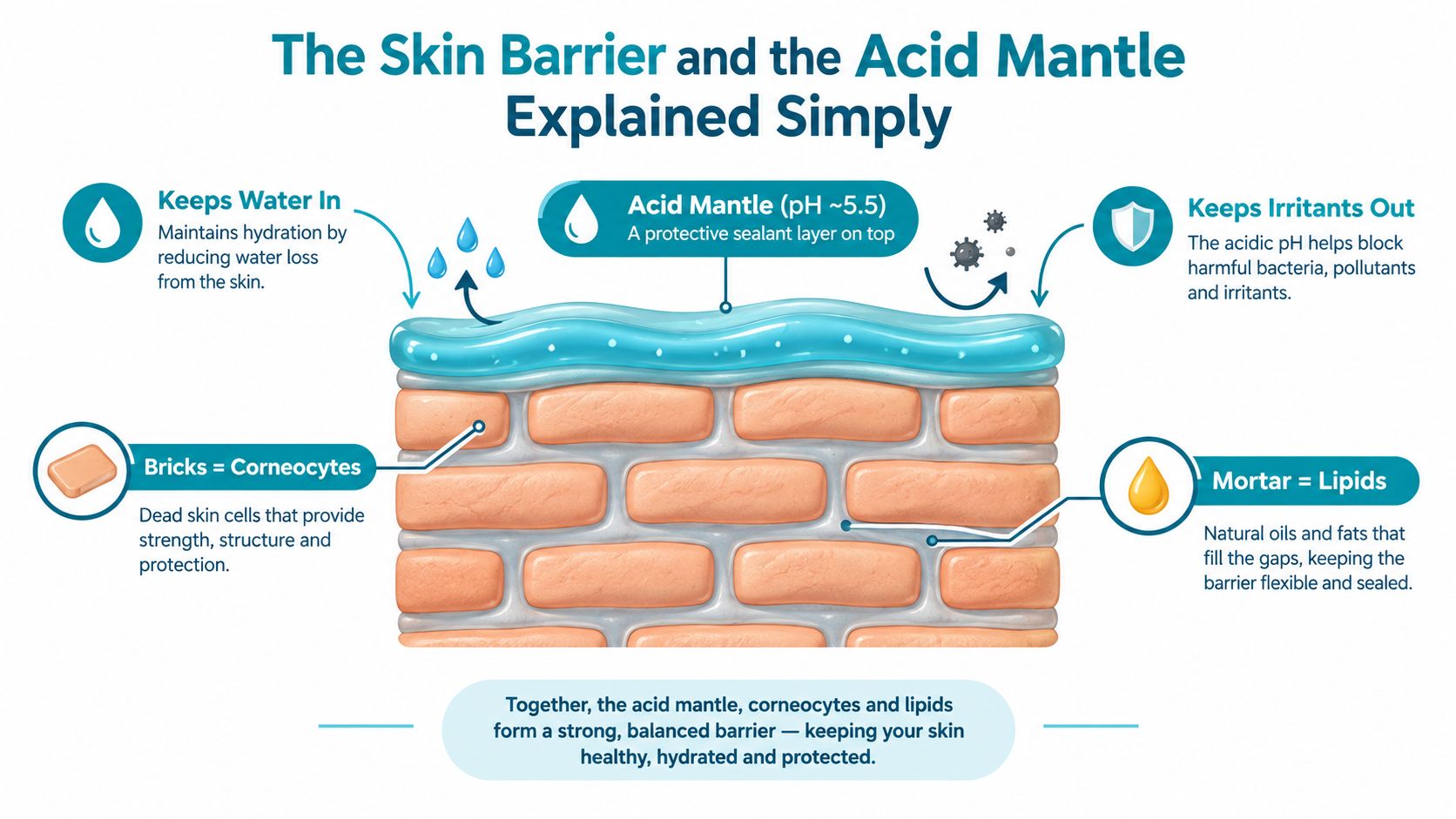
Think of the outer layer of facial skin as a brick wall. Corneocytes are the bricks, flattened cells that form the structure. Lipids are the mortar, filling the spaces between those cells and helping limit water loss. A thin, slightly acidic surface film sits over that wall like sealant. That film is commonly called the acid mantle.
The sealant isn't just a decorative chemistry lesson. It helps the surface hold onto moisture and creates an environment that supports the skin's normal microbial balance. Free fatty acids, sweat, and the microbiome all contribute to the surface conditions that make healthy skin mildly acidic, generally around the mid-five range.
What an aggressive cleanse can change
Alkaline soap and harsh detergents can disturb the wall in several ways. High-pH products can swell the stratum corneum, alter the behavior of its lipids, and make the surface feel less comfortable. Hot water and vigorous rubbing add physical stress, especially when the cleanser already removes a large amount of surface oil.
The result can be familiar without being diagnostic:
- Tightness, because the surface has lost some of its flexible, lubricated feel.
- Dryness, because the barrier holds water less effectively.
- Stinging, because everyday products can feel stronger on a temporarily vulnerable surface.
- Rough texture, because the outer cells no longer sit in an evenly conditioned environment.
This doesn't mean every wash causes lasting damage. Skin can recover, and people respond differently. It does mean that a cleanser should be judged by the condition it leaves behind, not by how dramatic the rinse feels.
For a broader explanation of seasonal barrier stress, see Skin Barrier 101. A leave-on product such as HydroGlow Anti-Aging Night Mask belongs to a different step of the routine. Its listed ingredients include hyaluronic acid, polyglutamic acid, jojoba, squalane, aloe, glycerin, and triglycerides, so it isn't a substitute for choosing a well-tolerated cleanser.
The brick-wall analogy has one important limit. It helps explain why pH and surfactants matter, but it can't predict an individual reaction by itself. Your formula, water temperature, cleansing frequency, contact time, and follow-up moisturizer all influence the final experience.
The pH Sweet Spot for Facial Cleansing
A lower pH is not automatically a gentler cleanser. The useful target is a formula that stays reasonably close to the skin's surface environment while using a surfactant system that cleans without excessive disruption.
Healthy skin surface pH is often described as around 5, and the acidic range of 4 to 6 has been linked with stratum corneum integrity in the literature (review in Clinical Interventions in Aging). Treat that range as a working zone, not a hard boundary. Readings change with the probe, sampling site, temperature, time since washing, and the product being tested.
A practical reading of the range
For a rinse-off facial cleanser, many formulators look toward the middle of that window. A finished product around pH 4.5 to 5.5 can be a sensible target for shoppers who want to stay near the skin's usual acidity, as long as the surfactant blend is mild. The printed number is one quality check, not a verdict.
| pH Range | Common Label | Typical Effect on Barrier |
|---|---|---|
| 4.0–4.5 | Acidic or very low pH | Close to physiological acidity, but pH alone does not establish mildness |
| 4.5–5.5 | Low pH or pH balanced | Often a practical comfort target with a suitable surfactant system |
| 5.5–6.0 | Mildly acidic | Still close to the commonly cited physiological range |
| Above 6.5 | Neutral to alkaline-leaning | May matter more for some users, especially with stronger detergents |
| 9–10 | Alkaline soap range | Traditional soaps commonly fall here and may feel tightening after rinsing |
Alkalinity deserves particular caution. Published reviews report that barrier repair proceeds more slowly at neutral pH 7.2 than at physiological pH 5.5. They also associate high-pH cleansers with stratum corneum swelling, changes in lipid rigidity, and greater barrier disruption (PubMed review).
Where the evidence stops
A controlled comparison found that a pH 4.7 cleanser produced significantly higher visual dryness than a pH 6.7 cleanser on days 3, 4, and 5, with p < 0.05. The result is a useful warning against treating “lower” as shorthand for “milder.” In that comparison, the surfactant system was mainly anionic (International Journal of Cosmetic Science review).
Use pH as a screening tool, then examine the full formula. A cleanser near the skin's physiological range is a reasonable starting point, but surfactant choice, concentration, and after-wash comfort decide whether it is suitable.
Surfactants Matter More Than the pH Number
The pH number is only one setting on the formula. Surfactants do the washing. They surround oil, sunscreen residue, soil, and other material, allowing water to carry it away. Their chemistry also shapes foam, slip, the rinsed feel, and the likelihood of dryness.
Cocamidopropyl betaine is an amphoteric surfactant often added to soften a cleansing blend and provide moderate foam. Decyl glucoside is a nonionic glucoside that may feel gentle in a well-balanced formula, although tolerance differs between users. Sodium cocoyl isethionate is an anionic surfactant commonly used in creamy cleansing bars and syndet-style systems.
A low-pH cleanser can still feel stripping if it relies heavily on a strong detergent. A formula at a somewhat different pH may feel comfortable when its surfactants, concentration, and conditioning ingredients work well together. The label's single pH value cannot show that interaction.
| Surfactant Class | Examples | Typical pH Range | Cleansing Feel | Barrier Impact |
|---|---|---|---|---|
| Amphoteric | Cocamidopropyl betaine | Around 4–6 in compatible systems | Soft foam and moderate slip | Often used to reduce blend harshness, though tolerance varies |
| Nonionic glucoside | Decyl glucoside | Often mildly acidic to near-neutral | Light, clean foam | Can feel comfortable, but is not automatically irritation-free |
| Isethionate | Sodium cocoyl isethionate | Common in syndet and low-water systems | Creamy, cushiony cleanse | Often chosen for a less squeaky after-feel |
| Stronger anionic detergent | Sodium lauryl sulfate, sodium laureth sulfate | Formula-dependent | Larger foam and a pronounced clean feel | Can be drying or irritating for some users |
| Saponified soap | Sodium salts of fatty acids | Commonly alkaline, often pH 9–10 | Firm lather and post-rinse tightness | Alkalinity can disturb the stratum corneum and surface lipids |
Traditional bar soap makes the distinction easy to notice. Soap is commonly alkaline, while many shampoos are closer to mildly acidic or near-neutral conditions. The tight sensation after washing may reflect both the soap's detergent action and its alkaline character.
For a related example, see this SLS-free shower gel formulation. Apply the same reading habit to facial cleansers: identify the surfactant family, consider how the blend is cushioned, then treat the printed pH as supporting information rather than the verdict.
How to Read a Cleanser Label Like a Formulator
Start at the ingredient list, not the product name. The first cleansing ingredients usually reveal more about the formula's behavior than a phrase such as “clean,” “natural,” or “pH balanced.”
Look for the surfactant group near the beginning of the list. A blend containing betaine, glucoside, amino-acid-derived surfactants, or sodium cocoyl isethionate may offer a different feel from one led by stronger anionic detergents. The list won't tell you every processing detail, but it gives you a useful first filter.
A quick label sequence
- Find the cleansing agents. Search for the ingredients that create the wash and foam. Don't assume “sulfate-free” means every other surfactant is automatically mild.
- Look for cushioning ingredients. Glycerin, panthenol, and hyaluronic acid can support a more comfortable formula, but they don't cancel out an aggressive surfactant system.
- Scan the later ingredients. Preservatives, fragrance, and botanical extracts often appear lower in the list. Their position can offer context, but fragrance-free status and your own tolerance matter more than counting ingredients.
- Check the finished pH. If the brand provides a range, treat it as helpful formulation information. If it doesn't, inexpensive pH strips can provide a rough check, while a calibrated digital meter offers more precise testing when the product's texture allows it.
A practical test needs a consistent sample. Follow the strip or meter instructions, test the product as directed, and don't treat one home reading as a laboratory certificate. Thick, colored, or highly surfactant-rich products can make strips difficult to read.
A pH number tells you where the formula sits. The ingredient list tells you how it cleans.
Keep a short personal list of surfactant families that leave your skin comfortable. You can then use that list as a shopping filter instead of repeatedly buying products based on a trend phrase. How to read a skincare label can help you build that ingredient-reading habit.
Matching Low pH Cleansers to Different Skin Profiles
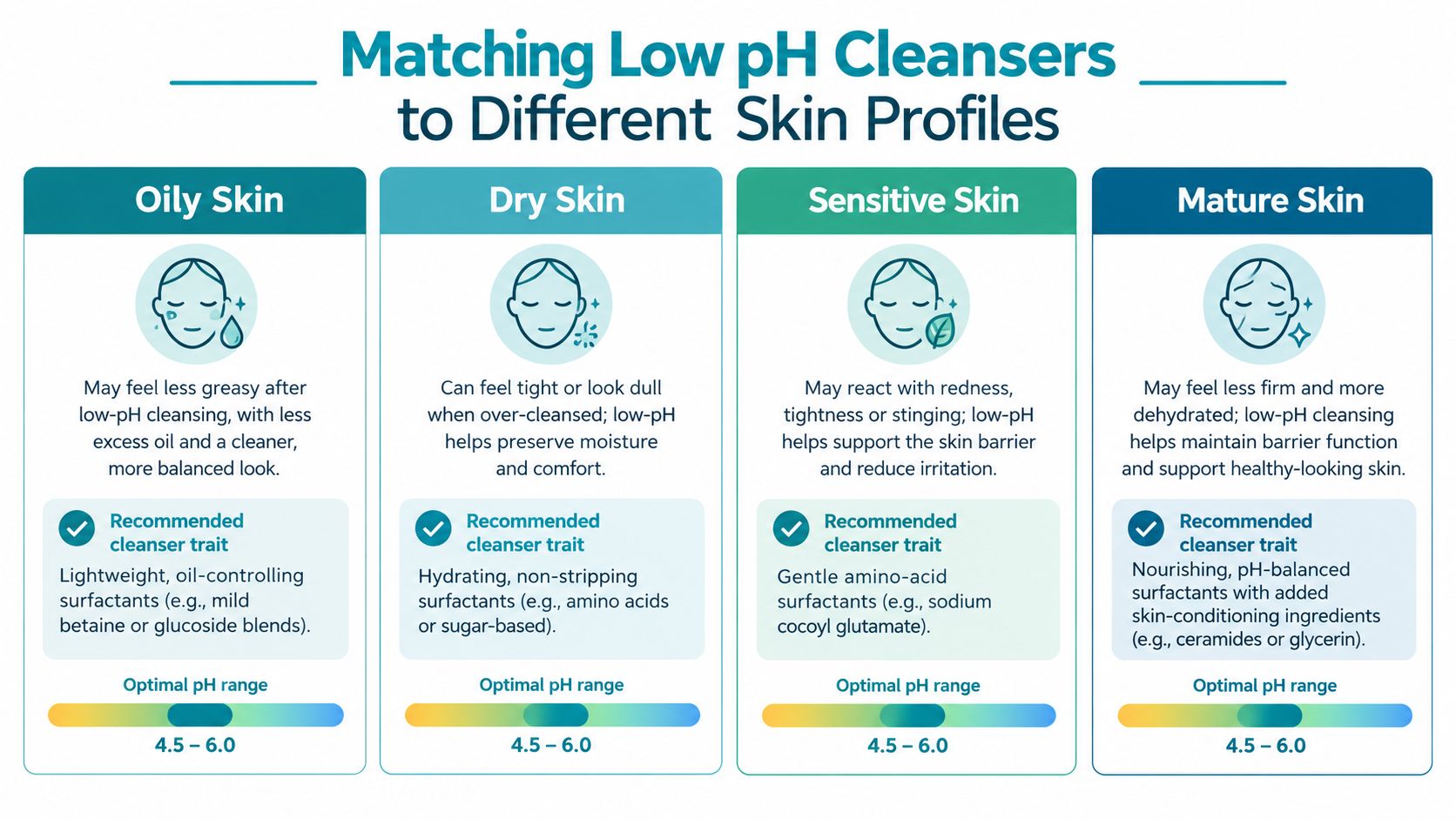
Two people can use the same low pH cleanser and describe it differently. One person notices a fresh, comfortable rinse. Another feels tightness within minutes. Skin profile, water temperature, cleanser amount, contact time, and the rest of the routine all shape that response.
Oily skin
Oily skin may prefer a light gel or foaming texture that removes surface oil without leaving a film. Some people with this profile tolerate a more active low-pH surfactant blend, while others experience rebound tightness or discomfort after a strong cleanse. The deciding signal is how the face feels later, not how much foam appears at the sink.
Dry skin
Dry-feeling skin often benefits from a creamier system built around betaine or sodium cocoyl isethionate, plus humectants such as glycerin. Short contact time, lukewarm water, and immediate moisturization can matter as much as the cleanser's pH.
Sensitive skin
A minimal, fragrance-free formula is a sensible place to start for skin that stings easily. Avoid selecting only by the words “low pH.” Check the surfactant blend, reduce rubbing, and introduce one new product at a time so you can identify what your skin accepts.
Mature skin
Mature skin often feels more comfortable with a milky or lotion-like texture rather than a high-foam wash. A cleanser can be paired with a separate leave-on product containing ingredients such as ceramides or squalane, but those ingredients don't transform a harsh cleanser into a mild one.
These are routine-comfort observations, not treatment claims. Your own response overrides the category. For a broader overview of skin profiles, see the five skin types.
A Simple DIY Low pH Cleanser Formula to Try at Home
A small water-based cleanser can be useful as a learning exercise, but it needs more discipline than mixing a few attractive ingredients in a jar. Water-based products can support microbial growth, and homemade batches don't have the stability testing of commercial formulas.
The following is a formula sketch, not a validated finished product:
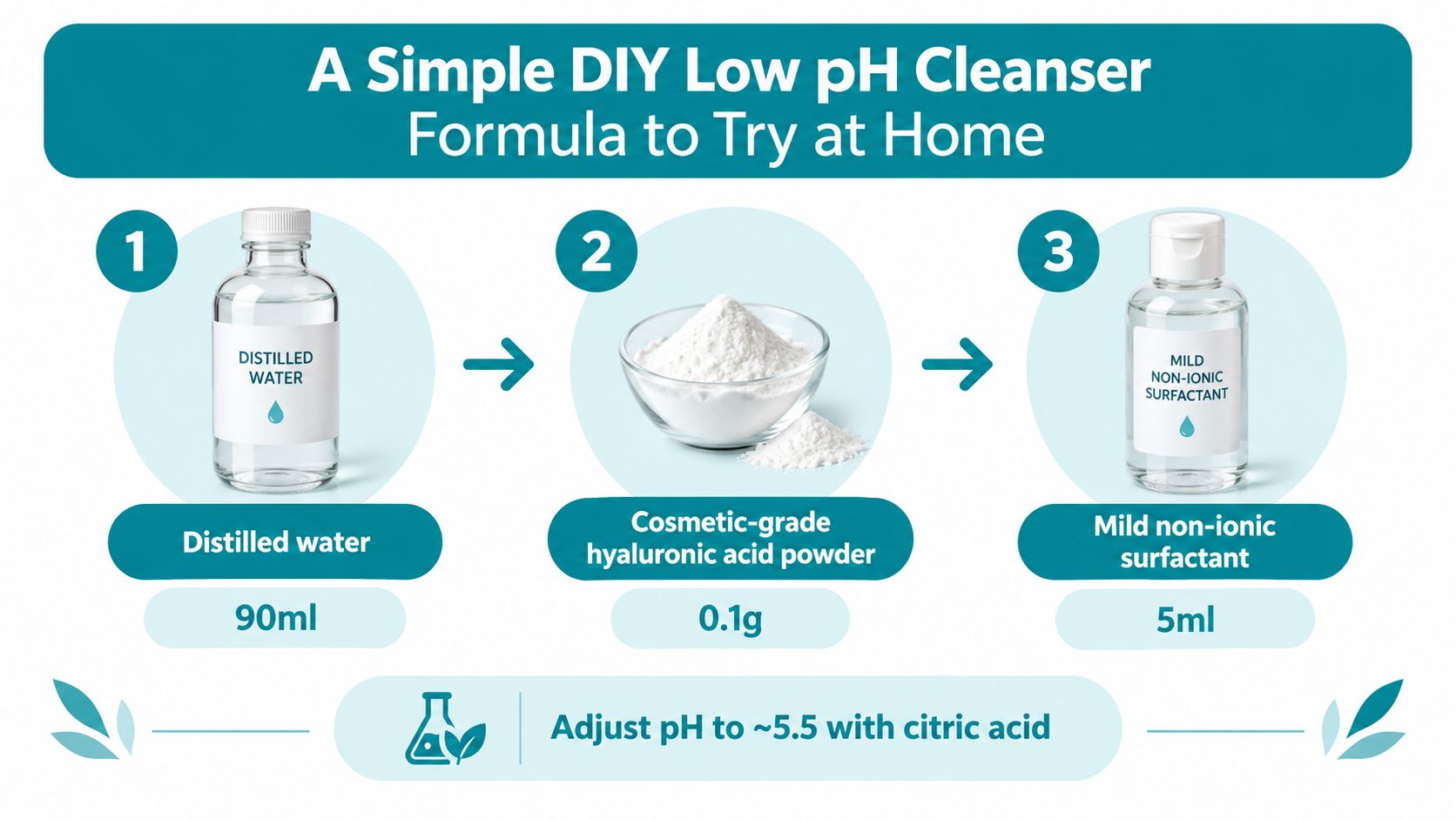
- Distilled water, 90 ml: Use distilled water rather than tap water to reduce unwanted minerals and contaminants.
- Cosmetic-grade hyaluronic acid powder, 0.1 g: This adds a small amount of a water-binding polymer and must be dispersed carefully to avoid clumps.
- Mild nonionic surfactant, 5 ml: Choose a supplier-documented cosmetic material and follow its handling and usage guidance.
- Broad-spectrum preservative: Use a compatible system, such as Liquid Germall Plus or a phenoxyethanol-based blend, at the supplier's stated rate and pH range.
Method and safety checks
Sanitize equipment, weigh ingredients accurately, and mix slowly to limit foam. Hydrate the hyaluronic acid in part of the distilled water before adding the surfactant, then add the preservative according to its technical documentation.
Measure the finished pH with calibrated strips or a digital meter. Adjust cautiously toward approximately pH 5.5 with a properly diluted citric acid solution. Add very small amounts, mix thoroughly, and recheck instead of making a large correction at once.
Never skip the preservative, substitute tap water, or assume essential oils provide cleansing power. Before facial use, perform a mandatory 48-hour patch test behind the ear. Stop if you notice persistent stinging, redness, itching, or other discomfort.
Store the batch in a clean, suitable container and discard it if its odor, color, texture, or pH changes. For formulation materials and preservation guidance, see natural skincare preservative options. A homemade cleanser should be treated as an experiment with limits, not as a validated commercial formula.
Key Takeaways and Common Questions About Low pH Cleansers
The central lesson is easy to state and easy to forget: surfactant system first, pH number second. A cleanser is more likely to feel mild when its cleansing agents and finished pH suit each other, rather than when the formula advertises an especially low number.
For many facial routines, pH 4.5 to 5.5 is a practical target. The wider physiological discussion often uses pH 4.0 to 6.0, but the number doesn't override the ingredient list. Read past fragrance claims and front-label language, identify the surfactants, and match the texture and cleansing strength to your skin profile.
Common questions
How long does skin take to adjust after switching cleansers?
There isn't one reliable adjustment timetable for everyone. Focus on immediate comfort and the pattern across several uses. If tightness, stinging, or visible dryness persists, the formula or routine may not suit you.
Does micellar water count as a low-pH option?
Only if the finished product is formulated within that range. “Micellar” describes a cleansing delivery system, not a guaranteed pH. Check the brand's specification or measure the product carefully at home.
How can I test a cleanser's pH?
Use pH strips for a rough indication or a calibrated digital meter for a more precise reading. Follow the tool's instructions and remember that thick or colored cleansers can make strip results harder to interpret.
Can I use a low-pH cleanser twice daily?
Some people can use a well-formulated cleanser morning and evening comfortably, while others do better with less frequent cleansing or a gentler evening-only routine. Let post-wash comfort, dryness, and irritation guide frequency rather than treating twice-daily use as mandatory.
FDA's distinction also matters for product language. A cosmetic is intended for cleansing, beautifying, promoting attractiveness, or altering appearance. Claims that a product treats or prevents disease, or affects body structure or function, can place it in drug territory (FDA cosmetic or drug guidance). FDA also says cosmetics don't require premarket approval and that it doesn't maintain an approved-claims list for cosmetics, while disease-oriented claims can trigger drug requirements (FDA labeling claims guidance).
Skin Perfection follows those FDA rules for product listings and describes its skincare and lotion-making supplies in cosmetic terms focused on beautifying the skin. Its approach also follows Etsy's medical claims policy, which prohibits disease claims regardless of accuracy or legality, including claims involving serious conditions, sexual dysfunction, antibiotics, antiseptics, antivirals, anti-inflammatories, steroids, vaccines, decongestants, prescription drugs, or FDA approval (Etsy Medical Claims policy).
Skin Perfection offers skincare products and lotion-making supplies for cosmetic routines and DIY formulation projects, so you can compare ingredients and create products with appearance and comfort in mind. Visit Skin Perfection to explore its skincare range and formulation supplies, then use the surfactant-first framework from this guide when choosing your next cleanser.