

 Buy with Prime



You choose a cleanser labeled “gentle,” swap your scented moisturizer for one marked “unscented,” and simplify your routine. Yet a few days later, your eyelids or cheeks feel itchy and look irritated. That experience doesn't necessarily mean you chose badly. It may mean that a product's scent claim is only one clue, and the full ingredient list and your own allergy history matter too.
Fragrance-free skincare can reduce exposure to fragrance ingredients, especially for people with a confirmed fragrance allergy or recurring dermatitis. But the label isn't a promise that every ingredient will suit every person. To make sense of it, you need to know what the words mean, how fragrance allergens appear on labels, and what else can trigger a reaction.
Table of Contents
- Why Fragrance-Free Matters More Than the Label Suggests
- What Fragrance-Free Really Means
- Who Actually Benefits from Going Fragrance-Free
- Why Fragrance-Free Does Not Automatically Mean Reaction-Free
- Reading Labels Like a Formulator
- Fragrance-Free and Actives How Peptides and Plant Stem Cells Fit In
- Two Fragrance-Free Routines You Can Adapt
- DIY Formulation Tips and Preservation Considerations
Why Fragrance-Free Matters More Than the Label Suggests
A routine can look carefully edited and still contain an ingredient that doesn't suit your skin. Someone who reacts after switching to an “unscented” lotion might assume the product has no fragrance-related ingredients. But “unscented” can describe a product made to have little noticeable odor, not necessarily one made without masking fragrance. A botanical extract or preservative could also be relevant, so the label alone can't diagnose the cause.
The useful starting point is risk reduction, not a guarantee. Fragrance allergy is a clinically significant reason some consumers choose fragrance-free skincare. A review estimated fragrance allergy prevalence at 0.7%–2.6% of the general population, while positive reactions among people patch-tested for suspected allergic contact dermatitis ranged from 5% to 11% (review indexed by the U.S. National Library of Medicine). Those figures describe different groups. The second group is already being evaluated for a suspected skin condition, so it shouldn't be read as the rate for everyone.
Fragrance-related allergic contact dermatitis often follows cosmetic exposure and commonly affects the face or hands, areas that meet cleansers, moisturizers, serums, and other skincare directly. For someone with documented fragrance allergy or recurring dermatitis, choosing products without intentionally added fragrance can be a practical way to reduce exposure. For someone without those concerns, it may be a preference.
A label helps you choose what to try. It can't tell you exactly what caused a rash.
Think of this guide as a way to read the label with more confidence: what “fragrance-free” may mean, what it doesn't promise, and how the same thinking applies to finished products and DIY formulas.
What Fragrance-Free Really Means
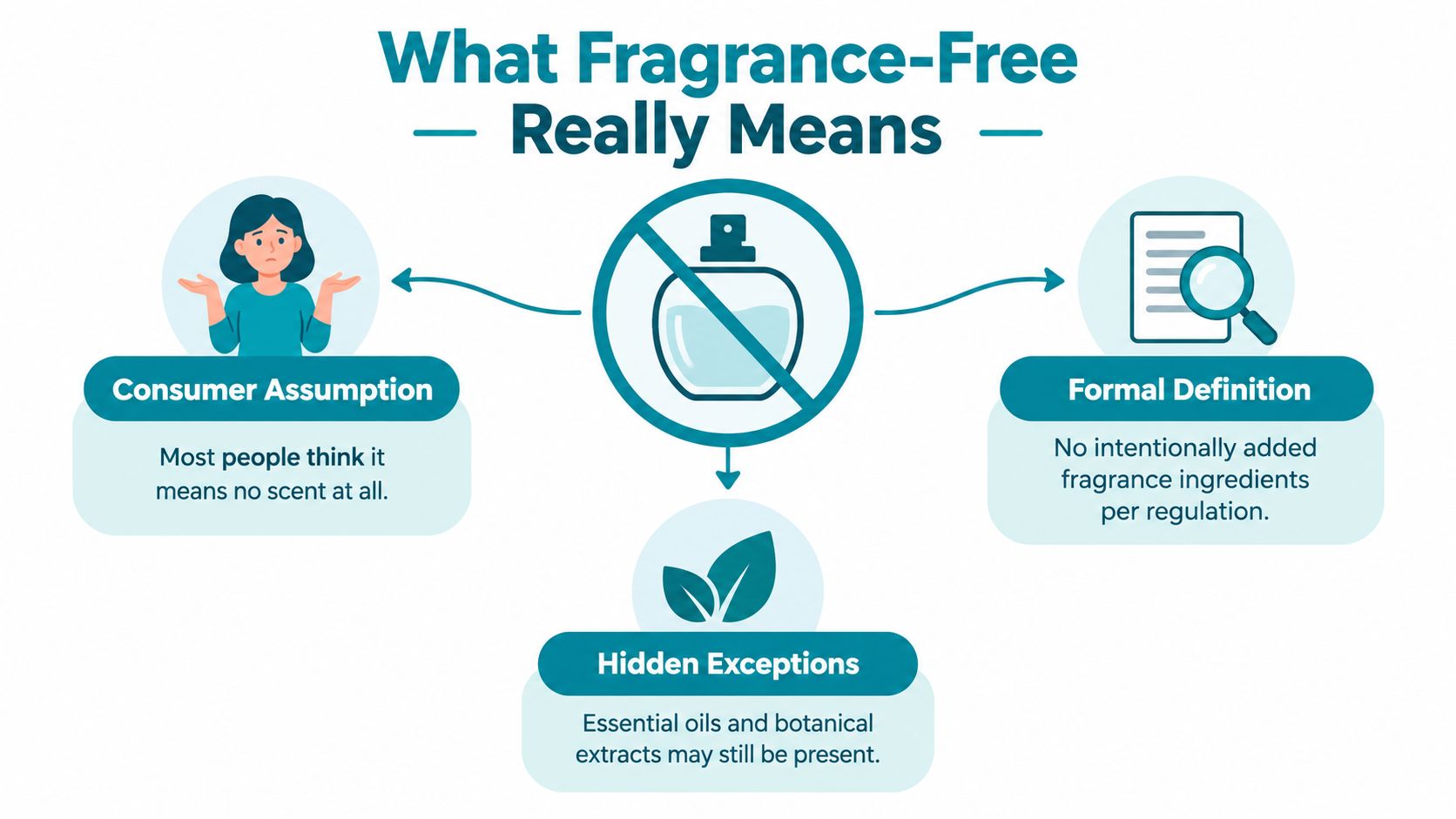
You pick up a moisturizer labeled fragrance-free, turn it around, and find lavender oil sitting in the ingredient list. Nothing has gone wrong. The term generally means no materials were added to scent the product; it never promised zero smell and never promised zero aromatic plant ingredients. "Unscented" means something different again: an unscented product can contain masking fragrance that neutralizes a raw-material odor until the product smells like nothing.
The next thing to check is whether parfum or fragrance appears at all. In the United States, where cosmetic ingredient labeling took full effect in early 1977, either word can stand in for an entire mixture, the way "spices" on a food label covers a blend without naming each component (FDA on cosmetic allergens). Reading it well matters in both directions: its absence removes a class of potential sensitizers from the suspect list, and its presence confirms a mixture exists without revealing what is inside it.
Why the regulatory history matters
The European Union's allergen rules show that fragrance labeling operates against a moving target. A 1999 scientific recommendation identified 26 fragrance substances with recognized potential to cause contact allergy, and the EU wrote them into its cosmetics rules through the 2003 amendment 2003/15/EC. A later scientific review identified 54 individual fragrance substances and 28 natural extracts as established human contact allergens, which means the original list was never a complete inventory (European Commission overview of perfume allergies).
That same review underpins the EU labeling thresholds: an individual fragrance allergen must be named on the ingredient list once its concentration passes 0.001% in a leave-on product or 0.01% in a rinse-off product. Below those lines, aromatic compounds from a fragrance mixture, an essential oil, or a botanical extract can still be present without appearing as separate entries.
If you want to see how two near-identical formulas can handle the scent question differently, the fragrance free dupes from Finding Favourites offer worked examples across similar products. Treat the front of the bottle as a screening tool and the full ingredient declaration on the back as the evidence.
Who Actually Benefits from Going Fragrance-Free
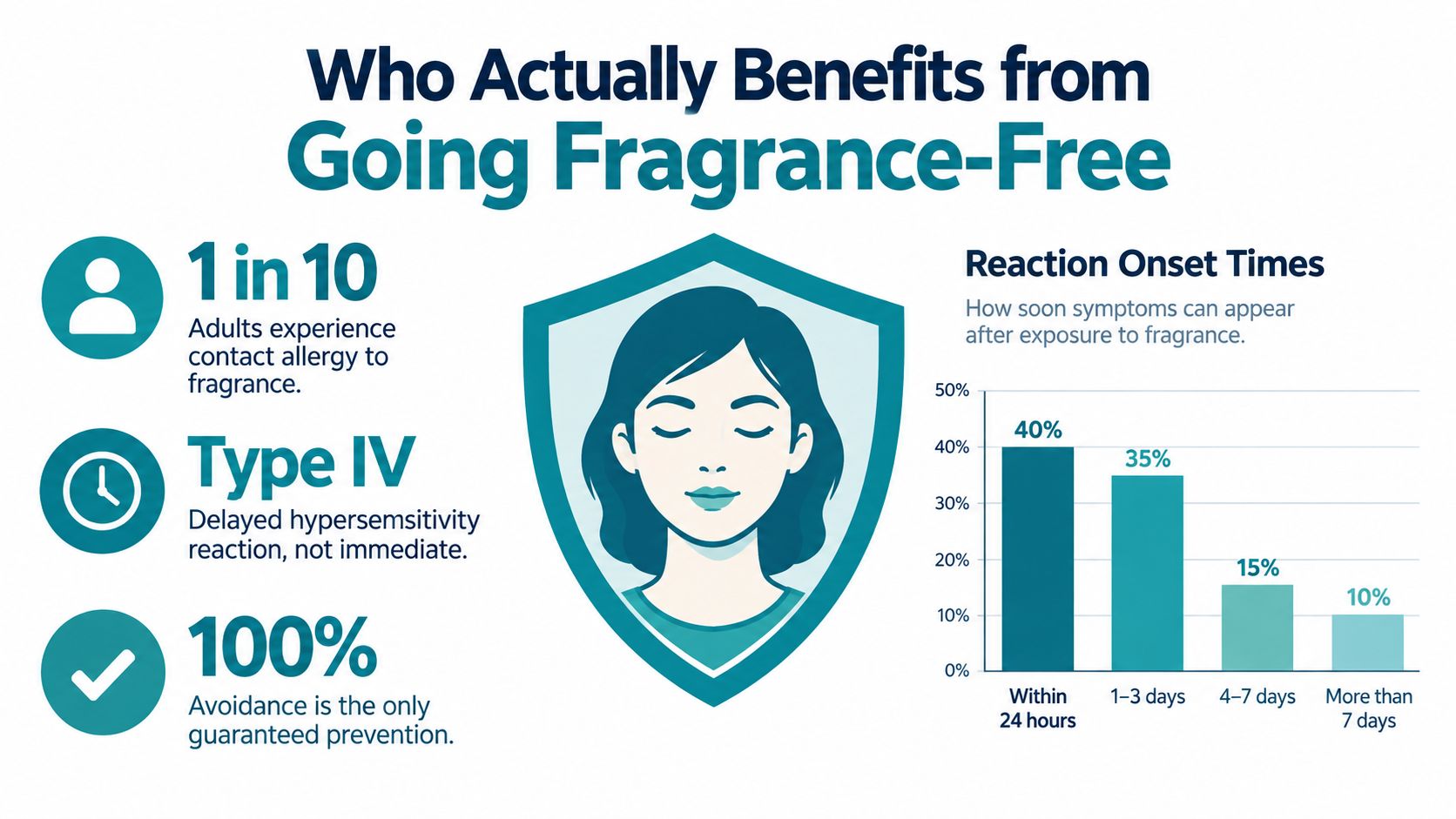
Someone who keeps getting eyelid or facial dermatitis despite changing moisturizers has a clearer reason to try fragrance-free than someone shopping by trend. In the European Commission review cited above, fragrance contact allergy is described as affecting roughly 1% to 3% of the general European population and about 16% of patients patch-tested for suspected allergic contact dermatitis. The second group was already selected for testing, so it signals how common fragrance allergy can be inside dermatology clinics, not in every bathroom cabinet.
The groups with the strongest case
A confirmed or suspected fragrance allergy sits at the top of the list, especially when patch testing has named fragrance as a trigger. People with recurring dermatitis in high exposure areas such as the face, eyelids, neck, or hands may also gain from removing one well documented trigger while they and their clinician look for the actual pattern. Going fragrance-free works like taking one suspect off the table in an investigation: the list of possible causes gets shorter, even though preservatives, botanicals, metals, or surfactants can still matter.
A delayed reaction is different from immediate irritation. Allergic contact dermatitis usually involves delayed type IV hypersensitivity, so redness, scaling, itching, or eczema can appear after repeated contact rather than within minutes of a single use. Timing can hint at the mechanism, but it cannot prove the culprit on its own.
For anyone rebuilding a routine around sensitivity, this sensitive skin routine guidance helps widen the check beyond scent alone.
Why Fragrance-Free Does Not Automatically Mean Reaction-Free
A customer swaps every product in her cabinet for fragrance-free versions, and three weeks later the redness along her jawline returns. The label did its job. The problem sat elsewhere in the formula, which is why a fragrance-free claim belongs in the risk-reduction toolbox rather than on a pedestal.
Allergy works like a smoke alarm wired to many sensors. Removing fragrance disconnects one well documented trigger, yet a preservative, a dye, a surfactant, or an aromatic botanical can still set the alarm off. A "natural" claim on the front panel says nothing about allergenicity either, and a product can carry a noticeable smell from its raw materials without any added perfume.
The science is also still catching up with what sits on shelves. A 2025 review and surveillance protocol highlights hydroperoxides of linalool and limonene as common contact allergies and outlines patch-testing of seven previously untested fragrance materials across 8,100 patients (2025 review). A fixed checklist may never capture every emerging or less studied exposure.
When a "clean" routine still causes trouble
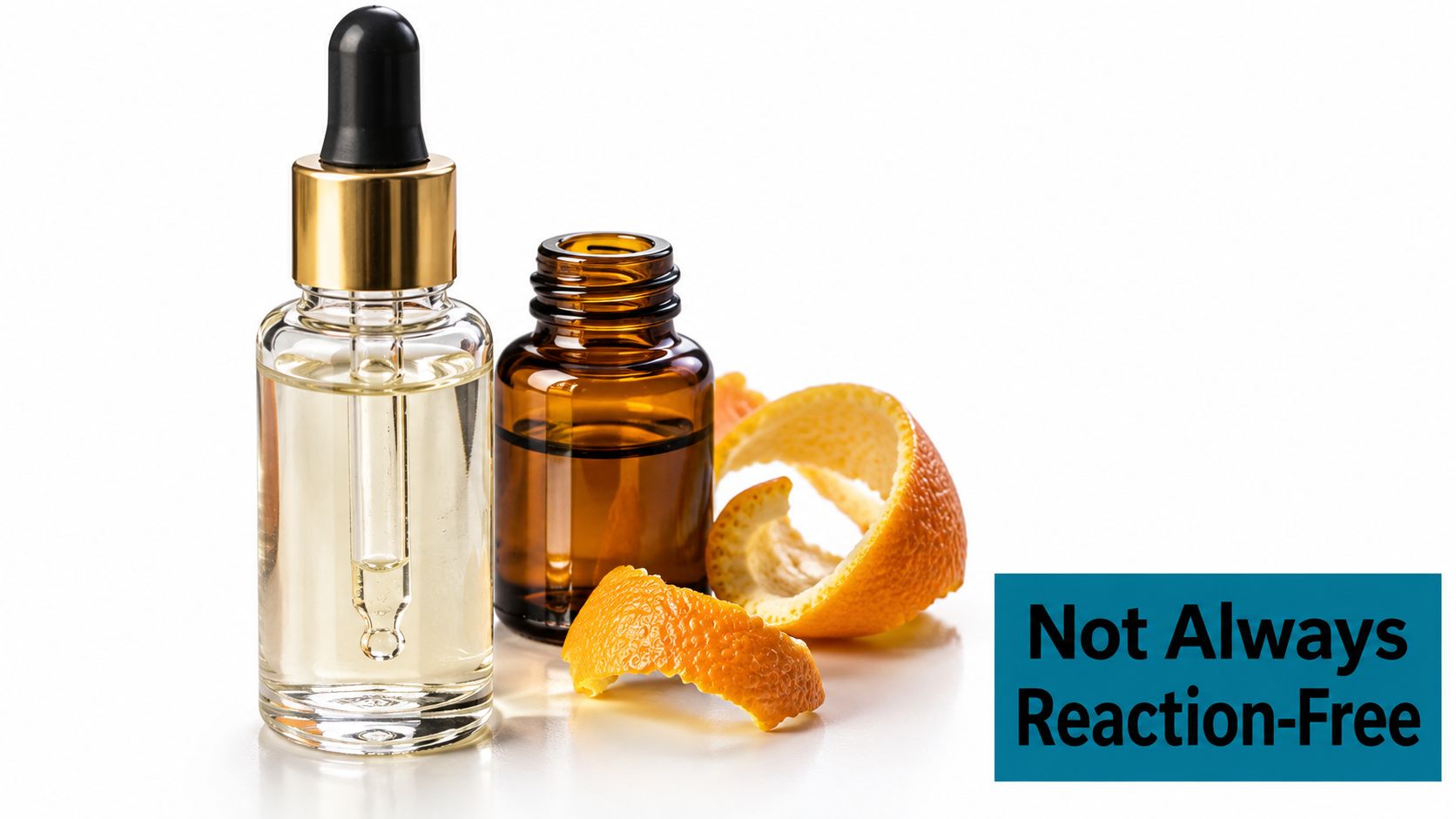
Oxidation explains part of the puzzle. Limonene starts out smelling bright and citrusy; left exposed to air, it gradually transforms into the hydroperoxides named above. A botanical formula can therefore drift over its shelf life, which helps explain why a product that felt gentle in week one can behave differently by month three.
The culprit may also sit entirely outside the scent question. The FDA allergen classes noted earlier span fragrances, preservatives, dyes, metals, and natural rubber, so a lotion's preservative system can cause trouble in a product that never contained perfume.
If your skin reacts to something labeled fragrance-free, resist clearing the whole cabinet. Record which product you used, where you applied it, when symptoms appeared, and whether it was leave-on or rinse-off. That record gives a clinician a far better starting point than a list of guesses.
Read a fragrance-free claim as one variable removed from a longer equation. Pairing that claim with careful label reading and a routine that supports the skin barrier narrows the remaining suspects more than any single front-panel promise can.
Reading Labels Like a Formulator
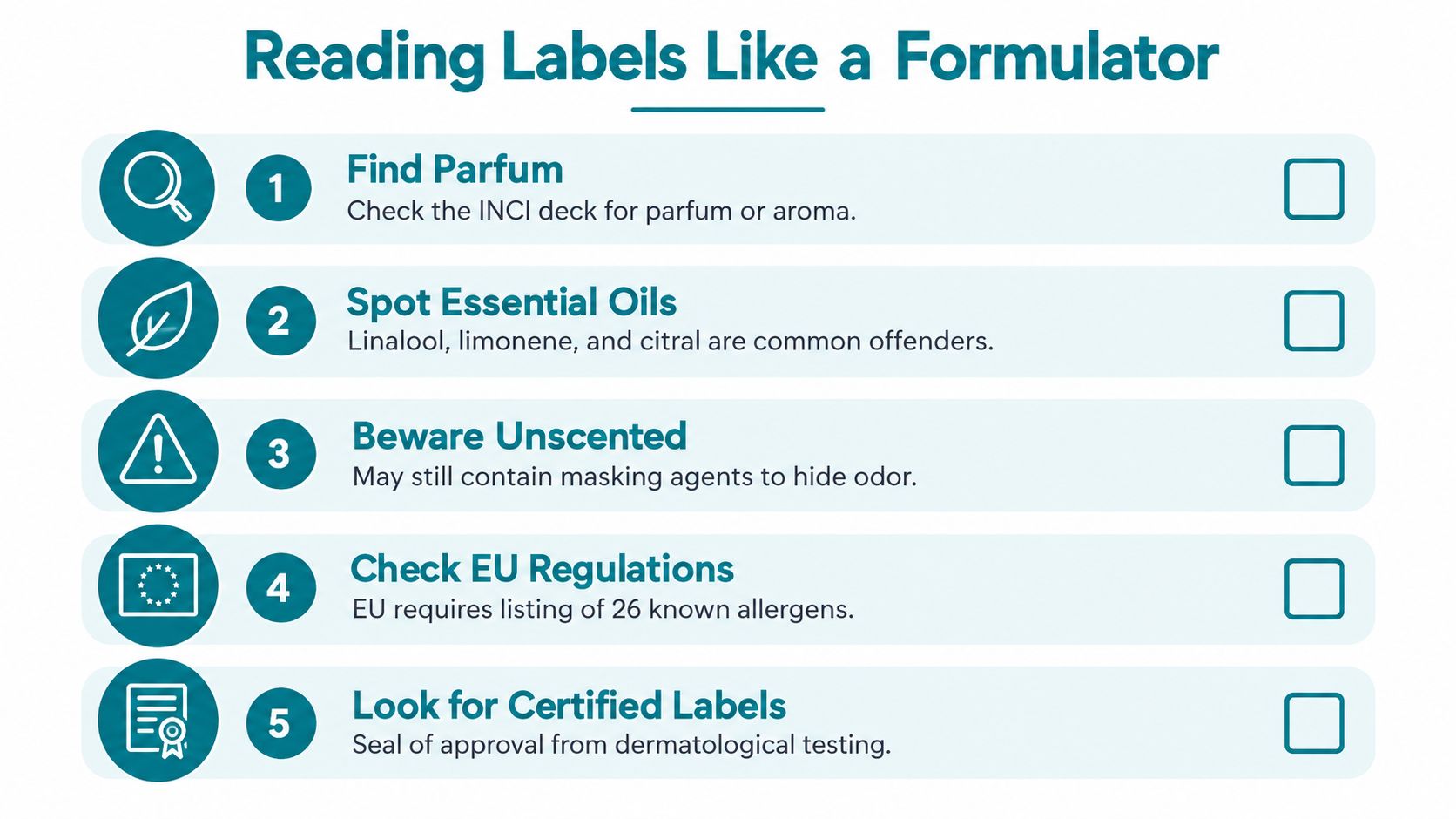
The front panel is marketing space. The ingredient declaration is the record. A shopper who reads only the front learns what the brand wants to say; a shopper who flips the bottle learns what is inside. Start with two short words, parfum and fragrance, then check for essential oils and aromatic botanical ingredients such as lavender oil or citrus peel extract.
One wrinkle confuses many readers. "Parfum" works like an umbrella term: a single word on the list can stand for a blend of many components, none of which gets named individually unless disclosure rules require it. That is where the EU thresholds covered earlier come in. They work out to 10 parts per million in leave-on products and 100 parts per million in rinse-off products, and crossing them is what forces an individual allergen onto the list rather than letting it sit inside "parfum." A threshold is a naming rule, not a safety promise, so an ingredient below it can still matter to a particular person.
An "unscented" claim deserves the same scrutiny. It describes how the product smells, not what it contains, and masking materials can neutralize odor while still counting as fragrance components.
Use the list as a map, not a verdict
Once the scent-related terms are checked, keep reading. The FDA allergen classes mentioned earlier, preservatives, dyes, metals, and natural rubber, are worth scanning here too, since a lotion's preservative system or a cleanser's surfactants can sit outside the fragrance question entirely. Words like "botanical," "clean," or "dermatologist-tested" do not close the case either; none of them replaces the full declaration or a patch test on your own skin.
If unfamiliar ingredient names slow you down, this primer on how to read a skincare label and INCI list explains the naming conventions line by line. The same read-the-fine-print habit applies to other claims as well, and this guide to decoding cruelty-free product labels walks through a term shoppers often mix up with ingredient or allergy information.
Before a product earns a place in your routine, run this shelf check:
- Find fragrance terms: Look for parfum or fragrance, then scan for essential oils and aromatic plant extracts.
- Question "unscented": Treat it as a scent description, not proof that fragrance materials are absent.
- Scan the rest: Note preservatives, surfactants, and dyes you already know you avoid.
- Keep the package: Save the ingredient list and product name in case a clinician needs them later.
One list read this way takes under a minute. Repeated across a whole shelf, it turns label reading from guesswork into a habit.
Fragrance-Free and Actives How Peptides and Plant Stem Cells Fit In
Removing added fragrance doesn't mean removing an active ingredient. A peptide's role comes from its formulation and use, not from whether the base smells pleasant. A simple carrier can include water and glycerin, or a hydrating base such as hyaluronic acid serum, without requiring perfume. Fragrance can add sensory appeal, but it isn't what makes a peptide a peptide.
That distinction is useful when comparing a multi-ingredient serum with a formulation ingredient intended to be incorporated into a finished product. Skin Perfection's Firming Serum Booster with Progeline is a formulation ingredient, not a finished serum, and it shouldn't be applied undiluted. Its listed ingredients are glycerin, water, dextran, and Trifluoroacetyl Tripeptide-2. The supplied product information gives a recommended use level of 0.5% to 2%.
Plant-derived actives don't have to be aromatic
Plant stem cell ingredients such as Malus Domestica or Edelweiss-derived actives can be discussed separately from a plant's volatile aromatic fraction. A formula can include a plant-derived ingredient without adding essential oils for scent. What matters to a shopper is the actual ingredient declaration and the product's intended use, not an assumption that every plant ingredient is a fragrance.
Peptide names can also sound more definitive than the evidence in a product listing. Argireline, SNAP-8, and SYN-AKE are examples of peptide names used in skincare discussions, but a product's performance can't be inferred from a name alone. Concentration, base, formulation quality, and directions all matter.
| Product | Hero Active | Recommended Usage | Target Concern | Fragrance-Free / Vegan |
|---|---|---|---|---|
| Firming Serum Booster with Progeline | Trifluoroacetyl Tripeptide-2 | 0.5%–2% as a formulation ingredient; don't apply undiluted | Appearance of slackness around the jawline, neck, and jowl area | Listed INCI contains glycerin, water, dextran, and the peptide; confirm any vegan or fragrance-free claim on the current product label |
| Wrinkle Eraser Supercharged Peptide Serum | Peptide serum | Follow the finished product's label directions | Appearance of lines | Confirm the current ingredient declaration and product claims before choosing |
If you're exploring how plant-derived actives are used in topical formulas, this overview of stem cell serum ingredients offers a related starting point. Keep the core distinction in mind: fragrance-free describes a formulation choice, not a measure of whether an active will suit every person.
Two Fragrance-Free Routines You Can Adapt
A routine for reactive, mature skin can stay simple without becoming inactive. In the morning, use a cleanser that doesn't leave your skin feeling tight, followed by a moisturizer and a sunscreen you already tolerate. Avoid swapping several products at once, because changing one product at a time makes it easier to notice which new item coincides with a reaction.
In the evening, cleanse gently, then use a familiar moisturizer. If you want to add a peptide product, introduce it as a separate step and patch test according to the product directions before applying it across your face. A product such as Wrinkle Eraser Supercharged Peptide Serum may fit this kind of routine if its current label and ingredients suit your preferences. The aim is a routine you can assess, not a shelf full of new variables.
Change one product at a time, and keep a note of what you used and when.
A maker's version
For a DIY maker, the same logic applies to a custom lotion or serum. Start with a simple base, select the ingredients for their function, and leave out perfume and essential oils if fragrance reduction is your goal. Skin Perfection's DIY lotion-making supplies and Firming Serum Booster with Progeline are examples of products and materials a maker might evaluate, while checking the label and directions before use.
A homemade product still needs a suitable preservation system if it contains water, and the maker must follow the supplier's instructions for the ingredients used. Keep the finished formula's purpose cosmetic: cleansing, moisturizing, or making skin look more attractive are appearance-related purposes. Results also depend on concentration, base, and consistent use, and no routine can promise that a product will suit every skin type.
For either routine, a fragrance-free label is a starting point. The complete formula and your own tolerance determine whether the product is a reasonable choice for you.
DIY Formulation Tips and Preservation Considerations
For a DIY maker, “no fragrance” is only one part of formula design. An oil-only anhydrous balm doesn't contain a water phase, so it presents a different preservation challenge from a water-based lotion. Once water is present, the formula needs a broad-spectrum preservative appropriate to its composition, and the maker should follow the supplier's directions for use and compatible pH range.
Choose ingredients for their function, then document the formula. Record the batch, date, and raw-material lot so you can trace what went into a product if you notice a change or a skin reaction. Store ingredients and finished products as their suppliers direct, and check for changes in appearance, smell, or texture before use. Those signs don't identify a cause, but they're practical reasons to stop using a product and review how it was made and stored.
Protect the formula from avoidable drift
Unsaturated oils can oxidize over time. An antioxidant may help slow that process, but it isn't a preservative and shouldn't be treated as a substitute for one. Packaging also matters: opaque or blue glass and airless pumps can limit light or repeated exposure to air, depending on the formula and package.
The formula's pH must suit both the ingredients and the chosen preservative. Don't guess at a pH window or shelf life; check supplier documentation, measure where appropriate, and follow sound cosmetic-formulation practices. For more on preservative choices, consult this guide to natural skincare preservatives.
A home formula is a cosmetic project, not a medical treatment. If a skin concern persists or keeps returning, take your notes to a qualified clinician instead of trying to solve it by adding more ingredients at the workbench.
Skin Perfection offers skincare products and lotion-making supplies for people who want to explore fragrance-conscious routines and custom cosmetic formulas. Review product ingredients and directions, then visit Skin Perfection to browse options for your routine or next formulation project.