

 Buy with Prime



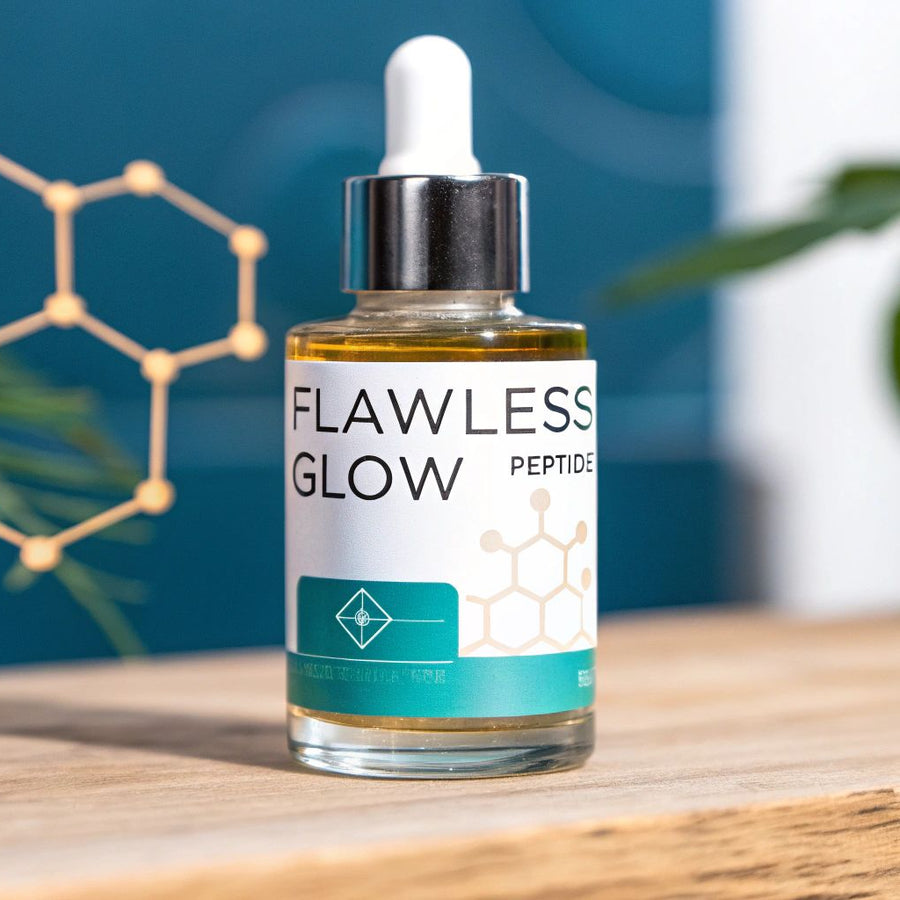
GHK-Cu is a copper peptide: a three-amino-acid sequence (glycine, histidine, lysine) bound to one copper ion, listed on ingredient labels as Copper Tripeptide-1. It occurs naturally in human plasma, and in cosmetics it is used for the look of firmer, smoother skin with fewer visible fine lines. The human studies behind it are real but small and mostly older, so this guide shows you exactly what was measured, how to read a GHK-Cu label, and how to use it well.
- INCI name: Copper Tripeptide-1 (also called GHK-Cu or copper peptide) (SpecialChem).
- What it is: the tripeptide glycyl-histidyl-lysine (GHK) found in human plasma, saliva and urine, working as a complex with copper (Pickart et al., 2015).
- Typical usage rate: 0.05% to 1% of pure Copper Tripeptide-1 (SpecialChem).
- pH working range: stable in water at pH 4.5 to 7.4 for at least two weeks at 60°C (Pickart et al., 2015); one supplier asks for a finished pH of 5 to 7 (Lotioncrafter).
- Solubility: water soluble and highly hydrophilic, with log D values of about -2.4 (Pickart et al., 2015).
- Color: the raw powder is blue (SpecialChem).
What is GHK-Cu?
GHK-Cu is the peptide GHK holding a copper ion. GHK itself is a tripeptide, glycyl-histidyl-lysine, that occurs naturally in human plasma, saliva and urine. Researchers propose that it does its work in the body as a complex with copper 2+, which is the form you buy as GHK-Cu (Pickart, Vasquez-Soltero and Margolina, BioMed Research International, 2015).
It was first described in 1973 (Pickart and Margolina, International Journal of Molecular Sciences, 2018). The level in our blood drops as we age. Both reviews report plasma GHK at about 200 ng/mL at age 20 and about 80 ng/mL by age 60.
On a cosmetic label, the INCI name is Copper Tripeptide-1. If a product says "copper peptide" but you cannot find Copper Tripeptide-1 in the ingredient list, ask the brand which copper peptide it is.
What does GHK-Cu do for the look of skin?
In the published human cosmetic studies, GHK-Cu creams were reported to improve the look of firmness, fine lines, wrinkle depth, skin clarity and blotchy pigment over 8 to 12 weeks. Here is what those studies were, as the two Pickart reviews describe them (2015, 2018):
- Facial cream, Leyden and colleagues (2002 conference abstract): 71 women, 12 weeks, placebo-controlled. Reported: less visible laxity, better-looking clarity, fewer visible fine lines, shallower-looking wrinkles, and skin that measured denser. No percentages were given.
- Eye cream, Leyden and colleagues (2002 University of Pennsylvania report): 41 women, 12 weeks, compared with a placebo and a vitamin K eye cream. The GHK-Cu cream was reported to outperform both for the look of lines and wrinkles.
- Twice-daily face cream, Finkley and colleagues (2005 book chapter): 67 women aged 50 to 59, 12 weeks. Reported improvements in the look of laxity, firmness, fine lines, coarse wrinkles and mottled pigment.
- Thigh skin biopsy study, Abdulghani and colleagues (1998 pilot): laboratory analysis of skin biopsies found more collagen in 70% of women using a GHK-Cu cream, compared with 50% using a vitamin C cream and 40% using retinoic acid. That is a biopsy finding, not a visible result. The number of participants is not given in either review.
- Randomized, double-blind trial, Badenhorst and colleagues (2016): women applied GHK-Cu in a nano-lipid carrier twice daily for 8 weeks. Compared with the carrier alone, wrinkle volume was reported 55.8% lower and wrinkle depth 32.8% lower. Against Matrixyl 3000 (Palmitoyl Tripeptide-1 + Palmitoyl Tetrapeptide-7), wrinkle volume was reported 31.6% lower. The review does not state how many women took part.
Beyond skin studies, there is a large body of laboratory research. In gene-expression data, GHK changed the activity of about 31% of human genes by 50% or more (Pickart and Margolina, 2018). That is laboratory research on cells, not a result you can expect to see in the mirror, so I do not translate it into a skin promise.
Does topical GHK-Cu work?
The honest answer: the human evidence points in a good direction, but it is small and mostly older. Most of the studies above are conference abstracts or book chapters from 1998 to 2005, and several do not report participant numbers or percentages in the reviews. The most recent one, from 2016, is double-blind but the review does not give its size. I could not find a large, recent, independently run trial of GHK-Cu on facial skin.
Two more things matter. First, both reviews were written by Loren Pickart and co-authors, the same research group that has published on GHK for decades. Second, GHK is very water-loving (log D around -2.4), and the outer layer of skin is oily. That is why researchers have studied delivery systems such as niosomes (Pickart et al., 2015) and nano-lipid carriers (Pickart and Margolina, 2018) for it.
My take after 20+ years of formulating: GHK-Cu is one of the better-documented cosmetic peptides, and it earns its place in a routine. Give it 8 to 12 weeks, the time frame used in the studies, before you judge it.
Copper peptide benefits for the appearance of skin
Pulling the studies together, the appearance benefits reported for GHK-Cu creams are:
- skin that looks firmer and less lax
- a visible softening of fine lines and the look of wrinkle depth
- improved look of clarity and more even-looking tone where pigment was mottled
- skin that looks denser
The 2015 review sums these placebo-controlled studies up the same way: skin that looks tighter, denser and firmer, with fewer visible fine lines and wrinkles (Pickart et al., 2015). Keep the study sizes in mind when you read any brand's claims, ours included.
Why does genuine GHK-Cu look blue?
The blue comes from the copper. GHK grips the copper ion through three nitrogen atoms, and that copper complex absorbs visible light most strongly at about 605 nm, in the orange part of the spectrum (Bossak-Ahmad et al., International Journal of Molecular Sciences, 2020). When orange light is taken out, what reaches your eye looks blue.
That is why the raw powder is blue (SpecialChem) and a supplier's 1% Copper Tripeptide-1 solution is described as "clear blue" (Lotioncrafter). The Skin Perfection DIY powder is deep blue, and that color is the copper, not a dye.
What this means for you: a serum sold on its copper peptide content should have some blue to it. A completely clear "copper peptide" product is worth a question to the brand about how much Copper Tripeptide-1 it contains. Color alone cannot tell you the exact percentage, so use it as a first check, not a final answer.
How to read "1% GHK-Cu" vs "1% copper peptide complex" on a label
These two phrases can describe very different amounts of the same ingredient. Here is the math a formulator does.
"1% GHK-Cu" should mean 1 gram of Copper Tripeptide-1 in every 100 grams of product, which is 10,000 ppm. That is what Skin Perfection puts in its serum, made from raw material at 99.7% or higher purity. The certificate of analysis for our current lot reads 99.9% purity, with a copper content of 13.4%.
"1% copper peptide complex" can mean 1% of a raw material that is itself mostly something else. Many copper peptide raw materials are sold as dilute solutions. For example, one supplier's copper peptide solution lists Water, Glycerin, Propanediol, Copper Tripeptide-1, Ethylhexylglycerin and Benzoic Acid, with a peptide content of 1.0% to 1.1% (Lotioncrafter). Add 1% of that solution to a serum and the finished serum holds about 0.01% Copper Tripeptide-1. That is one hundredth of "1% GHK-Cu."
Purity matters too. If a powder is less than pure, 1% of the powder delivers less than 1% of the peptide. Ask for the purity of the raw material, and ask whether the percentage on the front refers to the pure peptide or to a blend.
Ingredient order will not settle it. Under US cosmetic labeling rules, ingredients present at 1% or less may be listed in any order after the ingredients above 1% (21 CFR 701.3). So a copper peptide sitting near the top of a list is not proof of a high amount. That is why Skin Perfection prints exact concentrations and uses no proprietary blends.
How to use copper peptides
Apply copper peptide serum to clean skin, before heavier creams. For the Skin Perfection 1% GHK-Cu serum, use 2 to 3 drops on face and neck, twice daily. A 0.5 oz bottle holds about 300 drops.
- Step 1: cleanse and pat skin dry.
- Step 2: warm 2 to 3 drops between your fingertips and press over face and neck.
- Step 3: follow with your moisturizer. In the morning, finish with sunscreen.
- Step 4: stay with it for 8 to 12 weeks, the length of the published studies, before you judge the change in how your skin looks.
If you have sensitive skin, patch test on a small area first.
Can you use copper peptides with vitamin C?
Yes, in the same routine, but never in the same application. The reason is pH. Pure vitamin C (L-ascorbic acid) has to be formulated below pH 3.5 to enter the skin (Pinnell et al., Dermatologic Surgery, 2001). GHK was shown stable at pH 4.5 to 7.4 (Pickart et al., 2015), and one copper peptide supplier says the finished formula should be pH 5 to 7 with no fruit acids (Lotioncrafter). Layering the two puts the copper peptide in an acidic setting outside its documented range.
The simple fix: vitamin C in one application, copper peptide in another. One easy split: vitamin C in the morning, copper peptide at night.
Can you use copper peptides with retinol?
Yes, on different nights. The Skin Perfection rule: if you use retinol every other night, use copper peptide serum on the alternate nights. The full reasoning, plus a sample week, is in our guide to copper peptides vs retinol.
Serum vs powder: which one should a DIY formulator choose?
Choose the serum if you want a finished, ready-to-use 1% product. Choose the powder if you want to set your own percentage and build your own formula.
Working with the powder:
- Solubility: it dissolves in water, not oil. If your formula has an oil phase, you need an emulsifier (Skin Perfection GHK-Cu powder page).
- Usage rate: published ranges run from 0.05% to 1% (SpecialChem). At 1%, one gram makes 100 ml of finished formula.
- pH: keep the finished formula at pH 5 to 7 (Lotioncrafter).
- When to add it: at the last step of processing (Lotioncrafter).
- Keep out of the formula: chelating agents such as EDTA, fruit acids, and ionic plant extracts such as aloe vera (Lotioncrafter). A chelator is built to grab metal ions, and copper is the metal in GHK-Cu.
- Oxidation: the peptide is prone to breaking apart under oxidative stress (Pickart et al., 2015), so use airless or dark packaging and keep strong oxidizers out of the same formula.
Our full walk-through, with batch sizes and a base serum recipe, is in the DIY peptide formulation guide. For how copper peptides fit among the other peptides, read the peptides in skincare guide.
How to use it in a routine
A simple routine that keeps every active in its own lane:
- Morning: cleanse, vitamin C serum if you use one, moisturizer, sunscreen.
- Evening, copper peptide nights: cleanse, 2 to 3 drops of Skin Perfection 1% GHK-Cu Copper Peptide Serum, moisturizer.
- Evening, retinol nights: cleanse, retinol, moisturizer. Copper peptide stays in the bottle that night.
- No vitamin C or retinol in your routine? Use copper peptide serum morning and evening, as the directions say.
If you make your own products, start with our pure GHK-Cu copper peptide powder and set your own percentage.
Frequently asked questions
Is GHK-Cu the same as copper peptide?
GHK-Cu is the most widely studied copper peptide, and its INCI name is Copper Tripeptide-1. Some products use "copper peptide" loosely, so check the ingredient list. If you do not see Copper Tripeptide-1, ask the brand which copper peptide is inside and at what exact concentration, because the name on the front alone will not tell you.
How long does GHK-Cu take to show results?
The published human studies ran 8 to 12 weeks, so plan on at least two to three months of steady use before judging the change in how your skin looks. Take a photo in the same light on day one and again at week twelve. Those studies were small and mostly older, so your own photos are your most useful measure.
Why is my copper peptide serum blue?
The blue color comes from the copper ion bound to the GHK peptide. That complex absorbs orange light near 605 nm, so it looks blue to your eye. A serum built on real Copper Tripeptide-1 should show some blue. A completely clear product sold on copper peptide is worth asking the brand about.
What does "1% copper peptide complex" mean?
It can mean 1% of a raw material that is mostly water and other ingredients. If that raw material holds about 1% Copper Tripeptide-1, the finished product holds about 0.01%. "1% GHK-Cu" should mean 1% of the peptide itself, or 10,000 ppm. Always ask which one a brand means and how pure the raw material is.
Can I mix GHK-Cu powder into my moisturizer?
You can, with care. The powder dissolves in water, not oil, so dissolve it in a small amount of water-based liquid first, then blend it into the cream. Keep the final pH between 5 and 7, avoid EDTA and fruit acids, and store the mix in airless or dark packaging away from heat.
Should I use copper peptides in the morning or at night?
Either works. The Skin Perfection serum directions are 2 to 3 drops twice daily. If your routine includes vitamin C, keep copper peptide out of that same application. If you use retinol every other night, put copper peptide serum on the alternate nights so each product has its own turn.
Sources
- Pickart L, Vasquez-Soltero JM, Margolina A. GHK Peptide as a Natural Modulator of Multiple Cellular Pathways in Skin Regeneration. BioMed Research International, 2015. PMC4508379
- Pickart L, Margolina A. Regenerative and Protective Actions of the GHK-Cu Peptide in the Light of the New Gene Data. International Journal of Molecular Sciences, 2018. PMC6073405
- Bossak-Ahmad K, Wiśniewska MD, Bal W, Drew SC, Frączyk T. Ternary Cu(II) Complex with GHK Peptide and Cis-Urocanic Acid as a Potential Physiologically Functional Copper Chelate. International Journal of Molecular Sciences, 2020. Full text
- Pinnell SR, et al. Topical L-ascorbic acid: percutaneous absorption studies. Dermatologic Surgery, 2001. PMID 11207686. Europe PMC record
- SpecialChem. Copper Tripeptide-1 INCI ingredient page. specialchem.com
- Lotioncrafter. LCPeptide Copper product and technical information. lotioncrafter.com
- US Code of Federal Regulations, 21 CFR 701.3, Designation of ingredients. ecfr.gov
- Skin Perfection. GHK-Cu Copper Peptide Powder product page. naturalorganicskincare.com