15% Sitewide Labor Day Promotion with code SKINRESET15


DIY Hair Tonic Treatments and Rebuild Younger-Looking Skin with GHK Copper Peptides!
GHK Copper Peptide is a naturally occurring blue powder peptide that increases cell turnover and regenerates mature complexions. It's an excellent choice for improving the appearance of fine lines and wrinkles.


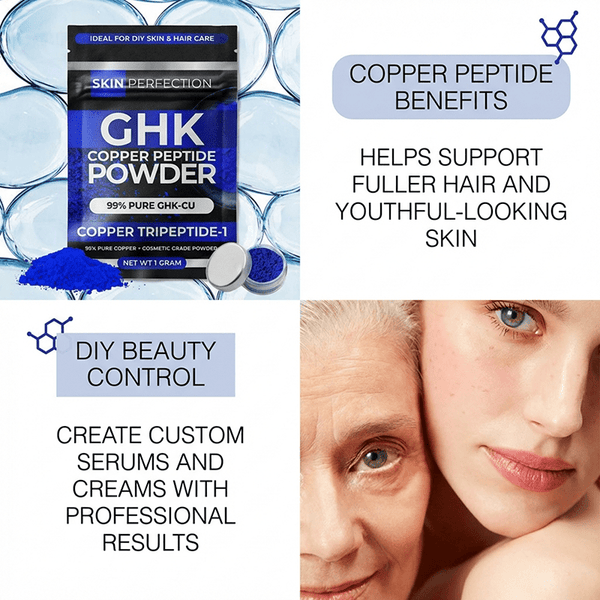
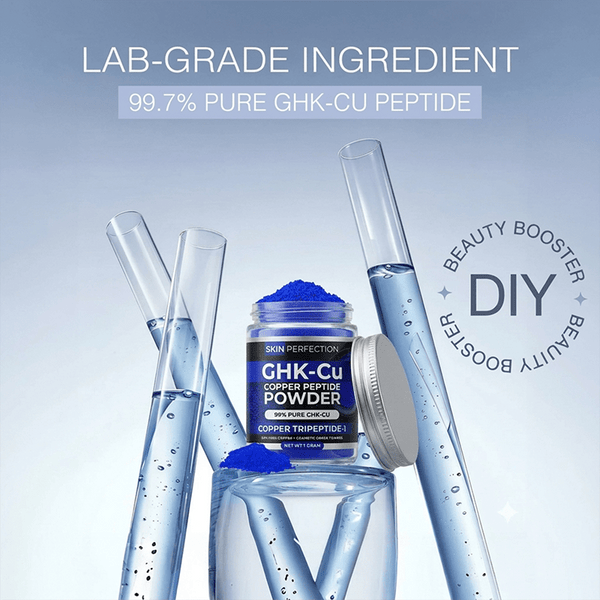
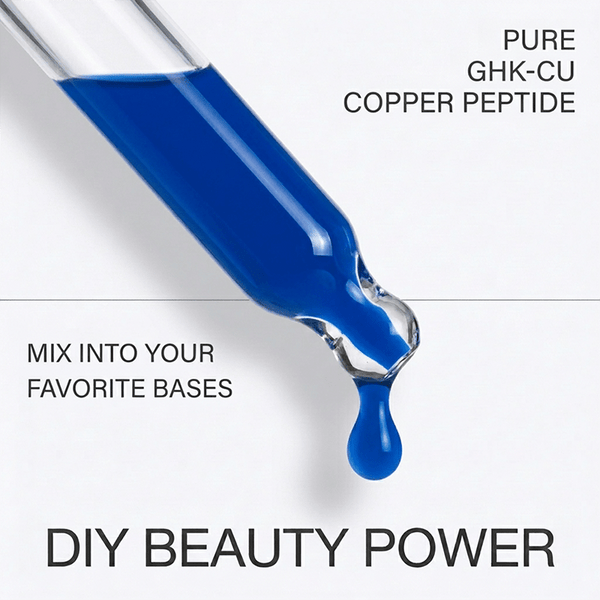
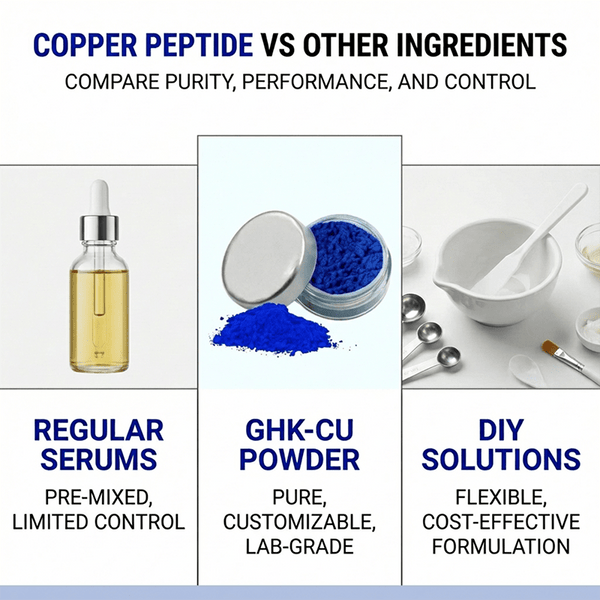
One gram of 99% pure GHK-Cu copper peptide powder. No water, no glycerin, no alcohol, no preservative, no carrier of any kind — just the peptide. You add it to your own formula at 1%.
This is a raw material for formulating. It is not a finished product.
INCI: Copper Tripeptide-1
GHK-Cu is three amino acids — glycine, histidine and lysine — bound to a copper ion. It occurs naturally in human plasma and becomes less abundant with age. Dr Loren Pickart identified it and has published on it since the 1970s; most of the research literature on copper peptides traces back to his work.
The powder is a deep blue. That colour is the copper, not a dye.
Water-soluble. It will not disperse into oil on its own — use an emulsifier if your formula contains an oil phase.
Recommended rate is 1%, which is 1 gram per 100 ml of finished formula.
| Batch size | Amount for 1% |
|---|---|
| 50 ml | 0.5 g |
| 100 ml | 1.0 g |
| 1 oz (30 ml) | 0.3 g |
| 2 oz (60 ml) | 0.6 g |
Weigh it. Powders are not measured in drops, and a small digital scale is the right tool here. A gram goes a long way — one bottle makes 100 ml of 1% serum.
In topical formulas, GHK-Cu is associated with the look of firmer skin, softened fine lines, and a more even-looking tone. It is used on the face, neck and chest, and in hair and scalp formulas.
It is gentle. Sensitivity is uncommon, which is part of why formulators reach for it instead of harsher actives. Patch test on the inside of the arm before first use anyway.
One combination to avoid: do not put copper peptide and vitamin C in the same formula. That includes ascorbic acid and magnesium ascorbyl phosphate. Keep retinol separate too.
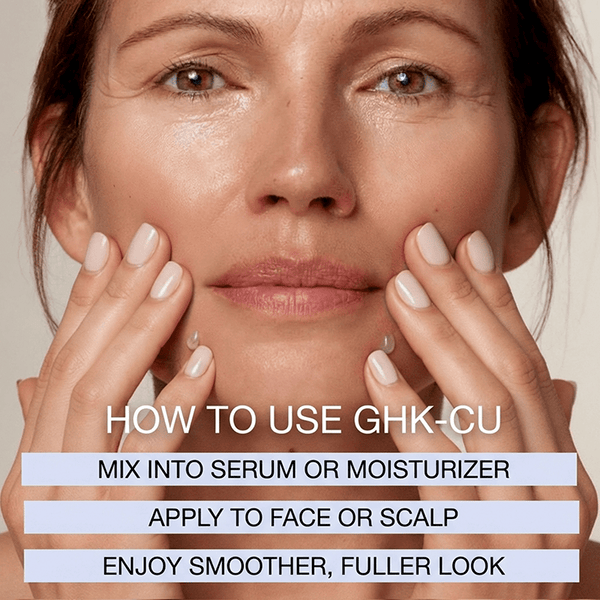
Add the powder to the hyaluronic acid in a glass bowl with a spout. Let it dissolve for a few minutes, then blend with a homogeniser or hand blender. Pour into an airless container and seal.
Combine the hydrosol, witch hazel and vinegar in a glass vessel. Add the powder and let it dissolve for five to ten minutes. Add essential oils if using, mix, and decant into a spray bottle. Shake before each use.
Want more from a hair formula? Add the multi-peptide lash and brow booster at 5%.
Because you control the number. Finished products naming GHK-Cu rarely tell you the concentration, and a gram of pure powder makes 100 ml of 1% serum for a fraction of what a finished bottle costs.
If you would rather not weigh anything, our 1% GHK-Cu serum is already blended.
Close the jar tightly and keep it in a cool, dry place. A sealed bag around the jar helps keep moisture out.
For external use only. Cosmetic grade. These statements have not been evaluated by the Food and Drug Administration. This product is not intended to diagnose, treat, cure, or prevent any disease.
You sell both the Copper powder and the liquid version with the dropper. When is there an advantage to using powder vs the liquid Copper peptide? I would assume that the powder is more difficult to disperse?
The difference is that you have more control over the percentage used with the powder. Both Copper Peptides are water-soluble and easy to disperse.
I have been ordering this every few months, but now it is out of stock. When do you expect to get it back in stock ? Please help.
Great news! The GHK Copper Peptide is in stock!
can you mix it with hyaluronic acid and other peptides?
Yes, GHK can be mixed with other peptides and Hyaluronic Acid. It should not be mixed with Vitamin C or Retinol.
how do you measure 0.1 g?
The best way to measure is an electronic scale. .1ml in a 1-ounce formula is .02 teaspoons.
My product has a little bit of citric acid, would this conflict with the peptides?
Citric Acid is generally used to adjust the ph of a formula, it should not interfere with copper peptides.
What size is the size of the container? How much product does it contain? Thank You.
The GHK Copper Peptide comes in a 1 gram jar.
1 gram will make a 1% concentration in 100ml.
The GHK Copper Peptide is still showing as "out of stock". How do I add it to my order? Thank You.
Good news! The GHK Copper Peptide is in stock! We do sell out fast. Please let us know if we are out of stock as it is usually on order and will be restocked very soon.
can I put the GHK powder directly into a cream without diluting it with water first? Will it completely blend without diluting?
The GHK Copper Peptide powder is very fine. It completely dissolves in water on its own. However, if you add the powder to water or any liquid and it doesn't dissolve right away, you can do one of 2 things. Let it sit for a few minutes until fully dissolved, or you can gently stir the liquid until dissolved. It is very easy to use.
To add to a powder, we recommend mixing it with a hand blender for approximately 2 minutes.
You can also dilute the powder with a 1:1 ratio and add it to a cream base. The 1:1 means one part powder to one part liquid.
How much product is in a single order in grams? And, is it pure Copper Peptide or does it have fillers? If it has fillers what percent by weight is copper peptide and what is the filler?
The GHK Copper Peptide Powder is 1 gram of powder that is 99.7% pure. There are no fillers added.
Do ypu provided SDS sheets, what is the inci name?
Yes, we provide MSDS sheets. The INCI name is Copper Tripeptide-1.
Can copper peptide be take orally?
We only sale cosmetic peptides that are for external use.
Can I add GHK copper peptide directly to a 5% Minoxidil solution?
Yes! You can add our GHK copper peptide powder to a Minoxidil solution. It makes a powerful combination.
Here are no directions for the copper powder. Your liquid copper says to add 9 drops to 30ml for a 1% concentration. How much of the powder copper I ordered do I need to add for the same 1% in 30 ml? Thank you.
As with all of our products, the instructions for each individual product can be found under the "how to use" tab on the product page.
Here are the intructions:
We recommend adding a 1 - 3% concentration of GHK copper peptide tripeptide-1 powder to your homemade skin, nail, or hair care recipe. This will give you a clinical-strength product with 1% pure GHK.
For a 1% concentration, add 1 gram to 100 ml of base.
For a 3% concentration, add 1 gram to 33 ml of base.
What should I use as a base with GHK copper peptide powder?
For a facial serum, you can use any water-soluble base such as Hyaluronic Acid, Aloe, or any Hydrosol. If you are making a hair tonic, any hydrosol or tea tincture.
Can GHK Copper Peptide be used in combination with Bakuchiol? I understand it's not advised to use with Retinol. Thank you.
Yes, copper peptides can be used with bakuchiol in your skincare routine. Both ingredients have unique benefits that complement each other nicely. Copper peptides are known for their regenerating properties and ability to promote collagen and elastin production, which can enhance skin firmness and reduce wrinkles. Bakuchiol, on the other hand, offers gentle retinol-like benefits without irritation, helping to improve skin texture and tone. Using them together can give your skin a rejuvenating boost, making it look healthier and more vibrant.
Retinol is an agressive ingredient that increases cell turnover and helps promote a more youthful complexion. Bakuchiol has the effects of retinol, but in a gentler fashion that doesn't cause irritation.
Based on one of the answers here, 1 gram of powder added to 100 ml will make a 1% solution. If I understand that correctly, I have added the 1 gram of powder to 1 ounce of hyaluronic acid and that makes approximately a 3% solution, correct? Is this too concentrated for facial application? If not, does it matter how much I use on my face each night? If so, can I add some of the prepared solution to a moisturizer and apply it that way to be safer? Thank you!
Yes, that is correct. 1 gram of GHK-Cu Powder can be added to 100ml for a 1% concentration. Adding 1 gram to 33ml will make a 3% concentration. 1 ounce of Hyaluronic Acid is 30ml. The serum that you made is just over a 3% concentration. For hair and facial applications, we recommend using a .1 to 3% concentration. We do recommend staying within the manufacturers guidelines, you could add a small amount of Hyaluronic Acid or add the prepared solution to your moisturizer. Please note that the manufacurer recommendation has changed from .1 - 1% to .1 - 3% recently. We are working to update all information on our website with the new guidelines.
Do you need to add Leucidal Liquid Radish Root to the Craft Your Hair Peptide Serum? Is the Rosemary acting as a preservative?
No, you do not need to add an additional preservative as hydrosols are already preserved.
Can this be combined with Palmitoyl Tetrapeptide-20? Can this be combined with Myristoyl Hexapeptide-16, Myristoyl Pentapeptide-17, and Palmitoyl Tetrapeptide-20, so all 4?
Yes, you can use the GHK Copper Peptide with Palmitoyl Tetrapeptide-20. It can also be used with Myristoyl Hexapeptide-16, Myristoyl Pentapeptide-17, and Palmitoyl Tetrapeptide-20.
Can I apply Vitamin C after I use the Copper Powder mixed in hyaluronic acid?
Vitamin C and copper peptide should not be used together.
We recommend using them on different days. However, you can also use one in the morning and a different one at night.
For example, use your vitamin C serum in the morning and then replace it with your copper peptide serum at night.
If you are only using a copper peptide serum once a day, it is best to use at night because it is regenerating.
I purchased your GHK-copper peptide powder and added it to a natural serum that is more oil based and it won't dissolve. Did I ruin it? Now it's more like a mini exfoliant because it won't dissolve. What are my options?
The GHK Copper Peptide Powder is water-soluble. There are a couple of things you can try. First, use a handblender and mix until well blended. If the blending doesn't dissolve the powder, you try adding some vegetable glycerin and blend or you can heat the oil and blend with a handblender.
If I add the powder to hyaluronic acid, does the hyaluronic acid need to be refrigerated?
No, you do not need to refrigerate the final product or serum that you make if you use our Hyaluronic Acid.
The Hyaluronic Acid uses Leucidal Liquid to preserve the product.
Sweet! I am trying to make something similar to Vitali (previously Restoracell) that worked great on my skin but is TOO expensive. Its ingredients are: 500mg GHK-Cu Peptide, Palmitoyl Tripeptide-1 GHK Peptide*, Macrocystis Pyrifera Extract, Silk Amino Acids, Hyaluronic Acid. Which serum of yours do you think would be close?
Start with our Hyaluronic Acid as your base. Then add GHK Copper Peptide, Pepha Tight, and Argireline. Or you can start with Peptide Fusion and add GHK Copper Peptide powder.
Sweet! I am trying to make something similar to Vitali (previously Restoracell) that worked great on my skin but is TOO expensive. Its ingredients are: 500mg GHK-Cu Peptide, Palmitoyl Tripeptide-1 GHK Peptide*, Macrocystis Pyrifera Extract, Silk Amino Acids, Hyaluronic Acid. Which serum of yours do you think would be close?
Start with our Hyaluronic Acid as your base. Then add GHK Copper Peptide, Pepha Tight, and Argireline. Or you can start with Peptide Fusion and add GHK Copper Peptide powder.
Sweet! I am trying to make something similar to Vitali (previously Restoracell) that worked great on my skin but is TOO expensive. Its ingredients are: 500mg GHK-Cu Peptide, Palmitoyl Tripeptide-1 GHK Peptide*, Macrocystis Pyrifera Extract, Silk Amino Acids, Hyaluronic Acid. Which serum of yours do you think would be close?
Start with our Hyaluronic Acid as your base. Then add GHK Copper Peptide, Pepha Tight, and Argireline. Or you can start with Peptide Fusion and add GHK Copper Peptide powder.


 Buy with Prime
