

 Buy with Prime



You find a moisturizer that promises deep hydration, a calm finish, and a formula made for delicate skin. The label looks reassuring, but minutes after application your cheeks feel tight, your nose starts to sting, or a faint rash appears. You're left wondering whether the cream is too rich, too active, or not suited to your kind of sensitivity.
A hydrating face cream for sensitive skin should be chosen by reaction pattern, not by marketing language alone. Irritant sensitivity, allergic sensitivity, barrier deficiency, rosacea, atopic dermatitis, and simple dehydration can look similar while needing different product strategies. The right formula should improve comfort without encouraging you to ignore burning, redness, itching, or recurring rashes.
Table of Contents
- Finding Your Balance with Sensitive Skin
- Understanding Soothing Ingredients for Delicate Complexions
- Identifying Hidden Irritants in Clean Formulas
- Mastering the Patch Test Process
- Layering Products for Optimal Hydration
- Comparing Ready-Made and DIY Skincare Options
- Building a Confident Skincare Routine
Finding Your Balance with Sensitive Skin
A new customer once described a familiar routine. Her skin felt dry after cleansing, so she bought a cream labeled natural, soothing, and suitable for sensitive complexions. The first application felt rich and comfortable. By the next morning, her cheeks were warm and rough, and each additional application made the reaction more noticeable.
That experience doesn't automatically mean every ingredient in the cream was unsuitable. It means the label didn't answer the more useful question: what kind of sensitivity was she experiencing? Skin that lacks water may need humectants. Skin with a weakened barrier may need a simpler, more cushioning formula. Skin reacting to a fragrance component or botanical extract may need allergen avoidance and professional assessment rather than another moisturizer.
Three reaction patterns to separate
Irritant sensitivity often appears quickly. Burning, stinging, tightness, or redness shortly after application can indicate that the formula is too stimulating for the skin at that moment. Cleansing, exfoliation, weather, and friction can all lower tolerance.
Allergic sensitivity may appear as recurring eczema-like redness, itching, swelling, or a delayed rash. Fragrance compounds, essential oils, preservatives, and botanical constituents can cause allergic contact dermatitis in sensitized people. A patch test can provide useful information, but recurring reactions deserve dermatologist-supervised evaluation.
Barrier-deficient or dehydrated skin may feel tight, rough, flaky, or uncomfortable without reacting to one clearly identifiable ingredient. That pattern calls for a balanced formula containing water-binding ingredients, emollients, and possibly occlusive components.
Practical rule: A cream that increases surface hydration but also increases burning isn't a successful sensitive-skin formula for you.
The phrase “natural” doesn't settle the question. Plant-derived ingredients may feel elegant and familiar, yet essential oils and botanical fragrance systems can still sensitize reactive users. Skin Perfection's organic skincare for sensitive skin resources are most useful when read alongside the ingredient list, your own reaction history, and clear instructions for stopping use when irritation develops.
Understanding Soothing Ingredients for Delicate Complexions
If a new cream leaves your cheeks comfortable but your nose tight, the problem may be balance rather than a single “bad” ingredient. Start with the role each ingredient plays. A hydrating face cream for sensitive skin commonly combines humectants, emollients, barrier lipids, and occlusives, while the right proportions depend on whether your main pattern is dehydration, irritation, allergy, or barrier weakness.
Match the ingredient to the need
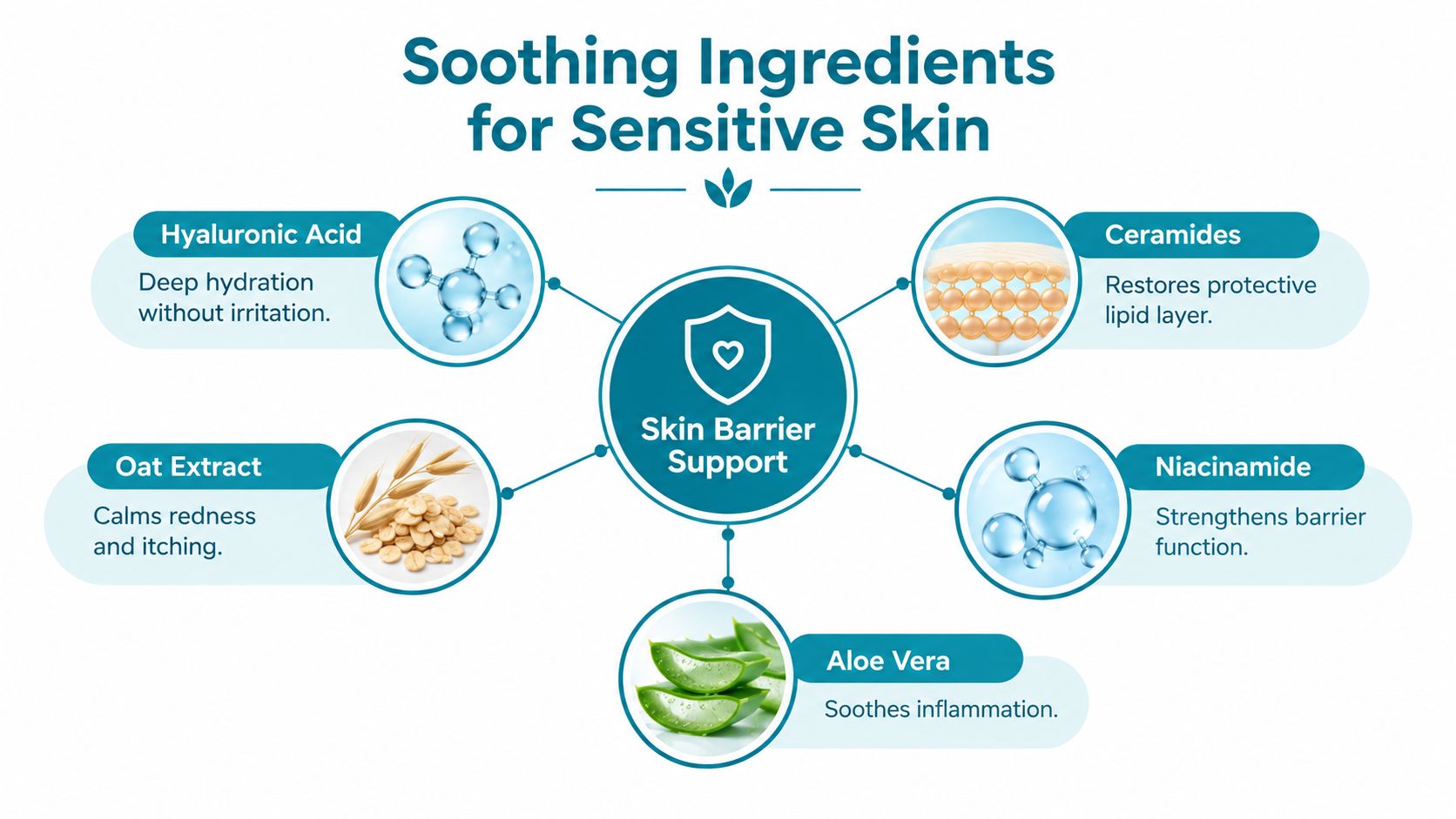
Hyaluronic acid and glycerin are humectants. They draw water into the outer layers of skin and can improve softness and surface fullness. They suit dehydration, but a humectant-focused formula may leave skin uncomfortable if it also needs lipids or loses water rapidly.
Ceramides are barrier lipids. They can support formulas intended to reduce roughness and improve comfort, although their presence alone does not prove that a product will repair or change your skin. A ceramide moisturiser meta-analysis found a statistically significant improvement in atopic-dermatitis severity measured by SCORAD, with a mean difference of −0.98 and a 95% confidence interval of −1.63 to −0.33. Ceramide products were not statistically superior to comparators for TEWL, and the TEWL results were highly heterogeneous, with I² = 92%. (Scientific Reports) These findings support judging a cream by several outcomes rather than assigning barrier benefits to one ingredient.
Niacinamide may support barrier function and reduce the appearance of redness for some users. Highly reactive skin may tolerate a lower-strength formula better, particularly when the rest of the product contains several active ingredients. A higher concentration does not automatically improve results.
Oat extract and aloe vera may provide a soothing feel, but plant origin does not replace finished-product testing. Review the full ingredient list, including the supporting base, rather than relying on highlighted ingredients on the front label.
Use a measured selection process
Begin with a fragrance-free formula and assess its balance of humectants, emollients, and occlusive support. Tight skin that is not greasy may suit a lighter lotion. Rough skin that quickly loses comfort may need a cream with more lipid and occlusive content.
Consistency matters when judging a product. In one 30-day self-controlled study, participants applied 0.6–0.8 g of lotion to the face twice daily. Mean skin moisturization rose from 35.58 to 45.02, a 26.6% improvement. For product selection, consider hydration alongside TEWL, erythema, tolerability, and any burning or stinging. Short-term plumping does not establish broader barrier benefit if irritation continues.
A guide to natural humectants for skin can help distinguish water-binding ingredients from a complete moisturiser strategy.
Identifying Hidden Irritants in Clean Formulas
“Clean,” “natural,” and “hypoallergenic” don't predict facial tolerance reliably. They describe positioning or intended reassurance, not a guarantee that a product won't sting or trigger allergy. A cream can exclude synthetic fragrance and still contain fragrant essential oils, aromatic plant extracts, or preservatives that a particular user can't tolerate.
Read past the front label
Essential oils from lavender, citrus, peppermint, and similar aromatic plants are common sources of fragrance exposure. Botanical fragrance components can trigger allergic contact dermatitis, especially in people with an established fragrance sensitivity. A plant-derived scent is still a scent system, and sensitive skin responds to the molecules, not the marketing category.
Preservatives deserve the same careful attention. They're necessary in water-containing products because microbial contamination can make a cream unsafe, but some preservative systems can cause allergic contact dermatitis in sensitized individuals. The practical answer isn't to avoid every preserved product or assume that an unpreserved homemade cream is safer. It's to assess the complete formula and use a properly manufactured product.
The DermNet guide to emollients and moisturisers notes that preservatives can cause allergic contact dermatitis and that people with atopic dermatitis or rosacea commonly report transient burning or stinging from emollients. It also supports a cautious distinction between temporary discomfort and clinical contact dermatitis. Stop using a product when a clear rash develops, rather than trying to tolerate it because the ingredient list looks wholesome.
Use a practical screening checklist
- Fragrance status: Look for an explicit fragrance-free statement, then confirm that essential oils and fragrant extracts aren't included.
- Formula complexity: A shorter, recognizable ingredient list makes troubleshooting easier, though simplicity alone doesn't prove safety.
- Claim language: Treat “hypoallergenic” and “dermatologist tested” as limited context, not personal guarantees.
- Reaction history: If you already know a preservative, fragrance compound, or botanical causes trouble, screen for it directly.
- Finished-product evidence: A promising ingredient still needs tolerability testing in the final cream.
For a clearer explanation of why “clean” can mean different things across brands, see this guide to what clean beauty means. The useful question isn't whether a cream sounds pure. It's whether the formula matches your known triggers and behaves comfortably on your skin.
Mastering the Patch Test Process
Patch testing is a filter, not a promise. It can reveal an obvious reaction before you spread a new cream across your face, but a small test area can't guarantee facial tolerance. If reactions recur, become severe, or resemble eczema, arrange professional assessment rather than repeatedly testing products at home.
Follow a controlled routine
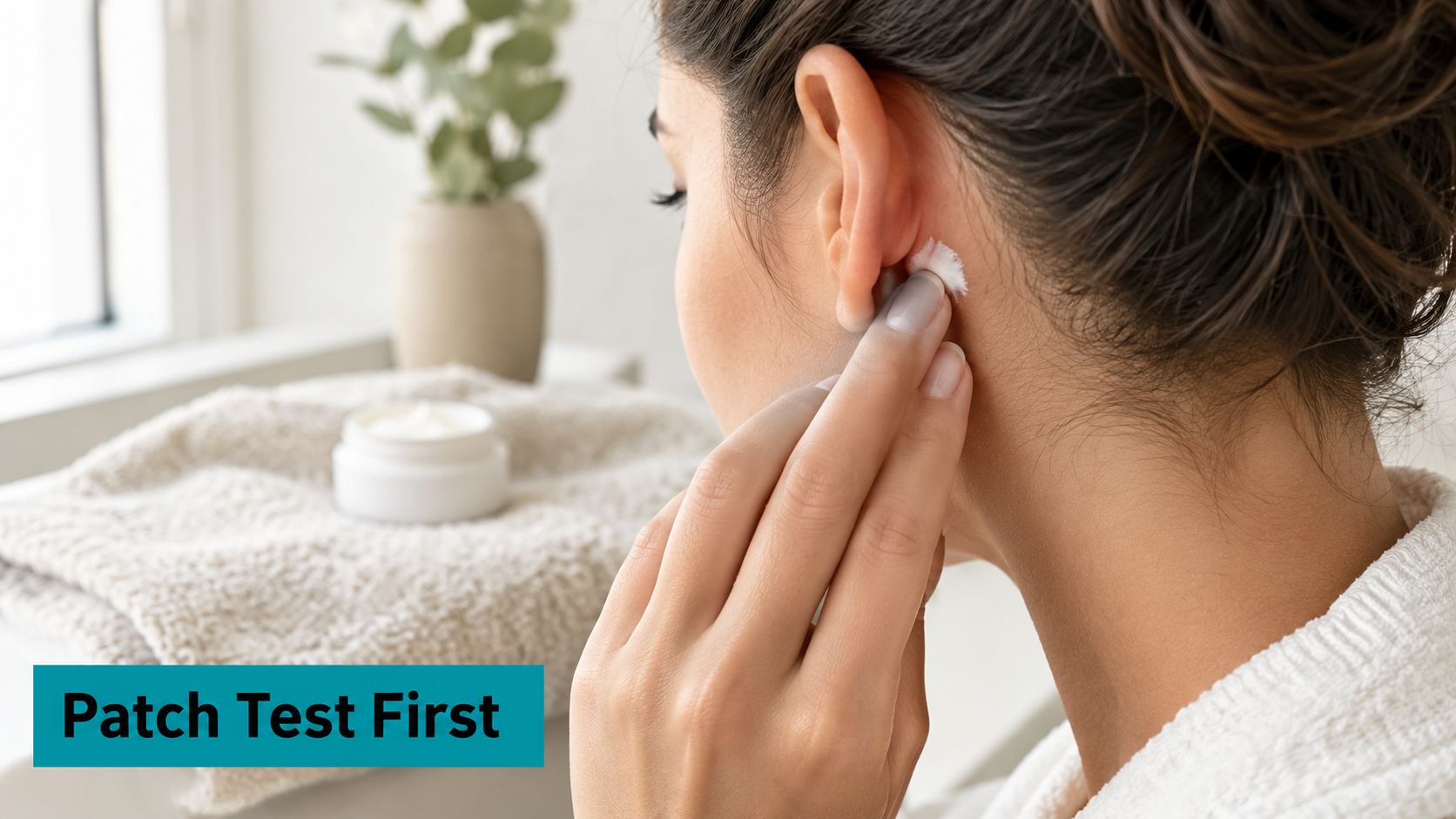
- Choose a discreet area. Behind the ear or on the inner wrist can work for an initial screen. A small area near the jaw may provide more relevant information for a leave-on facial product, but it's still not equivalent to full-face use.
- Apply a small amount. Use the product as directed, without mixing it with another new formula.
- Observe for 24 to 48 hours. Check for redness, itching, swelling, persistent burning, warmth, or a developing rash.
- Stop at the first clear reaction. Don't apply more product to “confirm” an increasingly inflamed response.
- Seek help for recurring reactions. A dermatologist may recommend supervised patch testing to investigate fragrance, preservative, vehicle, or other contact allergens.
Separate brief sensation from irritation
A brief, mild sensation can occur with some active formulas, but sensitive-skin users shouldn't treat persistent stinging as evidence that a product is working. Burning that continues, visible inflammation, swelling, itching, or worsening redness indicates poor tolerance. Atopic dermatitis and rosacea-prone skin may sting from otherwise ordinary emollients, so the full pattern matters.
The guide to treating irritated skin should never replace medical care when the reaction is persistent or severe. Remove the suspected product, simplify the routine, and avoid adding another active while the skin remains unsettled.
Layering Products for Optimal Hydration
A moisturizer can perform well in the jar and still disappoint if the surrounding routine strips the skin or adds unnecessary friction. Sensitive skin usually benefits from fewer layers, gentle application, and a clear reason for every product.
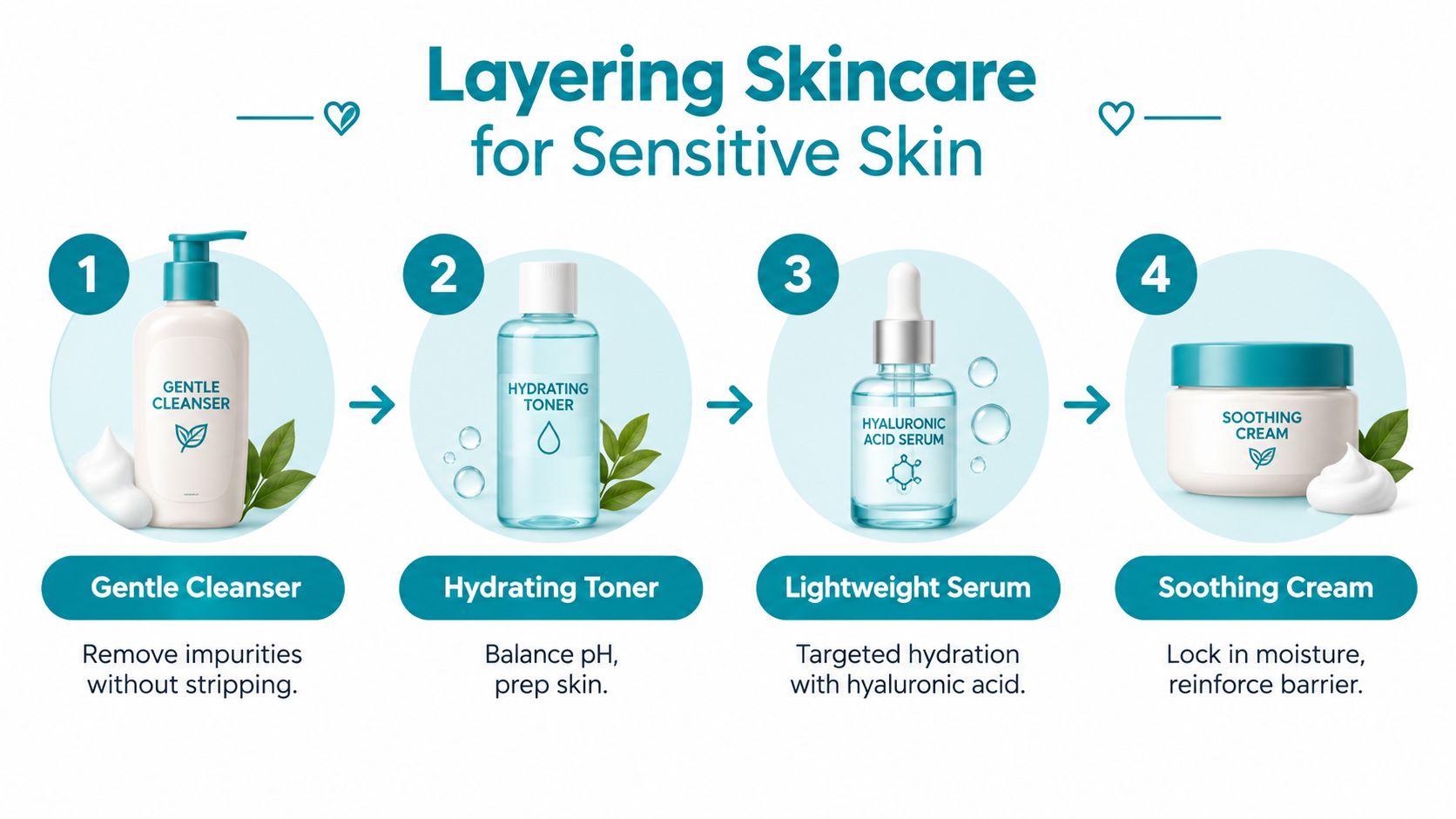
Begin with a cleanser that leaves the face comfortable rather than squeaky. Apply a hydrating toner or serum if you tolerate one, then use the cream while the skin is slightly damp. This helps the moisturizer sit over the water already present at the surface, but it doesn't mean you should rub repeatedly or use a larger amount than the formula requires.
Adjust the texture to the climate
A lightweight lotion can feel more comfortable in hot, humid conditions, while a richer cream may be preferable in dry air or cold weather. That choice is about water retention and wearability, not a universal ranking of textures. A very occlusive product can feel protective on dry skin but uncomfortable in heat, and recent clinical guidance notes that even fragrance-free coconut oil may predispose some users to miliaria in hot, humid conditions. (Indian Journal of Dermatology, Venereology and Leprology)
A useful layering order is:
- Gentle cleanser: Remove impurities without leaving tightness.
- Hydrating layer: Use glycerin or hyaluronic acid when your skin benefits from water-binding support.
- Soothing cream: Add emollients, barrier lipids, or occlusives according to comfort and climate.
- Sun protection: Finish the morning routine with a product your skin tolerates.
If you're comparing a botanical moisturizer with a simpler cream texture, this resource on aloe vera cream for dry skin offers another example of how soothing ingredients can be positioned in a routine. Evaluate the full formula, not aloe alone.
Comparing Ready-Made and DIY Skincare Options
Ready-made and DIY creams solve different problems. A finished product offers convenience, a defined texture, and a manufacturing process intended to manage stability, preservation, and ingredient compatibility. That doesn't make every commercial formula suitable for sensitive skin, but it reduces the formulation burden on the person using it.
DIY formulation offers control over selected ingredients. You can leave out a known fragrance allergen, choose a preferred humectant, or adjust the oil phase to suit your skin. The trade-off is that water-based creams require real knowledge of preservation, pH, contamination control, packaging, and stability. A product that looks smooth on the day it's made may not remain safe or uniform during use.
Compare the practical trade-offs
| Consideration | Ready-made cream | DIY formulation |
|---|---|---|
| Convenience | Ready to use and packaged for routine application | Requires equipment, ingredients, and preparation |
| Customization | Limited to available formulas | Greater control over selected ingredients and texture |
| Safety management | Stability and preservation should be addressed by the manufacturer | You must manage preservation, sanitation, compatibility, and storage |
| Troubleshooting | Easier when the ingredient list and batch information are clear | Easier to remove a known ingredient, harder to identify process failures |
| Best fit | Users who want a consistent, low-effort routine | Experienced makers who understand cosmetic formulation |
A beginner shouldn't improvise a water-based face cream by combining hydrosols, oils, and botanical powders without a validated preservative system. Microbial safety matters more than a short ingredient list. Even a fragrance-free product can become unsuitable if it's contaminated or destabilized.
For people who want a custom commercial option, a personalised skin hydration cream may be worth comparing with standard formulas, provided the ingredient disclosure is clear and the product can be patch-tested. For those learning formulation, how to make face cream should be approached as a cosmetic chemistry topic, not a shortcut around preservation and safety testing.
Building a Confident Skincare Routine
The most reliable routine is usually the one that gives you useful information. Introduce one product at a time, keep your cleanser and other basics stable, and record whether your skin feels tight, itchy, hot, rough, or comfortable. If a reaction appears, you'll have a much better chance of identifying the cause than if you've changed the entire cabinet at once.
Use the sensitivity categories as a decision aid. Immediate burning points toward irritation or low tolerance. A delayed recurring rash raises the possibility of allergic contact dermatitis. Persistent itch, flaking, or redness may reflect an inflammatory skin condition rather than ordinary dehydration. A moisturizer can support comfort, but it shouldn't be presented as treating, healing, or changing a medical condition.
Remember: Hydration is one outcome. Tolerability, stable comfort, and appropriate medical follow-up matter just as much.
Read claims carefully when shopping. In the United States, intended use determines whether a product is regulated as a cosmetic, a drug, or both. FDA explains that claims about diagnosing, curing, mitigating, treating, preventing disease, or affecting the structure or function of the body can create drug status, while cosmetic purposes focus on cleansing, beautifying, promoting attractiveness, or altering appearance. (FDA guidance on cosmetic and drug products)
FDA also states that ordinary cosmetics generally don't require premarket approval and that sellers must ensure their labeling is truthful and not misleading. Etsy separately prohibits explicit and implied medical claims, including claims that an item treats, mitigates, diagnoses, or cures a disease, or is equivalent to a prescription drug, antibiotic, steroid, vaccine, or other medical product. (FDA guidance on cosmetic claims, Etsy medical-claims policy, Etsy prohibited-items policy)
For additional product-selection ideas, you can browse skincare essentials while keeping your own reaction history at the center of the decision. Skin Perfection offers skincare products and lotion-making supplies for appearance-focused routines, including an Organic Essential Daily Moisturizer described for dry, sensitive, and combination skin with jojoba oil, evening primrose oil, and calendula extract, without synthetic fragrances, dyes, or harsh preservatives. Choose slowly, patch-test carefully, and stop when your skin gives you a clear warning.
Skin Perfection offers skincare products and lotion-making supplies for people building appearance-focused routines, including options for hydration and DIY formulation. Visit Skin Perfection to compare formulas and supplies, then select a fragrance-free, well-understood approach that matches your skin's reaction pattern.