

 Buy with Prime


Cosmetic raw ingredients are the very heart of all skincare and beauty products. Think of them as the individual ingredients in a chef's recipe—each one is hand-picked for a specific reason, whether it's to create that silky, luxurious texture or to give your skin a beautiful, healthy-looking glow.
Your Guide to Skincare Building Blocks
Have you ever flipped over a lotion bottle and felt like you needed a chemistry degree to understand the ingredient list? You're definitely not alone. But demystifying that label is the first step to becoming a smarter shopper and a more confident creator if you're into DIY.
Every single ingredient on that list has a job to do. Some contribute to how the product feels, others keep it stable and safe, and the exciting ones deliver the cosmetic effects we're all looking for. Understanding these building blocks is empowering. It lets you see the true science and artistry that goes into your favorite serum or moisturizer. This guide will break down the essential categories of cosmetic raw ingredients, turning that confusing label into a clear, easy-to-read roadmap.
Why Ingredient Knowledge Matters
Getting a handle on the basics is a game-changer for anyone who loves skincare, whether you're buying off the shelf or whipping up your own creations. Knowing what's what helps you:
- Spot the Stars: Quickly find the ingredients that are doing the heavy lifting and providing the product's main cosmetic benefits.
- Feel the Difference: Understand which components create that silky, lightweight, or rich, buttery texture you love.
- Shop Smarter: Pick products that truly align with your skin goals and personal beauty philosophy.
This knowledge also gives you a front-row seat to understanding how these ingredients work with your skin. To get a better grasp of the skin itself, check out the function of skin in our detailed guide.
A skincare formula is a lot like an orchestra. The carrier oils and butters are the string section, laying down the beautiful, foundational melody. The active ingredients are the soloists, delivering those powerful, unforgettable moments. And the emulsifiers and preservatives? They're the conductors, making sure every single part works together in perfect harmony.
When it comes right down to it, every single product begins with these raw materials. By learning what they do and how they come together, you’ll gain a whole new appreciation for the products you use every day. Let's walk through the core concepts and get you ready to explore the incredible world of cosmetic science.
The Core Components of Skincare Formulations
Every great skincare product, whether it's a feather-light serum or a decadent cream, is built from a few essential categories of ingredients. Think of it like baking a cake. You have your base—the flour and butter—your special flavorings like vanilla, and functional items like baking powder that make the whole thing work. Each piece has a specific job, and the final result hinges on getting that harmony just right.
Understanding these building blocks is the first step toward really getting a handle on formulation. It helps you see how simple, individual cosmetic raw ingredients can come together to create something truly beautiful for your skin.
This map breaks down a typical skincare product into its core parts: the base, the actives, and the texture enhancers.

As you can see, a successful formula isn't about just one thing; it's a balanced blend of these pillars working in concert.
Let's take a closer look at the main players you'll find in most skincare formulations. The table below breaks down the key ingredient categories and their functions.
Key Ingredient Categories and Their Functions
| Ingredient Category | Primary Function | Common Examples |
|---|---|---|
| Carrier Ingredients | Form the base of the product, deliver actives, provide moisture. | Jojoba Oil, Shea Butter, Squalane, Water, Aloe Vera Juice |
| Active Ingredients | Address specific aesthetic concerns like the appearance of fine lines or uneven tone. | Peptides, Vitamin C, Niacinamide, Botanical Extracts |
| Emulsifiers | Bind oil and water together to create a stable cream or lotion. | Cetearyl Alcohol, Glyceryl Stearate |
| Thickeners | Adjust the product's viscosity for a desired texture. | Xanthan Gum, Guar Gum, Carbomer |
| Preservatives | Prevent the growth of mold, yeast, and bacteria. | Phenoxyethanol, Caprylyl Glycol |
Each of these categories is crucial for creating a product that is not only effective but also stable, safe, and enjoyable to use. Now, let's explore these roles in more detail.
The Foundation: Carrier Ingredients
The bulk of most skincare formulas consists of the base, often called the carrier ingredients. These are the oils, butters, and waters that "carry" the powerhouse actives and make up most of the product. They are the foundation upon which everything else is built.
- Oils and Butters: Think jojoba oil, squalane, or shea butter. These ingredients provide moisture and significantly impact how a product feels. A formula rich in shea butter will feel very different from one based on a light, fast-absorbing oil like grapeseed.
- Aqueous Components: This includes purified water, hydrosols (also known as floral waters), and aloe vera juice. They are key for hydration and serve as solvents for water-loving ingredients.
Choosing the right carriers is a big deal. They dictate the product's texture, how quickly it sinks in, and the overall experience of using it.
The Power Players: Active Ingredients
While carriers set the stage, active ingredients are the stars of the show. These are the components added to achieve specific aesthetic goals, such as improving the look of skin tone, supporting a firmer appearance, or providing antioxidant benefits.
Active ingredients are chosen for their targeted functions. They are the reason a consumer picks up one product over another, hoping to see a visible enhancement in their skin's appearance.
These ingredients are usually used in smaller amounts, but they pack a punch. We'll dive into specific examples like peptides and botanical extracts later, but for now, you can explore our library of articles that discuss the functions of various skincare ingredients.
The Functional Support Team
To create a product that's both stable and feels amazing, formulators lean on a team of functional ingredients. These are the unsung heroes that ensure the formula mixes properly, has a beautiful texture, and stays fresh.
- Emulsifiers: Oil and water don't mix. It's a classic problem. Emulsifiers, like Cetearyl Alcohol, are the matchmakers that bind them together into a smooth, uniform cream or lotion.
- Thickeners: Ingredients like Xanthan Gum give formulators control over a product's viscosity. They can turn a watery liquid into a luxurious, thick cream, totally transforming its feel.
- Preservatives: Any product containing water is a potential breeding ground for bacteria, mold, and yeast. A preservative system is non-negotiable for ensuring the product is safe to use and has a decent shelf life.
The demand for ingredients that perfect a product's feel and stability is booming. In fact, the global market for cosmetic polymer ingredients—which are key for texture and performance—was valued at USD 8.3 billion and is projected to hit around USD 13.6 billion by 2034. This growth shows how vital these functional components are in creating the sophisticated formulas we all love.
A Closer Look at Popular Active Ingredients
If skincare formulas were a blockbuster movie, the active ingredients would be the A-list stars. These are the powerhouse components specifically chosen to deliver visible results—the very reason you pick one product over another. Let's dive into some of the most sought-after cosmetic raw ingredients, breaking down what they do, how much to use, and where they really get a chance to shine.
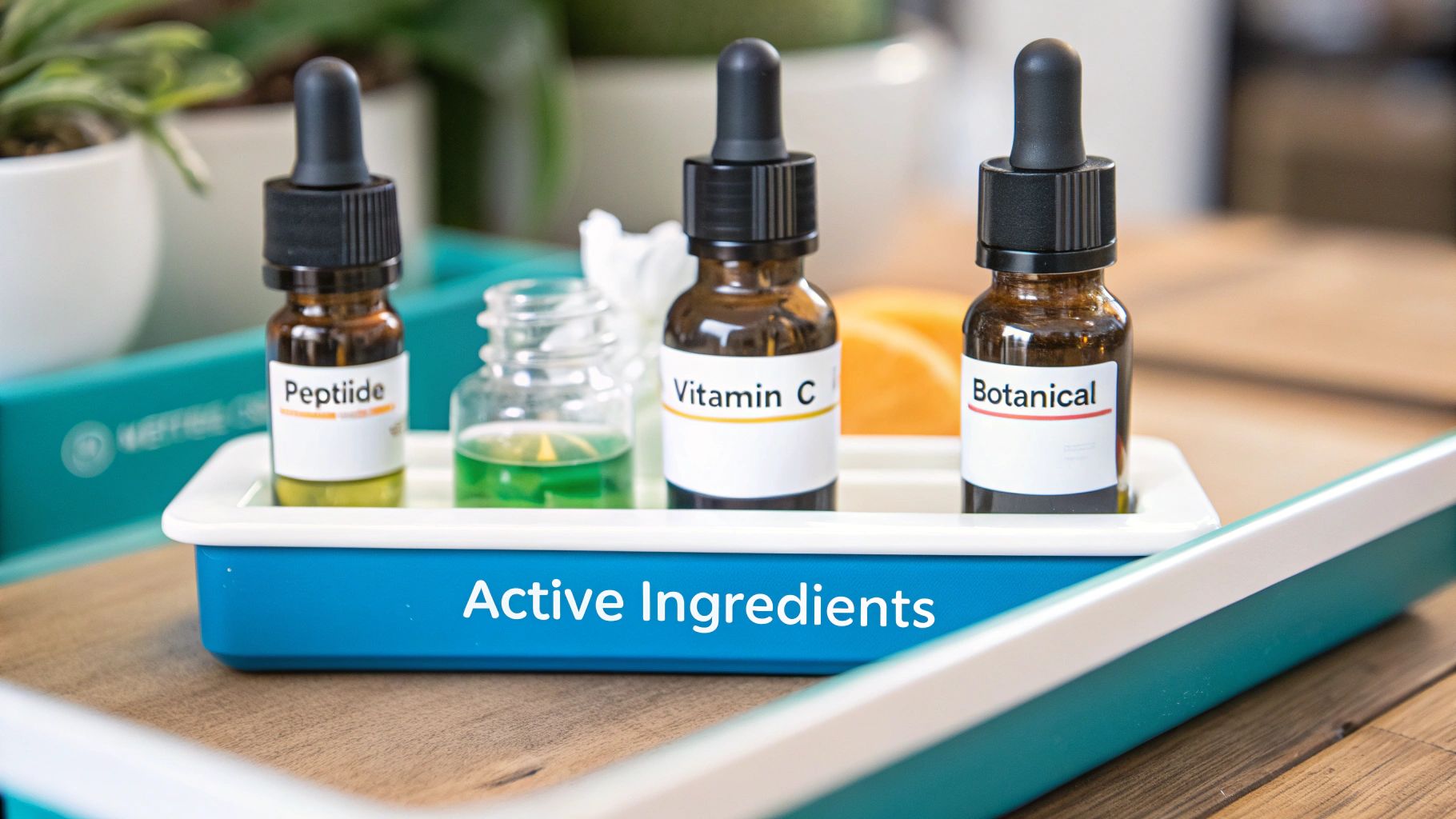
This intense focus on high-performance actives isn't just a trend; it's a massive shift in the beauty world. The global market for skincare ingredients is already valued at USD 13.4 billion and is expected to reach USD 21.5 billion by 2034. A huge piece of that pie is the demand for biotech goodies like peptides and growth factors, a category projected to surpass USD 12 billion by 2030. You can discover more insights about these market trends on gminsights.com.
What this all means is that understanding the most effective actives is more crucial than ever for anyone creating or using skincare.
Peptides: The Messengers for Youthful-Looking Skin
Think of peptides as tiny messengers for your skin. They're short chains of amino acids, which are the fundamental building blocks of proteins like collagen and elastin. In a skincare formula, they signal your skin to perform specific cosmetic functions that help it look firm, smooth, and youthful.
The beauty of peptides is their incredible versatility. Since there are so many different types, each with a unique job, you can find a peptide for almost any aesthetic concern. Some are brilliant for smoothing the appearance of fine lines and wrinkles, while others excel at promoting a more even-looking skin tone.
- Cosmetic Function: Supports the look of skin firmness and elasticity, diminishing the appearance of fine lines.
- Typical Usage Rate: 1-10%, but always check the specific peptide and supplier guidelines.
- Commonly Found In: Serums, moisturizers, and eye creams designed for mature-looking skin.
Botanical Extracts: Nature's Powerhouses
Botanical extracts are concentrated ingredients pulled from plants, flowers, and fruits. Each one brings a unique cocktail of compounds—such as antioxidants and vitamins—to the table, offering a wide range of cosmetic benefits.
For instance, Green Tea Extract is packed with potent antioxidants, making it a fantastic choice for daytime products. On the flip side, Chamomile Extract is loved for its calming appearance, making it perfect for formulas aimed at sensitive or delicate-looking skin. The possibilities are truly endless.
When formulating with botanical extracts, you are bringing the essence of that plant into your product. This not only adds a beautiful story but also leverages components that have been valued for their cosmetic properties for centuries.
These ingredients are a dream for anyone looking to create products with a "clean beauty" or "natural" vibe while still delivering visible, tangible results.
Brightening and Radiance-Boosting Agents
Who doesn't want a bright, even complexion? It's one of the most common skincare goals. Luckily, an entire category of active ingredients is dedicated to addressing dullness and uneven skin tone to bring out that radiant glow.
One of the most beloved and well-researched ingredients here is Niacinamide, also known as Vitamin B3. It’s a true multitasker, celebrated for improving skin texture, minimizing the appearance of enlarged pores, and promoting a brighter, more luminous complexion. Another heavy-hitter is Vitamin C (often found in forms like L-Ascorbic Acid or Sodium Ascorbyl Phosphate), a powerful antioxidant that helps skin look bright and refreshed. You can learn more about why Niacinamide is important in skincare in our detailed article.
- Cosmetic Function: Promotes a bright, even-looking skin tone and enhances overall radiance.
- Typical Usage Rate: Niacinamide is often used at 2-5%, while Vitamin C can range from 5-20%.
- Commonly Found In: Brightening serums, daily moisturizers, and targeted spot treatments.
Choosing the right active is one of the most critical steps in creating a great product. It all comes down to having a clear aesthetic goal and knowing what each ingredient can do. By carefully selecting the right peptides, botanical extracts, or radiance-boosters, you can formulate a product that genuinely helps people achieve the look they've been dreaming of.
Sourcing Quality Ingredients for Your Formulations
The final quality of any skincare product comes down to one thing: the cosmetic raw ingredients you choose to use. Think of it like a chef sourcing produce for a signature dish; they wouldn't dream of using wilted greens or subpar spices. In the same way, a formulator has to prioritize top-notch materials to create something extraordinary and effective.
Diving into the world of suppliers and ingredient labels can feel overwhelming at first, but once you get a handle on a few key terms and certifications, you'll feel empowered to make amazing choices. This knowledge ensures your raw materials align perfectly with your formulation goals and brand values.
Decoding Common Ingredient Labels
When you start looking for ingredients, you'll see words like "organic," "natural," and "wildcrafted" pop up everywhere. While they all sound wonderfully earthy, they have definite meanings in the cosmetics world.
- Natural: This is a broad term. It just means the ingredient comes from plant, mineral, or animal sources instead of being created synthetically in a lab.
- Organic: Now this is a regulated term. It means the ingredient was grown and processed in accordance with strict standards that typically ban synthetic pesticides and fertilizers.
- Wildcrafted: This refers to ingredients harvested right from their natural, wild habitat. Many believe these plants are more potent because they grew in their ideal native environment without any human meddling.
Getting these distinctions straight is the first step to making smart decisions. To really get into the weeds on this, you can learn more about certified organic ingredients and organic skin care in our comprehensive guide. It'll help you see past the marketing buzz and get to the true quality of your materials.
The Importance of Third-Party Certifications
For an extra layer of trust and transparency, many formulators rely on third-party certifications. These labels are proof that an independent group has verified an ingredient or product against specific standards for safety, sourcing, or purity.
Take a popular ingredient like aloe vera, for instance. You want to be absolutely sure you're getting the good stuff. To make sure you're sourcing the best, check out a guide to true quality in pure aloe gel for skin, which is a great example of how to evaluate any raw ingredient. This same principle applies to everything, from carrier oils to active peptides.
Certifications are like a quality guarantee stamped right on your ingredient. They give you objective, third-party validation that the material meets high standards, which gives both you and your future customers way more confidence.
Key Certifications to Look For
While there are tons of certifications out there, a few are especially important if you're focused on creating clean and conscious skincare.
- EWG VERIFIED™: This mark from the Environmental Working Group shows that a product steers clear of EWG's list of concerning ingredients. It’s a quick way to spot products formulated with consumer well-being in mind.
- COSMOS (COSMetic Organic Standard): This is a huge international standard for organic and natural cosmetics. A COSMOS-certified ingredient has passed strict tests on its sourcing, manufacturing, and environmental footprint.
By prioritizing certified ingredients and understanding the lingo, you can vet suppliers with total confidence. This thoughtful approach means you'll be working with premium raw materials, setting the stage to create exceptional skincare you can be genuinely proud of. Your commitment to quality starts long before you ever mix your first batch.
Safety Guidelines and Responsible Formulating
Creating beautiful skincare is an art, but making sure it's safe is a non-negotiable science. For anyone mixing up formulas—from a DIY hobbyist to a seasoned pro—the number one goal is creating products that are both consistent and entirely safe for use. This commitment is the bedrock of responsible formulating and is what builds trust.
A huge part of this is embracing Good Manufacturing Practices (GMP). Think of GMP as the gold standard for your workspace and your entire process. It means keeping a spotless environment, documenting every single batch you make, and using calibrated equipment to ensure every product is just as good as the last.
Navigating the Regulatory Landscape
In the United States, the Food and Drug Administration (FDA) keeps an eye on the cosmetics industry. A core principle to understand is the FDA's distinction between a "cosmetic" and a "drug." This difference comes down to one thing: your product's intended use, which is determined by the claims you make on labels, websites, and in your marketing.
It's absolutely critical to get this right. Cosmetics are for cleansing, beautifying, promoting attractiveness, or altering the appearance. The moment you use language suggesting a product can diagnose, cure, mitigate, treat, or prevent a disease—or affect the body's structure or function—you've crossed into drug territory. Sticking to cosmetic language is essential for compliance.
Responsible marketing is just as important as responsible formulating. The words you choose have to accurately reflect what your product does. Focus on its ability to enhance appearance, not on making claims about fixing or repairing skin conditions.
Prioritizing Safety in Your Workspace
Working with cosmetic raw ingredients demands focus and a serious approach to personal safety. Some ingredients, even the natural ones, can be pretty potent or require careful handling. This is where a Material Safety Data Sheet (MSDS) becomes your best friend. You can find examples and learn more about reading our Material Safety Data Sheets (MSDS) for all sorts of ingredients.
To create a safe formulating space, always follow these key practices:
- Wear Protective Gear: Always. That means gloves, safety glasses, and appropriate clothing to protect yourself from any spills or irritation.
- Ensure Proper Ventilation: Work in a well-ventilated area, especially when you're dealing with fine powders or ingredients with intense aromas.
- Understand Your Ingredients: Before you even open a new raw material, read its MSDS. You need to know its properties and any special handling it requires.
A core part of being a responsible formulator is knowing how to manage your raw ingredients. It’s worth exploring guidelines for handling hazardous substances safely to protect both yourself and your lab's productivity. This proactive mindset is what separates a hobby from a professional practice.
As more people become interested in what's in their skincare, the market for functional cosmetic ingredients continues to grow. It was valued at around USD 3.8 billion and is expected to hit USD 5.33 billion by 2030, all thanks to the demand for effective, thoughtfully made products. This growth just underscores how important it is to stick to high safety and quality standards to meet what consumers are looking for.
Your First Steps in Skincare Formulation
Diving into the world of making your own skincare is an incredible journey. This is where you get to play scientist and artist, transforming individual cosmetic raw ingredients into a single, elegant product that feels amazing on your skin. The key to crafting everything from silky, lightweight lotions to decadent, rich creams lies in mastering one fundamental process: emulsification.
Think of it as the foundational recipe every great chef learns. An emulsion is simply a stable, beautiful blend of oil and water—two things that famously don't like to mix. Your job as a formulator is to bring them together in harmony.

The whole process is methodical, almost like a carefully choreographed dance. Each step builds upon the last, and getting the order right is absolutely crucial for a successful product. Nail these basics, and you'll be well on your way to creating gorgeous, stable, and consistent formulas every single time.
Understanding the Three Main Phases
At its core, creating a lotion or cream involves three distinct stages: the Oil Phase, the Water Phase, and the Cool-Down Phase. Each one has a specific job and includes certain types of ingredients. Following this structure is the key to ensuring everything is incorporated properly.
-
The Oil Phase: This beaker is home to all your oil-loving ingredients. Think carrier oils (like jojoba or squalane), butters (shea or mango), and any oil-soluble emulsifiers or thickeners.
-
The Water Phase: In your second beaker, you'll gather all the water-soluble goodies. This is where you’ll pour your distilled water, hydrosols, aloe vera juice, and water-loving humectants like glycerin.
-
The Cool-Down Phase: The grand finale. It's reserved for all your delicate, heat-sensitive ingredients, added after the emulsion has formed and cooled a bit. Actives like peptides, precious botanical extracts, and your preservative go in here to protect their integrity.
Precision is your best friend in formulating. Always, always measure your ingredients by weight using a digital scale—not by volume with measuring spoons. This is the non-negotiable industry standard, and it’s the only way to guarantee your formulas are accurate and reproducible.
To help visualize this, here’s a simple breakdown of how a basic formulation is structured across these phases.
Basic Emulsion Formulation Phases
| Formulation Phase | Purpose | Example Ingredients to Add |
|---|---|---|
| Water Phase | Forms the base of the emulsion; dissolves water-soluble ingredients. | Distilled Water, Hydrosols, Glycerin, Aloe Vera Juice |
| Oil Phase | Provides moisturizing properties; dissolves oil-soluble ingredients. | Carrier Oils, Butters, Waxes, Emulsifiers, Fatty Alcohols |
| Cool-Down Phase | Adds heat-sensitive active ingredients and the preservative system once the emulsion is stable and cooler. | Preservatives, Peptides, Vitamin C, Essential Oils, Botanical Extracts |
Organizing your recipe this way from the start makes the entire process smoother and much more reliable.
Bringing It All Together
Once you've carefully weighed out your ingredients for the oil and water phases into separate heat-proof beakers, the real magic begins. You’ll gently heat both beakers in a water bath until they reach a similar temperature, usually around 70-75°C (158-167°F). This critical step ensures that any solid butters and waxy emulsifiers are completely melted and ready to blend.
Next comes the exciting part. You’ll slowly pour the water phase into the oil phase while mixing continuously with a small immersion blender. This high-shear mixing is what actually creates the emulsion, breaking the oil and water into teeny-tiny droplets and allowing the emulsifier to lock them together. Keep mixing for a few minutes until the mixture turns milky white and starts to thicken into a lotion.
Final Touches and Best Practices
As your creation cools, it will continue to thicken and set up. Once the temperature drops below 40°C (104°F), it's time for the cool-down phase. This is your moment to add your preservative system and any of those amazing heat-sensitive actives, stirring them in gently but thoroughly.
There's one final, absolutely critical step: checking the pH. The pH of a skincare product dramatically affects its feel, stability, and interactions with the skin. Most lotions and creams perform best at a pH range of 4.5 to 5.5, which is skin-friendly. You can easily test this with pH strips and adjust if needed with a drop or two of a weak acid solution, like citric or lactic acid.
Mastering these foundational techniques is the secret to leveling up from following simple recipes to designing sophisticated, personalized skincare creations that you can be proud of.
Got Questions About Cosmetic Raw Ingredients? We've Got Answers.
As you get more comfortable with creating your own skincare, you're bound to have questions pop up. It happens to everyone! To help you out, we've put together some straightforward answers to the questions we hear most often from formulators, whether they're just starting or have been at it for years.
Think of this as your go-to guide for those "wait, what does that mean?" moments. Our goal is to give you practical answers you can put to use right away.
What’s the Real Difference Between "Natural" and "Organic" Ingredients?
People throw these terms around all the time, sometimes using them interchangeably, but they actually mean very different things in the world of skincare. Getting this right is a big deal, especially when sourcing ingredients that align with your brand's values.
- Natural is a pretty broad term. It just means the ingredient comes from a plant, mineral, or animal source instead of being cooked up in a lab. The catch? There's no strict regulation around this word, so it can mean different things to different brands.
- Organic is the one with rules. For an ingredient to be called organic, it has to be grown and processed under very specific standards that forbid most synthetic pesticides and fertilizers. To be sure you're getting the real deal, always look for official certifications like USDA Organic or COSMOS.
How Do I Figure Out the Shelf Life of My Ingredients?
Keeping your ingredients fresh is non-negotiable for making products that are both safe and effective. Any supplier worth their salt will give you a Certificate of Analysis (CoA) for every single ingredient you buy.
This document is your best friend. It lists all the critical details, like when the ingredient was made and its recommended expiration or retest date. To get the most out of your cosmetic raw ingredients, store them properly: in a cool, dark, and dry place, far away from sunlight and moisture.
A Certificate of Analysis is like an ingredient's passport. It tells you everything you need to know about its quality, purity, and lifespan, so you can formulate with total confidence.
What Are the Best Ingredients for Mature Skin?
When you're formulating for mature skin, a few powerhouse ingredients tend to steal the spotlight. These actives are loved for their ability to help skin look smoother, firmer, and more radiant.
Here are a few favorites:
- Peptides: These are the building blocks of proteins and are fantastic for promoting a firmer, more youthful appearance.
- Vitamin C: A true multi-tasker, this antioxidant is brilliant for brightening the look of skin and evening out tone.
- Botanical Extracts: From green tea to licorice root, these plant-based goodies offer a huge range of benefits for a refreshed-looking complexion.
The secret is to choose ingredients that align perfectly with the results you want to see in your finished product.
At Skin Perfection, we're passionate about providing the highest quality lotion-making supplies and active ingredients to help you bring your beautiful skincare creations to life. Ready to get started? Explore our huge collection and find the perfect ingredients for your next formula at https://www.naturalorganicskincare.com.