

 Buy with Prime



Visible lash improvements typically take 8 to 16 weeks of consistent use, not overnight. In one FDA label, bimatoprost produced a mean eyelash-growth change of 1.4 mm, or a 25% increase, versus vehicle by the study endpoint.
So why do so many lash and brow growth serum guides focus on dramatic before-and-after photos instead of the ingredient's safety tradeoffs? A fuller-looking lash line depends on the hair cycle, the active formula, application habits, and the reason for thinning. The most effective ingredient class also carries the most important eye-health questions.
For Skin Perfection, that distinction matters. We sell skincare products and lotion-making supplies designed to beautify the skin, and we follow FDA rules and Etsy's restrictions on cosmetic claims. Our listings don't describe products as fixing, repairing, or healing skin, and we don't present cosmetic products as treatments, cures, diagnoses, prescription drugs, or FDA-approved products.
Table of Contents
- Understanding What Lash and Brow Growth Serums Actually Do
- The Science Behind Effective Growth Serums
- Comparing Prostaglandin, Peptide, and Botanical Actives
- Safety Considerations and What to Avoid
- Correct Application Techniques for Best Results
- How to Choose the Right Serum for Your Needs
Understanding What Lash and Brow Growth Serums Actually Do
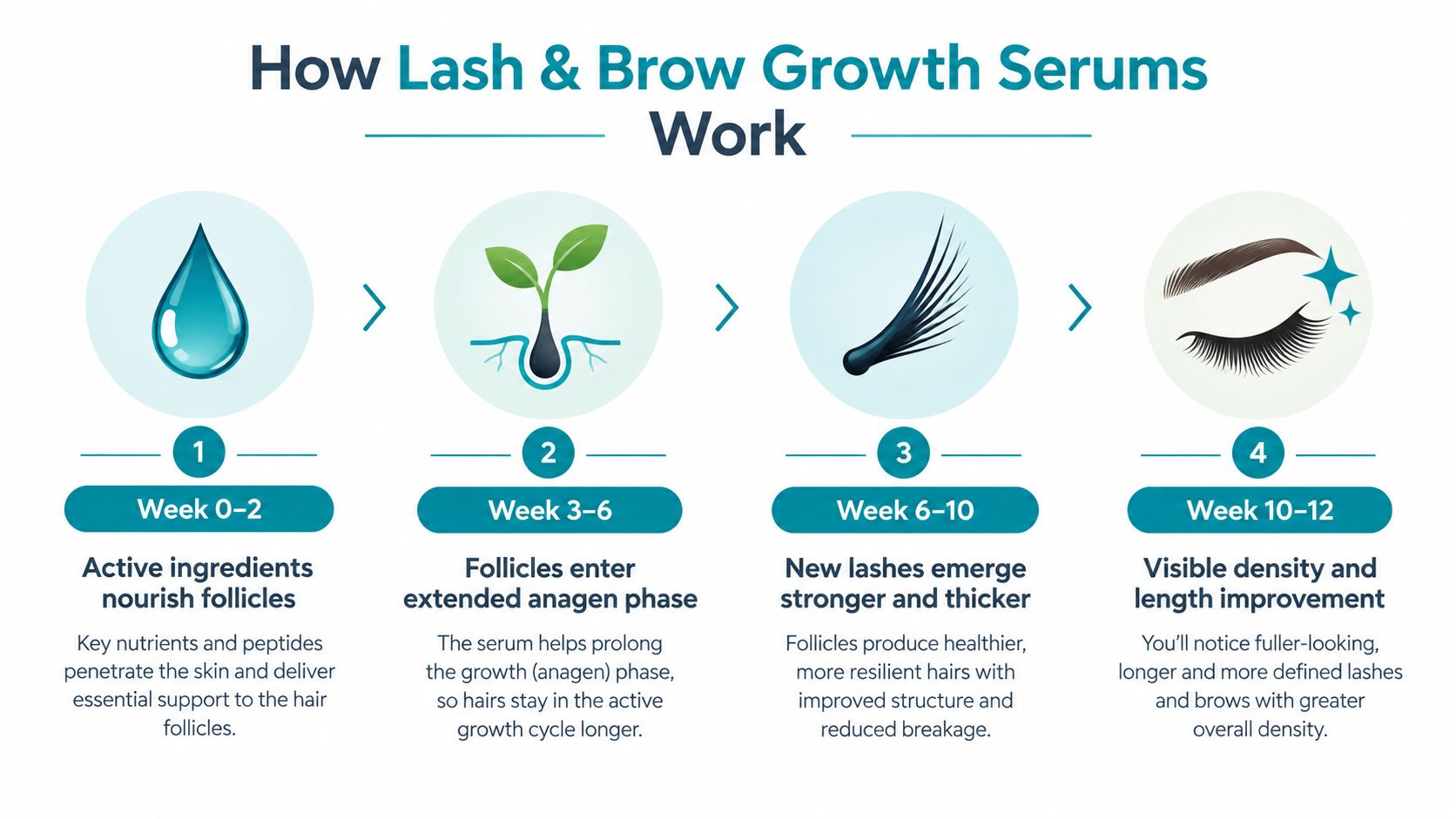
A person noticing sparse lashes may assume the follicles have stopped working. Often, the visible change is more ordinary: hairs are moving through their natural cycle, some break from rubbing or makeup removal, or the brow has been over-shaped for a long time. A serum can support the appearance of fuller lashes or brows, but it can't override every biological factor or promise the same result for every user.
Hair follicles move through anagen, the active growth phase, catagen, a transition phase, and telogen, a resting phase. Prostaglandin-based actives are understood to prolong anagen and shift more follicles from telogen into anagen, according to a category review in the Journal of Cosmetic Dermatology. Cosmetic peptide and botanical formulas are generally positioned more gently, often supporting conditioning and the look of healthier hairs rather than reproducing the same pharmacological effect.
A person applying serum every night may therefore see almost nothing at first. The follicle has to progress through its cycle, and the visible hair has to grow far enough to be noticed. Clinical outcomes for bimatoprost repeatedly become measurable around 8 weeks and continue through 16 weeks, which is why a short trial can give a misleading impression of failure or success.
Why the cause of thinning matters
Clinical results vary by population, ingredient, and the reason for lash loss. In one study involving chemotherapy-related or alopecia areata-related lash loss, bimatoprost didn't show a significant benefit over vehicle, as reported in the clinical literature on bimatoprost (review of randomized trials). That doesn't mean every serum is useless. It means a cosmetic product shouldn't be treated as a universal answer to every type of thinning.
Genetics, age, grooming, friction, makeup habits, and individual follicle behavior can all influence the starting point. A brow serum may make existing hairs look more conditioned and defined, while a lash serum is applied close to a sensitive ocular area where tolerance becomes especially important.
Practical rule: Judge a serum by its ingredient profile, tolerability, and realistic timeline, not by a single dramatic photograph.
For a practical visual reference, compare how expectations are framed in this guide to eyelash serum before and after results. Before-and-after images can help you observe change, but they don't reveal lighting, mascara, camera distance, grooming, or whether the product was used consistently.
The Science Behind Effective Growth Serums
What makes a lash or brow serum effective depends on more than the word growth on its label. Formulas may use a pharmacologically active prostaglandin analogue, peptides, botanical extracts, humectants, or several conditioning ingredients. These categories work through different pathways and should be judged against different expectations.
Prostaglandin analogues
Bimatoprost 0.03% became a key ingredient after receiving FDA approval for eyelash hypotrichosis in 2008. It remains the first and only prostaglandin analogue approved for eyelash growth in major category reviews (category review). The American Academy of Ophthalmology identifies Latisse, which contains bimatoprost ophthalmic solution 0.03%, as the only FDA-approved eyelash growth serum and notes that it requires a prescription (American Academy of Ophthalmology guidance).
This class has the clearest clinical mechanism among lash-growth actives. It can extend the active growth phase and increase the proportion of follicles producing visible lashes. Stronger evidence still involves a safety tradeoff. Repeated application near the eye requires more care than applying a conditioning product to brow hairs.
Peptides and conditioning systems
Peptides are short amino-acid chains included for several cosmetic support roles. Their presence does not show that a formula will reproduce bimatoprost's effects, and high-quality medical evidence for non-prostaglandin lash formulas remains less established. This science of peptide therapy explained provides broader context, although general peptide therapy evidence cannot be transferred automatically to a particular lash serum.
Copper peptides, signal peptides, film-forming agents, humectants, and conditioning polymers may improve hair feel, surface appearance, or surrounding skin comfort. The guide to how to use copper peptides offers practical formulation context. The meaningful questions are concentration, stability, delivery, preservation, and finished-product testing. A fashionable ingredient name alone says little about the finished serum.
Botanicals and hydration
Botanicals support a conditioning-focused approach, but “natural” does not mean proven or irritation-free. Rosemary oil, aromatic extracts, and biotin appear in cosmetic hair-care routines, while the strongest medical evidence for lash growth remains associated with prostaglandin-based actives, as discussed in the clinical review.
Hydration ingredients serve another purpose. Sodium Hyaluronate Powder Pure Hyaluronic Acid is a cosmetic-grade powder for water-based serums, creams, and lotions, with a stated NASHA high-molecular-weight range of 800 to 1500 Daltons and typical DIY serum use at 0.1% to 2%. It can support surface hydration and skin comfort, but it is not an eyelash-growth active. An improvised eye-area formula also needs suitable preservation, testing, and safety controls.
Comparing Prostaglandin, Peptide, and Botanical Actives
A useful comparison starts with a distinction that marketing often blurs: clinical evidence, cosmetic conditioning, and perceived fullness are not the same outcome. A prostaglandin analogue may have the strongest evidence for changing lash length, while a peptide or botanical formula may be chosen because the user prioritizes a gentler cosmetic routine.
| Active Category | Clinical Evidence | Primary Mechanism | Safety Profile | Best For |
|---|---|---|---|---|
| Prostaglandin analogues | Strongest evidence in the category, with bimatoprost 0.03% as the FDA-approved active | Prolongs anagen and shifts more follicles toward active growth | Highest level of regulatory and eye-area concern, including iris darkening and periorbital fat loss risks | Users discussing a prescription option with an appropriate medical professional |
| Peptide-based formulas | Broader cosmetic positioning with less established high-quality efficacy data in medical literature | Conditioning and proposed support of follicle or hair-fiber appearance | Often considered a lower-concern alternative, though the full formula can still irritate | Users seeking a non-prostaglandin cosmetic approach |
| Botanical formulas | Traditionally used for cosmetic support, with a weaker established clinical evidence base for lash growth | Conditioning, emollience, and botanical support | Natural fragrance components and essential oils may irritate sensitive eyes | Users prioritizing botanical ingredients, especially for brow use when the formula is suitable |
The table doesn't make the decision for you. It clarifies the tradeoff. A person seeking the strongest documented lash-growth evidence may need medical guidance, while someone with sensitive eyes may reasonably prefer a prostaglandin-free formula and accept more modest or less predictable cosmetic results.
Copper peptide discussions can also become confusing because haircare evidence and lash-line safety aren't interchangeable. This overview of GHK-Cu in haircare science is useful for understanding why ingredient mechanisms must be matched to the application site, formula, and intended claim.
Match the product to the area
A brow formula isn't automatically suitable for lashes. Essential oils, fragrance, and botanical aromatics may be tolerated on brow skin yet cause discomfort if they migrate toward the eye. The same principle applies to a rich facial product such as HydroGlow Anti-Aging Night Mask, which contains multiple hydrating and conditioning ingredients for the skin but isn't a lash-line serum.
For DIY formulators, the distinction is even more important. A formula designed for a cheek or brow area requires different risk management from one intended for repeated placement beside the ocular surface. Read the complete ingredient list, check the intended use, and don't assume that a familiar skin-care active belongs near the eye.
Safety Considerations and What to Avoid
Could a serum that improves lash appearance also change the tissue around the eye? That question matters because repeated exposure can affect more than the visible hair. Prostaglandin analogues have the strongest growth evidence in this category, yet their safety tradeoffs deserve close attention.
Reported concerns include irreversible iris darkening, loss of periorbital fat, changes to the eyelids or surrounding skin, and irritation. In June 2025, ANSES reported that the EU Scientific Committee on Consumer Safety concluded that three prostaglandin analogues used in cosmetic lash and brow products could not be considered safe, citing risks such as irreversible iris darkening and periorbital fat loss (ANSES and SCCS information).
A 2024 review also noted that U.S. law does not require premarket efficacy or safety assessment for many consumer eyelash enhancers. That leaves a gap between marketing language and product evidence. An over-the-counter serum is not automatically equivalent to a clinically evaluated prescription product.
Read past the front label
Check the complete ingredient list instead of relying on phrases such as “growth complex.” Isopropyl cloprostenate is a prostaglandin analogue found in some over-the-counter products, and it is not FDA approved. The regulatory status of an ingredient is separate from whether a product makes lashes look fuller or longer.
Stop using a formula if it causes repeated discomfort. Watch for:
- Burning or stinging: Persistent discomfort signals that the product may not suit the eye area.
- Redness or swelling: Irritation around the lash line can be difficult to distinguish from a more serious eye problem.
- Persistent dryness: Product migration may be especially uncomfortable for people with dry eyes.
- Changes in lash direction or density: Lash ptosis, trichiasis, and poliosis have appeared in safety reporting and warrant professional attention.
- Unclear claims: Avoid listings that suggest a cosmetic serum treats, cures, prevents, or diagnoses a medical condition.
“Natural” describes an ingredient source, not an eye-safety result. Essential oils, fragrance materials, preservatives, and botanical extracts can all cause problems for individual users, particularly near the ocular surface. Patch testing on suitable skin may reveal some reactions, but it cannot establish that a product is safe for the eye area.
DIY makers need appropriate preservation, accurate weighing, clean equipment, and a formula designed for its intended site. A facial recipe is not a suitable starting point for an eye-area product. This guide to top 10 toxins to avoid in skincare can support ingredient screening, but eye safety requires more than a “clean” or “natural” label.
Correct Application Techniques for Best Results
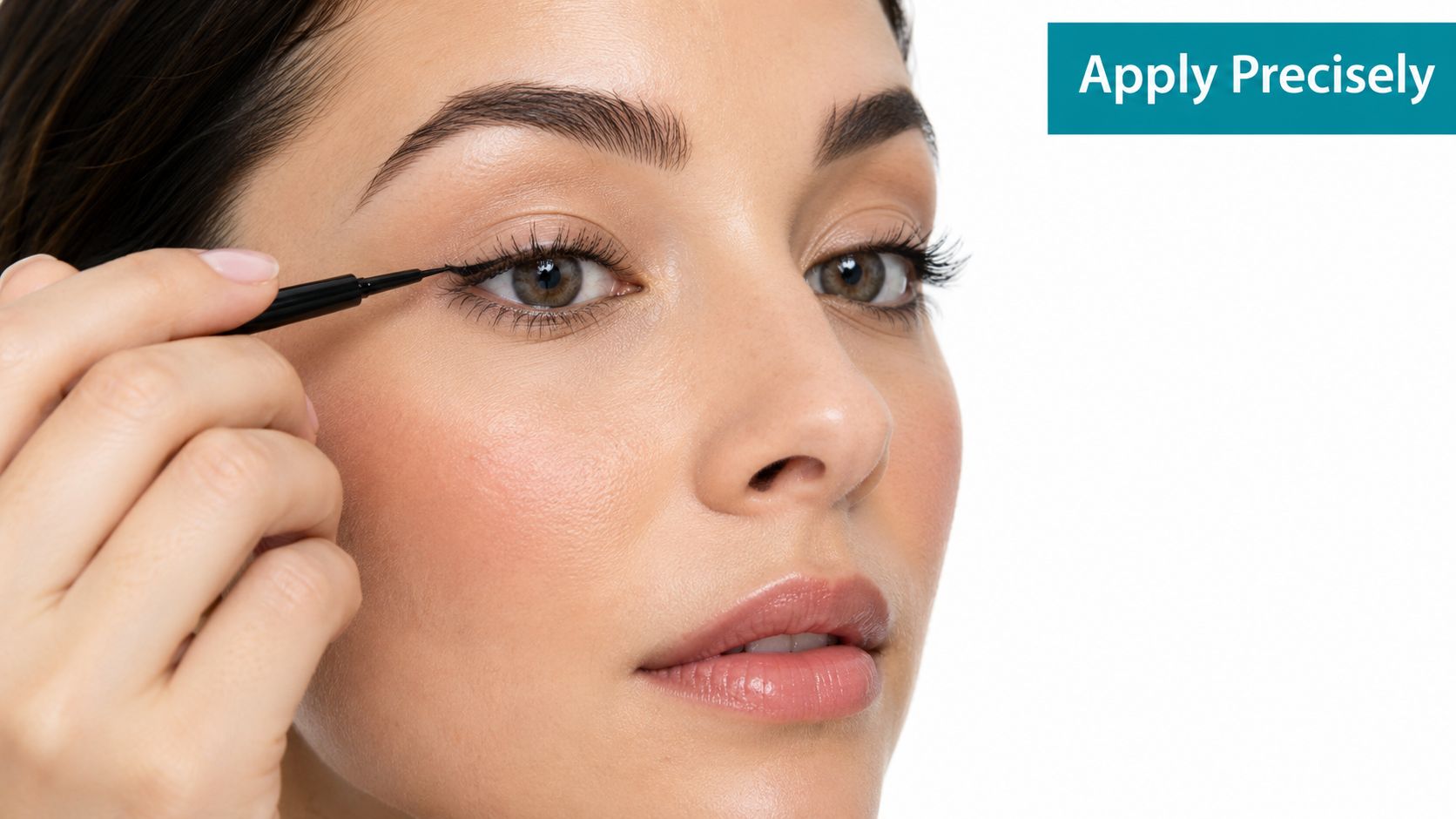
Application technique affects both consistency and exposure. A precise, minimal application is preferable to coating the entire eyelid or repeatedly adding more product in the hope of speeding up growth.
- Start with clean, dry skin. Remove makeup, sunscreen, oil, and residue from the upper lash line. Pat dry rather than rubbing, because friction can irritate the area and complicate your assessment of the serum itself.
- Use the applicator sparingly. Follow the product's directions and remove excess liquid before application. More product doesn't create a faster growth cycle, and excess fluid is more likely to migrate through blinking, perspiration, or skin heat.
- Place the product only where directed. For a lash-line product, this generally means a fine line along the upper lash line rather than the waterline or lower inner lid. Don't apply a brow serum to the lashes unless the manufacturer specifically states that it is suitable for that use.
Build a routine you can maintain
Apply the serum at the time recommended on its label, usually to a clean area before heavier creams or makeup. Let it dry before layering other products, and don't share the applicator. If you wear contact lenses, have dry eyes, or have had eye surgery, ask an appropriate eye-care professional whether the product and placement are suitable for you.
Consistency matters because the clinical timeline is measured in weeks, not isolated applications. Take photos under similar lighting and at a similar distance if you want to observe change, but don't use photography as a substitute for monitoring irritation.
For a more detailed routine reference, see how to use lash serum. Stop using the product and seek professional advice if you develop significant pain, vision changes, marked swelling, persistent redness, or other symptoms that concern you.
How to Choose the Right Serum for Your Needs
The right choice depends on what you're optimizing. Someone who wants the strongest documented lash-growth evidence is making a different decision from someone who has sensitive eyes, prefers botanical ingredients, or wants a conditioning brow product. Start with the application area, then assess the active category and the claims.
A product page should make it possible to answer basic questions without detective work. You should be able to identify the complete ingredient list, whether the formula is intended for lashes, brows, or both, and whether the manufacturer explains how to use it. Be skeptical of dramatic promises, “instant” results, or language suggesting that a cosmetic product is equivalent to a prescription drug.
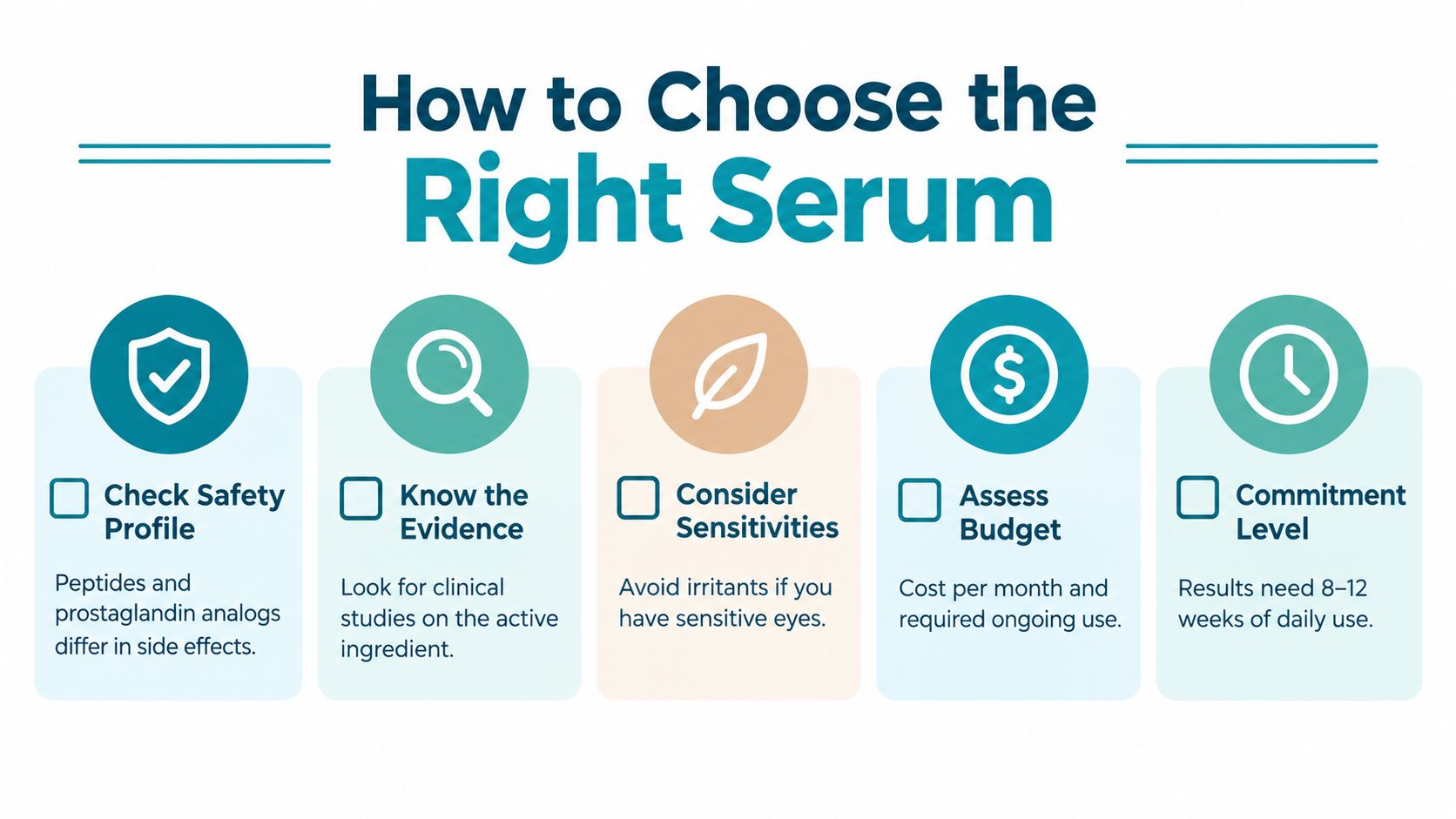
Use a five-question filter
- What result do you want? Length, density, definition, conditioning, and hydration are different cosmetic goals.
- Which active category fits your risk tolerance? Prostaglandin analogues have the strongest evidence and the most significant safety concerns. Peptide and botanical formulas generally offer a more cosmetic, lower-concern positioning, but their efficacy evidence is less established.
- How sensitive is the application area? If your eyes are easily irritated, avoid assuming that a “natural” formula is automatically comfortable. Fragrance and essential oils deserve particular scrutiny.
- Can the company explain the formula? Look for transparent ingredients, clear directions, batch information where available, and realistic claims rather than influencer-style promises.
- Will you use it consistently? Clinical outcomes cluster around 8 to 16 weeks, and a routine that causes irritation or feels impractical won't be sustainable.
Separate skin support from lash growth
A hydrating skin product can make the surrounding area look smoother or more comfortable, but it isn't necessarily a follicle-growth product. The same distinction applies to general natural skin support: helpful skin-care principles don't replace ingredient-specific evidence for a lash-line formula.
For brow users, a cosmetic serum may be reasonable when the goal is a fuller-looking, conditioned appearance. For lash users, the margin for error is smaller because migration toward the eye is possible. If thinning is sudden, pronounced, or associated with other symptoms, cosmetic experimentation shouldn't replace an evaluation by a qualified professional.
Skin Perfection offers skincare products, cosmetic ingredients, and lotion-making supplies for people who want to build informed routines and formulate skin-focused products with clear cosmetic positioning. Visit Skin Perfection to explore transparent options for hydration, conditioning, and DIY formulation, then choose any lash or brow product with the same attention to ingredients and safety.