

 Buy with Prime


Ever wondered how on earth oil and water manage to mix together to create that silky, luxurious lotion you love? The secret lies in one crucial ingredient: an emulsifier. It’s the single most important player in getting that perfect, creamy texture.
Think of an emulsifier as a skilled diplomat, grabbing onto both an oil molecule and a water molecule to unite them in a stable, harmonious blend.
The Secret to Creating Silky Smooth Lotions
Without an emulsifier, your carefully chosen oils and water-based ingredients would just separate into a sad, useless puddle. This is the component that transforms two distinct liquids into the cohesive, elegant product we all recognize as lotion. Learning how to pick the right one is the first real step toward crafting beautiful, professional-quality skincare at home.
The emulsifier you choose directly impacts your final product's feel, stability, and even its appearance. It’s the decision that determines whether you end up with a light, fast-absorbing daily moisturizer or a rich, decadent cream. This guide will set you up for success right from the start.
Why Emulsifiers Are Essential
At its core, any lotion is an emulsion—a mixture of oil and water, two things that famously don't get along. An emulsifier is the bridge that closes this gap, ensuring your creation stays perfectly blended over time. It’s the foundation of your formula; get it right, and everything else just falls into place.
The demand for skincare that feels amazing has driven huge growth in the cosmetic ingredient world. In fact, the cosmetic emulsifier market is projected to grow from USD 712 million in 2023 to around USD 1,298 million by 2033. This jump is largely thanks to our love for light, easily absorbed lotions, where oil-in-water (O/W) emulsifiers dominate with over 63.3% of the market share. You can learn more about this trend from recent industry reports on the cosmetic emulsifier market.
An emulsifier doesn't just mix your ingredients; it defines the character of your lotion. It controls the texture, influences how it feels on the skin, and ensures the product remains stable and consistent from the first pump to the last.
Mastering emulsifiers empowers you to create custom lotions that look and feel exactly how you want. It’s the secret to moving beyond basic recipes and into the world of truly personalized skincare formulation.
How Emulsifiers Work Their Magic in Lotions
If you've ever tried to mix oil and water, you know they just don't get along. So how does a lotion stay so perfectly creamy? You don't need a chemistry degree to understand the magic—it all comes down to the emulsifier.
Think of an emulsifier molecule as a tiny connector with a dual personality. One end is hydrophilic, which is just a fancy way of saying it loves water. The other end is lipophilic, meaning it’s drawn to oils. This unique structure makes it the ultimate peacemaker between the two.
When you start blending your heated oil and water phases, these little molecules spring into action. They position themselves right at the boundary where oil and water meet, grabbing a water droplet with one "hand" and an oil droplet with the other. By doing this over and over, they pull these incompatible ingredients into a stable, uniform mixture, preventing them from going their separate ways.
Oil-in-Water vs. Water-in-Oil Emulsions
This molecular matchmaking can create two very different kinds of emulsions, and the one you choose will completely shape your final product. Are you making a light, fast-absorbing daily lotion or a rich, protective cream? Your choice of emulsifiers for lotion is what gets you there.
This chart breaks down the key differences, showing how the structure impacts the final texture and which emulsifiers you'll need for the job.
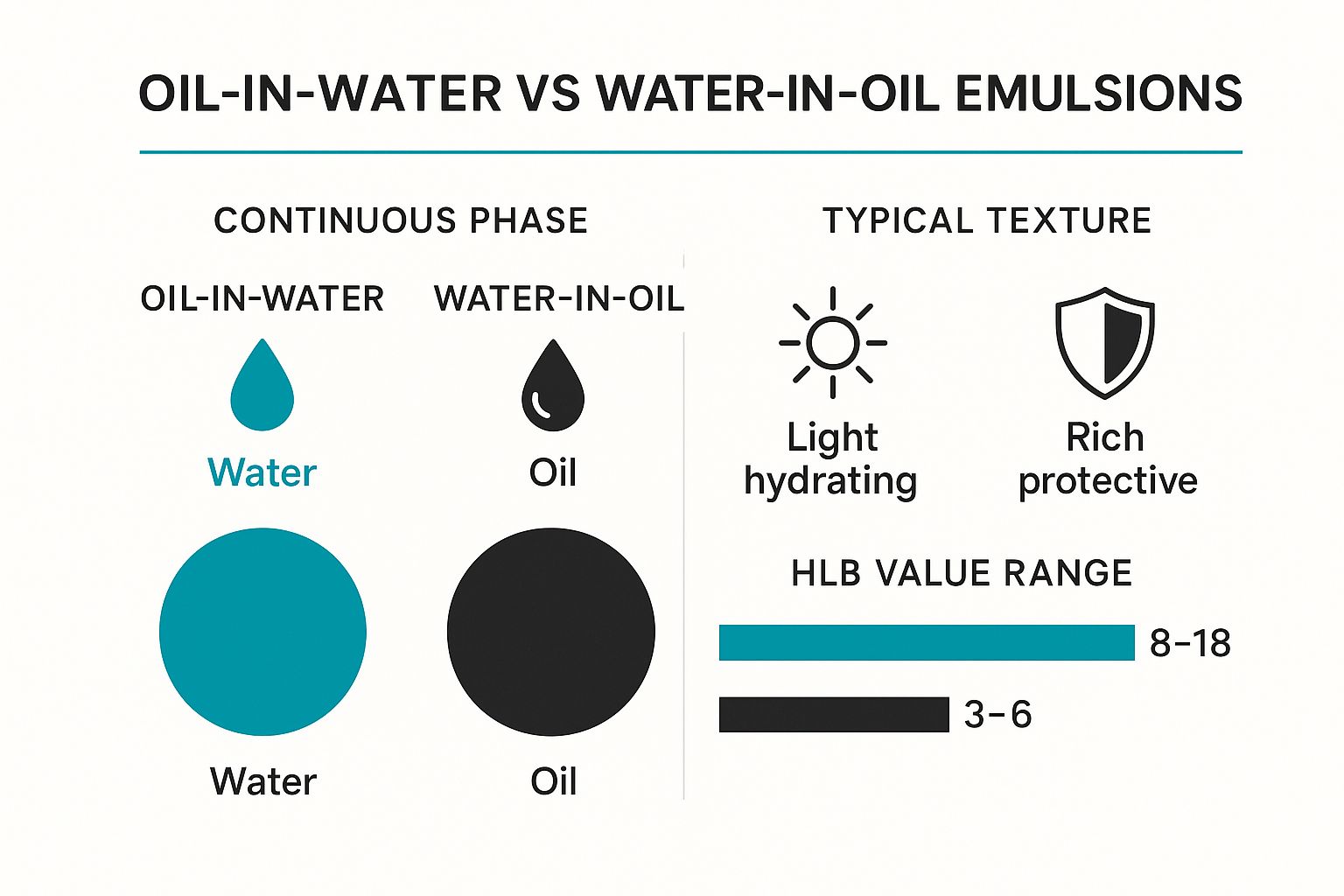
As you can see, what really defines the lotion's feel is the "continuous phase"—the ingredient that makes up the bulk of the formula. This is the fundamental knowledge that lets you control the texture of every lotion you create.
The two main types of emulsions you'll be making are:
- Oil-in-Water (O/W): This is the most common type you'll find. Tiny oil droplets are scattered throughout a continuous water base. The result is a product that feels light, non-greasy, and absorbs quickly, making it perfect for daily face and body lotions.
- Water-in-Oil (W/O): Here, the roles are flipped. Small water droplets are suspended within a continuous oil base. This creates the thicker, richer feel you'd want in a night cream, a heavy-duty hand balm, or a protective product.
Getting a handle on this simple concept is the first real step toward becoming a confident formulator. It’s what allows you to move beyond just following recipes and start intentionally designing products with a specific texture and skin feel in mind. It gives you complete creative control.
Finding the Best Emulsifiers for Your Lotion Project
Diving into the world of lotion emulsifiers can feel like a lot at first, but don't get overwhelmed. It’s really just about matching the right ingredient to the kind of lotion you want to create. With so many choices available to home formulators these days, getting to know their personalities is the secret to building both your confidence and your ingredient stash.
The emulsifier you choose is a big deal—it directly shapes the final texture, stability, and feel of your product. Are you dreaming of a thick, decadent body cream or a light, sinks-in-fast daily lotion? The answer to that question starts with your emulsifier.
Common Emulsifiers for Home Formulators
Let's get familiar with some of the most popular and dependable options you'll find. Each one brings something unique to the formulation table, and understanding their strengths will help you pick the perfect one for whatever you're whipping up next.
-
Emulsifying Wax NF: This is often the go-to for beginners, and for good reason—it's a robust, reliable workhorse. As a pre-blended wax, it creates stable, predictable emulsions. It’s an excellent choice for making classic medium-to-thick creams and lotions without any fuss.
-
Olivem 1000: Sourced from olive oil, this is a crowd favorite for creating products with a sophisticated, high-end feel. It’s known for giving lotions a silky, non-greasy finish.
-
BTMS-50: You’ll often see this in hair conditioners for its amazing detangling abilities, but it also creates incredibly luxurious, powdery-soft emulsions for skin. It contains Behentrimonium Methosulfate, a conditioning agent that leaves skin feeling exceptionally smooth and velvety.
The demand for these types of multi-functional, plant-derived ingredients is exploding. The global market for cosmetic emulsifiers hit USD 1,057 million in 2024 and is on track to reach USD 1,581 million by 2031. This growth is all thanks to formulators and customers who are actively seeking out bio-based ingredients that align with modern clean beauty ideals. You can get more details on the cosmetic emulsifier market here.
A Quick Comparison of Common Lotion Emulsifiers
To make things a little easier, here's a quick cheat sheet comparing some of the most common emulsifiers you'll come across. Think of this as your starting point for deciding which one best fits the vision for your next lotion.
| Emulsifier | Source Type | Typical Usage Rate (%) | Resulting Lotion Feel |
|---|---|---|---|
| Emulsifying Wax NF | Synthetic Blend | 3% - 6% | Classic, medium-to-thick, creamy |
| Olivem 1000 | Natural (Olive Oil) | 3% - 8% | Silky, light, non-greasy, elegant |
| BTMS-50 | Synthetic (Plant-derived) | 2% - 10% | Powdery, velvety, luxurious, soft |
| Polawax | Synthetic Blend | 3% - 6% | Robust, thick, very stable, protective |
| Ritamulse SCG | Natural (ECOCERT) | 4% - 8% | Light, soft, smooth, moisturizing |
This table isn't exhaustive, of course, but it covers the heavy hitters you're most likely to encounter. As you can see, the source, usage rate, and final feel can vary widely, giving you a ton of creative control.
Waxes and Gums as Formulation Helpers
It’s not just about the primary emulsifiers. Other ingredients can step in to play a crucial supporting role in your formulas. While they aren't "true" emulsifiers on their own, they are fantastic for boosting stability and tweaking the final texture.
For example, Beeswax is often added to recipes to thicken them up and add a protective quality. Natural gums like Xanthan Gum, on the other hand, are stability superstars. Adding just a tiny pinch (usually 0.2% to 0.5%) can stop a thinner lotion from separating over time, dramatically improving its shelf life.
Choosing an emulsifier isn't just a technical step; it's a creative one. The emulsifier is the heart of your lotion's personality—it dictates whether your final creation is light and airy or rich and comforting.
By getting to know these core ingredients, you start moving beyond just following a recipe. You gain the power to intentionally design a product and control the texture, creating a lotion that looks and feels exactly the way you imagined it.
How to Choose the Right Emulsifier for Your Formula
Moving from hopeful guesswork to intentional design is what separates a decent homemade lotion from a truly great one. Choosing the right emulsifier isn't about luck; it's about making a few key decisions that bring your vision for the final product to life. This framework will help you nail it every single time.
Think of yourself as a chef. You wouldn't use the same method to whip up a light, airy meringue as you would for a dense, fudgy brownie, right? The same logic applies here—your emulsifier choice directly shapes the final personality and feel of your lotion.
Start with Your Desired Outcome
Before you even glance at an ingredient list, ask yourself one simple question: What kind of lotion do I want to create? The answer will immediately point you in the right direction and narrow your options.
- For a light daily lotion: You'll want an oil-in-water (O/W) emulsifier. These create that fast-absorbing, non-greasy feel that's perfect when you're working with lighter carrier oils.
- For a heavy night cream: A water-in-oil (W/O) emulsifier is usually the better bet. They create richer, more protective creams that feel absolutely luxurious when formulated with heavier butters like shea or cocoa.
Your end goal is the single most important factor. It guides every other decision, ensuring the texture and skin feel are exactly what you imagined.
Understanding the HLB System
Once you know what you want to make, it’s time to get a little more technical with the HLB (Hydrophile-Lipophile Balance) system. Don't let the scientific name throw you off; it's just a simple matching tool. The HLB scale ranges from 1 to 20, indicating whether an emulsifier prefers to associate with oil or water.
Every single oil and butter you use has a "required HLB" value. Your job is to pick an emulsifier (or a blend of them) with an HLB value that matches the required HLB of your entire oil phase. This is the secret to a stable, harmonious blend.
Think of HLB like a puzzle. Your oil phase is one piece, and your emulsifier is the other. When their HLB values fit together perfectly, you create a stable, beautiful picture—a perfect emulsion.
Natural vs. Synthetic Emulsifiers
Finally, think about the kind of ingredients you want on your label. The demand for natural emulsifiers is absolutely booming right now. In fact, this "green" segment holds a massive 72.0% of the personal care emulsifier market in 2024, showing just how much consumers want plant-derived ingredients.
Whether you go for a natural, plant-derived emulsifier like Olivem 1000 or a reliable synthetic blend, the choice should align with your personal product philosophy. You can find a wide variety of both in our collection of lotion-making supplies to get started.
By thinking through your desired texture, the oils you’re using, and your ingredient preferences, you can confidently pick the perfect emulsifier for a stable, beautiful lotion.
Mastering Your Lotion Making Technique
Choosing the perfect emulsifier is a huge step, but even the best ingredient needs the right technique to truly shine. A successful lotion depends just as much on how you combine your ingredients as it does on what you use. Think of this as your pre-formulation checklist for success.
Following a few key practices will guarantee you get a stable, beautiful emulsion every single time. These steps aren't just suggestions; they are the foundation of good formulation that stops common issues like separation before they even start.
The Importance of the Heat and Hold Phase
One of the most critical steps in making lotion is the heat-and-hold phase. This is where you gently heat both your water phase (distilled water, hydrosols) and your oil phase (carrier oils, butters, emulsifier) in separate heat-proof beakers.
The goal is to bring both phases to the same temperature, usually around 160°F (71°C), and keep them there for about 20 minutes. This ensures your waxy emulsifiers are completely melted and that both liquids will blend together seamlessly. Skipping this step or having a big temperature difference between your phases is one of the most common reasons emulsions fail and separate later.
Why High Shear Mixing Is a Must
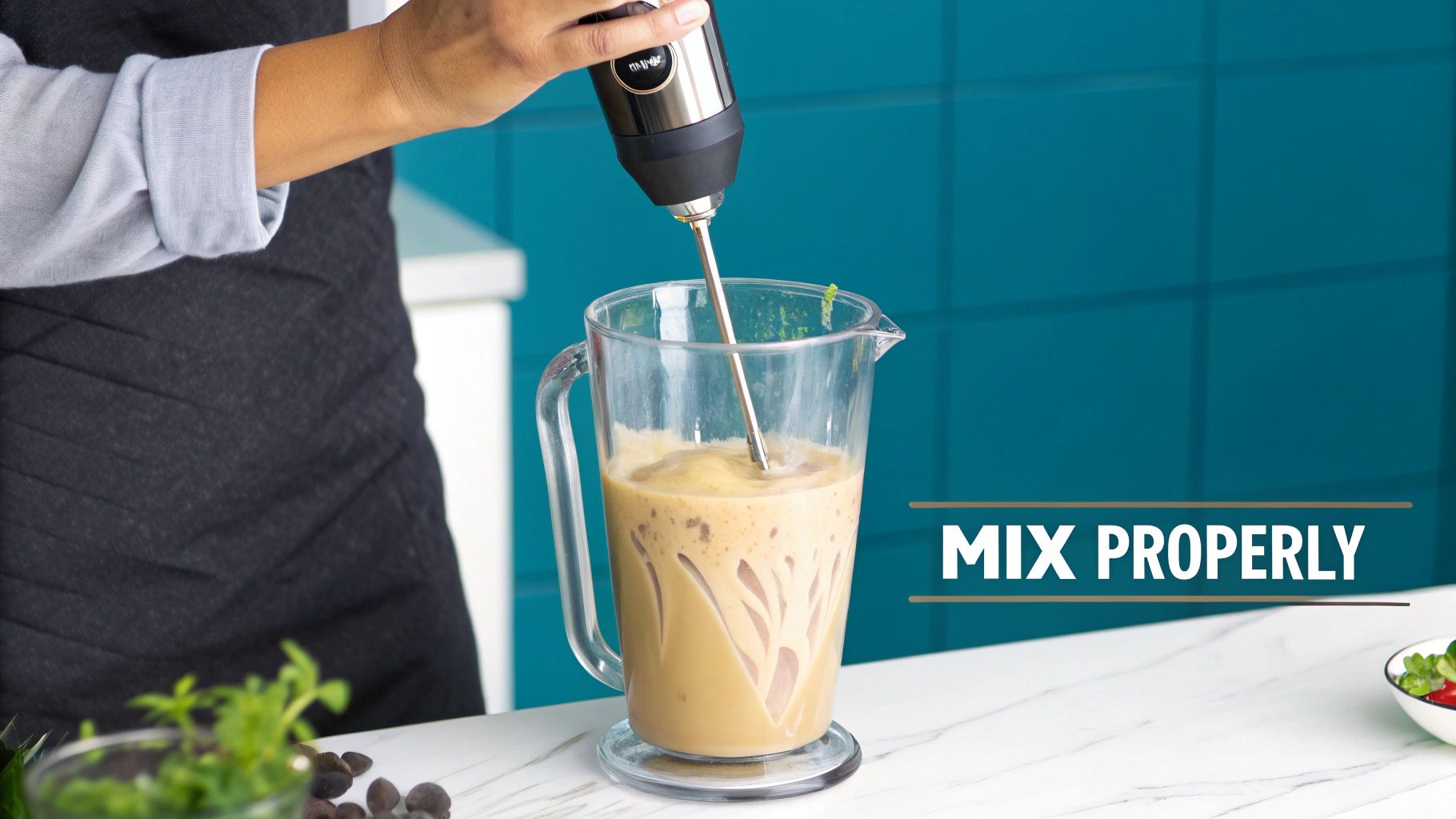
Once your phases are at the right temperature, it’s time to combine them. While a simple whisk might seem like it would work, it just isn’t powerful enough to create a stable lotion. For a lasting emulsion, you absolutely need high-shear mixing.
A high-shear mixer, like a stick blender (or immersion blender), is non-negotiable. It creates the intense force needed to break the oil droplets down into microscopic particles, allowing the emulsifier to grab on and suspend them evenly within the water. This process creates a tight, stable bond that won't break apart over time.
A stick blender isn't just a tool; it's the key to a stable emulsion. The high-speed blending creates tiny, uniform droplets that are essential for the smooth, creamy texture and long-term stability of a professional-quality lotion.
For anyone just starting, this simple tool is the single best investment you can make in your craft. If you're looking for more tips, our blog offers plenty of guidance to help you make your own skincare products with confidence.
Supporting Ingredients for Success
While your primary emulsifier does most of the heavy lifting, a few supporting ingredients can take your formula from good to great. These aren't always required, but they can make a huge difference in stability and texture.
- Co-emulsifiers: Ingredients like Cetyl Alcohol or Stearic Acid help your primary emulsifier work more effectively. They add body and richness to the final product and give the emulsion an extra stability boost.
- Thickeners: A tiny pinch of a gum, such as Xanthan Gum, can act as a stabilizer. It helps keep the droplets suspended and prevents the lotion from getting too thin over time.
- Preservatives: Because lotions contain water, a broad-spectrum preservative is an absolute must. Without it, your beautiful creation can become a breeding ground for bacteria and mold in just a few days. Always add your preservative during the cool-down phase, following the supplier’s instructions.
Troubleshooting Common Emulsion Problems
Even the most seasoned formulator sometimes runs into trouble. It’s that heart-sinking moment when a lotion that looked perfect suddenly separates or feels gritty. But don't get discouraged! These frustrating moments are actually incredible learning opportunities that will make you a better creator.
Figuring out what went wrong is the first step to making it right. Most issues with homemade lotions come down to just a few common culprits: temperature, mixing technique, or ingredient ratios. With a bit of detective work, you can diagnose the issue and get your formula back on track.
Identifying and Fixing Common Issues
When your lotion doesn’t turn out right, there’s almost always an apparent reason why. Let’s walk through the most frequent problems and how to solve them, turning a potential disaster into a formulation victory. This simple problem-cause-solution guide will give you the confidence to fix any issues that pop up.
Problem 1: The Lotion is Separating
This is every formulator's nightmare. You look at your beautiful creation, only to see a distinct layer of oil or water pooling at the top or bottom.
- Common Cause: The most likely suspect is a temperature mismatch. If your oil and water phases weren't at the same temperature when you combined them, they’ll never truly come together. Another possibility is that you didn't mix it well enough; a simple hand whisk just can't create the powerful shear needed for a stable bond.
- Solution: Get out your thermometer! Make sure both your oil and water phases are heated to the same temperature (usually around 160°F / 71°C) before you even think about combining them. Then, grab a high-shear tool like a stick blender and mix for a solid 1-2 minutes to create a tight, lasting emulsion.
Problem 2: The Texture Feels Grainy
Instead of that silky, luxurious feel you were aiming for, your lotion has a slightly sandy or lumpy texture against the skin.
- Common Cause: This grainy feeling often happens when certain butters, like shea or mango butter, cool down too slowly. This slow cooling allows different fatty acids to crystallize and solidify at different rates, creating those little gritty bits.
- Solution: The fix is surprisingly simple: "flash cool" it. Right after you’ve emulsified your lotion, place the beaker into an ice bath. Keep blending with your stick blender as it cools down rapidly. This forces all the ingredients to solidify at the same time, giving you a beautifully smooth final product.
Problem 3: The Lotion is Too Thin or Too Thick
Your final lotion is either a watery, runny mess or so thick it refuses to come out of the pump bottle.
- Common Cause: This one is all about your lotion emulsifiers and how much you used. Using too little emulsifier, or one that isn't strong enough for your oil phase, will result in a thin lotion. On the flip side, adding thickening co-emulsifiers like Cetyl Alcohol can dramatically thicken a formula, sometimes more than you intended.
- Solution: Go back to your recipe and double-check the recommended usage rates for your specific emulsifier. If your lotion is too thin, try bumping up the emulsifier percentage slightly in your next batch or add a co-emulsifier to give it more body. If it's way too thick, cut back on the waxy ingredients next time.
And don't forget, any formula containing water is a playground for mold and bacteria. It's crucial to explore different preservatives to keep your beautiful creations safe and stable.
Your Questions on Lotion Emulsifiers Answered
Can I Make a Lotion Without an Emulsifier?
The short answer is no—at least, not a true lotion. A real lotion is all about that beautiful, creamy blend of oil and water, and to get them to stay mixed, you absolutely need an emulsifier.
Without one, you’ll just end up with two distinct layers that separate almost immediately. If you've seen a product that looks like a lotion but doesn't list an emulsifier, chances are it's a water-free balm or a completely different kind of formula.
What Is a Co-Emulsifier and Do I Need One?
Think of a co-emulsifier as your primary emulsifier's trusty sidekick. Ingredients like Cetyl Alcohol or Stearic Acid aren't powerful enough to hold a lotion together on their own, but they provide crucial backup.
While they aren't always strictly necessary, adding a co-emulsifier is a formulator's trick to dramatically improve the stability, thickness, and luxurious feel of your final product. This one simple addition can take your lotion from homemade-feeling to professionally polished.
Co-emulsifiers are the secret to enhancing texture. They work alongside your main emulsifier to create a richer, more stable product, turning a good lotion into a great one.
Why Did My Lotion Separate After a Few Days?
Seeing your beautiful lotion separate is disappointing, but it's usually caused by just a couple of common missteps. The most frequent culprits are not heating your oil and water phases to the same temperature before you combine them, or simply not mixing them with enough muscle.
A simple hand whisk often just can't create the tiny, stable droplets needed for a lasting emulsion. To get the job done right, you really need a high-shear tool like a stick blender to create stable emulsifiers for lotion and ensure everything stays perfectly blended.
Ready to move from troubleshooting to creating beautiful lotions? Skin Perfection has all the high-quality ingredients and lotion making supplies you need to start your formulating journey.