

 Buy with Prime



In an American Academy of Dermatology survey of more than 1,000 U.S. adults, 73% used products or procedures intended to prevent premature aging, but only 56% used sunscreen regularly and just 20% used it on cloudy days. That gap changes the starting point for personalization. Before choosing another serum, build a short routine you'll repeat, then make one controlled change based on what your skin looks and feels like.
Table of Contents
- A Morning and Evening Baseline Worth Keeping
- Match One Visible Concern at a Time
- How to Patch Test and Add One Product
- Ease in a Night Active Without Overdoing It
- Shorten the Routine When Skin Feels Reactive
- Set Your Next Four Weeks
A Morning and Evening Baseline Worth Keeping
A useful routine starts with your day. Note how much time you spend outdoors, behind the wheel, exercising, or swimming, and whether your face feels tight after washing. Those observations tell you what your cleanser and moisturizer need to do before any targeted formula enters the picture.
Sara Katharine Creamer's view is that there's no one-size-fits-all solution for every skincare goal. Our routine advice at Skin Perfection is to keep a gentle cleanser, moisturizer, and daily sunscreen, then add one targeted serum or eye cream for your main concern, used morning and night. Three steps plus one addition. Anything beyond that waits until the baseline is comfortable.
Choose the closest skin pattern
Use this table as a starting arrangement, not a permanent identity. The serum in the dry-skin row is optional until the basic cleanser and moisturizer feel comfortable.
Morning and evening baseline by skin pattern
| Skin pattern | Morning order | Evening order | Leave out for now |
|---|---|---|---|
| Dry or tight-looking | Cream or lotion cleanser, hydrating serum, moisturizer, SPF 30+ | Cream cleanser, hydrating serum, richer moisturizer | Alcohol-heavy toner, daily scrubs |
| Oily or shiny by midday | Gel cleanser, lightweight moisturizer, SPF 30+ | Gel cleanser, light moisturizer | Heavy occlusive creams on the whole face |
| Combination | Gentle cleanser, moisturizer on drier areas, SPF 30+ | Same cleanser, lighter moisturizer layer on the T-zone | Different actives on every zone at once |
| Easily irritated | Fragrance-free gentle cleanser, moisturizer, SPF 30+ | Same cleanser and moisturizer only | Acids, retinoids, scrubs, and essential oils |
| Balanced | Gentle cleanser, moisturizer, SPF 30+ | Gentle cleanser and moisturizer | A second serum just to fill a step |
Cleanse with lukewarm water and your fingertips rather than a rough washcloth. Apply a water-based serum before moisturizer so it reaches clean skin, and keep sunscreen as the final morning skincare step before any makeup. Our guide to the correct order to apply skincare products can help when different textures make layering confusing.
Customize sun protection to your exposure
Use a broad-spectrum, water-resistant SPF 30 or higher, applied about 15 minutes before going outdoors and reapplied approximately every 2 hours, or after swimming or sweating. SPF 30 blocks most UVB radiation, which is why dermatology guidance treats that rating as the daily floor rather than a ceiling.
Coverage matters as much as the number on the bottle. Apply enough to leave a visible, even layer on every exposed area, even when a formula spreads easily and makes a thin coat feel sufficient.
Outdoor work, frequent driving, workouts, and swimming change your application planning, not how many bottles belong in your routine. Keep sunscreen accessible wherever you'll need to reapply it, and use shade and protective clothing alongside it.
Start smaller: Pick the closest row, set aside the extras, and judge whether the baseline feels comfortable before adding anything.
Treat the row you pick as a starting hypothesis. Give it a few weeks on your own skin before trusting a skin-type quiz or a microbiome label to predict the result, and remember that a shiny forehead can sit next to cheeks that want a richer cream.
Match One Visible Concern at a Time
Flakes on the cheeks while the forehead turns glossy by lunch is a useful starting picture. Pick the one look that bothers you most, then give that single concern one add-on and enough time to show a result.
The comparison below keeps the first change narrow. For shine, the first move is a lighter moisturizer; an extra serum over an unsuitable cream only muddies the result.
One visible concern and one add-on
| Look you want to change | One add-on | When | Add later, separately |
|---|---|---|---|
| Dry or crepey-looking skin | Hydrating serum in a water base | Morning and evening under moisturizer | A second active the same week |
| Midday shine | Lightweight gel moisturizer | Morning, and a thin layer at night | Heavy cream on the whole face |
| Dull-looking tone | Gentle exfoliant or an antioxidant; choose one first | Exfoliant 1 to 2 evenings a week; antioxidant according to its directions | Daily scrubs plus acids |
| Large-looking pores | Oil-free hydration first; gentle exfoliation later | Hydration daily, exfoliation weekly after skin settles | Strong acids every night |
| Expression lines | Peptide serum on clean skin | Morning and/or evening | Retinoid and acid in the same first month |
This visual offers a quick way to match the appearance you notice with a restrained starting choice.
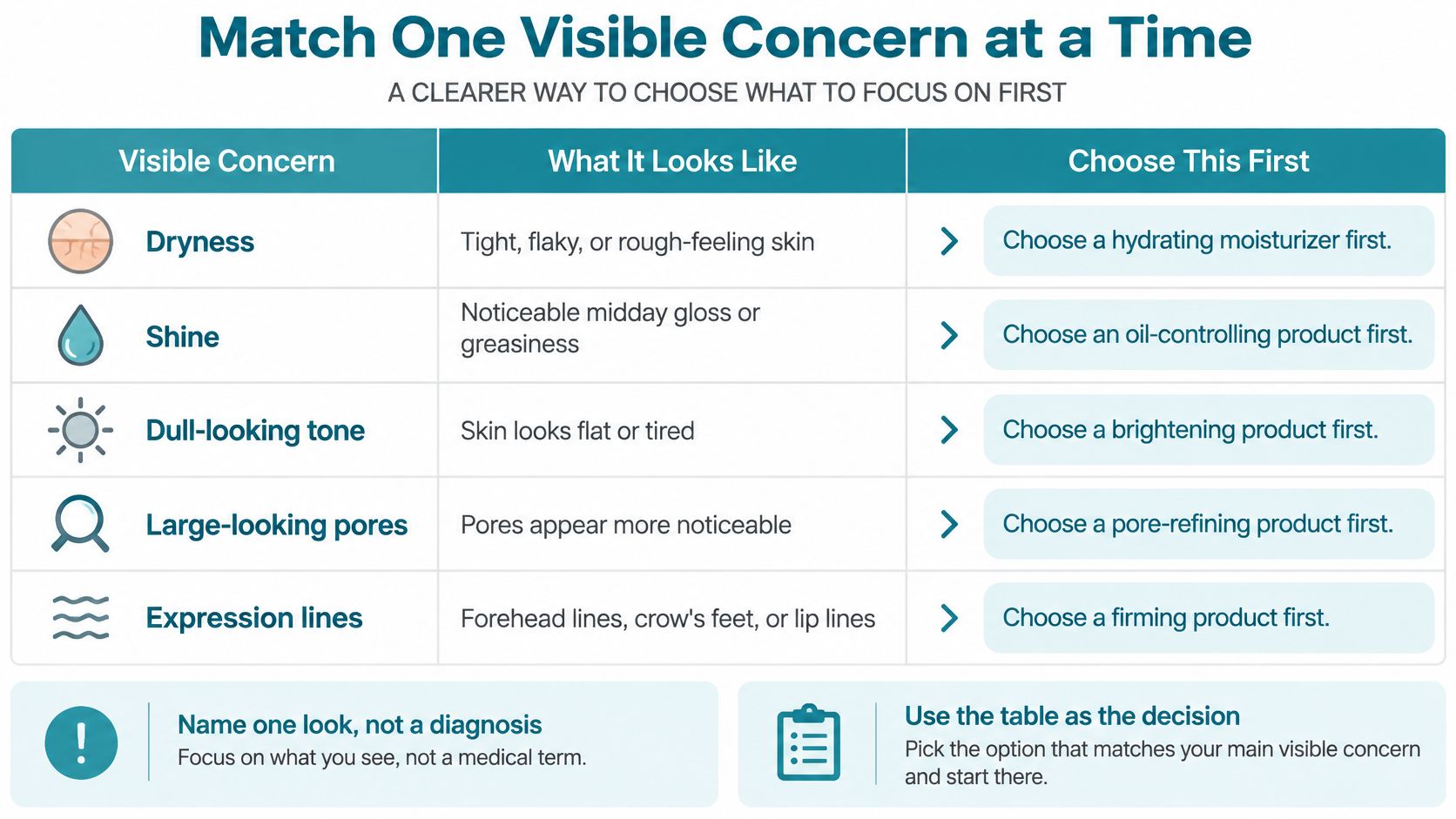
Choose by observation
A mixed pattern can feel contradictory: dry patches ask for comfort while shine asks for less weight. Start with the concern that bothers you most, and let one change prove itself before zoning every part of the face. Our skin analysis guide can help organize what you see into skin type first and the main concern second.
If tightness seems connected to washing, note the cleanser, water temperature, and where it happens. Water Filter Advisor's a homeowner's guide to water-related dryness gives context for considering household water as another variable before blaming the moisturizer.
Personalization has real complexity behind it. A 2025 study in Frontiers in Cellular and Infection Microbiology examined nearly 1,000 Korean participants, identified distinct skin cytotypes, and reported approximately 0.96 AUC for classifying microbiome patterns in a female subgroup. A classification result like that still leaves open whether a microbiome profile should steer shopping or whether changing it improves the look of skin.
Finished products keep the experiment simpler
Choose one row and keep it as your only add-on for the next four weeks. Hydration can look better quickly; changes in lines and firmness take longer, so a calm baseline and consistent use make the result easier to judge. In the pore row, begin with oil-free hydration and save exfoliation for a later test.
Ready-made cosmetics are enough for this approach. Home mixing adds concentration, base compatibility, and preservation variables.
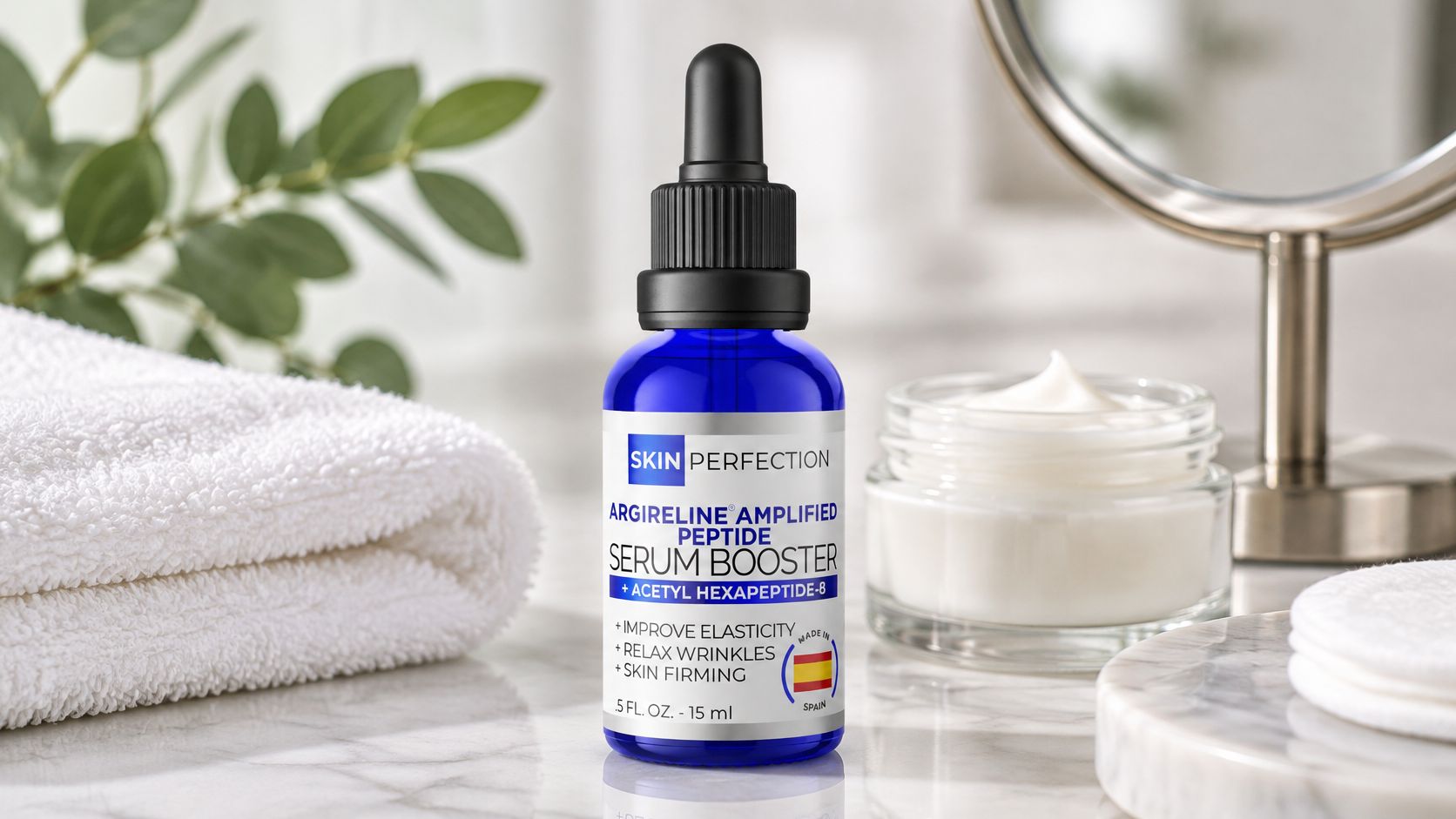
For formulators, Argireline Amplified Peptide Serum Booster is a Serum Booster option for expression-line concerns, meant to be blended into a suitable base according to its directions rather than used straight. A raw ingredient is a different project with its own controls, even when the goal is the same look.
How to Patch Test and Add One Product
A gentle or plant-based label isn't proof a product will suit facial skin, eyelids, or lips. Fragrance and botanical extracts can still cause irritation or allergy, and a product that feels comfortable on your arm may not suit every facial area.
Keep the experiment readable: one new product, everything else stays the same. If you change your cleanser, serum, exfoliant, and fragrance together, you lose the ability to identify the likely culprit when redness appears.
The visual summarizes the process; the detailed method adds the checks that matter.
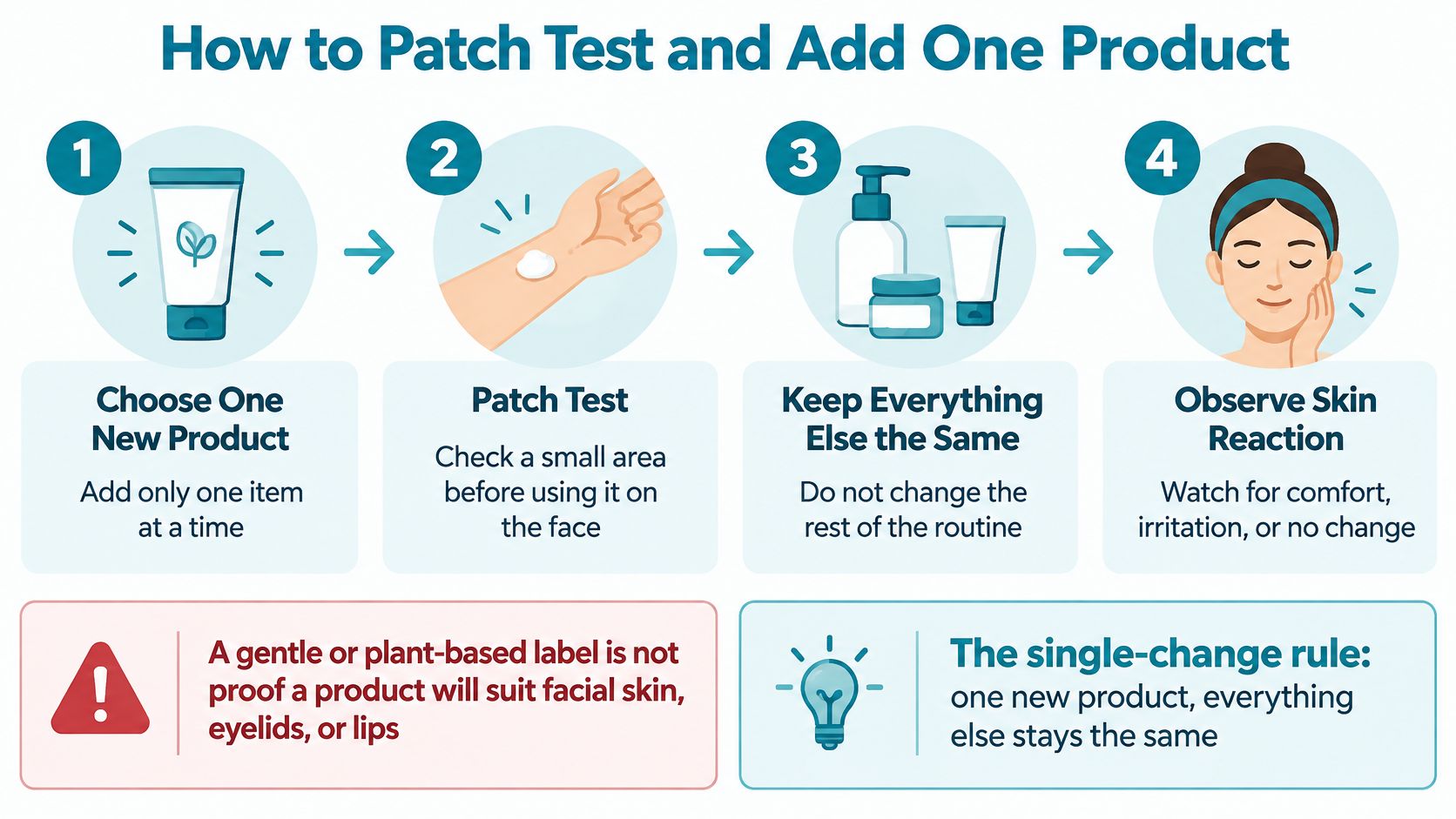
Run a small-area tolerance check
- Read the complete label. Skip ingredients you already know you're allergic to. Check intended application areas, rinse-off directions, and warnings before testing, rather than assuming every facial product belongs near the eyes.
- Test a small area before full-face use. The American Academy of Dermatology's skincare guidance recommends a quarter-sized area, twice daily for 7 to 10 days. Choose an accessible area such as the inner forearm, and use the product as directed; rinse-off products should still be rinsed off.
- Watch for a definite reaction. Lasting redness, burning, rash, swelling, or blisters mean wash it off and stop. Don't keep applying it to see whether your skin will become accustomed to discomfort.
- Move to facial use cautiously. If the test area stays calm, begin at the lowest suggested frequency. Keep the rest of your routine unchanged, and avoid eyelids or lips unless the product is specifically intended for them.
- Record what changed. Use a phone note or notebook for the product name, start date, application frequency, and next-morning appearance. Include comfort, not just whether your complexion looks smoother.
- Allow a fair evaluation period. At Skin Perfection, we advise at least 4 weeks of consistent use for a tolerated product. Hydration can show quickly, while changes in the appearance of lines and firmness take longer; that's not a reason to continue through irritation.
Know what this check cannot tell you
A home tolerance check isn't diagnostic allergy testing. The FDA's information on cosmetic allergens describes clinical testing in which an allergen remains on the skin for 48 hours, followed by physician inspection after 72 to 96 hours. Don't try to recreate that procedure by covering a cosmetic under a bandage unless a clinician directs you.
For a peptide product, our guide on how to use peptide serum helps with placement in the routine. Application order doesn't replace tolerance testing.
A calm test area is permission to proceed cautiously, not a guarantee that every application area will respond identically.
Continue when skin remains comfortable. Slow the schedule if mild dryness develops, and stop if there's a clear reaction. Swelling, blistering, or persistent dermatitis calls for clinical advice, not another product experiment.
Ease in a Night Active Without Overdoing It
A night retinoid or retinol-type cosmetic earns its place only after your baseline and one targeted serum already feel comfortable. The evening routine works like a staircase: you stand on each step until it stops wobbling before reaching for the next one. If your current lineup already addresses your main concern, skipping this step is a valid outcome, and a shorter routine is often easier to read when something goes wrong.
The research supports that patience. The AAD's retinoid and retinol guidance recommends a gradual introduction, and the published literature broadly agrees: irritation with cosmetic-strength formulas tends to be mild, peaks in the first weeks, and eases as skin adapts. Studies of prescription tretinoin report local reactions more often, which is one reason a prescription schedule should never be copied onto a gentler over-the-counter product.
This timeline emphasizes the choice to start gradually rather than force a new active into every evening.
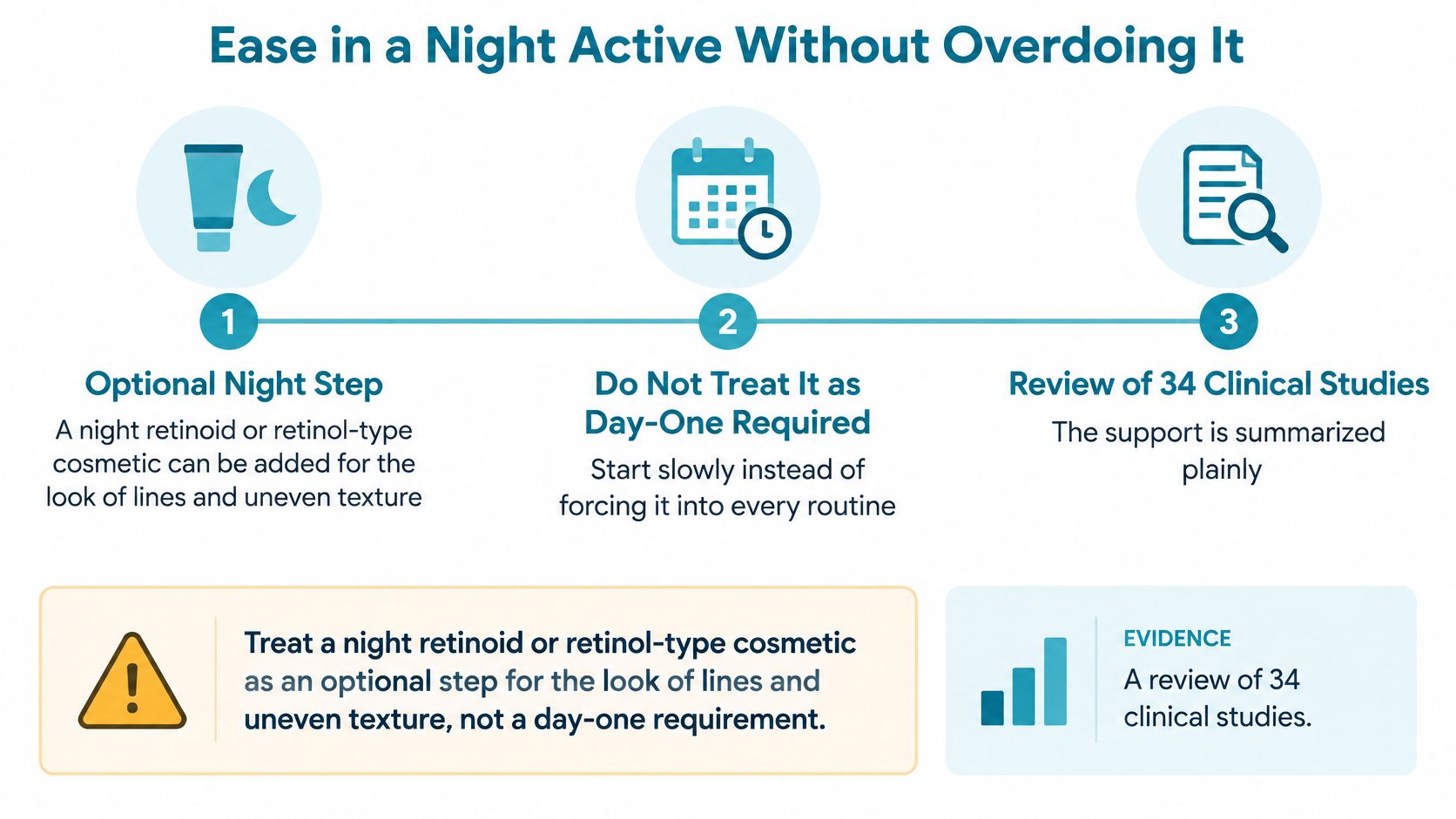
Let comfort set the pace
- Begin after cleansing, on alternate nights. A cautious starting schedule is every other night for the first 2 to 4 weeks. If the label or your clinician specifies a slower introduction, follow that schedule instead.
- Increase only when the current schedule stays comfortable. Peeling, redness, dryness, and stinging should be controlled before you add nights. Persistent discomfort means pausing or cutting back; reaching a stronger percentage by enduring irritation works against the goal.
- Buffer sensitive skin with moisturizer. Apply moisturizer right after cleansing, wait 20 to 30 minutes, then use a pea-sized amount of the active across the face, unless its directions specify otherwise. Keep it away from eye corners, nostril creases, and lips.
Maintain daytime SPF 30 or higher because these products can increase sun sensitivity. Keep exfoliating acids, benzoyl peroxide, and other concentrated actives out of this introduction. Each extra irritant you add makes it harder to tell which product caused a reaction, and that guesswork is exactly what one controlled change is meant to prevent.
Compare formulas rather than marketing names
A name containing bio retinol doesn't establish that a formula contains retinol or behaves like a topical retinoid. If you're comparing options such as Wallaby Wellness bio retinol serum, read the ingredient list and application directions before deciding where it fits. Applying a retinoid schedule to a differently formulated cosmetic assumes an equivalence the label may not support.
Our guide to combining retinol and peptides safely at home offers layering context for later. Starting both in the same fortnight still makes tolerance harder to assess, so sequence them.
Pregnancy, significant eczema or rosacea, or irritation that won't settle warrants clinician guidance before starting or increasing a retinoid. If you're pregnant, a gentler-sounding product name is no substitute for that conversation.
Shorten the Routine When Skin Feels Reactive
Only 12.5% of respondents in a 2025 survey of Dutch dermatologists and dermatology residents actively recommended structured multi-step skincare routines. That figure challenges the assumption that personalization requires more layers.
When skin burns, feels tight, flakes, or develops sudden breakouts, every extra product adds background noise to the experiment. A new formula used on already uncomfortable skin becomes harder to evaluate because irritation can hide whether the product itself was a poor fit.
Use a subtraction checklist
- Keep the baseline. Use a gentle cleanser, moisturizer, and daytime sunscreen that you already tolerate.
- Pause likely irritants. Set aside exfoliants, scrubs, fragrance, essential oils, and other concentrated actives.
- Keep a prescription plan unchanged. If a clinician has prescribed a product, ask about cosmetic compatibility before changing that treatment.
- Leave the slot empty. If you stop a serum, give skin time to settle before introducing another targeted product.
Natural ingredients can still irritate. A fragrant plant extract may sting, and replacing one synthetic-sounding ingredient with several botanical oils can widen the list of potential triggers.
A bottle can stay on the shelf while you reassess. You do not need to keep using an ingredient just because you bought it for a particular cosmetic goal.
Separate a pause from a medical concern
Mild next-day pinkness that fades after stopping a product calls for restraint and observation. Swelling, blistering, a spreading rash, or persistent symptoms need clinical assessment. Seek urgent help for breathing difficulty or swelling involving the mouth or throat.
Once skin has stayed comfortable for roughly 7 to 14 quiet days, consider reintroducing one paused item at its earlier low frequency, then observe for another week. Use that window for cautious planning, and skip retrying any product that caused a definite allergic-type reaction.
Our guide to caring for the skin barrier offers context for simplifying cleansing and moisturizing. Persistent discomfort still needs individual assessment.
Prebiotic and postbiotic labels do not tell you how your skin will respond. If a product marketed for the skin microbiome stings, treat it with the same caution as any other irritating formula.
If skin feels worse, subtract before you substitute.
A shorter routine is still customization: you are choosing products according to what your skin currently tolerates.
Set Your Next Four Weeks
A routine card works like a recipe card: it fixes what you are using, how often, and what you will check before touching anything else. Fill yours in while the baseline is still the only thing on your face, so every later observation has a fixed point of comparison. The dates only start counting once your add-on has passed its small-area test; if testing runs long, slide the whole schedule rather than squeezing the test short.
Copy your routine card
Routine card
| Week | Products | Frequency | Reassessment prompt |
|---|---|---|---|
| Week 1 | Gentle cleanser, moisturizer, SPF 30 or higher | Cleanser and moisturizer morning and evening, SPF in daytime only | Does skin feel calm, with no burning or tightness? |
| Week 2 | Add one patch-tested product | Tested low frequency | Any redness or stinging after use? |
| Weeks 3 and 4 | Same product, same frequency | Keep the add-on steady; plan sunscreen reapplication for outdoor time, driving, workouts, and swimming | Does the morning-after look stay calm? |
| Week 5 onward | Consider one second active | Only after the first product's rows are all answered comfortably | What visibly improved, what stayed the same, and what felt different? |
Write one line above the card describing the look you want to change, such as rough-looking cheeks or forehead lines, so every reassessment judges the same target. A quiet answer still counts as an answer. Hydration and comfort tend to show first, while changes in the look of lines and firmness take longer to read, so weigh early weeks mainly by how skin feels.
Adjust the baseline when life changes
- During winter dryness, choose a richer moisturizer where needed and keep cleansing gentle. Noticeable flakes do not automatically call for more exfoliation.
- For summer or vacation, organize sunscreen access around outdoor exposure, water, and sweating. Keep your cosmetic add-on steady rather than testing something new while traveling.
- During pregnancy or after a new prescription, pause the optional add-on and check suitability with your clinician before restarting.
- After a sensitivity change, note what shifted first, such as weather, a new medication, or a different product, and rebuild around what skin still tolerates.
Our Facial Care Solutions finder works in two steps: identify your skin type, then choose the concern that bothers you most. Use it to narrow the field. A category match points you toward options without promising that every formula in that category will suit you.
Customization can also include anti-aging peptides through our Serum Boosters, though formulation is a separate decision from routine planning. You can aim for a smoother, more comfortable-looking complexion without mixing anything at home.
Skin Perfection offers skincare products that beautify the skin, along with lotion-making supplies and Serum Boosters for customers who formulate their own cosmetics. Visit Skin Perfection to choose a simple baseline or explore an ingredient for your single next change, then put it on your routine card before adding anything else.