

 Buy with Prime


You wash your face after a long day and feel that familiar pull almost immediately. A new serum stings across your cheeks, your moisturizer seems to disappear, and foundation pills over patches that weren't visible that morning. Maybe the change followed a week of exfoliation, a colder spell, or one product added with optimistic expectations.
That pattern points to more than ordinary dryness. Skin barrier repair is best understood as restoring a working structure, not collecting as many soothing-sounding ingredients as possible. The barrier affects how well skin holds water, tolerates products, and responds to its surroundings. It can also be assessed objectively through transepidermal water loss, or TEWL, a direct indicator of barrier integrity. A systematic review found that TEWL varies substantially by body site, from 2.3 g/m²/h on breast skin to 44.0 g/m²/h in the axilla in its review of healthy adults.
This guide follows the same logic a thoughtful formulator would use: understand the structure, identify the disruption, choose ingredients by function, and build a routine that gives the skin fewer reasons to react.
Table of Contents
- When Your Skin Starts Talking Back
- The Architecture of a Healthy Barrier
- What Actually Weakens the Barrier Day to Day
- The Ingredient Families That Rebuild the Wall
- Occlusives, Humectants, and Emollients Compared
- A Practical Barrier Repair Routine
- Do You Need Ceramides or Just a Good Moisturizer
- Timelines, Prevention, and a Return-To-Routine Checklist
When Your Skin Starts Talking Back
Maya's routine seemed sensible. She cleansed, used an exfoliating acid, applied a retinoid on alternate evenings, then added a brightening serum when her complexion looked uneven. After the weather turned cold, the pattern changed. Within days, cleansing left her face taut, the hydrating serum prickled, and makeup gathered around rough areas near her nose and cheeks.
Her instinct was to add more products. That made the cause harder to identify. A formula that once felt comfortable could now sting because the surface had become less tolerant, even if the formula itself had not changed.
The signals beneath the surface
The skin barrier is the outer protective system linked to the stratum corneum. It helps slow water loss and limits the movement of external irritants into the skin. When the epidermis is disrupted, transepidermal water loss, or TEWL, increases. Researchers therefore use TEWL as a quantitative way to track barrier changes over time, as PubMed describes TEWL as a measurement that increases when the epidermis is disrupted.
A stressed barrier may also involve altered surface pH and greater reactivity. Familiar products can sting, skin can feel tight soon after washing, and roughness may appear beneath a shiny finish. These signs do not identify one cause by themselves. Together, they suggest examining the routine before adding another strong treatment.
Practical rule: If several previously comfortable products suddenly sting, reduce the number of variables before increasing the number of ingredients.
Start with a short investigation. Did exfoliation become too frequent? Did the cleanser leave the skin squeaky? Did wind, low humidity, friction, or a procedure add stress? The answers help separate a likely barrier problem from ordinary dryness or irritation caused by one product.
Once the trigger is clearer, care becomes measurable rather than trend-led. Track comfort after cleansing, stinging during application, visible roughness, and how quickly tightness returns. Then adjust lipid organization, water management, pH awareness, and consistent protection one change at a time.
The Architecture of a Healthy Barrier
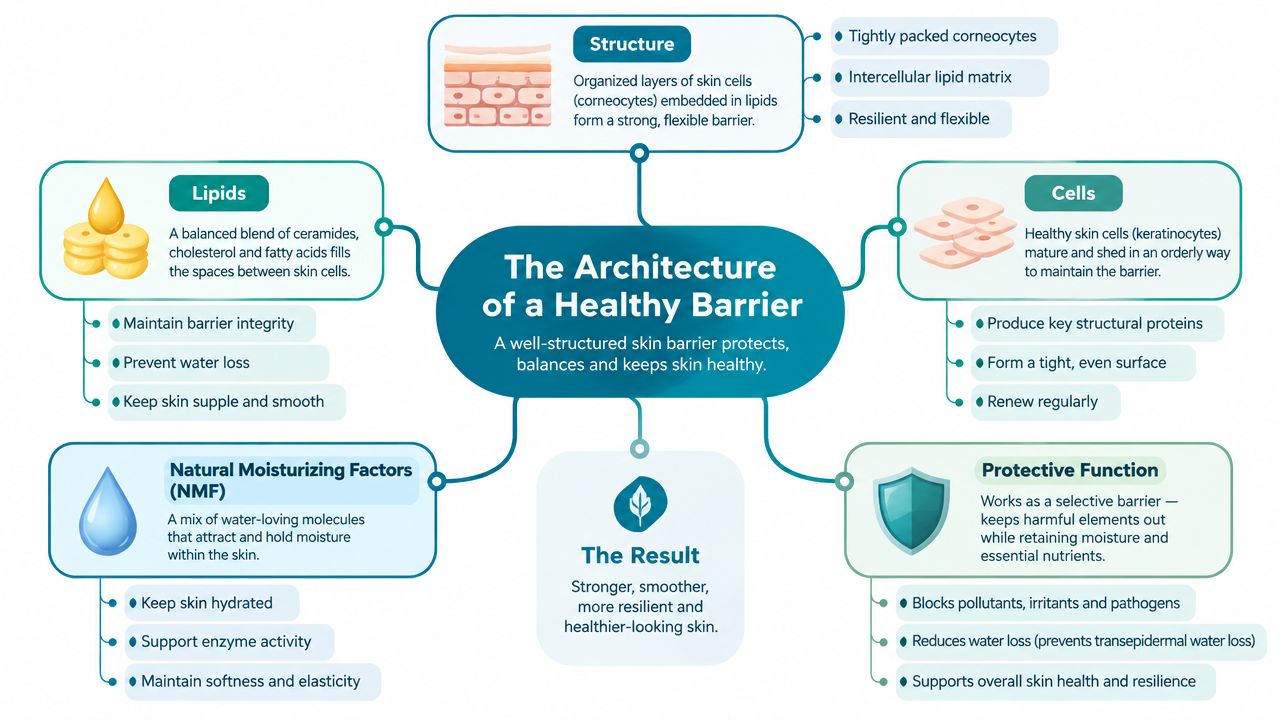
A healthy stratum corneum works like a carefully arranged wall. Flattened corneocytes provide the bricks, while ceramides, cholesterol, and free fatty acids form the mortar between them. The wall is selectively permeable rather than sealed: it allows controlled water exchange while limiting excessive loss and contact with irritants. Its organization, not its thickness, determines how well it performs.
Inside the corneocytes, natural moisturizing factor holds water-attracting substances that support flexibility. The surrounding lipid layers slow evaporation, helping the surface remain comfortable and pliable. When both parts are working together, skin is less likely to feel tight and products are less likely to produce a sharp sting.
Why the mortar needs balance
The extracellular matrix depends on several lipid types working in proportion. Ceramides help create an organized lipid structure, cholesterol supports flexibility, and free fatty acids contribute to lamellar packing. Adding a large amount of one fashionable ingredient cannot reproduce the full arrangement. For a formulator, lipid ratio and structure matter more than an impressive ingredient list.
The stratum corneum has a mildly acidic surface environment, often described as approximately pH 4.5 to 5.5, as noted in formulation guidance on stratum corneum pH. pH is one design variable because it affects how a leave-on formula behaves on the skin. A rich texture can reduce the feeling of dryness, yet the complete formula may still sting if its acidity, preservatives, solvents, or active ingredients are poorly suited to a sensitized surface.
Hydration isn't the whole structure
A humectant draws or holds water, an emollient smooths the feel of uneven areas, and an occlusive slows evaporation. Each helps with a different part of the problem. None, by itself, rebuilds the entire barrier. A more durable routine therefore addresses both water content and lipid organization.
For a DIY water phase, Sodium Hyaluronate Powder Pure Hyaluronic Acid is described as a cosmetic-grade, High-Molecular-Weight NASHA powder with a stated molecular weight of 800 to 1500 Daltons. The product is presented for water-based serums at typical concentrations of 0.1% to 2%. It can provide a controllable humectant step, but it is still one component of a formula, not a substitute for the lipid mortar.
What Actually Weakens the Barrier Day to Day
Barrier disruption often comes from accumulation rather than one dramatic mistake. A cleanser may be tolerable alone, exfoliation may be tolerable alone, and a windy commute may be tolerable alone. Together, they can push the surface beyond its comfort zone.
Three kinds of daily stress
Physical stressors increase friction or accelerate water loss. Cold wind and low humidity can leave the surface feeling tight, while hard water and repeated cleansing may make people wash more vigorously to remove residue. Chemical stressors include strong acids, rapidly introduced retinoids, harsh sulfates, and high-pH cleansers. These can disturb surface lipids or move the skin away from its naturally acidic environment.
Biological and lifestyle factors add another layer. Poor sleep, ongoing stress, ultraviolet exposure, and some medications may affect how comfortably skin maintains its outer structure. These influences are individual, so treat them as possible contributors rather than automatic explanations.
| Disrupter Category | Examples | Mechanism of Action | Visible or Sensory Signal |
|---|---|---|---|
| Physical | Cold wind, low humidity, friction, repeated cleansing | Increases water loss or removes surface lipids | Tightness, roughness, flaking |
| Chemical | Strong acids, quickly introduced retinoids, harsh sulfates, high-pH cleansers | Disturbs lipids and surface pH | Stinging, burning, sudden sensitivity |
| Biological and lifestyle | Poor sleep, stress, UV exposure, some medications | Can interfere with cohesion and lipid production | Persistent reactivity, uneven comfort, dryness |
A useful explanation of the measurement itself appears in this guide to transepidermal water loss and barrier function. TEWL is especially helpful because appearance alone can mislead. A glossy surface may still lose water quickly, while a matte surface may contain more visible scaling.
Pollution deserves attention too. A review of environmental and seasonal influences reported that all pollution-focused studies it examined showed increased TEWL in people exposed to particulate matter or nitrogen dioxide the review is available through PMC. You can't control every exposure, but you can reduce avoidable friction, simplify cleansing, and avoid stacking several potentially irritating products in the same routine.
The Ingredient Families That Rebuild the Wall
Ingredient labels become easier to interpret when each family has a defined job. A useful formula doesn't need every category, but it should solve the dominant problem without creating another one.
The structural lipid group
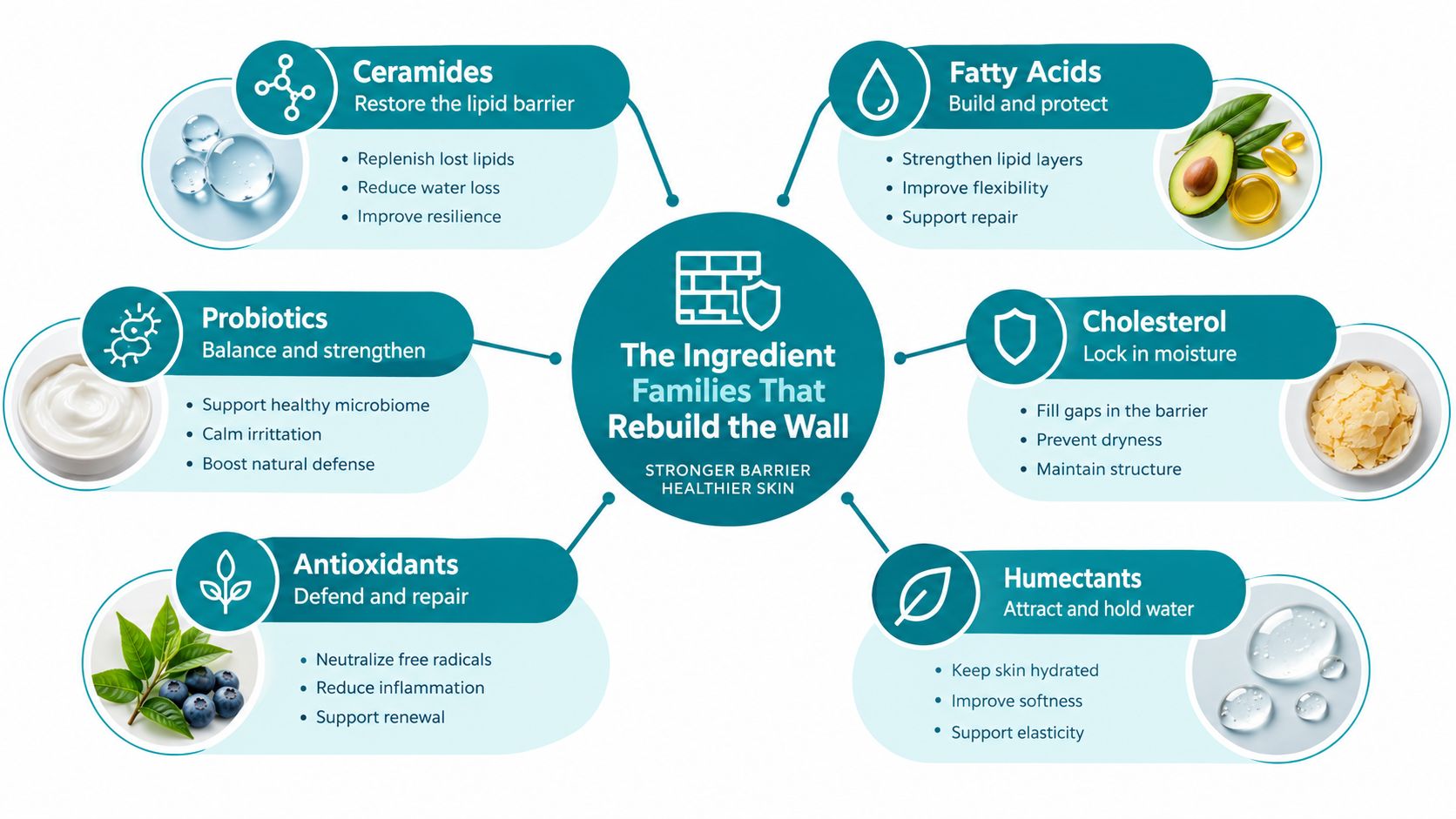
Ceramides belong to the mortar. They work best in a system that also contains cholesterol and free fatty acids, because barrier restoration depends on extracellular lipid organization rather than a lone lipid added for label appeal. Classic barrier-repair experiments found that an equimolar mixture restored normal recovery, while changing the amount of one component could alter the repair rate. The same research also found that acylceramides alone delayed recovery, whereas certain acylceramide and cholesterol combinations improved it the formulation findings are discussed in Experimental Dermatology.
Cholesterol helps the lipid matrix remain flexible. Free fatty acids, including linoleic, stearic, and palmitic acids, contribute to lamellar packing and support the overall lipid environment. Think of these materials as a coordinated building system, not three unrelated benefits.
The water-management group
Humectants such as glycerin, hyaluronic acid, and panthenol attract water into the epidermal environment. A 2023 review separates moisturizer functions into three mechanisms: occlusives reduce water loss from the surface, humectants draw water into the epidermis, and emollients integrate into the stratum corneum to improve its physical feel and cohesion PubMed summarizes these mechanisms.
Niacinamide fits into a broader support strategy. It can support ceramide synthesis and help moderate signaling associated with irritation, but it isn't a drug and shouldn't be presented as one. Peptides, including palmitoyl tripeptide-5 and copper peptides, are used as signaling ingredients in cosmetic formulations. Their role is to provide cues within a formula, not to promise medical treatment.
A topical lipid system won't permanently fuse into living cell membranes. It can temporarily reseal the surface and improve the water balance that gives deeper skin layers a more stable environment. For skin exposed to a procedure, a carefully staged resource such as this post-laser barrier care routine can help you think about product timing and simplicity without treating cosmetics as medical care. For humectant-focused formulation ideas, see natural humectants for skin.
Occlusives, Humectants, and Emollients Compared
Moisturizers are often discussed as though they all do the same thing. They don't. Occlusives reduce evaporation, humectants attract water, and emollients soften and fill uneven spaces in the outer surface. A formula can use one mechanism or combine all three.
| Mechanism | Primary Job | Example Ingredients | Feel on Skin | Best Climate |
|---|---|---|---|---|
| Occlusive | Slow water escaping from the surface | Petrolatum, dimethicone, squalane, beeswax | Sealed, from light to heavy | Especially useful in dry conditions |
| Humectant | Attract water into the epidermal environment | Glycerin, hyaluronic acid, sodium PCA | Damp, cushiony, sometimes tacky | Flexible, but benefits from a supporting seal |
| Emollient | Smooth rough areas and soften the surface | Shea butter, fatty alcohols, esters | Creamy, silky, conditioning | Useful across climates, adjusted by texture |
Why layering can make sense
Apply the lightest water-rich layer first, then the product that supplies softness, and finish with a surface seal if your skin tolerates it. For example, a glycerin or hyaluronic acid layer can add water attraction, a cream containing emollients can reduce rough feel, and a small amount of an occlusive can slow evaporation.
In a humid climate, a heavy occlusive may feel unnecessary, while a humectant and light emollient can be comfortable. In dry indoor air, humectants may work better when paired with an occlusive, because attracting water without limiting evaporation can leave the surface feeling tight for some people. The right balance depends on the formula, the climate, and your skin's response.
A natural formulation perspective on softening oils, butters, and esters is available in this guide to natural emollients for skin. The key is to judge the finished product, not the ingredient category in isolation. A well-preserved lotion with modest occlusion may be more comfortable and consistent than a greasy product applied too heavily.
A Practical Barrier Repair Routine
A reactive morning often reveals the problem clearly: water stings, cleanser leaves tightness, and several products create more confusion than comfort. Reduce the routine to a few products with distinct jobs, then keep the order steady while you observe your skin.
Morning structure
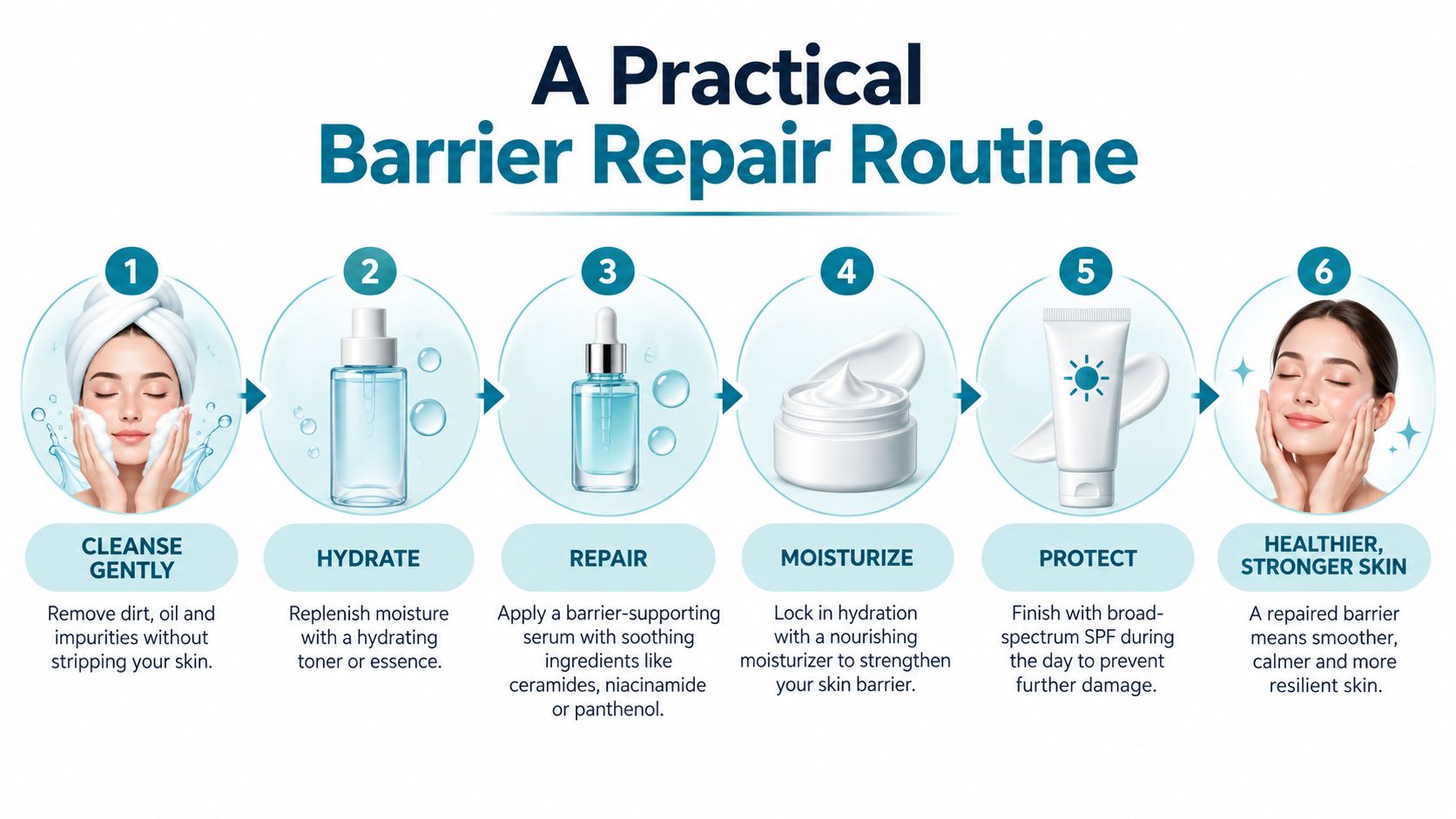
- Cleanse gently. Use lukewarm water if that feels sufficient. Otherwise, choose a low-pH cleanser that removes residue without a tight finish.
- Add water. Apply a humectant-rich toner, essence, or serum to slightly damp skin.
- Support the surface. Use a moisturizer or serum with ceramides. Cholesterol and fatty acids indicate a formula designed around a broader lipid system, though the finished formula still matters more than the label.
- Limit ultraviolet exposure. Apply a broad-spectrum mineral sunscreen labeled SPF 30 or higher.
- Add an optional finish. A silicone primer can smooth the surface and provide light occlusion when makeup is part of your routine, provided it does not sting.
Apply products from thinner to thicker textures. With several leave-on layers, waiting about 60 seconds between applications can reduce pilling and give you time to assess comfort. A leave-on formula near pH 5.5 is a reasonable target within the skin's commonly discussed acidic range, as noted earlier. pH supports the barrier environment, but it cannot compensate for an unbalanced lipid system or an irritating formula.
Evening structure
Use a cream or milk cleanser if foaming products leave your face tight. Repeat the humectant step, apply a moisturizer containing ceramides, cholesterol, and fatty acids, then add a thin occlusive layer to damp areas that still feel dry. Adjust the amount by climate and skin response. More product is not automatically better.
During a flare-up, pause acids, retinoids, vitamin C, fragrance, and harsh surfactants. Keep new-product testing out of the repair phase. If flaking is the main concern, the guide to the best moisturizer for flaky face offers product-selection considerations, but persistent scaling still warrants attention to possible underlying conditions.
Reintroducing actives
Wait until stinging and visible redness have resolved before restoring active products. Follow a four-week escalation approach: introduce one active at low frequency while leaving the rest of the routine unchanged. If discomfort returns, remove the newest addition instead of layering on another soothing product. For further hydration planning, see these skin care routines for hydration.
Do You Need Ceramides or Just a Good Moisturizer
The honest answer is that not everyone needs a dedicated ceramide product. Ceramide-containing regimens have shown measurable improvements in barrier-impaired skin, including lower TEWL and increased hydration in randomized testing, while a systematic review also summarized improvements in dry skin and barrier function among people with atopic dermatitis the clinical evidence is reviewed in PMC.
That evidence doesn't prove that every expensive ceramide serum will outperform a basic moisturizer. In one trial, the ceramide-dominant routine also contained multiple lipids and other active materials, so the isolated contribution of ceramides was difficult to determine. A separate review notes that undissolved ceramides can have counterproductive effects in formulation models, which makes delivery, dispersion, preservation, and stability as important as the ingredient name.
| Factor | Ceramide-blend product | Standard moisturizer |
|---|---|---|
| Main design | Recreates part of the lipid environment | Usually combines hydration, softening, and surface sealing |
| Potential value | Useful when lipid support is a priority | May provide comfortable everyday support with fewer ingredients |
| What to inspect | Ceramides alongside cholesterol and fatty acids | Humectants, emollients, occlusives, fragrance profile, pH |
| Main limitation | A ceramide label doesn't guarantee balanced delivery | May not target lipid organization as directly |
A simple petrolatum-based product can provide strong short-term occlusion without the cost or complexity of a specialized lipid blend. Conversely, a balanced lipid formula may be more appealing for chronic dryness, post-procedure cosmetic care, or skin that repeatedly struggles with tolerance. The finished formula and your response matter more than prestige.
DIY formulators can recreate the concept of a balanced lipid system, but that doesn't make home formulation low-risk. Preservative selection, pH control, heating, dispersion, packaging, and stability testing all matter. For a broader comparison of everyday options, consult this guide to the best natural moisturizer for dry skin.
Timelines, Prevention, and a Return-To-Routine Checklist
Barrier care rewards consistency, but the visible and measurable changes don't all happen on the same schedule. Acute irritation may settle over 48 to 72 hours with simplified care, while hydration and stinging can take one to two weeks to normalize. More measurable changes in TEWL and lipid organization may require four to six weeks, and chronically reactive skin can need three to six months to develop greater structural resilience. These are practical planning windows, not guarantees, and persistent symptoms deserve professional assessment.
Habits that protect the result
Use lukewarm water, keep surfactant contact brief, and choose a cleanser formulated near the skin's acidic range. Apply broad-spectrum sunscreen daily, and adjust the richness of your moisturizer when humidity drops. Treat friction as an ingredient too. A rough towel, repeated rubbing, or aggressive makeup removal can undermine an otherwise thoughtful formula.
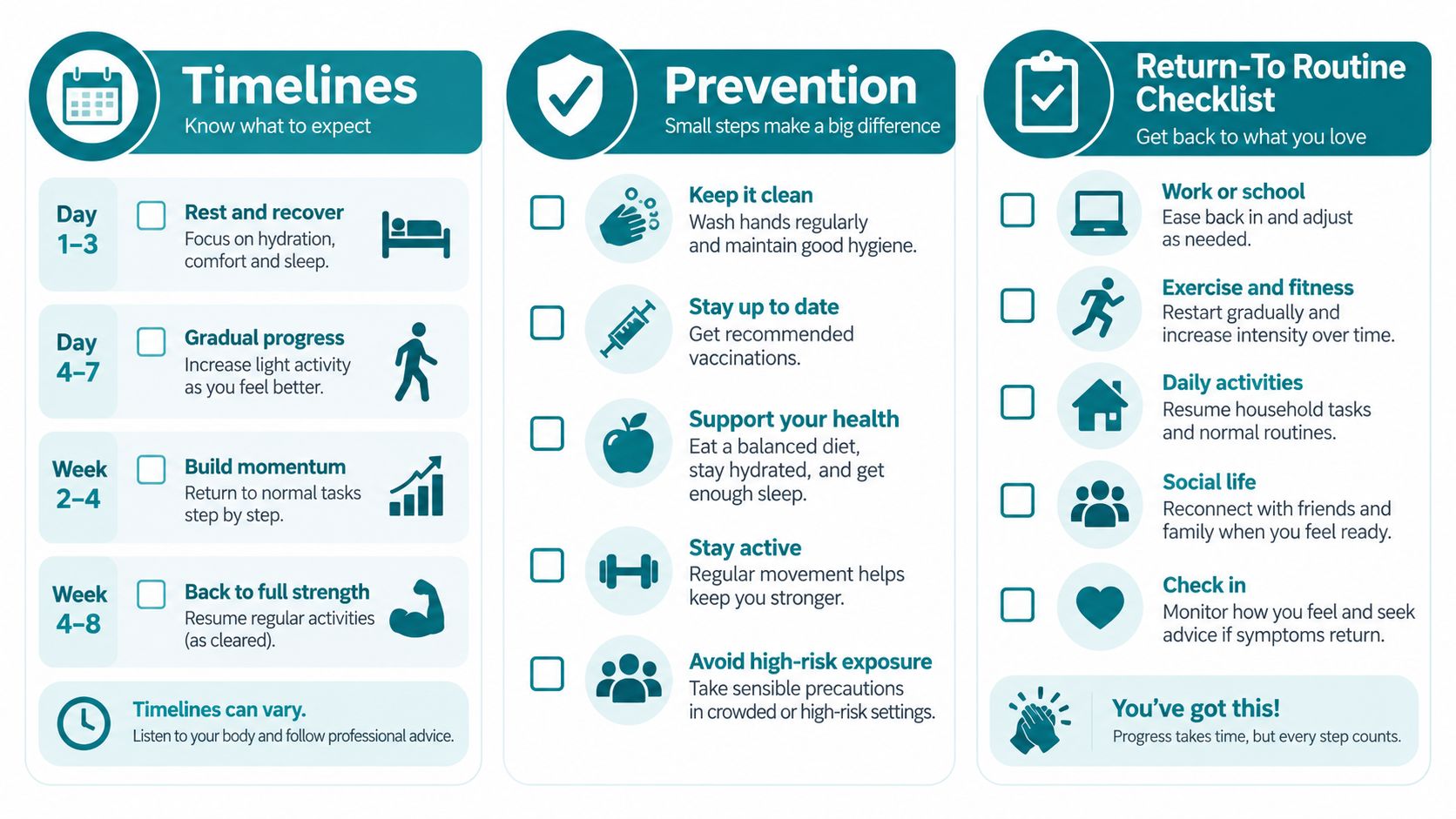
A return-to-routine checklist
Look for these six signs before progressing:
- Comfort: Cleansing no longer leaves a persistent tight pull.
- Tolerance: Basic moisturizer doesn't sting on application.
- Surface: Flaking and rough patches are settling.
- Color: Visible redness is no longer increasing.
- Hydration: Skin stays comfortable between applications.
- Consistency: Your response is stable across several days.
Reintroduce products in four steps:
- Choose one active. Don't restart acids, retinoids, and vitamin C together.
- Use it sparingly. Keep the rest of the routine unchanged.
- Observe the response. Watch for renewed stinging, redness, or scaling.
- Pause when needed. Return to the simple routine if symptoms recur.
Seek a dermatologist's advice if symptoms persist or worsen despite simplified care, if you notice weeping, unusual swelling, or crusting, or if you develop a severe reaction such as hives or breathing difficulty. Cosmetic routines have limits, and a recurring problem may need a diagnosis rather than another product.
When your skin feels off, return to this commitment: protect the surface, add only what has a clear job, and give consistency time to work.
Skin Perfection offers skincare products and lotion-making supplies for people who want to build appearance-focused routines or develop their own cosmetic formulas, including hydration-focused ingredients for DIY work. Visit Skin Perfection to explore ready-made skincare and formulation supplies, then choose products based on barrier-friendly function, transparent ingredients, and your skin's current tolerance.