

 Buy with Prime



“Natural” is often treated as a shortcut for “gentle,” “safe,” and “effective.” That shortcut can mislead. Plant based skincare ingredients range from familiar oils to chemically complex extracts, and their effects depend on what's in the finished formula, not where an ingredient came from.
A more useful way to shop is to ask what evidence supports a claim, what result was measured, and whether that evidence applies to the product in your hand. Here's a formulator's guide to reading plant-based labels with curiosity, not assumptions.
Table of Contents
- Why Natural Does Not Automatically Mean Safer
- The Major Categories of Plant Based Skincare Ingredients
- What the Clinical Evidence Shows
- Polyphenols and Photoprotection in Real Routines
- Pairing Botanicals With Peptides and Stem Cells
- Choosing Plant Based Ingredients for Your Skin Type
- Clean Beauty Claims and What Regulators Require
- A Reader's Proof Hierarchy for Plant Based Skincare
Why Natural Does Not Automatically Mean Safer
A botanical extract isn't one uniform substance. Its composition can shift with the plant species, growing conditions, harvest, extraction method, and storage. Two products that name the same plant may therefore contain ingredients with different chemical profiles and behave differently on skin.
Coffee makes the variability easier to picture. The same beans can taste quite different depending on how they're grown, processed, and roasted. Plant extracts have their own version of that variation, except the relevant differences involve their chemical makeup and how they perform in a formula.
This matters for safety as well as results. Essential oils can cause adverse reactions even though they're generally tolerated at low concentrations. A 2025 systematic review found promising clinical results for essential-oil skincare, while emphasizing that longer and larger human trials are still needed to establish safety and efficacy (review of essential-oil skincare). “Plant-derived” tells you something about an ingredient's origin. It doesn't, by itself, tell you its concentration, consistency, suitability for your skin, or strength of evidence.
A label is a starting point, not the whole story
Look beyond a plant name. A useful product description identifies the ingredient clearly and gives enough context to understand its role in the formula. If a brand makes a specific result sound certain but doesn't explain the extract, formulation, or evidence behind it, treat the promise cautiously.
That same discipline guides the rest of the discussion: separate the ingredient's identity from the proof for a particular outcome. Lab findings, human trials, and finished-product testing answer different questions. The word “natural” answers none of them on its own.
The Major Categories of Plant Based Skincare Ingredients
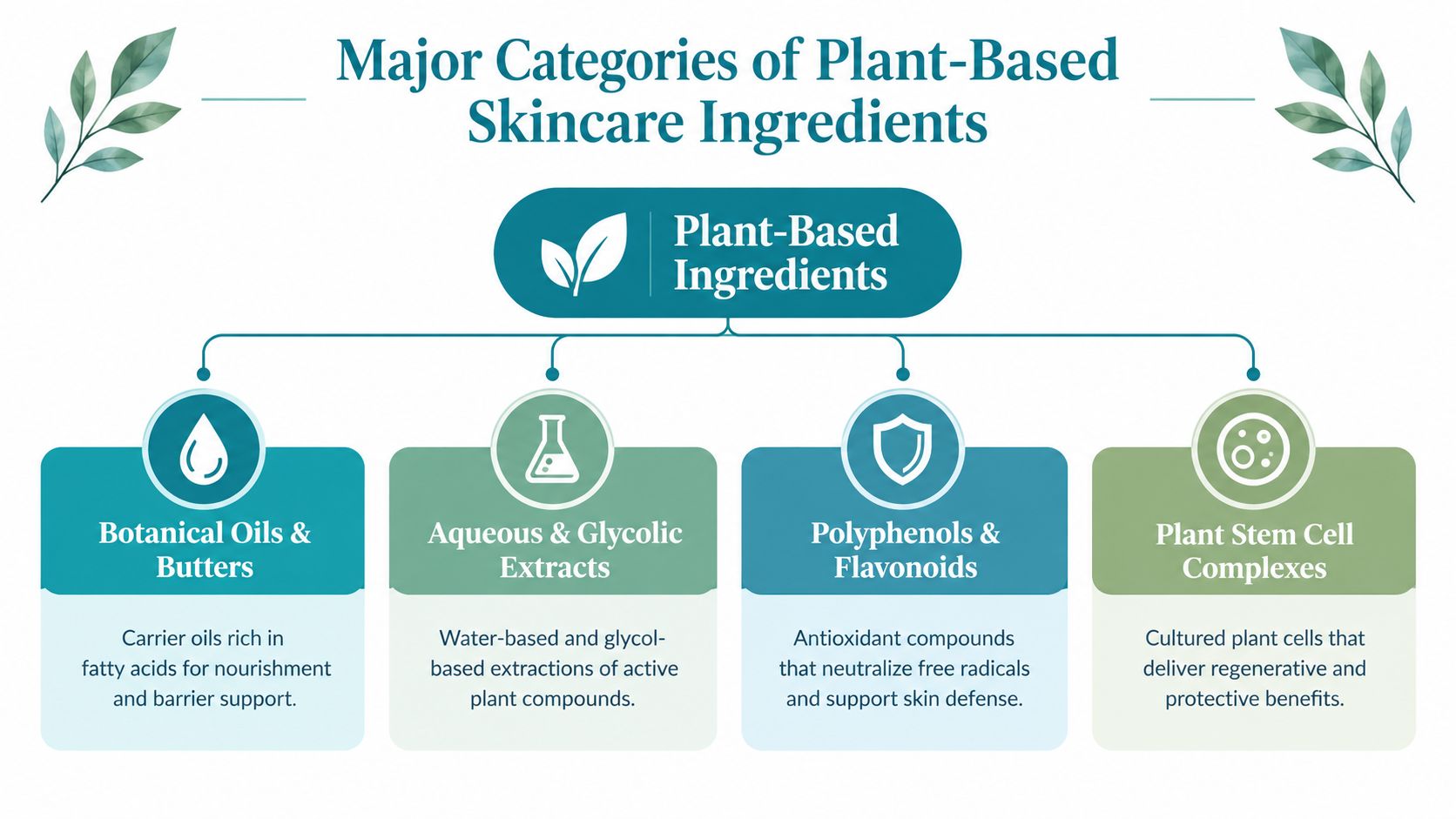
A plant-based label is easier to read when you sort ingredients into families. Think of a kitchen pantry: oils and butters are the rich ingredients, water-based extracts are more like infusions, and antioxidant compounds are a specialized tool rather than a whole-food category.
The main ingredient families
Botanical oils and butters include plant-derived oils and richer materials used to soften skin and give a product a more nourishing feel. Their fatty-acid profiles differ, so “plant oil” isn't a single performance category. The product's texture and formula matter too.
Aqueous and glycolic extracts are plant materials extracted into water or a glycol-based solvent. Think of them as infusions made for a particular formula. Aloe vera and green tea are familiar examples, though the plant name alone doesn't tell you which compounds the extract contains or how concentrated it is.
Polyphenols and flavonoids are families of compounds found in plants. Green-tea polyphenols and grape-seed compounds, for example, are of interest for antioxidant support. In plain language, they're more like selected tools in a toolbox than a whole plant in a bottle.
Plant stem cell complexes use cultured plant cells or related materials in cosmetic formulas. The phrase can sound more precise than it is, so check what the product names and what outcome it claims. Don't assume it means human stem cells or a proven effect on skin.
Why the category has grown
Plant-based cosmetic ingredients have roots in antiquity, while their modern commercial importance accelerated during the early 1990s. Concerns about bovine spongiform encephalopathy helped encourage a move away from some raw animal-derived materials and toward botanical oils, extracts, and polyphenols (history of plant-derived cosmetic ingredients).
That history explains why plants are now used for varied cosmetic purposes, from moisturization to appearance-focused care. It doesn't make every plant ingredient interchangeable: a soothing-feeling oil and an antioxidant-rich extract have different jobs, and neither category guarantees a particular result.
What the Clinical Evidence Shows
A promising laboratory result is a starting point, not proof that a botanical cream will improve your skin. Human trials test that next step, but their findings apply to the formulations studied and the outcomes measured. A plant name on a label cannot carry all that evidence by itself.
A 2025 meta-analysis of botanical preparations) covering eight randomized controlled trials found statistically significant improvements in hydration and elasticity, plus reductions in melanin and erythema, or visible redness. It found no statistically significant reduction in transepidermal water loss (TEWL), the water escaping through the skin barrier.
Hydration and TEWL answer different questions. A sponge can hold more water without becoming better at preventing water from escaping. Likewise, improved skin hydration doesn't establish improved barrier performance. Neither does an unchanged TEWL result erase a measured hydration benefit.
A broader 2025 review of plant-containing formulations reported a meta-analysis of 22 clinical trials involving 1,845 participants, with some formulations improving hydration, elasticity, wrinkle measures, pigmentation, and erythema. Aloe vera, green-tea polyphenols, and grape-seed extract showed the most consistent effects. However, many botanical studies remain small, short-term, or based mainly on laboratory experiments.
The evidence is uneven across botanicals.
Match the claim to the endpoint
An endpoint is what researchers measured. These findings from the eight-trial analysis help separate a tested benefit from a broader marketing promise:
| Endpoint | What it measures | Finding in the cited analysis |
|---|---|---|
| Hydration | Water content at the skin surface | Statistically significant improvement |
| Elasticity | Skin stretch and recoil | Statistically significant improvement |
| Melanin | A measure related to pigmentation | Reduction reported |
| Erythema | Visible redness | Reduction reported |
| TEWL | Water escaping through the barrier | No statistically significant overall reduction |
When reading a label, ask whether the supporting study involved people or laboratory samples, whether it tested the finished formula, and whether it measured the advertised benefit. Human evidence for one formulation doesn't establish the same result for every product containing that plant. Ingredient background, such as this guide to calendula in skincare, helps explain a botanical's role; product-specific trials are needed to support product-specific promises.
Polyphenols and Photoprotection in Real Routines
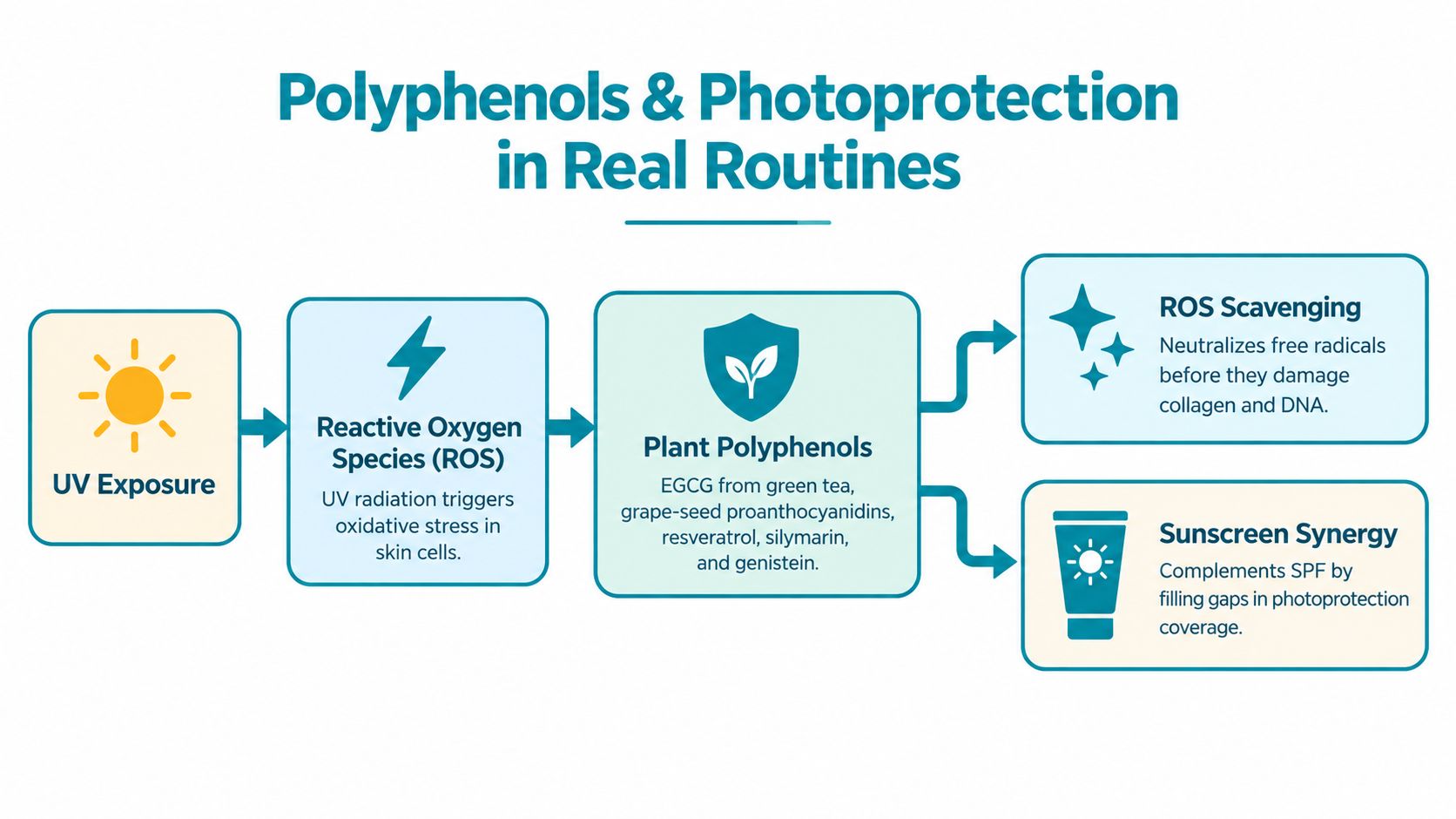
Plant polyphenols can play a supporting role in a routine that already includes sunscreen. They don't replace it. Think of sunscreen as the roof that provides the main cover, while antioxidant-rich skincare is more like an umbrella you carry alongside it.
What the antioxidant role means
Polyphenols include EGCG from green tea, grape-seed proanthocyanidins, resveratrol, silymarin, and genistein. They can support photoprotection through several mechanisms: scavenging UV-generated reactive oxygen species, suppressing inflammatory signaling, and reducing oxidative DNA damage (research on polyphenols and photoprotection).
These mechanisms make polyphenols relevant to appearance-focused anti-aging formulas. They don't establish that every product containing a named extract offers tested protection from sunlight. Performance can depend on concentration, vehicle, oxidation stability, and how well the ingredient penetrates the skin. Findings from cells or animals shouldn't be treated as proof of a finished product's performance.
Routine rule: Use a broad-spectrum sunscreen for sun protection. Treat plant antioxidants as a possible complement, not a substitute.
When comparing products, look for a clearly named extract and a realistic explanation of its role. Formulators need to manage oxygen and light exposure during manufacturing and packaging, then test the finished product using appropriate laboratory or clinical endpoints. For a reader-friendly overview of green tea extract for skin, focus on the named ingredient and the specific cosmetic outcome being discussed.
Pairing Botanicals With Peptides and Stem Cells
Plant actives don't have to compete with peptides or plant stem cell complexes. A well-planned routine can use each as a different instrument in a band: polyphenols bring antioxidant support, peptides have their own role in a formula, and plant stem cell ingredients belong to another category that should be judged by its stated composition and evidence.
The practical question isn't whether an ingredient sounds more advanced than another. It's whether the formula has a clear purpose and whether its claims match the available evidence. Layering a botanical serum with another product can make sense, but adding more ingredients doesn't automatically make a routine more effective.
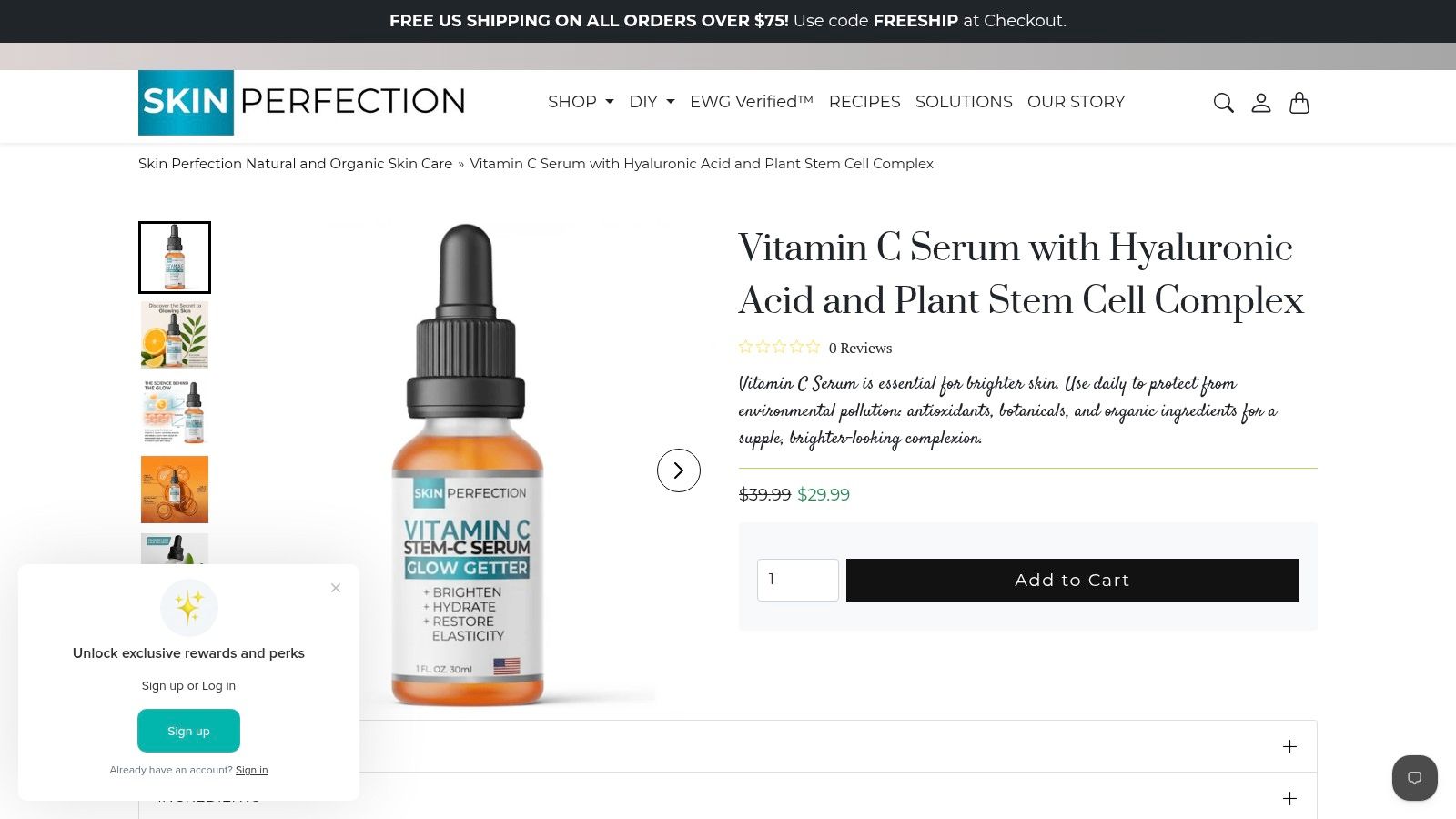
Skin Perfection's Vitamin C Serum with Stem-C Complex is one example of a product pairing a vitamin C formula with a stem-cell complex. That description identifies the combination, but it shouldn't be read as proof of a specific clinical outcome without product-level evidence. Readers curious about how cosmetic stem-cell language differs from medical services can review stem cell therapy at Luxe Aesthetic Surgery for context. The terminology may overlap, but a topical cosmetic and a medical service aren't the same thing.
If you're comparing formats, read what a peptide serum is as a separate ingredient-category question. Then consider how the product fits your routine, what outcome its label claims, and whether you have a reason to use each step.
Choosing Plant Based Ingredients for Your Skin Type
Skin type can help narrow the field, but it can't predict how you'll respond to every botanical. Use it as a starting point, then check the formula, ingredient identity, and your own tolerance.
- For dry or tight-feeling skin: Look at richer botanical oils or butters if you prefer a more emollient texture. A humectant such as sodium hyaluronate can be another option for a hydration-focused formula, though it isn't itself a plant extract.
- For oily or combination skin: Consider lighter-feeling textures rather than assuming every oil will feel the same. Green-tea ingredients may appeal if you're looking for antioxidant support, but don't infer acne treatment from a plant name.
- For mature-looking skin: Aloe vera, green-tea polyphenols, and grape-seed extract have comparatively consistent signals in the clinical evidence described above. Match those signals to the measured outcome, not a broad promise to reverse aging.
Read the ingredient list with sensitive skin in mind
Fragrance constituents such as linalool, limonene, eugenol, and citral can occur naturally in plant ingredients. “Plant-based” and “fragrance-free” therefore aren't interchangeable. If you're sensitive, check the ingredient list and avoid treating a botanical label as a guarantee of low irritation potential.
For a new product, patch test a small area first, follow the product's directions, and watch for an unwanted reaction before applying it more widely. Stop using it if your skin reacts, and seek appropriate professional advice if you're uncertain about a reaction or a persistent concern. A practical introduction to organic skincare for sensitive skin can help you think through those label choices. For people exploring broader approaches to skin appearance, acupuncture for clearer skin offers a separate perspective, not a substitute for evaluating a product's cosmetic evidence.
Custom hydration still needs careful formulation
Sodium hyaluronate powder can be used in custom formulations as a humectant. Mixing a powder into a serum isn't a matter of adding more for a stronger effect: the overall formula, dispersion, texture, and product stability matter. Use cosmetic-grade materials according to supplier directions, and don't assume that a DIY mixture has the same testing or performance evidence as a finished commercial product.
Clean Beauty Claims and What Regulators Require
“FDA approved” on a skincare label deserves scrutiny rather than automatic trust. Cosmetics and cosmetic ingredients generally don't require FDA approval; color additives, other than coal-tar hair dyes, are the principal exception. Facility registration or participation in the Voluntary Cosmetic Registration Program doesn't establish approval either (FDA guidance on cosmetic approval). Registration is an administrative step, not a performance test.
Cosmetic claims still have rules. Under U.S. FDA requirements, labeling and advertising must be truthful and not misleading. Claims that a product treats or prevents disease, or affects the structure or function of the body, including skin, can make it legally a drug (FDA guidance on cosmetic claims). For a botanical product, wording about improving appearance and wording about treating a condition carry different regulatory implications.
When shopping on Etsy, treat disease-treatment promises or claims that skincare can replace medication as red flags: its policies prohibit these claims, even with disclaimers (Etsy medical-claims policy; Etsy prohibited-items policy).
Ask before you buy
A verification mark and a results study answer different questions. EWG Verified may signal ingredient transparency, but it doesn't establish that a formula delivers a particular cosmetic result. A label is a promise, not the experiment that tests it. Ask:
- What exact outcome is promised, and was that outcome measured?
- Does the evidence concern this finished formula or only a named ingredient?
- Is the claim about cosmetic appearance, or does it imply treatment of a condition or bodily function?
Human testing can support a measured cosmetic outcome; laboratory findings alone don't establish that shoppers will see that result.
Skin Perfection follows FDA and Etsy rules in its product listings. Its products are intended to beautify skin, and its listing language doesn't claim they fix, repair, or heal skin. For background on cosmetic regulations, examine the wording of the promise separately from the evidence offered to support it.
A Reader's Proof Hierarchy for Plant Based Skincare
A promising laboratory result is a starting point, like a recipe that still needs testing in a kitchen. Follow the evidence toward the formula:
- Ingredient identity and standardization: Is the plant and extract clearly identified?
- Laboratory evidence: Is an effect plausible under controlled conditions? This supports a hypothesis, not a visible skin result.
- Human trials: Have people used the ingredient or formula, and what changed?
- Randomized controlled trials with measured endpoints: What improved compared with the control, and what did not?
- Finished-product testing: Does evidence apply to the product you will use?
These questions separate biological promise from demonstrated cosmetic benefit.
Botanicals can support hydration, antioxidant activity, and skin appearance, but evidence for one extract cannot establish benefits for every botanical formula. The review of plant-containing formulations reported cosmetic improvements while noting limitations including small, short-term, or laboratory-based studies.
Before buying, match the named extract to the measured outcome and finished formula. Keep cosmetic claims separate from medical promises.
Skin Perfection offers skincare products, lotions, and lotion-making supplies featuring plant-derived ingredients alongside peptides and stem cell complexes. Browse Skin Perfection for finished products and custom-formulation ingredients.