

 Buy with Prime



You're standing in front of the bathroom mirror after cleansing, and your face feels tight, warm, or easily bothered by products that used to be comfortable. A calendula cream catches your attention because the ingredient sounds gentle, familiar, and botanical. But what should you expect from it, and how can you tell whether a formula is thoughtfully made rather than just wrapped in calming language?
Calendula has a long cosmetic tradition, yet its modern role deserves a more careful explanation. In calendula in skincare, the flower is usually used to support the appearance of softness, hydration, and comfort. It isn't a universal answer for every visible concern, and its results depend on the extract, concentration, supporting ingredients, and your own sensitivity profile. This guide moves from the plant itself to human research, formulation choices, everyday use, and a practical allergy screen. For background on the plant's identity and how it differs from other marigolds, see this guide to calendula's botanical identity and skin benefits.
Table of Contents
- Introduction to Calendula in Modern Skincare
- What Calendula Is and How It Supports Skin Appearance
- What Clinical Research Actually Shows About Calendula
- Extract Types Concentrations and Formulation Choices
- How to Choose and Use Calendula Products for Everyday Routines
- DIY Tips for Adding Calendula to Lotions Creams and Oils
- Safe Use Allergy Screening and Your Next Steps With Calendula
Introduction to Calendula in Modern Skincare
Calendula is the bright orange or yellow flower often called pot marigold. You may find it in facial creams, body lotions, cleansing products, infused oils, and handmade formulas. Its appeal is easy to understand. People with dry or reactive-feeling skin often want a routine that feels like a soft blanket rather than another strong, active-heavy treatment.
That analogy matters because calendula is best understood as a supportive botanical, not a dramatic corrective ingredient. A well-designed calendula product may leave the skin feeling more comfortable and looking less stressed through its blend of emollients, humectants, and plant-derived compounds. The finished formula matters as much as the flower. Calendula in a lightweight lotion won't feel the same as calendula in an oil-rich balm.
A useful starting point: judge calendula by the finished product's texture, ingredient list, and testing approach, not by the flower name alone.
A shopper might choose calendula after noticing dryness around the cheeks, seasonal tightness, or a complexion that looks easily flushed after cleansing. A formulator might choose it because an oil-soluble extract fits naturally into an emollient cream. An esthetician may recommend a simple, fragrance-conscious routine that gives the skin fewer variables to manage. Each person is asking a slightly different question, even when the label says “calendula.”
The most important questions are practical. What does calendula contribute to the look and feel of skin? Which human studies are relevant, and where does the evidence remain uncertain? Does a higher concentration automatically mean a better product? Who should screen carefully before applying it to the face?
The answers are more measured than a typical ingredient roundup. Calendula has a meaningful history of cosmetic and topical investigation, but its reputation has grown faster than the overall evidence base. Used thoughtfully, it can be an interesting addition to a moisturising routine. Used carelessly, especially by someone with a related botanical allergy, even a gentle-sounding flower can create an uncomfortable experience.
What Calendula Is and How It Supports Skin Appearance
Calendula officinalis is a flowering plant in the Asteraceae family. In skincare, manufacturers commonly use material from the flower, then process it into an extract, oil, or more specialized preparation. The flower contains groups of compounds such as flavonoids, carotenoids, and triterpenoids. You don't need to memorize those names to understand the formulation logic.
Think of the skin's surface as a fabric. Humectants draw water toward the surface, emollients help the fabric feel smoother, and occlusive materials reduce the sense of moisture escaping. Calendula doesn't replace those roles. Instead, it can sit alongside them as a botanical supporting ingredient that contributes to the formula's overall skin feel and appearance.
Flower extract and infused oil are not identical
A flower extract can be prepared using different solvents and methods. The process affects which compounds are collected and whether the finished ingredient works best in a water-based, oil-based, or emulsified product. An infused oil is different. Plant material is steeped in a carrier oil, so the resulting ingredient is naturally suited to balms, facial oils, and the oil phase of creams.
More advanced processing can create a more defined ingredient. A standardized extract aims for greater consistency between batches, while a raw botanical preparation may vary with the plant material and extraction conditions. That doesn't automatically make one choice right for every product. It means the formulator should match the ingredient to the product's purpose and stability requirements.
When reading a label, look for calendula under names such as Calendula officinalis flower extract or Calendula officinalis flower oil. The surrounding ingredients tell you how the product is likely to behave. Glycerin, hyaluronic acid, oils, fatty alcohols, and emulsifiers may contribute more directly to hydration and slip than calendula itself.
A product such as HydroGlow Anti-Aging Night Mask illustrates this broader principle, although it isn't a calendula formula. Its snapshot describes three types of hyaluronic acid, polyglutamic acid, jojoba, squalane, aloe, sea silt ferment, algae extract, glycerin, and triglycerides. The example shows why ingredient context matters. A botanical is one part of a system, not the whole performance story.
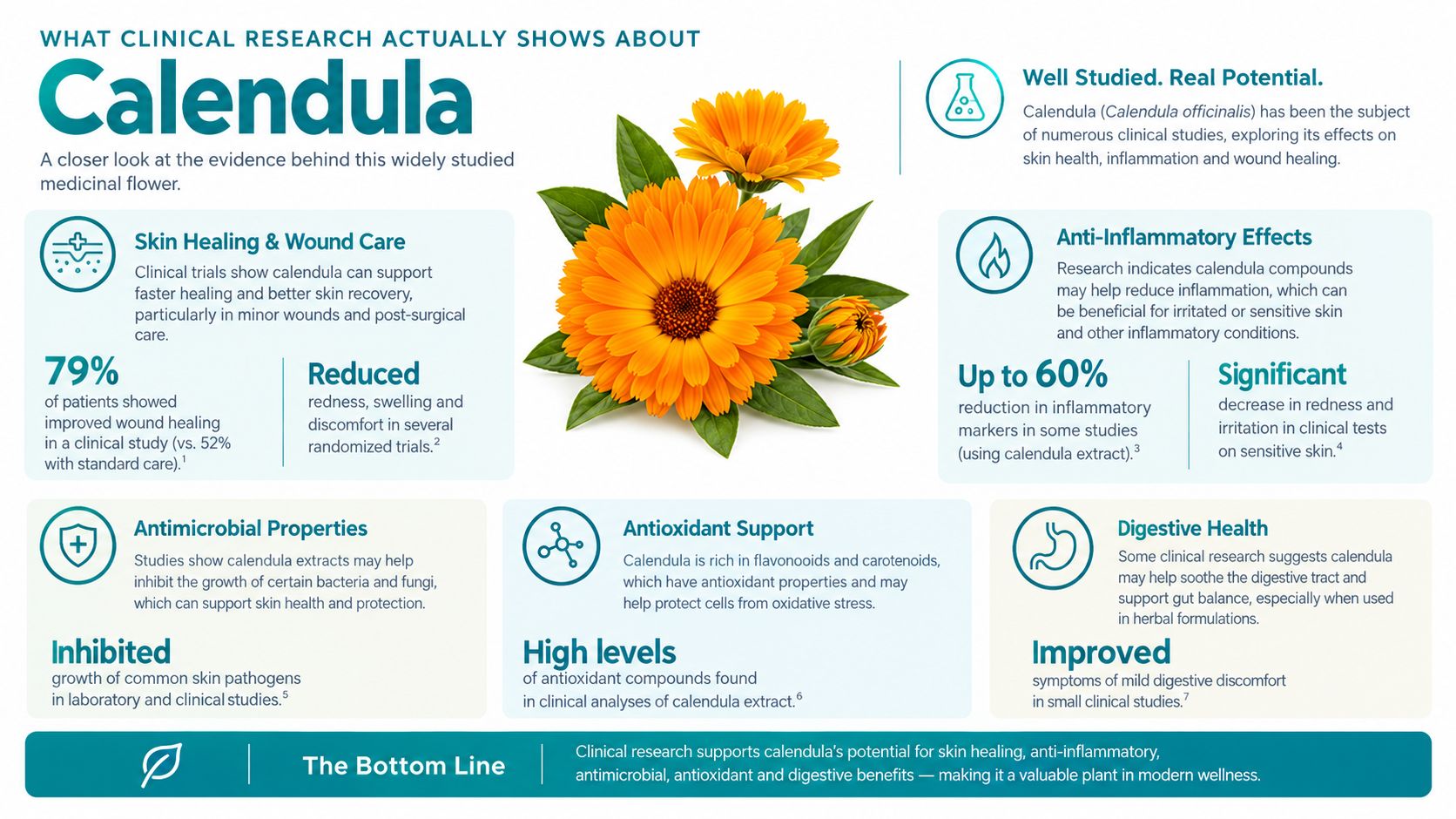
What Clinical Research Actually Shows About Calendula
A calendula cream can feel soothing on dry, irritated skin, but that experience does not automatically prove calendula caused the result. Traditional use and clinical research answer different questions. Longstanding use can justify investigation, while a controlled study examines a specific preparation, concentration, comparison product, and outcome.
One important historical trial examined prevention of radiation-related skin dermatitis. Grade 2 or higher acute dermatitis occurred in 41% of patients using calendula compared with 63% using trolamine, with a statistically significant difference of P < 0.001. These findings appear in the European Medicines Agency's assessment report on Calendula officinalis flower.
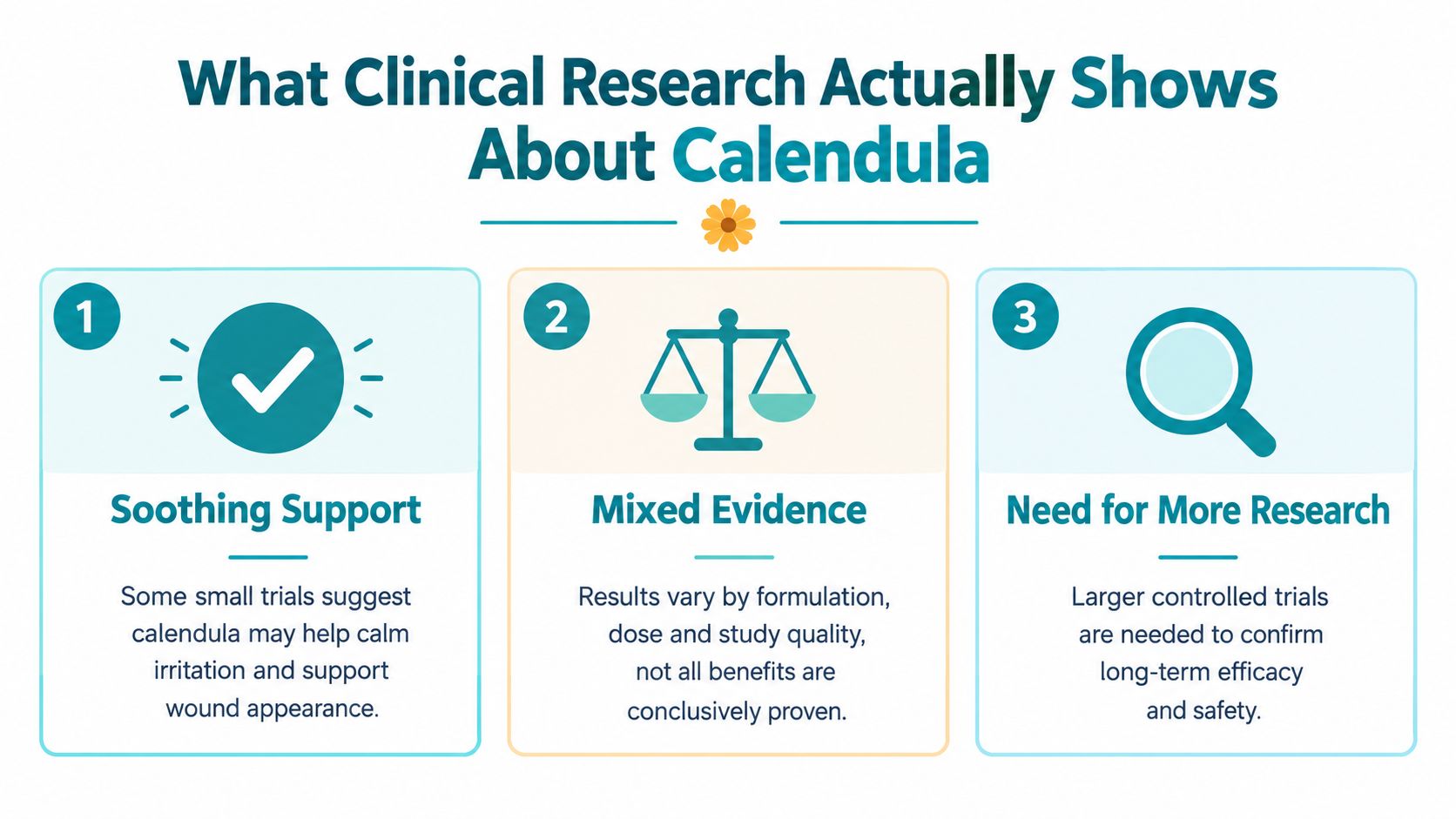
The result is meaningful within that study, not a universal promise for every calendula product. A later review described the broader evidence as mixed, with many studies being small or methodologically weak. The European Medicines Agency regarded cutaneous use of calendula flower preparations as safe, but concluded that the evidence was insufficient for a well-established use indication.
What the evidence supports
For cosmetic use, the most defensible conclusion is modest. Calendula may support a formula intended to make skin feel more comfortable after everyday dryness or irritation, particularly alongside an emollient base. The evidence does not support using it as a stand-alone answer for every redness, rash, or chronic skin concern. Understanding what causes skin inflammation helps keep expectations realistic.
A double-blind randomized controlled trial tested an emollient cream containing 1% supercritical CO₂ Calendula officinalis extract. Compared with the same cream without calendula, the calendula formula improved skin hydration and accelerated recovery after irritant exposure. This supports calendula as a supporting ingredient within a moisturising system, with the clearest relevance to short-term barrier recovery rather than broad anti-aging claims. The full report is available in this randomized trial of a calendula emollient cream.
Other human studies have examined hydration, firmness, elasticity, and melanin content. A 2024 summary described a small study involving 21 adults, in which a topical calendula cream improved firmness and hydration, while elasticity gains were slight. Another study reported decreased melanin content with a calendula extract cream. These outcomes belong to the tested preparations and cannot establish that every calendula product will perform similarly.
For surface hydration, calendula can accompany a dedicated humectant. Sodium Hyaluronate Powder Pure Hyaluronic Acid is described as a cosmetic-grade, high-molecular-weight NASHA powder with a stated molecular weight of 800 to 1500 Daltons and typical DIY serum use at 0.1% to 2%. Those specifications describe sodium hyaluronate, not calendula's effect.
The practical reading is balanced: calendula is a low-risk supportive ingredient with modest, formulation-dependent evidence, rather than a proven stand-alone treatment. A product's preparation, concentration, base, and intended outcome all shape what its results can reasonably mean.
Extract Types Concentrations and Formulation Choices
The word “calendula” doesn't tell you enough about a product. You also need to know which preparation was used, whether it dissolves in water or oil, and how much the formula contains. A flower oil, a water-compatible extract, and a supercritical CO₂ extract may all appear under the same broad ingredient story while behaving differently in a finished product.
The Cosmetic Ingredient Review safety assessment concluded that conventional topical calendula ingredients are safe at flower extract concentrations from 0.0001% to 0.8% and flower oil concentrations from 0.02% to 0.1%. A systematic review also summarized topical preparations in the 2% to 10% range for wound-oriented uses. These ranges aren't interchangeable. Clinical and commercial products may use very different strengths because they target different purposes and use different preparation methods. The concentration data are summarized in this Cosmetic Ingredient Review assessment of calendula safety.
| Ingredient Form | Typical Concentration Range | Common Cosmetic Role |
|---|---|---|
| Calendula flower extract | 0.0001% to 0.8% | Botanical support in creams, lotions, and water-compatible formulas |
| Calendula flower oil | 0.02% to 0.1% | Oil-phase conditioning in creams, facial oils, and balms |
| Calendula topical preparations in wound-oriented literature | 2% to 10% | Historically studied in more specialized topical preparations |
Match the extract to the base
An infused oil belongs in an oil-rich system. You might add it to an anhydrous balm, massage oil, or the oil phase of an emulsion. A water-compatible flower extract makes more sense in a lotion, gel, toner, or serum, provided the supplier's specifications support that use.
Supercritical CO₂ extraction is another option. The randomized trial discussed earlier used 1% supercritical CO₂ calendula extract in an emollient cream, and the comparison included a matching cream without calendula. That design is useful because it tests the botanical within a realistic base rather than pretending the extract works in isolation.
Formulation principle: a well-balanced emollient base can contribute more to immediate softness and hydration feel than simply increasing the botanical level.
A higher percentage isn't automatically better. It can alter colour, scent, texture, stability, or tolerability, and the acceptable range depends on the exact raw material. Always follow the supplier's technical documentation, including recommended use level, solubility, preservation requirements, and compatibility.
For makers comparing raw materials, a focused resource on cosmetic raw ingredients can help you think beyond the headline ingredient. Ask what the material is, how it was processed, where it belongs in the formula, and what outcome you can describe.
How to Choose and Use Calendula Products for Everyday Routines
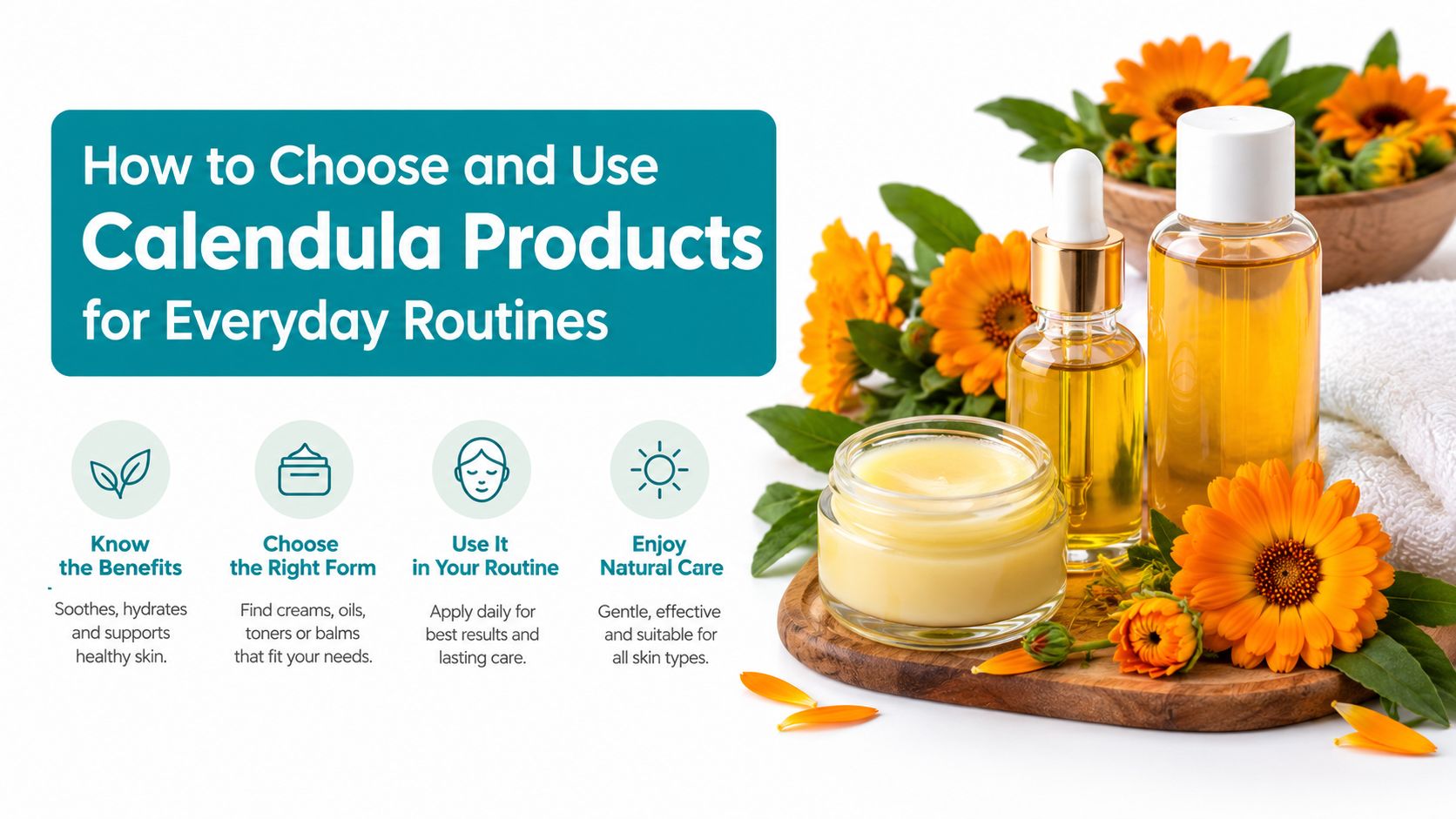
Choosing a calendula product starts with the finish you want on your skin. A lotion usually feels lighter and spreads quickly. A cream offers more cushion. An oil or balm leaves a richer film, which may suit very dry-feeling areas but feel heavy on combination skin.
Read the ingredient list rather than relying only on the front label. Calendula may appear as Calendula officinalis flower extract or Calendula officinalis flower oil. Look for the product's complete base as well. Humectants can support a hydrated feel, while oils and emollients can improve softness and slip.
Build a simple routine
Use a calendula lotion or cream after cleansing, when the skin is clean and slightly damp. If you also use a water-based hydrator, apply that first, then follow with the calendula-containing moisturiser. In the morning, finish with a broad-spectrum sunscreen that suits your routine.
At night, keep the order equally simple. Cleanse, apply a watery serum if desired, then use the calendula cream or oil as the more cushioning step. Start with the schedule that feels comfortable rather than adding several new products at once. If you change multiple products together, you won't know which one affected the skin's appearance or feel.
Combination skin often benefits from applying a lighter lotion across the face and a richer product only where dryness is noticeable. Dry-feeling skin may prefer a cream with calendula alongside humectants and emollients. Sensitive users should pay attention to the entire formula, especially fragrance, essential oils, and other botanicals, not just calendula.
If you're also comparing botanical oils, a practical guide on how to choose quality buckthorn oil offers a useful reminder to assess sourcing, processing, and product specifications instead of choosing an oil based only on its colour or marketing story.
Routine rule: introduce one new calendula product at a time, and give your skin enough time to show whether the texture and finish suit you.
DIY Tips for Adding Calendula to Lotions Creams and Oils
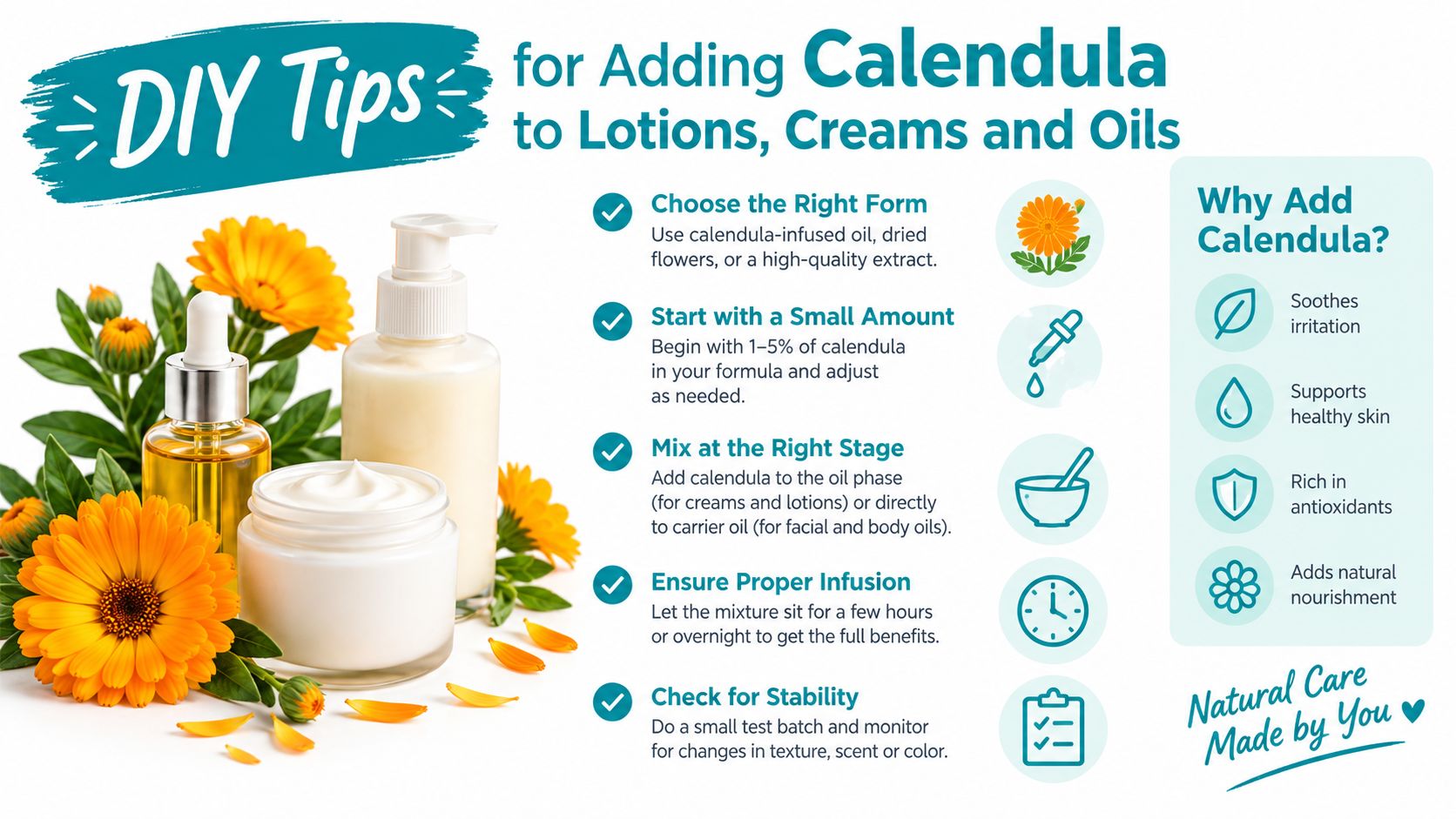
DIY calendula formulation begins with identifying the raw material. An oil infusion belongs in anhydrous products or in the oil phase of an emulsion. A water-based extract may fit a lotion or serum, but it can also introduce preservation and stability questions.
For a lotion or cream, weigh the calendula ingredient accurately and use the supplier's recommended inclusion level. Add oil-soluble material during the oil phase, and add water-compatible material at the temperature and stage specified by the supplier. Don't add an unpreserved botanical infusion to a water-based product and assume the finished batch will remain safe.
Choose the right format
- For an anhydrous balm: Use a calendula-infused oil with suitable waxes and other oils, then assess the finished firmness, scent, colour, and skin feel.
- For an emulsion: Include calendula in the correct phase and use a reliable emulsifier system. The base should remain stable after the botanical is added.
- For a water-based serum: Use a compatible extract and pair it with a humectant if the goal is a softer, more hydrated surface feel.
Sodium hyaluronate can be a companion ingredient in a custom hydrating serum, but it doesn't replace preservation. If you use a water-based system, record the formula, batch date, pH, and processing details. Small-batch work is easier to monitor, but every water-containing product still needs an appropriate preservative system and stability evaluation.
Makers who are new to plant ingredients may also benefit from this aloe care guide for beginners, particularly when comparing botanical formats and handling expectations. For broader cream-making fundamentals, see how to make face cream.
Don't confuse a supplier's suggested use range with a guarantee of performance. Test the finished formula for separation, odour, colour change, viscosity, and user comfort. Keep product descriptions cosmetic and accurate, using language such as “leaves skin feeling soft” or “supports a hydrated-looking complexion.”
Safe Use Allergy Screening and Your Next Steps With Calendula
Calendula may suit many people, but it isn't automatically suitable for everyone. People with known sensitivity to the Asteraceae family should be especially cautious. That group includes plants such as ragweed, chamomile, daisy, and marigold. Independent medical content notes that calendula may be relevant to eczema discussions but also states that studies haven't proven it works for common atopic dermatitis, while warning that Asteraceae allergies can lead to reactions. See the medical overview of calendula and eczema for that distinction.
Before using a new calendula product on your face, apply a small amount to the inner arm. Keep the rest of your routine unchanged while you observe the area. Mild product sensations can happen, but persistent or increasing itching, redness, rash, or swelling is a reason to stop using the product and seek professional advice if symptoms are severe or don't settle.
Use this checklist:
- Check the botanical name. Confirm whether the product contains flower extract, flower oil, or another preparation.
- Review the full formula. Look for fragrance, essential oils, and other ingredients that may affect tolerability.
- Patch test first. Test on the inner arm before applying to the face.
- Start with one new product at a time. Use one new calendula product at a time.
- Keep claims cosmetic. Describe softness, hydration, glow, and the appearance of comfort. Don't describe a product as treating, mitigating, diagnosing, curing, preventing, or healing a medical condition.
Etsy's Medical Claims policy prohibits listings that claim a product prevents, heals, treats, diagnoses, or mitigates a disease or medical condition, whether the claim appears in the title, description, or images. It also restricts claims that a product is, or is as effective as, an analgesic, antibiotic, antiseptic, antiviral, anti-inflammatory, steroid, vaccine, decongestant, prescription drug, or FDA-approved product. Skin Perfection follows FDA rules and regulations for product listings and uses cosmetic language focused on beautifying the skin.
For readers who want additional context about visible discomfort and skincare choices, this resource on irritated skin can help keep product decisions practical and appropriately cautious.
Skin Perfection offers ready-made skincare products and lotion-making supplies for routines and custom formulas focused on the appearance of hydration, softness, and radiance. Explore the Skin Perfection collection to find cosmetic ingredients and products that fit your calendula plans, then patch test and formulate with care.