

 Buy with Prime



You've got a moisturizer you like and a peptide booster beside it. Adding a few drops sounds simple, until you start wondering how much to use, whether the cream is too warm, and whether the finished mixture will keep.
Knowing how to add peptides to moisturizer means treating the cream as a complete formula, not just a container for another ingredient. The useful result is a measured, evenly blended batch with compatible pH and preservation, not the highest peptide percentage you can squeeze into the bottle.
Table of Contents
- Peptide Dosing Rates for Each Supplier Product
- Temperature and pH Limits That Protect Peptides
- How to Blend Peptides into Moisturizer Step by Step
- Preservation Risks Most DIY Guides Skip
- Problems After Mixing and How to Fix Them
- Test a Small Batch Before You Scale Up
Peptide Dosing Rates for Each Supplier Product
Dosing starts from the supplier's stated usage rate for the product you bought, not from a number borrowed off another bottle.
Peptide usage rates for a 1 oz base
| Peptide product | Usage rate | Drops per 1 oz base | Notes |
|---|---|---|---|
| Matrixyl 3000 Serum Booster | Supplier's listed rate | Dose by weight | Blend into a water-based serum, gel, lotion or cream |
| Uplevity (Acetyl Tetrapeptide-2) | Supplier's listed rate | Dose by weight | Calculate the addition in grams; dropper openings vary |
| Syn-Ake | 5% | 45 | Supplier figure for 1 oz of product, bulk base or formula |
| Ten's Up | 5% | 45 (90 per 2 oz) | Blend into existing serums or creams |
Start with the supplier's serum-booster instructions, then distinguish finished-batch percentage from an addition calculated against an existing base. These aren't mathematically identical. The percentage also describes the supplied ingredient blend, not pure peptide molecules.
A 30 g finished batch at 5% contains 1.5 g booster and 28.5 g base. Adding that same 1.5 g to 30 g of existing base follows a base-addition convention and produces a slightly lower finished concentration, because the total weight has increased. Write down which convention you're using before you open the bottle.
Weigh for repeatability
Drop counts are convenient, but dropper openings and ingredient viscosity change the amount dispensed. Weighing in grams makes a batch easier to reproduce, especially when you change container size. Where a supplier gives no drop count, use its weight-based calculation rather than borrowing another booster's count.
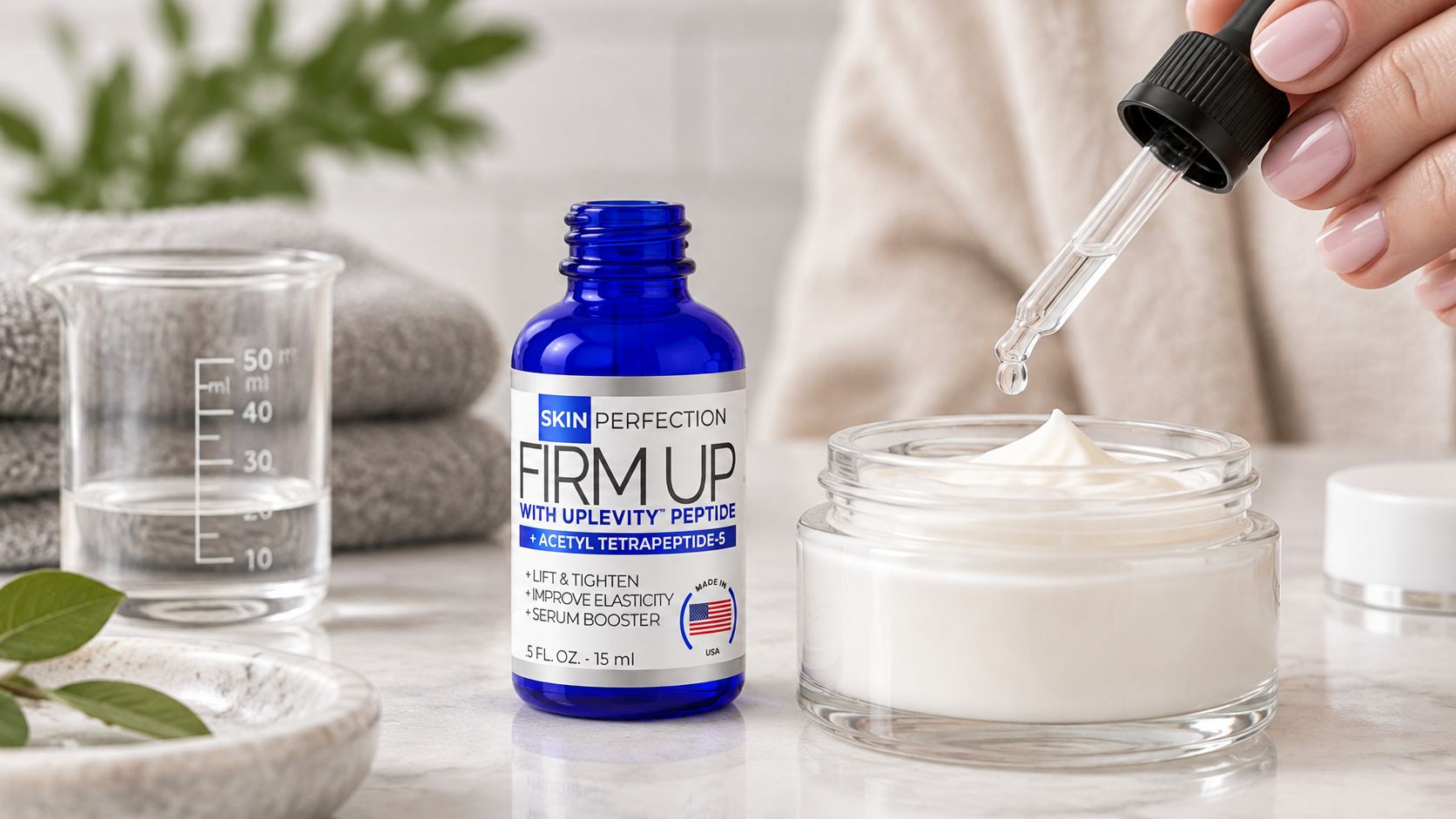
Staying inside the supplier's listed range matters. Doubling the booster share does not put twice the peptide on skin, and the extra volume thins the cream. Syn-Ake is listed for facial serums, body butters, day and night firming moisturizers, eye gels and firming lotions, and it can go into an aloe vera base, so match the application that most resembles your base instead of assuming every vehicle behaves alike.
A 2025 analysis of 245 peptide-containing cosmetic products from 70 manufacturers found that 81% contained SYN-AKE, according to researchers publishing in Applied Sciences. Its prevalence doesn't establish a universal dosing rate.
Batch-sheet habit: Write the ingredient identity, target percentage, calculation convention and gram weight before opening the bottle.
Certain concentrates aren't intended for direct skin application; they go into a formulation at the recommended usage rate. Each added gram also changes the finished cream as a system, diluting its preservative and shifting its pH, which is why the batch sheet matters as much as the drop count.
Temperature and pH Limits That Protect Peptides
There isn't one temperature or pH limit that protects every peptide. Molecular weight, charge, concentration, solubility and the surrounding vehicle all influence stability and delivery. Use the technical guidance for the specific ingredient you've purchased, including its solvent requirements.
In laboratory testing discussed in a review of acetyl hexapeptide-8 delivery, absorption from an oil-in-water emulsion was below 50%, described as satisfactory for a topical cosmetic, while separate diffusion experiments found that only about 2–3% reached an alkaline receptor solution after 8 hours under one condition, with significantly higher permeability in an acidic environment. Those findings don't mean you should acidify every moisturizer. They show why more peptide doesn't automatically produce proportionally more effect.
Check the actual finished cream
Use a calibrated pH meter suitable for semisolid cosmetics and a consistent measurement method. Test strips can provide a rough screen, but cream colour and poor contact can make their interpretation difficult. A white, smooth cream tells you nothing reliable about its pH.
Say you prepare a 30 g test batch, and its measured pH falls outside the peptide supplier's documented range. Hold that batch aside, verify the meter and repeat the measurement using the same method. If the result persists, remake with a compatible base rather than adding an unmeasured splash of acid or alkali.
- Record both readings: Measure the base before addition and the finished blend afterward.
- Control storage: Keep the batch cool and protected from light according to ingredient and base directions.
- Plan consumption: Make only what you can reasonably use within the batch's supported storage period.
- Reject compensation dosing: Don't increase the peptide amount to compensate for an unsuitable pH.
A thickening ingredient also needs formulation planning. The hyaluronic acid formulation guide is useful when considering that type of vehicle rather than improvising additions.
Keep topical cosmetic formulation separate from other peptide applications. Pro Tec Pep's discussion of pulsatile growth-hormone signaling in laboratory experiments concerns a different research context, not evidence for moisturizer dosing or cosmetic performance.
How to Blend Peptides into Moisturizer Step by Step
Set out a clean mixing vessel, spatula, balance, thermometer, pH equipment and suitable packaging before you begin. Clean and dry your work surface and tools using a procedure appropriate for cosmetic preparation. Don't work directly in the original moisturizer container if you want to preserve an untouched reference sample.
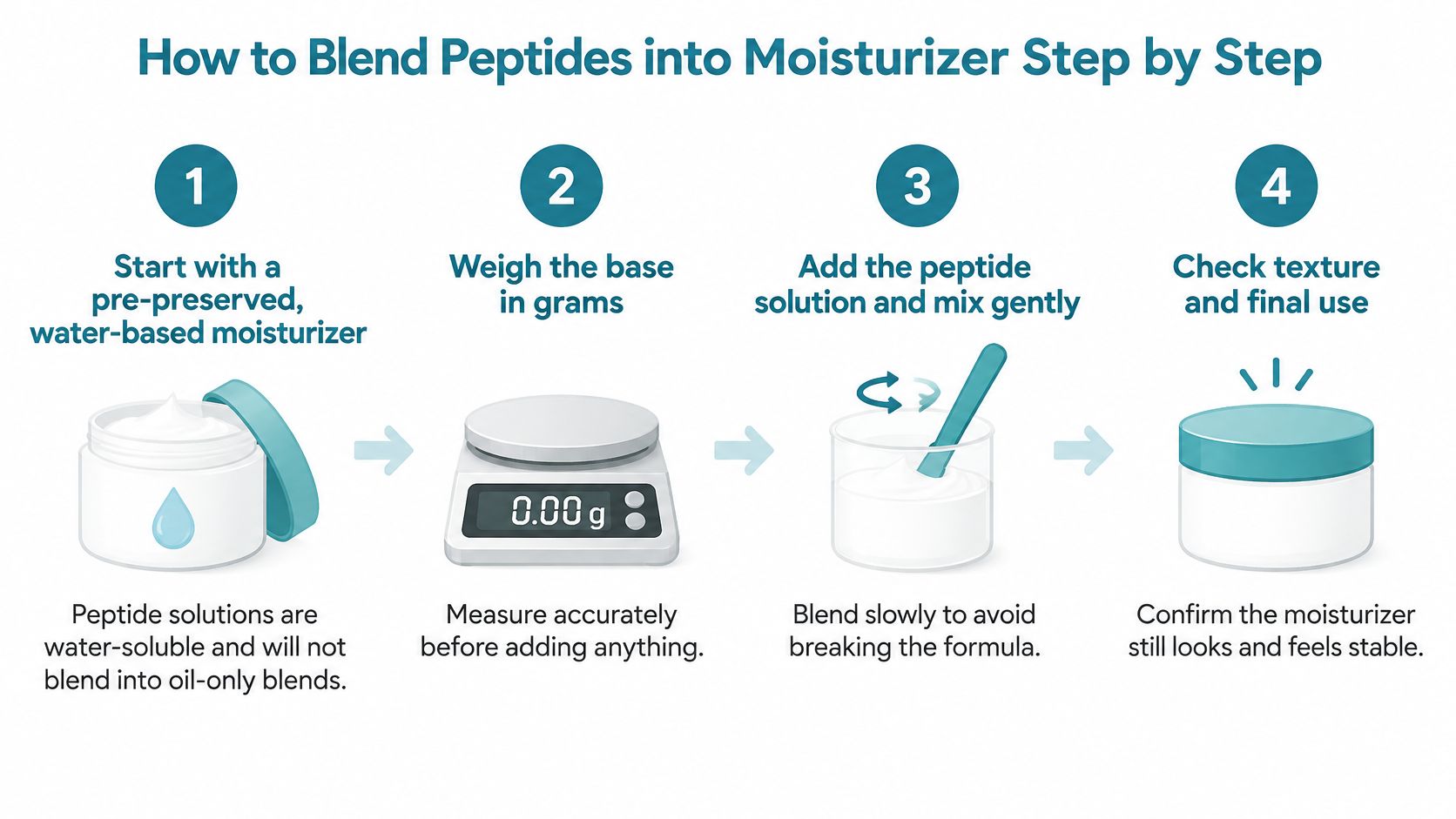
Prepare, measure and blend
- Choose a pre-preserved, water-based moisturizer or formulation base. The water-soluble booster solutions discussed here won't incorporate properly into an oil-only blend. Check the base's permitted additive allowance; an ordinary finished cream isn't automatically designed for customization.
- Weigh the base in grams. Use a balance that reads 0.1 g for this small-batch procedure, and tare the mixing vessel before adding material. Don't estimate weight from the jar's nominal ounce capacity, which may describe volume rather than mass.
- Calculate and weigh the booster separately. For the worked 30 g finished batch at 5%, weigh 1.5 g peptide blend and the remaining weight as base. Keep the calculation on the batch sheet so you don't accidentally add the full intended finished weight as base.
- Let a newly made emulsion cool before addition. About 40°C or below is a practical cool-down checkpoint for this procedure, but a lower supplier limit takes precedence; measure with a thermometer rather than touching the vessel. A cosmetic-formulation stability study reported retained active levels of 58.8% and 41% in different formulations under unfavorable temperature and storage conditions, illustrating why prolonged heat exposure matters.
- Add the solution and stir gently with a clean spatula for about 2 minutes. Scrape the sides and bottom, folding material back into the cream until no streaks remain. Rushed stirring can leave uneven pockets, while aggressive whipping introduces unnecessary air.
- Check pH, smell and texture, then record the results. Compare the blend with the untouched base under the same lighting. Don't assume an acceptable appearance proves chemical stability or microbial safety.
- Transfer into a clean, compatible airless pump and label it. Include the date, ingredient rate, batch identity and storage directions; refrigerate when the ingredient and base instructions call for cold storage. Avoid repeatedly decanting the mixture, which adds handling and makes traceability harder.
Know when mixing isn't enough
A peptide addition isn't an emulsification step. If you're building the moisturizer from separate phases, establish a sound emulsion first using an appropriate oil-and-water emulsification method.
The finished blend should have uniform colour, no visible streaks and no separation, with texture close to the starting base. A noticeable consistency change deserves investigation before use, even when the cream looks attractive.
Preservation Risks Most DIY Guides Skip
Every gram of peptide solution you add dilutes the original moisturizer. That dilution reaches further than the active percentage: it lowers the preservative concentration and shifts the pH and water conditions that preservative was designed to work in.
A pre-preserved base gives you a starting point; it does not certify a modified version. Cosmetic-emulsion formulation guidance from WF Academy stresses that final pH, preservative compatibility and adequate preservation in water-containing products all depend on the finished formula. Refrigeration doesn't replace preservation, and topping up with extra preservative by guesswork can create its own compatibility problem.
Protect the whole batch
Keep the first trial deliberately plain. Essential oils, aloe, fruit waters and hydrosols each carry their own microbial load and chemistry, and every extra material is another variable the preservative system was never tested against.
- Confirm the base's allowance: Establish whether its preservation and emulsion design accommodate the proposed addition.
- Limit ingredients: Add only the selected cosmetic-grade booster at its documented rate.
- Keep quantities modest: Plan a small personal-use batch rather than extending storage unnecessarily.
- Document final conditions: Record pH, packaging, handling and storage alongside the formula.
- Avoid preservative improvisation: Use a suitable preservation plan, sized to the batch by calculation instead of extra drops.
Planning to finish a batch within a few weeks sets a consumption target. It tells you nothing about whether the preservation held during that time, and the original moisturizer's expiry date stops applying the moment you modify the formula.
A cream can look unchanged while its preservation is inadequate. Appearance is a rejection check, not a safety certificate.
Airless packaging reduces repeated exposure during use, but it doesn't sterilize the contents. Treat a jar opened and handled daily more conservatively than a compatible pump, and assign neither container a shelf life you have not verified.
For choosing a preservative suited to water-based blends, our guide to natural skincare preservatives covers the main options. A personal fresh-mix experiment also sits in a different category from a product for sale, which needs qualified stability, microbiological and packaging assessment.
Problems After Mixing and How to Fix Them
A grainy or streaky texture is an immediate reason to pause. It may indicate incomplete mixing or a compatibility problem; appearance alone can't establish whether heat affected the peptide. Don't apply more heat to force the mixture smooth.
The first decision is whether you're looking at a simple mixing defect or evidence that the batch should be rejected. Only the former is a reasonable candidate for a gentle re-blend.
Batch symptoms, likely causes and fixes
| Symptom | Likely cause | Fix |
|---|---|---|
| Grainy or streaky texture | Peptide added to a warm base or stirred too briefly; incompatibility is also possible | Re-blend for 2 minutes if still cool and otherwise acceptable; remake if it has set or remains grainy |
| Thin, runny cream | Matrixyl 3000 above 8% or extra liquid added | Remake at a lower rate within the supplier range |
| Oily film or floating droplets | Oil-only base used with a water-soluble peptide, or emulsion failure | Remake in a compatible water-based base |
| Off smell or colour change within a week | Possible oxidation or contamination | Discard; start the next batch from a pre-preserved base in smaller amounts |
| pH outside supplier range | Added water, hydrosol or acidic or alkaline ingredient changed the formula | Record the reading; remake rather than adjust with unknown additives |
Save the mixing defect, not a failed formula
For an otherwise acceptable fresh batch, a clean spatula and deliberate scraping may resolve visible streaks. Stop if the material stays gritty, develops droplets or changes consistency further. Repeated stirring won't restore a chemically degraded ingredient or validate preservation.
A runny cream shouldn't be rescued by adding a random thickener. That would introduce another ingredient with its own hydration, pH and compatibility requirements, leaving you with a different untested formula. Remaking from a corrected batch sheet is more controlled.
Discard rule: An unexpected smell or colour change is enough to reject the batch. Don't mask it with fragrance or blend it into fresh cream.
For pH drift, check your equipment before blaming the formula. If the repeat reading remains outside the documented range, record both results and start again with a compatible base.
Also distinguish baseline properties from new defects. Some supplied peptide blends are naturally opaque or gel-like, so assess the ingredient before mixing and compare the finished cream with an untreated control. That comparison is more useful than expecting every peptide addition to disappear without any sensory change.
Test a Small Batch Before You Scale Up
Adding a peptide changes the whole moisturizer system, so a small trial should test preservation demand, pH, texture and odour together rather than only the active level. A documented 30 g batch gives a decision: keep the combination, change the base or stop. A full jar gives more material to discard if the phases separate.
I would start at the lowest documented supplier rate and keep an untreated portion of the same base beside it. If the booster-versus-finished-serum choice is still open, settle it at the dosing-rate stage; use this run to judge compatibility.
Use a short, repeatable test sequence
- At preparation: Record ingredient identities, lot details, weights, percentage convention, pH, mixing time and storage conditions.
- Before broader application: Try a small amount on the inner forearm and observe for 24 to 48 hours. Stop if redness, itching or irritation develops; a home patch test leaves later tolerance unresolved.
- After 24 hours: Compare separation, odour, colour and texture with the untreated base stored under the same conditions.
- After one week: Repeat the comparison and write down any change instead of trusting memory.
- Before increasing the rate: Require an acceptable lower-rate trial and a specific reason to change it, such as under-dosing against the supplier range.
Treat those intervals as a screen for early failure. Shelf life, preservative challenge and packaging compatibility need their own evaluation before a scaled batch or sale.
Decide from the batch record
For anything beyond personal trial use, a microbial screening kit can flag obvious contamination; arrange stability, microbiological and packaging evaluation with qualified testing before release.
Keep labeling focused on hydration, softness and the appearance of skin. The FDA cosmetic-labeling guidance makes clear that ordinary cosmetics aren't preapproved, and Etsy's medical-claims policy adds listing restrictions.
Make the decision today: prepare a measured trial with a labeled log, or choose a finished formula. Scale only what the record supports.
Skin Perfection offers skincare products and lotion-making supplies, including peptide boosters, bases and airless bottles for measured formulation work. Visit Skin Perfection to choose supplies for a small test batch or a ready-made peptide serum without the mixing step.