

 Buy with Prime



That simple lotion or complex serum you love? It all starts with a collection of cosmetic raw ingredients.
Think of a skincare formulator like a chef. They're meticulously choosing each component to whip up the perfect recipe, one designed to make skin look and feel amazing. This guide is here to pull back the curtain on that process, breaking down the essential building blocks of your favorite products.
Welcome to the World of Skincare Formulation
We’re going to explore the key players—actives, emulsifiers, and humectants—and show you how they work together to create that perfect texture and beautiful appearance. Here at Skin Perfection, we believe that really understanding your ingredients is the first step toward creating something incredible. Our mission is to give you the knowledge and high-quality supplies you need to bring your skincare ideas to life.
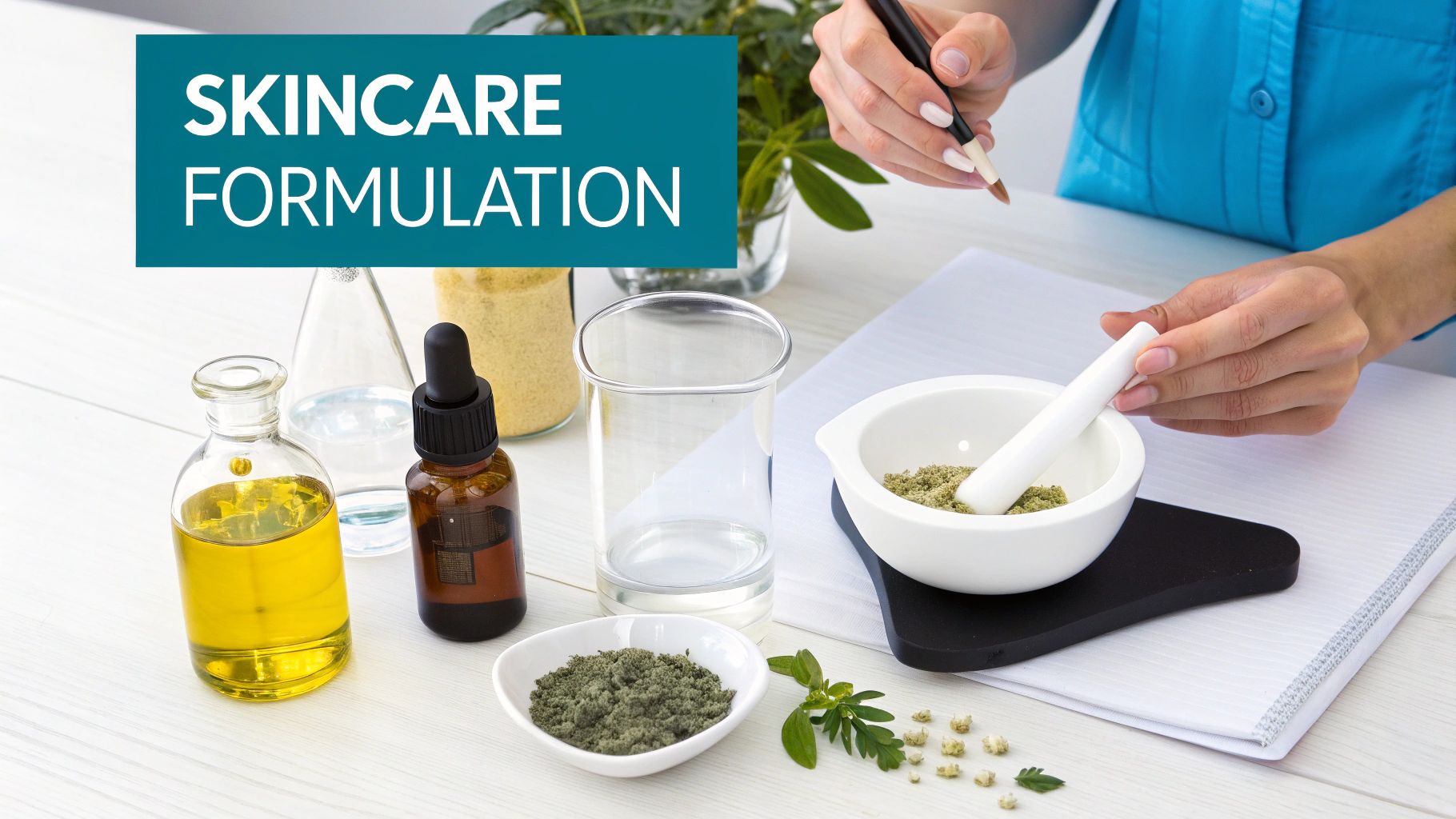
Why Understanding Ingredients Matters
Diving into cosmetic formulation can feel a bit like learning a new language. You'll see scientific names, percentages, and a whole array of different powders and liquids. But trust me, getting a handle on these basics is incredibly empowering, whether you're a DIY pro or just a curious skincare lover.
When you know the purpose of each ingredient, you can make much smarter choices. You start to understand why one lotion feels silky while another feels rich, or why a certain serum has a specific glow. This knowledge turns you from a passive user into a conscious creator, able to pick the absolute best components for your own projects.
The Art and Science of Formulation
Creating a skincare product is a perfect blend of art and science. The "science" part is all about understanding how different cosmetic raw ingredients interact with each other. For example, oil and water famously don't mix, so you need a special ingredient called an emulsifier to bind them together into a stable, creamy lotion.
The "art" comes in when you start choosing ingredients to create a specific feel and aesthetic. It’s about selecting emollients that give a luxurious glide or picking botanical extracts that contribute to a radiant look. It’s so much more than just mixing things in a beaker; it’s about crafting a product that feels like a delight to use.
At its core, formulation is the practice of combining individual raw materials in precise ratios to create a finished product with a desired look, feel, and function. Each ingredient has a specific job to do within the formula.
This guide will walk you through the main categories of ingredients you’ll come across. We'll focus on what they do from a cosmetic standpoint and how they contribute to the final product. Think of this as your introductory course to becoming a more knowledgeable and confident formulator. Let's get started.
How to Read an Ingredient Label Like a Pro
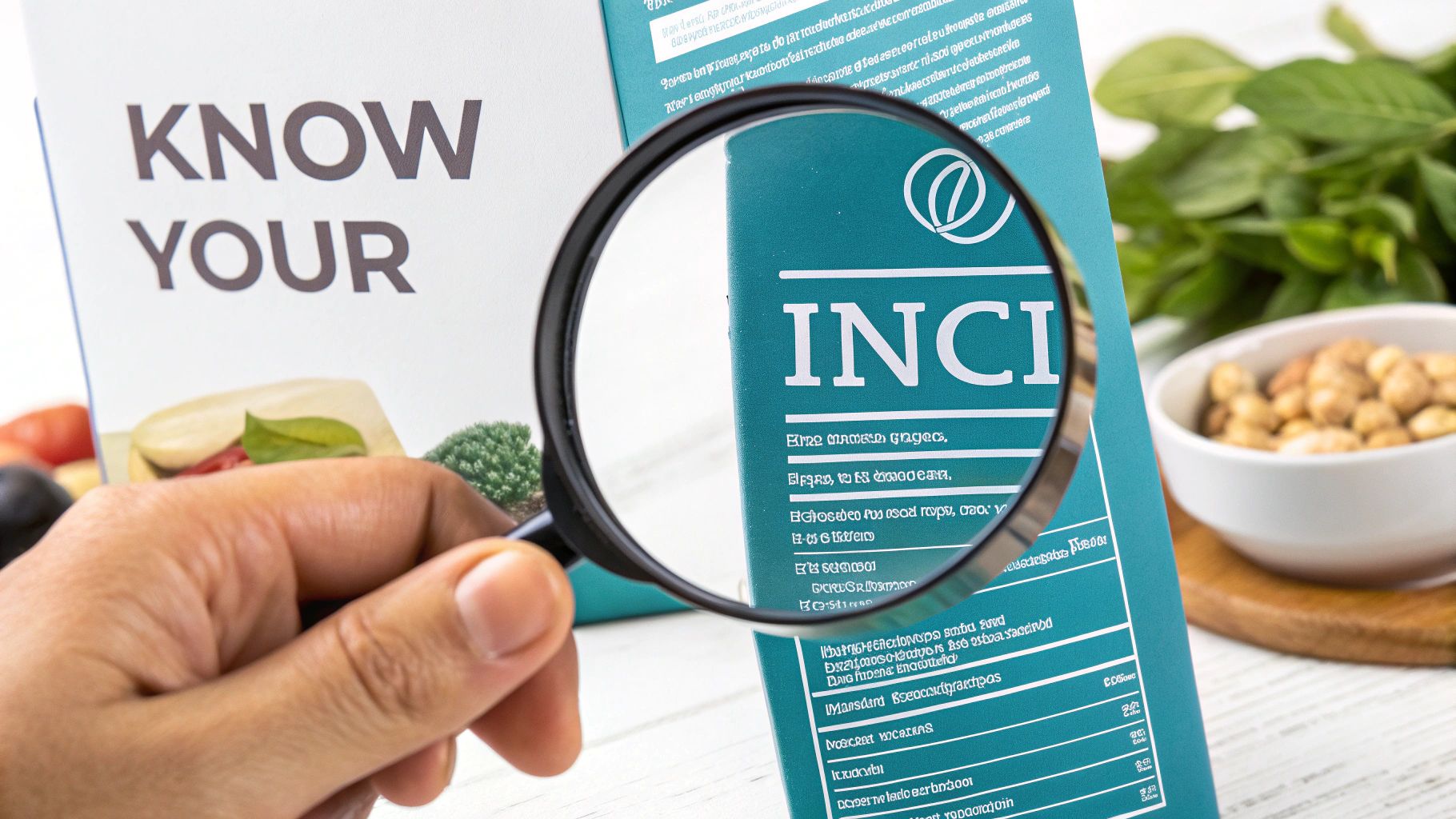
Before you can start picking out cosmetic raw ingredients with confidence, you have to learn the lingo. There’s a universal language for skincare labels, and it’s called the International Nomenclature of Cosmetic Ingredients, or INCI for short. Think of it as the standardized dictionary for everything inside that bottle or jar.
This system makes sure that no matter where a product is from, its ingredients are listed with the same name. It’s all about transparency, helping you compare products on a level playing field. For instance, you'll always see "Water" listed as Aqua, and "Shea Butter" will be called out by its scientific name, Butyrospermum Parkii (Shea) Butter. Getting a handle on INCI is your first real step toward becoming a truly savvy formulator.
The Golden Rule of Descending Order
One of the most crucial things to know about reading an ingredient list is that everything is listed in descending order by weight. That means the ingredient making up the biggest chunk of the formula comes first, followed by the second biggest, and so on down the line.
In most lotions and serums, you’ll find Aqua (Water) right at the top, since it usually forms the foundation of the product. This rule gives you a quick snapshot of what the product is really made of. If you spot an exciting active ingredient way down at the bottom of the list, you know there’s just a tiny bit of it in there.
This descending order rule applies to all ingredients present at a concentration of 1% or more.
Anything that makes up less than 1% of the total formula can be listed in any order after the 1% mark. This is usually where you'll spot the potent actives, preservatives, and fragrance components that work their magic in small doses.
Putting It All Together: A Practical Example
Let’s decode a simple, hypothetical lotion label to see how this all plays out. You pick up a bottle, and the back looks something like this:
- Aqua (Water): The main base and solvent. It’s listed first, so it makes up the largest part of the formula.
- Caprylic/Capric Triglyceride: A popular emollient from coconut oil that gives products a smooth, non-greasy feel.
- Glycerin: A powerhouse humectant that pulls moisture into the skin, helping to give it a hydrated appearance.
- Cetearyl Alcohol: This isn't a drying alcohol; it’s a fatty alcohol that works as an emulsifier and thickener to create that creamy texture.
- Phenoxyethanol: A preservative used in a small amount (typically under 1%) to keep the product safe and free from nasty microbes.
- Tocopherol (Vitamin E): A classic antioxidant that also helps protect the formula itself from going bad, used in a very small quantity.
Just from a quick scan, you can tell this is a water-based product packed with moisturizing and texturizing ingredients. The preservative and antioxidant are at the end, doing their important jobs in tiny concentrations.
For a deeper dive into this topic, you can learn more from our detailed guide on how to read a skincare label. Understanding this structure empowers you to make smarter choices, whether you're buying a finished product or sourcing your own cosmetic raw ingredients for a DIY project.
The Functional Building Blocks of Skincare
Every great skincare product starts with a solid foundation. While flashy "active" ingredients tend to grab all the attention, it's the functional ingredients that do the heavy lifting behind the scenes. Think of them as the unsung heroes—the framework of a house that keeps everything standing strong.
These cosmetic raw ingredients are what transform a simple mix of oils, waters, and powders into the elegant, creamy, or silky-smooth products you know and love. They’re responsible for making a lotion feel hydrating instead of greasy, ensuring a cream doesn’t separate into a watery mess, and keeping your product safe to use from the first pump to the last. Let's pull back the curtain on the core categories that make it all happen.
Emollients: The Secret to a Smooth Feel
Ever applied a lotion and marveled at how instantly soft and supple your skin felt? You can thank emollients for that luxurious feeling. Emollients are ingredients that help maintain the skin's soft, smooth, and pliable appearance.
They work by creating a super-thin, lightweight film on the skin's surface. This simple action is what improves the look and feel of your skin, giving it a beautifully conditioned appearance. Think of them as the "smoothers" in your formula, delivering that immediate sensation of comfort and silkiness.
Common emollients you'll find in cosmetic raw ingredients include:
- Butters: Ingredients like Shea Butter and Cocoa Butter offer a rich, cushioning feel.
- Oils: Natural oils such as Jojoba Oil, Coconut Oil, and Squalane provide a whole range of textures, from feather-light to deeply nourishing.
- Esters: These are often lab-created ingredients like Caprylic/Capric Triglyceride that give a smooth, non-greasy finish.
Humectants: The Moisture Magnets
Next up are the humectants, another vital group of cosmetic ingredients famous for their ability to attract water. Picture a tiny magnet for moisture—that’s pretty much what a humectant does. When they're in a skincare formula and applied to your skin, they pull water vapor from the air right to the skin’s surface.
This process is what gives skin that hydrated, plump, and dewy look. Humectants are absolute superstars in moisturizers, serums, and toners. They work beautifully alongside emollients to create a well-rounded moisturizing effect that your skin will drink up.
While emollients smooth the surface, humectants attract moisture to it. A great formula often uses both to provide a comprehensive cosmetic moisturizing experience, leaving skin looking hydrated and feeling soft.
The most popular humectants you’ll see are Glycerin, Hyaluronic Acid, and Propanediol 1,3. Each one has a unique feel and performance level, which allows formulators to perfectly fine-tune the hydration and sensory experience of a product.
Emulsifiers: The Peacemakers of Formulation
As anyone who has dabbled in DIY skincare knows, oil and water just don't mix. If you simply poured them into a bottle together, you’d end up with two separate layers. This is where emulsifiers step in—they are the magical peacemakers that allow oil and water to live together in perfect harmony.
An emulsifier is a special type of ingredient with a unique molecular structure. One end of the molecule is drawn to water (hydrophilic), while the other end is drawn to oil (lipophilic). This dual personality lets them create a stable, uniform mixture called an emulsion.
Without emulsifiers, our beloved creamy lotions and moisturizers simply wouldn't exist. Cosmetic polymer ingredients, which often act as emulsifiers or stabilizers, are a true cornerstone of the industry. In fact, the market for these texture-enhancing ingredients was around USD 8.30 billion in 2024 and is expected to climb to USD 13.60 billion by 2034, according to Precedence Research.
Getting an emulsion right is a foundational skill in formulating. If you're interested in mastering this crucial technique, you can dive deeper with our guide on how to emulsify oil and water.
Preservatives: The Guardians of Safety
Finally, we come to one of the most critical—and often misunderstood—categories of cosmetic raw ingredients: preservatives. Any product containing water (like a lotion, cream, or serum) is a potential playground for bacteria, yeast, and mold.
Preservatives are the essential guardians that keep your products fresh and safe for you to use. They stop microbial contamination in its tracks, making sure the product you create today stays stable and clean for its entire shelf life. Using a broad-spectrum preservative isn't just a good idea; it's a non-negotiable safety measure in any water-based formula.
Skipping a preservative is a huge risk. A product might look and smell perfectly fine, but it could be teeming with invisible microbes. Some of the most common and effective preservatives in modern skincare include Phenoxyethanol, Caprylyl Glycol, and natural-leaning options like Leucidal SF Max.
To help tie this all together, here is a quick look at the main ingredient categories and what they do in a formula.
Common Cosmetic Ingredient Categories and Their Functions
| Ingredient Category | Primary Function in a Formula | Common Examples |
|---|---|---|
| Emollients | Smooth and soften the skin's surface, improving feel and appearance. | Shea Butter, Jojoba Oil, Caprylic/Capric Triglyceride |
| Humectants | Attract and bind water to the skin for a hydrated appearance. | Glycerin, Hyaluronic Acid, Propanediol 1,3 |
| Emulsifiers | Bind oil and water together to create a stable, uniform cream or lotion. | Cetearyl Alcohol, Glyceryl Stearate, Polysorbate 20 |
| Preservatives | Prevent the growth of bacteria, yeast, and mold in water-based products. | Phenoxyethanol, Caprylyl Glycol, Leucidal SF Max |
Together, these functional building blocks—emollients, humectants, emulsifiers, and preservatives—form the backbone of almost every skincare product on the shelf. Understanding their individual roles is the first step toward appreciating the intricate science and artistry that goes into a truly great formulation. They are the essential team players that allow the star "active" ingredients to shine.
Understanding the Role of Active Ingredients
If functional ingredients are the bones of a skincare formula, then active ingredients are the heart and soul. These are the specialized cosmetic raw ingredients hand-picked to do a specific job, giving a product its true purpose. They’re the reason a serum helps your skin look more radiant or a cream improves the appearance of skin texture.
Think of it like building a house. The functional ingredients are the essential foundation, walls, and roof. But the active ingredients? They're the beautiful interior design—the art on the walls, the plush furniture, and the perfect lighting that creates a specific vibe. Actives are what make a product unique and targeted, whether it's for a more even-toned complexion or a youthfully smooth appearance.
Peptides: The Appearance Perfectors
Among the most exciting active ingredients are peptides. Peptides are simply small chains of amino acids, which are the fundamental building blocks of proteins. In skincare, specific peptides are prized for their incredible ability to visually improve skin's texture and tone.
For example, some peptides are absolute masters at diminishing the look of fine lines and wrinkles, helping skin appear smoother and more refined. Others are fantastic for improving the appearance of firmness, giving the skin a plumper, more lifted look. They are incredibly versatile and are often the key players in products designed to support graceful aging. Getting familiar with What Are Peptides In Skincare is a great first step to understanding their targeted benefits.
Peptides don't restructure your skin; they are all about enhancing its appearance. By adding them to a serum or cream, formulators can craft products that help your skin look its absolute best—visibly smoother, firmer, and more radiant.
If you’re curious about how these powerhouses are put to work in specific formulas, our guide on what a peptide serum does offers a deeper dive. It’s a perfect illustration of how formulators use actives to achieve a specific cosmetic goal.
Antioxidants: The Environmental Defenders
Another powerhouse category of actives is antioxidants. Every single day, our skin faces an onslaught from environmental aggressors like pollution and UV rays. This daily exposure can cause oxidative stress on the skin's surface, which can leave it looking dull, tired, and uneven.
Think of antioxidants as your skin's personal bodyguards. They work on the surface to help fend off these daily environmental challenges, acting as the first line of defense for your skin's appearance and helping to maintain a bright, even-toned, and healthy-looking complexion.
Here are some of the most popular antioxidants you’ll find in skincare formulations:
- Vitamin C (Ascorbic Acid and its derivatives): Famous for its ability to promote a brilliantly radiant and even-toned appearance.
- Vitamin E (Tocopherol): Often paired with Vitamin C, it helps to condition the skin and provides its own powerful antioxidant properties.
- Niacinamide (Vitamin B3): A true multi-tasker that helps minimize the appearance of pores and improve overall skin texture.
- Ferulic Acid: A plant-based antioxidant that works beautifully with Vitamins C and E to boost their effectiveness.
Botanical Extracts: Nature’s Beautifiers
Finally, we have botanical extracts. These are potent, plant-derived ingredients that have been staples in beauty rituals for centuries because of their cosmetic properties. From soothing chamomile to vibrant green tea, these extracts are concentrated sources of beneficial compounds like polyphenols and flavonoids.
In skincare formulas, botanical extracts serve a huge range of aesthetic purposes. Some, like Aloe Vera, are legendary for their ability to contribute to a soothed and hydrated appearance. Others, like Licorice Root Extract, are used to promote a bright, even-looking complexion. They allow formulators to add a natural touch to their products while targeting very specific cosmetic concerns.
It's no surprise that the demand for these powerful cosmetic raw ingredients is skyrocketing. The global market for skincare ingredients, including actives like peptides and natural extracts, was valued at USD 13.4 billion in 2024 and is projected to hit USD 21.5 billion by 2034. This incredible growth is driven by people just like you who want effective, high-performance skincare. This shows just how central these ingredients have become to modern formulation.
A Practical Guide to Beginner Formulation
Ready to roll up your sleeves and move from theory to practice? That leap from understanding cosmetic raw ingredients to actually creating your first product is such an exciting step. We'll walk you through the fundamentals of DIY formulation, keeping things clear, safe, and totally empowering.
Think of a basic lotion recipe as having three main parts, or phases. Each phase is where you group ingredients with similar properties before bringing them all together. Getting a handle on this structure is the secret to creating a stable, beautiful final product.
The Three Phases of Formulation
At its heart, a classic lotion is an emulsion—a careful blend of oil and water. To get them to play nicely together, you'll work in separate phases, heating some parts and keeping others cool to protect the more delicate ingredients.
- The Water Phase: This is the foundation of most lotions and includes everything that dissolves in water. Here, you'll mix your humectants, like Glycerin or Propanediol 1,3, into distilled water (Aqua).
- The Oil Phase: This phase is home to all your oil-loving ingredients. It's where you'll put your emollients like Shea Butter and Jojoba Oil, along with fatty alcohols and the oil-soluble portion of your emulsifier.
- The Cool-Down Phase: This final stage is reserved for heat-sensitive ingredients that can't take the heat of the emulsion process. This is where you'll add your preservative and those delicate active ingredients like peptides and certain botanical extracts.
The basic flow involves heating the water and oil phases in separate containers to the exact same temperature (usually around 70-75°C or 158-167°F). Then, you combine them while mixing vigorously before adding the cool-down ingredients once the mixture has cooled down a bit.
Why Percentages Are Non-Negotiable
When you start formulating, it's absolutely crucial to measure everything by weight, not volume (forget about cups or spoons). Calculating your formula in percentages is the gold standard for accuracy and consistency. It ensures every single ingredient is present in the right proportion, which is key for making a stable emulsion and using your actives at their effective levels.
Working in percentages makes it incredibly easy to scale your recipe. Whether you're making a tiny 50g sample or a huge 1000g batch, the proportions stay exactly the same. That means you get a consistent, reliable product every single time.
This visual shows how different types of active cosmetic raw ingredients find their way into a final formula.
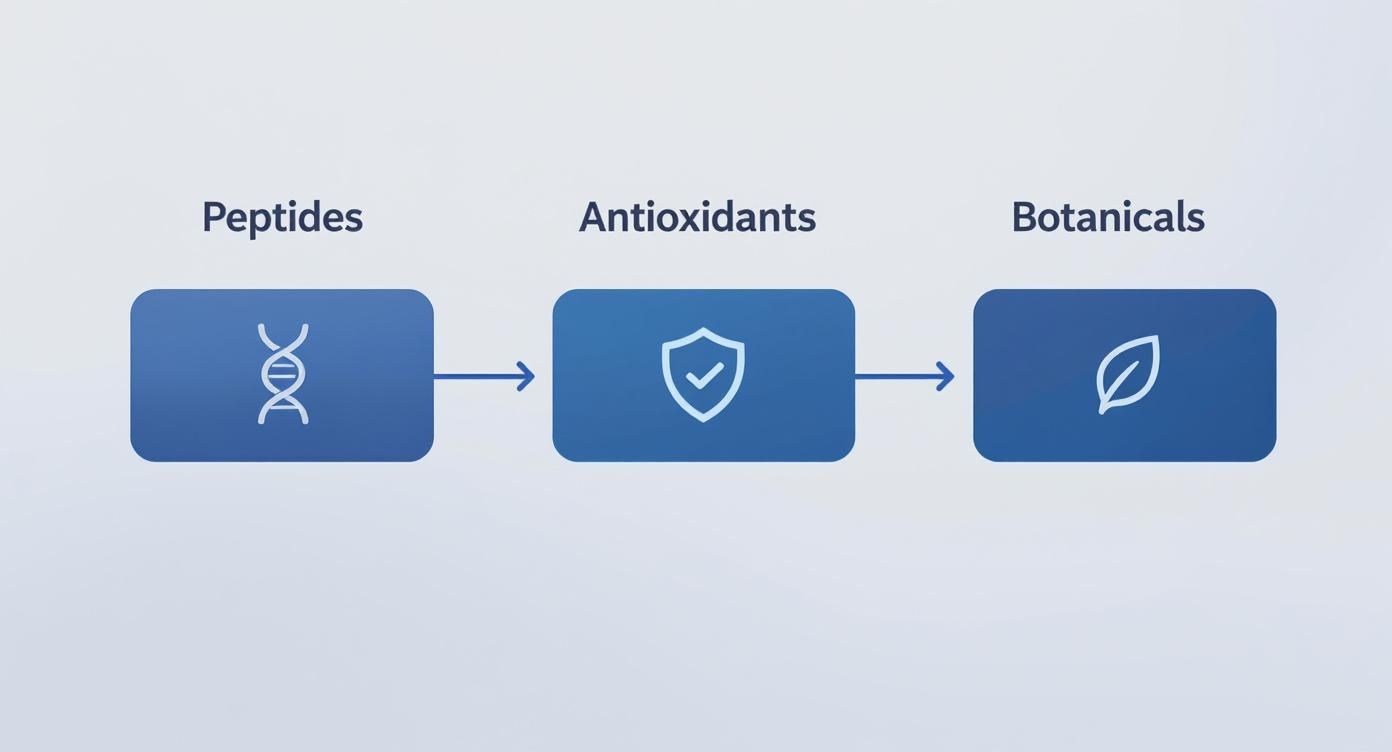
You can see the flow from peptides to antioxidants and botanicals, illustrating how these key players are chosen for their specific roles in making a product truly effective.
A Simple Starter Lotion Recipe
Here’s a fantastic starter formula to get you going. It’s designed to be straightforward, stable, and create a wonderfully hydrating lotion. If you're looking for even more recipes and helpful tips, our extensive section on how to make your own skin care products is a treasure trove of information.
| Phase | Ingredient (INCI Name) | Percentage (%) | Function |
|---|---|---|---|
| Water | Aqua (Distilled Water) | 75.2% | Base/Solvent |
| Water | Glycerin | 3.0% | Humectant |
| Oil | Caprylic/Capric Triglyceride | 10.0% | Emollient |
| Oil | Cetearyl Alcohol | 5.0% | Emulsifier/Thickener |
| Oil | Glyceryl Stearate | 3.0% | Emulsifier |
| Cool-Down | Phenoxyethanol | 1.0% | Preservative |
| Cool-Down | Tocopherol (Vitamin E) | 0.8% | Antioxidant |
A quick reminder: always work in a clean, sanitized space with the proper equipment. And for any formula that contains water, a preservative is an absolute must for safety. Skin Perfection is your trusted partner for sourcing all the high-quality cosmetic raw ingredients you'll need for this recipe and whatever you dream up next.
Sourcing Quality Ingredients and Ensuring Safety
The ultimate success of any skincare you create, whether it's for yourself or for a brand, really boils down to the quality of your cosmetic raw ingredients. Think about it – you can't build a beautiful house on a shaky foundation. Sourcing high-quality, pure materials isn't just a nice-to-have; it's everything. It's what makes a product look and feel its best.
This means you need to find and partner with reputable suppliers who are totally transparent about their materials. When you're looking around, especially in the global market, knowing how to find and vet suppliers is key. Sometimes, this might even involve using reliable sourcing agents to help you get the best quality. At the end of the day, a supplier you can trust will always provide the paperwork to back up their claims.
The Importance of Documentation
The single most critical piece of paper you should ask for is the Certificate of Analysis (CoA). Think of it as an ingredient's report card. This official document is issued by a quality control lab and confirms that the ingredient meets all its specifications. It gives you the hard data—purity, physical properties, and other key metrics—so you can be confident in what you're buying.
On top of that, a good supplier will always give you the safety information you need to handle the ingredients properly. We believe in this so strongly that we offer a whole library of these documents. You can take a look at our Material Safety Data Sheets (MSDS) for any of the products we stock.
Decoding Marketing Terms
Let’s be honest, the beauty world is filled with buzzwords. You'll see terms like 'clean,' 'natural,' and 'organic' everywhere. And while they sound great, they can be pretty vague because there's no single, universally enforced standard for them. A 'natural' ingredient can go through a ton of processing, while a lab-created one can be incredibly safe and effective.
My advice? Don't get too caught up in the marketing hype. Instead, zero in on transparency and quality. A truly great ingredient is one that's sourced responsibly, rigorously tested for purity, and backed up by clear, honest documentation—no matter if it came from a plant or a lab.
The real secret for any formulator, from a kitchen chemist to a seasoned pro, is to value verifiable quality over slick marketing. Your best move is always to source from suppliers who provide comprehensive paperwork, especially a Certificate of Analysis. It's the only way to truly guarantee the integrity of your finished product.
You're not alone in seeking out top-tier ingredients. The demand for cosmetic ingredients that deliver real results is booming. The global market for these functional cosmetic ingredients was pegged at around USD 3.8 billion in 2024 and is expected to climb to USD 5.33 billion by 2030. You can see more on these trends and discover more insights about the functional cosmetic ingredients market on deepmarketinsights.com. This incredible growth just shows how much people want products that offer specific, noticeable benefits.
You might also come across organizations like the Environmental Working Group (EWG), which has databases that many people use to check ingredients against their own safety criteria. It's a useful resource, for sure, but it’s important to remember that the EWG is a non-profit advocacy group, not a regulatory body. Their ratings are one tool in your toolbox, but the ultimate responsibility for creating a safe, high-quality product always comes back to meticulous sourcing and sticking to proven formulation principles.
Common Questions About Cosmetic Raw Ingredients
As you start diving into the world of making your own skincare, a few questions are bound to pop up. Don't worry, that's completely normal. Getting these basics down early on will build your confidence and help you create beautiful, stable products right from the get-go.
Let's tackle some of the most common questions about cosmetic raw ingredients.
Do I Absolutely Need a Preservative?
Yes, if your creation contains any water, a preservative is absolutely non-negotiable. Any product made with water—think creams, lotions, and serums—is a perfect playground for bacteria, mold, and yeast to grow. Using a broad-spectrum preservative is a critical safety measure to keep your formulas fresh, safe, and clean.
The only real exception is for anhydrous (water-free) products. Formulations like facial oils or solid balms that contain zero water can usually skip the preservative.
Distinguishing Raw Ingredients from Finished Cosmetics
This is a fundamental concept that every formulator needs to grasp. It's actually quite simple.
- A cosmetic raw ingredient is a single substance. Picture a bag of Hyaluronic Acid powder or a bottle of pure Shea Butter; these are the individual building blocks of your formula.
- A finished cosmetic is the final product you’d find on a store shelf. It's a complete recipe where many raw ingredients have been combined in precise ratios to create a stable, effective, and elegant product like a moisturizer.
Think of it like baking a cake. Flour is your raw ingredient, but the fully baked, frosted cake is the finished product. The raw ingredient is just one piece of the puzzle; the finished cosmetic is the complete masterpiece.
Where Can I Find Correct Usage Rates?
Your supplier is always the best and most reliable source for this information. Reputable suppliers will list the manufacturer's recommended usage rate right on the ingredient’s product page or in the technical documents they provide. Always stick to these guidelines to make sure your formulation is both effective and safe for cosmetic use.
Ready to start creating? At Skin Perfection, we offer a full range of meticulously sourced cosmetic raw ingredients and lotion making supplies to bring your vision to life. Shop our collection today.