

 Buy with Prime


Making your own DIY anti-aging cream is a gratifying process. You get to control every single ingredient that goes on your skin, blending beautiful oils, butters, and targeted cosmetic actives to create a formula that’s perfectly yours. This guide walks you through crafting a luxurious cream right from your own kitchen.
Why Create Your Own Skincare at Home

Diving into the world of homemade skincare is so much more than a hobby—it's a creative act of self-care. When you formulate your own cream, you’re stepping away from the one-size-fits-all approach of commercial products. You get the freedom to choose high-quality, fresh ingredients that truly align with your skin's needs and your personal beauty philosophy.
The process empowers you because you know exactly what's in your skincare. You get to hand-pick every oil, butter, and botanical extract, ensuring your final product is crafted with genuine intention. This personal connection can completely transform how you view your routine, turning it into a more mindful and enjoyable experience.
A Growing Movement Toward Personalization
The desire for personalized skincare isn't just a niche interest; it's a huge trend that shows how we're all thinking differently about beauty. People are looking for products that cater to their specific concerns. Crafting your own lotions is the ultimate form of personalization.
You can see this shift in the market, too. The global anti-aging products sector, valued at around US$53.7 billion in 2025, is expected to soar to US$90.8 billion by 2032. This incredible growth is fueled by consumers' demand for customized skincare, boosting the popularity of both commercial and DIY anti-aging options.
The Joy of the Creative Process
Beyond all the practical benefits, there's a deep satisfaction that comes from the creative journey itself. From researching unique ingredients to the magical moment your cream emulsifies into a silky, perfect texture, every step is a chance to learn and create. This guide is designed to make that process feel accessible and fun, setting you up for success right from the start.
Making your own skincare isn't about getting it perfect on the first try. It's about the pleasure of creating something beautiful with your own hands. It’s an invitation to slow down and connect with your beauty ritual on a much deeper level.
As you get started, it's also helpful to think about the broader aspects of aging gracefully, since a thoughtful skincare routine is just one piece of the wellness puzzle. Our goal here is to inspire confidence and show you that anyone with a passion for their skin can become a skilled creator.
For more ideas on crafting other skincare goodies, you can also explore our guides to make your own skin care products.
Your Home Skincare Lab Setup

Before we dive into crafting your luxurious DIY anti-aging cream, let's talk about setting up your creative space. Think of your kitchen counter or a spare table as your personal skincare lab. Getting organized with the right tools isn't just about making the process easier—it’s the secret to making it safer, more enjoyable, and ultimately, successful.
The goal here is to create a clean, efficient workspace where you can measure, melt, and mix with total confidence. Just like a chef preps their ingredients before cooking, having everything sanitized and ready to go is the key to a beautiful, high-quality cream you can be proud of.
Essential Tools for Your Skincare Creations
Precision and cleanliness are everything in DIY skincare. You don't need a professional laboratory, but a few key pieces of equipment are non-negotiable if you want to get consistent, beautiful results every time.
These are the absolute must-haves for your home setup:
- A Digital Scale: This is, without a doubt, your most critical tool. Skincare recipes rely on precise weight measurements (not volume!) to ensure your cream emulsifies correctly and has that perfect feel. Look for a scale that measures to at least 0.01 grams.
- Heat-Safe Beakers or Containers: You’ll need at least two. Glass or stainless steel containers are perfect for holding your oil and water phases while they heat up. Simple Pyrex measuring cups work wonderfully for this.
- A Mini Mixer or Immersion Blender: To create a stable emulsion—that magical moment when oil and water combine into a cream—you need more power than a whisk can offer. A small milk frother or a stick blender is precisely what you need.
- Sanitized Jars and Lids: Have clean, airtight containers ready for your finished cream. I recommend dark glass or opaque plastic to help protect the delicate ingredients from degrading in the light.
Pro Tip: Always, always sanitize your equipment before you start. A quick wash in hot, soapy water, followed by a wipe-down with 70% isopropyl alcohol, makes all the difference. This ensures your cream starts its life in a perfectly clean environment.
Understanding Your Core Ingredients
Every cream is built from a foundation of core components that give it texture, feel, and nourishment. Choosing these ingredients is where the fun really begins and where you can start to personalize your formula.
There's a huge market shift underway, with more people seeking high-quality, targeted ingredients for their routines. In the U.S., the anti-aging product market hit USD 14.05 billion in 2024 and is on track to reach USD 27.44 billion by 2033. This boom is all about consumer demand for ingredients like peptides and antioxidants, with a huge preference for natural and non-toxic formulas—a priority for 63% of American consumers. It’s no wonder so many of us are drawn to making our own anti-aging creams! You can read more about these skincare market trends to see just how much preferences are changing.
A basic cream formula has an oil phase and a water phase, which are bound together by an emulsifier. Simple as that.
- Oil Phase: This is your carrier oils, butters, and waxes. These ingredients determine how rich your cream will be and deliver tons of nourishing properties.
- Water Phase: This is usually distilled water, but you can also use hydrosols (floral waters) to add a touch of botanical luxury.
- Emulsifiers: These are special waxes that grab onto both the oil and water molecules, binding them together so your cream doesn't separate.
- Additives: These are the powerhouses you'll add during the cool-down phase. Think cosmetic actives, preservatives, and essential oils for scent.
Choosing Your Base Ingredients
Your choice of carrier oils and butters is one of the best ways to customize your cream right from the start. They each bring something different to the table, from a light, silky feel to a rich, protective barrier. This table breaks down a few popular options to help you find the perfect match for your skin.
| Ingredient | Texture Profile | Best For Skin Appearance | Notes |
|---|---|---|---|
| Shea Butter | Rich, creamy, and slow-absorbing | Dry or mature-looking skin | Provides a luxurious, protective feel on the skin. |
| Jojoba Oil | Lightweight and silky | Combination or oily-looking skin | Its composition is very similar to the skin's natural sebum. |
| Argan Oil | Medium-weight and nourishing | All skin appearances, especially dry | Known for giving the skin a smooth and supple look. |
| Mango Butter | Light and non-greasy | Normal to dry-looking skin | A great alternative to shea butter with a less heavy feel. |
Once you've picked your base, you're well on your way to creating a cream that's ideally suited to your skin's needs. Now, let's get to the fun part—the recipe.
How to Formulate Your Cream
This is where the real magic happens. It's the moment your carefully chosen ingredients come together and transform into a luxurious, silky cream. Making your own DIY anti-aging cream is a wonderfully rewarding process, and it’s way easier than you might imagine. It really just comes down to following a few key phases to create a stable, beautiful product.
We'll walk through the entire process, from getting your measurements just right to that final, satisfying stir. The trick is to work through each phase—heating, combining, and cooling—with a bit of care. Do that, and you'll get that perfect, smooth consistency every single time.
A Foundational Recipe to Get You Started
Before we jump into the how-to, here’s a simple, adaptable recipe for a 100-gram batch. Think of this formula as a fantastic launchpad for beginners. Once you get the hang of it, you can easily customize it.
Oil Phase (Total: 23g)
- 8g Argan Oil (or another liquid carrier oil you love)
- 3g Shea Butter (or Mango Butter for a lighter feel)
- 5g Emulsifying Wax NF (a reliable, all-purpose emulsifier)
- 2g Cetyl Alcohol (this is a thickener that gives a lovely, velvety feel)
- 5g Olive Squalane (for a light, non-greasy finish)
Water Phase (Total: 70.2g)
- 34g Distilled Water (always use distilled to steer clear of contaminants)
- 30g Rose Hydrosol (adds a gentle, botanical touch)
- 4g Vegetable Glycerin (a humectant that pulls moisture into the skin)
- 1g D-Panthenol Powder (also known as Pro-Vitamin B5)
- 0.2g Xanthan Gum (a thickener to help stabilize the cream)
Cool-Down Phase (Total: 6.8g)
- 5g Hyaluronic Acid Gel (for its incredible hydrating properties)
- 1g Broad-Spectrum Preservative (absolutely essential for any water-based formula)
- 1g Vitamin E Oil (an antioxidant that also helps keep your oils fresh)
- 0.8g Essential Oils of your choice (optional, for scent)
And for those who'd rather skip sourcing everything individually, our Regenerating Facial Cream Lotion Base Kit is a super convenient option with high-quality, pre-measured ingredients.
Preparing and Heating Your Phases
The very first move in making any cream is to split your ingredients into two teams: the oil phase and the water phase. Getting this organization right is the foundation for a successful emulsion.
Grab two heat-proof containers—glass beakers or Pyrex measuring cups work great. In the first container, weigh out all of your oil-phase ingredients: the argan oil, shea butter, emulsifying wax, cetyl alcohol, and olive squalane.
For the second container, you’ll start by making a "slurry." Mix your glycerin and xanthan gum together until the gum is fully dissolved into a smooth paste. This little trick is the key to preventing clumps later on. Once that's smooth, add the rest of your water-phase ingredients: the distilled water, rose hydrosol, and D-panthenol powder. Give it a good stir.
The Magic of Emulsification
Now it's time to set up a double boiler, or simply use a saucepan with a few inches of simmering water. Place both of your containers into this water bath.
Let the ingredients in both containers heat up gently. The goal here is to get them to roughly the same temperature, right around 160°F (70°C). This is a non-negotiable step for a stable emulsion. The heat will melt the butters and waxes in your oil phase while warming up the water phase.
Once everything in the oil phase has completely melted and both containers have hit that target temperature, you’re ready for the most exciting part. Carefully take both containers off the heat. Now, pour the water phase into the oil phase.
Immediately grab a mini-mixer or an immersion blender and get to mixing. You'll watch the mixture transform before your eyes—first a thin, watery liquid, then a milky white, and then it will start thickening into a beautiful, creamy lotion. Keep blending for about two minutes straight.
After that initial blend, put the mixer away and switch to gentle hand-stirring with a spatula. This keeps you from breaking the delicate emulsion you just worked so hard to create.
This infographic lays out the simple workflow for creating your cream, from measuring to bottling.
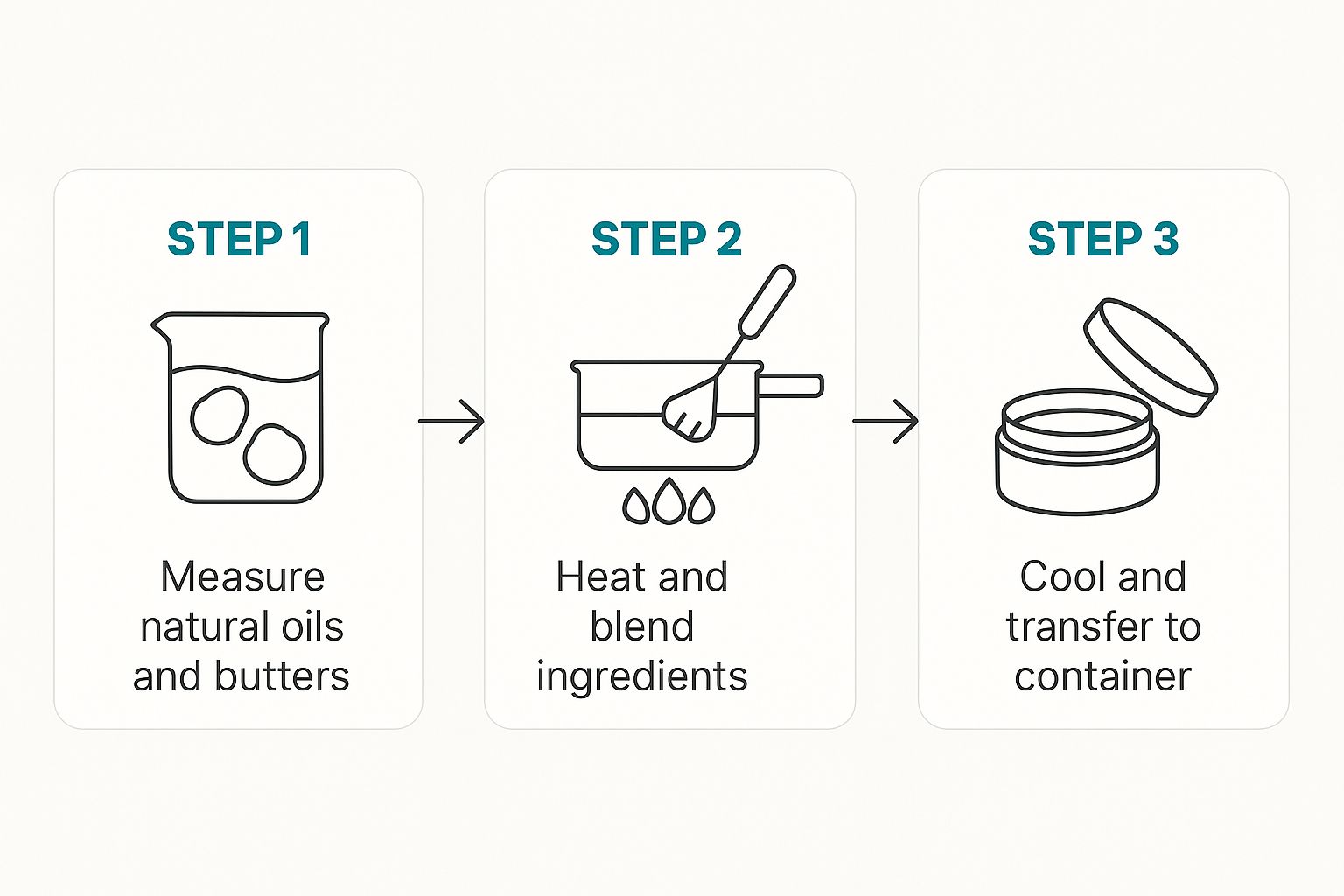
As you can see, the process flows logically from one step to the next, showing how an organized approach is the key to a fantastic final product.
The Cool-Down Phase
As your cream cools, keep stirring it by hand every few minutes. This is what ensures you get a smooth, even texture without any weird separation.
The cool-down phase is when you bring in your heat-sensitive superstars. These are the powerful active ingredients that could be damaged or lose their punch if they get too hot. Once your cream has cooled to below 104°F (40°C), it's time to add them to the mix.
Add your cool-down ingredients one by one, stirring gently but thoroughly after each addition. I like to start with the hyaluronic acid gel, then the Vitamin E oil, any essential oils, and—last but definitely not least—the broad-spectrum preservative.
Adding the preservative last is a critical step for the safety and shelf life of your cream. I can't stress this enough: any product that contains water must have a preservative to stop nasty mold and bacteria from growing.
Once everything is fully mixed in, you're done! Your cream is complete. Carefully transfer it to a clean, sanitized, and airtight container. Make sure to label it with the name of your creation and the date you made it. It’s best to let it sit for about 24 hours to fully set to its final consistency before you dive in and start enjoying your beautiful, homemade creation.
Personalizing Your Formula with Additives

Once you've nailed down a basic cream recipe, the real fun begins. Now you can start playing with cosmetic additives to transform a simple moisturizer into a powerhouse DIY anti-aging cream made just for you. Adding these potent ingredients during the cool-down phase is where you give your formula its unique personality and targeted benefits.
Think of your base cream as a beautiful, blank canvas. The additives are the vibrant colors you'll use to paint your masterpiece. By thoughtfully choosing ingredients like peptides, antioxidants, and humectants, you can design a cream that addresses your specific skin goals. This is where your inner formulator really gets to shine.
Choosing Your Star Ingredients
The world of cosmetic additives is huge, and it can feel overwhelming when you're just starting out. Let's keep it simple and focus on a few of the most popular categories that are easy for home crafters to get their hands on.
This focus on high-performance ingredients isn't just a DIY trend. In 2024, the U.S. anti-aging products market hit an incredible USD 13.99 billion, and it's still growing. This boom is about consumers seeking top-notch formulas packed with actives like peptides and hyaluronic acid. You can discover more insights about these skincare market trends to see just how big this movement is.
Here are a few of my favorite go-to ingredients:
- Peptides: These are absolute stars for promoting a firm, youthful appearance. A well-known option like Matrixyl 3000 is fantastic for helping skin look smoother and more resilient.
- Antioxidants: Ingredients like Vitamin C (look for a stable, oil-soluble form like Ascorbyl Palmitate) or Vitamin E are your skin's bodyguards. They help protect it from daily environmental stressors and give your complexion a brighter, more even look.
- Humectants: You probably have glycerin in your base, but adding a super-humectant like Hyaluronic Acid is a total game-changer. It's like a magnet for moisture, drawing it into the skin for a plump, hydrated look that makes fine lines much less noticeable.
Safe and Effective Usage Rates
When you're working with powerful actives, a little goes a long way. Precision is your best friend here. You absolutely have to follow the supplier's recommended usage rates to make sure your cream is both gentle and works as intended. Trust me, using more of an active ingredient won't get you better results faster—it's more likely to irritate.
My golden rule of formulating has always been: "Start low and go slow." You can always bump up the percentage in your next batch, but you can't take an ingredient out once it's in there.
To help you get started, I've put together a quick reference table of some of the most common additives you might want to try.
Popular Cosmetic Additives for Your DIY Cream
Here’s a quick look at some popular active ingredients, what they do for the skin's appearance, and the typical amounts to use.
| Ingredient | Appearance Benefit | Usage Rate | Phase to Add |
|---|---|---|---|
| Matrixyl 3000 | Promotes a firm, smooth look | 3-8% | Cool-Down |
| Hyaluronic Acid (1% Solution) | Gives skin a plump, hydrated look | 1-5% | Cool-Down |
| Niacinamide (Vitamin B3) | Visibly improves skin tone and texture | 1-5% | Water or Cool-Down |
| Vitamin E Oil | Provides antioxidant benefits | 0.5-2% | Cool-Down or Oil |
Always double-check the specifics with your supplier, as concentrations and recommendations can vary between products.
The Importance of pH Testing
Okay, this last step is absolutely critical, so don't skip it! After you've mixed in all your beautiful ingredients, test the pH of your finished cream. Your skin's surface is naturally a little acidic, sitting somewhere between 4.5 and 5.5. Creating a cream within this range means it will be much gentler and work better with your skin's natural barrier.
You can grab some pH test strips online or from a local supplier—they're cheap and super easy to use. Just dip a fresh strip into a little bit of your cream and match the color to the chart that comes with them.
If your cream's pH is too high (too alkaline), don't panic. You can easily bring it down by adding a single, tiny drop of a citric acid or lactic acid solution (I use a 50% solution mixed with distilled water). Stir it in really well, then test it again. This final tweak ensures your custom cream is perfectly balanced and ready for you to enjoy.
Keeping Your Homemade Cream Fresh and Safe
You did it! You’ve whipped up a batch of gorgeous, silky DIY anti-aging cream. Now for the most important part: making sure all that hard work results in a cream that stays fresh, safe, and effective.
Think of it this way: any time you add water, aloe, or hydrosols to a recipe, you're rolling out the welcome mat for bacteria, mold, and yeast. That’s why a preservative isn't just a suggestion; it's a non-negotiable for safe home formulating. Skipping it is like leaving a fresh meal on the counter for days—you just wouldn't risk it.
Why a Preservative is a Must-Have
There's a common myth floating around that antioxidants like Vitamin E or certain essential oils can preserve a cream. While they’re fantastic for keeping your oils from going rancid (a process called oxidation), they do absolutely nothing to stop microbial growth.
For that, you need a true broad-spectrum preservative. This is an ingredient specifically designed to fight off a whole host of nasty microorganisms. Using one means your beautiful creation will be safe to use for months, not just a few days. It's all about peace of mind.
Thankfully, there are some great, naturally derived preservatives out there, perfect for home crafters. A popular and effective choice is a blend of Gluconolactone and Sodium Benzoate, which offers reliable protection. Our GSB Natural Preservative Powder is a fantastic option to keep your creations pristine.
Remember, a well-preserved cream is a safe cream. This one step elevates your DIY project from a perishable item with a three-day shelf life to a stable cosmetic you can use with confidence for months.
Smart Storage for a Longer Shelf Life
Once your cream is preserved correctly, how you store it makes a huge difference. The biggest enemies of your delicate ingredients are light, air, and heat. They can break down active ingredients and reduce the potency of your cream over time.
To keep your formula in top shape, follow these simple tips:
- Pick the Right Container: Opt for opaque or dark-colored containers, such as amber or cobalt blue glass. They act like sunglasses for your cream, shielding it from damaging light. Better yet, use an airless pump bottle. It minimizes oxygen exposure and keeps you from introducing bacteria with your fingers.
- Keep It Cool and Dark: A cabinet or drawer is the perfect home for your cream—away from direct sunlight. Try to avoid the bathroom counter, where the steam and temperature swings can mess with the emulsion and degrade your lovely ingredients.
- Use Clean Hands (or a Spatula!): If you're using a jar, always scoop out the cream with freshly washed hands. For bonus points, use a small cosmetic spatula. This simple habit prevents you from re-introducing bacteria into the jar, keeping your product pure from the first scoop to the last.
Troubleshooting Your DIY Skincare
Jumping into the world of making your own skincare is a blast, but let's be real—it's totally normal to have questions. Getting a handle on the common hiccups can boost your confidence and help you figure out what to do when things don't go exactly as planned. Let's walk through some of the most frequent questions that pop up for at-home formulators.
This is all about giving you clear, practical answers for the typical challenges you'll face when making your own DIY anti-aging cream. From a cream that decides to un-mix itself to getting the pH just right, I've got you.
Why Did My DIY Cream Separate?
It’s one of the most frustrating moments for any DIYer: you whip up a gorgeous, silky cream, only to check on it a day later and find it’s separated into a puddle of oil and water. This is hands-down the most common issue for beginners, and the culprit is almost always a broken emulsion.
When an emulsion isn't stable, it’s usually because of one of these things:
- Temperature Mismatch: Your oil and water phases weren't the same temperature when you tried to combine them. To achieve a firm bond, heat both phases to about 160°F (70°C) before mixing.
- Not Enough Emulsifier: You might not have used enough emulsifying wax to hold all the oil and water together in your recipe. It's worth double-checking your formula's percentages to make sure your emulsifier can handle the job.
- Mixing Too Much: It sounds counterintuitive, but blending too aggressively after the initial emulsion forms can actually break it apart. Once you see the cream start to come together and thicken, switch from your power mixer to gentle hand-stirring.
Think of it like making a good vinaigrette. You need the right amount of an emulsifier (like mustard) and a really good initial whisk to keep the oil and vinegar from going their separate ways. A stable emulsion is the heart of a great cream, and the same principle applies here, just with a bit more science.
Can I Make a Cream Without a Preservative?
I get this question a lot, and the short answer is no—not if there’s any water in it.
Any product that contains water, aloe vera juice, or a hydrosol is the perfect breeding ground for bacteria, mold, and yeast. This is a serious safety issue you can't skip.
If you’re absolutely set on a preservative-free formula, it must be anhydrous, meaning it contains no water. Anhydrous products, like body butters made from only butters and oils, don’t need a preservative. But for a classic lotion or cream, a broad-spectrum preservative isn't just a good idea—it's essential for a safe product you can use for months.
How Should I Test a New Homemade Cream?
Never, ever slather a brand-new creation all over your face without testing it first. A patch test is a super simple but critical step to make sure your skin is on board with your new formula.
Just apply a small, pea-sized amount of the cream to a hidden spot. The inside of your wrist, the crook of your elbow, or the area right behind your ear are all great places. Leave it alone for a full 24 hours, then check for any redness, itching, or irritation. This little bit of patience can save you from a much bigger problem later.
What Is the Right pH for My DIY Cream?
Nailing the pH is one of those final touches that takes your cream from homemade to pro-level. Your skin’s surface is naturally a little acidic, usually somewhere between 4.5 and 5.5. When you formulate your cream to match that range, you’re helping support your skin's protective barrier.
You can easily check the pH of your finished cream with some inexpensive pH test strips. If you find your cream is too alkaline (say, above 6.0), you can adjust it. Just add a single drop of a lactic acid or citric acid solution, stir it in really well, and test again. Keep going until you hit that skin-loving sweet spot.
At Skin Perfection, we believe in giving you the knowledge and top-notch ingredients to create beautiful, personalized skincare. Take a look at our full range of lotion making supplies and cosmetic actives to bring your formulas to life.
Shop our DIY supplies at naturalorganicskincare.com