

 Buy with Prime


You've opened a lotion making kit, lined up the oils and botanical ingredients, and imagined a smooth, elegant cream coming together in one satisfying afternoon. Then the practical questions arrive. How should the water and oil phases be measured? When should the preservative go in? Can a lotion look perfectly creamy and still be unsuitable for use?
A responsible formulator treats those questions as part of the creative process, not as obstacles. A water-based lotion is a carefully controlled emulsion, and the quality of the result depends on sanitation, mass-based weighing, temperature control, preservation, packaging, testing, and accurate cosmetic-only claims.
Table of Contents
- Unboxing and Preparing Your Formulation Workspace
- Mastering the Heating and Emulsification Process
- Cooling and Incorporating Heat-Sensitive Actives
- Navigating Preservation and Realistic Shelf Life
- Formulating Within Cosmetic Claim Boundaries
- Designing a Stability Testing Protocol for Pilot Batches
Unboxing and Preparing Your Formulation Workspace
Opening a lotion making kit is exciting because every component suggests a finished product. You may find oils, an emulsifier, a water phase, functional ingredients, containers, and instructions arranged together. Before heating anything, read the complete procedure and identify which tools are included and which must be supplied separately.
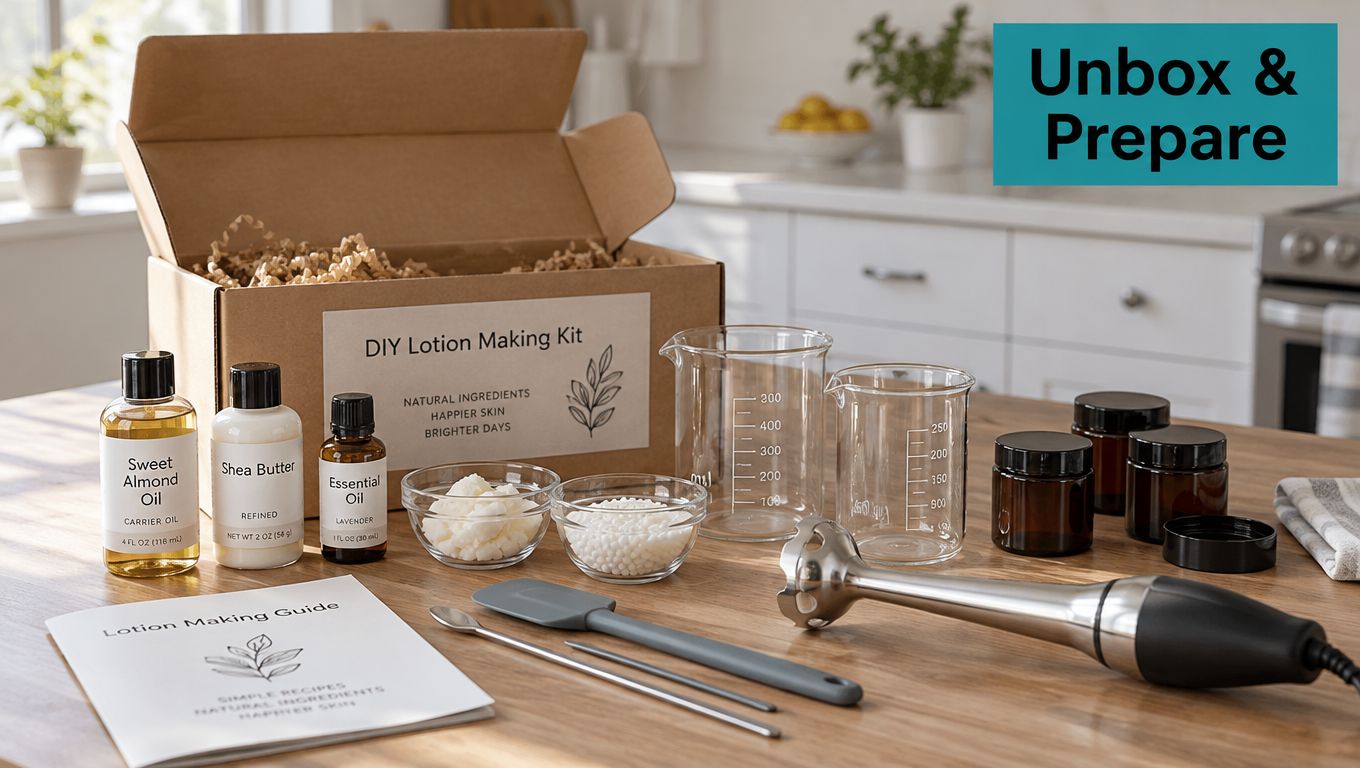
A clean, dedicated workspace matters because contamination can come from hands, utensils, surfaces, pets, and poorly stored raw materials. Keep the area away from children and animals, tie back hair, and use suitable protective clothing, gloves, and eye protection when the formulation or supplier directions call for them. Sanitize your mixing vessels, spatulas, thermometer probe, immersion blender shaft, and final containers before weighing.
Why mass beats volume
Measure every ingredient by mass, using a calibrated digital scale. Volume measurements vary with density, temperature, the shape of a spoon, and how tightly a powder settles. A scale gives you a reproducible batch record and makes it possible to calculate each ingredient as a percentage of the final batch weight.
Your basic workstation should include:
- A calibrated scale: Use it for every ingredient, including small additions.
- Sanitized vessels: Separate the aqueous and oil phases before combining them.
- A thermometer: Confirm that both phases reach the intended matched temperature.
- A pH meter: Check the finished emulsion and any pH-sensitive preservative system.
- High-shear equipment: An immersion blender or suitable homogenizing tool helps build a uniform emulsion.
- Batch documentation: Record ingredient lot information, weights, processing observations, pH, and packaging.
For additional ideas about ingredients and equipment, compare this organic lotion-making supplies guide. It's also useful to review finished options such as best lotions for soft smooth skin, especially when you want to compare the texture and dispensing experience of a professionally prepared lotion with your own pilot batch.
Practical rule: If you can't write down what went into a batch and how you processed it, you can't reliably reproduce or troubleshoot it.
Mastering the Heating and Emulsification Process
Oil and water don't stay blended just because they were stirred together. A stable lotion needs a controlled sequence that gives the emulsifier enough heat and mechanical energy to organize the two phases.
Build the emulsion in stages
Start by weighing the aqueous phase into one sanitized vessel and the oil phase into another. Heat them separately to the matched temperature specified by the formula and supplier instructions. The infographic below presents a common process sequence, including the supplied 70 to 75°C heating range and the 3 to 5 minute initial blending interval.
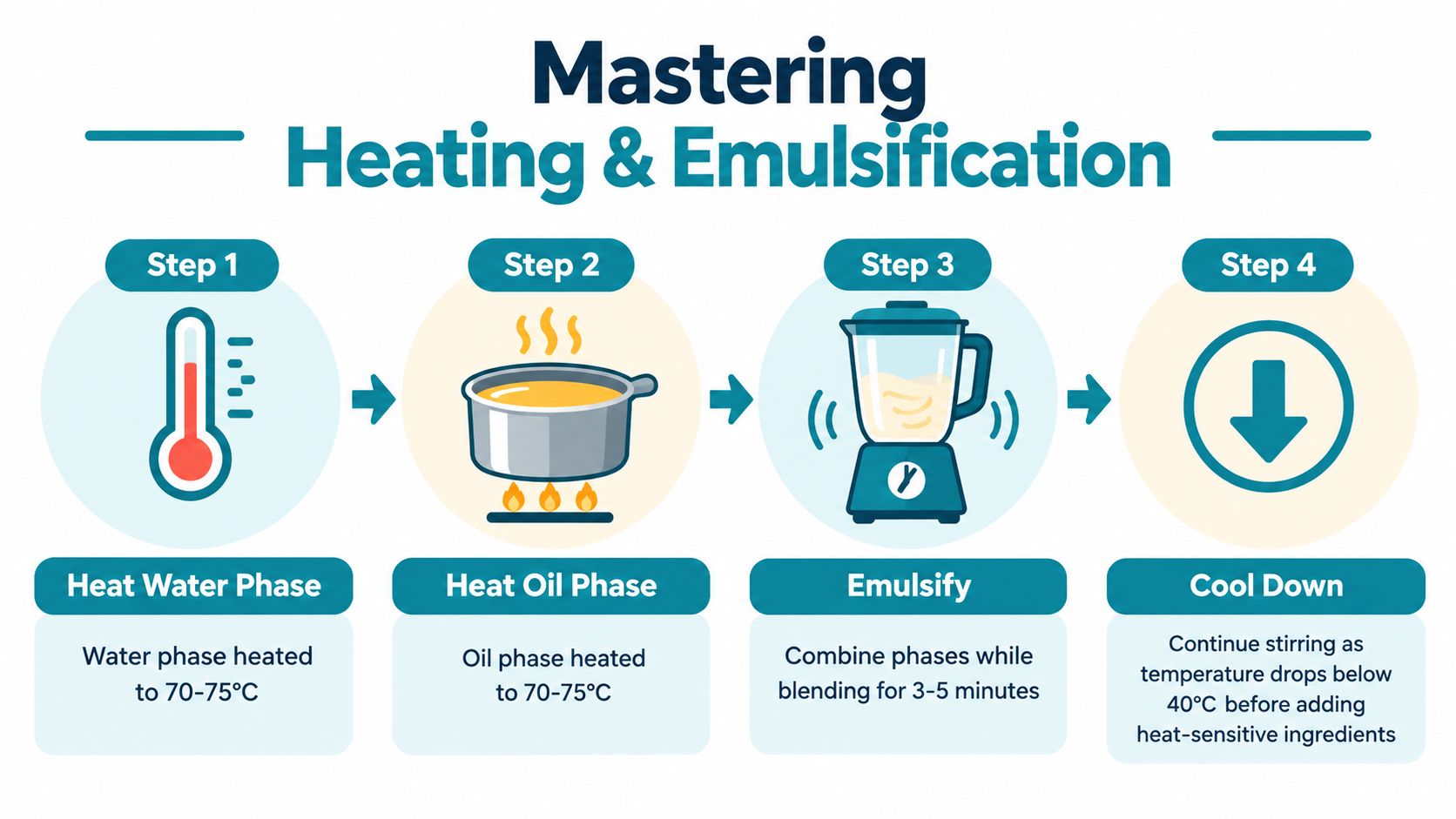
When both phases are at the target temperature, combine them gradually while applying high-shear mixing. Keep the blender head below the surface where possible. This reduces unnecessary air incorporation, which can create bubbles, distort the apparent viscosity, and make it harder to judge the true texture.
Continue mixing through the initial emulsification period, then switch to gentler agitation as the lotion cools. Scrape the vessel walls carefully so that the material at the edges doesn't cool into a different structure from the center. The formula may look fluid at first and thicken later, so don't make an early judgment about its final consistency.
A process refined over centuries
The method has a long cosmetic history. The earliest formulation commonly associated with modern lotion and cream making is attributed to Galen, a Greek physician working in the Roman Empire around 150 CE. His preparation reportedly combined water, molten beeswax, and olive oil, representing an aqueous phase, an oil phase, and a structuring agent, as described in this historical review of cold creams.
That history explains why a modern lotion making kit separates water, oils, waxes or emulsifiers, and optional functional ingredients. The tools are contemporary, but the underlying challenge remains the same: create a controlled oil-and-water system that remains uniform after cooling and during use.
For a focused explanation of phase matching and mechanical mixing, consult this resource on how to emulsify oil and water. A good formula can still fail if the phases aren't heated consistently, the emulsifier isn't fully incorporated, or the mixer adds excessive air.
Cooling and Incorporating Heat-Sensitive Actives
The cool-down phase decides whether a promising emulsion becomes a usable lotion. As the batch loses heat, keep the mixer moving at a gentle pace instead of letting the vessel sit still. That steady agitation helps the emulsion cool evenly and lowers the risk of localized thickening, separation, or an uneven spread of later additions.
A practical workflow for a water-based lotion stays simple:
- Sanitize equipment and containers.
- Weigh ingredients by mass.
- Heat the aqueous and oil phases separately to the same temperature range.
- Combine them under high-shear mixing.
- Cool with continued gentle agitation.
- Add heat-sensitive actives and preservative within the supplier's stated temperature and pH range.
That approach fits the preservation-testing mindset described in ISO 11930. A quick visual check is not enough. A responsible formulation process treats processing conditions, preservation, and verification as linked steps.
Add sensitive materials deliberately
Botanical extracts, peptides, some vitamins, fragrances, and essential oils can change under heat, oxidation, or the wrong pH. Add them because the supplier data supports the timing, not because the lotion feels cool to your hand. Use the supplier's temperature limit, recommended use rate, solubility notes, and pH compatibility before you commit them to the batch.
The same discipline applies to preservatives. A broad-spectrum preservative is not a general-purpose add-in that works at any stage. Its performance depends on the correct concentration, final batch weight, pH, processing temperature, and compatibility with the rest of the formula.
Concentrated actives can also shift viscosity or destabilize the emulsion if they are not dispersed well. Pre-dissolve or pre-disperse them exactly as the supplier recommends, then add them slowly while stirring gently. Avoid vigorous blending at this point unless the formula specifically calls for it.
For ingredients that need separate handling or preparation, this guide to ascorbic acid powder for skin gives useful formulation context. A finished lotion should stay smooth, uniform, and free from unexplained particles, air pockets, or sudden thinning.
Formulator's note: A beautiful texture shows good processing. It does not prove preservation or long-term stability.
Navigating Preservation and Realistic Shelf Life
A lotion can look clean and still carry microbial risk. Once water is part of the formula, contamination can come from raw materials, tools, hands, packaging, storage, and repeated use. A “natural” label or a “preservative-free” claim does not change that reality.
The U.S. Food and Drug Administration identifies ineffective preservation, inadequate packaging, poor manufacturing conditions, and warm or damp storage as contamination risks. It also warns that adding water or saliva can dilute preservatives and support microbial growth, as explained in the FDA's guidance on microbiological safety and cosmetics.
Preservation requires calculation and testing
Work from the final batch weight, not the water phase and not the jar size. Confirm the supplier's use rate, pH range, temperature limit, and compatibility before the preservative goes in. If you change the formula, preservative, supplier, packaging, or process, treat it as a new system and check it again.
Consumer use adds its own burden. Research on 96 consumer-used personal-care and topical products found that many products exceeded commonly used microbial limits, including 55% of certain eye and face products and 79% of mascara products containing broadly accepted preservative systems. The lesson is simple. Preservation depends on clean processing, suitable packaging, correct pH, and testing, not on appearance alone.
For handling aqueous materials in a lab-style routine, review bacteriostatic water. It is useful context, but it is not a replacement for a complete cosmetic preservation strategy.
Choose packaging that limits contact
An airless pump usually reduces repeated finger contact more effectively than an open jar. A jar can work for thick creams, but each opening exposes the product to the user and the surrounding environment. Do not add water after filling to loosen the lotion. Quarantine any batch that develops an unexpected odor, visible growth, separation, or a major texture change.
A preservative challenge test measures antimicrobial protection under controlled conditions. ISO 11930 describes a reference approach in which a finished product is inoculated with calibrated microorganisms and survivors are assessed at defined intervals across 28 days ISO 11930. That gives far better evidence than assuming a product is safe because it still looks fresh.
Formulating Within Cosmetic Claim Boundaries
The same discipline used to weigh and process a lotion should guide the product listing. A formula can be carefully made and still create regulatory or marketplace problems if its description promises effects beyond cosmetic appearance.
The U.S. FDA determines whether a skincare product is a cosmetic or a drug primarily through intended use. Cleansing, beautifying, promoting attractiveness, moisturizing, softening, and altering appearance fit within cosmetic positioning, while claims about treating disease or affecting the structure or function of the body can change the product's legal category, as explained in the FDA's cosmetic or drug guidance.
Write what the product does cosmetically
A responsible listing can describe a lotion as lightweight, rich, silky, fast-absorbing, scented, unscented, moisturizing, or designed to improve the look and feel of skin. It can discuss the formula's ingredients and sensory profile without turning those ingredients into medical promises.
Avoid language suggesting that a product treats, mitigates, diagnoses, or cures a disease or medical condition. Don't describe it as an alternative to an analgesic, antibiotic, antiseptic, antiviral, anti-inflammatory, steroid, vaccine, decongestant, prescription drug, or FDA-approved product.
This matters on Etsy as well as on your own website. Etsy's medical claims policy applies to titles, descriptions, images, and implied statements. The platform can remove listings that suggest a product treats or prevents a condition, regardless of whether the maker believes the claim is accurate.
Keep responsibility visible
Skin Perfection follows FDA rules and Etsy requirements for product listings and sells skincare products and lotion-making supplies intended to beautify the skin. Its formulation resources and supplies can support customization, but the maker remains responsible for safe processing, labeling, packaging, and truthful claims. Further regulatory context is available in this guide to cosmetic regulations.
Labels should use ingredients' common or usual names and should not imply official FDA approval. If you sell or gift a lotion, describe the product accurately and keep the promise focused on appearance, texture, and user experience.
Designing a Stability Testing Protocol for Pilot Batches
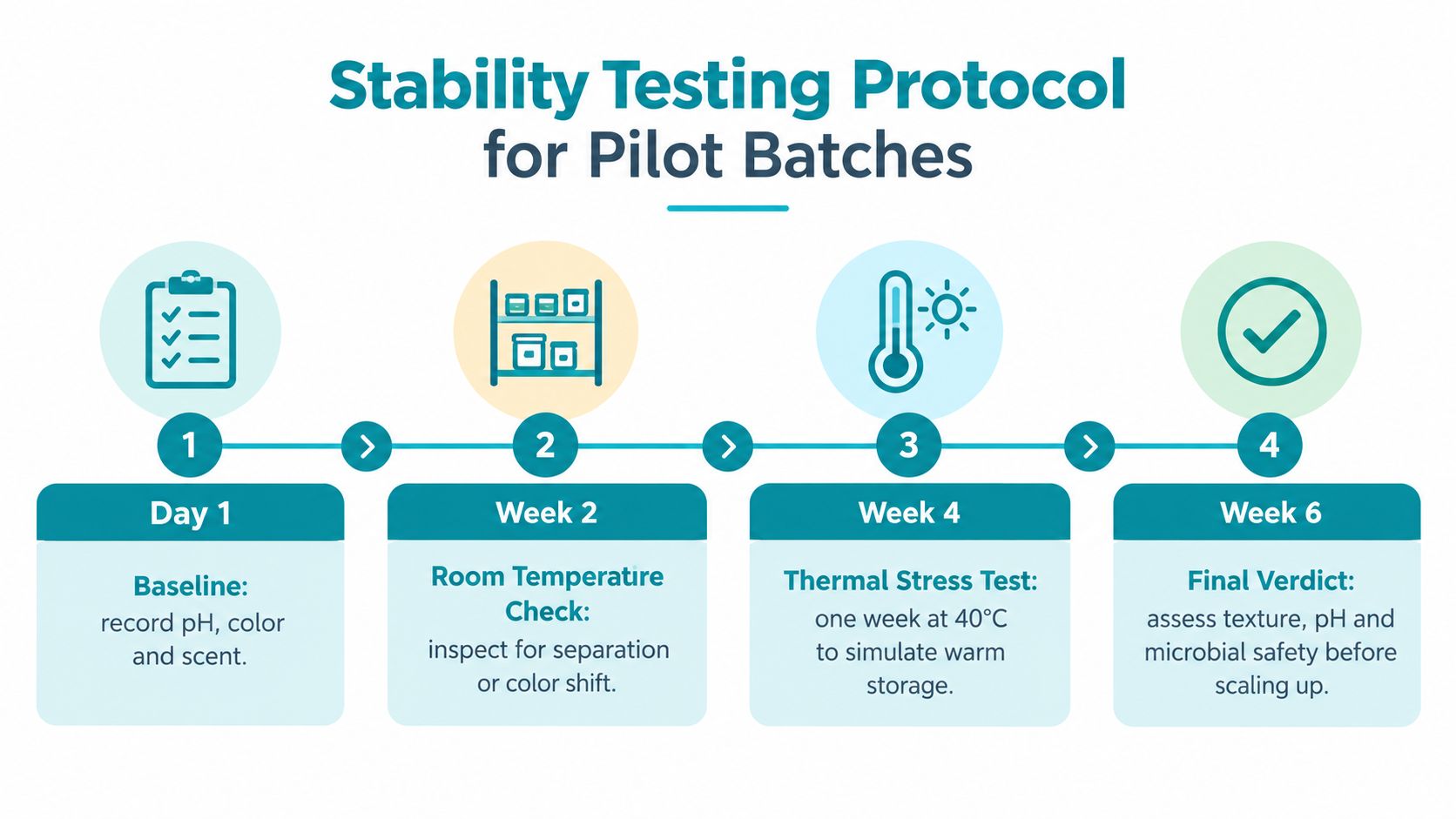
A lotion isn't ready for wider distribution because it looked smooth on the day it was made. Stability should be treated as a test program, with observations recorded against acceptance limits decided before testing begins.
At baseline, record the batch identification, appearance, odor, color, pH, viscosity, and emulsion integrity. Photograph the sample under consistent conditions if that helps you detect gradual change. Keep retained samples in their intended packaging, because the container affects dispensing, contamination exposure, and the way the emulsion experiences air.
Use varied storage conditions
Store pilot samples at room temperature, under refrigeration, and under high-temperature conditions. Published cosmetic-emulsion stability practice evaluates samples at 4°C, room temperature, 40°C, and 50°C, with observations at intervals such as days 0, 1, 2, 7, 14, 30, 60, 90, 180, and 360 cosmetic emulsion stability practice.
For a practical pilot screen, create a record like this:
- Baseline: Note pH, color, odor, viscosity, and visible uniformity immediately after filling.
- Early checks: Look for creaming, separation, air release, unexpected thinning, or a rapid odor change.
- Temperature comparison: Compare room, refrigerated, and high-temperature samples rather than relying on one storage condition.
- Acceptance limits: Define the allowable pH range, viscosity range, color change, odor profile, and dispensing behavior before reviewing results.
- Decision point: Quarantine any sample with unexplained separation, odor, material pH change, or unusual viscosity drift.
Centrifugation can help screen for creaming or phase separation, but it doesn't replace real-time stability observation or microbiological testing. A successful preservative challenge test also doesn't prove that the emulsion will remain physically stable.
Heat-sensitive materials deserve their own storage review. This information about peptide storage and stability can help you think through ingredient handling, but the finished lotion still needs evaluation as a complete formula. For microbiological verification, use a suitable bacterial test kit or qualified testing service appropriate to your product and market.
Skin Perfection offers assembled lotion-making kits, ingredients, preservatives, essential oils, bulk bases, tools, and airless bottles for DIY formulators and skincare professionals. Choose supplies that support mass-based weighing, hygienic processing, controlled preservation, and cosmetic-only presentation, then visit Skin Perfection to build a more disciplined formulation workspace.