

 Buy with Prime


You're standing in front of the mirror, noticing that your skin doesn't look quite as springy as it once did. On the shelf, a serum promises firmer-looking skin, and the ingredient list includes palmitoyl tripeptide-5. The name sounds technical, but the practical question is simple: does this peptide deserve a place in your routine, or is it another impressive-sounding addition?
Palmitoyl tripeptide-5 is best understood as a supporting cosmetic active. It has a plausible collagen-signalling mechanism and some reported human-study results, but it isn't a miracle in a bottle, a drug, or a substitute for proven routine basics. This guide separates what the molecule is thought to do from what the available evidence demonstrates, then applies that information to product selection and DIY formulation.
If you're comparing peptide serums, the broader explanation in this guide to what peptide serum means can help with the terminology. By the end, you'll be able to read an INCI list more confidently, judge a formula rather than a marketing promise, and decide whether palmitoyl tripeptide-5 fits your skincare goals.
Table of Contents
- Meet Palmitoyl Tripeptide 5 and Why It Is in Your Serum
- What Palmitoyl Tripeptide 5 Actually Is
- How Palmitoyl Tripeptide 5 Supports Collagen and the Skin Matrix
- What the Research Actually Shows
- How Palmitoyl Tripeptide 5 Compares to Other Anti-Aging Actives
- Formulating With Palmitoyl Tripeptide 5 at Home and in the Studio
- Setting Realistic Expectations and Shopping Smart
Meet Palmitoyl Tripeptide 5 and Why It Is in Your Serum
A reader once described the buying decision perfectly: she had several serums in her hand, each promising smoother, firmer-looking skin, but only one listed palmitoyl tripeptide-5 near the front of the formula. She wanted to know whether that placement meant the product would visibly change her skin, or whether it only made the label look more advanced.
The honest answer starts with a distinction. Palmitoyl tripeptide-5 is a signal peptide, so formulators use it to send a message associated with the skin's extracellular matrix. That makes it different from a moisturizer that mainly improves surface hydration, and different from an exfoliant that loosens the bonds between surface cells. Its role is quieter. It supports the conditions associated with a firmer, smoother appearance over consistent use.
The ingredient is often marketed under the name Syn-Coll, but a trade name doesn't guarantee a particular result in every finished product. The supplier's raw material, the amount used, the surrounding formula, packaging, preservation, and storage all influence what reaches the skin.
What this guide will help you judge
You'll see five practical questions answered:
- What is it? The structure explains why the molecule belongs to the peptide family.
- How might it work? The proposed pathway involves fibroblast signalling, collagen production, and reduced activity from enzymes that break down matrix proteins.
- What do studies report? The strongest available figures come from limited, manufacturer-linked research, so they need careful interpretation.
- How does it compare? Retinoids, vitamin C, niacinamide, hyaluronic acid, and other peptides serve different roles.
- How can you formulate with it? DIY makers need to think about stock strength, pH, heat, packaging, and cosmetic claims.
A useful starting point: Treat palmitoyl tripeptide-5 as a low-risk supporting active, not as the main engine of an entire anti-aging routine.
That framing keeps expectations sensible. The peptide may contribute to a smoother and firmer-looking complexion, but it won't replace daily sun protection, sensible hydration, or a carefully chosen renewing active. It also doesn't turn a weak formula into a strong one just because the ingredient list contains a familiar peptide name.
By the time you finish, you should be able to decide whether the ingredient belongs in your serum, lotion, or studio formula, and whether a particular product gives you enough information to make that decision.
What Palmitoyl Tripeptide 5 Actually Is
Start with the name. A tripeptide is a short chain made from three amino acids. Palmitoyl tripeptide-5 adds a palmitoyl group, a fatty-acid portion that acts like a delivery handle. A simple analogy is a small message attached to a handle that helps the message interact more effectively with the skin's surface and upper layers.
The molecule is synthetic and cosmetic-grade, not a botanical extract. Its INCI name is Palmitoyl Tripeptide-5, which is the name you should look for on a finished-product ingredient list. The common trade name Syn-Coll refers to the marketed ingredient, while the INCI name identifies the cosmetic ingredient itself.
Its commercial history also helps put the molecule in context. Palmitoyl tripeptide-5 traces to Pentapharm, a Swiss cosmetic-ingredients company founded in 1948. Formulation guidance for Syn-Coll dates to December 2004, and DSM acquired Pentapharm in July 2007. The ingredient received public presentation at in-cosmetics in Munich in 2009, a clear commercialization milestone for its place in the modern peptide-cosmetics market. This history is documented in the palmitoyl tripeptide-5 ingredient profile.
Don't confuse the peptide names
The number in the name matters. Palmitoyl tripeptide-5 contains three amino acids in its peptide sequence. Palmitoyl pentapeptide-4, commonly known as Matrixyl, contains five. Both include a palmitoyl group, but they aren't interchangeable ingredients and shouldn't be treated as if they follow identical signalling pathways.
The confusion grows because skincare labels often place several peptides together. You may see palmitoyl tripeptide-5 alongside other palmitoylated peptides, copper peptides, or longer peptide complexes. Read each INCI name separately rather than assuming that every ingredient containing “palmitoyl” provides the same function.
What its status means
Independent summaries describe palmitoyl tripeptide-5 as a topical cosmetic active, not a drug. It has no FDA-, EMA-, or PMDA-approved systemic indication. That distinction matters for both consumers and sellers. A cosmetic product may be designed to improve the look and feel of skin, but it shouldn't be presented as diagnosing, treating, healing, or curing a medical condition.
This is why a responsible product description uses cosmetic language such as “supports a firmer-looking appearance” or “helps skin feel smoother.” It doesn't claim that the ingredient changes a disease process or provides a prescription-level result.
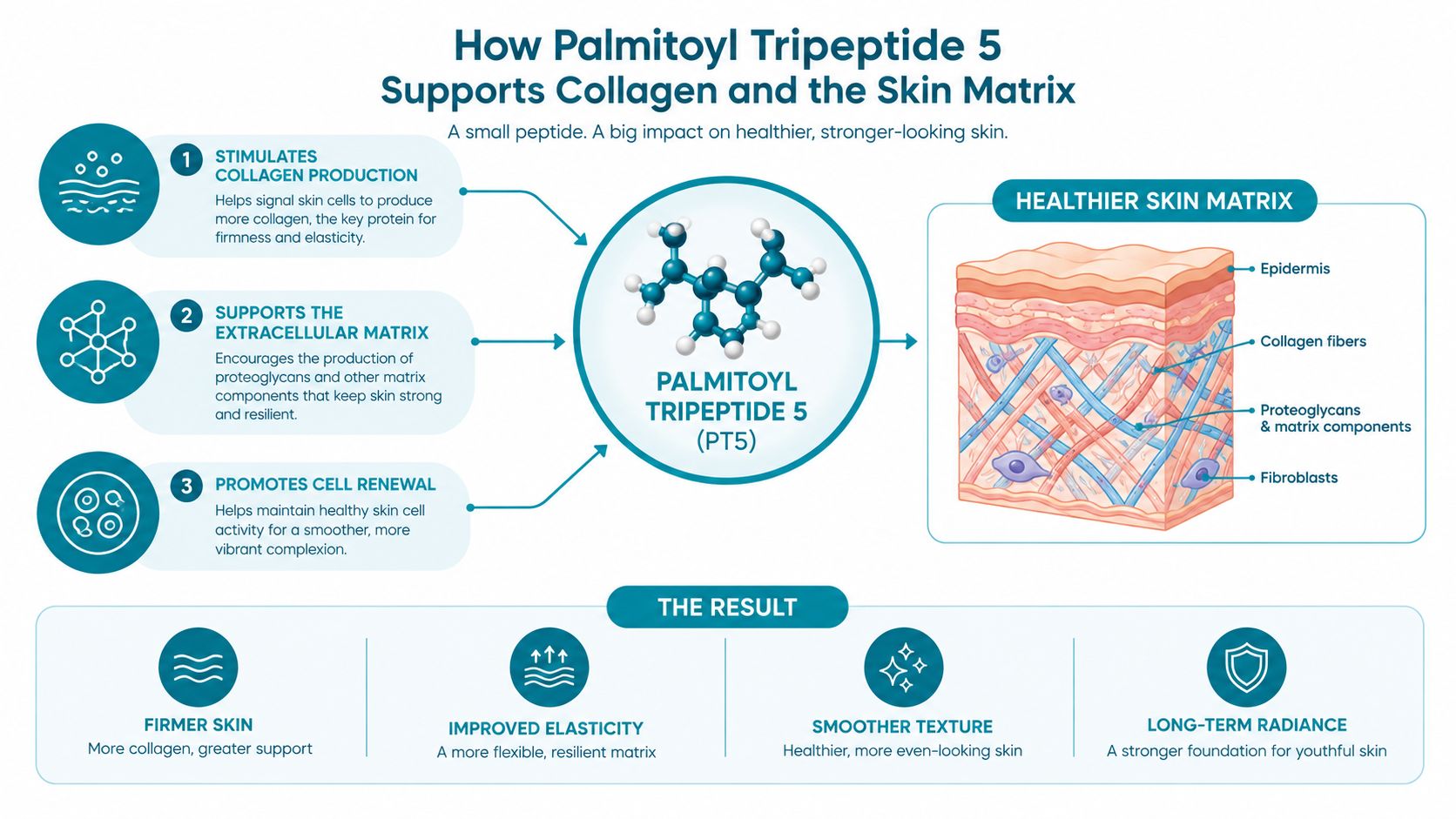
How Palmitoyl Tripeptide 5 Supports Collagen and the Skin Matrix
The dermal matrix works like a scaffold. Fibroblasts are the builders, collagen and fibronectin provide structural materials, and matrix metalloproteinases, or MMPs, help break down older matrix proteins.
Palmitoyl tripeptide-5 is described as a thrombospondin-1 and TGF-β mimetic. In practical terms, it resembles a signalling fragment that may encourage fibroblasts to produce matrix components. The proposed message partly involves the TGF-β pathway, which is associated with collagen-related activity. For a broader explanation, see this guide to peptides for collagen production.
The palmitoyl portion helps the peptide interact with the skin's surface and suits it to topical formulas. It does not mean the molecule travels throughout the body, and it does not make a cosmetic peptide equivalent to an injectable treatment. Its role is to support the ingredient's design as a topical signal.
Building and preserving the scaffold
The second part of the proposed mechanism concerns MMP activity. Technical product literature describes palmitoyl tripeptide-5 as helping limit collagen breakdown through MMP-related activity, including MMP-1 and MMP-3. This creates a two-part rationale: support matrix production while reducing some breakdown associated with matrix-degrading enzymes.
A review of bioactive ingredients places palmitoyl tripeptide-5 among signal peptides used in anti-aging cosmetics because of proposed effects on collagen synthesis and MMP activity. It also mentions possible tyrosinase inhibition, which has led to discussion of pigment-modulating potential. However, the review states that efficacy studies of palmitoyl tripeptide-5 alone, or in the cited mixture, were unavailable for rosacea or sensitive-skin use. Read the peer-reviewed review on bioactive ingredients as mechanistic context, not proof of a disease outcome.
Formulator's translation: This peptide supports the matrix. It does not exfoliate the surface, remove built-up dead cells, or replace a renewing ingredient.
That makes it a companion to retinoids and alpha hydroxy acids, not a replacement for them. Surface roughness may respond more quickly to hydration and controlled exfoliation. A peptide fits better as a low-risk supporting active for gradual improvements in the look of firmness.
For hydration alongside matrix support, Sodium Hyaluronate Powder Pure Hyaluronic Acid is a separate cosmetic ingredient used in water-based serums, creams, and lotions. Its stated NASHA high-molecular-weight grade is 800-1500 Daltons, and the product information describes typical DIY serum use at 0.1-2%. It can add a hydration layer to a peptide formula, while the peptide serves a different signalling role.
For textured-skin routines, an evidence-based acne moisturizer provides useful context on why barrier support and overall formula design matter alongside individual actives.
What the Research Actually Shows
The evidence has two distinct layers. Laboratory and technical material support a plausible mechanism involving fibroblasts, collagen-related signalling, fibronectin, and MMP activity. Human cosmetic studies provide reported changes in firmness and wrinkle appearance, but the available evidence is limited and much of it comes from small, manufacturer-linked studies rather than large, independently replicated randomized trials.
One clinical summary reports that topical palmitoyl tripeptide-5, used twice daily for two months, increased skin firmness by 10.8% versus placebo. The same source reports immediate reductions in fine lines of about 20% and deep wrinkles of about 28%, with further changes after three months to roughly 38% and 50%, respectively. These figures come from the ExperChem product information, so they should be read as reported supplier-linked outcomes, not as definitive proof for every serum containing the ingredient.
Key Studies on Palmitoyl Tripeptide-5
| Study | Type | Concentration | Duration | Reported Outcome |
|---|---|---|---|---|
| Firmness assessment | Human cosmetic study summary | Not stated in the verified summary | Twice daily for two months | 10.8% greater firmness versus placebo |
| Fine-line assessment | Human cosmetic study summary | Not stated in the verified summary | Immediate assessment and three months | Fine lines reported at about 20% immediately, improving to roughly 38% |
| Deep-wrinkle assessment | Human cosmetic study summary | Not stated in the verified summary | Immediate assessment and three months | Deep wrinkles reported at about 28% immediately, improving to roughly 50% |
| Matrix signalling evidence | Mechanistic and technical literature | Not stated in the verified summary | Not applicable | Proposed collagen and fibronectin support with MMP-related protection |
The table is useful, but it shouldn't hide the limitations. The summaries don't establish that the same outcomes will appear in every product, and the available human evidence is not the same as a large independent clinical literature. Objective measurements can help, while subjective grading can capture how skin looks, but neither removes the importance of study design, sample size, control conditions, and replication.
For readers comparing lifestyle, topical, and professional approaches, a broader overview of firmer skin collagen strategies can provide useful context. The decision remains personal, but palmitoyl tripeptide-5 should be placed in the category of promising cosmetic support with a constrained evidence base, not guaranteed transformation.
A practical summary of what bioactive peptides are is helpful here. Mechanistic plausibility tells you why an ingredient might work. It doesn't tell you how much visible change a specific formula will produce on your skin.
How Palmitoyl Tripeptide 5 Compares to Other Anti-Aging Actives
Suppose your morning routine already includes vitamin C, while your evening routine includes a retinoid. Palmitoyl tripeptide-5 may fit between those stronger, more clearly defined jobs as a low-risk supporting active. It is associated with dermal-matrix signalling, while retinoids focus more on renewal and collagen-related changes, vitamin C on antioxidant and brightening support, and niacinamide on barrier and tone-related goals.
Each active is a different tool. The useful question is which visible concern and tolerance level your routine needs to address.
Palmitoyl Tripeptide-5 vs Common Anti-Aging Actives
| Active | Primary Mechanism | Typical Concentration | Irritation Risk | Best Role in Routine |
|---|---|---|---|---|
| Palmitoyl tripeptide-5 | Signal peptide associated with collagen and matrix support | Product-dependent | Generally considered gentle, but patch testing remains sensible | Supporting serum or lotion active |
| Retinoids | Skin renewal and retinoid receptor activity | Product-dependent | Higher potential for dryness and irritation | Night-time renewing active |
| Niacinamide | Barrier, tone, and sebum-related cosmetic support | Product-dependent | Usually well tolerated, though formulas vary | Flexible morning or evening support |
| Vitamin C | Antioxidant and brightening support | Product-dependent | Can sting or irritate depending on form and formula | Antioxidant-focused morning formula |
| Matrixyl 3000 | Peptide complex associated with matrix support | Product-dependent | Usually low, but depends on the full formula | Peptide-focused support |
| Copper peptides | Carrier-peptide approach involving copper and skin-supporting pathways | Product-dependent | Formula-dependent | Targeted peptide step |
| Sodium hyaluronate | Water-binding hydration and surface plumping | Product-dependent | Usually low, formula-dependent | Hydration layer under moisturizer |
The table also shows why label comparisons can mislead. A peptide may arrive as a diluted stock, whereas a product label may list only a finished blend. Without the supplier specification or a disclosed amount, ingredient order alone cannot show whether two products deliver comparable peptide levels.
Build around roles, not hype
A morning routine could place vitamin C first on clean, dry skin, followed by a palmitoyl tripeptide-5 serum, moisturizer, and sunscreen. In the evening, a retinoid can take the treatment step if the skin tolerates it. Apply a hydrating sodium hyaluronate product before moisturizer, either after the peptide serum or in a separate routine when the formulas are easier to keep comfortable.
The sodium hyaluronate powder referenced earlier can improve hydration and give skin a temporarily smoother surface. It does not perform the same job as a collagen-signalling peptide, so visible plumping should not be treated as proof of matrix remodeling.
Palmitoyl tripeptide-5 also does not need to compete directly with every active. A retinoid may offer a more active renewal approach, while a peptide can provide gentler supporting care. That distinction separates mechanistic plausibility from guaranteed wrinkle improvement.
For a closer comparison of bakuchiol, retinol, and peptide routine roles, compare tolerance, formula stability, and the job each product is meant to perform. For DIY makers, the practical choice is to build around compatible functions, verify each supplier's format, and let the peptide support the routine rather than asking it to carry the entire anti-aging claim.
Formulating With Palmitoyl Tripeptide 5 at Home and in the Studio
Formulation starts with the supplier's specification sheet, not a generic recipe. Palmitoyl tripeptide-5 is commonly supplied as a diluted stock, and the final amount of peptide depends on both the stock strength and the percentage of that stock added to the batch.
For a supplied 1000 ppm stock, a typical working range described for formulation is 2-5% of the stock, producing a final dose of 2-5 ppm in the finished product. Those figures apply to that stock format. They shouldn't be copied onto a powder, a different supplier solution, or a blend with another active.
A practical bench workflow
- Confirm the raw material. Check the INCI, carrier, active percentage, recommended use level, storage conditions, and lot documentation.
- Choose a water-based format. Serums, emulsions, and lotions are more natural homes than anhydrous balms because the supplied material is commonly designed for aqueous cosmetic systems.
- Control the pH. A working window around 5.0-7.0 is commonly used for this type of formulation, but the supplier's specification takes priority.
- Limit heat exposure. Add the peptide during cool-down when the formula has reached a suitable temperature. Avoid treating it like a heat-stable wax or oil.
- Package carefully. An opaque, airtight pump can limit light and repeated air exposure better than an open jar.
- Preserve the finished product. Compatibility with common preservatives and humectants depends on the complete formula, so run stability and preservation checks rather than assuming compatibility.
A small studio should record batch size, supplier lot, stock concentration, addition percentage, pH, processing temperature, preservative system, packaging, and observations during stability testing. Home makers should work with clean equipment, accurate scales, and small batches, and shouldn't rely on visual appearance as proof of preservation.
Bench note: A precise stock calculation is more useful than a vague claim that a serum contains “a powerful peptide complex.”
Cosmetic claims for sellers
Skin Perfection sells skincare products and lotion-making supplies, and its products are positioned to beautify the look of skin. Product listings should use cosmetic language and follow FDA rules and regulations around claims. They shouldn't say that a product fixes, repairs, or heals skin, and they shouldn't imply that a cosmetic peptide is FDA-approved.
Etsy's medical-claims policy allows general wellness descriptions but prohibits claims that a listing prevents, heals, treats, diagnoses, mitigates, or cures a disease or medical condition. Its cosmetics ingredients policy also restricts products presented as treating or preventing illness, or as affecting the body's structure or function in a medical sense.
A safe seller checklist looks like this:
- Describe appearance: “supports a smoother-looking complexion” is cosmetic language.
- Avoid disease language: Don't mention treatment, cure, diagnosis, or prevention of a condition.
- Don't imply prescription equivalence: A peptide serum isn't a prescription drug.
- Don't claim approval: Don't state or imply that the product is FDA-approved.
- Keep records: Retain supplier documents, batch information, and formulation notes.
More detailed guidance on cosmetic formulation can help DIY makers move from an informal kitchen experiment toward a more controlled studio process.
Setting Realistic Expectations and Shopping Smart
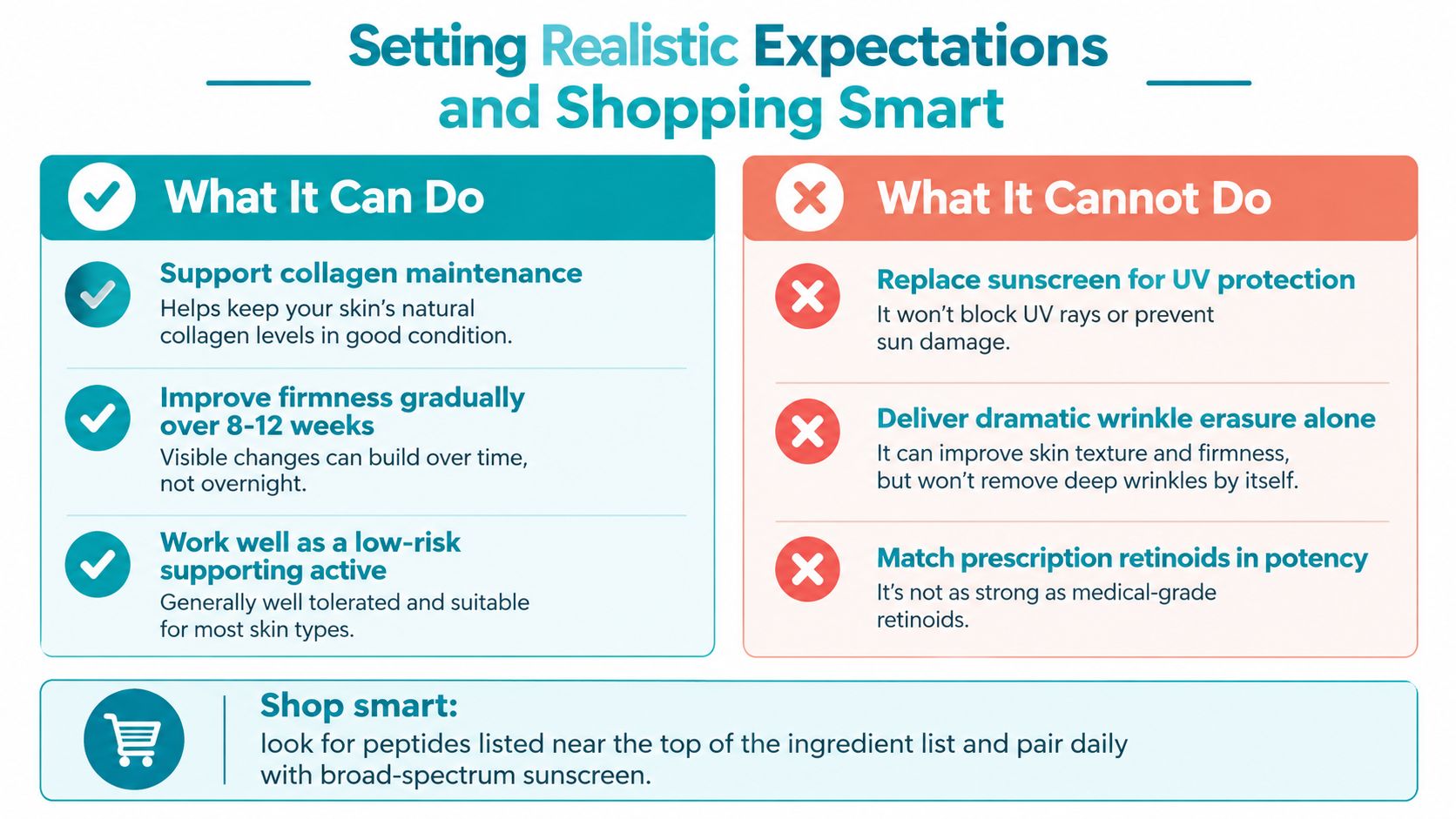
Palmitoyl tripeptide-5 can make sense when you want a gentle supporting active for a smoother, firmer-looking complexion. It may contribute to the appearance of fine-line softening over time, but it won't erase deep wrinkles, restore lost facial volume, or solve every pigment concern. Those goals require a broader plan, and sometimes professional guidance.
A realistic timeline should separate immediate surface effects from slower structural support. Hydration and texture may look better within two to four weeks, especially when the formula also contains effective humectants and emollients. Subtle changes in firmness and fine-line appearance are more reasonably assessed between eight and twelve weeks, consistent with the limited study durations reported in supplier-linked material. The ingredient still won't replace broad-spectrum sunscreen, and it shouldn't be expected to match prescription retinoids in potency.

A smarter product check
Before buying a serum or choosing a raw material, look for:
- A clear INCI listing: The exact name should be identifiable rather than hidden inside an undefined “peptide blend.”
- Supplier transparency: A concentration or stock-strength statement is more useful than the word “complex” alone.
- Suitable packaging: Opaque, airtight packaging is preferable for a delicate active.
- A balanced formula: Strong irritants may undermine a product that's meant to be gentle.
- Quality documentation: Third-party testing or a certificate of analysis can provide more confidence than a dramatic claim.
- A sensible value assessment: Price should reflect the entire formula, supplier quality, testing, packaging, and manufacturing, not just the presence of one peptide.
Patch test first, introduce the product into an existing routine, and take consistent photos in similar lighting if you want to judge gradual changes. If you have persistent irritation, a sudden change in skin, or concerns that go beyond cosmetic appearance, consult a dermatologist rather than escalating actives on your own.
The balanced verdict is straightforward. Palmitoyl tripeptide-5 is promising, plausible, and useful as a supporting ingredient, but its independent human evidence remains limited. Choose a transparent formula, pair it with routine fundamentals, and judge it by measured expectations rather than miracle language.
Skin Perfection offers skincare products and lotion-making supplies for people who want to beautify the look of their skin or create customized formulas with cosmetic ingredients. Visit Skin Perfection to explore peptide-focused skincare and formulation supplies, then choose a practical next step such as patch testing a finished product or building a carefully documented serum.