

 Buy with Prime



The most popular advice about sensitive skin is also the least precise: buy a product labeled “barrier repair” and expect it to solve the problem. That phrase describes a useful cosmetic category, but it can also blur the line between surface hydration, soothing support, and regulated medical claims.
In practice, reactive skin usually benefits from fewer irritants, better water retention, and a formula that respects the stratum corneum. The right skin barrier repair products for sensitive skin won't transform the biology of your skin overnight. They can, however, make the surface feel less tight, look smoother, and appear more comfortable when the formula combines humectants, emollients, physiological lipids, and occlusives.
Table of Contents
- The Truth About Cosmetic Barrier Support
- Key Ingredients That Support Reactive Complexions
- Building a Gentle Daily Skincare Routine
- Evaluating Commercial Formulas Versus DIY Serums
- Application Frequency and Measuring Real Progress
- Troubleshooting Common Reactive Skin Scenarios
The Truth About Cosmetic Barrier Support
“Repair” sounds reassuring, but it isn't a reliable ingredient category. In cosmetic marketing, the word can suggest that a product changes skin structure or treats a medical condition. The FDA's cosmetic claims guidance explains that products marketed to treat or prevent disease, or to affect the structure or function of the body including the skin, may be regulated as drugs rather than cosmetics.
That distinction matters for shoppers and makers. A lotion can support the appearance of smoother, softer, more hydrated skin. It can reduce the sensation of tightness by helping limit water loss. It shouldn't promise to heal, cure, or medically restore skin. The FDA's cosmetic labeling regulations also make the manufacturer or distributor responsible for accurate labeling, and cosmetics don't receive FDA pre-market approval.
Etsy applies an additional layer of caution. Its medical-claims policy for listings says a medical claim can appear in a title, description, or image, and prohibits claims that a product prevents, treats, mitigates, diagnoses, or cures a disease or medical condition. It also prohibits presenting a cosmetic as a substitute for, or as effective as, prescription or over-the-counter medication.
What cosmetic formulas can realistically do
A credible product description should focus on cosmetic outcomes:
- Hydration: Humectants such as glycerin and sodium hyaluronate help attract or hold water near the outer skin layers.
- Water-loss reduction: Occlusives such as dimethicone and petrolatum form a protective film that slows transepidermal water loss, or TEWL.
- Surface comfort: Emollients and soothing ingredients can make rough, dry-feeling skin feel more flexible.
- Visible appearance: A well-balanced moisturizer can improve the look of flaking, dullness, and uneven texture.
A 2024 dermatology review describes ceramides, cholesterol, and fatty acids as important components of the stratum corneum lipid barrier, while also noting that humectants, occlusives, and emollients can support dry, sensitive-feeling skin without requiring disease claims. Read the review's discussion of barrier-support ingredients when you want a more technical explanation.
Practical rule: Judge a cosmetic by its formula, tolerability, and clearly stated appearance benefits, not by the strongest verb on the front label.
For a consumer-friendly explanation of the symptoms people often associate with a weakened moisture barrier, this guide on how to fix damaged skin barrier offers useful routine context. Product descriptions from Natural Organic Skincare's barrier-care collection should still be read alongside the actual ingredient list and your own skin response.
Key Ingredients That Support Reactive Complexions
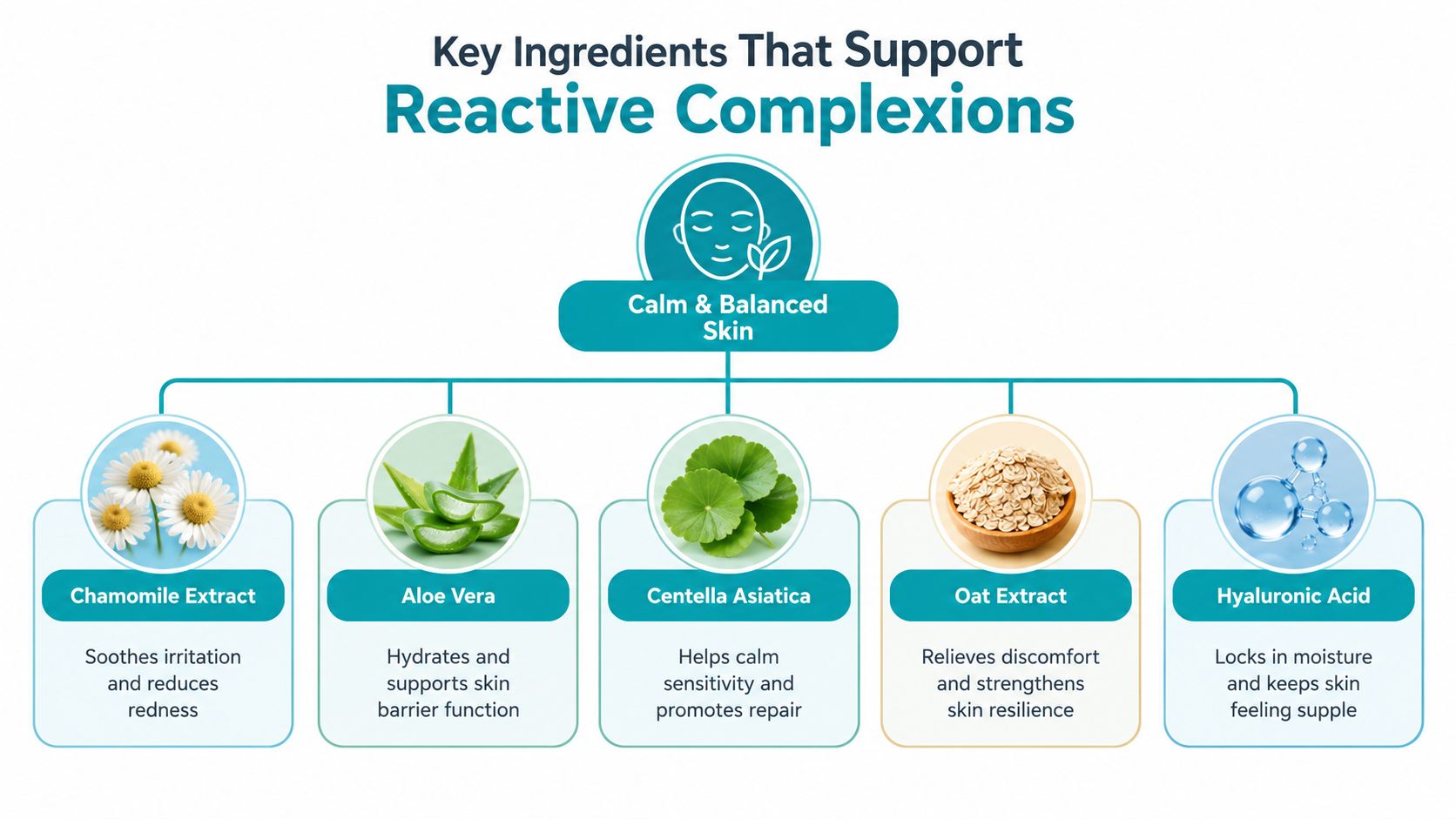
Sensitive skin doesn't need the longest ingredient list. It needs a formula that supplies water, reduces unnecessary evaporation, and avoids creating another source of irritation. The most useful way to evaluate skin barrier repair products for sensitive skin is to separate ingredients by function rather than treating every “calming” botanical as equivalent.
Physiological lipids and biomimetic design
Ceramides, cholesterol, and fatty acids work in the spaces between corneocytes, the flattened cells that form the outer stratum corneum. A recent review describes the skin's lipid barrier as commonly represented by roughly 50% ceramides, 25% cholesterol, and 10–25% fatty acids, although finished products do not automatically reproduce those proportions just because they contain all three ingredients. The review on barrier-repair moisturizers explains why lipid selection and formulation design matter more than checking off a fashionable ingredient.
A lipid blend can outperform a basic water-and-oil lotion. Petrolatum may be highly effective at forming an occlusive film, but a formula containing physiological lipids is designed to offer more than surface coating. The same review cites evidence that ceramide-containing formulations can maintain hydration and reduce TEWL for 24–48 hours, compared with 4–8 hours for formulations without physiological lipids. Those figures come from the cited review and describe formulation evidence, not a guarantee for every commercial cream.
The 2018 clinical study published in the Journal of Clinical and Aesthetic Dermatology offers a useful historical proof point. Over four weeks, investigators reported a 100% improvement in IGA scores and a 67% improvement in overall subject skin-assessment scores, along with statistically significant improvements in TEWL, skin water content, and smoothness. Review the original clinical study for the formulation and assessment details.
Humectants and soothing support
Glycerin remains one of the most dependable humectants for reactive complexions. Hyaluronic acid and sodium hyaluronate also bind water, but they don't replace an emollient or occlusive. If a humectant-rich serum leaves skin tight, the missing step is often a cream or lotion that slows evaporation.
Aloe and panthenol can contribute to a comfortable, conditioned feel, while betaine may help a formula feel less harsh during cleansing and hydration. Ingredient tolerance still matters more than a “natural” label, so this overview of betaine skincare can be a useful starting point for comparing ingredient roles.
For formulators, Sodium Hyaluronate Powder Pure Hyaluronic Acid is a cosmetic-grade powder intended for water-based serums, creams, and lotions. The product snapshot specifies a high-molecular-weight NASHA grade of 800–1500 Daltons and typical DIY serum concentrations of 0.1–2%, so careful weighing and preservation remain essential when making a water-based product.
Building a Gentle Daily Skincare Routine
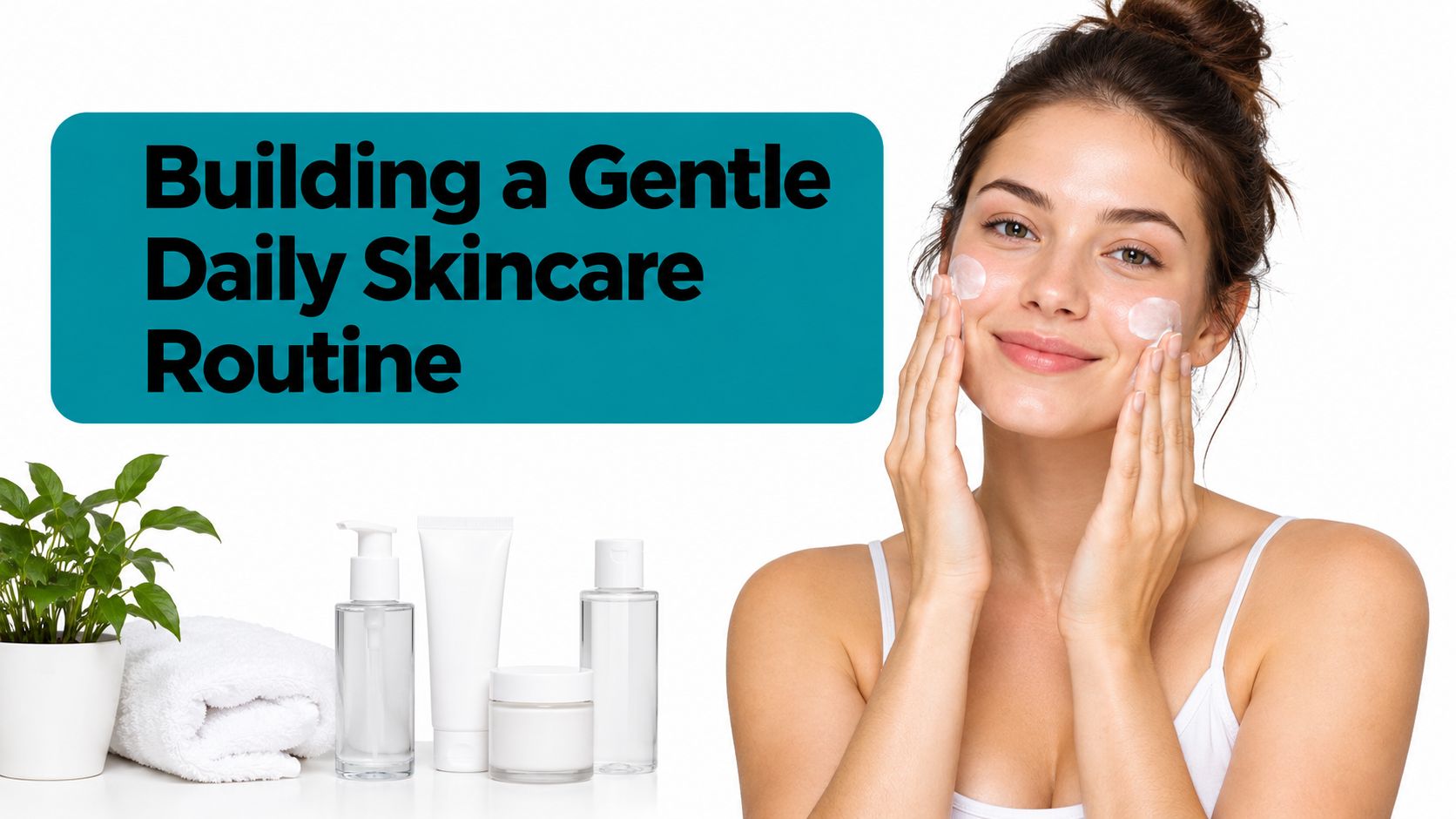
A reactive routine should be boring on purpose. The fastest way to lose control is to add a cleanser, acid, retinoid, essence, mask, and new moisturizer at the same time. You won't know which product helps, which one stings, or whether the combination is too much.
Morning choices
Begin with lukewarm water or a low-foam, fragrance-free cleanser if you need cleansing. Harsh surfactants, very hot water, vigorous rubbing, and repeated washing can leave sensitive skin feeling stripped, especially when the cleanser is followed by several active products.
Apply a simple moisturizer while skin is still slightly damp. Look for a combination of humectants, emollients, and an occlusive rather than choosing a product based on one hero ingredient. During the day, use a sunscreen your skin tolerates. If sunscreen stings, test a different vehicle or filter system rather than abandoning sun protection altogether.
Evening choices
Remove sunscreen and makeup with a gentle cleanser, using your fingertips instead of a brush or scrub. If the skin feels comfortable after cleansing, apply your hydrating layer, then a moisturizer that leaves the surface supple rather than waxy or congested.
Pause exfoliating acids, scrubs, and retinoids when products consistently sting. Peptides and antioxidants can be useful in an appearance-focused routine, but introduce them only after the basic cleanser, moisturizer, and sunscreen combination feels predictable. Add one change at a time and give your skin enough observation time to identify a pattern.
A useful boundary: A product that burns every time isn't delivering a better result because you tolerate it.
People with frequent reactions can also consult this practical sensitive skin advice for treatment-room perspective. For ingredient selection and routine ideas, Natural Organic Skincare's organic skincare guidance provides another reference point, but patch testing remains personal and worthwhile.
Evaluating Commercial Formulas Versus DIY Serums
Commercial products win on convenience. A finished cream has already been tested for its texture, packaging compatibility, preservation system, and expected use. It may spread more evenly and feel more elegant than a home-mixed gel. The trade-off is that you don't control every variable, and a formula may include fragrance, botanical extracts, multiple preservatives, or a texture modifier your skin doesn't tolerate.
DIY formulation offers transparency, but it isn't automatically safer. A single powder can reduce the number of ingredients you need to evaluate, yet a water-based serum still needs appropriate preservation, hygienic handling, compatible pH, accurate weighing, and suitable storage. Contamination isn't visible, and adding more powder doesn't necessarily improve the finished product.
A practical comparison
| Option | Main advantage | Main limitation |
|---|---|---|
| Finished moisturizer | Convenient texture and a complete humectant, emollient, and occlusive system | You can't remove an ingredient that your skin dislikes |
| Single-ingredient serum base | Easier to identify the source of a reaction | It may provide hydration without enough water-loss protection |
| DIY formula | You can control selected ingredients and concentration | You carry responsibility for preservation, stability, and safe use |
| Rich balm or ointment | Strong surface protection for very dry-feeling areas | It may feel heavy or unsuitable for some facial routines |
A pure sodium hyaluronate powder can be useful when your priority is a defined hydrating step. It won't replace a lipid-containing moisturizer or occlusive layer, because water binding and water-loss reduction are different jobs. A fresh small batch may also make sense for an experienced formulator, but “fresh” doesn't mean preserved, stable, or safe by default.
When each format makes sense
Choose a commercial cream when you need a dependable routine with minimal preparation. Choose a DIY serum when you understand cosmetic preservation and want to test a narrowly defined formula. Don't use DIY experimentation as a way to bypass a reaction. Sensitive skin benefits from fewer variables, not from unlimited customization.
For a controlled starting point, this DIY hyaluronic acid serum resource can help you think through concentration, water phase, and formulation technique before you mix anything.
Application Frequency and Measuring Real Progress
Application technique can matter as much as ingredient selection. In a four-week single-site clinical study involving 50 participants with sensitive-skin conditions, the protocol required application to affected areas three times daily, with assessments at baseline, Week 2, and Week 4. The investigators reported a 100% improvement in investigator global assessment and a 67% improvement in overall subject skin assessment after use. The study protocol and results are available here.
That doesn't mean every person should apply every moisturizer three times daily. It does show why a once-daily trial may underrepresent a product designed for repeated barrier-supportive use. The vehicle included glycerin, dimethicone, and petrolatum, so the results can't be transferred directly to a lightweight, natural-only serum.

Track useful signals
You don't need laboratory equipment to notice meaningful cosmetic progress, although TEWL and stratum-corneum hydration are stronger endpoints than softness alone. A randomized, single-blind study tested a pseudo-ceramide spray twice daily for four weeks against a commercial spray without pseudo-ceramide. The treated group showed proportional changes in ceramide NP/NS ratio, stratum-corneum water content, TEWL, corneocyte area, and scaling score, while the control group showed no meaningful change. See the study record and outcomes.
At home, record whether cleansing leaves tightness, whether moisturizer stings, whether flaking is less visible, and how long comfort lasts. Take photographs under similar lighting and keep the rest of the routine stable. A single soft-feeling application can be misleading, while several consistent observations reveal whether the formula is useful.
Build maintenance, not intensity
The strongest routine is usually the one you can repeat without provoking new discomfort. Apply moisturizer after cleansing, reapply when the skin feels dry, and use a richer occlusive layer only where the surface needs it. If you stop a product and tightness returns, that may reflect the loss of ongoing surface support rather than proof that the product caused dependence.
Recent evidence increasingly considers multi-target care, including barrier proteins, pH, redness, and comfort rather than hydration alone. A review of this direction reports that effects vary by endpoint and timing, with some changes becoming clearer later in a study period than at an earlier assessment. Read the review of multi-target moisturizer evidence before treating one quick result as the whole story.
Troubleshooting Common Reactive Skin Scenarios
Consider a client who applies a new serum and feels immediate stinging. The tempting response is to add a richer cream, a soothing mask, and another serum. The more disciplined response is to stop the new product, return to the last routine that felt comfortable, and reintroduce changes individually once the skin settles.
If moisturizer stings
Stinging can come from the formula, the condition of the skin surface, or the combination of products underneath it. Remove acids, retinoids, scrubs, essential oils, and heavily fragranced products from the test routine. Use a bland cleanser, a familiar moisturizer, and sunscreen if tolerated. If burning persists or symptoms are severe, consult a qualified clinician rather than escalating cosmetic products.
If tightness continues
A lightweight gel may supply water without limiting evaporation enough. In that situation, layer a cream over the hydrating product, or apply a small amount of a traditional occlusive to the driest areas at night. Comparative barrier discussions continue to find petrolatum particularly strong for pure occlusion and TEWL reduction, even though plant-derived and biomimetic formulas may feel more appealing. The most complex ingredient story isn't always the most protective short-term texture.
If dryness returns after stopping
Treat recurrence as information. Your cleanser may be too aggressive, your climate may be dry, or your routine may depend on frequent application for comfort. Reintroduce the last tolerated moisturizer, keep the routine stable, and avoid changing several products at once. This guide to irritated skin care can help you review common routine triggers without turning a cosmetic concern into a self-diagnosis.
Skin Perfection offers skincare products, moisturizers, serums, and lotion-making supplies for people who want cosmetic hydration and appearance-focused care, including ingredients for customized formulations. Visit Skin Perfection to compare ready-made options and DIY supplies, then choose the simplest formula that your sensitive skin can use consistently.