

 Buy with Prime


A glass of water may be good advice for general health, but it isn't a complete answer to dry, tight, flaky skin. Many people drink plenty of fluids and still feel uncomfortable after cleansing, see rough patches around the cheeks, or notice that moisturizer seems to disappear within an hour. The missing piece is often skin water loss, especially the passive evaporation known as transepidermal water loss, or TEWL.
Your skin isn't an open sponge. It has an outer barrier that controls how quickly water moves out and how easily irritants move in. If that barrier becomes disorganized, adding more water inside the body may not change how the surface feels. A sponge covered with intact plastic wrap holds water well. The same sponge with torn wrap leaks, even if you keep pouring more water into it.
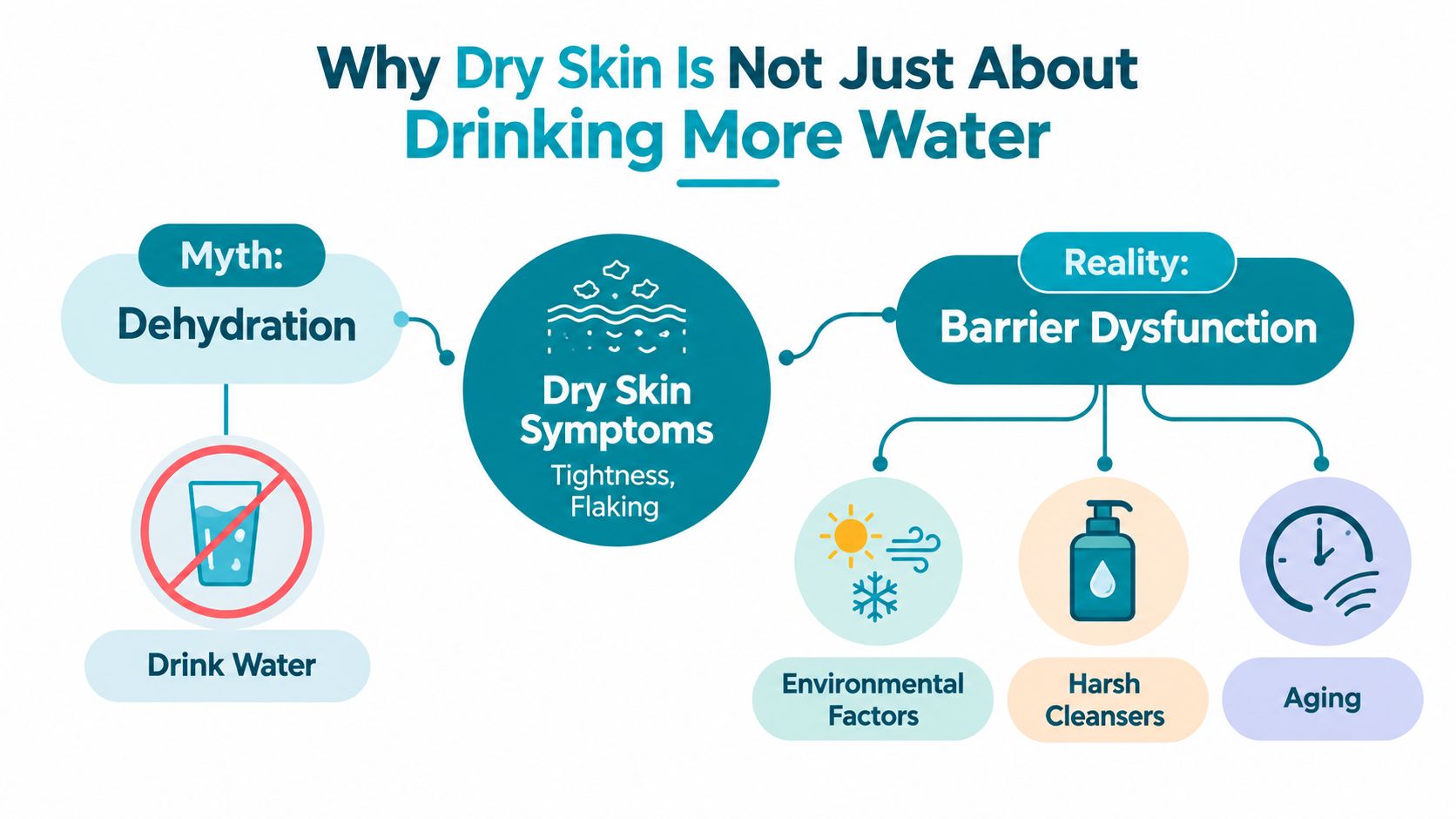
This distinction is explored in more detail in dehydrated skin and why water is not always enough. The practical question isn't how to add water. It's how to help the skin hold on to the water it already contains.
Table of Contents
- Why Dry Skin Is Not Just About Drinking More Water
- What Transepidermal Water Loss Actually Means
- How the Skin Barrier Controls Water Loss
- Why Skin Water Loss Varies by Body Site and Person
- Drinking Water Versus Topical Barrier Repair
- Ingredients That Help Reduce Skin Water Loss
- Habits and Routines That Lower Daily Water Loss
- Putting It All Together for Lasting Hydration
Why Dry Skin Is Not Just About Drinking More Water
Dry-feeling skin can have several causes, and not all of them begin with a lack of water intake. A person may drink regularly yet experience tightness because hot water, strong cleansers, low humidity, pollution, or repeated exfoliation has disturbed the outer barrier. In that situation, the surface is losing water faster than it can comfortably retain it.
A useful way to separate the ideas is to think of skin hydration as the amount of water currently held in the outer skin, while TEWL describes the rate of leakage. One is the level in the reservoir. The other is the size of the hole. A moisturizer can make the reservoir feel fuller for a while, but the result won't last if the leak remains fast.
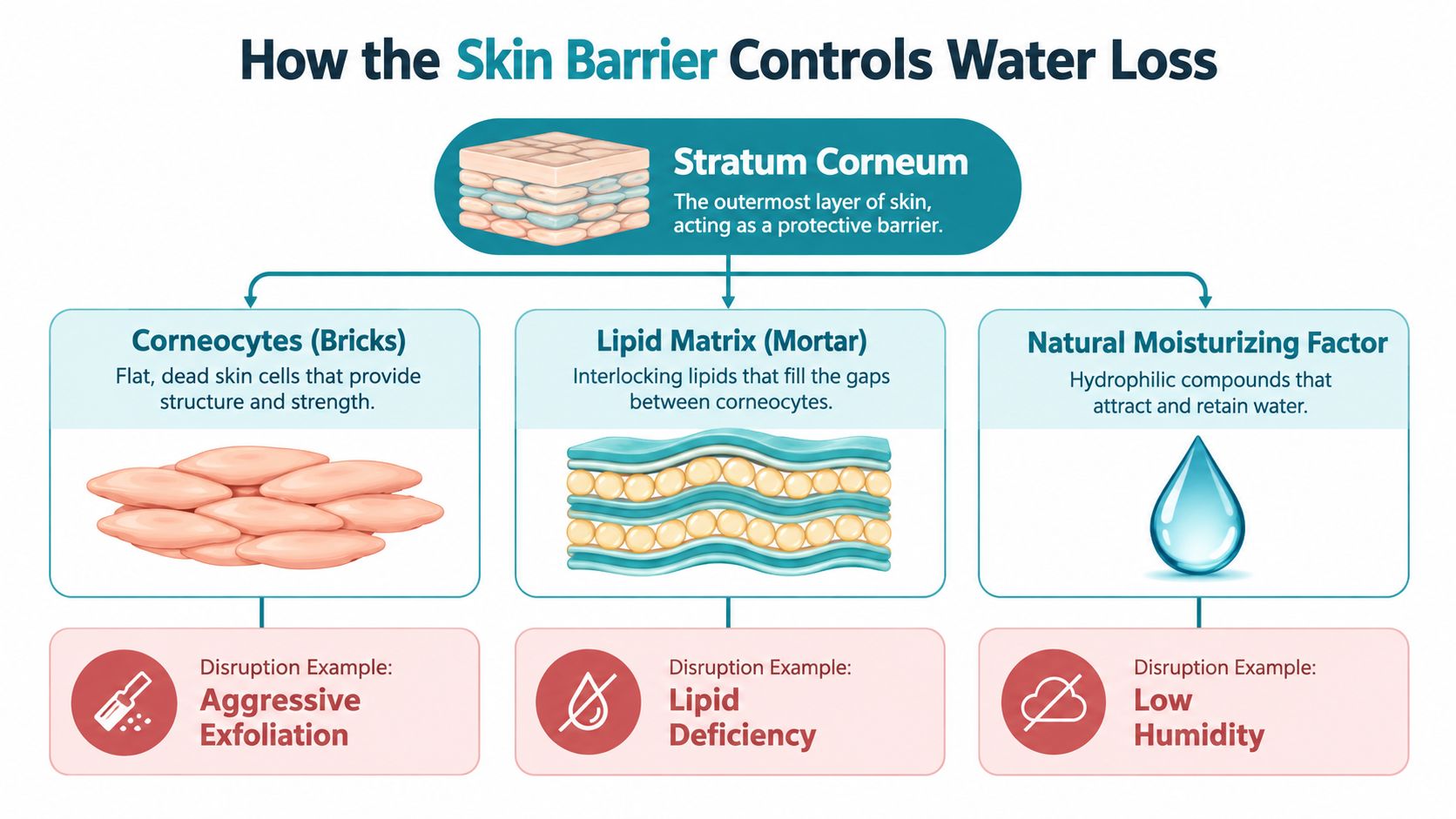
The outermost layer, the stratum corneum, works more like a carefully built wall than a drinking glass. Flattened skin cells form the bricks, and lipids form the mortar between them. When the wall is intact, water escapes gradually. When cleansing, friction, environmental stress, or other factors disturb that structure, water vapor moves outward more easily.
Practical rule: If your skin feels tight even though you drink enough water, assess the barrier and your routine before simply adding more fluids.
That doesn't mean drinking water is irrelevant. The body needs adequate fluid intake, and fluid needs can change with illness, exercise, heat, or other circumstances. It means that visible surface comfort is often controlled more directly by the outer skin than by another glass of water.
What Transepidermal Water Loss Actually Means
Skin can lose water even when you feel neither hot nor sweaty. Transepidermal water loss, or TEWL, is the passive movement of water vapor through the epidermis and into the surrounding air. Sweat follows an active gland response to heat, exertion, or another stimulus. TEWL continues in the background.
Researchers report TEWL in grams of water per square meter of skin per hour, written as g/m²/h. Under normal ambient conditions, healthy skin typically loses about 4 to 10 g/h/m². One systematic review associated that range with roughly 500 mL of water per day. A separate review estimated whole-body TEWL in resting, thermoneutral adults at about 26 to 43 g per hour, or 0.6 to 2.3 liters per day for someone with 1.8 m² of skin surface area.
Those figures are different because researchers may test different body sites under different conditions and use different calculation methods. A single universal “normal” number would therefore create a false sense of precision. The systematic review of TEWL measurement provides the background needed to interpret these ranges.
A tewameter or evaporimeter detects water vapor leaving the skin without needles or painful sampling. A higher reading usually means that more water is passing through the barrier. The number only becomes useful alongside the tested body site, room conditions, temperature, humidity, and the person's skin state.
Reading the numbers with care
TEWL readings describe water movement, not a diagnosis by themselves. The 2018 systematic review pooled 212 studies and identified estimates for 86 skin areas. The lowest reported value was 2.3 g/m²/h on breast skin, while the highest was 44.0 g/m²/h in the axilla. Study samples ranged from 4 to 4,013 participants, showing how widely the evidence varies. The review of TEWL across body sites explains why anatomy belongs beside every TEWL reading.
| Skin condition or context | Approximate TEWL | What it means |
|---|---|---|
| Healthy skin under normal ambient conditions | About 4 to 10 g/m²/h | A general reference range, not a universal result |
| Resting, thermoneutral whole-body estimate | About 26 to 43 g/hour | A whole-body calculation, not a single-site reading |
| Breast skin in a healthy-adult review | 2.3 g/m²/h | The lowest reported body-site value in that review |
| Axillary skin in a healthy-adult review | 44.0 g/m²/h | The highest reported body-site value in that review |
| Damaged epidermal barrier | May rise by up to 30 times | A potentially substantial increase, depending on the type and extent of damage |
The practical meaning is straightforward: faster leakage can make skin feel tight, rough, or uncomfortable. A more permeable barrier may also let irritants move inward more easily. Researchers use TEWL as an objective marker of barrier integrity and wound closure, so it has a role in dermatology and skin research as well as skincare.
The skin's water-holding system also includes natural moisturizing factors. A useful introduction to these compounds is this guide to natural moisturizing factors, which help explain why water content and water retention are related but separate ideas.
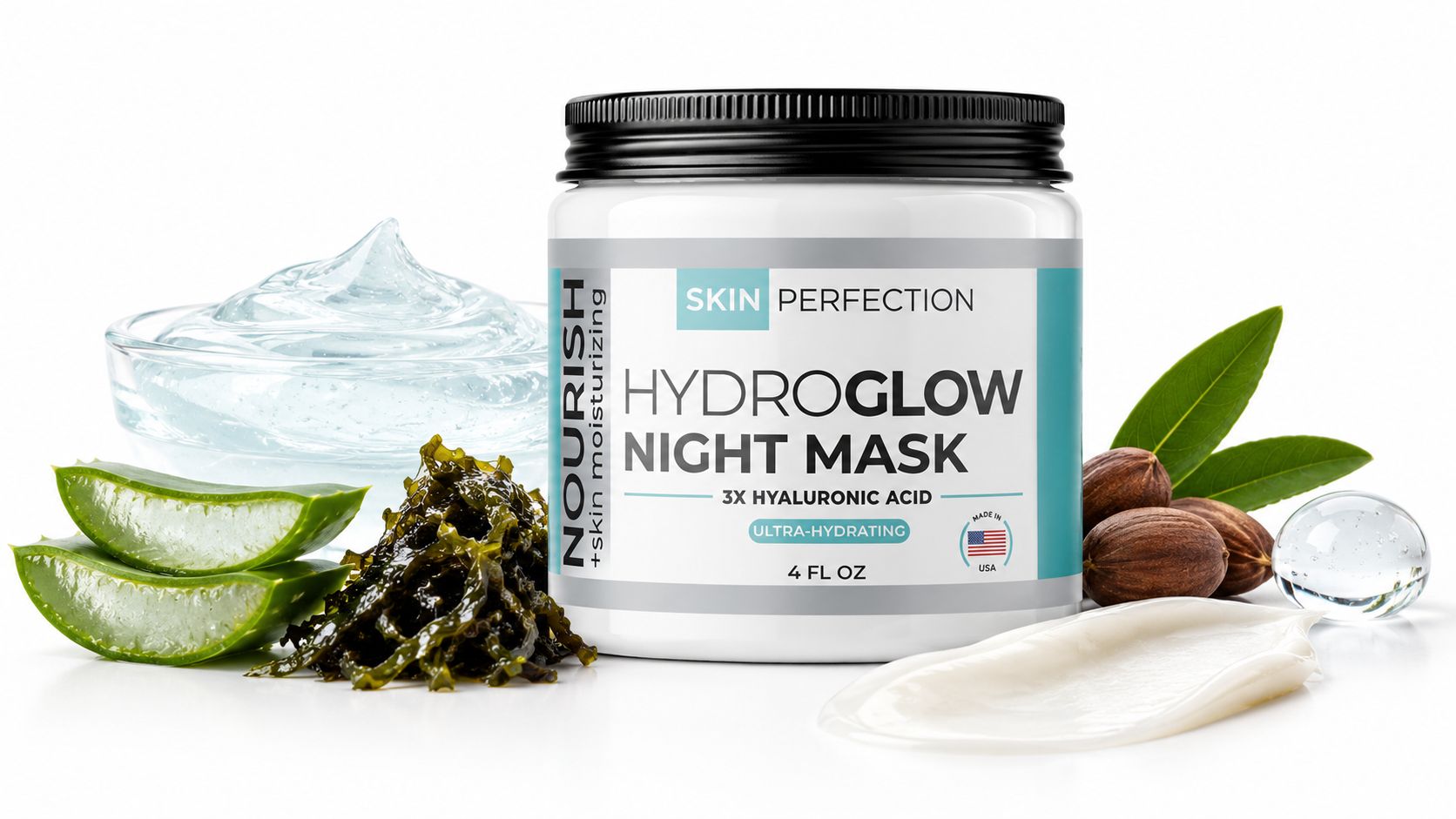
A formula such as HydroGlow Anti-Aging Night Mask contains humectants and conditioning ingredients, including multiple types of hyaluronic acid, polyglutamic acid, glycerin, triglycerides, jojoba, and squalane. These ingredients may support a hydrated, conditioned feel. A product description, however, is not the same as a clinical TEWL measurement.
How the Skin Barrier Controls Water Loss
The stratum corneum controls evaporation through several cooperating structures. The familiar brick-wall analogy is useful because it shows why a single “hydrating” ingredient may not address every weakness.
Corneocytes form the bricks
Corneocytes are flattened cells in the outermost layer. They provide structure and help create a physical path that water must pass through before reaching the air. Aggressive exfoliation can remove or disturb too much of this outer material, leaving the surface less orderly and more vulnerable to moisture escape.
A rough patch after over-exfoliation doesn't automatically need another scrub. It may need less friction and a simpler routine while the surface regains stability. This is why strong acids, abrasive tools, and frequent polishing can be counterproductive when tightness and flaking are already present.
Lipids act as mortar
The spaces between corneocytes contain organized lipids, especially ceramides, cholesterol, and fatty acids. These materials slow water movement through the spaces between the cells. Hot water and harsh cleansing can remove surface oils and disturb the lipid environment, much like dissolving mortar from between bricks.
The lipid story is not just about how rich a cream feels. A formula can feel light while still providing useful emollient support, and a heavy formula may mainly create a surface film. For a practical introduction to barrier structure and seasonal stress, see skin barrier basics and why it breaks down in summer. Readers who want another technical explanation can also explore how to fix a damaged barrier for good.
Moisturizing factors hold water inside cells
Natural moisturizing factor, or NMF, is a collection of water-attracting substances within corneocytes. Amino acids and related compounds help these cells retain water and remain flexible. Low humidity can make this system work harder, while a disrupted outer layer can allow its water to escape more readily.
The three parts depend on one another. Strong bricks without enough mortar leave gaps. Lipids without adequately hydrated cells cannot create the same supple surface. A well-designed routine therefore considers cleansing, lipid support, and water-binding ingredients together. The natural moisturizing factors guide offers a closer look at that internal water-holding system.
Why Skin Water Loss Varies by Body Site and Person
A TEWL reading isn't a grade for your entire body. It's a measurement from a particular place, at a particular time, under particular conditions. The 2018 review's spread from 2.3 g/m²/h on breast skin to 44.0 g/m²/h in the axilla demonstrates how strongly anatomy changes the result. The body-site review in the British Journal of Dermatology supports the central point that location matters.
The underarm has a high reported value, while breast skin sits at the low end of that review. That difference doesn't mean one area is “healthy” and the other is “unhealthy.” It means the skin's structure, thickness, glands, folds, and local environment influence how water vapor moves.
A more useful body-site table
Because the evidence base does not provide one universal reference value for every consumer-relevant site, the table below separates measured values from interpretation.
| Body site | Typical TEWL | Relative permeability |
|---|---|---|
| Breast skin | 2.3 g/m²/h in the healthy-adult review | Lower end of the reviewed sites |
| Axilla | 44.0 g/m²/h in the healthy-adult review | Higher end of the reviewed sites |
| Other sites | No single universal value | Interpret only with site-specific conditions and methods |
The face, hands, scalp, and body can also feel different because they encounter different exposure patterns. The face meets wind, sunlight, cleansing, makeup removal, and pollution. Hands are washed repeatedly and exposed to friction. A fold may stay warm and humid while the forearm meets dry air. These differences can make one part of the body feel uncomfortable even when another part feels normal.
Person-to-person interpretation also requires care. The review found that TEWL varies by body site and population, and it concluded that TEWL in elderly people is generally similar to or lower than in younger adults, although the evidence was limited. That finding is more cautious than the common assumption that age always produces a higher baseline reading.
Environment can shift the meaning of a result too. A reading after exercise, a hot shower, recent exfoliation, or product application shouldn't be treated as interchangeable with a controlled baseline. If you're comparing readings, keep the body site and testing conditions consistent rather than chasing a number from a different location.
Drinking Water Versus Topical Barrier Repair
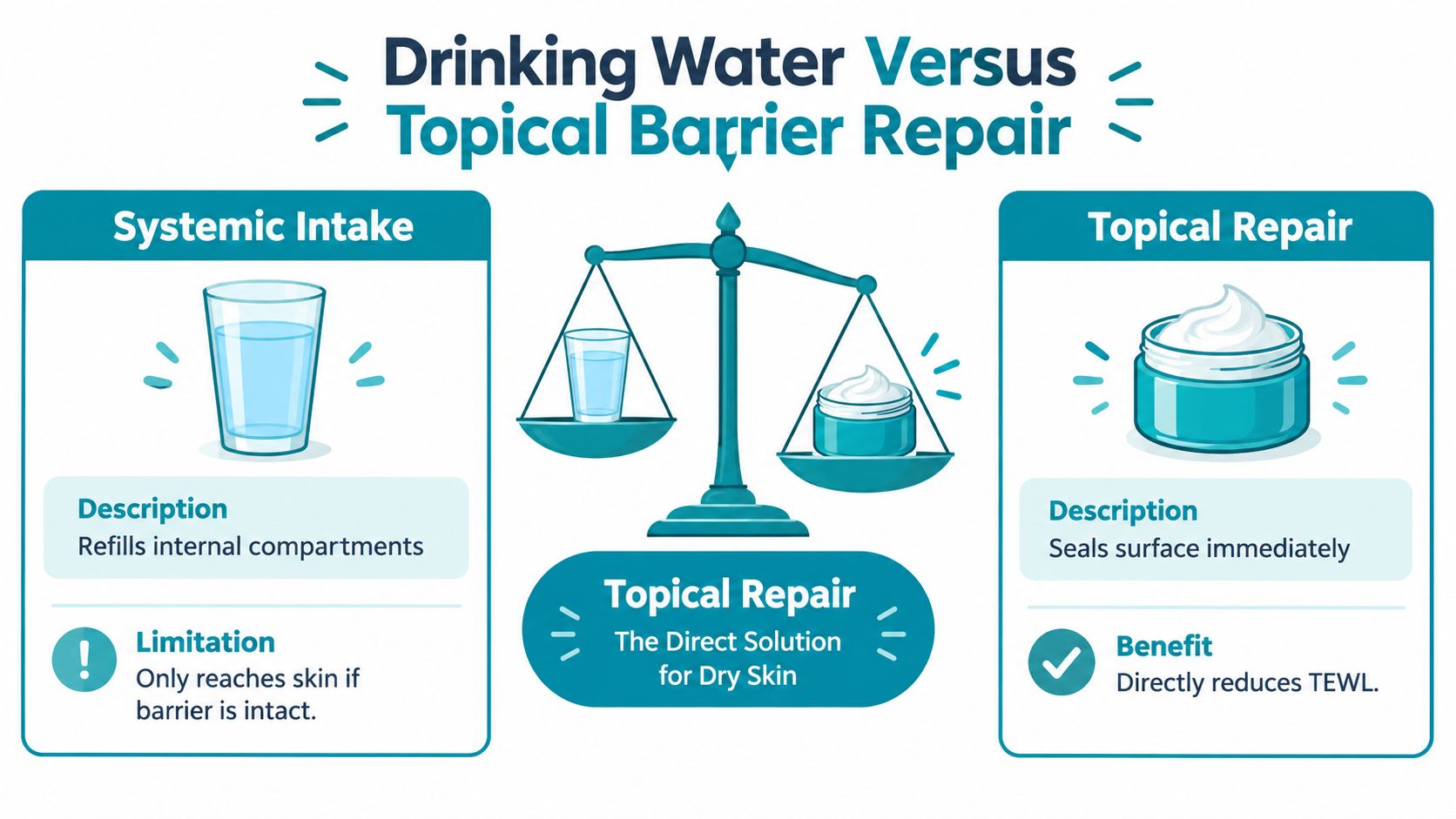
Drinking water and applying a topical product work through different routes. Fluid intake supports the body's internal water balance, while a moisturizer interacts directly with the outermost skin. If a person is short of fluids because of illness, exertion, heat, or another cause, adequate intake matters. It still doesn't follow that extra water will correct every surface symptom.
A 2024 clinical study summarized in the verified evidence found that adding moisturizers improved skin hydration more than increasing water intake. The same review described TEWL as capable of accounting for about 45% of total daily water loss in one analysis, reinforcing that the skin can be a meaningful route of water loss while remaining a separate barrier problem. The clinical discussion of water intake, moisturizers, and skin hydration provides that comparison.
Use both pathways intelligently
A sensible approach has two parts:
- Maintain normal fluid intake: Drink according to your body's needs rather than treating water as a direct replacement for a topical barrier routine.
- Support the surface: Use a formula that combines water-binding, emollient, or occlusive functions when tightness and flaking are linked to rapid evaporation.
- Look for the trigger: If symptoms began after a new cleanser, colder weather, or repeated exfoliation, remove or reduce that stressor instead of only adding hydration.
- Keep expectations realistic: A topical product can improve surface comfort without being a treatment for a medical condition.
Skin flooding can be understood as a layering approach, but skin flooding and how to use the method thoughtfully shouldn't be reduced to applying more and more watery products. Without a final layer that slows evaporation, the routine may feel hydrating briefly while leaving the underlying leakage unchanged.
Ingredients That Help Reduce Skin Water Loss
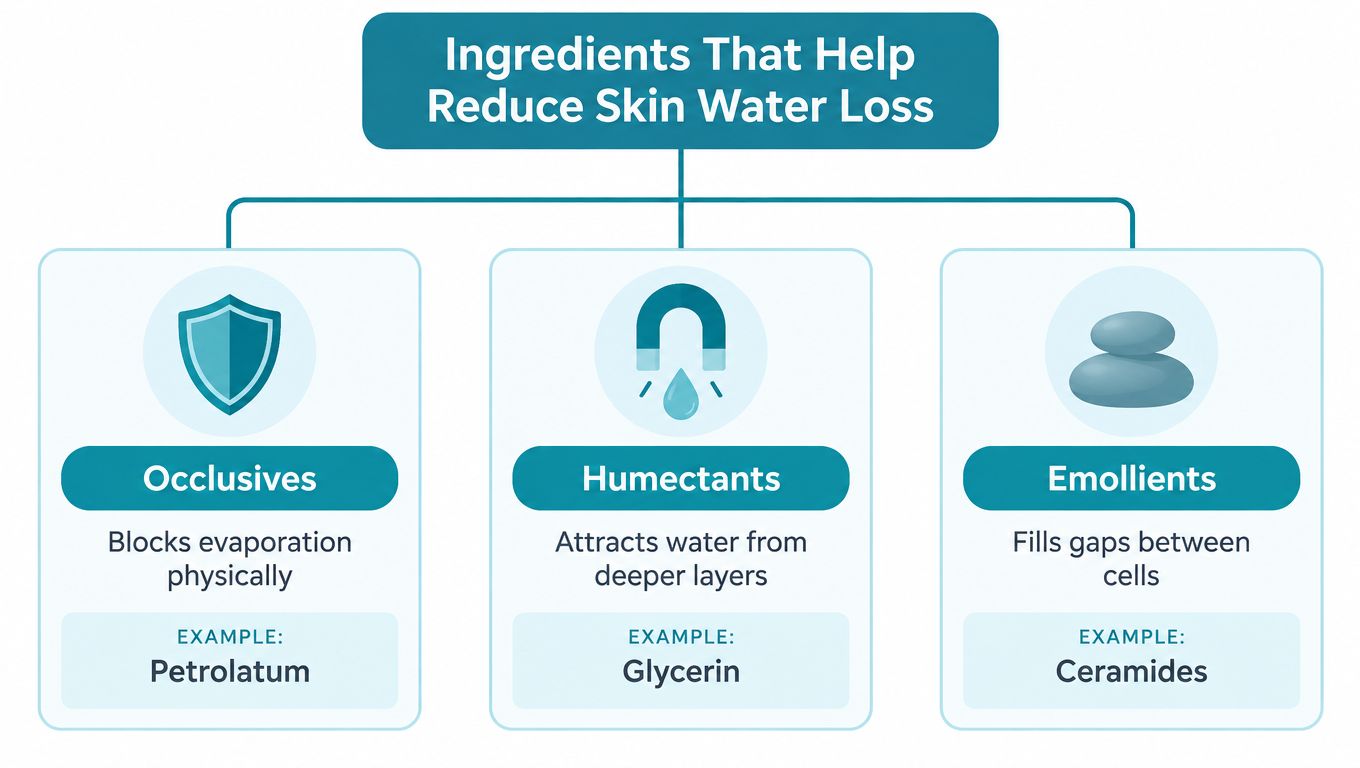
Ingredient labels make more sense when grouped by function. Occlusives slow escape at the surface, humectants bind water in the outer layer, and emollients or barrier-supporting lipids improve how that layer feels and functions. One formula may use all three, but they solve different parts of the same water-loss problem.
Occlusives create a surface brake
Occlusives leave a film over the skin that slows evaporation. Petrolatum is the benchmark example, with controlled testing showing a very strong reduction in TEWL under occlusive conditions. Silicones, waxes, and squalane can provide lighter textures or a different after-feel, depending on the formula.
The texture alone does not reveal how well an occlusive works. Concentration, how evenly the product spreads, and the other ingredients in the formula all affect its performance. A balm may feel rich, while a lighter lotion can still provide useful evaporation control.
Humectants attract and hold water
Humectants such as glycerin, hyaluronic acid, and panthenol bind water in the outer skin. They can make skin feel softer and more flexible, but they do not form the same protective film as an occlusive. In dry air, a humectant usually works better alongside emollient or occlusive ingredients that slow water from leaving the surface.
A watery serum may therefore give short-term comfort without resolving persistent tightness. The humectant helps hold water in the outer layer, while a cream or lotion reduces its escape. This ingredient guide to natural humectants for skin explains how common water-binding ingredients are used in skincare.
Barrier-supporting lipids fill the gaps
Ceramides, cholesterol, and fatty acids resemble parts of the skin's own intercellular lipid system. Niacinamide also appears in barrier-focused formulas and is associated with supporting ceramide production. Results still depend on the complete product, its concentration, and the user's skin.
A practical layering order is:
- Apply a humectant: Use a water-binding serum or lotion on clean skin, preferably while it remains slightly damp.
- Add barrier-supporting ingredients: Follow with emollients or skin-compatible lipids that improve the feel and continuity of the surface.
- Finish with an occlusive when needed: Apply a richer cream or balm to areas that lose water quickly, such as dry patches at night or during dry weather.
Product claims also need clear boundaries. The FDA's guidance on cosmetic claims explains that cosmetic claims must be truthful and not misleading. A product promoted to treat or prevent disease, or to affect the structure or function of the body, including skin, may be regulated as a drug. Etsy's Medical Claims policy similarly prohibits listings that claim to treat, mitigate, diagnose, or cure a disease or medical condition. Skin Perfection follows these boundaries in its product listings, describing products as beautifying cosmetics rather than claiming they fix, repair, or heal skin.
Habits and Routines That Lower Daily Water Loss
Products can't fully compensate for a routine that repeatedly strips the surface. The most useful habits reduce unnecessary stress and create better conditions for the barrier to hold water.
Start with cleansing. Use lukewarm rather than very hot water, keep washing efficient, and avoid rubbing the face or body with a rough towel. Patting leaves less mechanical friction than dragging fabric across freshly cleansed skin.
Build a simple post-cleansing sequence
After cleansing, apply a humectant-containing product while the skin is slightly damp, then follow with a lotion or cream that provides emollient or occlusive support. The exact timing matters less than avoiding a long interval in which water on the surface evaporates without any film to slow it.
For hands, reapply after washing when the skin feels tight. If you wear a mask or work in an environment with repeated friction, pay attention to the areas that become rough first and use a simpler, fragrance-free routine there if products sting.
Adjust the room, not only the bottle
Cold wind, indoor heating, air conditioning, and dry surroundings can increase the evaporation pressure on exposed skin. A hygrometer can help you understand whether the room feels dry rather than relying on guesswork. If the air is uncomfortable, modest humidification and regular ventilation may be more useful than constantly changing products.
Keep the rest of the routine restrained during a flare of tightness:
- Reduce exfoliation: Pause abrasive scrubs and reduce strong exfoliating products when the skin feels raw or persistently tight.
- Limit friction: Pat dry, choose soft fabrics, and avoid repeatedly touching or rubbing rough patches.
- Protect exposed areas: Use a suitable moisturizer on the face, hands, and other zones that meet wind or frequent washing.
- Observe patterns: Note whether discomfort appears after bathing, overnight, outdoors, or after a particular product.
These habits don't guarantee a particular TEWL result, because measurement depends on site and conditions. They do, however, remove common sources of avoidable barrier stress and make it easier to judge whether a routine is helping.
Putting It All Together for Lasting Hydration
Lasting hydration starts with the stratum corneum, not with a larger water glass. This outer layer acts like a controlled seal: water can move toward the surface, while its cells, lipids, and natural moisturizing factors slow evaporation. When that seal is disrupted, adding water alone rarely solves the underlying problem.
The reported measurements also explain why a single “normal” TEWL value is misleading. Healthy skin loses water at a lower rate under stable conditions, while whole-body estimates reflect the combined contribution of many sites. The TEWL measurement review and whole-body TEWL review provide that context. Readings also differ sharply by body area, because thin, folded, exposed, and oilier regions do not behave like one another. The body-area analysis shows why the measurement site must always be recorded.
A damaged epidermal barrier can allow substantially more water to escape than intact skin. That makes persistent tightness, roughness, or stinging a reason to reduce barrier stress, rather than just applying more water-based products.
Match the routine to the mechanism
Choose ingredients according to the problem being addressed. A humectant helps bind water in the outer layer. An emollient or barrier-lipid formula fills uneven spaces and improves flexibility. An occlusive forms a more resistant surface layer, which can help when evaporation is the main concern, particularly overnight or on small dry patches.
Support the formula with gentle cleansing, limited friction, and a room that is not excessively dry. Pollution may add another source of barrier stress. The review of pollution and skin barrier effects found that the included studies consistently associated particulate matter or nitrogen dioxide exposure with higher TEWL.
Personal testing is useful only when conditions stay consistent. A corneometer can compare surface hydration, while a tewameter can compare water-vapor loss. Test the same area with similar product use and environmental conditions, then look for a pattern rather than treating one reading as a diagnosis. A skincare formulator can apply the same logic when balancing humectants, emollients, and occlusives for a chosen skin feel.
Persistent redness, marked sensitivity, or suspected eczema warrants assessment by a qualified healthcare professional. Cosmetic products can condition the skin, but they do not replace diagnosis or medical care.
Skin Perfection offers ready-made skincare products and lotion-making supplies for people building a considered hydration routine or creating cosmetic formulas. Explore Skin Perfection for skincare and DIY ingredients suited to a humectant, emollient, and occlusive approach.