

 Buy with Prime



When your skin feels tight after applying a rich cream, is it asking for more oil, or is the formula missing the water-binding system that normally works inside the outer skin cells?
That distinction is the key to understanding natural moisturizing factors, usually shortened to NMF. NMF isn't one fashionable ingredient or a synonym for “hydration.” It's a mixture of small, water-soluble molecules inside the stratum corneum, where they help corneocytes hold water, remain flexible, and shed normally. A useful moisturizer therefore needs more than a slippery surface. It needs the right balance of humectants, emollients, and occlusives, selected for the condition of the skin and the environment.
Table of Contents
- Why Your Skin Can Feel Dry Even After Moisturizing
- What Natural Moisturizing Factors Actually Are
- The Composition of NMF and Why Each Part Matters
- How NMF Gets Depleted Day to Day
- The Hidden Role of NMF Beyond Water Binding
- Ingredients That Replenish and Mimic NMF
- Building a DIY Formula That Respects NMF
- Common Mistakes and a Smarter Hydration Checklist
Why Your Skin Can Feel Dry Even After Moisturizing
By mid-afternoon, the routine looks successful in the mirror. A thick cream has gone on smoothly, the cheeks feel temporarily soft, and the skin has a glossy protective film. Then the tightness returns. Fine flakes gather around the nose, foundation catches on rough patches, and the surface takes on a crepey appearance despite all that product.
That experience reveals the difference between surface emollience and water retention inside the stratum corneum. An oil-rich cream can make skin feel smoother because its lipids reduce friction and soften the surface. An occlusive can slow evaporation. Neither function, by itself, supplies the small hygroscopic molecules that help corneocytes retain water internally.
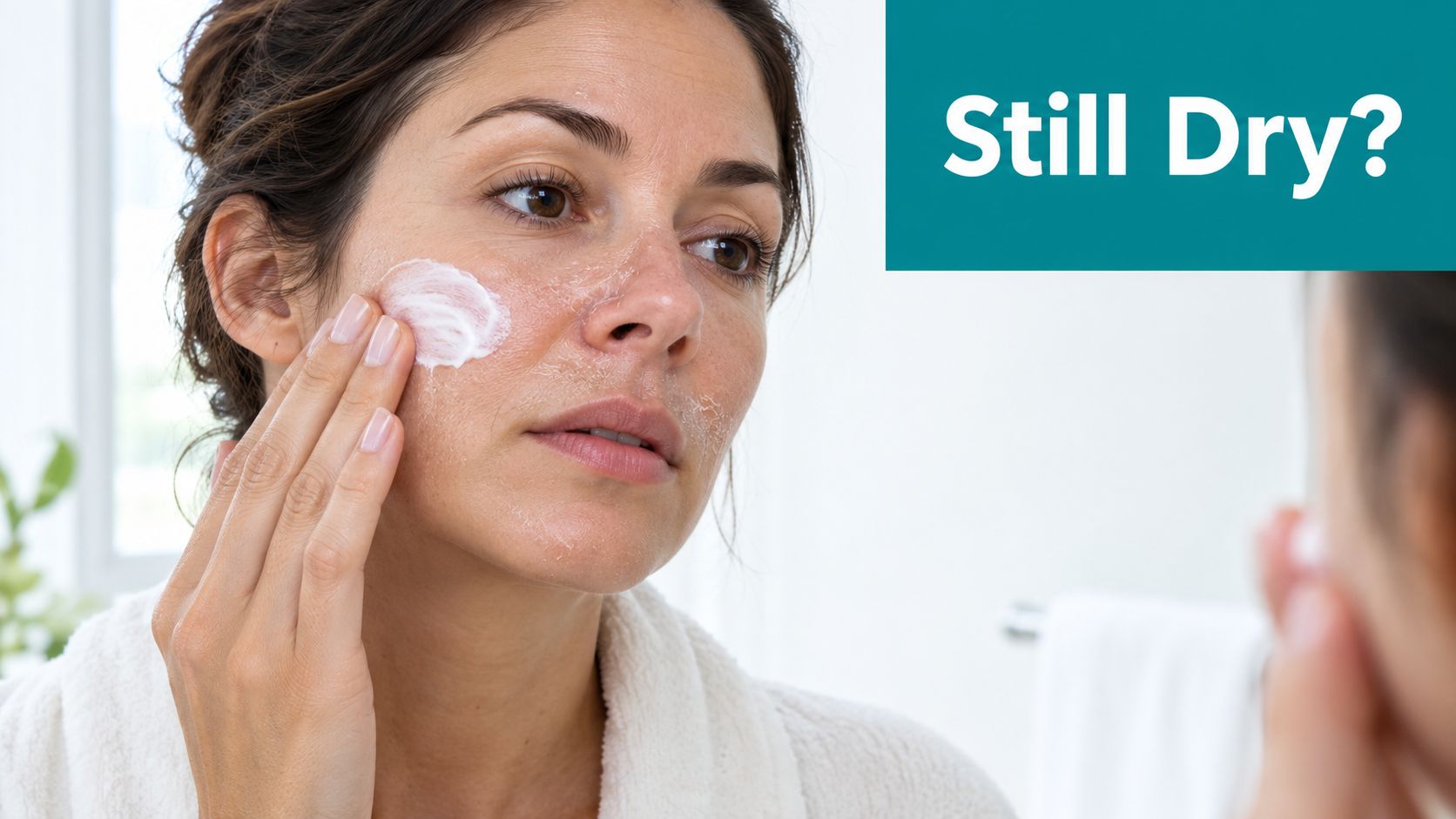
A cream can feel rich and still miss the target
Think of the outer skin layer as a wall made from cells. Lipids between those cells provide part of the mortar, while NMF works inside each cell like a moisture-holding sponge. Adding more oil around a dry corneocyte may reduce water loss at the surface, but it doesn't automatically refill the sponge.
The stratum corneum depends on NMF to bind water and support flexibility and barrier function. When these compounds are depleted, the skin can feel rough or tight even when a cream leaves a noticeable film. A practical explanation of the difference between water loss from skin and topical moisturization is available in this guide to transepidermal water loss.
Read the skin's behavior before adding another product
Tightness immediately after cleansing points toward a cleanser or washing habit that the skin may not tolerate. Flaking that returns after a cream wears off suggests that surface occlusion isn't addressing the underlying water-binding problem. A routine designed around a nourishing dry skin regimen can help organize cleansing, hydration, and moisturization without assuming that a heavier texture solves every type of dryness.
The better question isn't “How much cream should I apply?” It's “Which part of the skin's moisture system is this product supporting?” NMF supplies intracellular water binding. Lipids support the surrounding barrier structure. Occlusives slow outward water movement. Dry-feeling skin often needs all three, but not always in equal proportions.
What Natural Moisturizing Factors Actually Are
Start with the structure. The stratum corneum is often compared with a brick wall, where flattened corneocytes act as the bricks and specialized lipids form the mortar between them. That model is useful, but incomplete. To understand NMF, zoom into one brick.
A corneocyte isn't an empty tile. Its interior contains keratin structures surrounded by a concentrated mixture of small, water-soluble, hygroscopic compounds. These molecules attract and bind water within the cell, much like a sponge holds moisture rather than allowing every drop to run across its surface.
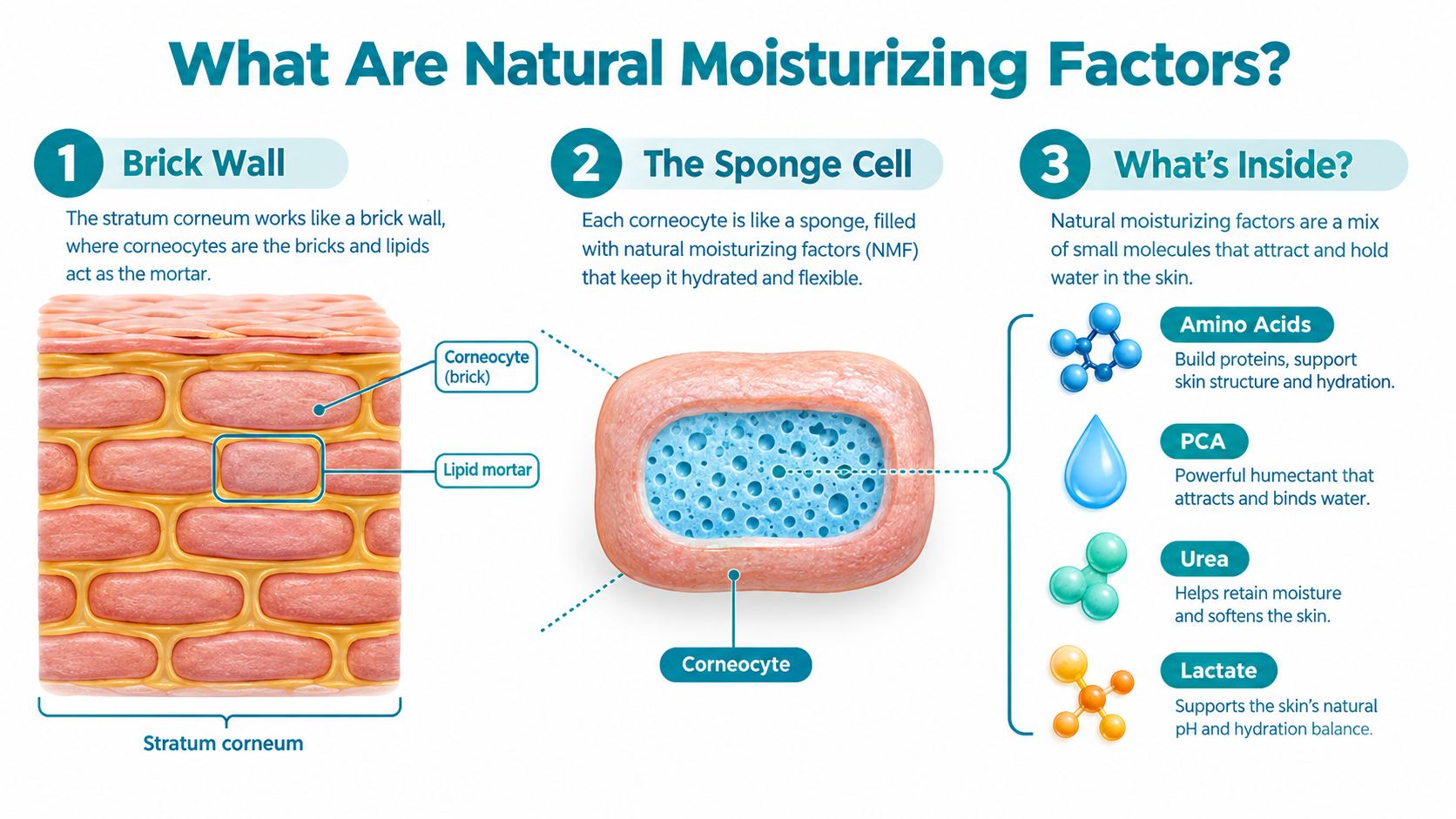
The filaggrin-to-NMF pathway
NMF is generated during the maturation of skin cells. Keratinocytes produce a large precursor protein called profilaggrin. That precursor is cleaved into filaggrin, which helps organize and aggregate keratin inside developing corneocytes. Later, filaggrin is broken down into smaller molecules, including amino acids, PCA, urocanic acid, and related compounds. Those products become a substantial part of the NMF pool, as described in this dermatology review of skin structure and skin-care requirements.
The origin matters. NMF is not just residue left by sweat on the surface, and it is not the same thing as the lipid mortar outside the cell. It is a keratinocyte-derived, intracellular system concentrated inside corneocytes. Lipids occupy the spaces between cells, while NMF occupies the water-management environment within them.
Why the location changes formulation thinking
A topical NMF-like ingredient doesn't need to be chemically identical to every molecule naturally present in skin to be useful. It needs to be water-compatible, hygroscopic, and suitable for delivery in a formula that leaves enough of the material at the outer skin layer.
This is why a blend can make more sense than a single “hero” humectant. Urea, PCA, lactate, amino acids, and electrolytes each interact with water differently. Together, they more closely resemble a system than a one-note hydration claim.
The Composition of NMF and Why Each Part Matters
The widely cited composition of stratum corneum NMF shows why the term should be treated as a family name. The largest share is made up of free amino acids, followed by ions, PCA, lactates, urea, and smaller groups of sugars, inorganic acids, peptides, and related compounds. The approximate breakdown below comes from the dermatology reference on natural moisturizing factors and their composition.
| NMF Component | Approximate Share | Primary Function |
|---|---|---|
| Free amino acids | Roughly 40% | Water binding and corneocyte flexibility |
| Ions such as sodium, chloride, calcium, and potassium | 18.5% | Water balance and ionic conditions |
| Pyrrolidone carboxylic acid, or PCA | 12% | Hygroscopic water binding |
| Lactates | 12% | Water binding and moisture-environment support |
| Urea | 7% | Humectancy and support for normal shedding |
| Sugars, inorganic acids, and peptides | 8.5% | Supporting the broader NMF environment |
| Ammonia, uric acid, glucosamines, and creatinine | 1.5% | Minor contributors to the mixture |
| Citrate | 0.5% | Minor constituent of the NMF pool |
Turning the composition into a formulation decision
The amino-acid fraction is the largest portion, so a formula containing several free amino acids can provide a more biologically familiar profile than one built around a single humectant. PCA and lactates add strong water-binding capacity, while urea has a dual identity. It attracts water, and it also helps soften compacted corneocyte material.
The ions may look less glamorous on an ingredient label, but they reinforce the idea that NMF isn't random water-attracting material. It is a chemically diverse environment that helps maintain the conditions required for flexible corneocytes and controlled desquamation. When NMF levels fall, reduced hydration can interfere with normal enzyme activity and contribute to roughness, flaking, and fissuring, according to this review of NMF function in the stratum corneum.
For a formulator, the practical lesson is simple: water binding, plasticization, ionic balance, and shedding support are related but distinct jobs. Sodium hyaluronate isn't an NMF component, but Sodium Hyaluronate Powder Pure Hyaluronic Acid can be used as a separate water-compatible humectant in serums, creams, and lotions. The product snapshot describes a cosmetic-grade NASHA powder with a stated molecular weight of 800–1500 Daltons and typical DIY serum use at 0.1–2%, so it should be treated as a complementary polymeric hydrator, not as a complete substitute for an NMF blend.
For ingredient background and bench selection, a practical reference is this guide to cosmetic raw ingredients.
How NMF Gets Depleted Day to Day
NMF loss rarely arrives as one dramatic event. More often, several small pressures change how the skin feels. A foaming cleanser may leave a squeaky finish, dry indoor air may make the cheeks feel tight, and repeated exfoliation may leave makeup clinging to the same patches.
The biological starting point is filaggrin processing. Filaggrin degradation supplies many NMF molecules, so changes in expression or processing can reduce the skin's endogenous water-binding capacity. Barrier-impaired skin can then show greater transepidermal water loss and increased sensitivity, as discussed in this review of filaggrin, NMF, and barrier function.
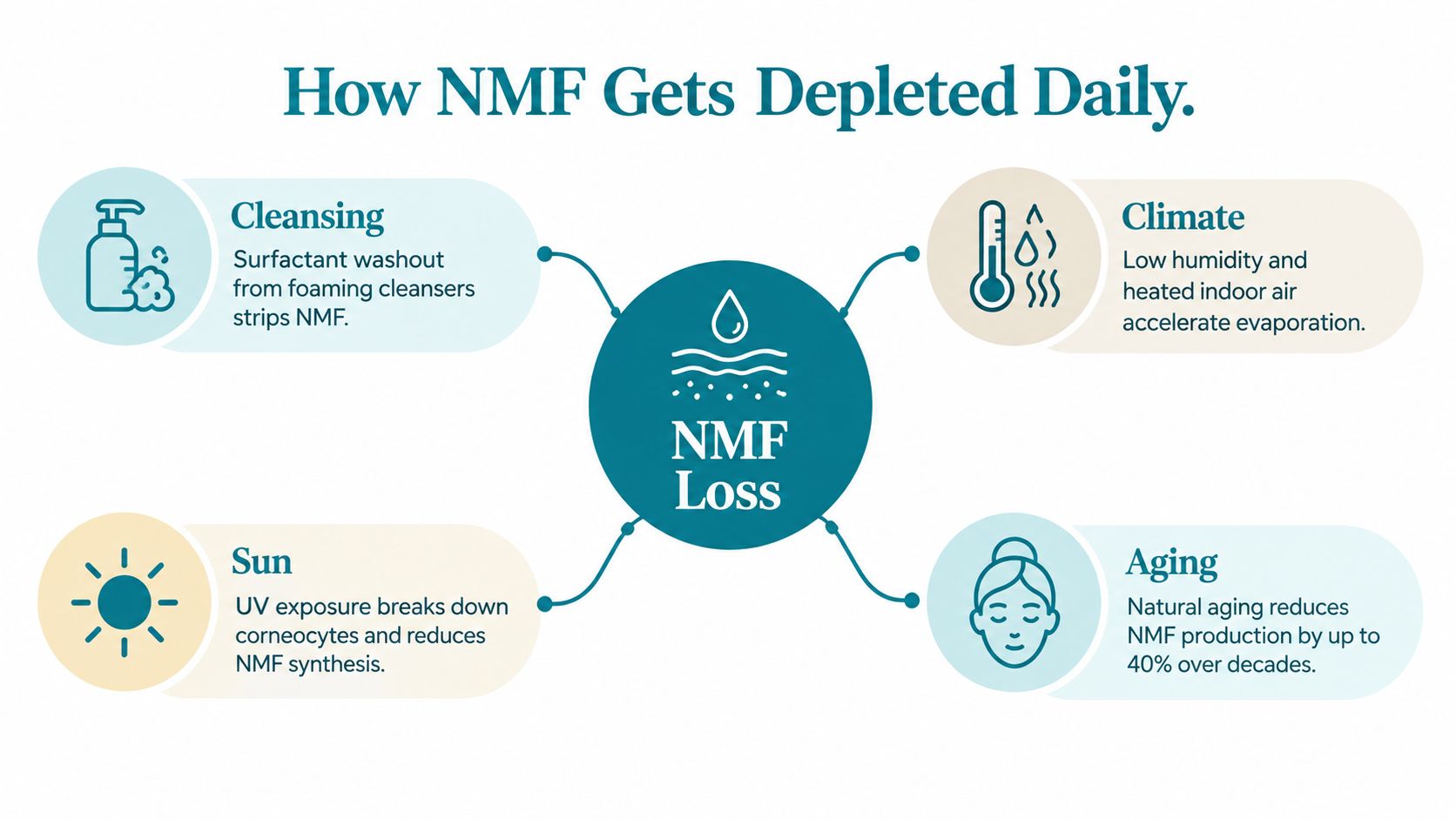
Four patterns worth recognizing
- Aggressive cleansing: Strong surfactant systems and frequent washing can leave the surface feeling stripped. If tightness appears immediately after rinsing, start by examining cleanser strength, water temperature, and washing frequency.
- Dry air: Low humidity and heated indoor air increase the demand placed on the skin's water-retention system. The result may be fine flaking, a papery feel, or a moisturizer that seems to disappear quickly.
- Maturation of the skin: NMF production and processing can change with age. The useful response is not to assume that every mature skin type needs the richest possible cream, but to combine water-binding ingredients with a supportive lipid phase.
- Repeated barrier stress: Over-exfoliation, retinoid use, solvents, and other irritating routines can make the outer layer less comfortable and less efficient at retaining water. The visible pattern often includes rough cheeks, flakes around the nose, and stinging when several products are layered.
Match the symptom to the intervention
A tight, squeaky feeling after cleansing calls for a gentler cleansing strategy before another active serum. Flaking that improves briefly under an occlusive but returns later may call for NMF-like humectants plus lipids, not occlusion alone. A useful overview of seasonal barrier stress and ingredient support appears in this resource on skin barrier care.
The goal isn't to diagnose a medical condition from a mirror. It is to identify whether the routine is removing water-binding material faster than it can support the outer layer.
The Hidden Role of NMF Beyond Water Binding
Calling NMF a humectant system is accurate, but incomplete. Recent research has explored how NMF molecules influence the physical behavior of the surrounding stratum corneum membrane. A 2025 atomistic simulation study reported that NMFs such as urea, glycerol, and urocanic acid altered membrane properties, including fluidity, by reshaping hydrogen-bond networks. See the study on NMF effects on stratum corneum membrane properties.
That finding changes the formulator's mental model. Water isn't held in isolation. It exists within a structured environment containing keratin, small solutes, and extracellular lipids. If NMF changes the way water interacts with that environment, it can influence how flexible the corneocyte feels and how the membrane behaves around it.
| NMF Component | Non-Hydration Function |
|---|---|
| Urea | Helps soften compacted corneocyte material and supports comfortable surface texture |
| PCA | Contributes to the ionic and hydrogen-bonding environment inside the corneocyte |
| Urocanic acid | Participates in the chemistry of the corneocyte interior and its interaction with water |
| Free amino acids | Help maintain the flexible, hydrated condition of keratin-containing corneocytes |
| Electrolytes | Contribute to the solute environment that governs water interactions |
Why a humectant-only formula can feel incomplete
Glycerin and hyaluronic acid can make a well-designed serum feel immediately cushioned. They don't automatically supply the full range of small solutes found in NMF, and they don't replace the lipid portion of a moisturizer. A lightweight water-based product may therefore feel excellent in moderate conditions but underpowered when the skin is very dry or the surrounding air is unusually dry.
The distinction between hydration and moisturization becomes practical here. NMF-like materials and other humectants help manage water. Emollients smooth and soften. Occlusives slow water escape. A formula that ignores one of these jobs may still be pleasant, but its performance can be temporary or uneven.
For a cosmetic chemist, the emerging lesson is not to abandon classic humectants. It's to stop asking one ingredient to perform the work of an entire moisture system.
Ingredients That Replenish and Mimic NMF
A practical NMF strategy uses several compatible materials rather than chasing a single ingredient. The right choice depends on whether you're making a toner, serum, lotion, or richer emulsion, and whether the finished product also contains an emollient and an occlusive phase.
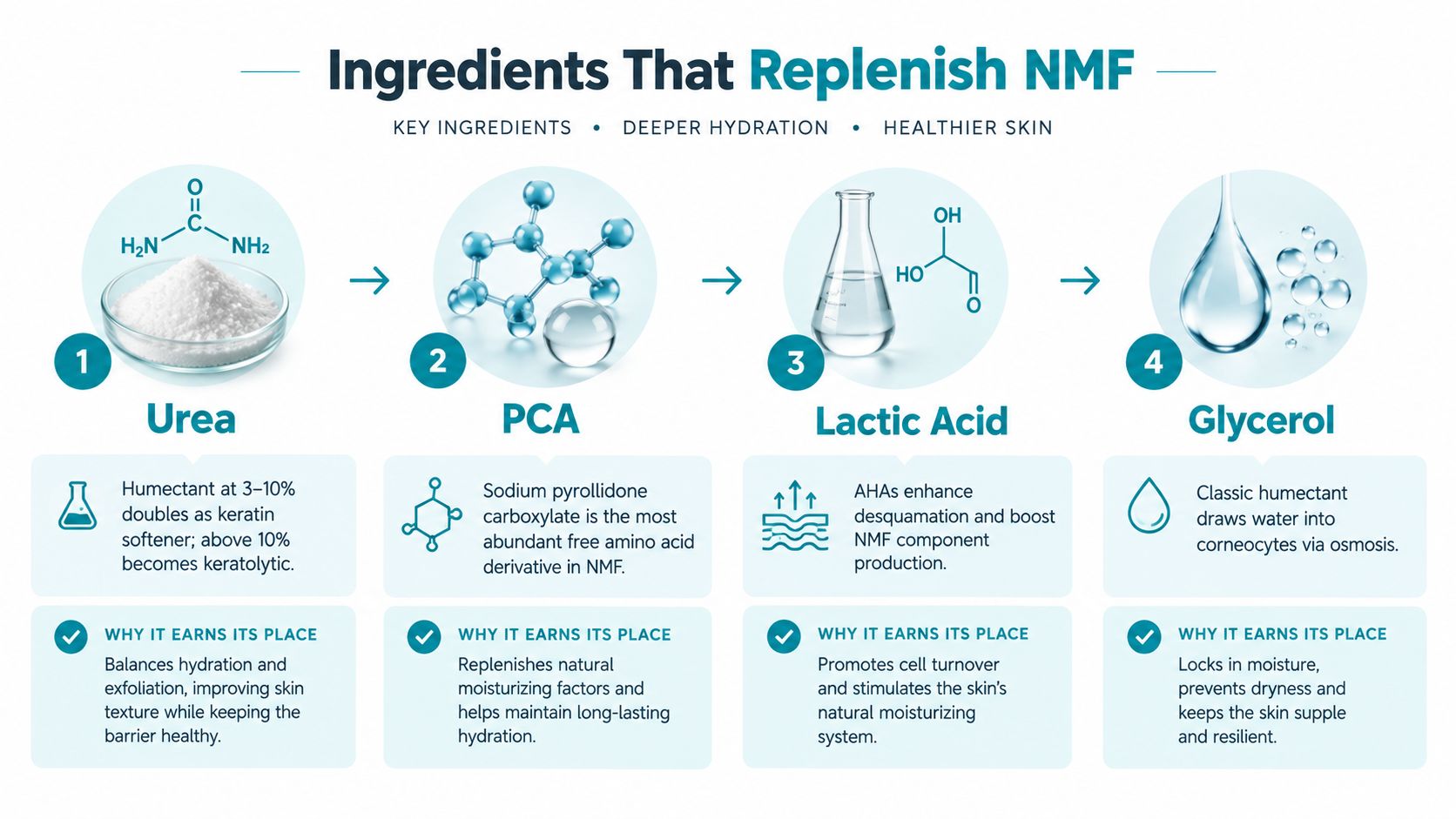
Build around complementary functions
Urea is a classic multifunctional material. In a leave-on formula, a starting range of 3–10% can serve as both a humectant and a keratin softener. Above 10%, its behavior becomes more keratolytic, so texture, tolerance, and the intended product category deserve careful attention. These are bench starting points, not guarantees of a particular skin result.
PCA and sodium PCA are useful when you want a strongly hygroscopic, water-compatible humectant system. A starting range of 2–5% can work in serums, toners, and emulsions, provided the finished formula remains comfortable and stable. PCA is especially valuable when the goal is to mimic the chemistry of NMF rather than only increase viscosity or surface slip.
Lactic acid and sodium lactate bring different formulation options. Lactic acid can contribute humectancy and acidity, while sodium lactate is generally easier to place in a leave-on moisturizer when you want lactate without relying on a low-pH acid format. A 2–5% starting range can be explored, with pH verification and skin tolerance testing treated as essential.
Free amino acids such as serine, glycine, alanine, and proline help echo the amino-acid-rich profile of natural NMF. A blend in the 1–5% range can suit aqueous serums and emulsions, although the finished feel, odor, preservation system, and supplier specifications all matter.
Glycerin remains a dependable baseline humectant. It complements NMF-like ingredients, but it shouldn't be presented as a complete replacement for the mixture inside corneocytes.
Delivery matters as much as the label
A formula may contain the right ingredient names and still deliver a disappointing experience if the aqueous phase is unstable, the pH is unsuitable, or the product lacks a lipid phase. Delivery approaches that increase contact with the outer skin layer should be evaluated carefully. Readers curious about professional delivery concepts can review this explanation of how DermoElectroPoration works, while keeping cosmetic topical formulation separate from professional procedures.
For a plain-language overview of glycerin, PCA, and related water-binding materials, consult this guide to natural humectants for skin.
Building a DIY Formula That Respects NMF
A useful DIY lotion doesn't dump every humectant into water and hope for the best. It gives the aqueous phase enough NMF-like material to support water binding, then adds an oil phase that helps reduce water escape and improve feel.
Start by designing the water phase. A practical trial can include 3–5% urea, 2% sodium PCA, and 1% lactic acid, with the finished formula adjusted to approximately pH 4.5–5.0. Those figures are a development starting point, not a validated production formula. Lactic acid can shift pH significantly, so measure the finished emulsion rather than assuming the calculated value.
A 100 g development example
For a first bench trial, you might structure the formula like this:
| Phase | Ingredient | Amount for 100 g |
|---|---|---|
| Aqueous | Distilled water | 78.5 g |
| Aqueous | Glycerin | 4 g |
| Aqueous | Urea | 4 g |
| Aqueous | Sodium PCA | 2 g |
| Aqueous | Lactic acid | 1 g |
| Oil | Squalane | 4 g |
| Oil | Light ester | 3 g |
| Oil | Emulsifier and consistency agents | 2.5 g |
| Cool-down | Amino-acid blend | 0.5 g |
| Cool-down | Sodium lactate | 0.5 g |
| Cool-down | Broad-spectrum preservative | 0.5 g |
| Total | 100 g |
This example deliberately leaves room for the emulsifier system and consistency agents because their required amounts depend on the supplier, oil load, and processing method. Add urea and the water-soluble humectants to the aqueous phase, prepare the oil phase separately, emulsify under the system's recommended conditions, then add amino acids and sodium lactate during cool-down if their supplier instructions support that process.
Control feel, humidity, and safety
A high humectant load can feel tacky, especially in a leave-on lotion. In low humidity, cap the total humectant load if the formula feels tight after drying, and increase attention to emollients or a light occlusive rather than continually adding more water-binding ingredients.
Use sanitized equipment, a suitable preservative system, and a reliable pH meter. Patch test the finished product, record the batch, and don't bottle until the emulsion is uniform and the pH has been verified. A structured guide to how to make moisturizer can help organize the process, but supplier documentation remains the authority for each raw material.
Common Mistakes and a Smarter Hydration Checklist
More humectant isn't automatically more hydration. NMF works as a balanced pool of water-soluble molecules, and the outer skin layer also depends on lipids and controlled water loss. A formula can therefore become sticky, uncomfortable, or incomplete when the maker keeps increasing humectants without improving the surrounding barrier system.
Three habits commonly create that mismatch:
- Foaming at every wash: A cleanser that leaves a squeaky finish may be removing more surface material than the skin comfortably tolerates.
- Exfoliating through roughness: High-strength glycolic routines can add further stress when the corneocyte surface already feels tight or flaky.
- Using occlusion alone: A heavy balm can slow evaporation, but it doesn't supply the intracellular solutes that help corneocytes hold water.
The better question is not “Do I need NMF?” It is “Which support does my skin need today?” Use NMF-like humectants when the surface feels dehydrated, tight, or rough. Add lipids when the skin needs softness and a more complete barrier-supporting emulsion. Add occlusion when the environment or skin condition demands slower water loss.
A screenshot-friendly checklist
- Cleanser: Choose a comfortable, non-stripping wash and avoid hot water.
- Humectant load: Increase gradually, and reduce it if the finished product feels tacky or tight.
- Lipid support: Pair NMF-like ingredients with suitable emollients and, where appropriate, barrier-compatible lipids.
- Occlusion: Use a light or rich sealing layer according to climate, texture preference, and skin feel.
- Humidity: Adjust the balance when indoor heating or dry air makes water loss more noticeable.
- Re-evaluation: Give a new routine one week before changing several variables at once, unless discomfort requires earlier removal.
Skin Perfection offers ready-made skincare products and lotion-making supplies for people who want to explore NMF-supportive routines or develop customized cosmetic formulas. Visit Skin Perfection to compare cosmetic ingredients and formulation supplies, then choose a humectant, emollient, and occlusive strategy that fits your skin and your bench process.