

 Buy with Prime



You've seen the line. Polyglutamic acid holds four times more water than hyaluronic acid, so the advice goes, swap your serum and never look back. It reads well on a product page. It falls apart the moment you ask which polyglutamic acid, at what percentage, in what base, measured on which meter, and in what humidity.
Both ingredients are humectants, meaning they attract and hold water. Hyaluronic acid is the longer-studied of the two. Polyglutamic acid, almost always sold as gamma-PGA, is a newer fermented polypeptide that earns its place as a light film rather than a headline replacement.
There's no universal winner here, and the useful decision isn't "which one is stronger." It's which molecular weight, at which percentage, in which base, for your skin and your climate.
Table of Contents
- Why This Humectant Matchup Is Not a Winner
- Polyglutamic Acid and Hyaluronic Acid Side by Side
- How Each Polymer Holds Water on Skin
- Skin Type Humidity and Formula Fit
- How to Layer the Two Humectants
- The Four Times Water Claim Under a Closer Look
- Pick the Polymer for Your Routine
Why This Humectant Matchup Is Not a Winner
Two bottles, same shelf, same promise. One lists sodium hyaluronate, the other gamma-polyglutamic acid, and both print the word hydration three times on the front. The person holding them wants a verdict, and the honest answer is that the question itself is the problem.
Hyaluronic acid is a linear polysaccharide your body already makes, found in your eyes and your joints. Skin recognises it, which is why sensitivity to it is rare and why it's been the benchmark water binder in cosmetics for decades. Polyglutamic acid is an anionic polypeptide, usually produced by fermentation, and its job on skin is closer to a thin, breathable film than to a sponge.
A percentage is not a material. One percent of a high-weight hyaluronate and one percent of a fermented polypeptide are different molecules with different slip, tack, and staying power, so the number on the front of the carton buys you nothing on its own.
That's the first place readers get confused. They picture a scale where PGA sits above HA, and a label reading "1% PGA" against "1% HA" as an even contest. It isn't. Salt form changes how a hyaluronate behaves, molecular weight changes where it sits, and the vehicle (a water gel versus a rich cream) changes the feel more than either named polymer does.
Where the comparison actually lives
The comparison lives in the finished formula, not the ingredient list. A serum that names its hyaluronic acid weight and percentage gives you something to reason with. A bottle that says "PGA complex" and nothing else gives you a mood.
Direct human head-to-head work is thin. The most detailed recent poly-γ-glutamic acid study ran in keratinocytes and a reconstructed-skin model, not in people using retail products, as Superpower's polyglutamic acid guide sets out. That's a reason for interest, not a verdict.
What you can say with confidence is appearance language. Skin can look smoother, look fuller, and feel more comfortable with either polymer, and PGA can sit beside HA as a film-forming complement. The word swap is not required.
The rest of the decision comes down to a scan table, how each polymer holds water, which skin and climate favour which choice, how to layer them if you use both, and why a "four times more water" slogan is a weak buying rule. Start with the table below and treat it as a map, not a scoreboard.
Polyglutamic Acid and Hyaluronic Acid Side by Side
| Criterion | Hyaluronic acid | Polyglutamic acid |
|---|---|---|
| What it is | Linear polysaccharide the body already makes | Anionic polypeptide, usually gamma-PGA from fermentation |
| Evidence standing | Isolated in 1934 and widely characterized | Newer cosmetic biopolymer with a smaller human evidence base |
| Main cosmetic job | Binds water; high MW forms a surface film | Forms a hydrating film that can slow the look of water loss |
| Molecular weight | Above about 600 kDa stays nearer the surface; under about 100 kDa is discussed for farther travel | Supplier-dependent; not one standard size |
| Cited test strength | 2% sodium hyaluronate, about 800 kDa | 1% gamma-PGA in the same reported comparison |
| Reported rise at 3 hours | 28.3% in that cautious split-face description | 42.7% in that same description |
| Reported rise at 8 hours | 19.8% in that description | 36.1% in that description |
| Fair shopping read | Benchmark humectant when MW and percent are named | Complementary film former, not an automatic replacement |
Read the top rows first, because they explain why the bottom rows exist. Hyaluronic acid was first isolated from biological tissue in 1934, and the same 2024 review indexed on PubMed reports that high-molecular-weight HA above roughly 600 kDa generally has limited skin permeability and forms a thin hydrating film on the epidermis, while lower-weight HA is discussed for movement into deeper layers. That single fact explains most of the marketing you'll read about "penetrating" versus "surface" formulas.
The row most shoppers misread is the test strength. The comparison cited in these tables was not a matched contest. A widely circulated write-up describes a double-blind, split-face design in 42 adults with mild dryness, comparing 1% gamma-PGA against 2% sodium hyaluronate of roughly 800 kDa, with corneometry reported at 42.7% versus 28.3% after three hours and 36.1% versus 19.8% after eight, as the product-insights comparison sets out.
Those figures belong only to those concentrations, that vehicle, and that timing. They don't prove PGA hydrates better in general. Two percent of a different hyaluronate, at a different weight, in a different base, can move the same meter the other way. The accessible report also isn't a primary academic publication, which is exactly why it should be quoted with the numbers and the caveat attached.
Polyglutamic acid is also a young commercial category. DataIntelo's 2025 industry estimate valued the global gamma-polyglutamic-acid market at $142.6 million, projecting $312.28 million by 2034, which explains why the ingredient is suddenly on every shelf and why the marketing has outrun the clinical record.
For the low-weight side of the story, low molecular weight hyaluronic acid is worth reading before you pay a premium for the word "penetrating." The figures above measure one thing: water in the outer layer at a moment in time. They say nothing about the two different ways these polymers hold it.
How Each Polymer Holds Water on Skin
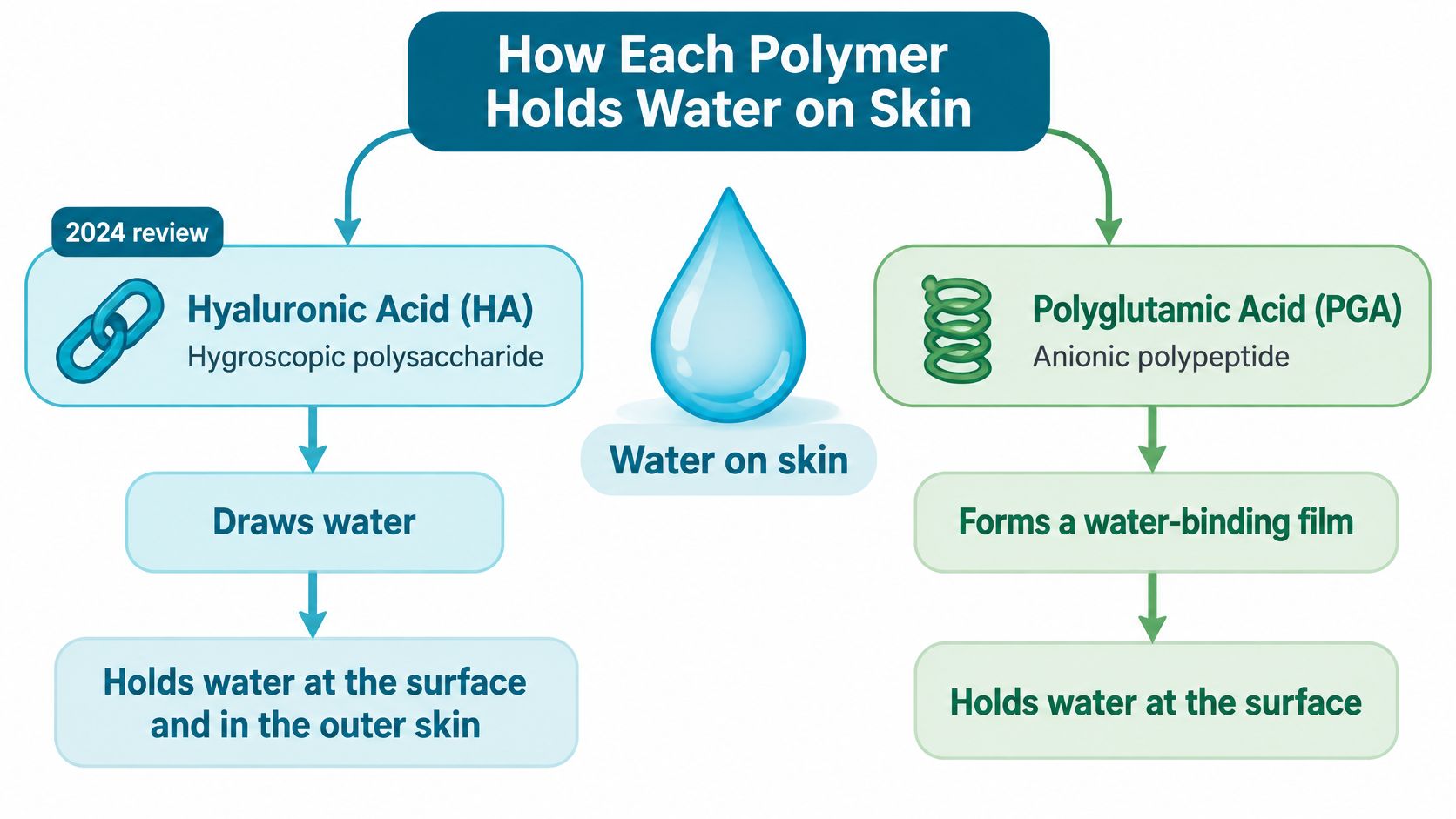
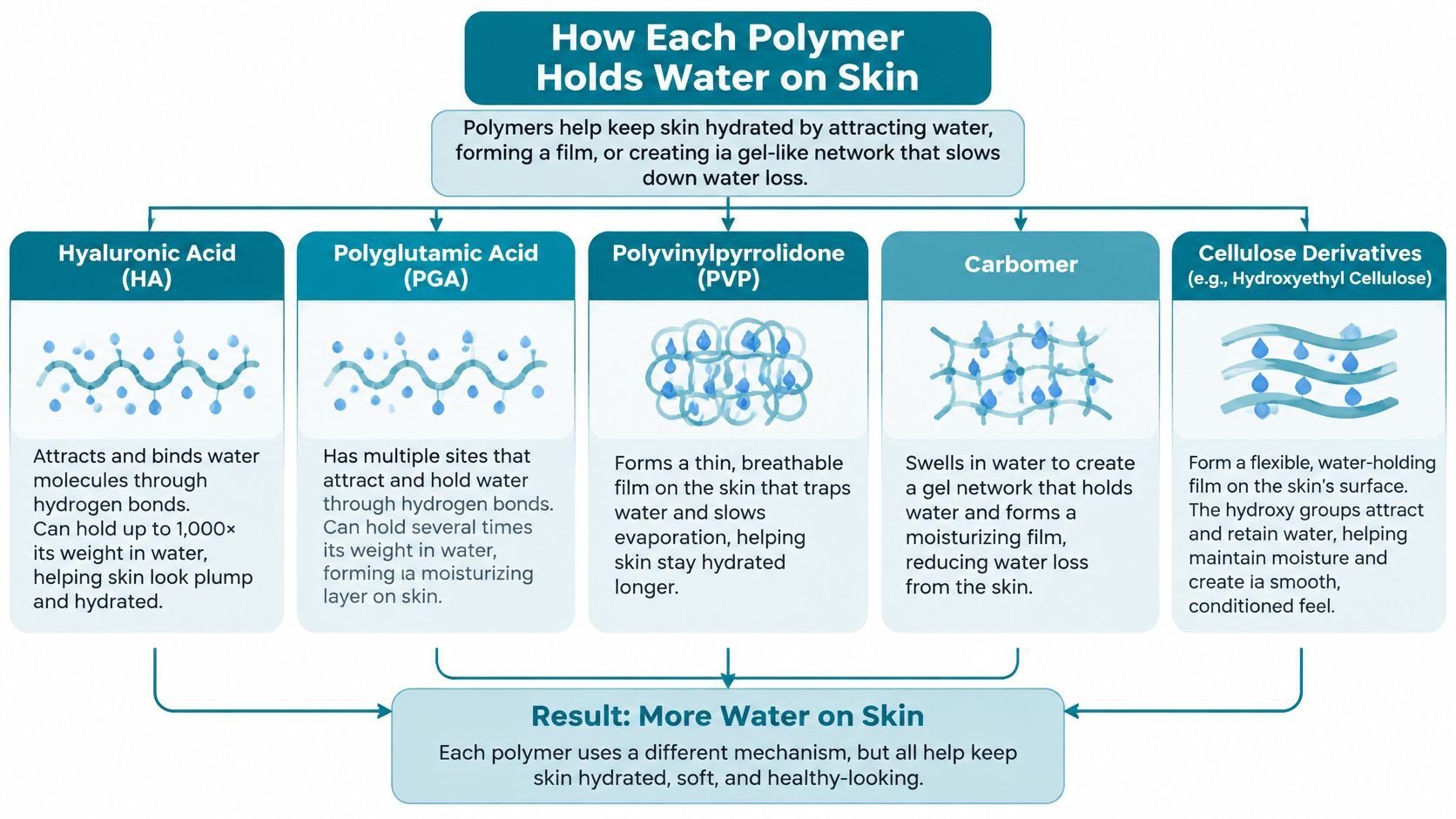
Picture two ways of keeping a full glass from spilling. One is the water itself, held by something that grabs it. The other is a lid. Hyaluronic acid is closer to the first. Gamma-PGA is closer to the second.
Hyaluronic acid is hygroscopic. It binds water at the skin surface and within the stratum corneum, and how deep it goes depends on molecular weight, cross-linking, salt form, concentration, and pH. Sodium hyaluronate, the salt you'll see on most labels, behaves differently from an acetylated or crosspolymer version. That's why two "hyaluronic acid serums" can feel like different products on the same face.
Gamma-PGA is a biodegradable anionic polypeptide. Its film-forming behaviour is the point. It doesn't so much grab water as lay a light, flexible sheet that slows the look of water leaving the surface, which is a very different cosmetic effect from a plumper, wetter feel.
What the lab work actually measured
A 2025 peer-reviewed study of keratinocytes and a reconstructed-skin model found that topical 1% gamma-PGA increased expression of filaggrin, involucrin, CD44, and aquaporin-3 versus a control, with dose-dependent rises in barrier-associated markers and hyaluronic-acid-synthase transcripts in cell work, per the reconstructed-skin study published in PMC. Separately, a 2024 reconstructed-skin-model study reported that 1% topical gamma-PGA upregulated all three tested hyaluronic-acid synthase genes, HAS-1, HAS-2, and HAS-3, as summarized in this esthetician education guide.
Those markers are laboratory context, not a promise about your Tuesday morning. The work was done ex vivo and in vitro, not in a human comparison of finished retail products. It suggests PGA may do more than sit there, and that's the end of what it establishes.
There's also formulation evidence: gamma-PGA derived from brown algae proved hygroscopic and could be built into model cream formulations, per coverage of Mattia Parati and colleagues' paper in Polymers. Useful if you make lotion. Not a reason to swap a serum.
Practical reading: the visible difference between a water-held look and a filmed look shows up in how fast comfort fades, not in a single number. If skin feels tight by mid-morning, the missing layer is probably a film or a cream, not a stronger humectant.
The other ingredient in the bottle often matters more than either polymer. Glycerin is the workhorse humectant in most of these formulas, and the gel or cream base controls how long anything stays on the surface. A 2% HA gel with a high glycerin load will out-feel a 1% PGA serum in a watery base, and neither label will tell you that. For a wider view of humectant choices, natural humectants for skin covers the options that usually sit alongside both polymers.
Skin Type Humidity and Formula Fit
| Situation | Practical lean | Why it fits |
|---|---|---|
| Dry or crepey-looking skin in low humidity | HA serum, then a cream or PGA film | Water binding plus something that slows the look of evaporation |
| Oily or combination skin | Lightweight HA gel or a thin PGA layer | Water gels absorb and sit under makeup without a heavy oil |
| Humid climate | HA alone may be enough | Ambient moisture gives a humectant water to hold |
| Dry heated indoor air | HA plus an occlusive cream or PGA film | A surface humectant can feel tight if water leaves freely |
| Sensitive skin | One modest-percent product and a patch test | HA is widely tolerated; PGA has less consumer evidence |
| DIY lotion or serum | Name the polymer, molecular weight, and percent | Equal percentages are not equivalent formulation guidance |
The table gives you the lean. What it can't show is the variable often ignored: molecular size, and how much water is already in the air.
Why the same serum feels different in July and January
Recent academic coverage reports that hyaluronic acid below 100 kDa can penetrate skin, with lower-weight forms reaching deeper layers, while high-molecular-weight HA largely remains at the surface and forms a film that helps limit water loss, per the delivery research summarized in PMC. In the same body of work, a 2026 study of dissolving HA microparticles reported four-week improvements in hydration and water loss versus a control regimen.
That's a reminder to judge delivery systems and finished products, not ingredient names. A microparticle format and a watery serum can carry the same INCI and behave nothing alike.
Surface film is a legitimate cosmetic goal. For a comfortable, less tight-feeling face in a heated office, a film is often the whole point. Deeper-penetration marketing deserves more scrutiny, because a smaller polymer doesn't automatically give you the same surface feel, and a single measurement taken after one application can't predict months of use, different skin types, or a different climate.
Sensitive skin gets its own rule: pick one modest-percentage product, patch test it, and change only that product for a week. If you're still mapping your own skin, what are the 5 skin types is a sensible place to start before you buy a third serum.
Professionals who read full ingredient decks rather than hero claims often point to how a line positions its humectants across a range. Epionce skin care ingredients from Luxe Aesthetic Surgery & Medical Spa is a useful reference for that habit, because seeing where a brand places its humectants tells you more than the front label does.
For DIY makers, the gap is wider. Published comparisons don't establish that equal percentages of PGA and HA are chemically or sensorially equivalent, so a recipe can't swap one for the other at the same number and expect the same slip, tack, or finished look.
How to Layer the Two Humectants
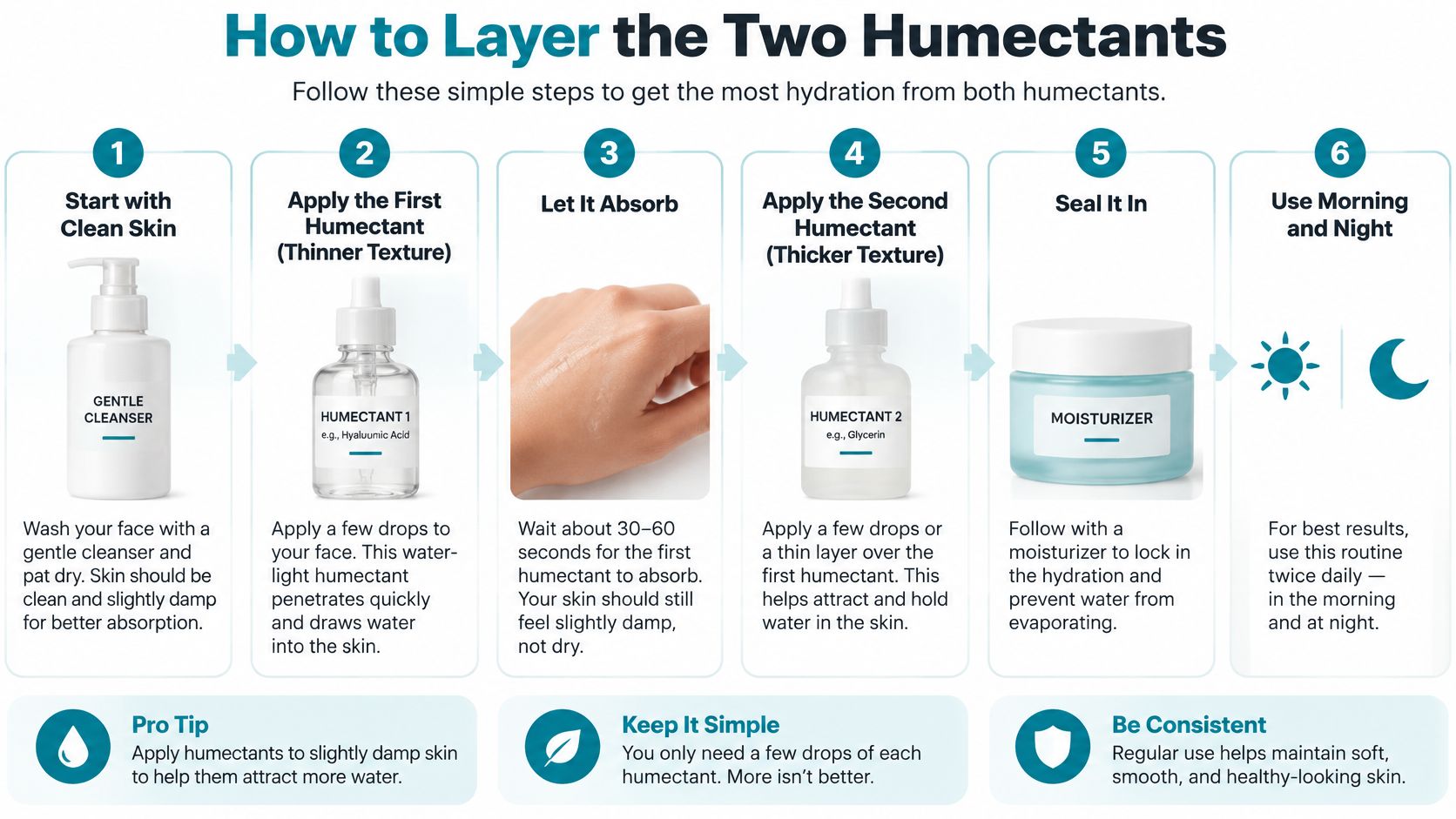
If you're using both, order does real work. Thin to thick, water before oil, and always onto something damp.
- Cleanse and leave the skin slightly damp. A humectant needs water to hold, so a mist or a splash before the serum does more than a extra layer of product. Skip the mist if you're cleansing in a humid bathroom and skin already feels cool and damp.
- Press in a pea-sized amount of hyaluronic acid serum or water-based HA gel. Look for a formula that names its high-molecular-weight HA for the quicker surface look, or states a high-and-low blend if it carries both. Hyaluronic Acid Plumping Serum is built this way, pairing low and high molecular weight hyaluronic acid (NASHA gel) with Argireline, and it's oil-free and non-comedogenic. Massage a pea-sized amount onto damp skin. If your skin is oily and already feels comfortable, you can stop after this step.
- Add polyglutamic acid as a thin second layer. If PGA is already in the HA bottle, it stays in the water step and you skip this. If it's a separate product, smooth a pea-sized amount over the top. It's there for the light film, not as a replacement for HA and not as a stand-in for a thick occlusive. Reactive skin should try each one on separate days first, then together only once both feel fine.
- Follow with moisturizer when skin feels dry or the room is heated. A cream or lotion slows the look of evaporation in a way a serum alone doesn't. If your skin looks very dry or crepey, don't skip this step, even in summer.
- Apply sunscreen in the morning. Hydration steps sit underneath it, never instead of it.
The logic repeats anywhere you want water held and then sealed. Around the mouth, the night version is to gently smooth flaky lips with a sugar scrub, press a peptide or hyaluronic serum into the skin around the mouth, and finish with a thick layer of balm over the lips and lip line. Same two jobs, smaller area.
Pilling usually comes from quantity, not chemistry. Use less than you think, press rather than rub, and give each layer thirty to sixty seconds before the next.
Expect the surface to look plumper and fine lines to look softer, serum first and moisturizer after. For more on application order and timing, how to use hyaluronic acid walks through the damp-skin step in detail.
The Four Times Water Claim Under a Closer Look
Retire the slogan. The claim that polyglutamic acid holds three or four times more water than hyaluronic acid gets repeated across comparison pages without separating ingredient identity, concentration, molecular weight, vehicle, humidity, the meter used, or the study design. That's not a comparison. It's a headline.
The strongest neutral comparison available is small. Five volunteers used creams containing PGA or HA, overall moisturizing performance was comparable, and HA produced slightly greater outer-skin hydration 15 minutes after application because it bound water at the surface, according to the supplier technical document reviewing that work. One application, five people, one moment. That can't support long-term superiority claims in either direction.
The better question: not "which ingredient holds more water," but "which finished formula, at what molecular weight and percentage, in what base, will still feel comfortable on my skin at four in the afternoon."
Four label checks that beat any ingredient boast
- Polymer name. Sodium hyaluronate, hydrolyzed sodium hyaluronate, and sodium hyaluronate crosspolymer are not interchangeable, and "PGA" alone tells you nothing about molecular size.
- Molecular weight or a stated blend. A brand that names a high-and-low HA blend is giving you something to reason with.
- Percentage, when printed. If it isn't stated, assume the ingredient is present at a level chosen for feel and cost, not for a study.
- The vehicle. A water gel and an oil cream can both list HA and feel nothing alike on the same face. This is the check most shoppers skip.
For DIY makers, the practical gap is bigger still. Published comparisons don't establish that equal percentages of PGA and HA are chemically or sensorially equivalent, so a concentration-based "winner" isn't formulation guidance. A recipe that trades one for the other at the same number will change texture before it changes anything else. If you're working on water loss specifically, what is transepidermal water loss explains the measure those meters are reading.
A word on wording, because it matters if you sell anything. Under U.S. rules a cosmetic doesn't require premarket approval and the FDA doesn't maintain a list of approved cosmetic claims, though labeling must be truthful and not misleading, as the FDA's cosmetics labeling and claims page explains. A product can be treated as a drug when its marketing says or implies it treats or prevents disease or affects the structure or function of the body. Etsy's medical claims policy is stricter for sellers there, prohibiting disease claims and drug-like positioning, including describing an item as FDA approved.
Judge the bottle by comfort, how makeup sits, and whether skin looks smoother after two weeks. A multiple printed in an ad isn't a measurement of your face.
Pick the Polymer for Your Routine
Look back at the situation table and the verdict writes itself. Choose hyaluronic acid first when the label names a molecular weight or a high-and-low blend and the goal is an immediate smoother, fuller look. It's the benchmark for a reason, and it's the ingredient with the deeper evidence base.
Add polyglutamic acid second, and only when the routine still feels like water leaves too quickly and a light film on top would help. Use the pair together in low humidity and heated rooms. Use the HA step alone when the air is humid or the routine has to stay short.
That's the whole decision. Not which polymer wins, but whether your skin needs water held in, a film over the top, or both at once.
Skin Perfection stocks hyaluronic serums and gels plus the lotion-making supplies for building your own water step, and the same four checks apply whether you buy or batch: polymer name, molecular weight if printed, percentage if printed, and whether the base is a gel, serum, or cream. Apply a pea-sized amount to damp skin, follow with moisturizer if skin feels dry, and give it two weeks before you judge. If you're making a batch, add the booster at the supplier's rate into a finished water base rather than using a raw material neat, and don't treat equal percentages of PGA and HA as the same formula.
Skin Perfection makes the water step simple to get right, with a Hyaluronic Acid Plumping Serum that carries both low and high molecular weight hyaluronic acid, plus the lotion-making supplies to build your own. If you'd rather compare finished formulas than argue about ingredient slogans, browse the serums and DIY bases and read the labels the way this guide taught you to. Visit Skin Perfection to find your water step.