

 Buy with Prime



The most repeated advice on this topic says peptides belong at night, because skin renews itself while you sleep, and that a morning application wastes the ingredient. Skin biology does shift across the day, so that reasoning has a plausible ring to it. The trouble starts when you look for the proof behind the timing claim.
The missing piece is the comparison nobody ran. No study has taken the same peptide serum, given it to a morning-only group and a night-only group, and measured which one did better. Until that trial exists, "night is best" stays a reasonable guess dressed up as a rule.
So the peptide serum morning or night question comes down to two practical checks. What does your formula do? And what else already lives in your routine? Those two answers pick your slot more reliably than any universal rule can.
Table of Contents
- Which Time of Day Fits Your Peptide Serum
- Layer Peptide Serum Morning and Night
- What the Research Says About Morning and Night
- Common Mistakes and How to Fix Them
- Check Your Routine Before Adding Another Serum
Which Time of Day Fits Your Peptide Serum
Treat the question as a matching exercise rather than a verdict. The 2026 systematic review and meta-analysis flagged wide variation among its included studies in peptide type, concentration, dosing schedule and outcome measurement, which is exactly why a single best-time answer falls apart. The slot that suits your serum depends on its formula and on what else shares your routine.
Match your bottle to the closest profile below.
| Serum profile | Better time | Reason | Watch for |
|---|---|---|---|
| Hydrating or barrier-focused peptide serum | Morning or night | Sits under moisturizer and sunscreen in either routine | Follow the label for frequency |
| Peptide serum with antioxidants | Morning | Pairs with daytime sunscreen protection | Apply before moisturizer and sunscreen |
| Peptide serum used with retinoids or strong acids | Night | Keeps potentially irritating actives away from daytime sun | Introduce one new active at a time |
| Peptide serum on a makeup-heavy routine | Night, or morning if fully absorbed | Less chance of pilling under makeup at night | Wait until the serum is dry before makeup |
Two rules sit above the table. If the label specifies twice daily, follow it. If it says once daily, choose the slot you can repeat every day for long enough to judge the result, and our guide to how long peptides take to work sets a realistic window for that call.
Still torn between rows? Default to the slot with fewer competing steps. A morning already crowded with makeup argues for night, while a serum paired with a retinoid or strong acid belongs in the evening, where those actives stay clear of daytime sun.
Run this on your own bottle: Does the label say once or twice daily? Does the ingredient list include antioxidants? Is a retinoid or acid already in your evening? Do you wear makeup most mornings? Four answers and you have your slot.
Layer Peptide Serum Morning and Night
The hour on the clock does less for your results than the order of the steps. No study has run the same peptide serum head-to-head at morning only versus night only, so the clock is the one variable you can stop optimizing. What you can control is the layering: both sequences below take about two minutes once you have run them a few times, and both call for damp skin rather than wet skin at the serum step.
Here is the whole routine in one view.
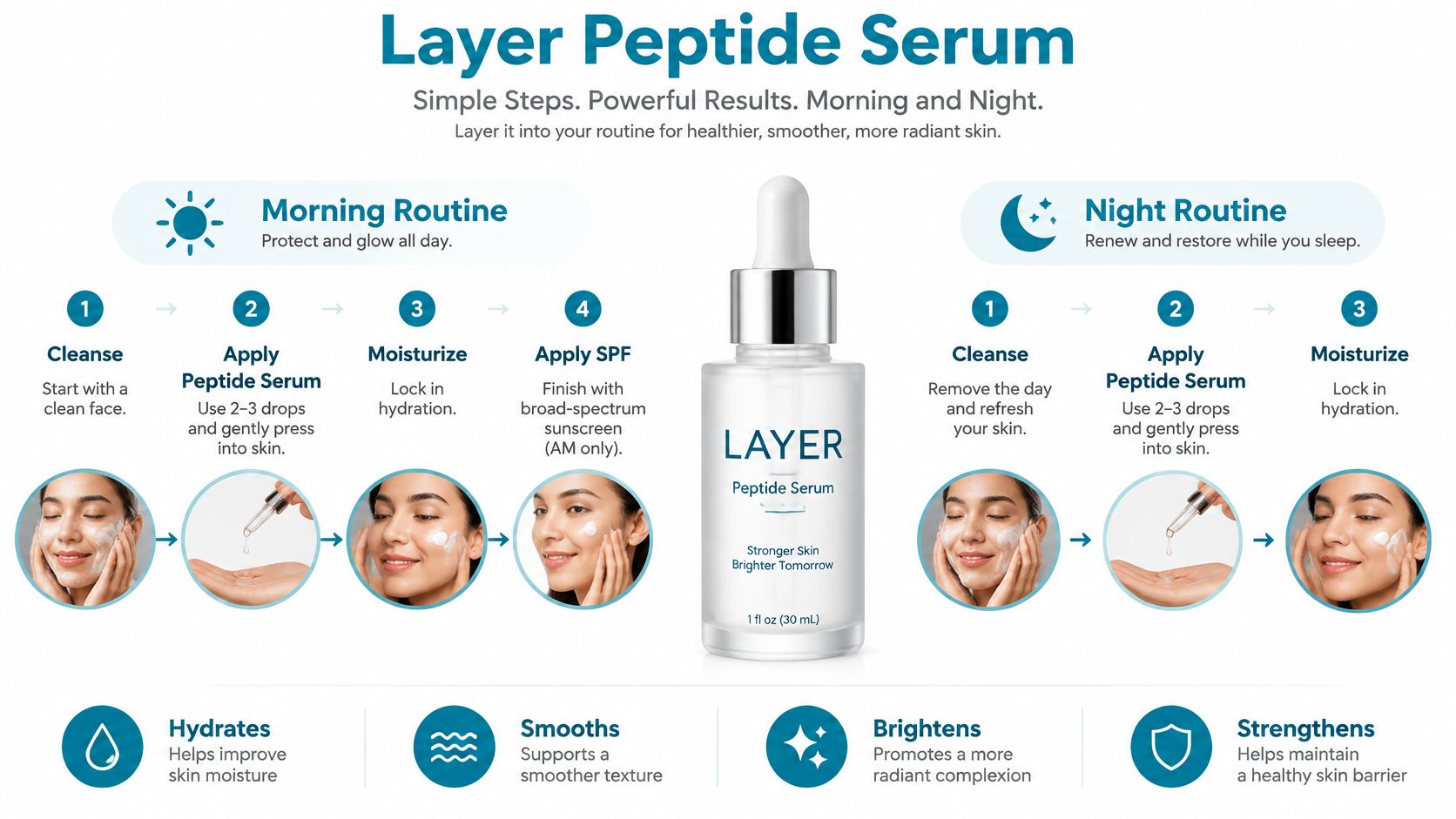
The Morning Sequence
- Cleanse, then pat until damp. Start with a gentle cleanser. Damp skin lets the serum spread evenly across the face and neck instead of sitting in puddles.
- Apply the serum in the labeled amount. Usually a few drops for face and neck. Press it in with flat fingers rather than rubbing, which drags at the skin and pushes product into the hairline.
- Wait until the tacky feeling goes. Thirty seconds covers most water-light formulas, and the pause is what keeps the next layer from sliding around.
- Layer moisturizer. This step holds the hydration in place, and it does more for your skin than adding a second serum.
- Finish with broad-spectrum sunscreen. Peptide serums do not replace UV protection, so this step stays in every morning version of the routine.
The Night Sequence
- Cleanse and pat damp. Identical to the morning step, patting included.
- Apply the serum in the labeled amount. If a retinoid is also in your routine, the serum goes on first on damp skin and the retinoid follows once the serum has absorbed.
- Wait until it is dry to the touch.
- Layer moisturizer. A richer texture is fine at night if your skin feels tight.
- Skip sunscreen, add oil if you use one. A facial oil can be applied as soon as the serum is dry, which generally takes only a few seconds.
The slip that causes most of the trouble is applying serum to dripping wet skin. Surface water dilutes the drop you dispensed, so you spread a weaker film over a larger area, and the excess sits on top and rolls into little balls when the next layer arrives. Damp is the target. If water runs down your jaw, you have gone too far.
Where Companion Products Fit
A vitamin C serum is a common morning pairing, and the thinner product goes on first. If both feel identical in texture, check the label for layering guidance rather than guessing.
A retinoid belongs at night. Start on alternate nights and keep the peptide serum in the same routine, since the two can share an evening without competing for the same step.
Leave AHA and BHA exfoliants out of the morning, because they can increase sun sensitivity, and run them on separate nights rather than stacking them with everything else.
Hyaluronic acid and other humectants sit comfortably under moisturizer in both routines. They work best on damp skin, which is the same instruction as the serum step.
| Companion product | Morning | Night | Practical note |
|---|---|---|---|
| Broad-spectrum sunscreen | Required final step | Not needed | Peptides do not replace UV protection |
| Vitamin C serum | Often used, thinner product first | Optional | Check the label for layering guidance |
| Retinoid | Avoid | Preferred companion | Introduce on alternate nights first |
| AHA or BHA exfoliant | Avoid before sun exposure | Use on separate nights | Can increase sun sensitivity |
| Hyaluronic acid or humectant | Fine under moisturizer | Fine | Apply to damp skin |
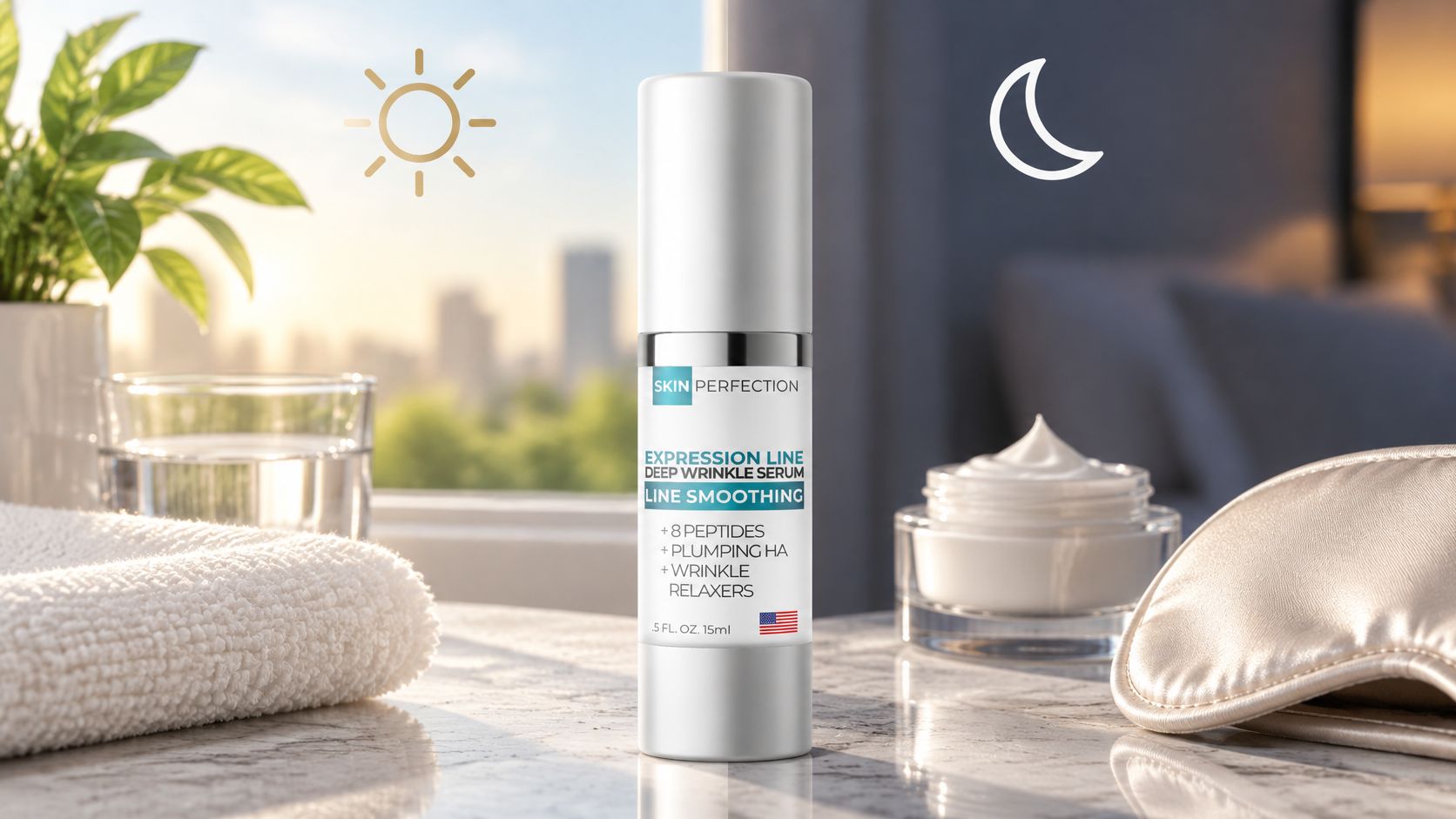
Our routine advice is to keep a gentle cleanser, a moisturizer and a daily sunscreen, then add one targeted serum or eye cream for the main concern, used morning and night. Expression Line Deep Wrinkle Serum is an anti-aging serum for wrinkles and one of Skin Perfection's best sellers, and it fills that single targeted slot. For expression lines on the forehead or between the brows, apply a thin layer to the area, keep it in the same slot morning and night, and judge the look of those lines only after steady use.
If you are juggling more than one serum, our guide to how to layer skincare serums sets the full order of operations.
A good routine is quick enough that you do not skip it, produces no pilling between layers, and runs the same way every day so you stop re-deciding it.
What the Research Says About Morning and Night
No published trial has taken a single peptide serum and compared morning-only, night-only and twice-daily application head to head. That gap hides easily, because studies do report real results. What they report is one formula used at a frequency the authors chose before the trial began. An ingredient guide to peptides puts the limitation directly: a randomized study built on twice-daily application cannot establish that nighttime use is superior, or that twice daily works better than once.
A gel-based peptide serum looks the same at 7 a.m. and at 10 p.m. What changes is everything you put around it.
Skin biology does give the night routine a rationale. A 2020 peer-reviewed study on cosmetic formulations and the skin's circadian clock found that genes involved in keratinocyte differentiation are expressed during the late night and early morning, and that barrier repair begins during the morning hours. The pattern is real, and it still leaves the timing question open.
The same double-blind, placebo-controlled investigation measured circadian changes in 44 women, and the 84-day formulation study reported that hydration increased by up to 30% in the morning and 28% in the evening with placebo, while the active formulation produced increases of 40% in the morning and 27% in the evening.
Read those figures slowly. Hydration improved at both times, and the active treatment's strongest single result landed in the morning, the opposite of what night-only advice predicts. Both changes were cumulative across 84 days, the product of steady repetition rather than one perfectly timed application.
So the reasons to pick a slot are practical. Night suits people who want undisturbed layering, who dislike the feel of product under makeup, or who already run a heavier evening routine. Morning suits people who want the serum beneath moisturizer and sunscreen and who'd rather skip an extra step late in the day. Peptides do appear in published trial data, and our breakdown of whether anti-aging peptides are effective sets expectations for what that data covers.
Choose the hour you can repeat without effort; repetition is what the studies measure.
Common Mistakes and How to Fix Them
Give a peptide serum 8 to 12 weeks before judging it. A randomized, double-blind 12-week pilot of 60 women aged 60 to 90 compared a topical peptide formulation with a commercially available moisturizer, and 70% of the peptide group reported improved overall appearance versus 42% of controls, with significantly improved barrier function and hydration on objective testing. Results like that accumulate across the full study period, so a check-in at two weeks tells you little about where your skin will land.
Irritation is possible and it is usually explainable. A safety review of cosmetic peptides reports minimal penetration, no systemic toxicity or genotoxicity, and none-to-slight irritation across the data it examined, though the tolerability studies it cites ran about 30 days to 7 months. Mild redness or flaking can still surface in the early weeks of a new formula, even when overall tolerability is rated acceptable. A formula that is gentle for most users can still irritate a reactive barrier.
None of the fixes below depend on the hour you apply, because no published trial has put morning peptide application head-to-head against night. Each one is a formula or consistency problem with a concrete fix.
| Symptom | Likely cause | What to change |
|---|---|---|
| Stinging or redness in the first weeks | Strong formula or stacked actives | Pause the newest product and patch-test |
| Serum pills under sunscreen | Too much product or applied too soon | Use less and wait until fully dry |
| No visible change after a month | Window too short or routine inconsistent | Keep the same slot for 8 to 12 weeks |
| Color or smell has changed | Heat, light or repeated air exposure | Store as the label directs and replace if altered |
| Dry or tight skin | Too many actives at once | Simplify the routine until skin settles |
A change in color or smell is the one row you should not troubleshoot. Water-based peptide formulas can be sensitive to heat, light and repeated air exposure, so store the bottle the way the label says and replace it if it no longer looks or smells like it did when you opened it. Never start a new product on broken or inflamed skin.
If a retinoid already sits in your evening, using peptides with retinol explains how to pace the two so neither gets dropped.
Labels are a poor place to look for proof, and that is by design. Under U.S. FDA rules, a cosmetic is intended to cleanse, beautify, promote attractiveness or alter appearance, and the FDA cosmetics labeling guide notes that claims to treat or prevent disease, or to affect the body's structure or function including skin, can make a product a drug. The agency also does not approve cosmetics before they reach the market and keeps no list of accepted claims, per its guidance on cosmetic labeling claims. Treat any approved-by-FDA line on a serum listing as a reason to keep reading.
Check Your Routine Before Adding Another Serum
Before a new bottle goes on the shelf, run this sequence. It takes about ten minutes and saves you from spending eight weeks testing two things at once.
- Read the frequency on the label. Once daily or twice daily is the first thing to confirm, because it decides whether you're choosing a slot at all.
- Pick one slot and commit. Morning or night, whichever already has a gap in your routine. Then repeat it for the full evaluation window instead of drifting between times.
- Introduce one product at a time. Patch-test on the jawline for several days before you use it across the whole face, especially if your skin is reactive.
- Check that the routine matches the hour. A morning routine ends with broad-spectrum sunscreen. A night routine leaves out strong acids and retinoids unless the label and your skin support them.
- Write down the start date. A marker note on the bottle is enough, and it turns a vague memory into an actual check.
If marks left by past breakouts are part of what you're managing, UK pharmacist advice on scars is a useful companion read. It explains which products can sit together and which need spacing out, which keeps you from stacking a new serum onto an already crowded routine.
Skin Perfection's serum boosters exist for the same reason: they let you add anti-aging peptides to a base you already tolerate instead of introducing a whole new formula at the same time. Our guide to customizing your skincare routine walks through how that works in practice.
Pick the time you will repeat, follow the label, and protect your skin during the day.
Skin Perfection makes the products that make this decision simple: a gel-based peptide serum designed for morning and night use under moisturizer or makeup, and serum boosters that let you add anti-aging peptides to a base your skin already tolerates. If the morning-or-night question has been the reason your serum is still sitting in a drawer, choose the slot you'll repeat and start tonight or tomorrow. Visit Skin Perfection to browse the serums and the lotion-making supplies for building your own blend.