

 Buy with Prime



Yes, peptides and vitamin C can share one routine: vitamin C goes on first, on clean, dry skin, and the peptide follows once that layer has dried. In a nine-country observational study of a single finished formula, 63% of 1,360 assessed participants improved in forehead wrinkles and 64% in crow's feet after 28 days of twice-daily use, while 97.7% rated tolerability good or very good.
So why does the question keep coming back? Because most advice answers the wrong question. People ask whether the two ingredients fight each other, then spend weeks hunting for a chemistry verdict that never arrives. The limits that decide your results sit somewhere else: how much irritation your barrier will tolerate, how consistent you are on a Tuesday night when you're tired, and whether the product in your hand was ever tested as a finished formula.
That reframing matters more than any ingredient chart. Peptides and vitamin c together are a scheduling decision first and a chemistry question second. Get the schedule right, keep the barrier calm, and stay consistent long enough for a change to register, and you've solved the parts you control.
Table of Contents
- Can Peptides and Vitamin C Go in the Same Routine
- Stability Limits Behind Every Layering Choice
- How to Build a Routine Without Overloading Your Skin
- Irritation, Barrier Status and Adherence Risks
- What the Studies Show About Benefits and Limits
- Choose a Layering Plan and Patch-Test First
Can Peptides and Vitamin C Go in the Same Routine
Layering vitamin C and peptides is a scheduling problem, not a chemical standoff. They can share one routine. What they can't do is substitute for each other, because vitamin C works as an antioxidant that supports collagen-related structural processes while peptides may provide signaling or matrix-support effects. Two different jobs, one face.
The confusion usually starts with how the word together gets read. Together can mean blended into one bottle, layered in one sitting, or used in the same week. Those are three different situations with three different risk levels, and only the first one requires a formulator's judgment.
Here are the four ways to arrange them across a day, with the order and wait each one needs.
| Routine | When | Order | Wait between layers |
|---|---|---|---|
| Vitamin C serum, then peptide moisturizer | Morning | Vitamin C first, then peptide, then sunscreen | Until dry, about one minute |
| Peptide serum at night, vitamin C in the morning | Split day | Vitamin C in the morning, peptide at night | Not applicable |
| Finished product containing both | Either | Follow the label directions | Follow the label directions |
| Hand-mixed blend in a DIY base | Either | Not advised until pH is measured | Measure the finished pH before the first application |
Routine A is the standard morning. Thin vitamin C serum on clean, dry skin, roughly a minute until the layer stops feeling wet, then a peptide moisturizer, then sunscreen last. The SPF isn't a separate concern bolted onto the end. Morning antioxidant use and sun protection belong to the same decision.
Routine B splits them by time of day. This is the calmest arrangement for a first attempt and for anyone whose skin stings easily, because when a reaction appears you know which bottle caused it.
Routine C is a finished formula that already contains both. The maker settled the pH and the order, so the label directions outrank any general rule you've read online, including the ones below. Routine D is where to slow down. Until you measure the pH of a hand-mixed blend, you don't know whether the vitamin C is still in its useful range or whether the peptide is sitting somewhere it degrades.
The simplest rule: if the layers pill, sting or stay sticky, separate them by time of day before blaming either ingredient. Pilling is usually a texture problem, not a chemistry verdict.
If peptide serums are new to you, our walkthrough on how to use peptides for skin covers where they sit in a fuller routine.
Stability Limits Behind Every Layering Choice
Slice an apple and leave it on the counter. The cut face browns because oxygen, light and warmth are working on the same kinds of compounds that make vitamin C useful on skin. A serum lives under identical pressure inside its bottle, which is why the same formula can hold its potency in an airless pump and fade in a wide-mouth jar you open twice a day.
Pure L-ascorbic acid is absorbed through the stratum corneum substantially better when the vehicle sits below about pH 3.5, and it is also sensitive to oxygen, heat, light and water exposure. A published review of peptide and vitamin C formulation puts those two facts side by side and draws the practical conclusion: pH, packaging and oxygen control aren't secondary details, they are the formula.
The packaging tells you as much as the ingredient list does.
Three ways a blend fails
- The pH drifts upward. A buffer that doesn't hold lets the vehicle rise out of the range where L-ascorbic acid absorbs well. The vitamin C is still printed on the label, and it is no longer doing the job you paid for.
- The pH sits too low for the peptide. Some peptide sequences hydrolyze or change charge behavior under strongly acidic conditions, so a vehicle tuned for L-ascorbic acid can be hostile to a peptide that behaves perfectly at a gentler pH.
- Oxygen gets in after the first opening. Every squeeze of a dropper pulls air into the bottle, and oxidation begins on contact. That's the reasoning behind single-dose amber packaging, which limits both oxygen exposure and the preservative load.
Peptide compatibility is judged at the final product pH, not at the pH of each raw material measured alone, because the blend is what sits on your shelf for the next three months.
| Ingredient or form | Stability concern | pH or condition to check | Test before use |
|---|---|---|---|
| L-ascorbic acid | Oxidation from oxygen, heat and light | Absorption best below about pH 3.5 | Measure pH and watch for discoloration |
| Sodium ascorbyl phosphate | Lower acid sensitivity than L-ascorbic acid | The supplier's declared working range, not the pH 3.5 rule | Confirm working pH range with the supplier |
| Ascorbyl tetraisopalmitate | Oil-soluble form, vehicle dependent | The pH of the water phase it's carried in | Check compatibility with the base |
| Acetyl hexapeptide-8 | Possible breakdown at strongly acidic pH | Test at the final product pH | Confirm peptide integrity after storage |
| Tripeptides in general | Charge change under strongly acidic conditions | Test at the final product pH | Accelerated heat and light test |
Three checks a blender can run
Measure the pH of the finished blend, not the pH of each part. Record the number, the date and the container type, because a reading without a date tells you nothing six weeks later.
Look for discoloration after light exposure. A serum that has turned yellow or brown has oxidized. Clear glass on a sunny shelf accelerates the process, and a dark bottle in a cupboard slows it.
Choose single-dose or airless packaging to limit the oxygen that enters after opening. A pump beats a dropper for anything water-based and antioxidant-rich.
A proper stability program tracks five measures: vitamin C assay, discoloration, pH drift, viscosity and peptide integrity, under accelerated heat and light and under real-time storage. The peptide storage and stability research from Bulk Aussie Peptides complements that checklist well, since it follows how peptide behavior shifts over time in storage rather than only at the moment of mixing.
An unbuffered, repeatedly opened water-based serum can lose vitamin C activity while the ingredient list stays exactly the same.
If keeping the vehicle below pH 3.5 irritates the skin you're formulating for, a more stable vitamin C derivative or an anhydrous system may be the better technical call. What doesn't transfer is the evidence. Clinical results for L-ascorbic acid don't automatically apply to a derivative, and our tetrahexyldecyl ascorbate serum guide explains how an oil-soluble form behaves differently inside a base.
How to Build a Routine Without Overloading Your Skin
Seven steps, in order. Each one keeps a variable isolated, so that when something feels wrong you know where to look instead of guessing.

- Start with vitamin C alone, mornings, for one week. Clean, dry skin, a thin layer. One new active makes any reaction easy to trace to its source.
- Patch-test the peptide along the jawline for 48 hours. This small area tells you whether the full combination suits your skin before it reaches your cheeks.
- Add the peptide at night, on alternate nights for the first week. Spreading the load gives a barrier that's new to the ingredient room to adjust.
- Wait about a minute between layers, until each one is dry. A peptide applied over a wet vitamin C layer dilutes both and encourages pilling.
- Store the vitamin C cool, dark and tightly closed. Light, heat and air degrade it first. A shelf above a radiator is the worst place in the house.
- Finish every morning with sunscreen as your last layer. The antioxidant supports your photoprotection strategy. It doesn't replace the SPF.
- Log stinging, redness and changes in tone for eight weeks. One variable at a time, so the log tells you something.
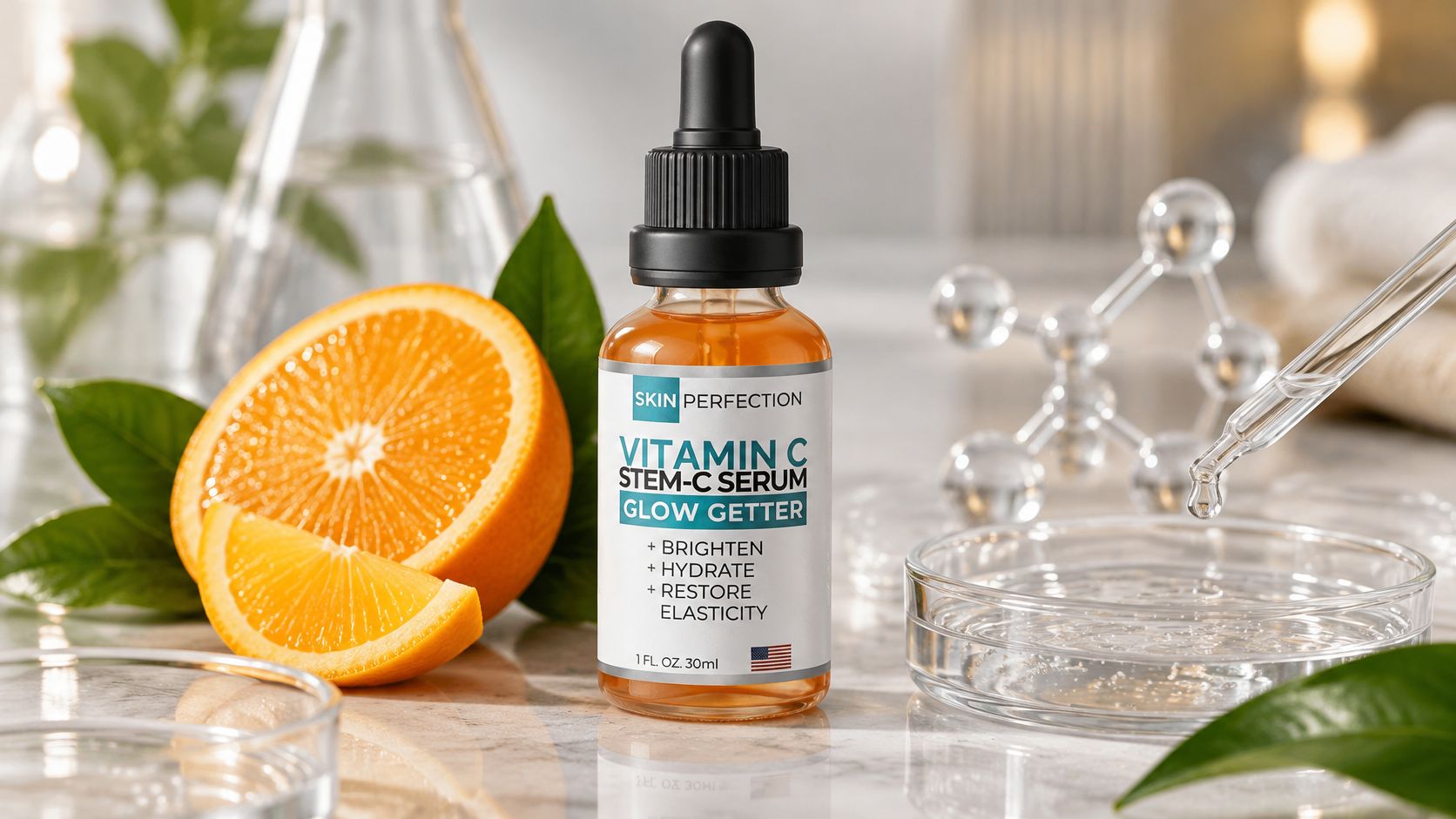
A finished serum built for layering removes most of this guesswork, which is why our Vitamin C Serum with Hyaluronic Acid and Plant Stem Cell Complex uses sodium ascorbyl phosphate as its vitamin C source in a fast-absorbing base designed to sit under peptide serums and retinoids.
After two weeks of nightly peptide use with no irritation, move both products to daily. If the log shows a reaction, return to the last version of the routine that felt calm and hold there for a week before changing anything again. Our guide to layering skincare serums covers the order for a longer routine.
Irritation, Barrier Status and Adherence Risks
Ingredient clash gets blamed for reactions that strength, frequency and barrier status cause. A low-pH vitamin C serum can sting on its own, with no peptide within arm's reach, and that sting tells you about your barrier and the formula's acidity rather than how hard the product is working.
Four groups should move slower than the standard schedule. Sensitive skin reacts to concentration before it reacts to combination. Rosacea-prone skin flares with acidity and with too many actives at once. Recently exfoliated skin has a thinner, more permeable surface layer for a few days. Compromised barriers, the flaky, tight, stinging kind, need one gentle product and time, not a new four-step routine.
| Symptom | Likely cause | Fix |
|---|---|---|
| Stinging or burning within minutes | Low-pH vitamin C on a weakened barrier | Use vitamin C alone in the morning for a week, then reintroduce slowly |
| Redness or flaking after two weeks | Too many actives started at once | Drop to every other night and add one active at a time |
| Tingling only with a new peptide | Reaction to the base or a preservative | Patch-test the new product alone and stop it if the reaction continues |
| Yellow or brown serum | Vitamin C oxidation | Discard it and store the next bottle cool, dark and tightly closed |
| No change after eight weeks | Inconsistent use | Keep a log and adjust one variable at a time instead of increasing strength |
Stinging is a pH and barrier signal, not a performance indicator.
A review of the vitamin C literature summarized in PMC flags a second problem worth knowing: many studies are open-label, single-center or industry sponsored, and none of them answer whether someone with a compromised barrier should combine a low-pH antioxidant with a peptide product in the first place. That's a clinical judgment call, not something an ingredient list can settle.
Adherence decides more outcomes than potency does. The datasets that report measurable change all relied on steady twice-daily application over weeks, which is a very different pattern from a strong routine used on the nights you remember. A simple routine done daily for eight weeks will beat a demanding one done twice a week, every time.
For estheticians working with clients, the escalation protocol is short. Start with one active, lower the frequency, and refer to a dermatologist when redness or flaking persists beyond a couple of weeks. Our skin barrier repair resources cover what to use while the barrier settles.
What the Studies Show About Benefits and Limits
A 2025 study in the Brazilian Journal of Pharmaceutical Sciences tested a topical formulation combining ascorbyl tetraisopalmitate and a synthetic tripeptide in 43 healthy women aged 30 to 65, and reported significant improvements in skin firmness and elasticity.
Now read the design closely. Forty-three people, one specific formula, and no arm testing either ingredient alone. That structure can show a formula performs better than baseline over time. It cannot show the combination outperforms a well-made vitamin C product or a well-made peptide product used separately.
The biological rationale is complementary rather than synergistic. Vitamin C acts as an antioxidant and supports collagen-related structural processes. Bioactive peptides may provide signaling or matrix-support effects. Plausible, useful, and still a hypothesis about a tested product rather than a rule that applies to every mix you assemble at home.

The largest human dataset on a combined formula is a 2022 observational study across nine countries, published in the Journal of Cosmetic Dermatology. Effectiveness analyses included 1,382 participants, and after 28 days of twice-daily use, 63% of 1,360 assessed subjects improved in forehead wrinkles, 64% in crow's feet, and skin hydration improved in 67.3%. Tolerability was rated good or very good by 97.7% of the 1,742 safety participants aged 30 and older. It was observational, not randomized or placebo-controlled, so it shows association under real-world use.
An earlier report in the International Journal of Cosmetic Science covered three clinical studies of a formula combining 10% L-ascorbic acid with rice- and lupin-derived biopeptides and hyaluronic acid, available as a full paper on PMC. One consumer-assessment component included 51 women, and a skin-renewal measure showed mean fluorescence of 59.6 versus 64.9 for untreated skin at day 22, with estimated cell-turnover time of 17.1 versus 19.2 days, both reported as statistically significant.
Three questions to ask of any study
Was there a control group? Open-label work describes what happened, not what caused it.
Was the finished product tested, or only the raw materials? A result for a peptide powder in a lab dish tells you nothing about how it behaves in your bottle at pH 3.4.
Who paid for it? The 2021 authors were candid that well-designed in-vivo evidence for peptide and vitamin C combinations remained limited, so a positive outcome isn't proof of synergy.
Notice what improvement means in all three: a measured change in a skin property, evaluated on instruments and on participants' own assessment. Not a medical outcome, and not a reason to expect the same numbers from a different formula. For more on what these ingredients can and can't be expected to do, see our peptide serum benefits overview.
Choose a Layering Plan and Patch-Test First
Default to the split. If your skin is sensitive or you've never used either ingredient, vitamin C in the morning and peptides at night, and each active can be traced on its own when something changes.
Reserve a combined routine for a finished product whose pH and stability the maker has tested, and follow that label instead of any general schedule.
The shelf next to your mirror is where this gets practical.

Skip the hand mix unless you're set up to measure it. No tested dosage or preservative level for a DIY vitamin C and peptide blend comes out of the evidence above, and unpreserved water-based blends are a microbial risk. Peptide boosters often ship with no preservative at all, so a preservative such as Leucidal Liquid or Leucidal Complete at 4% belongs in the finished blend. Our recommended use for Syn-Ake, for instance, is a 5% concentration twice a day.
If you do blend, keep the peptide in a base you can control. Argireline, Acetyl Hexapeptide 8 is a formulation ingredient rather than a finished serum, blended into a water-based base at 2 to 10% and never applied undiluted. Once the serum is dry, which generally takes only a few seconds, an oil can follow.
Then treat your result as unvalidated until a stability check confirms it. Measure the finished pH, write it down with the date and container type, and ask any supplier for their pH range and stability data before you buy an ingredient marketed for combination use.
This week, do three things. Patch-test a small area along the jawline for 48 hours, pick one of the four routines and commit to it, and start the eight-week log.
Skin Perfection supplies both the finished products and the raw materials for people who want to understand what they're putting on their skin. Our serum boosters let you add proven peptides to a base you choose, while our vitamin C serum is formulated to layer underneath them without fillers or guesswork. Visit Skin Perfection to see the full range of peptide boosters, antioxidant serums and DIY lotion-making supplies, and build a routine where every layer earns its place.