

 Buy with Prime



The popular advice to choose peptides for gentleness and retinol for results is too simplistic. It treats peptides as a single ingredient and assumes every retinol serum delivers comparable performance. For a useful peptides vs retinol comparison, ask what was tested: the molecule, its concentration, the finished formula and the outcome measured. Those details matter more than a category-level winner.
Table of Contents
- Peptides vs Retinol Side by Side
- What Retinol Research Shows
- What Peptide Research Shows
- Irritation, Timing and What Pairs Well
- How to Combine Retinol and Peptides
- Choose the Routine That Fits Your Skin Goal
Peptides vs Retinol Side by Side
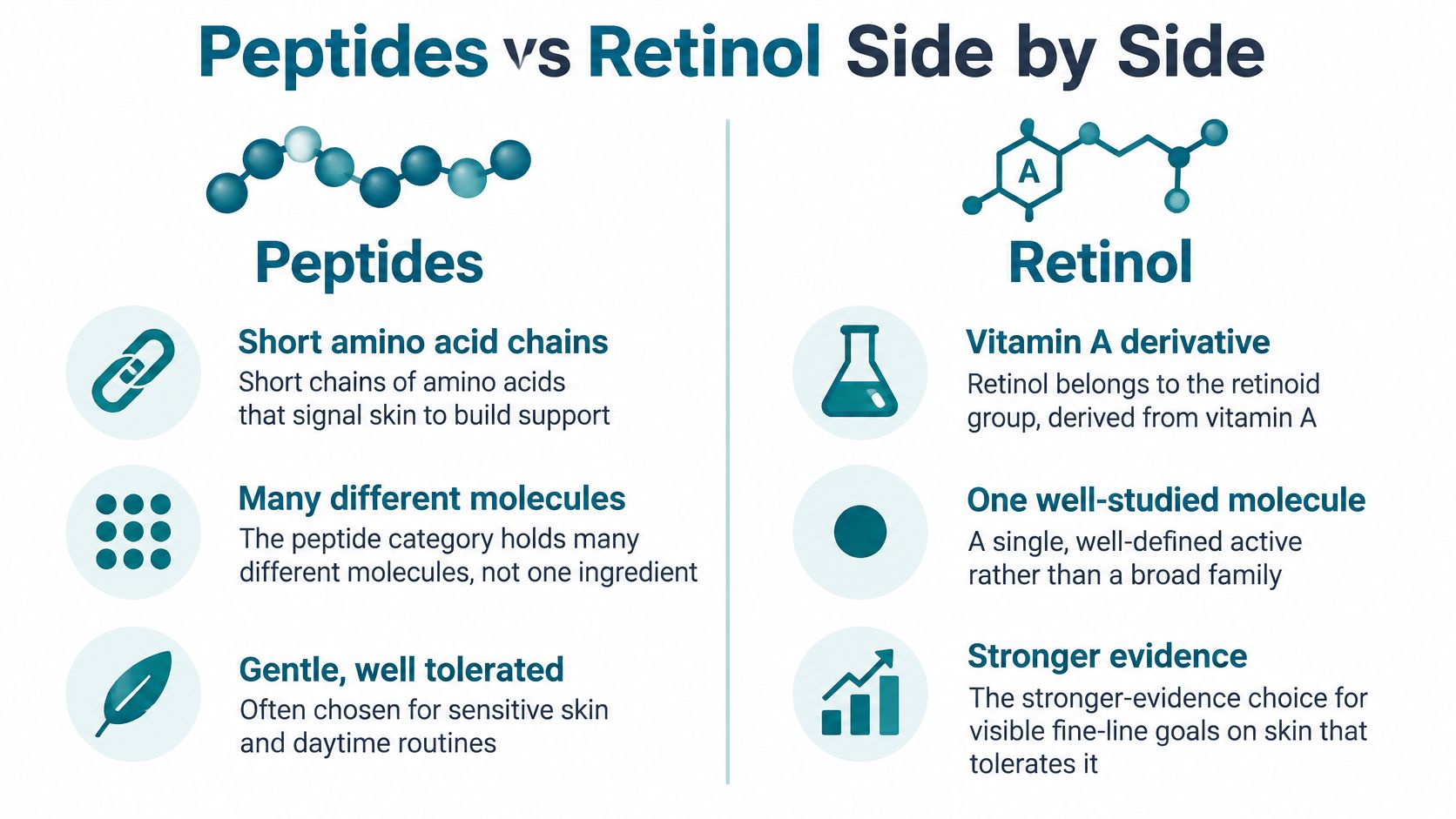
Retinol is a vitamin A derivative from the retinoid group. Peptides are short amino acid chains, and the peptide category contains many different molecules and complexes. You're comparing a defined ingredient with a broad family, not two interchangeable actives.
Peptides and retinol compared on the same criteria
| Factor | Retinol | Peptides |
|---|---|---|
| Ingredient type | Vitamin A derivative from the retinoid group | Short amino acid chains and peptide complexes |
| Evidence base | Longest clinical record among nonprescription anti-aging ingredients in this comparison | Newer, smaller and more varied trials |
| Typical irritation | Dryness, redness and peeling are common during introduction | Generally gentler, though tolerance is formula-specific |
| Time to visible change | Months of consistent use | Weeks in short studies of specific products |
| Usual timing | Night, after gradual introduction | Morning or night, within a compatible routine |
| Best fit | Structured nighttime routine for skin that tolerates irritation | Sensitive skin, daytime routines or a retinol-free routine |
These are typical patterns, not guaranteed results. A peptide serum can still sting, and a retinol product isn't automatically effective because its label displays a prominent percentage. The complete formulation determines what you're applying.
Why a head-to-head result isn't a category verdict
A 2025 randomized, double-blind, vehicle-controlled comparison tested cyclized hexapeptide-9 and retinol serums, both at 0.002%, applied twice daily for 56 days. The peptide preparation reportedly performed better on several crow's-feet and forehead-wrinkle measures. However, that retinol concentration is far below the strengths consumers commonly consider.
The defensible conclusion is narrow: that peptide preparation outperformed that retinol preparation on selected measurements under that study's conditions. It doesn't establish that every peptide serum will outperform retinol, or that the same ranking would hold at a different retinol concentration.
Equal percentages don't necessarily create equivalent comparisons, either. Different molecules aren't interchangeable by weight, and a numerical match doesn't demonstrate equal cosmetic potential. A finished-product comparison answers a product question more directly than an ingredient-category question.
Several details can change the interpretation:
- Dose: The concentration tested must match the concentration you're evaluating.
- Vehicle: A gel, emulsion or serum provides a different formulation environment.
- Stability: The amount added during manufacture isn't the only relevant detail. Packaging and storage also matter.
- Application frequency: A study regimen may not resemble a buyer's gradual introduction schedule.
- Peptide sequence: Evidence for cyclized hexapeptide-9 doesn't automatically apply to another peptide or blend.
What a buyer should ask instead
The broader literature remains asymmetric. Retinoids have more established clinical support, while topical-peptide investigations are often short, small or conducted on multi-ingredient formulas. That makes confidence in the exact finished product especially important for peptide buyers.
For DIY makers and professionals, the distinction is practical. Adding an ingredient associated with a published result doesn't reproduce the tested product. Concentration, pH, delivery system, packaging and stability can all separate a promising ingredient from a useful finished formula.
Replace “Which category wins?” with “What evidence exists for this exact peptide and this exact retinol concentration?”
A product study is most helpful when its formula resembles what you'll use. If a supplier cites ingredient testing, distinguish that from testing of the finished serum. Both can inform a purchase, but they answer different questions.
Before choosing any product, use this checklist:
- Which exact ingredient? Identify retinol or the named peptide, rather than relying on a broad anti-aging label.
- At what concentration? Clarify whether the percentage describes the active ingredient or a supplied ingredient blend.
- In what vehicle? Look for a suitable base, protective packaging and meaningful stability information.
What Retinol Research Shows
Retinol has the longer-established nonprescription evidence base in this comparison. Its reputation rests partly on controlled studies that measured visible fine wrinkling, not just ingredient familiarity or laboratory activity.
In a 2007 randomized, double-blind, vehicle-controlled trial published in Archives of Dermatology, 36 older adults applied 0.4% retinol or vehicle three times weekly for 24 weeks. Fine-wrinkle scores changed by −1.64 points with retinol versus −0.08 points with vehicle; the retinol result had a 95% confidence interval of −2.06 to −1.22, with P<.001.
What the trial actually establishes
The investigators evaluated naturally aged skin. That gives the visible-wrinkle finding more direct relevance than a test limited to laboratory markers, although it still doesn't guarantee the same outcome on every buyer's face.
The vehicle control also matters. Comparing retinol with its base helps distinguish the ingredient's contribution from benefits associated with using the formula itself. A before-and-after photograph without a control can't make that distinction as reliably.
A change in a wrinkle score isn't a percentage reduction in wrinkles. It would be misleading to convert those points into a universal improvement claim or use them to predict an individual's result.
Retinol strengths used in the cited studies
| Study | Retinol strength | Duration |
|---|---|---|
| 2007 randomized, vehicle-controlled trial | 0.4% | 24 weeks |
| Split-face trial | 0.075% | 26 weeks |
| 2025 hexapeptide comparison | 0.002% | 56 days |
How to read a strength label
The table describes different study conditions, not a strength ladder. You can't isolate concentration from duration, vehicle, application schedule and participant characteristics, then assume a higher percentage must deliver proportionally better results.
For a shopper, the useful variables are:
- Formulation and concentration: Consider the active within its finished product.
- Adherence and tolerability: A demanding schedule has little practical value if discomfort prevents consistent use.
- Age and sun exposure: The skin evaluated in a trial may differ from yours in visible aging and photodamage.
Retinol is also distinct from prescription tretinoin, which has a larger and longer clinical literature. Evidence for one shouldn't be presented as proof of identical performance for the other.
Our retinol serum guide provides additional product-selection context. The practical reading is straightforward: retinol has support for improving the appearance of fine lines over sustained use, but no single percentage guarantees a result.
What Peptide Research Shows
Peptide evidence is newer and more heterogeneous than retinol's. The important distinction isn't whether peptides have any clinical support. It's how narrowly each finding must be applied to a particular molecule and formula.
A systematic review of topical neurocosmetic peptides identified 11 eligible investigations involving 412 participants, comprising 7 randomized controlled trials, 3 prospective observational studies and 1 uncontrolled trial. Within that evidence base, a 10% AHP-8 preparation produced a 48.9% reduction in periorbital wrinkle depth versus 0% with placebo after 4 weeks in 60 participants.
Different measurements answer different questions
The same review described a multi-peptide serum with a 100% responder rate for fine-line improvement after 12 weeks in 56 participants. It also reported a separate observational study of a peptide-and-vitamin-C formulation involving 1,360 subjects, in which 63% showed forehead-wrinkle improvement and 64% showed crow's-feet improvement after 30 days.
Those findings aren't interchangeable. A responder rate tells you how many participants met a study's improvement criterion. It doesn't tell you that their lines disappeared, or establish the average magnitude of improvement.
An observational study can describe what happened while participants used a product. Without an appropriate control, it can't isolate the contribution of the peptide from vitamin C, the base formula or other influences.
A high responder rate describes how often a study's threshold was met, not how dramatic the result looked.
Why peptide identity matters
A separate systematic review of extracellular-matrix-stimulating cosmetic peptides found only 15 independent clinical studies, with six using placebo controls and five double-blinded. Many relied on image-based assessments, and the authors characterized the clinical literature as sparse and methodologically limited.
That doesn't make the category unhelpful. It means buyers should resist transferring evidence between unlike products.
- A named peptide isn't a whole category: AHP-8 findings don't establish identical results for every peptide blend.
- A combined formula isn't an isolated ingredient: Hydrators and other actives may contribute to the observed appearance.
- A photograph isn't every endpoint: Wrinkle depth, visible grading and hydration measure different outcomes.
Our guide to whether anti-aging peptides are effective offers more context for evaluating these distinctions. The strongest purchasing argument is a clearly identified peptide supported by relevant finished-formula testing, not a long ingredient list alone.
Irritation, Timing and What Pairs Well
Retinol is the higher-evidence, higher-irritation choice, but its over-the-counter results deserve realistic expectations. A critical review of retinol trials identified nine randomized, double-blind, vehicle-controlled trials: four found no statistically significant difference from vehicle, while five reported possible mild improvements, with substantial methodological limitations.
The review also described a split-face trial using 0.075% retinol for 26 weeks, with fine-wrinkle improvement by week 4 and deep-wrinkle improvement by week 26, alongside tolerability outcomes including redness, swelling and scaling. Discomfort shouldn't be treated as proof that a product is working.
Schedule for comfort rather than intensity
Introduce retinol gradually, keep the rest of the routine simple and use a moisturizer that leaves skin comfortable. Daytime sun protection belongs in the routine throughout use. Our guide to barrier-supportive skincare can help you assess the hydration steps around your active.
Peptides are often the more practical daytime or sensitive-skin option, but assess the entire formula rather than assuming the category guarantees tolerance. For another consumer-oriented perspective on routine choices, Finding Favourites discusses drugstore retinol swaps for glass skin; use such comparisons to consider texture and scheduling, not to infer clinical equivalence.
Common pairings and how to schedule them
| Pairing | Usual Approach | Watch For |
|---|---|---|
| Retinol and peptide serum | Peptide layered after retinol, or on alternate nights | Stinging or redness; reduce retinol nights if it occurs |
| Peptide serum and daytime sunscreen | Peptide in the morning, sunscreen as the final layer | Sunscreen is required daily when using retinol |
| Retinol and vitamin C | Vitamin C in the morning, retinol at night | Layering both in one night can increase irritation |
| Retinol and exfoliating acids | Alternate nights rather than stack | Stacking increases dryness and peeling |
| Bakuchiol and peptides | Bakuchiol blended into a water-based base at 3% to start | Start low and increase only if skin tolerates it |
A formulation option when retinol feels too drying
Skin Perfection's Bakuchiol Serum Booster 0.5oz is a plant-derived formulation ingredient, not a finished serum. Its recommended usage rate is 3 to 15%, starting at 3%, in a water-based serum, gel or cream.
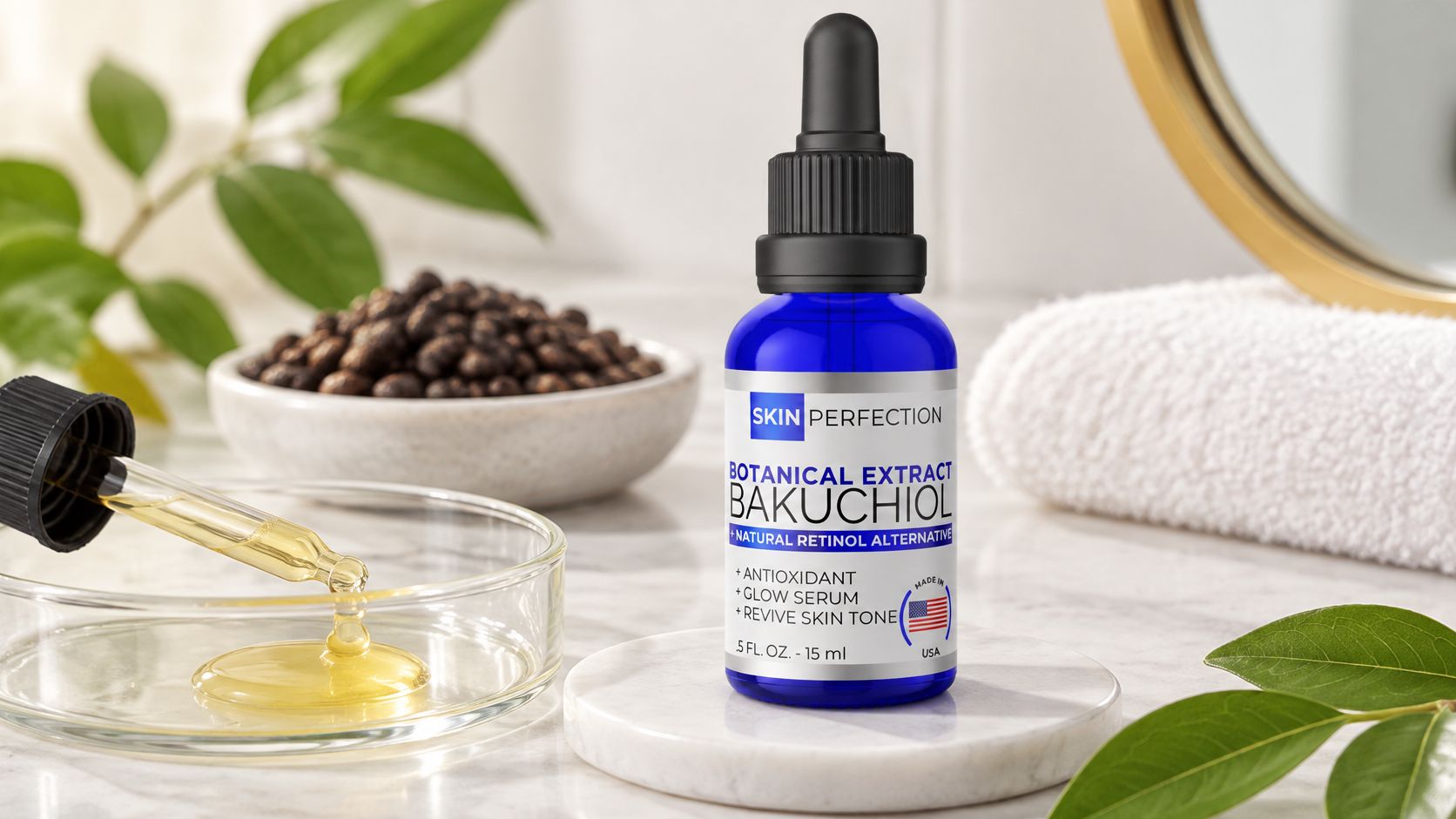
The glycerin-and-water carrier suits water-based formulas, and the booster can be paired with peptides. Don't apply it undiluted; formulate it into a suitable base and refrigerate as directed.
Stacking potentially irritating actives on the same night raises irritation risk. That caution isn't a blanket prohibition on using retinol with peptides. It concerns the complete routine, especially when acids or other demanding products are added.
How to Combine Retinol and Peptides
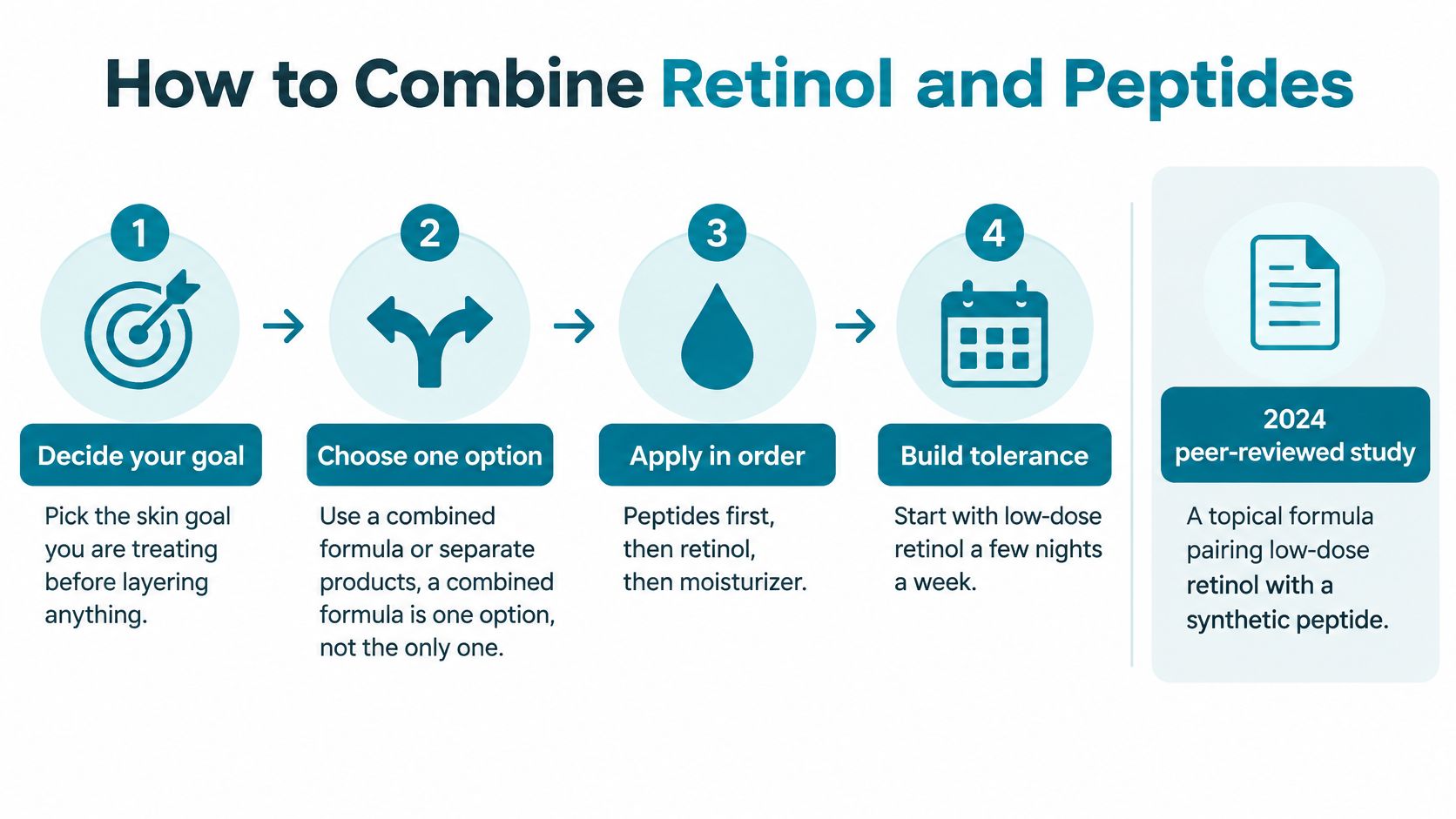
A combined formula is one way to use retinol and peptides, not the only way. Separate products let you adjust retinol frequency independently, while a combined serum offers a simpler application step.
A 2024 peer-reviewed clinical study evaluated a formula containing low-dose retinol, a synthetic retinoid ester, a pea peptide and antioxidants in 30 adults aged 35–70, used once nightly for 8 weeks. Compared with baseline, investigators reported statistically significant improvements in hydration, transepidermal water loss, elasticity and nine visible parameters, with no irritation in the clinical assessment.
What combination testing can tell you
Visible observations included radiance, smoothness, texture, pore appearance, dark spots and skin-tone evenness. The results belong to the combination product, not to retinol or the peptide in isolation.
A baseline comparison also doesn't establish that the combination is better than a suitable retinol-only or peptide-only product. Nor does an irritation-free assessment guarantee that every person will tolerate a different formula.
A cautious introduction schedule
Consult a healthcare professional before combining these actives if you're pregnant or breastfeeding, or use prescription retinoids. Don't start retinol during pregnancy without appropriate medical guidance.
- Patch test on the jaw for three days. Apply a small amount of the new finished product to a limited area. This is a cautious screening step, not a guarantee against a later reaction.
- Start retinol two nights per week. Use your peptide serum on off nights so you can assess each product separately. Keep cleansing and moisturizing consistent.
- Add morning peptides once tolerated. Apply beneath sunscreen rather than introducing another new active at the same time. This separates your daytime peptide step from retinol frequency.
- Consider increasing retinol every two to four weeks. Only increase if skin stays comfortable, and don't exceed the product's directions. There's no requirement to reach nightly use.
- Keep fruit masks away from retinoid nights and peels. We advise skipping them on sunburned or broken skin and on the day before or after a chemical peel or retinoid night. Avoid adding an exfoliation experiment while establishing tolerance.
- Review your routine after 12 weeks. Treat that as a progress checkpoint, not a deadline for a guaranteed result. The longer retinol trial described earlier ran for 24 weeks.
Our serum-layering guide helps with texture-based application order. A thin peptide serum may precede a richer retinol product, while a peptide moisturizer follows it, so ingredient names alone don't dictate order.
Pause retinol if you develop persistent burning, marked redness, swelling or uncomfortable peeling. Seek professional advice for severe or persistent reactions rather than trying to push through.
Choose the Routine That Fits Your Skin Goal
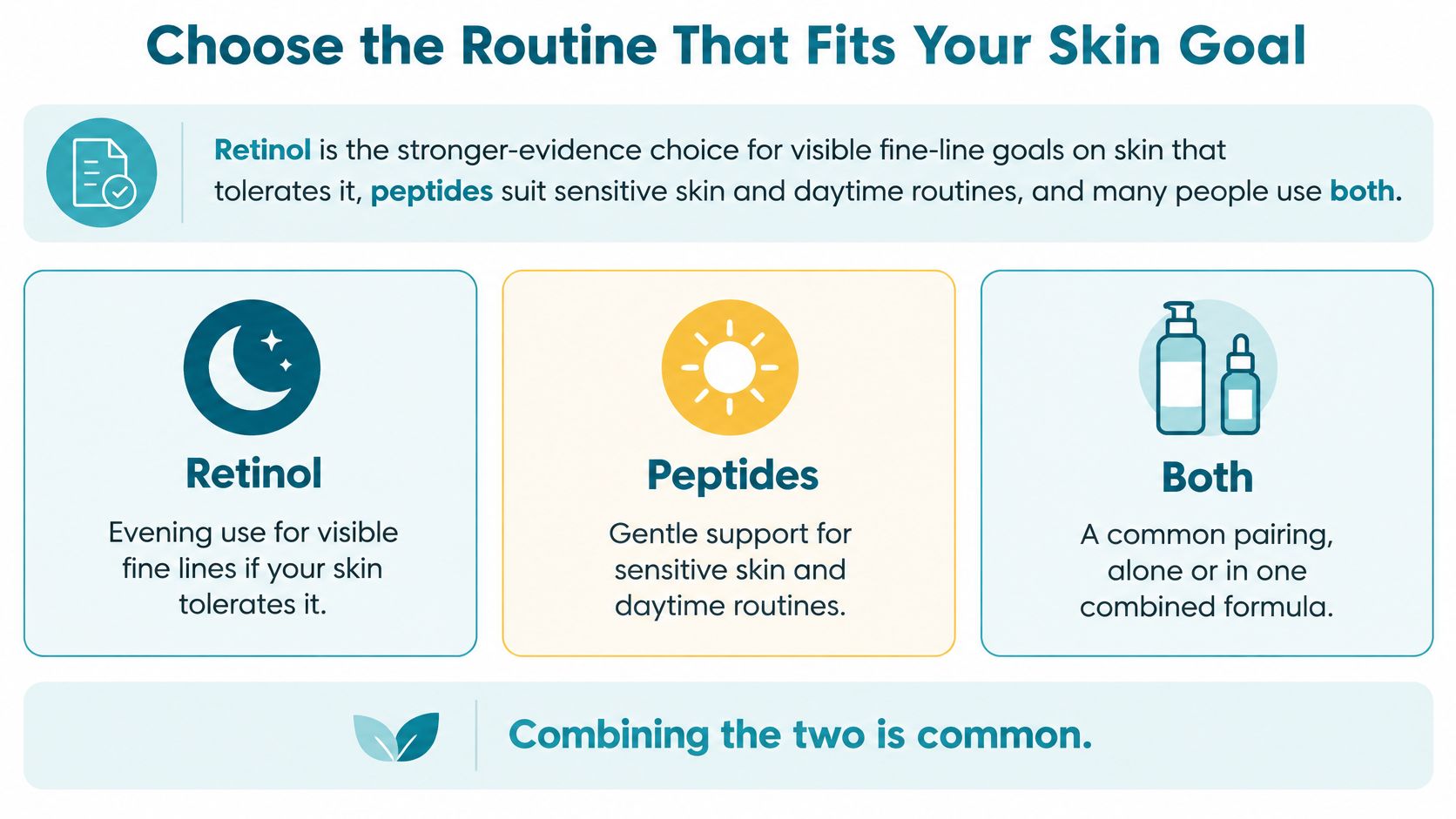
Retinol is the stronger-evidence choice for visible fine-line goals on skin that tolerates it, peptides suit sensitive skin and daytime routines, and using both on a schedule is a practical option. The best choice is the one you can evaluate consistently without making your routine unnecessarily demanding.
Which ingredient fits which skin goal
| Skin Goal or Situation | Lean Toward | Why |
|---|---|---|
| Fine lines you want to address over several months | Retinol, with peptides as added support | Retinol has the strongest clinical base for visible fine wrinkling in this comparison |
| Sensitive skin that reacts to retinoids | Peptide serum or a bakuchiol booster | Potentially gentler options; introduce slowly |
| Crow's feet and expression lines | Eye peptide and Argireline or Snap-8 formulas | Peptide products are commonly formulated for this area |
| Daytime routine with no retinol | Peptide serum under sunscreen | Fits a morning routine without adding retinol |
| Want both actives with fewer steps | Combined serum with retinol and peptides | Simplifies application, though evidence must match the exact product |
Match the ingredient to the visible goal
For crow's feet, our ingredient starting points are Argireline, Snap-8 and eye peptides. For fine lines and wrinkles, we direct buyers toward Matrixyl 3000, Matrixyl Synthe-6 and peptide blends. Those are selection categories, not promises that every formula will deliver the same outcome.
Our Serum Boosters let customers customize skincare with anti-aging peptides and adjust inclusion levels within formulation guidance. Adjusting strength still requires attention to the base and the supplier's recommended usage, not adding more.
Skin Perfection also offers a combined serum listing retinol, Argireline, Matrixyl 3000, Pepha-Tight and alpha lipoic acid. Schedule it as a retinol-containing evening product, with gradual introduction, rather than treating it as an unrestricted peptide serum; the published combination trial doesn't establish that this different formula will reproduce its findings.
Use our guide to customizing your skincare routine to keep those choices manageable. Start with one active, track your routine for 12 weeks and change only one variable at a time. Record comfort alongside appearance, because a visible result isn't useful if you can't sustain the routine.
Skin Perfection offers ready-made skincare, peptide Serum Boosters and lotion-making supplies for routines designed to beautify the skin. Visit Skin Perfection to compare finished formulas or choose ingredients for a customized routine, starting with your visible skin goal and the level of formulation control you want.