

 Buy with Prime


You're probably standing in front of two moisturizers that look almost identical. One says “peptide complex,” the other doesn't, and the peptide jar costs noticeably more. If you've ever wondered whether that extra line on the label means anything, you're asking the right question.
I've made enough test batches to know that a peptide rich moisturizer isn't defined by a fancy front label. It's defined by the actual peptide chosen, the base carrying it, the pH, the packaging, and the supporting hydrators around it. The peptide name matters, but it's only one variable in whether the formula feels elegant and gives visible cosmetic improvement over time.
At Skin Perfection, we sell skincare products and lotion making supplies, and our products are intended to beautify the skin. We follow FDA rules and Etsy policy closely, so we avoid language that suggests a cosmetic product can fix, repair, or heal skin. We also avoid prohibited medical claims, including statements that a product can treat, mitigate, diagnose, or cure disease or medical conditions, act like a drug, or claim FDA approval. Etsy's medical claims policy is very clear on those boundaries, and FDA-related guidance also makes the cosmetic-versus-drug distinction important in product listings and marketing language through summaries like this FDA claim overview.
Table of Contents
- What a Peptide Rich Moisturizer Really Is
- The Main Peptide Families Used in Skincare
- Reading an Ingredient List Like a Formulator
- Peptide Moisturizers Compared to Other Actives
- Building Your Own Peptide Moisturizer at Home
- Matching Peptide Moisturizers to Skin Types and Ages
- Setting Realistic Expectations and Choosing Well
What a Peptide Rich Moisturizer Really Is
A peptide rich moisturizer is a moisturizer where the peptide is part of the formula design, not just part of the front-label story.
Two creams can both print “peptides” on the jar, yet behave very differently on skin. In the lab, that difference usually comes from the full system around the peptide: the water phase, the emulsifier choice, the humectants, the pH range, and the container that keeps the batch stable after opening. The peptide name matters. It just does not work alone.
That point trips up beginners because peptide marketing often treats one INCI name as the whole product. Real formulas do not work that way. A peptide sits inside a vehicle, and that vehicle decides a lot about texture, spread, dryness after application, and how well the formula holds up over time.
Here is the practical version of “peptide rich” that I use when reading a label or building a test batch:
- A specific peptide or peptide blend is named on the INCI list, rather than hidden behind vague wording like “peptide complex.”
- The base looks supportive, with ingredients such as glycerin, sodium hyaluronate, propanediol, or skin-softening emollients that help keep the formula comfortable and usable.
- The formula is set up with reasonable stability in mind, including a pH range and ingredient pairing that do not work against the peptide.
- The packaging fits the formula, especially if the product relies on low air exposure and decent preservation after repeated use.
Packaging gets overlooked, but it matters. A peptide serum in an airless pump often has an easier life than a wide-mouth jar opened with damp fingers twice a day. The same logic applies to moisturizers. If you want a broader barrier-focused reference for judging moisturizers beyond buzzwords, this Buy Me Japan moisturizer guide is a useful comparison point.
Another common confusion is the word “rich.” It can mean rich in texture, rich in marketing, or rich in actual supporting ingredients. Those are not the same thing. A true peptide-focused moisturizer usually reads like a complete formula on the ingredient list, with water-binding ingredients, emollients, preservatives, and a peptide chosen to fit the rest of the base.
That is why I treat the peptide as one variable among several. In a real batch, even a well-chosen peptide can feel underwhelming if the cream pills, dries tacky, sits at an awkward pH, or uses a weak humectant system. A simpler formula with a sensible peptide level and a better vehicle can be the better product.
If you want a category-level primer before reading ingredient lists more closely, what peptide cream means in skincare gives a helpful starting point.
The Main Peptide Families Used in Skincare
Most beginners get stuck because “peptide” sounds like one ingredient. It isn't. It's a family name. Different peptides do different jobs, and formulators choose them based on the outcome they want from the finished product.
Four families that show up most often
I sort topical skincare peptides into four plain-English groups.
| Peptide Family | Primary Function | Example INCI Name | Formulation Caveat |
|---|---|---|---|
| Signal peptides | Send cosmetic “make more” messages tied to smoother-looking skin | Palmitoyl Pentapeptide-4 | Often perform better when paired with a stable, hydrating emulsion |
| Carrier peptides | Help deliver trace elements used in skin processes | Copper Tripeptide-1 | Can be fussy around low-pH formulas |
| Enzyme-inhibiting peptides | Aim to slow visible breakdown pathways | Rice peptides or specialty oligopeptides | Formula quality matters more than label drama |
| Neurotransmitter-inhibiting peptides | Target expression-line appearance cosmetically | Acetyl Hexapeptide-3 | Usually subtle and highly formula-specific |
What those jobs mean in real life
Signal peptides are the easiest starting point. These are the ones people often mean when they talk about collagen-supporting moisturizers. Palmitoyl pentapeptide-4 is the classic example.
Carrier peptides are often associated with copper. Copper tripeptide formulas attract a lot of attention because the copper portion gives the peptide a distinct functional identity. If you're curious how GHK-Cu gets discussed outside facial skincare, this overview of GHK-Cu for thinning hair shows how the same ingredient family gets interpreted in adjacent cosmetic categories.
Enzyme-inhibiting peptides are less famous on social media, but they matter. Their role is usually framed around reducing visible breakdown rather than pushing dramatic change.
Neurotransmitter-inhibiting peptides are the ones often marketed with “expression line” language. I'd treat those claims cautiously. In finished moisturizers, they tend to be subtle, and the base still matters enormously.
Structure changes performance
A peptide's structure can determine whether it has a fair chance of doing anything useful in a moisturizer. Palmitoylated peptides have a fatty tail attached. That can improve compatibility with the skin surface and help with delivery compared with a simple free peptide floating in water.
Solubility matters too. Copper peptides often dislike strongly acidic environments. Many palmitoyl peptides prefer a well-built emulsion rather than a stripped-down watery gel. This is why ingredient-list literacy matters more than peptide trend names.
For DIY formulators, I often pair peptide work with straightforward hydration builders. Sodium Hyaluronate Powder Pure Hyaluronic Acid is a cosmetic-grade powder used for water-based serums, creams, and lotions, with a stated molecular weight of 800-1500 Daltons and typical DIY use at 0.1–2% for hydrating formulas. It's a practical example of a support ingredient that can make a peptide moisturizer feel and perform more like a complete product.
For a broader look at newer peptide categories, next-generation peptides in skincare is worth reading.
Label cheat sheet: First identify the peptide family, then ask whether the formula gives that family the right pH, texture, and support system.
Reading an Ingredient List Like a Formulator
Most shoppers read the front of the jar. Formulators read the back. That's where the useful information lives.
Start at the top, not the claim panel
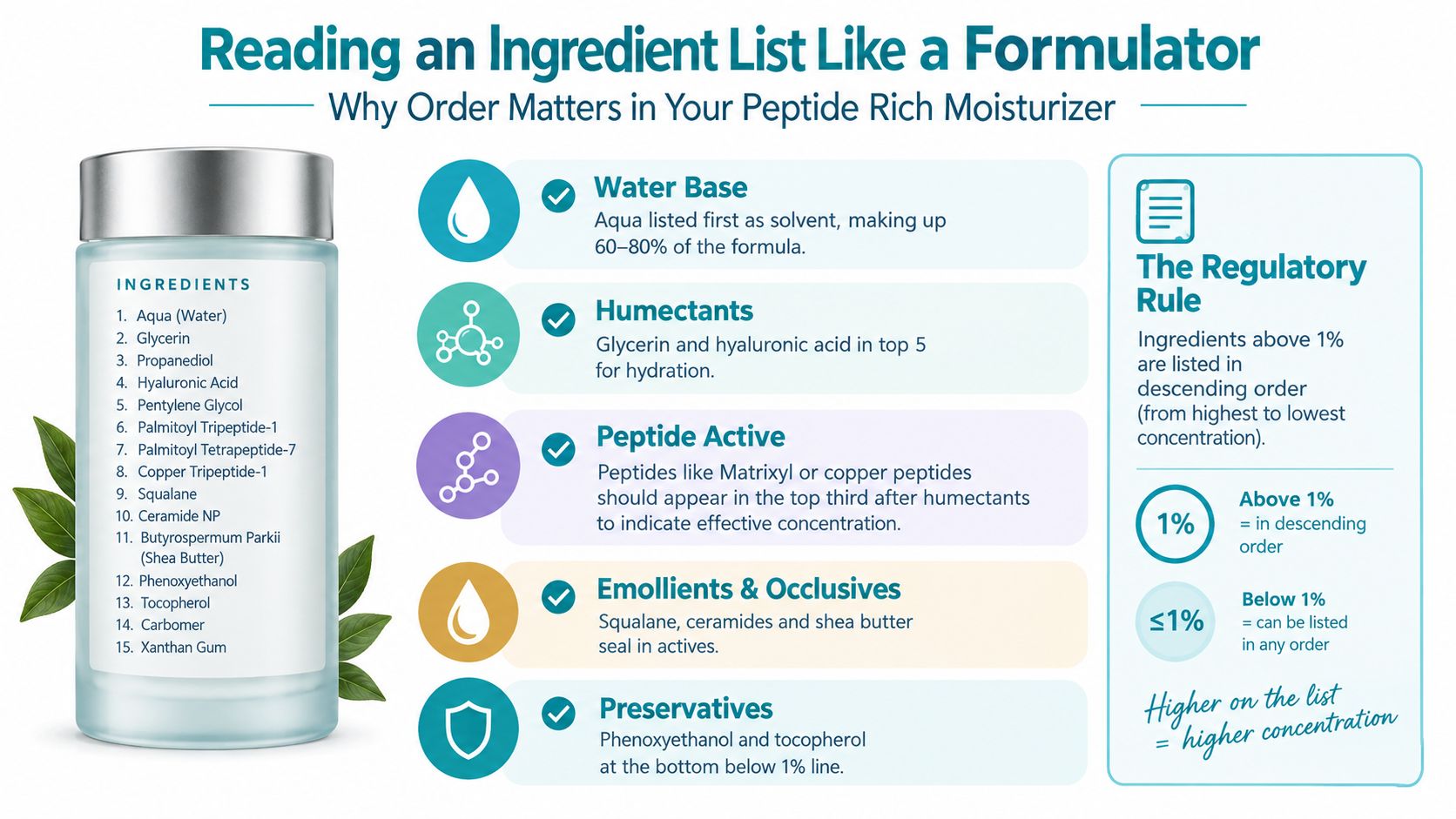
In most cosmetic labeling systems, ingredients above the low-level cutoff are listed in descending order. That means the first several ingredients tell you what the formula mostly is. In a peptide rich moisturizer, you'll usually see water first, then humectants or emollients, then emulsifiers and texture agents, and somewhere in the upper to middle part of the deck, the peptide.
If a peptide appears after fragrance, color, or the usual preservative cluster, I treat it carefully. It may still be present for label accuracy, but it's less likely to be a central design feature of the formula.
What to look for in the supporting cast
When I scan an ingredient deck, I group ingredients by job:
- Humectants pull water toward the skin. Look for glycerin, sodium PCA, and hyaluronic acid forms.
- Emollients and occlusives reduce rough feel and help hold moisture in place. Squalane, shea butter, triglycerides, and ceramide systems belong here.
- Thickeners and emulsifiers shape texture. They don't get enough credit, but they control spread, slip, and how evenly the peptide film sits on skin.
- Preservatives and antioxidants protect the formula itself. If the product is water-based, preservation isn't optional.
A hydrating support product can illustrate this logic well even when it isn't centered on peptides. HydroGlow Anti-Aging Night Mask combines three types of hyaluronic acid, polyglutamic acid, glycerin, jojoba, and squalane in a moisturizer-style overnight format. That's the kind of support matrix I look for around actives, because skin usually responds to systems, not isolated buzzwords.
Red flags I'd notice immediately
Here are the common problems I see when people bring me products and ask why they aren't impressed:
- The peptide sits too low on the list and everything above it is generic base material.
- The formula pairs peptides with a strong acid profile that may not be the best fit for peptide stability.
- The package is a clear jar that gets opened constantly, exposing the formula to light and air.
- The moisturizer lacks humectant depth, so the skin feels dry again quickly and the peptide never gets a supportive environment.
When a moisturizer disappoints, the peptide often gets blamed first. In practice, the base is just as often the weak point.
If ingredient names still feel like a foreign language, this glossary of anti-aging ingredient terms helps decode them.
Peptide Moisturizers Compared to Other Actives
You buy a peptide cream because the label sounds advanced, then compare it with a retinol serum that gives faster visible change. That comparison is where frustration usually starts. These ingredients are built for different jobs, and the vehicle around them changes how useful they are in real life.
Peptides usually play the slower, support-focused role. Retinoids push visible renewal. Vitamin C is often chosen for antioxidant support and uneven tone. Exfoliating acids work mainly at the skin surface, helping loosen dull, built-up cells.
A moisturizer with peptides often behaves more like good scaffolding than a spotlight treatment. In a lab batch, I can add an appealing peptide name to a weak base and still end up with an average product. I can also build a simple cream with strong humectants, sensible pH, and protective packaging, and that formula may serve skin better day to day even if the peptide percentage is modest.
| Active | Main role in a routine | Common tolerance pattern | pH concerns | Pairing with peptides |
|---|---|---|---|---|
| Peptides | Support, hydration, and cosmetic signaling | Often well tolerated | Depends on the specific peptide and base | Often yes |
| Retinoids | Visible renewal and fine-line work | Irritation is common at first | Formula-dependent | Often yes, usually in separate products |
| Vitamin C | Antioxidant support and brightening | Varies a lot by form | Some forms need a lower pH | Sometimes |
| Exfoliating acids | Surface smoothing and desquamation | Stinging or dryness is common for some users | Usually acidic | Sometimes, but use care |
The mistake beginners make is treating "works in the same routine" and "belongs in the same formula" as if they mean the same thing. They do not.
A peptide moisturizer can sit comfortably next to a retinoid because each product is doing a different piece of the job. The peptide product helps keep the barrier comfortable and hydrated. The retinoid handles the renewal side. That is a routine decision, not proof that every peptide and retinoid should be mixed into one jar.
Vitamin C needs the same kind of caution. Some forms are easier companions than others. A low-pH ascorbic acid serum and a peptide cream may both be useful, but I would usually rather separate them by step or by time of day than force them into one formula and hope the whole system stays happy.
Acids need the most care. If an exfoliant is strongly acidic, the question is not just irritation. It is also whether the environment suits the peptide and the rest of the base. A formula is a small ecosystem. Change the pH enough, and you have changed more than one ingredient's comfort zone.
That is why I do not rank peptides above retinoids, vitamin C, or acids as if they are in a competition. I compare them by role, skin tolerance, and formula design. The peptide name on the label is only one variable. The base, pH, air exposure, and supporting ingredients often decide whether the moisturizer feels helpful, forgettable, or poorly matched to the rest of the routine.
Research on topical peptides is still more limited than the marketing around them suggests. A review in the International Journal of Molecular Sciences describes peptides as promising cosmetic ingredients while also making clear that results depend on peptide structure, stability, delivery, and formulation context, not just the headline ingredient name alone (Jeong et al., 2021). That fits what formulators see in practice. A peptide moisturizer can be a smart support step, but it is not automatically stronger than a well-made moisturizer built around glycerin, ceramides, and sunscreen habits.
Building Your Own Peptide Moisturizer at Home
DIY peptide work is where excitement and reality meet. You can make a very nice peptide rich moisturizer at home, but you can also waste expensive actives fast if you drop them into the wrong phase or ignore pH.
Build the base first
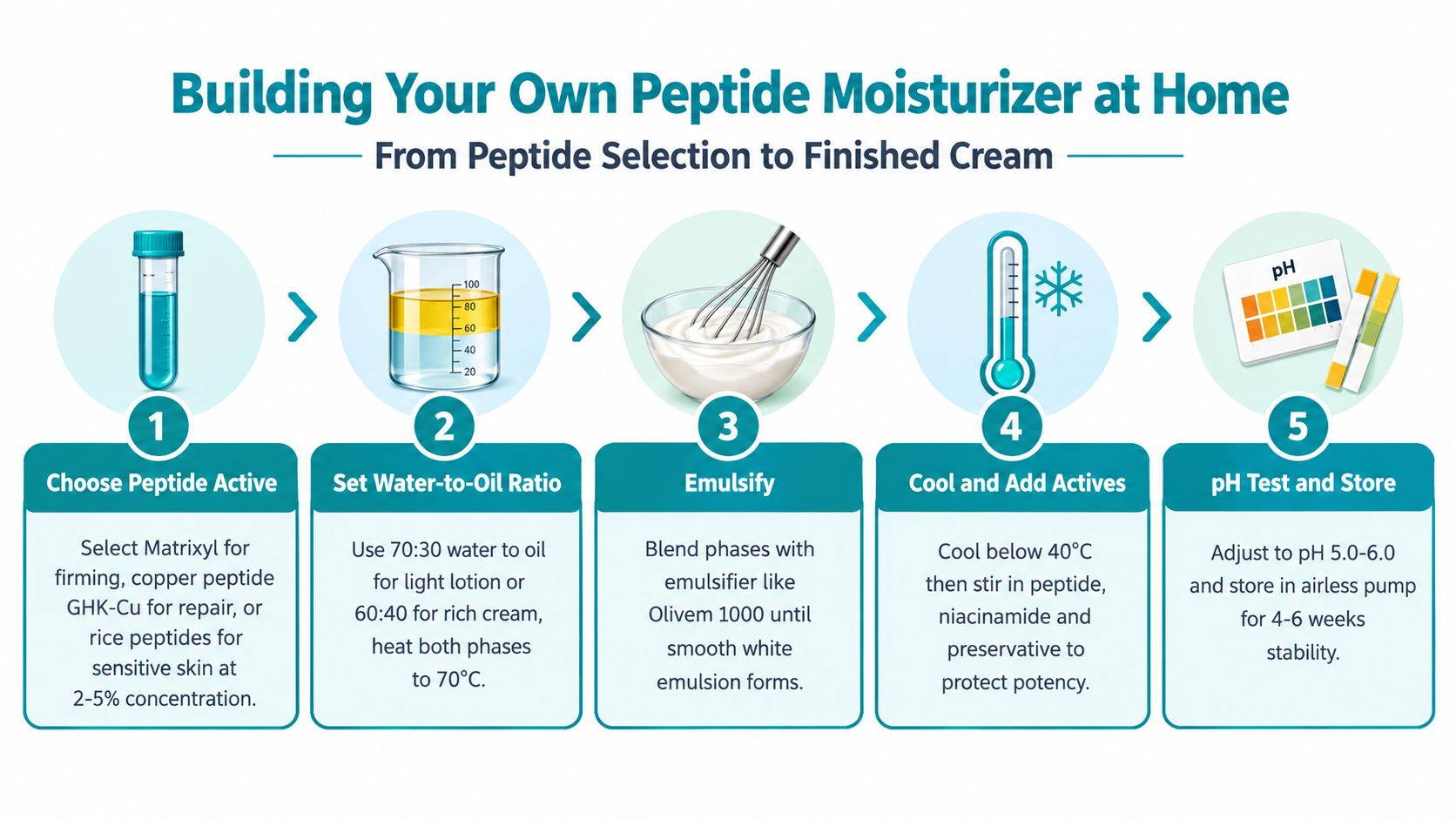
I always tell beginners to choose the base before chasing the peptide. Decide whether you want a lotion, cream, or gel-cream texture. Then choose humectants, emollients, and an emulsifier system that can carry the peptide without making the product unstable or sticky.
A simple starter framework looks like this:
- Water phase with distilled water, glycerin, and panthenol
- Oil phase with lightweight emollients or richer oils depending on skin feel
- Emulsifier suited to your chosen texture
- Cool-down phase for the peptide, preservative, and any more delicate support ingredients
Add peptides in the cool-down phase
This is the mistake I see most often. New formulators heat everything together because it feels simpler. For many peptide materials, that's not the smartest move. I add them once the emulsion has cooled enough for delicate ingredients.
Your checklist should be simple:
- Choose the peptide with a job in mind. Signal peptide for general anti-aging support, copper peptide for a different functional profile, or a gentler peptide type for sensitive routines.
- Use a meter, not guesswork, for pH. Peptide systems are more forgiving when the formula sits in a skin-friendly range rather than drifting acidic.
- Preserve the formula correctly. A water-containing DIY moisturizer needs a broad-spectrum preservative.
- Package it well. Airless or opaque packaging often makes more sense than a clear open jar.
Batch-room rule: If you spent money on the active, don't sabotage it with lazy packaging.
Common DIY mistakes
I'd avoid these three first:
- Adding peptides to the hot water phase
- Combining them in the same bottle with strong acid systems
- Ignoring the rest of the formula, especially humectants, chelators, and preservative compatibility
Clinical use patterns also remind us to be patient. In a randomized, double-blind trial of 60 women aged 60 to 90, a topical OS-01 peptide formulation outperformed a commercial moisturizer over 12 weeks for skin barrier function and hydration, and another peptide-containing serum study reported a 21.7% increase in Corneometer-measured moisturization over the study period, according to the PubMed Central review on peptide topical systems. That's a good reality check for DIYers who expect visible change in a few nights.
If you're making your own creams regularly, this guide on how to make moisturizer is a helpful companion.
Matching Peptide Moisturizers to Skin Types and Ages
A peptide rich moisturizer shouldn't look the same for everyone. Dry skin needs a different support system from oily skin, and mature skin usually needs a different texture from a teenager's routine.
Match the skin profile, not the trend
Here's how I think about it in practice.
| Skin Profile | Suggested Peptide Family | Preferred Texture | Key Companions |
|---|---|---|---|
| Dry skin | Signal peptides | Rich cream | Ceramides, glycerin, squalane |
| Sensitive skin | Gentle signal peptides | Fragrance-free lotion or cream | Panthenol, simple humectants, low-irritant base |
| Mature skin | Signal peptides or carefully chosen peptide blends | Richer cream | Retinoid on separate nights, occlusives, humectants |
| Breakout-prone skin | Lighter peptide systems | Gel-cream | Niacinamide, lighter emollients, lower residue finish |
| Younger preventative use | Simple peptide support | Lotion or gel-cream | Daily SPF, glycerin, balanced hydration |
A few patterns work especially well
For dry skin, I like peptides in a barrier-focused cream. A signal peptide in a skimpy gel usually won't feel satisfying here.
For sensitive skin, I'd keep the formula plain. Fragrance-free, low-fuss, and not overloaded with exfoliants in the same step. If someone flushes easily, I'd rather use a straightforward peptide lotion than an overbuilt “everything cream.”
For mature skin, peptides make more sense as part of a layered strategy. They don't replace sunscreen, and they don't automatically replace a retinoid. A practical routine for visible aging often combines those categories thoughtfully. This anti-aging guide from Ideal Face & Body is a good outside reference for how mature-skin routines usually need more than one type of support.
Age changes the role, not the basic logic
If you're in your teens or twenties, peptides are more of a maintenance choice than an urgent intervention. The routine basics still matter more: cleansing that doesn't strip, enough hydration, and daily sun protection.
For people dealing with menopause-related texture and dryness shifts, peptide formulas often work best when paired with richer moisturization and realistic expectations around firmness. This resource on peptides for mature skin during menopause goes deeper into that stage-specific approach.
Setting Realistic Expectations and Choosing Well
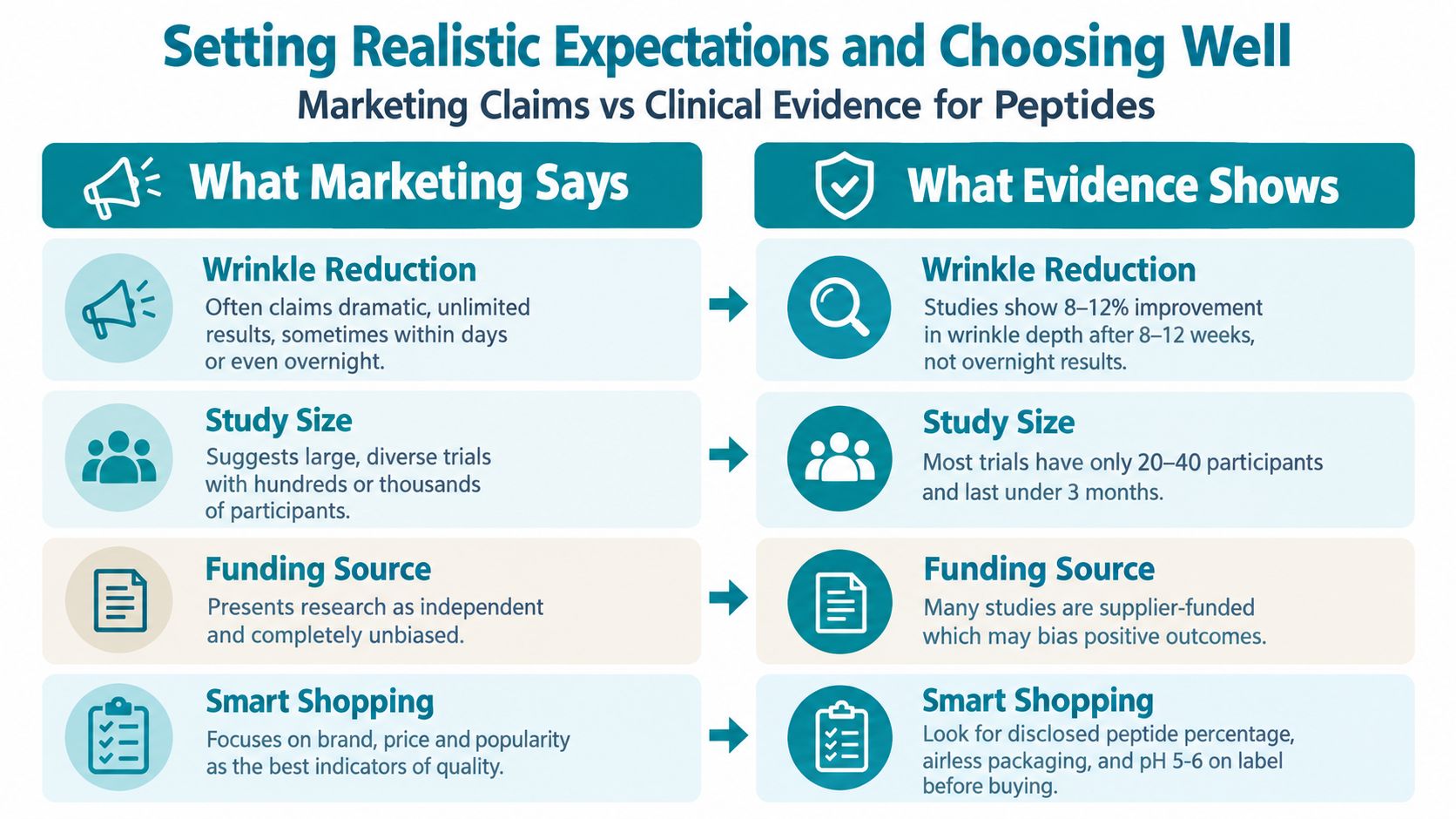
The biggest problem with peptide marketing isn't that peptides do nothing. It's that labels often promise more than the current topical evidence clearly supports.
What a peptide moisturizer can reasonably do
A peptide moisturizer can make sense if your goal is better hydration support, a smoother look, and gradual cosmetic improvement in fine lines. It may also support barrier-focused routines when the peptide and base are chosen well.
One placebo-controlled, randomized trial in 43 patients with mild-to-moderate atopic dermatitis found that a moisturizer containing pentasodium tetracarboxymethyl palmitoyl dipeptide-12 improved SCORAD, skin hydration, transepidermal water loss, and pruritus at weeks 2 and 4 versus baseline, while the control improved hydration and SCORAD but didn't significantly change TEWL or itch, according to the Frontiers clinical report on a peptide-containing moisturizer. For me, the practical takeaway is that peptides can contribute to measurable cosmetic barrier support in the right formula.
Where I'd stay skeptical
I get cautious when a moisturizer implies dramatic lifting, major collagen rebuilding, or “injectable-like” results. The independent coverage on peptide skincare keeps returning to the same point. Benefits are usually modest, and the finished formula often matters as much as the peptide category itself.
Commercially, peptides are clearly a serious ingredient category. The broader peptide cosmetic ingredient market was estimated at $1.2 billion in 2025 and projected to reach $2.1 billion by 2034, with a projected 7.8% compound annual growth rate, while moisturizing and hydration uses represented 18.3% of peptide ingredient demand in 2025, equal to about $220 million in that segment, according to the Market Intelo peptide cosmetic ingredient market report. Growth, though, isn't proof that every peptide jar is worth the money.
My buying checklist
When I evaluate a peptide rich moisturizer, I ask five questions:
- Is the peptide named clearly? I want an actual INCI, not vague “peptide blend” language.
- Where does it sit on the list? Position doesn't tell the whole story, but it tells part of it.
- Does the base support hydration? Glycerin, hyaluronic acid, and sensible emollients matter.
- Does the packaging protect the formula? Airless and opaque usually beat open jars for fragile actives.
- Is the claim language cosmetic and realistic? That keeps the product grounded in what a moisturizer is supposed to do.
The FDA doesn't pre-approve cosmetic products before they enter the market, and it doesn't maintain a list of approved cosmetic claims, as summarized in this explanation of FDA cosmetic claim rules. That's exactly why careful wording matters. A moisturizer can moisturize, smooth, soften, and improve the look of skin. It shouldn't drift into disease or drug territory.
Patch test first. Then give the product a fair window, take photos in consistent lighting, and judge it by your skin's actual response instead of the promise on the carton.
Skin Perfection offers both finished skincare and lotion-making supplies for people who want to understand what's in a formula and why it works cosmetically. If you're comparing peptide moisturizers, building a DIY cream, or looking for supporting hydrators to pair with peptides, visit Skin Perfection to explore ingredient-focused options and formulation resources.