

 Buy with Prime



The popular advice to judge sodium lauroyl lactylate by a single ingredient rating misses the decision that matters: whether the finished formula is stable, appropriately tested, and suitable for its intended use. A favorable ingredient screen isn't a finished lotion's safety assessment, and an ingredient-checker warning isn't proof that a product will cause breakouts. For skincare makers, the useful questions concern identity, concentration, compatibility, exposure, and the evidence behind the final product.
Table of Contents
- Sodium Lauroyl Lactylate at a Glance
- How It Emulsifies and Where It Clashes
- Use Levels for Cleansers, Lotions and Serums
- Safety Data and What It Does Not Prove
- Fungal Acne Concerns and Where the Evidence Stops
- Choose Your Route and Word It Safely
Sodium Lauroyl Lactylate at a Glance
Sodium lauroyl lactylate is a sodium salt of a lauric-acid ester of lactyl lactate, used in cosmetics as an emulsifying surfactant. Its name identifies a functional ingredient, not a promise about how every cream containing it will perform.
The PubChem compound record gives its molecular formula as C18H31NaO6, molecular weight as approximately 366.4 g/mol, CAS Registry Number as 13557-75-0, and compound CID as 23674328. The record also reproduces the U.S. Environmental Protection Agency's Safer Chemical Ingredients List classification of the substance as a surfactant of low concern on available experimental and modeled data.
Identifiers and hazard screens for sodium lauroyl lactylate
| Property | Value | Why It Matters |
|---|---|---|
| Molecular formula | C18H31NaO6 | Checks supplier specifications |
| Molecular weight | Approximately 366.4 g/mol | Objective identifier for batch records |
| CAS Registry Number | 13557-75-0 | Matches regulatory and supplier files |
| PubChem compound CID | 23674328 | Cross-checks chemical identity |
| Cosmetic function | Emulsifying ingredient; surfactant class | Defines its co-emulsifier role |
| U.S. EPA Safer Chemical Ingredients List | Surfactant class; low concern on available data | Supports low-concern screening |
| EWG Skin Deep hazard categories | Low concern for cancer, allergies/immunotoxicity, developmental and reproductive toxicity, and use restrictions | Does not confirm compatibility with a specific formula |
Identity Checks Come Before Performance Claims
Use these identifiers to reconcile the supplier's technical sheet, certificate of analysis, and internal batch record. The formula and molecular weight provide objective checks independent of a distributor's trade name or marketing description. A discrepancy is a reason to pause and ask whether the documentation describes the defined substance, a commercial blend, or a different material.
The ingredient has an oil-compatible fatty portion and a water-compatible, oxygen-rich portion. That combination explains why it belongs in discussions of emulsification, not just cleansing.
For readers comparing a supplier document with a retail ingredient declaration, our guide to reading a skincare label and INCI names provides useful context. An INCI declaration identifies ingredients, but it doesn't reveal the manufacturing process or establish finished-product tolerability.
Identity is the starting point: A correctly identified raw material can still produce an unsuitable formula when its concentration, partners, or processing conditions aren't controlled.
Public hazard screens answer a narrower question than many shoppers assume. They help characterize ingredient-level concern; they don't tell a formulator whether a particular lotion will suit a particular skin type.
How It Emulsifies and Where It Clashes
Think of sodium lauroyl lactylate as a molecular handshake between oil and water. Its C12 lauroyl portion associates with oil, while its ionizable lactylate portion associates with water, allowing the molecule to occupy the boundary between them. The European cosmetic ingredient database entry identifies its function as an emulsifying surfactant, consistent with its ability to lower interfacial tension and support dispersed oil droplets.
That action helps emulsification, but it doesn't establish that sodium lauroyl lactylate can replace a complete emulsifier system. In a cream or lotion, treat it initially as a co-emulsifier or secondary surfactant, then verify what it contributes to the actual base.
Emulsification Isn't the Same as Complete Formula Stability
A successful emulsion needs more than a mixture that looks uniform immediately after blending. The formulator must assess whether the dispersed phase remains distributed and whether the product retains its intended viscosity during storage and temperature changes.
Our explanation of emulsifiers in cosmetics helps distinguish an ingredient's interfacial role from the broader job of designing a stable cream. Adding a supporting surfactant doesn't remove the need to select an appropriate primary system and manufacturing process.
Compatibility checks by partner and condition
| Partner or condition | Risk to watch | Test to run |
|---|---|---|
| Cationic polymers and conditioning agents | Complexing that lowers efficiency | Compare viscosity and separation against a control base |
| Salts and electrolytes | Shifts in emulsion stability | Test at the intended salt level, with and without the ingredient |
| Peptides and botanical extracts | Charge and solubility changes | Check clarity, texture, and separation over time |
| Low-pH formulas | Performance and tolerance shift | Test across the full intended pH range |
| Freeze-thaw conditions | Hidden instability | Cycle samples and compare with the control |
The important distinction is anionic charge. Cationic conditioning agents and polymers can interact with anionic ingredients, potentially producing complexes or reducing the performance expected from either partner. Increasing sodium lauroyl lactylate isn't a reliable answer to an incompatibility caused by the pairing itself.
Salts introduce a different variable: they can change the behavior of the emulsion system without producing an obvious immediate precipitate. Peptides and botanical extracts also deserve individual checks because their supplied forms can introduce additional dissolved substances and charge-related effects.
Build a Comparison You Can Interpret
Use a controlled bench series rather than changing several ingredients in an unrecorded batch.
- Prepare a control base. Make the intended emulsion without the added active or partner under investigation. Keep the mixing equipment, order of addition, and processing conditions consistent.
- Build comparison versions. Test across the intended pH range, including versions with and without the relevant salts, peptides, extracts, and charged polymers. Change one variable at a time where practical.
- Measure performance. Record separation and viscosity, then compare freeze-thaw behavior with the control. Use the same viscosity method and measurement temperature for every sample.
- Recheck stored samples. Examine them after days or weeks, not just when freshly made. Delayed changes can reveal a combination that initially appeared acceptable.
A hydrating powder is another formulation variable, not evidence that the surfactant system will work. Sodium Hyaluronate Powder Pure Hyaluronic Acid is a cosmetic-grade powder for water-based serums, creams, and lotions; evaluate its addition within the complete formula rather than assuming compatibility from the product category.
If a combination fails against the control, investigate the partner, pH, or processing conditions before adding more surfactant. Judge the finished product's feel alongside its droplet stability and viscosity, not from the reputation of an individual ingredient.
Use Levels for Cleansers, Lotions and Serums
Maximum use levels by product type
| Product type | Maximum use level | Basis and practical note |
|---|---|---|
| Rinse-off skin-cleansing products | 10% | Reported CIR maximum use concentration; brief contact |
| Leave-on body and hand products | 6.1% | Reported CIR maximum use concentration; longer contact |
| Leave-on facial creams and serums | Establish from supplier specification and finished-formula testing | No facial-product figure established by the cited summary |
| Homemade lotions and creams | Establish from supplier specification and finished-formula testing | Include preservation challenge testing and stability testing |
The 2024 Cosmetic Ingredient Review Expert Panel assessment, as summarized by PuriActives, reported maximum use concentrations of 10% in rinse-off skin-cleansing products and 6.1% in leave-on body and hand products. Read those as reported use maxima, not recommended starting concentrations or universal regulatory limits.
Calculate by Total Batch Weight
For a hypothetical 100 g lotion, a 2% sodium lauroyl lactylate level means weighing 2 g of the ingredient into the total batch; a 6% level means 6 g. These are arithmetic examples, not formulation recommendations.
The calculation is:
Ingredient weight = total batch weight × selected percentage ÷ 100
Confirm whether the supplier's recommendation refers to the material as supplied or its active content. A commercial preparation and a defined chemical aren't automatically interchangeable on a weight-for-weight basis.
Start by confirming the cosmetic grade and specification. Select a supplier-supported trial level, weigh it against the final batch weight, and evaluate the lowest level that achieves the intended performance. Increase only when the comparison demonstrates a reason to do so.
A published maximum answers how much was reported in a product category. It doesn't answer how much your formula needs.
Product Category Changes the Decision
The cited summary doesn't establish a separate maximum for leave-on facial creams, facial serums, or homemade products. Don't fill that gap by borrowing a body-product figure and treating it as a facial recommendation.
Rinse-off exposure is brief, while a leave-on facial product remains in contact with skin. That difference supports a more conservative development approach for facial formulas, but it doesn't justify assuming that every rinse-off formula is tolerable at a higher concentration.
If you're comparing cleansing systems, the guide to disodium cocoyl glutamate offers context for evaluating another surfactant rather than substituting ingredients solely by name. If you'd rather compare finished facial products than formulate, REVETIX's guide can help you find an anti-aging moisturizer; keep product-selection advice separate from raw-material dosage decisions.
Safety Data and What It Does Not Prove
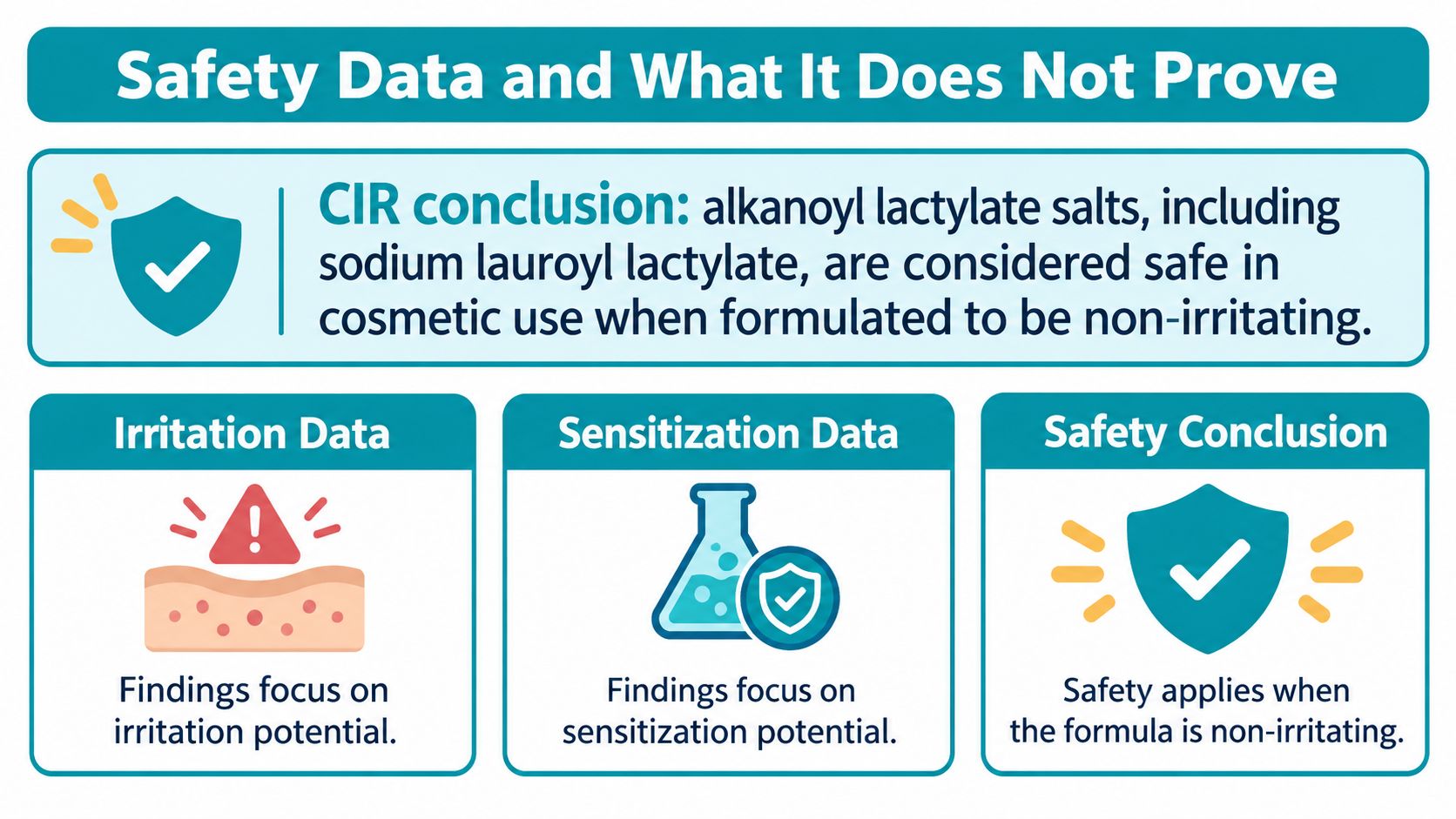
The safety conclusion for alkanoyl lactylate salts, including sodium lauroyl lactylate, is conditional: they are considered safe in cosmetic use when formulated to be non-irritating and non-sensitizing. The CIR safety assessment behind that conclusion reports rat acute oral LD50 values of 6.81 g/kg in one study and an estimated 4.88 g/kg in another, while noting incomplete protocol details.
The qualification carries the operative instruction: the unit of safety is the finished formula, and a favorable raw-material summary does not transfer automatically to the product a customer applies.
Oral Toxicity Isn't a Facial-Use Limit
An acute oral LD50 is an animal toxicity endpoint for a single exposure route. It speaks to systemic hazard, and the reported values support a relatively low acute-toxicity interpretation subject to the reporting limitations. The question that matters for a leave-on cream, whether it will irritate under prolonged skin contact, sits outside what this endpoint can address.
For leave-on anti-aging and scalp products, local irritation is the more actionable development question. Sodium lauroyl lactylate is an anionic surfactant, so a cream format alone guarantees nothing about skin compatibility.
Test the Product People Will Actually Use
A qualified testing provider can design human repeat-insult patch testing or an equivalent irritation and sensitization assessment for the finished product. Give the provider the intended application site, exposure pattern, full composition, and relevant manufacturing information.
Low-pH systems, high active loads, and intended use on compromised skin call for particular care in protocol design. Testing should follow a professionally designed protocol. Improvised trials, such as asking volunteers to apply experimental material to irritated areas, generate no usable evidence and create unnecessary risk.
- Define the test article. Identify the finished formula, packaging, and batch so the result can be connected to a reproducible product.
- Document the process. Record the validated addition phase, temperature conditions, and final pH, since manufacturing details shape the result.
- Separate the evidence. Ingredient toxicology, physical stability, preservation testing, and human tolerability answer different questions.
Raw-material material safety data sheets document handling for the ingredient as supplied. They belong in the manufacturing file; finished-product tolerability is a separate evidence question.
Practical rule: Never describe a finished lotion as non-irritating solely because its ingredients have favorable safety summaries.
If you're buying a finished base, request information relevant to that base. If you modify it, assess the modified formula, since the original evidence may not cover every addition. For a product you're developing yourself, commission the appropriate evaluation before making a finished-product tolerability claim.
Fungal Acne Concerns and Where the Evidence Stops
Documented irritation and sensitization findings aren't the same as fungal-acne screening rules. Screening rules are far less established as a way to predict whether an individual will tolerate a finished product containing sodium lauroyl lactylate.
Malassezia folliculitis is a yeast-related follicular breakout, often discussed by consumers as fungal acne. Screening lists built for Malassezia-prone skin sometimes flag sodium lauroyl lactylate, and the flag rests on ingredient-class heuristics. No cited evidence tests this emulsifier against Malassezia directly, so a flag on a list describes a hypothesis about susceptibility rather than a measured outcome for the ingredient or for any formula containing it.

Hazard Categories Measure Toxicology Endpoints
The identifiers table above summarizes the hazard ratings for this material: low concern across cancer, allergies and immunotoxicity, developmental and reproductive toxicity, and use restrictions. Those categories describe toxicology endpoints for the raw material. They say nothing about whether a Malassezia-prone person will tolerate a specific finished formula.
The variables that decide tolerance live in the finished product: personal susceptibility, co-ingredients, occlusiveness, and contact time. Contact time changes the exposure most. An anti-aging cream, scalp product, or brow or lash product stays on skin far longer than a rinse-off cleanser, so a reaction tied to one product says little about every other product containing the ingredient.
Keep a Product Diary
For mild, uncertain product-associated breakouts, a controlled elimination-and-reintroduction approach can surface a pattern. It can neither diagnose Malassezia folliculitis nor isolate one responsible ingredient inside a complex formula.
- Record a defined pause. Note the products containing the ingredient and the period during which you stop using them. Keep the rest of the routine as consistent as practical.
- Reintroduce one finished product at a time. Don't restart several products together.
- Observe before adding another. Record breakouts and other changes over several days, including application site and frequency.
- Stop a product if the pattern recurs. Consider retesting only that product after professional advice, and don't deliberately repeat a significant reaction.
Persistent, itchy, or worsening breakouts warrant assessment by a qualified clinician rather than repeated home experimentation. A diary can support that conversation without turning a suspected association into a diagnosis.
The same reasoning applies to whether squalane is comedogenic: evaluate the actual product and the person's response. An ingredient-checker category is a starting flag, never a final verdict.
Choose Your Route and Word It Safely
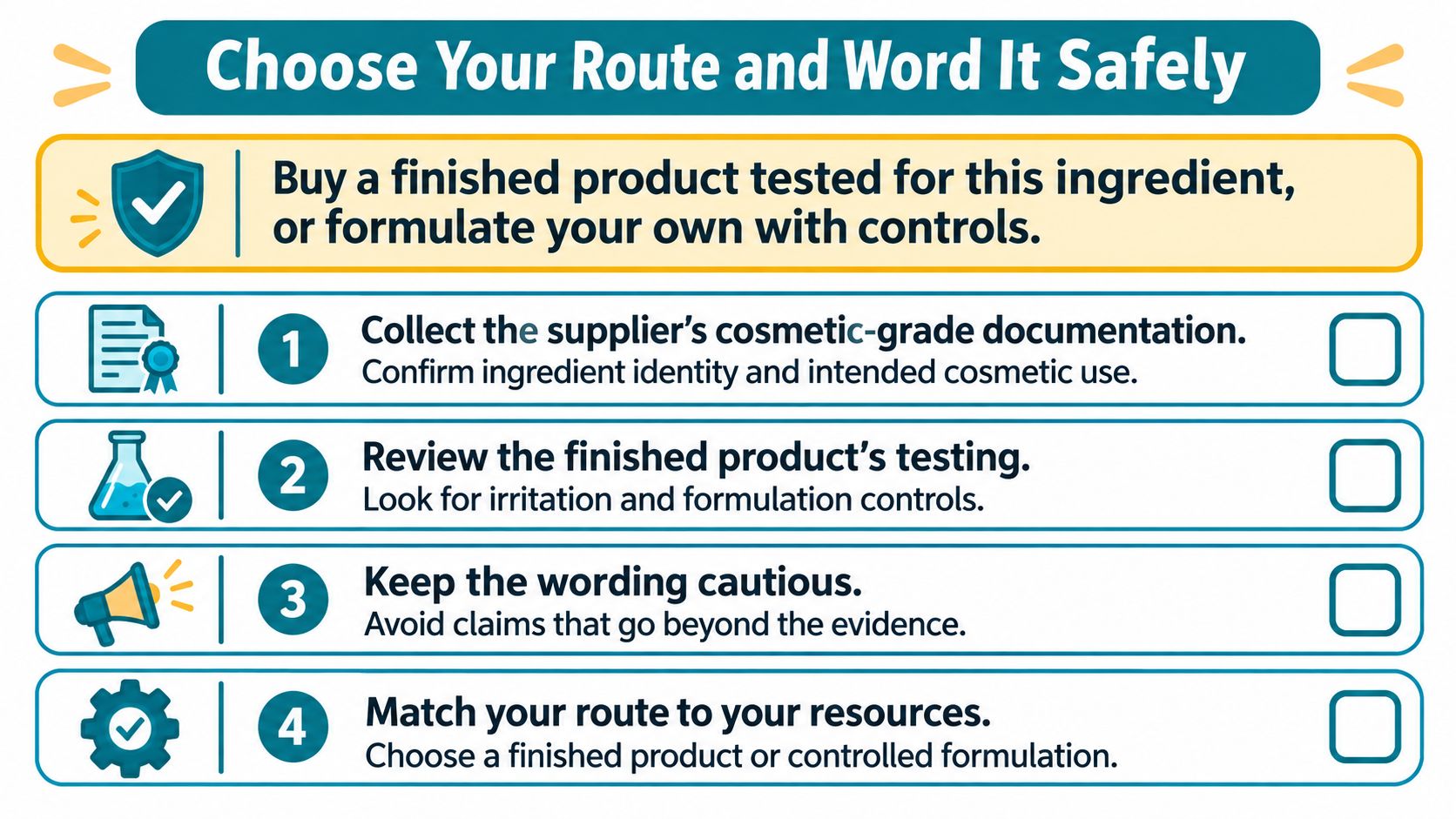
Choose between a finished product with relevant testing and your own formulation developed with controls. The better route depends on whether you have the equipment, documentation, and testing resources to evaluate what you will put on skin.
A finished product lets you assess a defined commercial formula against its label and any test data the brand publishes. DIY development gives you control over composition, and it also makes you responsible for every change you introduce. Each added ingredient can shift preservation demand and finished-formula tolerability, which is the unit that safety evidence describes.
Keep a Decision Record
Use-level selection, preservation planning, and tolerability testing are covered in the sections above. The record is where their outputs live, along with the steps those sections do not cover:
- Collect cosmetic-grade documentation. Match the supplier's identifiers to your raw-material record and resolve discrepancies before weighing a batch.
- Log the finished formula. Record whether each calculation refers to the supplied material or its active content, and file the use-level, preservation, and tolerability results alongside it.
- Write the label and listing copy. Describe the ingredient's emulsifying role and substantiate any finished-product appearance or sensory claims with the data you hold.
- Retain traceable records. Keep batch numbers, ingredient weights, pH measurements, processing details, packaging information, and test results together so any single batch can be reconstructed if a complaint or stability question surfaces later.
Describe Cosmetic Function Without Medical Implications
One rule covers every channel: describe the cosmetic function, not a therapeutic outcome. The FDA's cosmetic claims guidance requires labeling to be truthful and not misleading, and warns that intended-use claims can change a product's regulatory classification. Its cosmetic labeling regulations guidance separates ordinary ingredient declarations from drug labeling, so calling sodium lauroyl lactylate an "active" in promotional copy does not make drug-style presentation appropriate for a cosmetic. For this ingredient, the safe description names its role as an emulsifying surfactant. Marketplace rules draw the same line and extend it further: Etsy's medical-claims policy treats implied claims in titles, descriptions, and images as claims, and a disclaimer does not make a prohibited claim acceptable. Disease claims, prescription-drug comparisons, claims of equivalence to medical treatments, and assertions of FDA approval all sit outside that line, and FDA keeps no list of preapproved cosmetic claims to borrow credibility from.
Write what the cosmetic does within the evidence you hold, not what a customer might hope its ingredient name implies.
At Skin Perfection, our cosmetic wording focuses on beautifying the skin. Katherine Lucas leads customer service and can help with questions about orders, serum layering, and which formula fits a routine; laboratory testing remains a separate part of formulation development.
Skin Perfection offers skincare products and lotion-making supplies for customers who want to create their own natural products, including bulk bases, powders, preservatives, airless bottles, kits, anti-aging peptides, essential oils, and formulas. Visit Skin Perfection to choose your route, then use the documentation checklist above to evaluate a finished product or plan a controlled trial batch before scaling up.