

 Buy with Prime


Making your own homemade body lotion is a genuinely rewarding experience. You get to control every single ingredient that goes onto your skin, blending rich oils and butters with water, and bringing it all together with an emulsifier. Topping it off with a preservative keeps it fresh and safe. This process gives you total freedom to create a beautiful, handcrafted product that’s perfect for you, from its texture down to its scent.
The Art of Crafting Your Own Body Lotion

Diving into the world of DIY skincare is an exciting journey, and making your own body lotion is one of the most satisfying projects to start with. It's so much more than just mixing things in a bowl; it’s about creating a little bit of luxury that is uniquely yours. When you make your own lotion, you hand-pick every component, which gives you an incredible understanding of what you’re putting on your body.
This move toward handcrafted skincare isn't just a small hobby; it’s part of a huge trend. The global body lotion market was valued at about USD 52.46 billion in 2024 and is expected to climb to around USD 86.27 billion by 2034. A major reason for this surge is the growing demand for natural and organic ingredients—something that fits right in with the DIY spirit.
Understanding the Building Blocks
Whipping up a stable, beautiful lotion from scratch might sound intimidating, but it really just comes down to a few key players working in harmony. Think of it as a simple recipe where a few essential elements come together to create something wonderful.
Here are the basic components you’ll get to know:
- Oils and Butters: These are the heart of your lotion, forming its emollient base. They determine how rich it feels on your skin. You could go for creamy shea butter for a luxurious feel or a light, silky sweet almond oil for a quicker-absorbing texture.
- Water (or Hydrosols): Every lotion needs a water element, and distilled water is the go-to. If you want to add a little something extra, you can swap it out for a floral water, like a rose or lavender hydrosol, for a hint of natural fragrance.
- An Emulsifier: Here's the magic. Since oil and water famously don’t mix, an emulsifying wax is what binds them together into that creamy, stable consistency we all love in a lotion.
- A Preservative: This is a non-negotiable safety step. Any product that contains water is a potential environment for bacteria and mold, so a broad-spectrum preservative is crucial to keep your creation safe and fresh.
The real joy of making your own lotion comes from choosing high-quality ingredients you truly trust. It transforms a simple daily routine into a mindful act of self-care.
Embracing the craft of making body lotion is about more than just going natural; it’s a deeply rewarding experience that fits perfectly among other revitalizing self-care activities. Once you grasp these fundamentals, you’ll have the confidence to create something truly special.
For more ideas and guidance on crafting other products, feel free to explore our guides to make your own skin care products.
Gathering Your Lotion Making Essentials
Before you dive headfirst into the fun part of whipping up your own homemade body lotion, you need to get your station prepped. I always tell beginners to think like a chef—get your mise en place in order. Having all your tools and ingredients cleaned, measured, and ready to go makes the whole process smoother and honestly, way more enjoyable. It’s the first real step to a beautiful finished product.
The best part? You don’t need a fancy lab. The truth is, over 90% of what you need to make amazing organic body lotions can be found at your local supermarket or online. This means you can go from zero to a custom batch of lotion in a surprisingly short amount of time.
The Right Tools for Precision and Safety
When you're making skincare, accuracy and cleanliness are everything. Using the right gear isn't just about making things easier; it's about creating a lotion that's stable, safe, and feels incredible. These items will quickly become the workhorses of your DIY skincare toolkit.
Here’s what you absolutely need to have on hand:
- A Digital Scale: This is non-negotiable. Cosmetic formulation is a science of weight, not volume. For consistent, repeatable results, you need a scale that measures to at least 0.1 grams.
- Heat-Safe Beakers: Grab at least two. You'll need one for your water-based ingredients and another for your oils. Glass is perfect because it handles heat like a champ and is super easy to sanitize.
- A Double Boiler (or a DIY version): Heat your ingredients gently and evenly to avoid scorching. If you don't have a double boiler, no worries. Just place a heat-safe beaker in a saucepan with a few inches of simmering water. Works like a charm.
- An Immersion Blender: This little gadget is the secret to a creamy, dreamy emulsion. While a milk frother might work for tiny test batches, an immersion blender gives you the power to properly bind oil and water.
Before you start, it’s a great idea to gather all the essential tools and ingredients for your lotion-making project. This table provides a handy checklist to make sure you have everything you need right at your fingertips.
Your Lotion Making Starter Kit
| Category | Item | Purpose |
|---|---|---|
| Tools | Digital Scale | For precise, consistent measurements by weight. |
| Tools | Heat-Safe Beakers (x2) | To safely heat your oil and water phases separately. |
| Tools | Immersion Blender | To create a stable and creamy emulsion. |
| Ingredients | Distilled Water | The hydrating base of your lotion; free of contaminants. |
| Ingredients | Carrier Oil/Butter | Provides emollients, texture, and skin-feel. |
| Ingredients | Emulsifying Wax | Binds the oil and water phases together. |
| Ingredients | Broad-Spectrum Preservative | Prevents microbial growth, ensuring safety. |
Having these items ready will set you up for a successful, stress-free formulation session, allowing you to focus on the creative side of lotion-making.
Core Ingredients: The Foundation of Your Lotion
With your equipment ready, let's get to the good stuff—the ingredients. At Skin Perfection, we're obsessed with providing high-quality, thoughtfully sourced components that form the backbone of any great lotion. You can browse our full lineup in the lotion making supplies collection.
A great lotion is a balanced symphony of its parts. Each ingredient has a specific role, from providing the luscious feel to ensuring it remains fresh and safe to use over time.
The Oil Phase: For Emollience and Feel
This is where you determine the texture and emollient properties of your lotion. It's a blend of butters, oils, and your emulsifier.
- Carrier Oils and Butters: These are your headliners. You might go for jojoba oil, which is famously similar to our skin’s natural sebum, or maybe sweet almond oil for a lighter touch. If you want something richer and more decadent, butters like shea or cocoa butter add a wonderful creaminess.
- Emulsifying Wax: This is the magic ingredient that makes lotion, well, lotion. Oil and water don't mix on their own, so an emulsifying wax is crucial for creating that stable, creamy bond we all love.
The Water Phase: Pure Hydration
Simple, yet absolutely vital.
- Distilled Water: Always, always use distilled water. Tap water has minerals and microbes that can interfere with your formula and drastically shorten its shelf life. Don't risk it.
- Optional Hydrosols: Want to add a little something extra? You can swap some or all of the distilled water for a floral water (hydrosol), such as rosewater or chamomile, for a subtle botanical boost.
The Cool-Down Phase: Preservation and Finesse
These ingredients are added once the lotion has emulsified and cooled slightly. Timing is key here.
- Broad-Spectrum Preservative: This is the most important ingredient for safety, and it's 100% non-negotiable. Any product that contains water is a potential breeding ground for bacteria, mold, and yeast. A good preservative keeps your beautiful creation safe to use for months.
- Optional Additions: This is where you can really customize. Add a little Vitamin E for an antioxidant kick or some fresh aloe vera gel. If you're growing your own aloe, this comprehensive guide to aloe vera plant care will help you get the most potent gel from your plant.
How to Formulate Your Lotion Step by Step
This is where the magic happens—where a little bit of science and a whole lot of creativity come together. You’ve got your ingredients and your tools lined up, and now it's time to turn them into a bottle of luxurious, creamy homemade body lotion.
Don't get bogged down in trying to make it perfect the first time. We're going to break this down into simple, easy-to-follow stages. The most important thing is to understand the flow of the process and, honestly, to just have fun with it.
First things first: preparation is your best friend. Make sure your workspace is completely clean, and sanitize every piece of equipment, from your beakers to your immersion blender. A quick wipe with 70% isopropyl alcohol does the trick beautifully. This isn't just for show; good hygiene is absolutely critical for the safety and shelf life of your lotion.
At its core, making lotion is about three things: careful measuring, gentle heating, and then mixing everything together to create a stable blend. This simple visual breaks down the main phases.
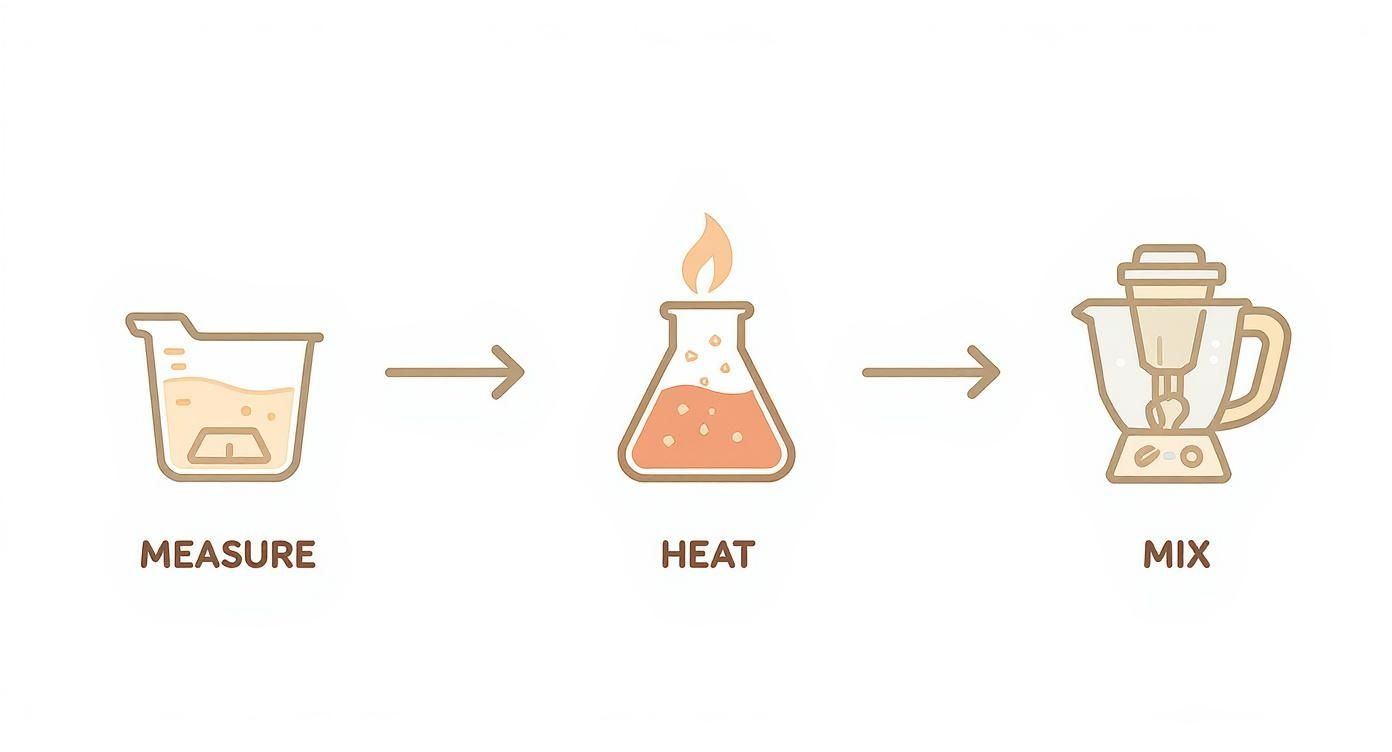
As you can see, the basic steps are pretty straightforward. If you can master precise measurement, controlled heating, and effective mixing, you're well on your way to creating gorgeous lotion every single time.
Measuring and Heating Your Phases
When it comes to cosmetic formulation, accuracy is everything. Get out your digital scale—one that measures to at least 0.1 grams—and carefully weigh your oil phase ingredients. This includes your carrier oils, butters, and emulsifying wax, all into one heat-safe beaker. In a separate beaker, weigh out your water phase, which is usually just distilled water.
With everything measured, it's time to gently heat both phases. Your goal is to get them to roughly the same temperature, right around 160°F (71°C). This ensures your emulsifying wax and any solid butters melt completely, and that both phases are warm enough to blend properly. A double boiler is perfect for this job because it provides gentle, even heat. No double boiler? No problem. Just place your beakers in a saucepan with a couple of inches of simmering water.
Pro Tip: Whatever you do, don't use a microwave to melt your oils and waxes. The intense, direct heat can actually damage the delicate fatty acids in your oils, which can diminish their beautifying properties.
The Magic of Emulsification
Okay, this is the most critical part of the whole process—and the most exciting! Emulsification is the art of convincing oil and water to get along. These two naturally want nothing to do with each other, but your emulsifying wax is the peacemaker that brings them together into a stable, creamy union.
Once both your oil and water phases hit that target temperature and all the solids have melted, it's time for them to meet. Carefully pour the water phase into the oil phase. You'll see the mixture immediately turn a milky, opaque white. That's your lotion starting to form!
Now, grab your immersion blender. To avoid splashing hot liquid everywhere, make sure you submerge the head of the blender before you turn it on. Blend the mixture in short bursts of 30-60 seconds each, moving the blender around to ensure everything is incorporated. You’ll see it start to thicken almost right away.
Reaching Trace and Cooling Down
As you keep blending, you're looking for something called 'trace'. This is the point where the lotion has thickened just enough that when you lift the blender out, it leaves a faint trail on the surface. Hitting trace means you've successfully created a stable emulsion. You can stop blending now.
The next step requires a bit of patience. Your lotion needs to cool down. Set the beaker aside and let it rest, stirring it gently with a spatula every 5-10 minutes. This helps it cool evenly and keeps the texture silky smooth. You'll notice it continues to thicken up quite a bit as it gets closer to room temperature.
Adding Your Final Touches
The cool-down phase is your window to add all the delicate, heat-sensitive goodies. If you add these while the lotion is still hot, you risk diminishing their properties. Wait until the lotion has cooled to below 113°F (45°C) before adding your preservative and any other custom ingredients.
- Preservative: This is non-negotiable for any water-based product. Follow the supplier's recommended usage rate (usually 0.5-1% of the total weight) and add your broad-spectrum preservative. This keeps your lotion safe from mold and bacteria.
- Fragrance and Botanicals: Now for the fun part! This is your chance to add a few drops of a skin-safe essential oil for a beautiful scent or a cosmetic active for added benefits. Gently stir them in until they're fully combined.
Once everything is mixed in, transfer your beautiful lotion into a clean, sanitized pump bottle or jar. It's best to let it sit for about 24 hours to fully set and reach its final consistency. And that's it—congratulations on making your very own handcrafted lotion!
Looking for more ideas? Be sure to check out our growing library of other skincare recipes you can try.
Personalizing Your Homemade Body Lotion
Once you've nailed the basic recipe, the real fun begins. This is where you transform a standard formula into a homemade body lotion that’s perfectly suited to your skin and personal style. Think of the base lotion as a blank canvas just waiting for your creative touch.
Personalization isn’t just a niche hobby; it’s a massive trend in the skincare world. People everywhere are seeking out products that feel made just for them, which is why bespoke creations like the one you’re making have become so popular.
Swapping Oils and Butters for Texture Control
The easiest and most dramatic way to customize your lotion is by playing with the oils and butters in your oil phase. A simple swap here can completely change the texture, turning a light, summery lotion into a rich, decadent cream for dry winter skin.
Want a lighter, daytime lotion that absorbs in a flash? Try switching out some of the heavier butters, like shea, for a lighter oil like grapeseed or fractionated coconut. These sink right in, leaving a silky, non-greasy finish that’s perfect for applying right before you get dressed.
On the other hand, if you're after a super-rich, intensive cream, you can increase the percentage of cocoa or mango butter. These ingredients give the lotion more body and a luxurious feel, making it ideal for areas like elbows and knees. Getting to know your oils is the key to elevating your formulas. For a deeper dive, explore our guide to discover the benefits of beauty oils.
To help you get a feel for how different ingredients will affect your final product, here's a quick cheat sheet:
Ingredient Customization for Your Desired Feel
| Ingredient (Butter/Oil) | Texture Profile | Best For |
|---|---|---|
| Shea Butter | Rich, creamy, slow-absorbing | Intense moisture, dry/mature skin, winter formulas |
| Cocoa Butter | Solid, thick, protective barrier | Very dry skin, rich body creams |
| Grapeseed Oil | Very light, silky, fast-absorbing | Oily or blemish-prone skin, lightweight daily lotions |
| Fractionated Coconut Oil | Feather-light, non-greasy, stays liquid | All skin types, fast-absorbing summer lotions |
| Avocado Oil | Medium-weight, nourishing, slightly slower absorption | Dry or mature skin, nourishing night creams |
| Sweet Almond Oil | Medium-light, smooth glide, easily absorbed | Normal to dry skin, all-purpose daily lotions |
This table is just a starting point. The best part about DIY is that you have complete control to experiment until you find the perfect blend for your skin.
The real beauty of making your own lotion is the absolute control you have over its feel. Don't be afraid to experiment; even small changes in your oil phase can lead you to your new favorite formula.
Enhancing Your Lotion with Cosmetic Actives
The cool-down phase is your golden opportunity to supercharge your lotion with powerful cosmetic actives. These are potent ingredients you add once the lotion is below 113°F (45°C) to protect their delicate structures from heat. At Skin Perfection, we offer a whole range of extracts and actives designed to take your lotion to the next level.
For example, you could add:
- Botanical Extracts: Ingredients like Green Tea or Chamomile Extract bring their well-known antioxidant properties to your formula.
- Vitamins: A touch of Vitamin E does double duty—it’s great for the skin and also acts as an antioxidant for your oils, helping to keep your lotion fresh.
- Peptides: If you want to support your skin's firm and youthful appearance, adding targeted peptides can be a fantastic upgrade for a daily body lotion.
Always follow the recommended usage rates for any active you add. With these ingredients, a little truly goes a long way, ensuring your final product is both effective and a pleasure to use.
Creating Your Signature Scent
Scent is what makes a body product truly personal. Using essential oils or skin-safe fragrance oils, you can create a signature aroma that makes your lotion uniquely yours. Just like with actives, you'll add these during the cool-down phase to prevent the heat from damaging the fragile aromatic compounds.
Let’s brainstorm a couple of ideas to get you started.
Example 1: A Calming Lavender & Chamomile Blend
Imagine a lotion you can smooth on right before bed. A calming scent can be a beautiful part of a relaxing evening ritual.
- 10 drops of Lavender essential oil
- 5 drops of Roman Chamomile essential oil
- 2 drops of Cedarwood essential oil
This blend creates a serene, earthy, and floral aroma that’s perfect for winding down after a long day.
Example 2: An Uplifting Citrus Blend
For a morning lotion, you might crave something bright and energizing to kickstart your day. A citrus blend is a perfect choice.
- 8 drops of Sweet Orange essential oil
- 6 drops of Grapefruit essential oil
- 3 drops of Bergamot essential oil
This vibrant combination results in a zesty, cheerful scent that feels incredibly refreshing and invigorating on the skin.
Just remember to always use high-quality, skin-safe oils and stick to the proper dilution rates, which are typically around 0.5% to 1% of your lotion's total weight. By carefully choosing your ingredients, you can turn a simple homemade lotion into a truly luxurious, personalized skincare experience.
Common Lotion Making Hiccups (and How to Fix Them)
Even with the most careful planning, sometimes a batch of homemade body lotion just doesn't turn out right. Don't panic, and whatever you do, don't toss it! Most of these little hiccups are fixable, and honestly, they're the best way to learn and become a more confident creator.
Think of it as part of the crafting journey. Figuring out what went sideways is how you truly master your technique. Let's walk through some of the most common challenges and exactly how to get your formula back on track.
My Lotion Separated or Broke
This is the big one, the issue that strikes fear into the hearts of new lotion makers. You come back to your beautiful creation a day later only to find a sad layer of oil floating on top of a watery mess. It's a classic case of a broken emulsion—the bond between your oil and water just didn't hold.
When an emulsion breaks, a few usual suspects are to blame:
- Temperature Mismatch: Your oil and water phases really need to be at a similar temperature when you combine them, right around 160°F (71°C). If one is way cooler than the other, they'll refuse to play nicely and won't form a stable bond.
- Not Enough Blending: Creating a solid emulsion requires some serious mixing muscle. An immersion blender is your absolute best friend here. You need to blend for a good 1-2 minutes in short bursts to shear the oil and water droplets small enough to stay suspended.
- Wrong Emulsifier Ratio: This is a super common one. If you skimp on the emulsifying wax relative to your oils, separation is almost guaranteed. A good rule of thumb is to use an emulsifier at about 25% of the weight of your oil phase.
Got a separated lotion on your hands? You can often save it. Gently reheat the whole mixture in a double boiler until everything melts back into a uniform liquid. Then, get that immersion blender back in there and blend thoroughly. This usually gives the emulsion the second chance it needs to form correctly.
The Texture Isn't Right
Did your lotion come out way thicker or thinner than you'd hoped? This is another frequent issue, but the fix is usually a simple tweak for your next batch. The final consistency is a delicate dance between your ingredients.
The secret to controlling your lotion's texture is all in the ratios. The amount of emulsifying wax, hard butters, and liquid oils you use directly determines whether you end up with a light, pumpable lotion or a thick, rich cream.
If your lotion is too thin or watery, it's telling you it needs more body. The easiest fix for next time is to slightly increase the percentage of your emulsifying wax. You could also add a small amount of a hard butter (like cocoa butter) or a fatty alcohol like Cetyl Alcohol to give it a significant boost in thickness.
On the flip side, if your lotion is too thick and more like a body butter, you'll want to dial back the emulsifying wax or hard butters in your next attempt. Swapping a portion of a solid butter for a lightweight liquid oil is another great way to create a more fluid, lighter product.
Preventing Graininess and Other Problems
Sometimes a lotion feels perfectly smooth right after you make it, but a few days later, it develops a weird, grainy texture. This is almost always caused by butters like shea or mango cooling down too slowly. Their different fatty acids solidify at different rates, which creates those tiny, hard crystals.
The fix? A "flash cool" method. Right after you've emulsified your lotion, pop the beaker into an ice bath. Stir it continuously as it cools until it thickens up and reaches room temperature. This forces all those fatty acids to solidify simultaneously, giving you a perfectly silky-smooth texture every time.
Finally, and this is a big one, any product that contains water needs to be protected. Forgetting to add a preservative is a critical mistake that can lead to mold and bacteria. To keep your creations fresh and safe, always include a broad-spectrum preservative. You can find a whole range of reliable options in our collection of cosmetic preservatives.
Your Homemade Lotion Questions, Answered
Jumping into the world of DIY skincare is exciting, but it's natural to have a few questions. Making your own homemade body lotion is a seriously rewarding process, and getting clear answers upfront can make the whole experience smoother and more fun.
Let's tackle some of the most common questions we hear from formulators just like you.
Why Do I Absolutely Need a Preservative in My Lotion?
This is one of the first things people ask, and it's a fantastic question. It shows you're already thinking like a real formulator!
Here's the deal: any product that contains water (including your lotion) is a potential breeding ground for bacteria, mold, and other nasty microbes. A broad-spectrum preservative is non-negotiable; it's the single ingredient that keeps your lotion fresh, safe, and ready to use. Without one, your beautiful creation could spoil in a matter of days. At Skin Perfection, we only offer cosmetic-grade preservatives that are perfect for your at-home projects.
How Long Will My Homemade Body Lotion Actually Last?
This is the next logical question, and it's a practical one. When you use a good broad-spectrum preservative and follow clean, sanitary practices (think sterilized equipment and containers), your lotion can easily have a shelf life of 6 to 12 months.
The freshness of your oils and butters also plays a role. To give your lotion the longest life possible, always store it in a clean, airtight container away from direct sunlight and heat. A cool, dark cabinet is perfect.
Can I Scent My Lotion with Essential Oils?
Absolutely! Using essential oils is one of the best parts of DIY—it’s how you can add that personal, signature fragrance to your lotion.
The key is when you add them. You'll want to wait for the cool-down phase of your recipe, specifically when the lotion's temperature drops below 113°F (45°C). Adding them at this lower temperature is crucial because it protects the delicate aromatic compounds in the oils, making sure your scent is beautiful and lasting. Always double-check the recommended usage rates for any essential oil to ensure it's skin-safe, as they are incredibly concentrated.
A beautifully crafted homemade lotion should feel luxurious and absorb nicely, never heavy or sticky. If your first attempt isn't quite there, don't worry. A simple tweak to your formula is usually all it takes to get it just right.
Help! My Lotion Feels Greasy. What Did I Do Wrong?
A greasy feeling is a common hiccup, and it’s usually an easy fix. It often comes down to one of two things: your choice of oils and butters, or having too high a percentage of the oil phase in your overall formula.
Some oils, like olive or avocado, are naturally heavier than others. For your next batch, try swapping in some lighter, fast-absorbing oils.
- Fractionated Coconut Oil
- Grapeseed Oil
- Safflower Oil
Another pro tip? You can add a tiny amount of an ingredient like tapioca starch to your formula. It works wonders to cut that oily feeling on the skin.
Ready to put this knowledge into practice? Explore the high-quality ingredients and DIY kits at Skin Perfection and start crafting a body lotion you'll absolutely adore. You can find everything you need to get started at https://www.naturalorganicskincare.com.