

 Buy with Prime


Learning how to make your own face serum really comes down to three things: picking a hydrating base, choosing the right active ingredients for your skin goals, and adding a preservative to keep it safe. The whole point is to give you total control over creating a potent, lightweight formula that's made just for you.
Why a Custom Face Serum Is Your Skincare Game Changer
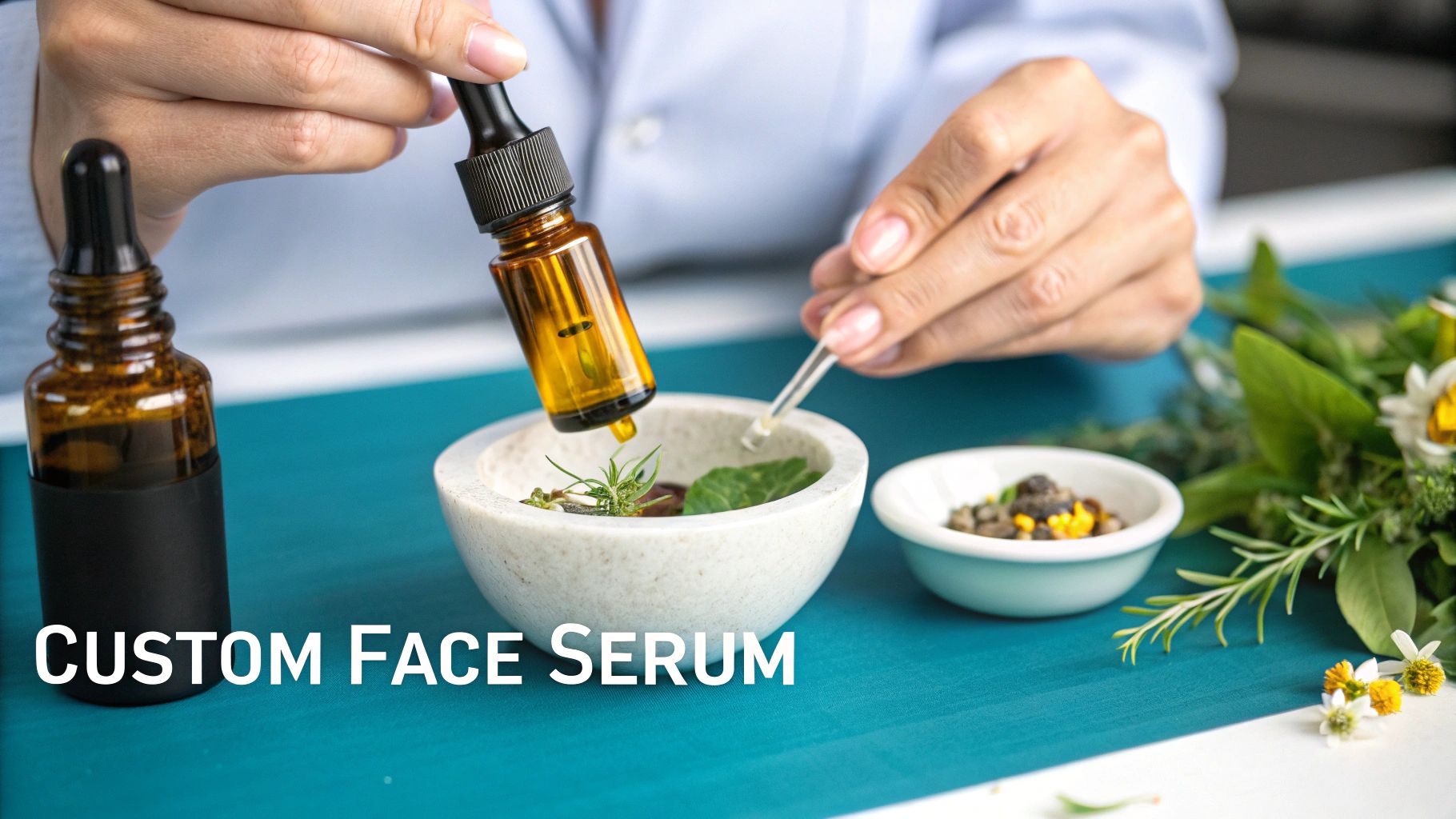
Imagine moving past the one-size-fits-all products on the shelf and creating something that perfectly matches what your skin actually needs. That’s the real magic of formulating your own face serum. It puts you in the driver’s seat of your beauty routine, letting you hand-pick high-performance ingredients to address your specific skin appearance goals.
By its very nature, a serum is a concentrated powerhouse designed to deliver potent ingredients to the skin. Its lightweight texture absorbs beautifully, unlike heavier creams, making it the perfect vehicle for actives like peptides, plant stem cells, and botanical extracts.
The Advantage of a DIY Approach
When you learn how to make a face serum, you gain incredible control over every single drop that touches your skin. This isn't just a hobby; it’s a commitment to quality, freshness, and true personalization.
Here’s why it’s a total game-changer:
- Targeted Solutions: You can select specific actives to zero in on what matters most to you, whether that's supporting a firm, youthful look, getting a serious hydration boost, or promoting a brighter, more even-looking complexion.
- Ingredient Transparency: You know exactly what's in your formula. No mystery fillers, no unwanted fragrances, and no ingredients that don't serve a real purpose for your skin.
- Peak Freshness and Potency: Many of the most effective skincare ingredients, like certain vitamins, can lose their punch over time. Making your serums in smaller batches ensures you're always using a fresh, potent product at its best.
A lot of people get confused about the difference between a serum and a hydrator. Serums are all about delivering targeted actives to the skin, while hydrators are focused on adding water content. If you want to dive deeper, you can explore the differences between hydrators and serums to see where each one fits.
Understanding the Core Components
Whipping up a professional-quality serum is more than just mixing a few nice ingredients in a bottle. A successful, safe formula is built on a balanced structure. It all starts with a hydrating base, which creates the foundation for your serum and is where you'll dissolve your water-soluble goodies.
Next up are the actives—these are the stars of the show. They're the power-packed components doing the heavy lifting to help you reach your skin goals.
Finally, and this is critical, a reliable preservative system is completely non-negotiable. Any time you have water in a formula, you're creating a playground for bacteria, mold, and yeast. A preservative keeps your creation safe to use. With this guide, you’ll get comfortable with each of these elements and be on your way to unlocking a more radiant-looking you.
Choosing Your High-Performance Serum Ingredients
The heart of any truly exceptional serum is its ingredient list. This is where you move from just mixing liquids to becoming a thoughtful formulator. Crafting a face serum that actually delivers visible results means really understanding what each component does, from the hydrating base all the way to the potent actives.
Every great serum begins with a quality base. Think of this as the foundation of your formula—it makes up the largest chunk of the final product and acts as the delivery vehicle for all your powerhouse actives.
You've got some fantastic options to choose from:
- Hyaluronic Acid Solution: A pre-made 1% solution is a formulator's dream. It creates that beautiful, plush gel texture and gives skin an immediate plump, hydrated feeling.
- Botanical Hydrosols: These are the aromatic waters, like rose or lavender, collected when plants are distilled. They lend a gentle, natural fragrance and subtle skin-beautifying properties, making them a wonderful upgrade from plain distilled water.
- Glycerin: A classic humectant, glycerin is brilliant at drawing moisture to the skin. Adding just a little (2-5%) to your base can seriously boost your serum's hydrating power without that sticky feeling.
Selecting Your Powerhouse Actives
Once you've picked your base, it's time for the fun part—the actives. These are the concentrated ingredients that do the heavy lifting to help you reach your skin appearance goals. The global facial serum market has absolutely exploded, hitting USD 5.86 billion in 2024, and it's all because people are actively seeking out these high-impact ingredients for their targeted benefits.
Actives come in all shapes and sizes, each with a unique job. When you're just starting out, it’s a smart move to begin with just one or two key actives. This way, you can see how your skin responds before you start creating more complex cocktails.
If you're new to making your own skincare, a great place to start is by exploring the best natural ingredients for skin to get a solid feel for what works and why.
For example, if you're looking for potent ingredients for your custom blends, understanding Vitamin C serums can offer some incredible insights, as they're often seen as the gold standard for a glowing complexion. You could also dive into peptides, which are fantastic for supporting a firm, youthful look, or check out various plant extracts known for their amazing beautifying qualities.
To help you get started, here's a quick reference guide for choosing the best active ingredients based on what you want to achieve for your skin's appearance.
Selecting Actives for Your Skin Appearance Goals
| Appearance Goal | Recommended Actives | Why It Works Well |
|---|---|---|
| Youthful & Firm Look | Peptides (Argireline, Matrixyl 3000), Retinoids, Plant Stem Cells | These support collagen and help relax the appearance of expression lines, promoting a smoother, firmer look. |
| Hydration & Plumping | Hyaluronic Acid, Niacinamide, Glycerin | These are powerful humectants that draw moisture into the skin, giving it a dewy, plump appearance. |
| Brightening & Even Tone | Vitamin C (L-Ascorbic Acid), Niacinamide, Licorice Root Extract | They offer antioxidant benefits and help lessen the appearance of dark spots, promoting a more even skin tone. |
| Soothing Appearance | Green Tea Extract, Chamomile, Aloe Vera, Allantoin | These ingredients have properties that help reduce the appearance of redness and calm the skin. |
This table is just a starting point, of course. The real magic happens when you start experimenting and finding the combinations that your unique skin absolutely loves.
Supporting Ingredients: The Unsung Heroes
While the actives get all the glory, your supporting ingredients are just as critical for creating a product that's both safe and effective. Honestly, skipping this step can turn a brilliant formula into something useless—or even harmful.
Let's talk about the two non-negotiables: preservatives and pH adjusters.
Preservatives Are Essential
Any formula that contains water (and yes, that includes hydrosols and aloe vera) is a potential playground for bacteria, mold, and yeast. A broad-spectrum preservative isn't just a good idea; it's a critical safety requirement.
Think of it this way: skipping the preservative in your water-based serum is like leaving food out on the counter for weeks and then eating it. It’s simply not safe. Always follow the manufacturer's recommended usage rate, which is typically 0.5% to 1.5% of your total formula.
Why pH Matters
The pH level of your serum impacts both how well it works and how it feels on your skin. Our skin's natural pH is slightly acidic, usually somewhere between 4.7 and 5.75. A well-made serum should fall right into that sweet spot to be gentle yet effective.
Certain active ingredients also need a specific pH to do their job properly. You can easily test and adjust your serum’s pH with some simple pH test strips. To tweak it, a few drops of a citric acid solution will lower the pH, while a baking soda solution will raise it. It’s a tiny step that makes a huge difference in creating a truly professional-quality product.
Your Guide to the Serum Formulation Process
Alright, you’ve picked out your star ingredients. Now for the fun part: bringing your serum to life. This is where the magic happens, blending careful measurements and proper technique to create something truly special and effective. Formulating might sound intimidating, but once you get the basic flow down, you'll see it's a straightforward, methodical practice.
We're going to walk through the process in distinct phases. Following these steps is key to making sure every ingredient is incorporated correctly, which protects the stability of your final product and the integrity of your delicate actives.
Setting Up Your Workspace for Success
Before you even touch an ingredient, the very first step is to create a clean, organized workspace. This isn't just about being tidy; it's a critical safety measure. You want to prevent any unwanted microbes from crashing the party and spoiling all your hard work.
Start by giving your work surface a thorough wipe-down with a disinfectant. Then, sanitize every piece of equipment you'll be using—beakers, mixing rods, and especially the final bottle your serum will call home. A quick and easy way to do this is to spray everything with 70% isopropyl alcohol and let it air dry completely.
Always wear gloves. This protects your hands from the ingredients and your serum from you. Precision is also non-negotiable here. You absolutely need a digital scale that measures to at least two decimal points (0.01g) to get your percentages spot-on.
The Three Phases of Formulation
Most water-based serums come together using a simple three-phase method. This ensures everything is combined at the right time and temperature, which is a huge deal for heat-sensitive ingredients that can easily be ruined.
This diagram shows the simple flow of building your serum from the base up.
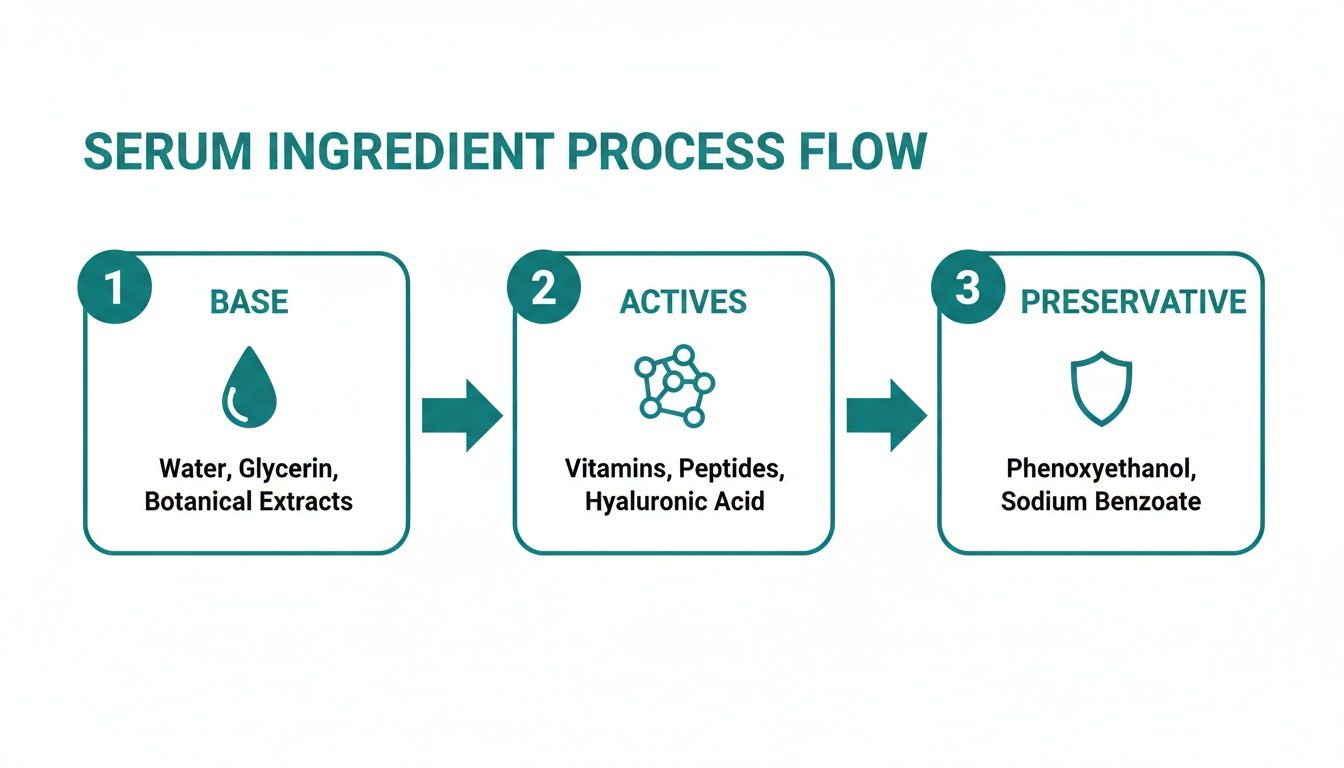
Think of it as laying down a solid foundation, adding the high-impact features, and then securing everything to last.
The Water Phase
This is the backbone of your serum. Here, you’ll combine all the water-soluble ingredients that aren't sensitive to heat. This usually means your base (like distilled water or a botanical hydrosol), glycerin, and any water-loving powders or extracts that can handle a bit of warmth.
- Place a sanitized beaker on your digital scale and hit the "tare" button to zero it out.
- Carefully weigh your distilled water or hydrosol.
- Next, weigh and add your other water-phase ingredients, like glycerin or panthenol, right into the same beaker.
- Stir gently until everything is dissolved. If you've got some stubborn powders, you can gently heat the beaker in a warm water bath to help them along.
The Oil Phase
Now, if you’re making a simple hydrating serum, you might skip this phase entirely. But for formulas that include carrier oils or oil-soluble actives, this step is essential. This is also where you'd add an emulsifier if you were creating a creamy serum lotion that blends oil and water.
For a basic serum, you might add a small percentage of a lightweight oil like squalane or jojoba. You'd simply weigh these ingredients in a separate beaker.
The Cool-Down Phase
Pay close attention here, because this is arguably the most important phase. This is when you add your most valuable and delicate ingredients—the ones that can be damaged or completely destroyed by heat. We're talking about most peptides, certain vitamins, and your preservative.
Your water-phase mixture must be at room temperature, which means below 104°F (40°C), before you even think about moving on.
Pro Tip: Never, ever rush the cool-down phase. Adding your expensive actives to a warm base is like throwing money down the drain—they'll become completely ineffective. A quick check with a digital thermometer is always a smart move.
Once your base is cool, you can weigh and add your heat-sensitive actives, one by one, stirring gently after each addition. The very last step is to add your broad-spectrum preservative. Mix thoroughly here; you need to ensure it's evenly distributed throughout the serum to protect every last drop.
For more advanced tips, you can find a wealth of information on cosmetic formulation to really sharpen your skills.
Perfecting Your Serum’s pH Balance
The final, crucial step before bottling is to test and adjust the pH of your serum. This is what makes your creation effective, safe, and comfortable for the skin. Our skin's surface is naturally a bit acidic, sitting somewhere between 4.7 and 5.75, and your goal is to have your product fall right within that sweet spot.
Using pH test strips is the easiest way to check your work. Just dip a fresh strip into your serum and compare the color to the chart that came with them.
- If the pH is too high (alkaline): You'll need to bring it down. A diluted solution of citric acid (a 10% solution is a good starting point) works perfectly. Add it drop by drop, mixing and re-testing until you hit your target range.
- If the pH is too low (acidic): You'll need to raise it. A carefully added diluted baking soda solution or some L-arginine will do the trick.
Getting the consistency and active concentrations just right involves more than just mixing. For example, knowing the proper techniques for reconstituting powdered ingredients is vital when you're working with potent actives like peptides. This kind of precision at every stage—from weighing to pH balancing—is what separates a homemade concoction from a professional-quality product.
Once that pH is perfect, you're officially done. Your serum is ready to be bottled
Proven Serum Recipes for Every Skin Appearance Goal
Alright, you've got the theory down. Now it's time for the fun part—putting that knowledge into practice. To get you started on your formulation journey, I've laid out three of my go-to recipes, each targeting a common skin appearance goal.
I've written these formulas in percentages, which makes it super easy to scale them up or down. Whether you're making a tiny 30ml test batch or a much larger supply, the math stays the same. Think of these as your launchpad. You can follow them to the letter or use them as a solid foundation to start experimenting with your own unique blends.
Ageless Appearance Formula
Formulas that support a youthful look are always in high demand, and it's easy to see why. These serums are a powerhouse in the market, expected to pull in about 34.6% of all serum revenue in 2025. With a global population that's gracefully aging—we're looking at over 2 billion people aged 60 or older by 2050—the desire for products that help skin look firm and supple isn't going anywhere. You can dive deeper into the facial serum market stats on futuremarketinsights.com.
This particular recipe is loaded with some incredible peptides and antioxidants designed to give you that smooth, firm, and youthful appearance. It’s a fantastic choice for anyone wanting to support their skin's natural resilience.
Here is an ingredient breakdown for a 30ml (1 oz) batch of serum designed to support a youthful appearance.
Sample Recipe: Ageless Appearance Formula
| Ingredient | Percentage (%) | Amount for 30ml | Phase |
|---|---|---|---|
| Distilled Water or Rose Hydrosol | 74.5% | 22.35g | Water |
| Matrixyl 3000 | 10% | 3g | Cool-Down |
| Argireline | 10% | 3g | Cool-Down |
| Glycerin | 3% | 0.9g | Water |
| Niacinamide (Vitamin B3) | 1.5% | 0.45g | Water |
| Liquid Germall Plus (Preservative) | 1% | 0.3g | Cool-Down |
The process is straightforward: first, combine your water phase ingredients (the water or hydrosol, glycerin, and niacinamide) and give it a good stir until everything is completely dissolved. Let it cool to room temperature, then add your cool-down ingredients one by one—Matrixyl 3000, Argireline, and finally, your Liquid Germall Plus. Make sure to stir gently after adding each one. The final, crucial step is to test the pH and adjust it to land somewhere between 5.0 and 6.0.
Hydration Boost Quenching Serum
Skin that feels dry or dehydrated is a universal complaint. It can happen to anyone, no matter their skin type. This formula is like a huge drink of water for your face. It uses a high concentration of Hyaluronic Acid, paired with some soothing botanicals, to drench your skin in moisture and leave it looking plump and dewy.
It’s a deceptively simple recipe, but it's a perfect example of how a few carefully chosen ingredients can deliver incredible, visible results.
Here’s what you’ll need:
- 88.5% Hyaluronic Acid 1% Solution (Water Phase)
- 5% Green Tea Extract (Cool-Down Phase)
- 5% Panthenol (Provitamin B5) (Water Phase)
- 1% Leucidal SF Max (Preservative) (Cool-Down Phase)
- 0.5% Allantoin (Water Phase - may require gentle heat)
You'll start with a pre-made Hyaluronic Acid solution as your base. To get the Allantoin to cooperate, gently warm a small bit of your HA solution and dissolve it in there first. Then, you can mix that back into the rest of the HA solution along with the Panthenol. Once it’s cooled down to room temp, stir in the Green Tea Extract and your preservative. You're aiming for a final pH between 4.5 and 5.5.
Formulator's Tip: Allantoin can be a bit tricky to dissolve. I've found it helps to create a slurry with a small amount of glycerin before adding it to your warm water phase. This little trick helps it incorporate beautifully without clumping up.
Brightening Elixir for a Radiant Complexion
An uneven skin tone or a dull appearance can really keep your skin from looking its absolute best. This Brightening Elixir is built with ingredients known for promoting a more luminous, even complexion. It relies on a stable form of Vitamin C and some key botanical extracts to help you get that healthy, coveted glow.
If you really want to dive deep into these types of formulas, we have a complete guide on how to create a fantastic homemade vitamin c serum recipe that you should definitely check out.
Here’s the ingredient breakdown:
- 80% Distilled Water (Water Phase)
- 10% Magnesium Ascorbyl Phosphate (MAP) (Water Phase)
- 5% Licorice Root Extract (Cool-Down Phase)
- 3% Glycerin (Water Phase)
- 1% Optiphen Plus (Preservative) (Cool-Down Phase)
- 1% Ferulic Acid (Cool-Down Phase - may need a solvent)
First, combine the distilled water and glycerin. Then, stir in the Magnesium Ascorbyl Phosphate (MAP) until it’s fully dissolved. Once the mixture has cooled, you can add the Licorice Root Extract, Ferulic Acid, and Optiphen Plus. This formula performs best at a pH of 6.0-7.0, so make sure you test and adjust carefully.
Consider these recipes your starting point for creating beautiful, effective skincare that you can be proud of.
Proper Packaging and Storage for Lasting Freshness
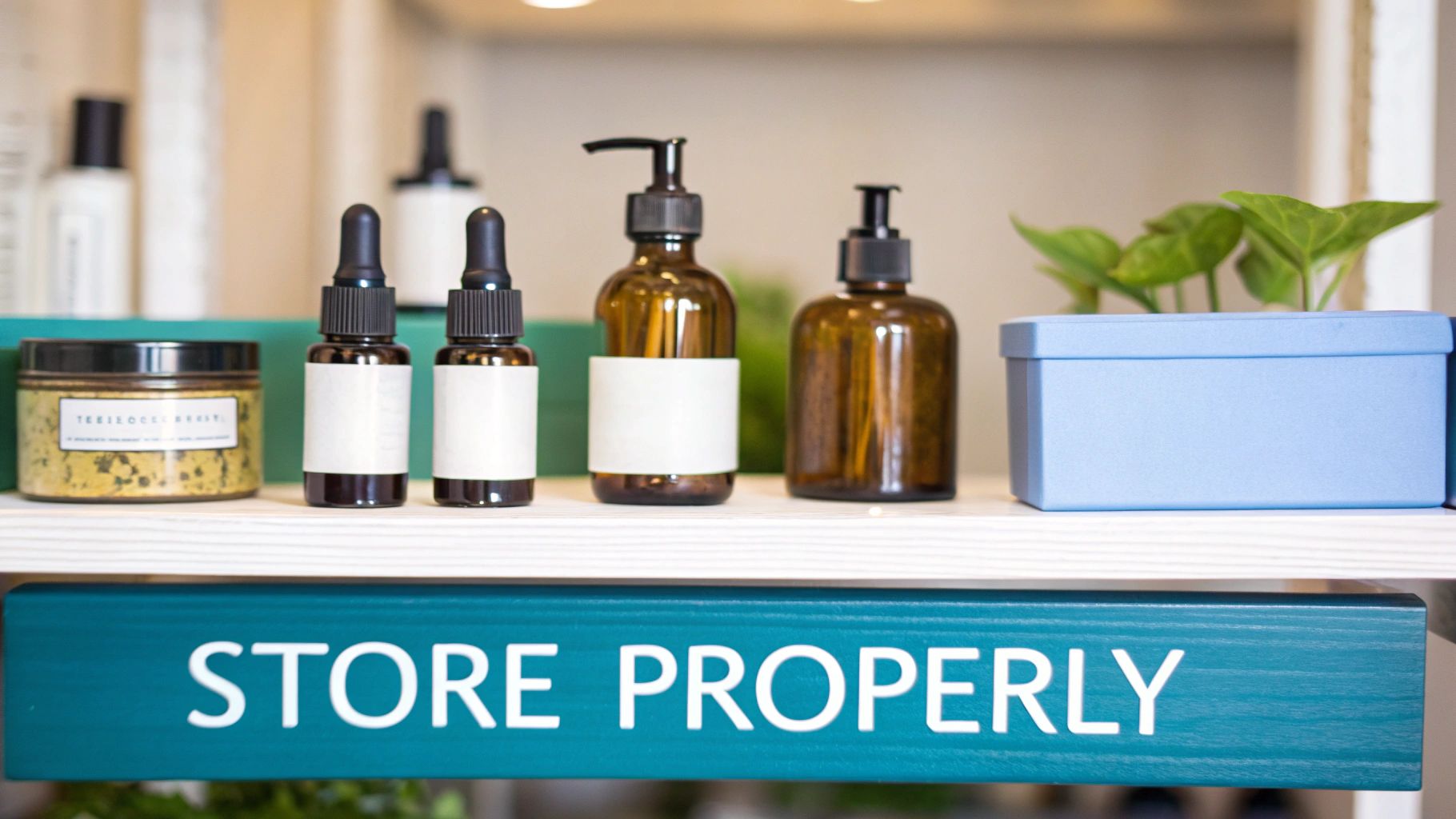
You’ve spent all this time carefully crafting the perfect serum, and now you need to give it a safe home. Don't overlook this step! How you package and store your creation is just as critical as the formula itself, directly impacting its potency and how long it will last.
A good container does more than just hold your serum; it actively protects it from the elements. Air and light are the biggest enemies of your delicate active ingredients. This is why professional formulators are so incredibly particular about their packaging—it ensures the serum is just as effective on the last drop as it was on the first.
Choosing the Right Container for Your Serum
When it's time to bottle your DIY face serum, not all options are created equal. You need packaging that will preserve the integrity and stability of everything you’ve put inside.
Here are the top choices for protecting your hard work:
- Dark Glass Bottles: This is non-negotiable. Amber, cobalt blue, or even violet Miron glass are essential for blocking the UV light that quickly degrades sensitive ingredients like Vitamin C and certain botanical extracts.
- Airless Pump Bottles: These are the gold standard for a reason. An airless pump uses a vacuum to push the product up, which means no air ever gets back into the container. This massively cuts down on oxidation and contamination, keeping your serum fresh for much longer.
- Dropper Bottles: They're classic and look great on a vanity, but dropper bottles do introduce a little air every time you open them. They’re still a solid option; just be extra mindful about screwing the cap on tightly after each use.
Your goal is to build a fortress for your formula, shielding it from degradation. An airless pump is the ultimate defense, creating a stable environment that preserves the delicate actives you’ve so carefully chosen.
Smart Storage for Maximum Shelf Life
Where you keep your serum plays a huge role in its longevity. Heat and sunlight are basically catalysts for destruction, speeding up the breakdown of your active ingredients and potentially weakening your preservative system.
The best spot is somewhere cool, dark, and consistent. A bathroom cabinet (away from shower steam) or a bedroom drawer are perfect. Whatever you do, avoid leaving your serum on a sunny windowsill. Temperature fluctuations are a recipe for a spoiled formula. If you want to dive deeper into this crucial aspect of formulating, you can read more about selecting the right natural skin care preservative.
And one last pro tip: always label your bottles with the product name and the date you made it. It’s a simple habit that stops you from accidentally using an expired product and helps you keep track of your batches. Freshness is everything when you make face serum, and a good label is your best friend.
Answering Your DIY Face Serum Questions
When you first start formulating your own skincare, it's completely normal to have a ton of questions. It's a new skill, after all! This is the part where we tackle the most common questions that pop up, giving you the confidence to move forward with your amazing serum creations.
Can I Really Make a Serum Without a Preservative?
This is easily the most important question we get, and the answer is a hard no—not if you're using any water at all. That includes distilled water, hydrosols, aloe vera juice, or any other aqueous ingredient.
The moment water enters a formula, you've rolled out the welcome mat for bacteria, mold, and yeast. Without a proper broad-spectrum preservative, your beautiful creation can become a contaminated mess in just a few days, making it totally unsafe for your skin. Think of a preservative as non-negotiable insurance for your hard work and your face.
How Long Will My Homemade Serum Actually Last?
The shelf life of your serum really boils down to two things: your preservative and how you store it. If you use a good broad-spectrum preservative at the right concentration and keep your serum in a cool, dark spot (like a medicine cabinet), you can reasonably expect it to last for three to six months.
That said, always trust your senses. If you ever notice the color, smell, or texture seems off, it’s time to toss it. Don't risk it—just whip up a fresh batch.
Help! Why Did My Serum Separate or Get Cloudy?
It’s always a little disappointing when your serum doesn't look as perfect as you imagined, but don't worry, there's usually a simple fix. Cloudiness often means an ingredient hasn't fully dissolved. Sometimes, gently warming the water phase of your formula before mixing can solve this.
Separation is the classic sign that your oil and water components aren't playing nicely together. For a simple hyaluronic acid serum, this won't be an issue. But the second you add oils into a water-based formula, you absolutely need an emulsifier to bind them into a stable, creamy blend.
A rookie mistake is adding your "cool-down" ingredients while the base is still warm. Certain actives are sensitive to heat and will literally fall out of the solution, making it look cloudy. Patience is a formulator's best friend; always let your base cool down to room temperature before adding those precious final ingredients.
Is an Oil-Based Serum Better Than a Water-Based One?
Neither one is "better" than the other—they just do different jobs. It’s like asking if a green smoothie is better than a glass of water. You need both!
-
Water-based serums are the champions of hydration. They excel at delivering water-soluble goodies like hyaluronic acid, niacinamide, and most peptides deep into the skin. They're typically lightweight, absorb in a flash, and work for nearly every skin type.
-
Oil-based serums are all about nourishment and protection. They are fantastic for delivering oil-soluble vitamins (like A, D, E, and K) and antioxidants. They also work wonders for sealing in moisture and supporting your skin's natural barrier.
For the ultimate routine, many people love layering a water-based serum onto clean skin and then locking it all in with a facial oil or moisturizer. It's truly the best of both worlds.
How Do I Know if My DIY Serum Is Actually Working?
Seeing real change from your skincare is a marathon, not a sprint. While a hydrating serum can give you that instant plump, dewy feeling, the true magic from most active ingredients takes time and consistency to reveal itself.
Be on the lookout for subtle shifts in your skin. Maybe your skin tone looks a bit more even, or the texture feels smoother. Perhaps you just have a healthier-looking glow. The best way to gauge progress is to stick with your routine and really pay attention to how your skin looks and feels over a four-to-six-week period.
The demand for effective serums isn't just in your head; it's a massive global trend, with the Asia-Pacific region leading the charge. The market is projected to skyrocket to USD 6.24 billion in 2025 and is expected to grow at a compound annual rate of 7.9% from 2025-2030. This data, which you can explore in the full research about the expanding facial serum market on grandviewresearch.com, shows just how much people value the potent, targeted skincare you now have the power to create for yourself.
At Skin Perfection, our goal is to empower you to create skincare that’s perfectly suited to you. From high-performance actives to the ideal bottle for your finished product, you can find all your lotion-making supplies at https://www.naturalorganicskincare.com.