

 Buy with Prime



L-ascorbic acid is the most researched form of topical vitamin C, and it is also the least stable. Anyone who has mixed a DIY vitamin C serum has watched it go from clear to pale yellow to amber. If you want the full method for mixing a serum from powder, our DIY guide to ascorbic acid powder for skin walks through it. This page is about the part that decides whether that serum is still worth applying a week later: stability. As a cosmetic formulator, I will cover what the research says about pH, concentration, ferulic acid, and vitamin E, and the storage habits that slow oxidation at home.
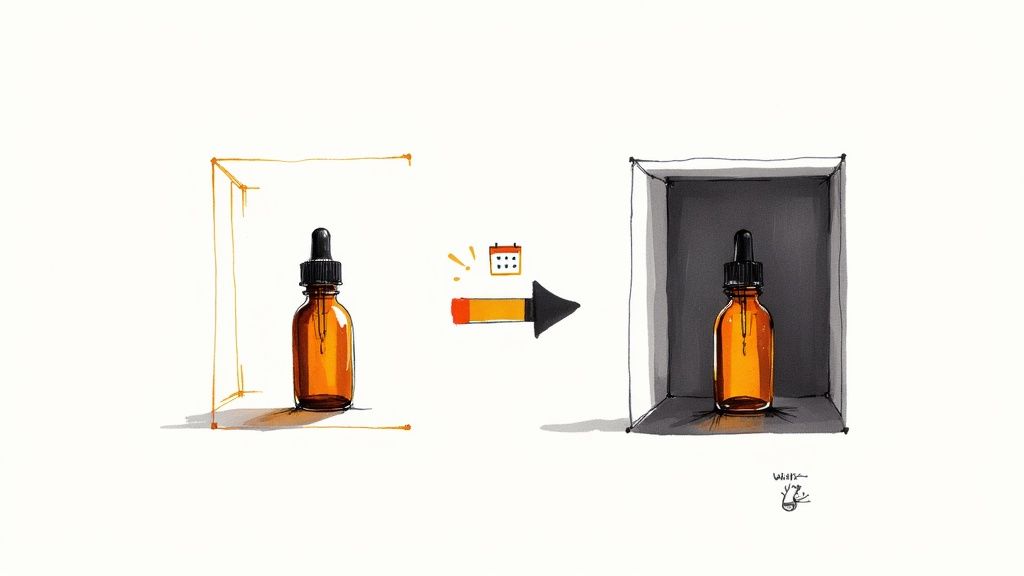
Why DIY Vitamin C Oxidizes
L-ascorbic acid is an antioxidant, which means its job is to give up electrons to reactive molecules. The catch is that it does that in the bottle too. Once dissolved in water, it starts reacting with oxygen, and light, warmth, and repeated opening of the bottle all give it more opportunity to do so. Once oxidized, it is no longer L-ascorbic acid, and in the Pinnell absorption study described below, dehydroascorbic acid, an oxidized form, did not raise skin levels of L-ascorbic acid. A color shift toward yellow, then amber, is the visible sign that the serum has changed.
You cannot stop this process in a water-based DIY serum. You can slow it, and you can plan around it. Everything on this page is about buying time, so plan your batch size around how quickly you actually use a serum.
The Three Numbers That Come From the Research
| Variable | What was found | Source |
|---|---|---|
| pH | L-ascorbic acid had to be formulated below pH 3.5 to enter the skin | Pinnell et al., 2001, pig skin |
| Concentration | 20% was the maximum concentration for optimal absorption | Pinnell et al., 2001, pig skin |
| Antioxidant partners | Adding ferulic acid to 15% L-ascorbic acid with 1% alpha-tocopherol improved the chemical stability of the vitamins and doubled photoprotection from about 4-fold to about 8-fold | Lin et al., 2005 |
The Pinnell study also found that skin levels saturated after three daily applications, and that magnesium ascorbyl phosphate, ascorbyl-6-palmitate, and dehydroascorbic acid did not increase skin levels of L-ascorbic acid. That is the trade-off of the pure form: it is the one that reached skin in that study, and it is the one that needs the most care in the bottle.
Stabilizer 1: Ferulic Acid
Ferulic acid is a plant-derived antioxidant. In the 2005 Journal of Investigative Dermatology study by Lin and colleagues, adding ferulic acid to a solution of 15% L-ascorbic acid and 1% alpha-tocopherol improved the chemical stability of vitamins C and E, and doubled the solution's photoprotection against solar-simulated irradiation, measured by redness and sunburn cell formation, from about 4-fold to about 8-fold. The same paper reported reduced thymine dimer formation.
How to use ferulic acid in a DIY serum
- Use the usage rate your ferulic acid supplier gives on its data sheet. The abstract I verified for this page does not state the ferulic acid concentration used, so I am not giving a number here.
- Check the solubility section of your supplier's data sheet and dissolve ferulic acid exactly as it directs before adding it to the water phase. Undissolved crystals will not do their job and will feel gritty.
- Add it to a formula that already sits below pH 3.5 for the vitamin C, and recheck pH at the end.
Stabilizer 2: Vitamin E
Vitamin E (tocopherol) was the second antioxidant in the Lin study, at 1% alpha-tocopherol. On its own, it is an oil-phase antioxidant: one supplier's specification sheet lists it as soluble in alcohol and oil and insoluble in water, with use levels of 0.1 to 1% for stabilizing oils and 0.5 to 2.5% for skin effects, and advises storing it protected from light.
What that means for a water-based vitamin C serum
- Vitamin E will not dissolve into a plain water serum. It needs a solubilizer or a vehicle that can carry both water-soluble and oil-soluble ingredients.
- If you add it, follow your supplier's usage rate and solubilizer guidance, and check that the finished serum is clear and uniform.
- If you would rather not formulate a three-antioxidant system yourself, our Vitamin C Serum with Hyaluronic Acid already combines vitamin C, vitamin E, and ferulic acid with hyaluronic acid.
To learn more about vitamin E as an ingredient, read our guide to 100% pure vitamin E oil.
Stabilizer 3: Your Storage Habits
These are the habits I use at the bench. None of them make L-ascorbic acid permanently stable; together they give your serum the longest useful life a home batch can have.
| Habit | Why I do it |
|---|---|
| Make small batches, about 15 to 30 mL | The less serum sitting in the bottle, the less of it oxidizes before you use it. |
| Weigh the powder fresh each time | Pre-dissolved stock solutions start oxidizing the moment they are made. |
| Use distilled water | Tap water can carry dissolved minerals into the batch. |
| Fill amber glass or an opaque airless pump | Keeps light out, and an airless pump limits fresh air each time you dispense. |
| Fill the bottle close to the top | Less headspace means less trapped air above the serum. |
| Refrigerate | Cold slows chemical reactions. Store the bottle in the fridge, not the bathroom. |
| Keep the cap on except when dispensing | Every opening lets oxygen in. |
| Label with the mix date and starting color | Gives you a clear reference point for change. |
How to Tell When Your Serum Has Oxidized
- The color you recorded on mixing day: your reference point. Any shift from it means change.
- Noticeably yellow: oxidation is underway. Use it up quickly and make a smaller batch next time.
- Amber, orange, or brown: discard. The serum has changed.
- Any off smell, cloudiness, or film: discard regardless of color.
Compare against the color you noted on the label on mixing day, in the same light. Small changes are easy to miss without a reference.
pH: Stability and Performance Pull in the Same Direction
The Pinnell study found L-ascorbic acid needed a pH below 3.5 to enter skin, so a DIY L-ascorbic acid serum belongs in that range. Check pH with strips or a meter after the powder is fully dissolved and after every addition. Because the formula sits at such a low pH, keep ingredients that are formulated for higher pH in separate products. For example, our DIY vitamin C serum recipe keeps vitamin C as its own serum rather than blending it into a peptide or niacinamide serum.
Common Stability Mistakes
- Making a month of serum at once. Make what you will use in days, not weeks.
- Clear glass on a sunny counter. Light and warmth are working against you.
- Heating the water to dissolve the powder faster. Stir at room temperature instead.
- Using a dropper bottle that is opened twice a day. An airless pump limits air exposure better.
- Adding more L-ascorbic acid to "make up" for oxidation. In the Pinnell study, 20% was the maximum concentration for optimal absorption. Make a fresh batch instead.
Frequently Asked Questions
How do I keep DIY vitamin C serum from oxidizing?
You can slow it, not stop it. Keep the pH below 3.5, consider adding ferulic acid and vitamin E at your supplier's rates (a combination that improved stability in a 2005 study), make small batches, store in amber glass or an airless pump in the refrigerator, and discard at a clear color change.
Does ferulic acid really make vitamin C more stable?
In the Lin 2005 study, adding ferulic acid to 15% L-ascorbic acid with 1% alpha-tocopherol improved the chemical stability of vitamins C and E and doubled photoprotection from about 4-fold to about 8-fold.
Can I add vitamin E oil directly to my vitamin C serum?
Not to a plain water-based serum. Vitamin E is insoluble in water, so it needs a solubilizer or a vehicle that can carry both water- and oil-soluble ingredients. Follow your supplier's guidance.
Should I refrigerate DIY vitamin C serum?
Yes. I keep every DIY L-ascorbic acid serum in the refrigerator, in a dark or opaque bottle with the cap closed.
My serum turned yellow. Is it still usable?
A slight yellow means oxidation has started, so use it up quickly. Amber, orange, or brown means discard it and mix a fresh, smaller batch.
Sources
- Lin FH, Lin JY, Gupta RD, Tournas JA, Burch JA, Selim MA, Monteiro-Riviere NA, Grichnik JM, Zielinski J, Pinnell SR. Ferulic acid stabilizes a solution of vitamins C and E and doubles its photoprotection of skin. Journal of Investigative Dermatology. 2005;125:826-832. Abstract
- Pinnell SR, Yang H, Omar M, Monteiro Riviere N, DeBuys HV, Walker LC, Wang Y, Levine M. Topical L-ascorbic acid: percutaneous absorption studies. Dermatologic Surgery. 2001;27:137-142. Pig skin study. doi:10.1046/j.1524-4725.2001.00264.x
- MakingCosmetics. Vitamin E (Tocopherol, Natural) specification sheet: solubility, use levels, storage. Specification sheet (PDF)
These statements have not been evaluated by the Food and Drug Administration. These products are not intended to diagnose, treat, cure, or prevent any disease.
About the Author
Written by Kari Thomas, cosmetic formulator and founder of Skin Perfection.