

 Buy with Prime



What if the strongest bottle on the shelf is the wrong one for the marks on your face? Many shoppers looking for a vitamin C serum for uneven skin tone begin by focusing on the percentage. That number doesn't reveal whether the marks resulted from sun exposure, hormones, a breakout, or years of dull, photoaged skin. A well-chosen serum is a gradual supporting step in a routine that also includes sunscreen. It is not a shortcut, and a formula that causes stinging can leave a darker mark than the one you started with. Identify the pattern first. Then evaluate the formula by its form, its pH, and how the bottle protects against air and light.
Table of Contents
- Why Your Skin Tone Is Uneven Before You Buy
- Vitamin C Forms and Which One Fits Your Goal
- Concentration and pH Ranges That Matter
- Choosing a Serum for Sensitive, Normal or Oily Skin
- Which Actives Share Your Routine
- Daily Routine and Timing for Each Concern
- Realistic Timelines and When to Stop
- Build Your Routine and Test It First
Why Your Skin Tone Is Uneven Before You Buy
A dark mark left after a cystic breakout has a different likely cause than a patch that deepens after time outdoors. Matching the treatment to the pattern starts with noticing when and where the uneven tone appeared. This guide to common causes of uneven skin tone can help you sort the possibilities.
Sun-induced spots are often small, flat marks on exposed areas such as the cheeks, nose, and hands. Melasma tends to appear as larger, fairly symmetrical patches on the cheeks, forehead, or upper lip, and may track with hormonal changes. Post-inflammatory hyperpigmentation is a mark left after acne, eczema, shaving, or a cosmetic procedure. General dullness or redness from photoaging usually affects a broader area rather than appearing as one distinct spot.
A three-question self-check
- Did the marks follow a breakout or irritation? A spot that appeared after a pimple, razor burn, or peel may be post-inflammatory rather than sun-related.
- Do they darken after sun exposure? If marks look deeper after beach days or long commutes, light exposure may be contributing. A serum alone may not be enough to manage their appearance.
- Are they similar on both sides of the face? Matching patches on both cheeks or sides of the upper lip fit the melasma pattern more than a single acne mark.
If your skin is still red or tender, wait before adding a strong acid serum. Ongoing inflammation can deepen discoloration, especially on skin that marks easily. Calm the irritation first, then consider a gentle formula.
A 2024 systematic review discussed vitamin C derivatives as possible options for skin of colour, but reported no specific outcome data for post-inflammatory hyperpigmentation. Treat vitamin C as a supporting step alongside daily broad-spectrum sunscreen, and consider whether the pigment followed acne, eczema, shaving, or a procedure rather than light exposure. Have a dermatologist assess patches that grow, change shape, or persist after several months of consistent care.
Vitamin C Forms and Which One Fits Your Goal
Once you have considered what may be driving uneven tone, choose a vitamin C form your skin can tolerate and your packaging can protect. The three main trade-offs are absorption, shelf stability, and irritation. L-ascorbic acid is the best-studied form, but it needs a pH below about 3.5 and oxidizes quickly. If the serum turns deep amber or brown, it is past its best.
Derivatives such as ascorbyl glucoside, magnesium ascorbyl phosphate, and tetrahexyldecyl ascorbate tend to be more stable and less sting-prone, though there is less comparative research on their effect on uneven tone. For more on how vitamin C and magnesium appear in skincare, browse the vitamin C and magnesium articles.
A 2023 systematic review identified 7 publications involving 139 volunteers who used topical vitamin C for melasma, solar lentigines, photoaging, or related pigmentation concerns. In a 2002 study included in the review, the average lightness-difference value fell from about 4.00 to 2.78 after 12 weeks, with p = 0.002 at the treated site and p = 0.03 versus placebo. Another study in the review reported improved pigmentation in 14 of 16 participants, while 2 of 16 worsened; visible lightening was reported by the third month. Subjective ratings did not consistently favor vitamin C, and it was preferred to placebo for reversing hyperpigmentation in only one of five studies measuring that outcome. The takeaway is gradual, modest brightening, not a quick removal of dark spots.
Vitamin C forms compared
| Form | Typical strength | Stability and pH | Best fit | Trade-off |
|---|---|---|---|---|
| L-ascorbic acid | 10-15% | Unstable; needs pH below 3.5 | Users who tolerate acid and want the most-studied option | Stings, can irritate sensitive skin, oxidizes fast |
| Ascorbyl glucoside | 1-2% | Stable; near-neutral pH | Sensitive skin and daily use | Slower results, less tone-specific research |
| Magnesium ascorbyl phosphate | 3-10% | Stable; near-neutral pH | Oily or acne-prone skin | Lower skin penetration than L-ascorbic acid |
| Sodium ascorbyl phosphate | 1-5% | Stable in water-based formulas | Sensitive skin with tone concerns | Needs skin conversion, mild effect |
| Tetrahexyldecyl ascorbate | 1-3% | Stable; oil-soluble | Dry or mature skin with dullness | Limited clinical data for tone |
| Ethyl ascorbic acid | 1-3% | Stable in water-based formulas | Users wanting a stable water-soluble option | Fewer long-term studies |
If your skin tolerates acidic products, L-ascorbic acid is a reasonable starting point. If it stings easily or the bottle discolors before you finish it, consider a derivative. People adding a peptide product for the look of fine lines may consider Ageless Advanced Age-Defying Serum, a 1-ounce airless serum listed at $79.95 that includes Haloxyl among its ingredients for the look of discoloration.
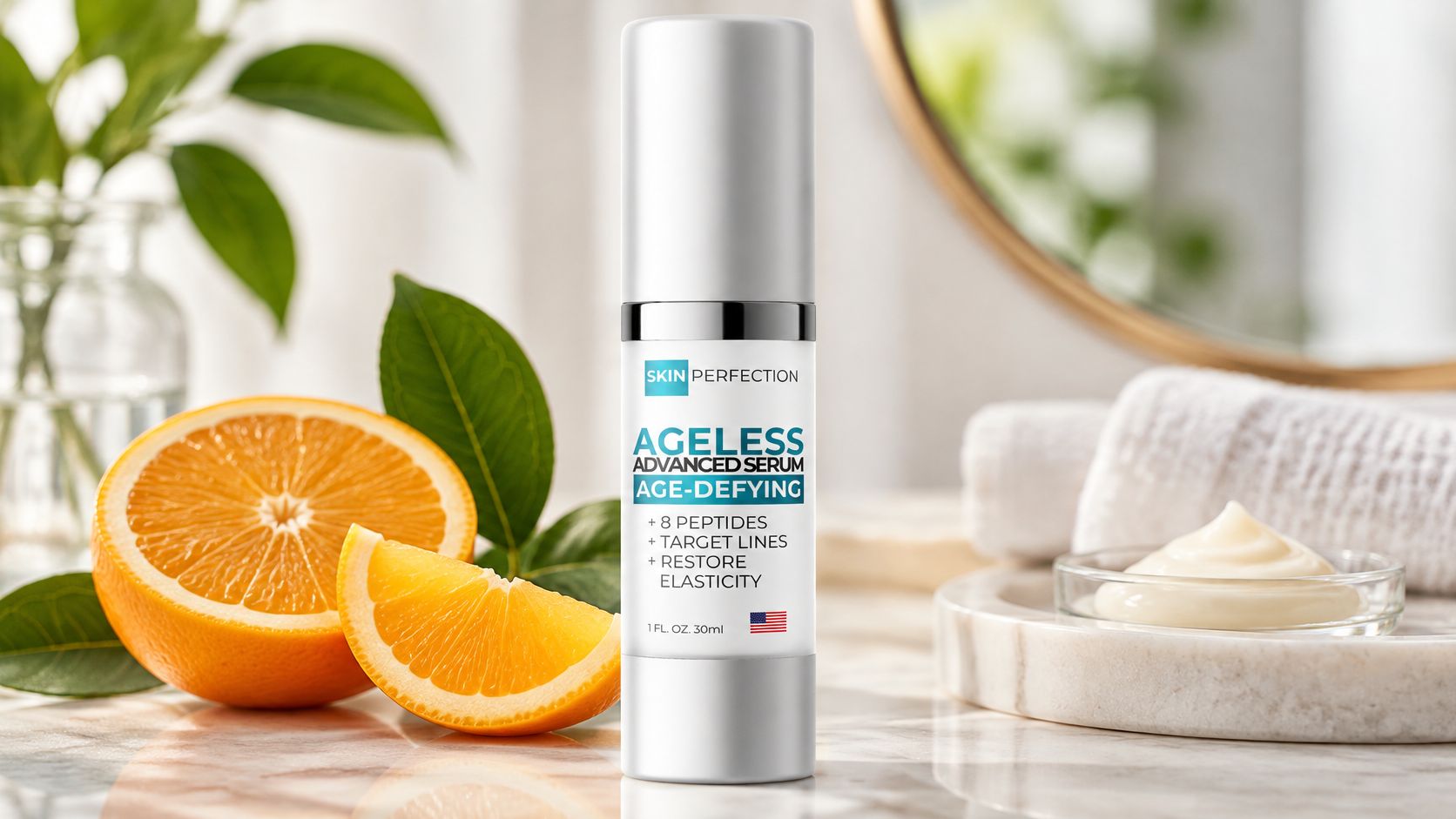
A more stable derivative may suit a daily routine better if a very acidic serum irritates your skin. Check the ingredient list for the specific form: “vitamin C” on the front label does not tell you which one the formula uses.
Concentration and pH Ranges That Matter
Uneven tone can have different causes, so first match the serum to the form you chose for your skin. For L-ascorbic acid, two useful reference points are 10–15% concentration and a water-based formula at below about pH 3.5. At this pH, more of the vitamin C remains in the form that can enter the skin. A formulation review reports clinical evidence across 3.75–20%, with irritation increasing as concentration and acidity rise. A 2024 dermatology guide says concentrations above 8% are generally considered more effective, while those above 20% more often cause burning, stinging, scaling, or itching.
Strength bands, pH and who each suits
| Strength band | Typical pH | Who it suits | What to watch |
|---|---|---|---|
| Under 5% | Near-neutral for derivatives | Sensitive or first-time users | Slower, milder results |
| 5–8% | Under 3.5 for L-ascorbic acid, nearer neutral for derivatives | Users building tolerance | Check the label for pH and form |
| 8–15% | Below pH 3.5 for L-ascorbic acid | Standard tone routines | Stinging in the first weeks |
| 15–20% | Below pH 3.5 | Tolerant skin and experienced users | Irritation and redness risk |
| Above 20% | Strongly acidic | Few users gain extra benefit | Burning, scaling and itching |
Use the table to compare a serum's strength with its form and pH. Derivative percentages are not directly interchangeable with L-ascorbic acid percentages.
Why the bottle matters as much as the percent
Light and repeated exposure to air can reduce a serum's potency after opening. Choose opaque, air-limiting packaging, such as an airless pump, and keep the bottle away from heat and sunlight. For sensitive skin, choose ascorbyl glucoside; for dry or mature skin, tetrahexyldecyl ascorbate is the oil-soluble option listed for those concerns. Both are derivatives, so their effects depend on how the skin converts them, and their clinical evidence for tone differs from that for L-ascorbic acid.
Check for a stated percentage, a stated pH or named vitamin C form, and packaging described as opaque, airless, or a pump.
Start at the low end of the range that fits your chosen form. Apply every other day for two weeks, then increase only if stinging or redness does not appear. Patch test first if your skin is sensitive. The printed percentage is one part of the choice; form, pH, and packaging determine how useful that number is in practice.
Choosing a Serum for Sensitive, Normal or Oily Skin
Match the product to how your skin behaves on a normal week, not to the strongest option in the aisle. Strength logic sits in the bands above. Here the job is form, finish, and what to leave out.
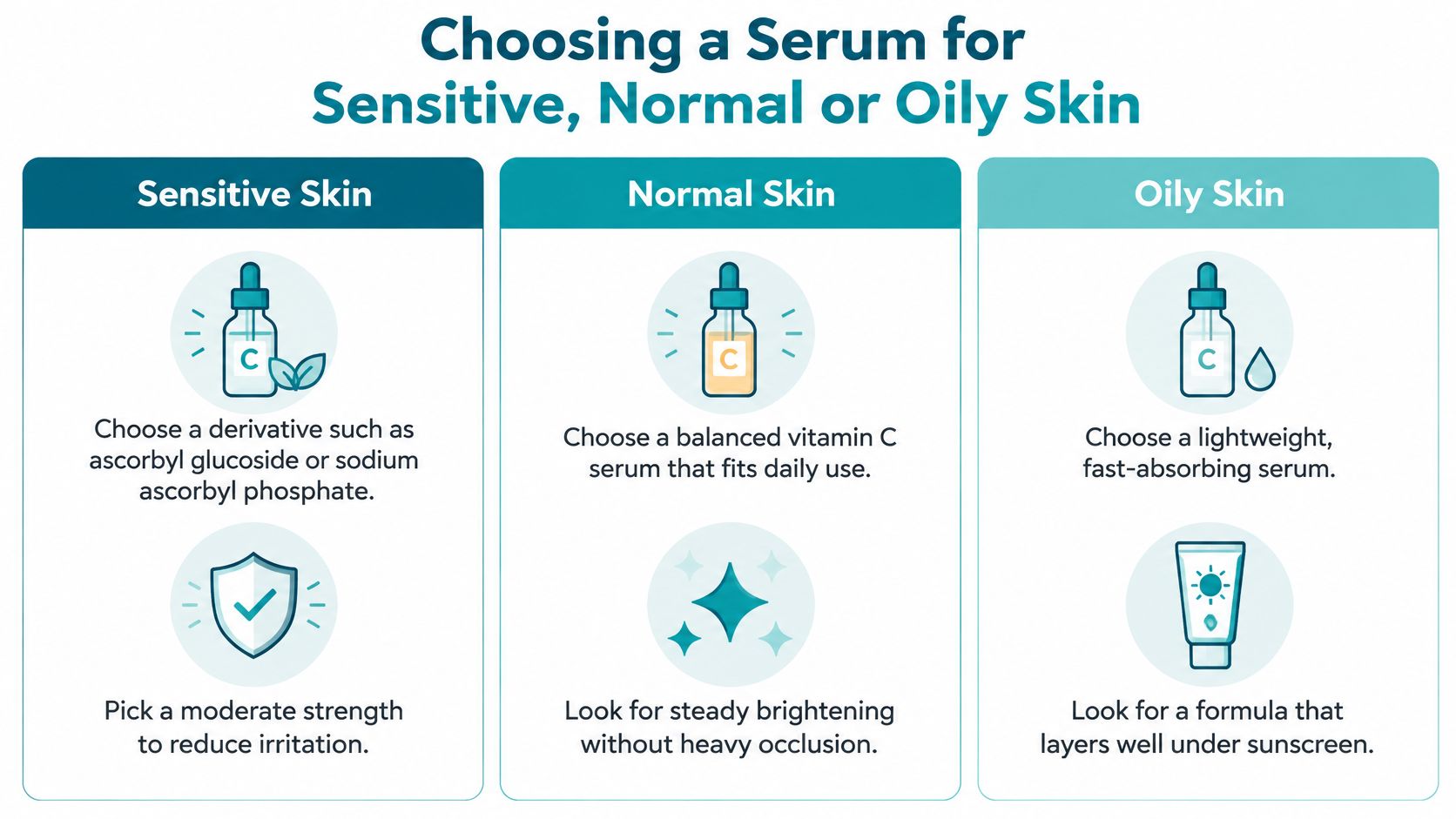
Sensitive skin does better with a derivative such as ascorbyl glucoside or sodium ascorbyl phosphate, at a moderate strength, fragrance-free, with a short ingredient list and an airless pump. Patch test on the inner arm for three to five days before it goes on the face. Skip fragrance, alcohol, and stacked acids. If a skin barrier is already thin from over-exfoliating, a low-pH serum will announce itself as burning, not as brightness.
Normal skin can start with L-ascorbic acid at 10–15% and a stated pH below 3.5, ideally with stabilizers such as ferulic acid or vitamin E, in an opaque bottle. Pass on any serum that's already amber or brown. That color shift means the active has oxidized, so you're paying for a weaker formula and a higher chance of irritation.
Oily or acne-prone skin usually prefers magnesium ascorbyl phosphate at 3–10%, or a lightweight L-ascorbic acid gel. The serum should dry to a light finish so sunscreen doesn't pill. Heavy oils that sit in pores are the mismatch, even when the vitamin C form is a good one.
Serum criteria by skin type
| Skin type | Form to start with | Strength and pH | Packaging and extras | Avoid |
|---|---|---|---|---|
| Sensitive | Ascorbyl glucoside or sodium ascorbyl phosphate | Moderate strength, near-neutral pH | Airless pump, fragrance-free | Fragrance, alcohol and stacked acids |
| Normal | L-ascorbic acid with stabilizers | 10-15%, pH below 3.5 | Opaque bottle with stated pH | Serums already amber or brown |
| Oily or acne-prone | Magnesium ascorbyl phosphate or L-ascorbic acid gel | 3-10% for derivatives, 10-15% for L-ascorbic acid | Lightweight, quick-drying base | Heavy oils that block pores and pill sunscreen |
Buy the texture you'll use every morning. A rich oil-soluble ascorbate can be lovely on dry cheeks and miserable under sunscreen on a shiny T-zone.
Which Actives Share Your Routine
Pairing is a timing problem, not a personality test. Two good actives can still sting when they land on the same night. If both of them sting, separate them by time instead of layering them.
Retinol belongs at night, with vitamin C in the morning. That split avoids most stacked irritation. If your schedule only allows one routine, alternate nights rather than stacking both. Niacinamide is generally compatible: apply the vitamin C first, let it absorb, then follow with niacinamide. Sunscreen is the essential last morning step, because ultraviolet light can darken existing marks and undo weeks of careful use.
Exfoliating acids are the pair many people rush. Glycolic acid or salicylic acid shouldn't share a night with L-ascorbic acid if your skin is sensitive. Leave at least one night between them. Copper peptide is the other split: keep GHK-Cu at the opposite end of the day from an acidic vitamin C, which is why a note on copper peptides with vitamin C is worth reading before you combine droppers.
Pairing vitamin C with other actives
| Partner | Combine in one routine? | Timing | Reason |
|---|---|---|---|
| Retinol | Only with care | Vitamin C in the morning, retinol at night | Avoids stacked irritation |
| Niacinamide | Yes | Vitamin C first, niacinamide after it absorbs | Compatible with patience |
| Sunscreen | Always | Final morning step | UV can reactivate pigment |
| Copper peptide (GHK-Cu) | No, separate | Opposite ends of the day | Avoids overlapping actives |
| Glycolic or salicylic acid | Avoid on the same night | Separate by at least one night | Higher risk of stinging and redness |
Sensitive skin should add one active at a time, over about two weeks, before a second one joins. A mild tingle that fades in a minute can be the low pH. Burning that stays, or new redness the next morning, means you've stacked too much.
Daily Routine and Timing for Each Concern
The same six morning steps work for most patterns. What changes is how often you apply, and how strict you are with sun.
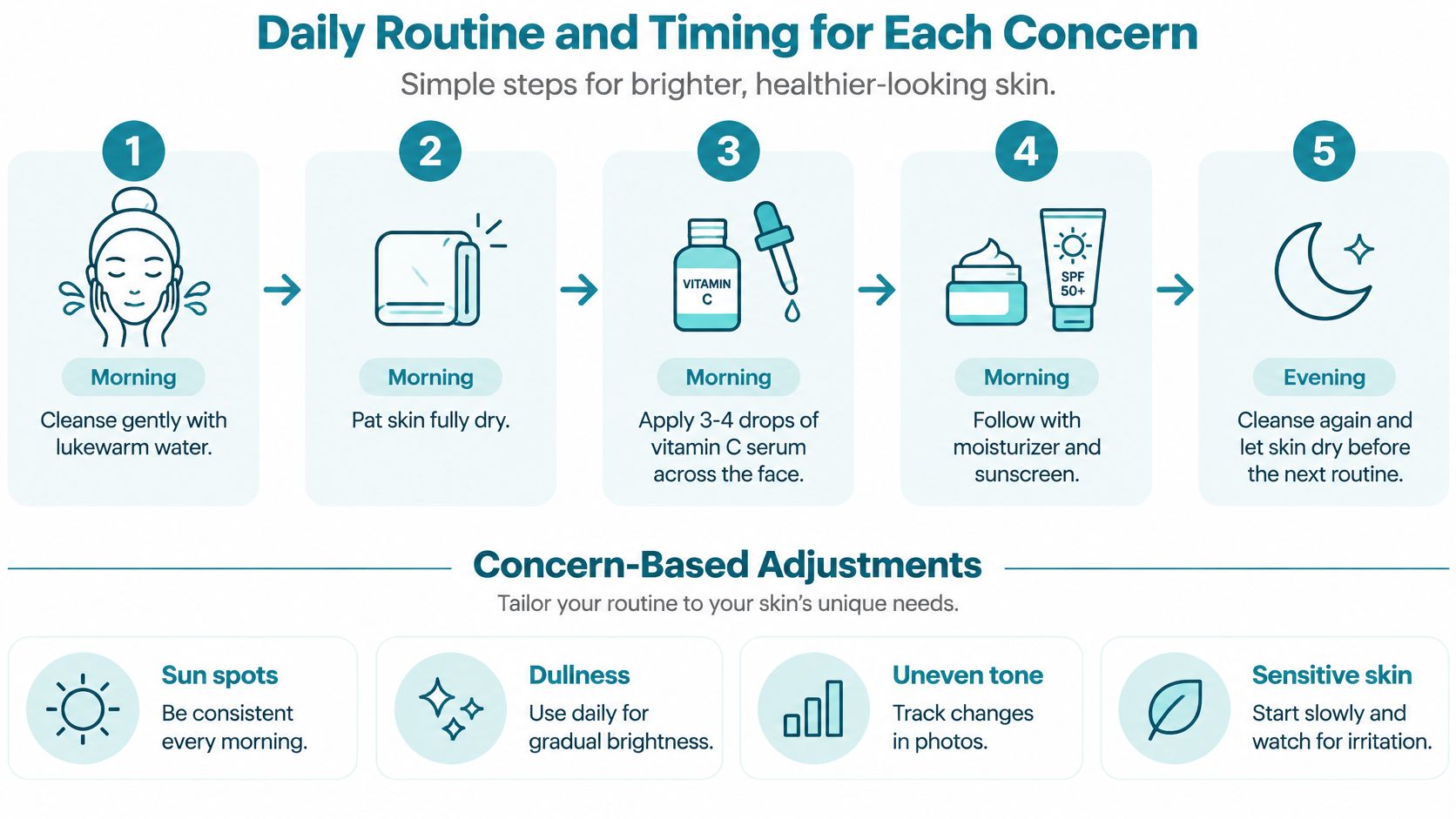
Morning
- Cleanse gently with lukewarm water, so you don't strip the barrier before an acid.
- Pat skin fully dry, because water on the surface can change how an acidic serum feels.
- Apply 3–4 drops of vitamin C serum across the face and avoid the eye area, so the dose stays even.
- Wait one to two minutes, so the next layer doesn't dilute it.
- Apply moisturizer, so the low pH doesn't sit on bare, tight skin all day.
- Finish with broad-spectrum SPF 30 or higher, and reapply every two hours outdoors, because light can darken the marks you're trying to soften.
Evening
- Cleanse, so sunscreen and the day's grime aren't left under the next product.
- Apply retinol on alternate nights if you use it, so it doesn't share a slot with morning vitamin C.
- Apply moisturizer, so overnight dryness doesn't turn into irritation.
If you're unsure of order, a short guide on how to layer skincare serums keeps the drops in a sequence you can repeat.
Sun spots on the cheeks get vitamin C every morning, with the same lighting in a photo at twelve weeks. Melasma-prone skin stays at a moderate strength and leans on strict sunscreen plus a hat, because light and hormones keep feeding the patches. A dark mark after a breakout starts every other day for two weeks, then moves to daily use only if the skin stays calm. General dullness and photoaging pairs morning vitamin C with evening retinol on alternate nights, so texture and tone aren't chased with one product.
Keep the bottle in a cool, dark cupboard, or in the refrigerator if the brand allows it. Close it right away. A missed day is a pause, not a reset. Don't double the drops the next morning to "catch up."
Realistic Timelines and When to Stop
When should you expect a vitamin C serum to make a visible difference? Use weeks 8 to 12 as the first realistic checkpoint for a tonal shift, rather than expecting a change in the first month. Skin changes slowly, so compare photos taken in consistent lighting instead of relying on memory.

Checkpoint schedule
- Week 0: Take baseline photos at the same time of day, in the same window light.
- Week 4: Check your skin's tolerance. If you notice stinging, redness, or peeling, reduce use to every other day.
- Weeks 8 to 12: Look for an early tonal shift in the photos.
- Weeks 12 to 16: Judge progress on most sun spots and general dullness.
- Around six months: Allow a longer window to assess stubborn melasma-pattern patches or deep post-breakout marks.
If photos show no change after the relevant time window, first confirm that you use broad-spectrum sunscreen every morning and that the serum's form and pH suit your skin. If the concern persists, consult a dermatologist rather than changing products every month.
Stop using the serum if burning lasts more than a few minutes, or if you develop scaling, dermatitis, swelling, or spreading patches. Vitamin C is a gradual supporting step; irritation can make skin harder to tolerate and may worsen the appearance of marks. A photo under the same lamp beats a glance in a different bathroom.
Build Your Routine and Test It First
What will help you follow through this week? Choose one vitamin C serum that suits your skin, and decide where it fits into your existing routine. Adding several new products at once makes it harder to tell what your skin is reacting to.
Keep the rest of your routine steady while you introduce the serum. If a spot changes or spreads, or remains despite months of consistent care, consult a dermatologist rather than moving to a stronger formula. For sensitive skin, a derivative may be the gentler fit; tolerant skin may prefer L-ascorbic acid in the 10–15% range.
Skin Perfection offers serums alongside natural and organic skin care products and lotion-making supplies. Explore the available formulas at Skin Perfection to find an option that fits your routine.