

 Buy with Prime



The most common advice about liposomes in skin care is to choose them for deeper penetration. That's too simple. Deeper isn't automatically better, and a liposomal label doesn't tell you where an ingredient goes, how much stays there, or whether you'll notice a difference in your skin's appearance.
A better starting point is the carrier itself: what it's made of, its size, and whether it remains stable in the bottle. Those details help separate a useful formulation choice from a promise the finished product hasn't demonstrated.
Table of Contents
- What Liposomes Are and Why Skincare Uses Them
- Liposome Types and Sizes at a Glance
- How Liposomes Move Actives Through Skin
- What Studies Show for Specific Actives
- Why Stability and Storage Decide Results
- DIY Mixing or a Finished Product
- Read the Label and Patch Test Before You Commit
What Liposomes Are and Why Skincare Uses Them
A liposome is a tiny, hollow sphere made from phospholipids, fat-based molecules that also form biological membranes. Each molecule has a water-loving head and water-avoiding tails. In water, they can arrange into a double-layered wall that closes around a watery center.
Think of a soap bubble with a water-filled interior, although a liposome's wall has a different molecular structure. A water-soluble ingredient can sit inside the bubble; an ingredient with an affinity for fats can associate with its wall. This gives formulators different places to package ingredients within the same carrier.

Why the bubble is useful
Say a formulator is developing a serum containing an oxidation-sensitive antioxidant. Rather than leaving all of that ingredient freely dispersed in the base, the formulator might investigate encapsulation to protect it and manage its release. Peptides such as Matrixyl 3000 or Argireline, along with botanical extracts, are other ingredients a formulator might consider for a compatible carrier.
The skin's outermost layer, the stratum corneum, contains cells surrounded by organized lipids. A lipid-based carrier offers a way to interact with that environment, rather than acting as a container sitting above it.
This isn't a newly invented cosmetic idea. A review of topical liposomal formulations traces liposomes to Alec Bangham and colleagues in 1965 and identifies 1980 as the year they were first proposed specifically for topical delivery.
The useful distinction: Liposome describes a carrier category, not a standardized performance guarantee.
Two serums can contain the same named active and still behave differently. The carrier's structure, the finished cream or serum, and the way both hold up during storage determine whether the original formulation idea remains useful by the time you apply it.
Liposome Types and Sizes at a Glance
| Type | Size range | Structure | What it means for skin |
|---|---|---|---|
| Small unilamellar vesicles (SUV) | 20-100 nm | One bilayer wall | Closer access to superficial skin; more prone to aggregation and leakage |
| Large unilamellar vesicles (LUV) | 100-500 nm | One bilayer wall | Overlaps the range commonly preferred for dermal delivery; many effective systems at 100-300 nm |
| Multilamellar vesicles (MLV) | 500-1,000 nm | Several concentric bilayers | Larger, layered carriers; weaker fit when the goal is delivery into the skin |
These size classifications come from a review of liposomal formulation characteristics, which describes approximately 50-500 nm as a commonly preferred range for dermal delivery, with many effective experimental systems around 100-300 nm. The categories are useful orientation, not a ranking of finished skincare products.
Unilamellar means the vesicle has a single bilayer wall around its core. Multilamellar means it has several concentric walls, rather like the layers of an onion. Neither term tells you the active concentration or establishes that a formula is suitable for your skin.
How to interpret the trade-offs
Small unilamellar vesicles offer access to superficial skin structures, but making a vesicle smaller can introduce practical problems. Particles may cluster together, membranes may fuse, or the ingredient may escape before application. A small starting size is useful only if the formulation maintains it.
Large unilamellar vesicles occupy a middle ground that formulators often investigate for topical delivery. They aren't automatically stable, but they illustrate why choosing the smallest available particle isn't a sensible buying rule. Lipid selection and manufacturing conditions still matter.
Multilamellar vesicles have more layers and a larger overall structure. That makes them a less obvious choice when access into skin is the priority, although their architecture may still serve other formulation goals. Extra layers shouldn't be mistaken for extra penetration.
Look beyond the average
An average diameter can hide a broad mixture of small and large particles. Polydispersity describes that spread, so a stated size range and distribution are more informative than an isolated average.
Don't confuse carrier diameter with the molecular weight of the ingredient inside it. Our guide to low-molecular-weight hyaluronic acid addresses a different size question: the ingredient molecule itself. For liposomes, you're evaluating the surrounding delivery structure.
How Liposomes Move Actives Through Skin
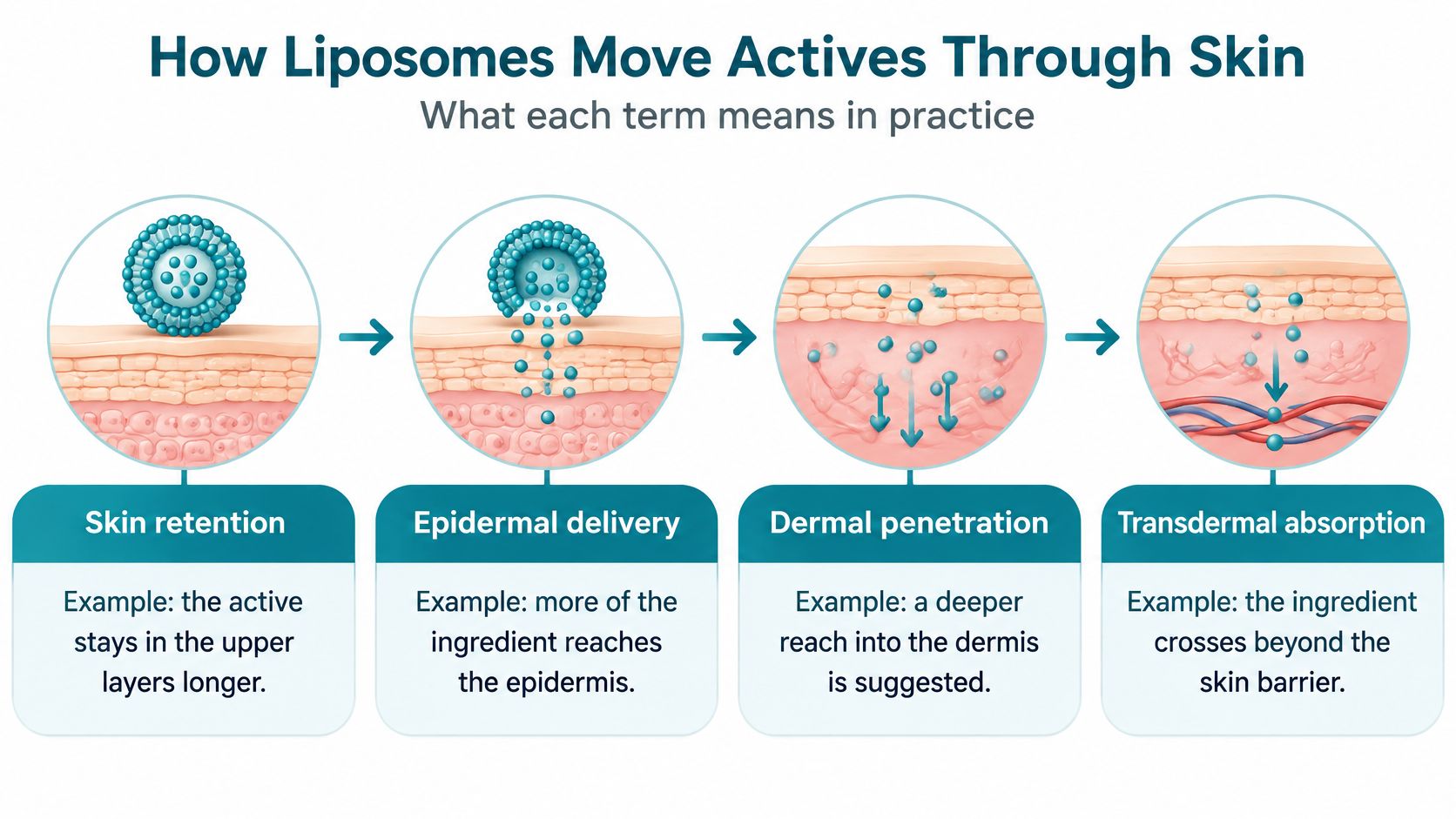
Before interpreting a penetration claim, separate the destinations. These terms aren't interchangeable, and none independently proves a visible cosmetic benefit.
- Skin retention means the ingredient remains within skin rather than being removed or passing onward. A peptide held in the outer layers is a simple example.
- Epidermal delivery means the ingredient reaches the epidermis. Useful testing should specify whether that means the stratum corneum or the living epidermis beneath it.
- Dermal penetration means the ingredient reaches the dermis, below the epidermis. That requires more specific evidence than a general statement about absorption.
- Transdermal absorption means passage through the skin toward systemic availability. It isn't another name for a serum sinking in.
The carrier and its cargo can behave differently
A technical review of topical liposome delivery explains that conventional, rigid liposomes generally accumulate in the stratum corneum, while intact liposomes don't cross skin to a significant extent and systemic availability is generally negligible. Deformable systems can behave differently, but their performance remains formulation-specific.
A carrier doesn't have to travel intact to help an ingredient interact with skin. Liposomes can associate with surface lipids, influence ingredient distribution, and moderate release. Measuring an active deeper in a skin sample therefore doesn't necessarily mean an intact bubble carried it all the way there.
What size experiments actually tell us
In laboratory comparisons summarized in a review of liposomal skin penetration, 80-nanometer vesicles reached approximately 588 micrometers after 24 hours, compared with about 504 micrometers for 500-nanometer vesicles; another experiment found strong stratum-corneum accumulation with 120-nanometer vesicles, with deeper-compartment accumulation falling as sizes increased to 191, 377, and 810 nanometers.
These are measurements from particular experimental systems. They don't establish how far an unrelated face cream will deliver an ingredient on a person's skin, and the measured depths shouldn't be treated as universal maps of human skin layers.
Ask what was measured: the active ingredient, the carrier, or a marker used to track the formulation.
Encapsulation is especially worth investigating for unstable, poorly soluble, or potentially irritating ingredients, including some vitamins, antioxidants, peptides, and plant compounds. Protecting an ingredient or moderating its release may be the useful outcome, even when deeper delivery isn't the objective.
What Studies Show for Specific Actives
| Active or form | Reported finding | Takeaway |
|---|---|---|
| Liposomal vitamin D3 vs vitamin D3 in solution | 1.65 times higher skin retention | Retention gain, not proof of deeper penetration |
| Vitamin E in macroemulsion, liposomes, and liposomes within a macroemulsion | Delivery increased in that order | Liposome-based forms ranked above macroemulsion alone |
| Niacinamide across liposome types | No significant permeation difference | Encapsulation type mattered little in this comparison |
| Retinol in deformable liposomes | Significantly improved permeation | Carrier design mattered for this active |
| Encapsulated drugs in animal studies | 40-60% higher dermal concentration than non-liposomal controls | Animal data, not a human cosmetic outcome |
A review of anti-aging delivery studies reports the findings above, including 1.65-times higher vitamin D3 skin retention and 40-60% higher dermal drug concentrations in animal studies; it also summarizes approximately 3-5-times greater penetration than conventional creams or gels and about a two-fold increase in epidermal retention in comparative delivery work.
Those figures describe specific tested systems, not expected improvements from any product labeled liposomal. The animal findings concern encapsulated drugs in non-human models. They can help researchers investigate delivery mechanisms, but they don't predict a cosmetic result on your face.
Read the comparison before the headline
The vitamin E finding is particularly useful because it shows that the surrounding formulation matters. Putting liposomes within a macroemulsion produced a different delivery result from liposomes alone. The carrier and the base need to work together.
The niacinamide result provides an equally important counterexample: changing liposome type didn't significantly change permeation in that comparison. The retinol result, meanwhile, involved deformable liposomes, not every possible retinol carrier.
For peptide formulas, apply the same discipline. Our guide to skin biology and copper peptides offers ingredient context, but understanding a peptide doesn't establish how a particular liposomal formula will deliver it.
Laboratory evidence isn't a human outcome
A 2024 Journal of Cosmetic Dermatology article tested liposome-assisted collagen delivery in a 3D skin model and reported anti-aging and penetration outcomes. That's a laboratory mechanism signal, not a clinical trial demonstrating visible results on people.
Before accepting a performance claim, look for:
- Active-specific testing, such as Franz diffusion-cell testing or an equivalent method that distinguishes retention from passage through the sample.
- Human outcome data for the finished formula, using an appearance-related endpoint relevant to the claim.
Tolerance deserves its own attention, including when skincare extends to the scalp. Inner You's guide on when to skip a scalp massage is a complementary resource for considering whether a hands-on routine is appropriate, rather than assuming more application or manipulation is always helpful.
Why Stability and Storage Decide Results
A liposome can lose useful properties after manufacturing. Heat and light can contribute to premature release or degradation, while unsuitable pH, incompatible ingredients, air exposure, and repeated freezing and thawing can undermine the formulation.
A review of anti-aging delivery systems and safety limitations identifies temperature and light as stability concerns and notes gaps in long-term safety testing. It also highlights unresolved concerns associated with some positively charged, or cationic, liposomes. A carrier's resemblance to a biological membrane doesn't settle either its shelf life or its tolerance profile.
What a maker needs to measure
Particle size and polydispersity help establish whether the vesicle population changes during storage. A formula that begins with a narrow distribution but later develops larger clusters needs investigation, even if it still looks smooth.
Zeta potential describes an electrical characteristic related to how particles interact and repel one another. Encapsulation efficiency measures how much of the active is associated with the carrier rather than remaining free in the surrounding liquid. Neither measurement should be treated as a stand-alone certificate of stability.
Preservation is a separate requirement. Liposomes don't make a water-based serum self-preserving, and refrigeration doesn't replace an appropriate preservative system. Our guide to natural cosmetic preservatives is a useful starting point for understanding that distinction.
A practical storage routine
- Refrigerate when the ingredient or product requires it. Controlled cool storage can limit temperature stress, but don't assume every finished formula belongs in the refrigerator.
- Choose opaque or suitable light-protective packaging. Blue glass can reduce some exposure, but keep the bottle away from direct light rather than relying on its color alone.
- Add heat-sensitive carriers at room temperature after the hot phase. This avoids exposing them to unnecessary processing heat.
- Stir gently until uniform. Avoid whipping in air, which complicates filling and increases exposure to oxygen.
- Label the batch with its preparation date. A written record helps you track changes, although it doesn't establish an expiry date.
- Avoid repeated freeze-thaw cycles and watch for changes. Separation, unusual odor, or color changes are reasons to stop using the blend, not reasons to stir it back together.
Storage rule: A normal-looking serum isn't proof that its liposomes, active ingredient, or preservation system remain intact.
Ask for compatibility information covering pH, preservatives, and the intended base. A stable, moderately sized vesicle population is more useful than a very small one that grows, fuses, or releases its cargo during storage.
DIY Mixing or a Finished Product
| Factor | Home blend | Finished product |
|---|---|---|
| Particle size control | Needs your own measurement or supplier data | Known only when the maker publishes measurements |
| Stability testing | Your responsibility; no established shelf data without testing | Ask for documentation; unverified if not provided |
| Usage rate | Supplier-specified inclusion in a water-based serum or lotion | Set by the manufacturer's formula |
| Heat and light exposure | Room-temperature addition and supplier-directed storage | Follow the product's storage instructions |
| Preservation and pH | You must establish compatibility with the complete formula | Look for confirmation of finished-formula testing |
| Human tolerance data | Patch testing doesn't replace formal assessment | Unknown unless relevant human data are supplied |
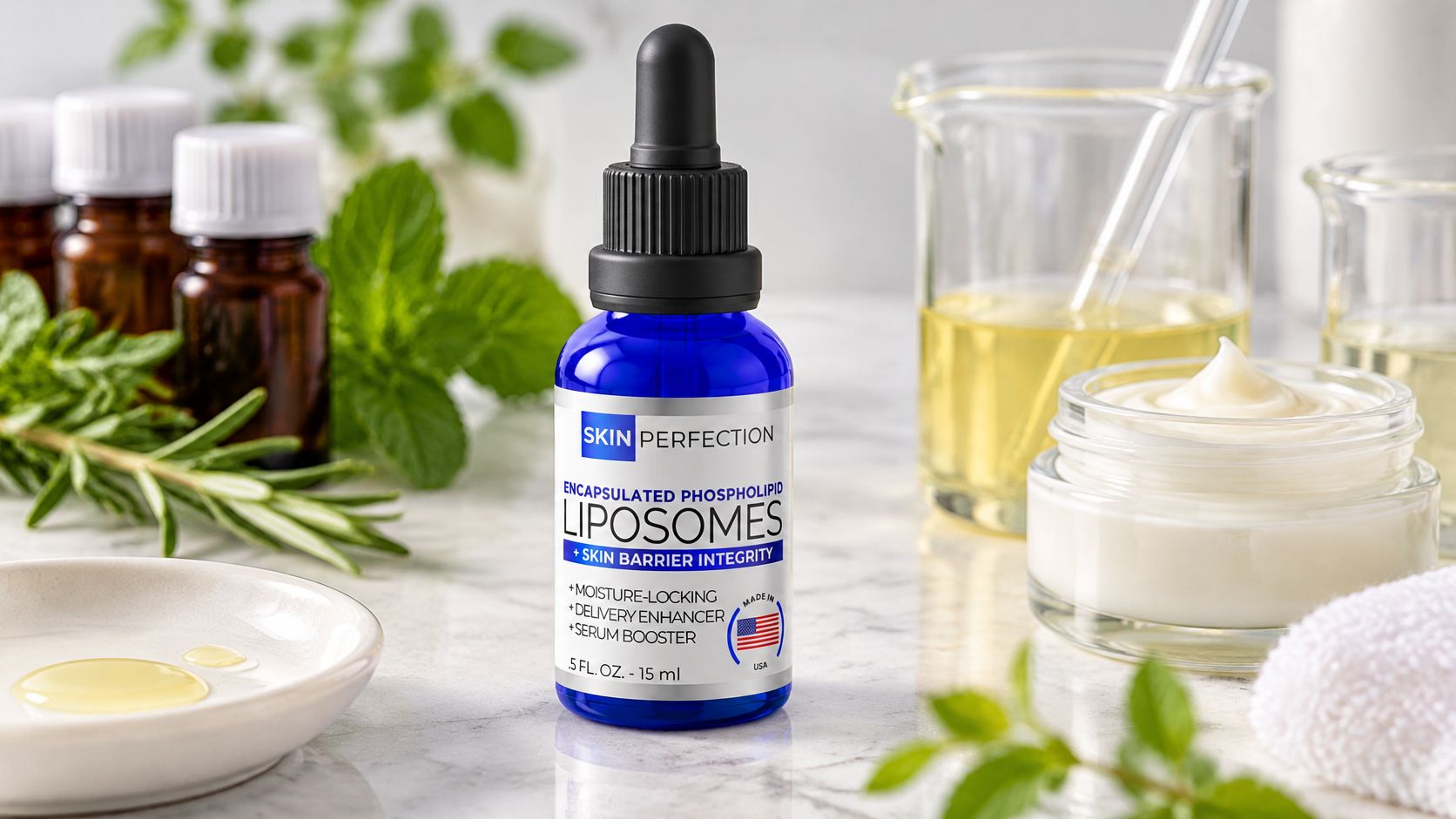
For a concrete ingredient example, Phospholipid Liposomes has a recommended 1-10% inclusion rate for DIY serums and creams. That range is an ingredient-specific direction, not a universal rate for every liposomal material.
What a home blend asks of you
At the lower end of a supplier's permitted range, you're adding less of the carrier ingredient; at the upper end, you're changing more of the base formula. Neither end tells you how much active becomes encapsulated. More carrier doesn't automatically mean more useful delivery.
Choose a compatible water-based serum or lotion, weigh ingredients rather than estimating by eye, and add heat-sensitive materials at room temperature after any heated processing. Keep a batch record that identifies the base, ingredient lot, amount added, and storage conditions.
Adding a carrier to an existing serum isn't the same as manufacturing a validated encapsulated active. Don't assume that stirring automatically loads a peptide into preformed vesicles. The preparation method and ingredient compatibility determine what happens.
Our cosmetic formulation guide can help organize the development process. The practical burden remains with the maker: a modified base needs its own evaluation rather than borrowing the original product's shelf-life assumptions.
When a finished formula makes more sense
A finished product removes the need to perform the mixing yourself. It doesn't automatically provide public proof of vesicle size, stability, or tolerance, so distinguish a convenient format from a documented formulation.
Before choosing either route, ask the supplier:
- What size range is present, and was it measured in the ingredient concentrate or the finished formula?
- What lipid type is used, including relevant information about charge and compatibility?
- What stability data exist for the intended storage conditions and formulation?
For readers who aren't equipped to measure particle behavior or assess preservation, a finished product with clear documentation is the more sensible choice. DIY offers customization, but it also transfers responsibility for the altered formula to you.
Read the Label and Patch Test Before You Commit
A useful label connects the named ingredient to clear directions and realistic appearance benefits. It shouldn't require you to infer performance from scientific-sounding language.
Your label checklist
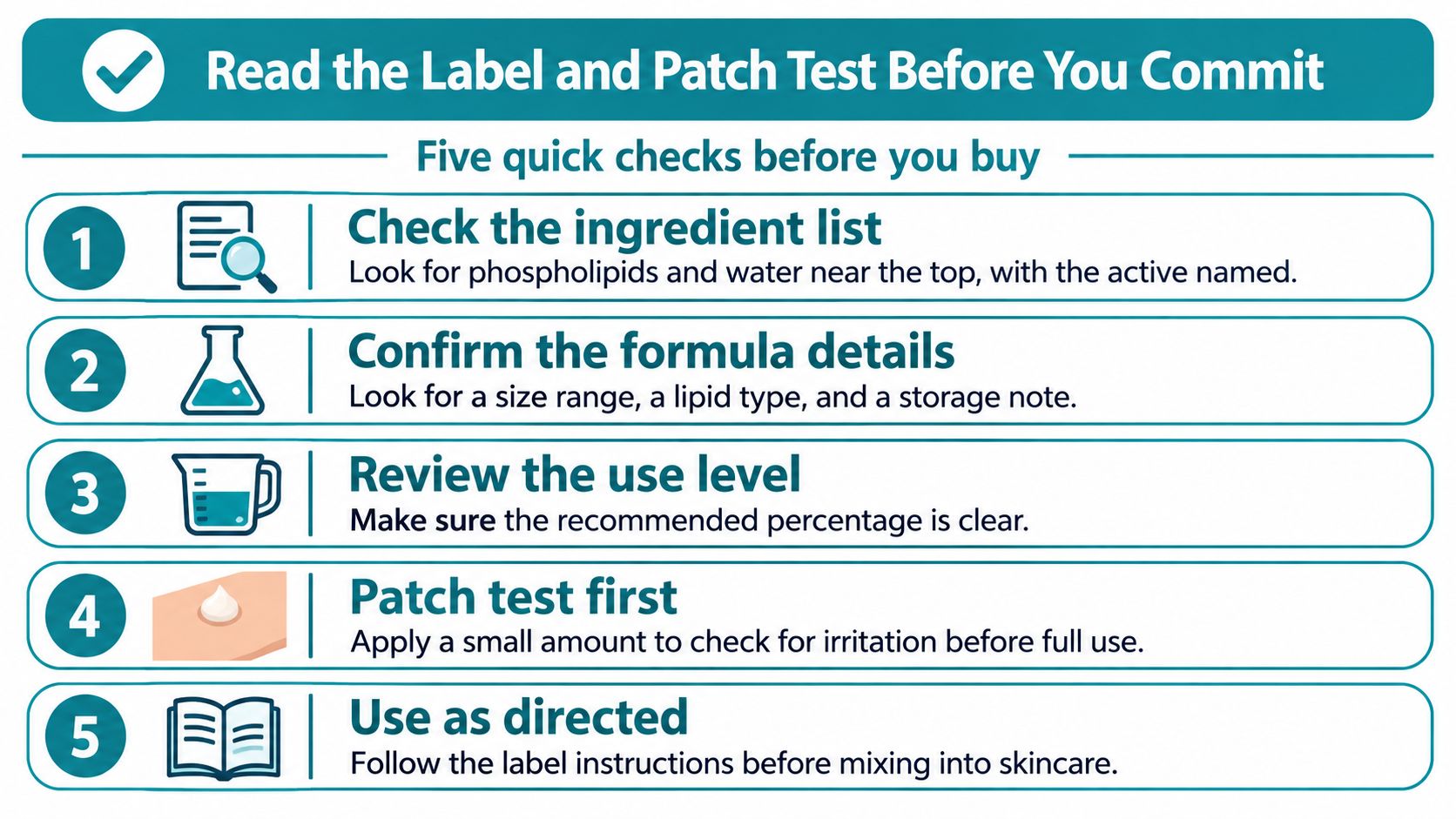
- Identify the ingredients. Look for phospholipids and the named active; water often appears prominently in aqueous formulas, but ingredient order alone doesn't prove encapsulation. Our guide to reading a skincare ingredient label explains how to approach an INCI list.
- Confirm the formula details. Look for the lipid type, carrier size information, recommended use level, and storage directions on the label or supporting technical sheet.
- Read claims carefully. Prefer clear descriptions of moisturized skin, softness, or fine lines looking less noticeable rather than promises to change skin structure.
- Patch test before wider use. Apply a small amount to an area of the inner arm or jaw over several days, stop if irritation develops, and avoid applying new blends to broken or irritated skin.
- Consider carrier charge and tolerance. Neutral or naturally derived phospholipids can be a starting preference, but neither is a safety guarantee; approach cationic systems cautiously when tolerance documentation is limited.
The FDA's cosmetic labeling claims guidance explains that ordinary cosmetics and their claims generally don't receive premarket approval, apart from the principal exception of color additives. We follow FDA rules and Etsy's claims restrictions, keeping our cosmetic descriptions focused on appearance rather than therapeutic promises.
For another perspective on evaluating ingredient disclosure, the GLAZE - House of Wellness skincare guide is a complementary reading resource. Natural and liposomal aren't synonyms for irritation-free.
Keep the routine manageable
Our routine advice is to keep a gentle cleanser, a moisturizer, and daily sunscreen, then add one targeted serum or eye cream for the main concern, used morning and night when its directions allow. Don't increase frequency just because a formula uses liposomes.
Our skincare is for appearance and isn't a substitute for medical care. See a dermatologist for persistent or worsening concerns. Choose documented finished-formula stability when convenience matters most, or accept the testing responsibilities of DIY, and patch test either way.
Skin Perfection offers skincare products and lotion-making supplies for readers who prefer a ready-made routine or want to formulate their own. Visit Skin Perfection to explore those options, then check the ingredient's use level, compatibility, and storage directions before choosing your next serum or blend.