

 Buy with Prime



The most popular advice says the best peptide serum for wrinkles is the bottle with the longest peptide list. That advice fails a basic test. A label can name eight peptides and still have no human trial on the finished formula, no stated amount, and almost no peptide that stays on skin.
Judge a serum by two things only. First, published human results for the exact peptide, in a stated amount, over a stated number of weeks. Second, whether the bottle can deliver that peptide in daily use. A blend is not automatically stronger than one well-tested peptide in a stable base.
The rows below are benchmarks for tested formulas, not a ranking of brands. Two cells stay open on purpose. The triple-peptide percentage is unverified, and Syn-Ake has no human wrinkle figure in the material reviewed here.
Table of Contents
- Best Peptide Serums for Wrinkles at a Glance
- What Clinical Trials Show About Topical Serums
- How Peptides Signal Your Skin to Smooth Lines
- Five Criteria That Separate Strong Serums From Weak Ones
- Matching Peptides to Where Your Wrinkles Are
- How to Apply a Peptide Serum Step by Step
- Choose a Serum and Commit to a 12-Week Trial
Best Peptide Serums for Wrinkles at a Glance
These studies are useful benchmarks, not a leaderboard. The peptide, formula, application area and measurement all matter: a result from an eye cream cannot automatically predict what a different face serum will do.
| Peptide | Reported result | Study context | Best-fit concern |
|---|---|---|---|
| Palmitoyl pentapeptide-4 (Matrixyl) | Fine-line and wrinkle improvement versus placebo | 12-week split-face trial, 93 women aged 35–55, 3 ppm in a full moisturizer. Study details | Fine lines and general wrinkles |
| Acetyl hexapeptide-8 (Argireline) | A review reports reduced wrinkle depth after 30 days in a 10% cream. A separate penetration study found that 0.22% reached the stratum corneum. Review and study context | In-vivo study summarized in a review; penetration result measured separately | Expression lines |
| Leuphasyl and Argireline combination | 24.62% mean wrinkle reduction. Study details | 43 healthy women aged 39–64, eye-area creams twice daily for 28 days | Crow's feet |
| Triple-peptide complex at 3% | Reported reductions in wrinkle number and total wrinkle surface after one month; the precise result is not established here | One month of use; study population not specified | Photoaged facial skin |
| Copper peptide GHK-Cu at 0.05% | A report describes increased firmness and fewer fine lines, but the cited market-news article does not substantiate those clinical figures | The stated study details cannot be checked against the linked source | Firmness and fine lines |
| Syn-Ake | No human wrinkle result is established in the information cited here | Human wrinkle-trial size and duration are not established | Expression lines |
Read each row as a result for a specific test, not a promise attached to an ingredient name. The Matrixyl trial, for example, tested a moisturizer over 12 weeks. It does not show that every product containing Matrixyl will produce the same outcome.
The studies also measure different things. Wrinkle depth, wrinkle count, surface area and firmness are not interchangeable endpoints, just as a ruler and a scale do not measure the same property. For a product comparison, look for human evidence on the exact peptide and finished formula, plus enough information to judge how the product is meant to deliver it.
Practical rule: Start with the wrinkle area you want to address, then compare the evidence and formula. Crow's feet, forehead lines and general fine lines are distinct concerns, and a result for one should not be treated as proof for another.
What Clinical Trials Show About Topical Serums
A long peptide list does not show whether a serum reduces the look of wrinkles. The main challenge is matching the evidence to the product: studies of oral collagen cannot establish how a leave-on serum performs.
A 2026 systematic review and meta-analysis included 19 randomized controlled trials with 1,341 participants and an average age of 50.2 years. Only 2 studies tested topical peptide formulations, covering 105 participants; the other 17 studied oral collagen peptides in 1,236 participants. Across this combined evidence, peptide interventions showed a statistically significant wrinkle change, with a pooled mean difference of 0.27 (95% confidence interval 0.01 to 0.52, p = 0.04). The review also reported improvements in hydration (p < 0.01) and elasticity (p < 0.05), while noting that evidence for topical products was limited.
What those numbers do and don't cover
Oral collagen is swallowed; a serum is applied to facial skin. Those routes are not interchangeable, so the pooled result cannot be read as proof that a topical serum produces the same effect. Because just two studies in the review tested topical peptides, the overall average mostly reflects oral supplements.
The topical studies described in the review focused on appearance measures such as fine lines and the eye area. Hydration and surface smoothness are different outcomes from changes in deeper folds, so a result in one measure does not establish a result in the other. For a broader guide to what peptide serums are studied for, focus on the specific peptide, the finished formula, and the outcome researchers measured.
How Peptides Signal Your Skin to Smooth Lines
A wrinkle's appearance reflects both the skin's support structure and repeated facial movement. Collagen and elastin help support the skin, while repeated folding can leave a visible crease. The folded-map analogy helps explain why a line may remain visible after the expression relaxes.
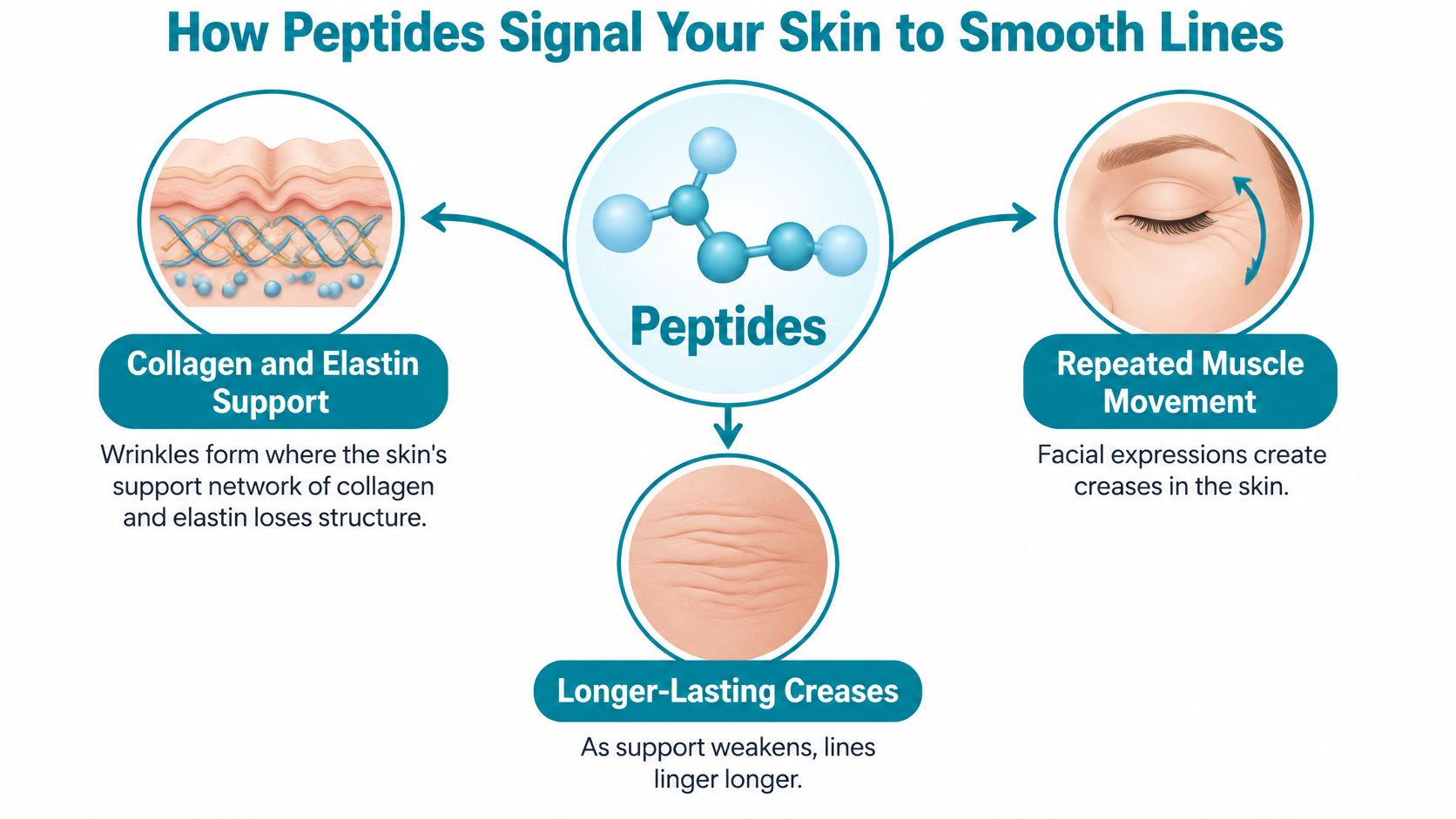
Peptides are short chains of amino acids. In skincare, different peptide families are used to target different aspects of how lines appear. Their proposed roles are useful for understanding a label, but the finished formula and human testing matter more than the ingredient list alone.
Signal peptides are described in cosmetic skincare as messages associated with fibroblasts, the cells involved in producing skin matrix material. Their intended cosmetic role is to support the appearance of skin structure, with results judged by visible changes such as fine-line appearance.
Expression-line peptides, including acetyl hexapeptide-8, are used in products targeting lines associated with repeated facial expressions. Their proposed cosmetic role is to soften the appearance of these lines. A serum's results should be judged by human testing of the finished formula, rather than by a mechanism suggested by the ingredient name.
Matrikines, such as palmitoyl pentapeptide-4 (pal-KTTKS, often sold as Matrixyl), are designed to resemble fragments associated with the skin matrix. This offers a way to understand the ingredient's intended role; it does not establish that every product containing it will produce the same result.
The human result that carries the most weight
In a 12-week, double-blind, placebo-controlled, split-face study, 93 women aged 35 to 55 used an otherwise identical moisturizer with 3 ppm pal-KTTKS on one side and the control on the other. Quantitative image analysis and expert grading found significant improvements in fine lines and wrinkles versus placebo, and the treatment was well tolerated.
The study tested a complete moisturizer, not an isolated serum. Its result applies to that tested formula; it does not show that every serum listing pal-KTTKS will perform the same way. The useful label-reading lesson is to look for the named peptide and evidence on the finished product, rather than assuming that a higher listed amount guarantees better delivery or results.
Five Criteria That Separate Strong Serums From Weak Ones
Judge a serum by the evidence for its peptide and finished formula, then check whether its packaging and formula make sense for daily use. These five criteria help separate a testable product from a label that offers too little information.
| Criterion | Good sign | Red flag |
|---|---|---|
| Named peptide | Full INCI name, with percentage or ppm | Only a trade name or the words "peptide complex" |
| Concentration | Amount stated for each peptide, with units | "Contains peptides" with no amount given |
| Finished-product testing | Human trial of the same formula against a vehicle or placebo | Only ingredient-level or in-vitro data |
| Packaging | Airless pump or opaque sealed tube | Clear open jar exposed to air and light |
| Formula profile | Fragrance-free, pH stated, patch-test guidance provided | Strong fragrance, essential oils, no pH information |
Why a big percentage can still miss the skin
The earlier Argireline figures illustrate why results need context: a cream's reported wrinkle improvement does not establish how much peptide reached the skin or whether another formula would perform the same way. In a penetration study, only 0.22% of the applied peptide entered the stratum corneum, about 99.7% was removed from the skin, and none was detected in the receptor solution. That means no measurable passage across the tested skin model.
Delivery can vary with molecular size, charge, vehicle, exposure time, cleansing, and barrier condition. A stated concentration helps you assess a label, but it cannot show how much peptide reaches its intended site.
How to score the bottle in front of you
- Name. A full peptide name lets you compare the ingredient with relevant research. A trademark or “peptide complex” alone may not.
- Amount. Look for ppm or a percentage for each peptide. If the concentration is hidden, you cannot judge how the formula compares with a tested one.
- Test. Ingredient lab data is not the same as a human trial of the finished formula. Some topical studies report improved fine lines, while results across studies remain inconsistent.
- Pack. An airless pump or opaque tube limits the formula's exposure to air and light. A clear jar offers less protection.
- Comfort. Fragrance-free formulas, a stated pH, and patch-test guidance can help you assess whether a product suits your skin. From a practical standpoint, fragrance and a strong acid formula may be less comfortable for sensitive skin.
Treat a hidden concentration or dish-only test as limited evidence. More peptide names do not make up for gaps in testing or delivery.
Matching Peptides to Where Your Wrinkles Are
A peptide's name can suggest where to use it, but the evidence may cover a narrower area. A study of an eye cream, for example, does not establish that the same peptide blend works on the forehead or neck.
| Wrinkle location | Peptides to look for | Evidence window |
|---|---|---|
| Crow's feet | Argireline, Snap-8, and eye peptides | 28 days, 43 women, eye-area creams |
| Forehead and between brows | Argireline, Snap-8, Syn-Ake, and Inyline | Argireline has a 30-day, 10% cream report; this review found no human wrinkle figures for Snap-8, Syn-Ake, or Inyline |
| Jowls and neck | Relistase, Progeline, and Pepha Tight | This review found no human wrinkle figures for these three |
| Overall fine lines | Palmitoyl pentapeptide-4 (Matrixyl) | 12 weeks, 93 women, split-face |
Crow's feet versus forehead lines
For crow's feet, look for Argireline, Snap-8, and eye peptides. The closest human evidence window in the table is a combination cream used around the eyes. An eye cream's lighter texture can make it easier to apply to this delicate area; check the label for fragrance-free status if that matters to you.
Forehead lines and the lines between the brows call for a different ingredient shortlist: Argireline, Snap-8, Syn-Ake, and Inyline. The review cited a human wrinkle figure for Argireline, but not for the other three in those zones. A peptide's presence on the label identifies what is in the formula, not whether that formula has been tested on the specific lines you want to address.
Neck, jowls, and blends
For sagging neck and jowls, check for Relistase, Progeline, and Pepha Tight. The review found no human wrinkle figures for these ingredients, so treat them as options to investigate rather than proven matches.
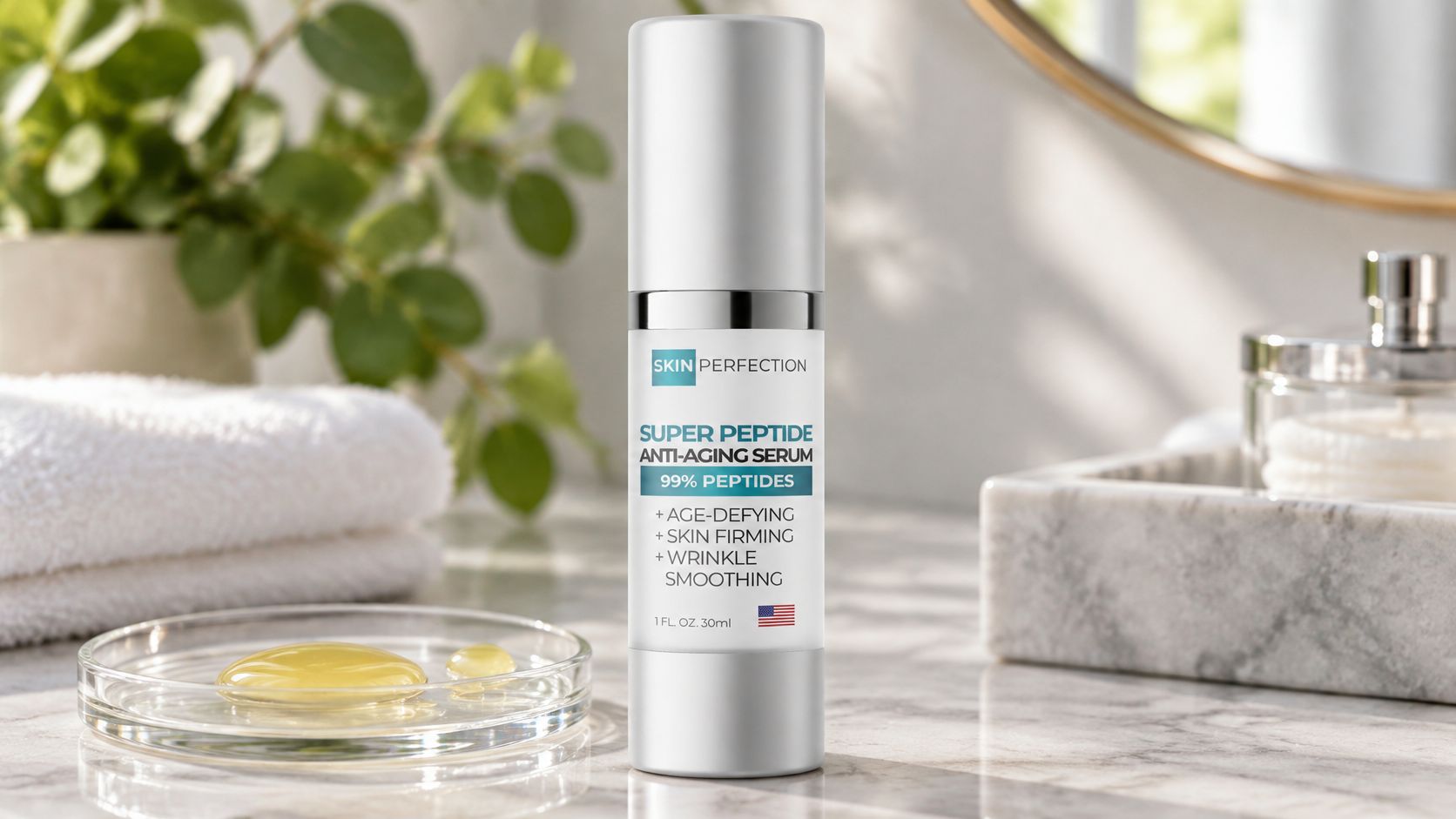
Overall fine lines have a human-study benchmark: a 12-week split-face trial of a moisturizer containing palmitoyl pentapeptide-4. A blend is like a recipe: knowing its ingredients does not show which one produced a result, or whether a different finished formula will perform similarly. Skin Perfection's Super Peptide Anti-Aging Serum is one product example, but the palmitoyl pentapeptide-4 trial does not establish its effects. For a closer look at the different peptide names, see this guide to Matrixyl 3000 and Argireline.
How to Apply a Peptide Serum Step by Step
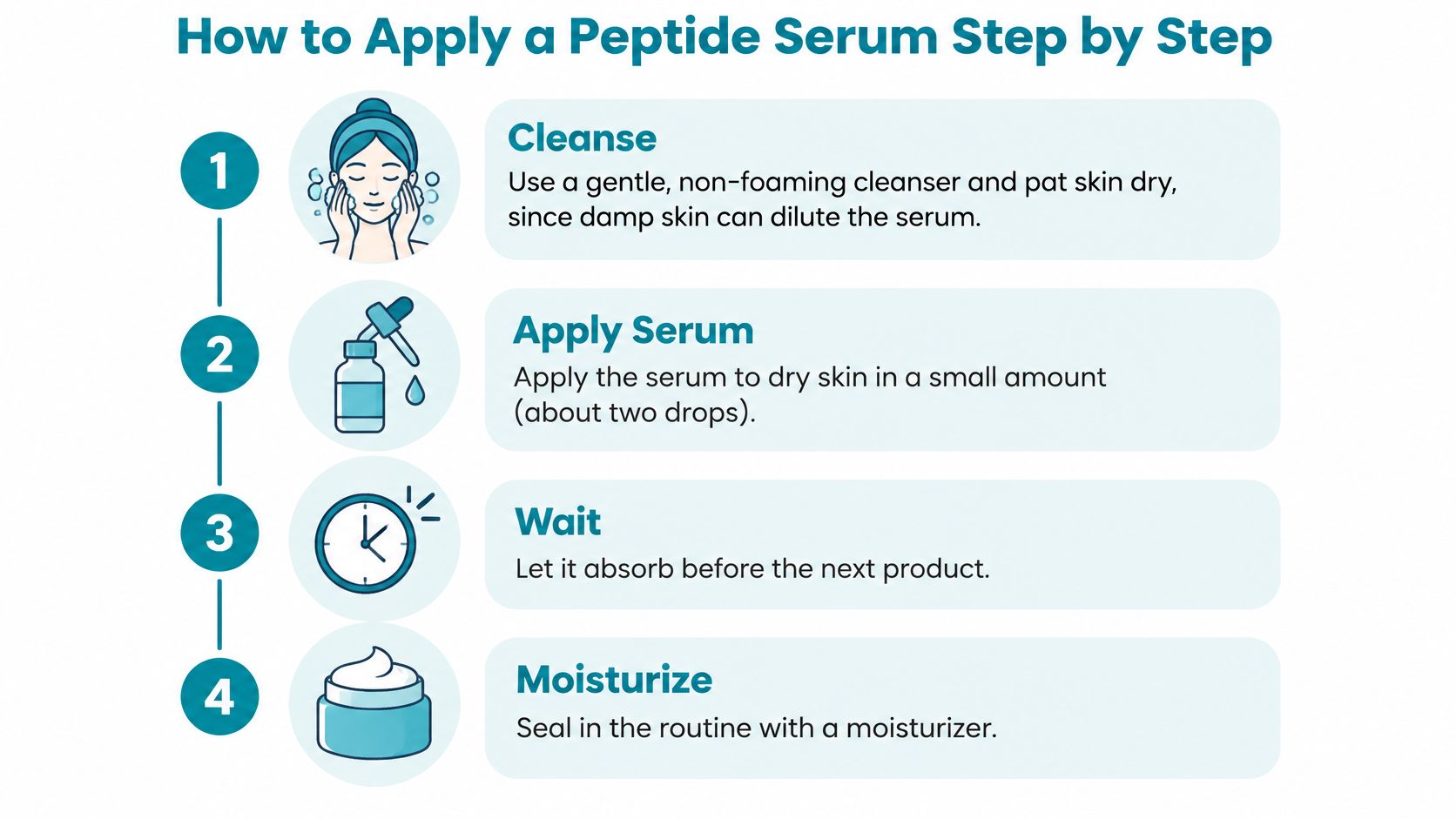
Apply the serum to clean, dry skin, then follow with moisturizer. A simple order helps you tell whether the serum suits your skin and avoids layering several new products at once.
- Cleanse, then dry. Use a gentle cleanser and pat your skin dry.
- Apply a small amount. Two to three drops, or one pump, is a practical starting amount for the face. Press it over the skin rather than rubbing it around.
- Let it settle. Wait about a minute before applying moisturizer. If products pill, try a longer pause or use less serum.
- Moisturize, then apply sunscreen in the morning. Keep daily sunscreen in the routine alongside the targeted serum.
- Keep other actives manageable. If you already use a retinoid or an acid, consider using it on alternate nights. If vitamin C stings when layered with the serum, use it at another time of day.
- Patch-test first. Try the product on a small area, such as the jawline, before applying it across the face. Stop if persistent redness develops.
Packaging and mixing
Choose packaging and a formula you can use consistently. A long ingredient list does not show that a peptide has been tested in the finished serum. Likewise, combining several peptides does not establish that they work better together. If you formulate your own products, start with one peptide in a simple base and test that base on skin before adding other actives.
For a practical guide to how to use a peptide serum, including application order and amount, see the linked article. For the week-by-week schedule and photo comparisons, follow the 12-week plan in the next section.
Choose a Serum and Commit to a 12-Week Trial
A serum earns a place in your routine through consistent use and a fair comparison, not a crowded ingredient list. Choose one product that targets your main concern, has evidence for its peptide and finished formula, and comes in packaging you will use regularly.
Use it as your single targeted step alongside cleanser, moisturizer, and sunscreen. If you want to customize a base with an anti-aging peptide, Skin Perfection's Serum Boosters offer that option. Keep the test simple: changing several products at once makes it harder to tell what helped.
The 12-week plan
- At the start: Choose one product, keep the rest of your routine steady, and take photos in consistent lighting.
- During the trial: Track how your skin looks and feels without adding another serum just because results are not yet clear.
- At 12 weeks: Compare your photos with the starting images, focusing on the lines the product was chosen to address.
If the comparison shows no visible change, consider asking a dermatologist or licensed skincare professional about deeper lines. For more on how long peptides may take to work, keep in mind that timing varies by product and concern.
Before starting, check that the label identifies the peptide and that the product's evidence relates to the finished formula. Match the peptide to the wrinkle location, then date your photos so the comparison stays useful.
Skin Perfection offers anti-aging serums and DIY lotion-making supplies for custom formulations. If you are choosing a product for crow's feet, forehead lines, or overall fine lines, compare the peptide and its evidence with your concern. Visit Skin Perfection to explore its peptide serums and Serum Boosters.