

 Buy with Prime



You've watched enough videos to feel ready: a small amber bottle, a few beautiful plant oils, and essential oils that promise a smoother, younger-looking complexion. Then you reach the difficult part. Which oil belongs in the blend, how much is safe for facial skin, and how can you tell whether you're making skincare or just creating an unstable bottle of fragrant oil?
A careful DIY essential oil face serum for anti aging starts with realistic expectations. Essential oils can make a blend smell beautiful and feel enjoyable, but they aren't automatically proven wrinkle treatments. The method below treats them as sensory ingredients inside a measured, anhydrous formula, with dilution, patch testing, storage, and honest product wording built into the process.
Table of Contents
- What a DIY Anti Aging Face Serum Can Realistically Do
- Essential Oils and Carrier Oils Explained Simply
- Choosing Ingredients for Your Anti Aging Blend
- Mixing Your Serum the Right Way
- Safe Dilution Ratios and Patch Testing
- A Hydrating Alternative Without Essential Oils
- Storage, Shelf Life, and Quick Fixes
What a DIY Anti Aging Face Serum Can Realistically Do
At the kitchen counter, you might be weighing rosehip oil into a clean amber bottle and wondering whether a few drops of frankincense or lavender will transform it into an anti-aging treatment. The finished blend can soften the feel of dry skin, add slip, reduce a tight sensation, and leave a comfortable lipid film on the surface. It may also make your evening routine more pleasant because fragrance and texture influence whether you use a product consistently.
That's useful, but it isn't the same as clinically established wrinkle reduction. A water-free oil serum can support moisturized-looking skin and temporarily make dehydration lines appear less noticeable. It can't erase deep wrinkles, restore lost collagen, remove sun damage, or replace daily broad-spectrum sunscreen.
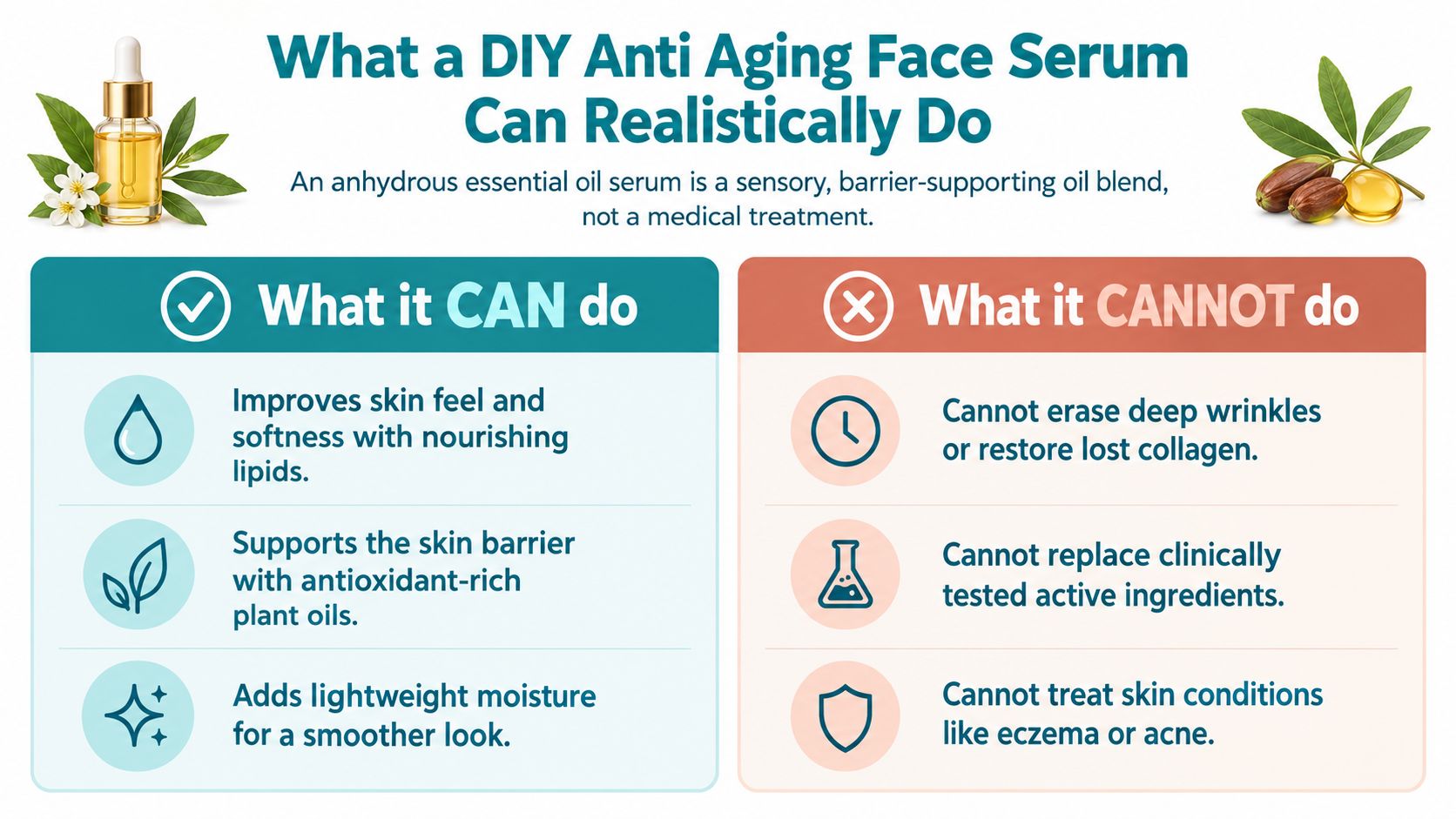
Separate sensory benefits from treatment claims
The strongest clinical evidence for topical photoaging treatment concerns tretinoin, not essential oils. A systematic review included seven randomized controlled trials, with treatment concentrations ranging from 0.025% to 5% and study durations from three months to 24 months. The included trials consistently reported improvement in visible photoaging signs, including wrinkles and uneven pigmentation, which is why evidence for retinoids shouldn't be transferred automatically to fragrant plant extracts. The review of topical tretinoin for photoaging provides the useful comparison.
For this recipe, “anti aging” means helping skin look and feel more comfortable, supple, and moisturized with consistent use over time. It doesn't mean claiming that the oil blend repairs or heals skin. A suitable description would be a nourishing, sensory facial oil for moisturized-looking skin.
Formulator's rule: Let the carrier oils create most of the skin feel. Let essential oils contribute fragrance, not carry the entire anti-aging claim.
If you're comparing ingredients and evidence, this guide to what actually works for anti-aging skin can help you keep clinically supported actives separate from preliminary or laboratory-only ideas. The rest of this article focuses on a conservative oil-based formula, simple dilution math, and practical checks before the serum reaches your face.
Essential Oils and Carrier Oils Explained Simply
Essential oils are concentrated, volatile plant extracts. They evaporate readily, carry a strong aroma, and are used in very small quantities. Even when an oil comes from a familiar plant, its concentrated chemistry can irritate skin or trigger sensitization, so it should never be treated like an ordinary cooking oil.
Carrier oils are fixed plant oils or cosmetic lipid ingredients that form the bulk of the serum. Jojoba, rosehip, and squalane each bring a different texture and oxidation profile, while supplying slip and a softening finish. In a home blend, the carrier usually does most of the practical work: it spreads the essential oil through the formula and determines whether the serum feels light, rich, dry, or glossy.
| Property | Essential Oils | Carrier Oils |
|---|---|---|
| Main function | Fragrance and a small supporting role | Bulk lipid phase, slip, softness, and conditioning feel |
| Concentration | Used sparingly and diluted | Makes up most of the formula |
| Skin contact | Should be diluted before application | Selected for the intended cosmetic use and skin feel |
| Texture | Volatile, aromatic, quick to evaporate | Fixed, oily, and persistent on the skin |
| Formulation concern | Irritation, sensitization, and phototoxicity | Oxidation, freshness, and compatibility with the blend |
An absolute is another aromatic material, but it's made through a different extraction process and shouldn't be substituted gram-for-gram for an essential oil. A hydrosol is an aromatic water, so it belongs in a water-containing formula, not in this anhydrous recipe. Adding a hydrosol, aloe, or botanical tea changes the preservation requirements because essential oils don't reliably preserve water-based products.
For readers who want more examples of how aromatic ingredients can fit into a broader routine, these vegan essential oil skincare blends offer useful formulation context. For carrier selection, compare texture and oxidation considerations in this resource on the best carrier oils for skin. A water-based product, such as the HydroGlow Anti-Aging Night Mask, belongs to a different formulation category because it contains hydrating ingredients and an aqueous system.
Choosing Ingredients for Your Anti Aging Blend
Start with the carrier phase, because it controls the serum's finish. Rosehip oil gives the blend a richer, more nourishing character and works well when dry skin prefers a substantial feel. Balance it with jojoba or squalane if you want easier spreading and a less heavy finish. Drier skin may prefer more of the richer oil, while oilier skin often feels more comfortable with a lighter carrier-led blend.
A small amount of vitamin E can serve as an antioxidant for the oils and may help slow oxidation. It isn't a preservative, and it won't make a water-containing formula safe. Think of it as part of the oil-phase support system, not as permission to add aloe or hydrosol.
Essential oils come last in the decision process. Frankincense, lavender, and geranium can provide a distinct aromatic profile, but use them as fragrance and gentle supporting ingredients rather than as proven anti-aging actives. Keep the blend simple at first. One essential oil is easier to troubleshoot than a complex aromatic combination.
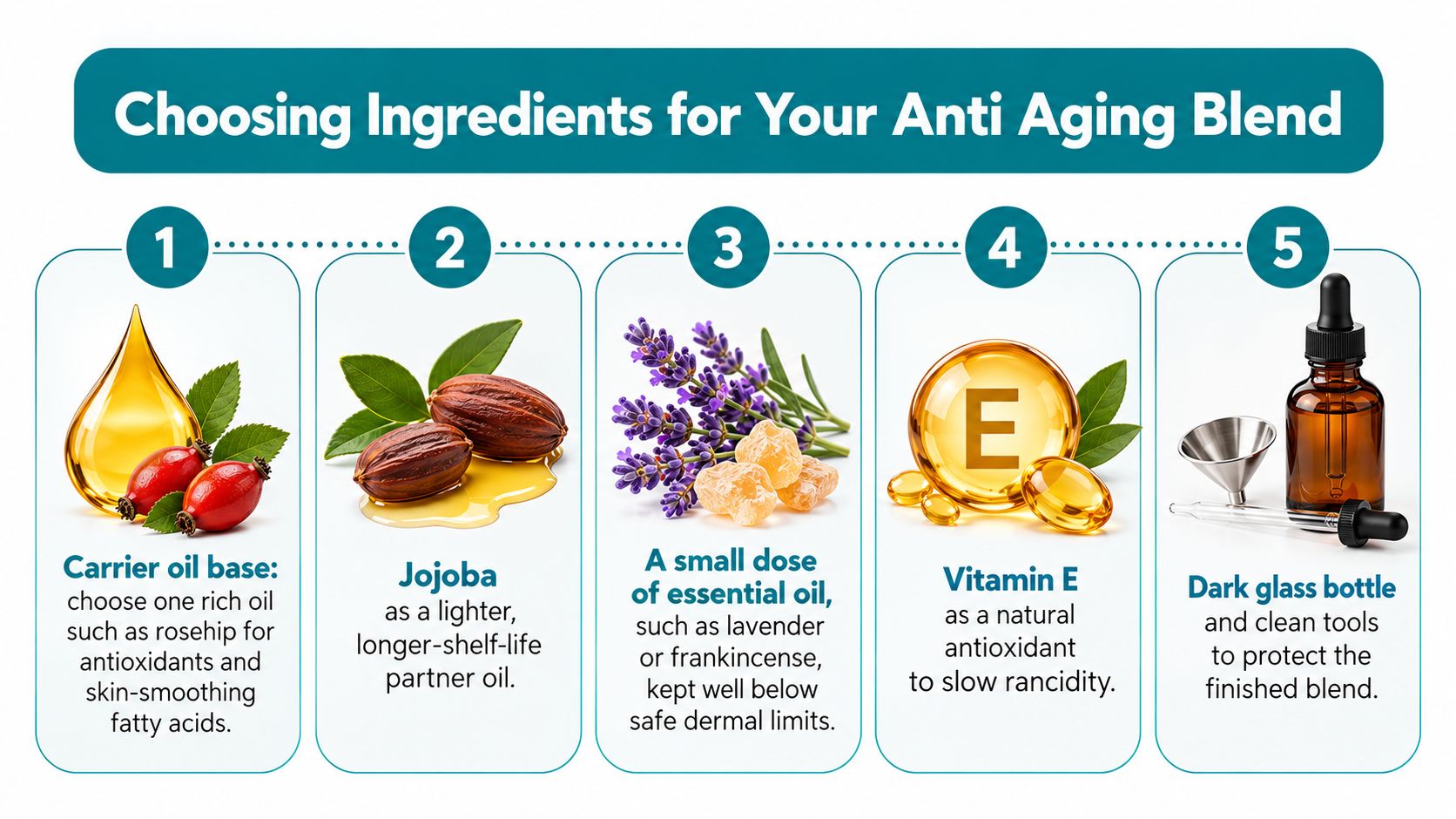
Avoid phototoxic citrus oils in a leave-on daytime face serum unless you know the exact material is non-phototoxic or you're following an established phototoxicity limit. Expressed citrus oils deserve particular caution because sunlight can worsen photoreactions. This is one reason a quiet, non-citrus aromatic profile is the more sensible starting point.
Choose for the skin's needs first: texture, tolerance, and freshness matter more than collecting a long list of aromatic oils.
Before selecting additional ingredients, use this overview of anti-aging ingredients to distinguish a carrier oil's conditioning role from the role of a clinically studied active. A DIY serum can be elegant without pretending that every botanical ingredient has the same evidence.
Mixing Your Serum the Right Way
Use a clean, dry 30 mL amber glass bottle, a sterile glass beaker or small stainless steel vessel, a lint-free cloth, and a precision scale that reads to 0.1 g. An anhydrous formula is the safer home choice because it contains no water, hydrosol, aloe, or botanical infusion that would require a validated preservative system.
Measure by weight rather than counting drops. Drop size changes with the oil, bottle orifice, temperature, and viscosity, so a scale gives you a repeatable batch. Weigh the heavier carrier oil first, add the lighter oil next, then add the essential oil blend last. For a 30 g batch, keep the combined essential-oil load within the conservative facial range of approximately 0.5% to 1.2%, or 0.15 g to 0.36 g total essential oil, as described in the essential-oil safety guidance.
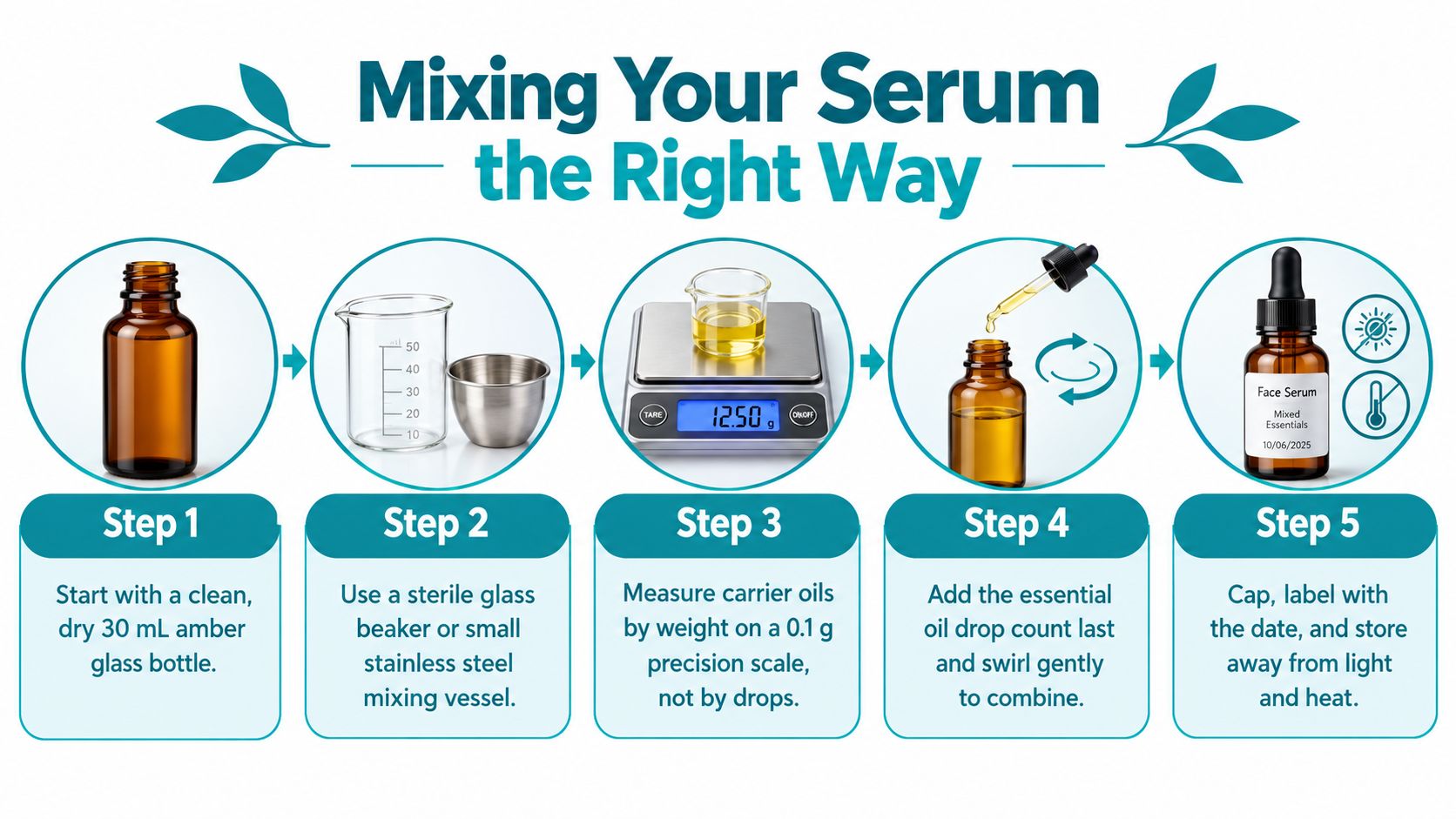
Swirl the mixture gently in the vessel so you don't whip unnecessary air into the oils. Transfer it to the bottle, cap it immediately, press a finger over the opening, and shake gently for about 30 seconds to distribute the ingredients. Wipe the bottle threads before tightening the cap, since oil on the threads can cause leaks.
Label the bottle with the full ingredient list, the batch weight, and the date mixed. If you're learning formulation, also record the carrier proportions and essential-oil material used. This face serum making guide can provide additional context for working cleanly and consistently.
Safe Dilution Ratios and Patch Testing
For facial use, a cautious beginner range is 0.5% to 1% essential oil in the finished serum. The broader facial-cosmetic guidance allows approximately 0.5% to 1.2%, while reaction-prone or barrier-impaired skin may need a lower range of 0.2% to 1%. For a 30 g serum, that means 0.15 g to 0.36 g total essential oil when using the broader range. Weigh the amount rather than relying on drops, especially when making a formula for someone else.
| Dilution Guide for a 30 g Serum Batch | Essential Oil Drops | Carrier Oil Weight | Use Case |
|---|---|---|---|
| 0.5% | Use a weighed total of 0.15 g essential oil rather than counting drops | About 29.85 g | Conservative starting point for facial use |
| 1% | Use a weighed total of 0.30 g essential oil rather than counting drops | About 29.70 g | Upper beginner range for well-tolerated skin |
| 1.2% | Use a weighed total of 0.36 g essential oil rather than counting drops | About 29.64 g | Broad facial-cosmetic ceiling described for careful formulation |
A negative patch test doesn't prove that long-term use is risk-free. An analysis of targeted patch-test results from 10,930 patients found that 908 people, or 8.3%, reacted to at least one essential oil. Reactions varied by material, including 3.9% for ylang-ylang oil, 2.6% for lemongrass oil, 1.8% for jasmine absolute and sandalwood oil, 1.6% for clove oil, and 1.1% for neroli oil. The German Contact Allergy Group analysis supports conservative dilution and careful ingredient selection.
A cautious testing routine
Apply a rice-grain amount of the finished, diluted serum to the inner forearm and cover the area with a bandage. Check it after 24 hours for redness, burning, itching, swelling, or scaling, then repeat a small test on the jawline and observe it for 48 hours before facial use. Introduce the serum every other night rather than applying it several times in one day.
Skip the blend if your skin is broken, sunburned, or recently treated. Use extra caution if you have a fragrance allergy, scent-triggered asthma, eczema-prone or sensitive skin, or a history of reactions. Pregnancy, nursing, prescription actives, recent facial procedures, and photosensitizing drugs are reasons to ask a qualified clinician before using aromatic leave-on products. Children should not use this facial blend, and citrus oils such as bergamot and expressed lemon are poor choices for this application.
Stop immediately if you develop hives, swelling, persistent redness, burning, or scaling. Record the exact oil, supplier, dilution, and batch date. If a later bottle causes irritation after an earlier one seemed fine, the new oil may have a different constituent profile, so don't assume the original patch test still applies.
A Hydrating Alternative Without Essential Oils
The look people call “plumper” isn't always the result of an anti-aging active. Dehydrated skin can show fine lines more clearly, and adding water-binding ingredients may temporarily soften that appearance without fragrance or essential oils.
A simple alternative is a preservative-treated aqueous formula containing 1% low-molecular-weight sodium hyaluronate and 3% vegetable glycerin. Hyaluronic acid helps hold water at the skin surface, while glycerin attracts moisture and supports a comfortable, hydrated feel. Because this is a water-based system, use a professionally preserved blank base or a validated preservative system. Don't assume that essential oils can preserve it.
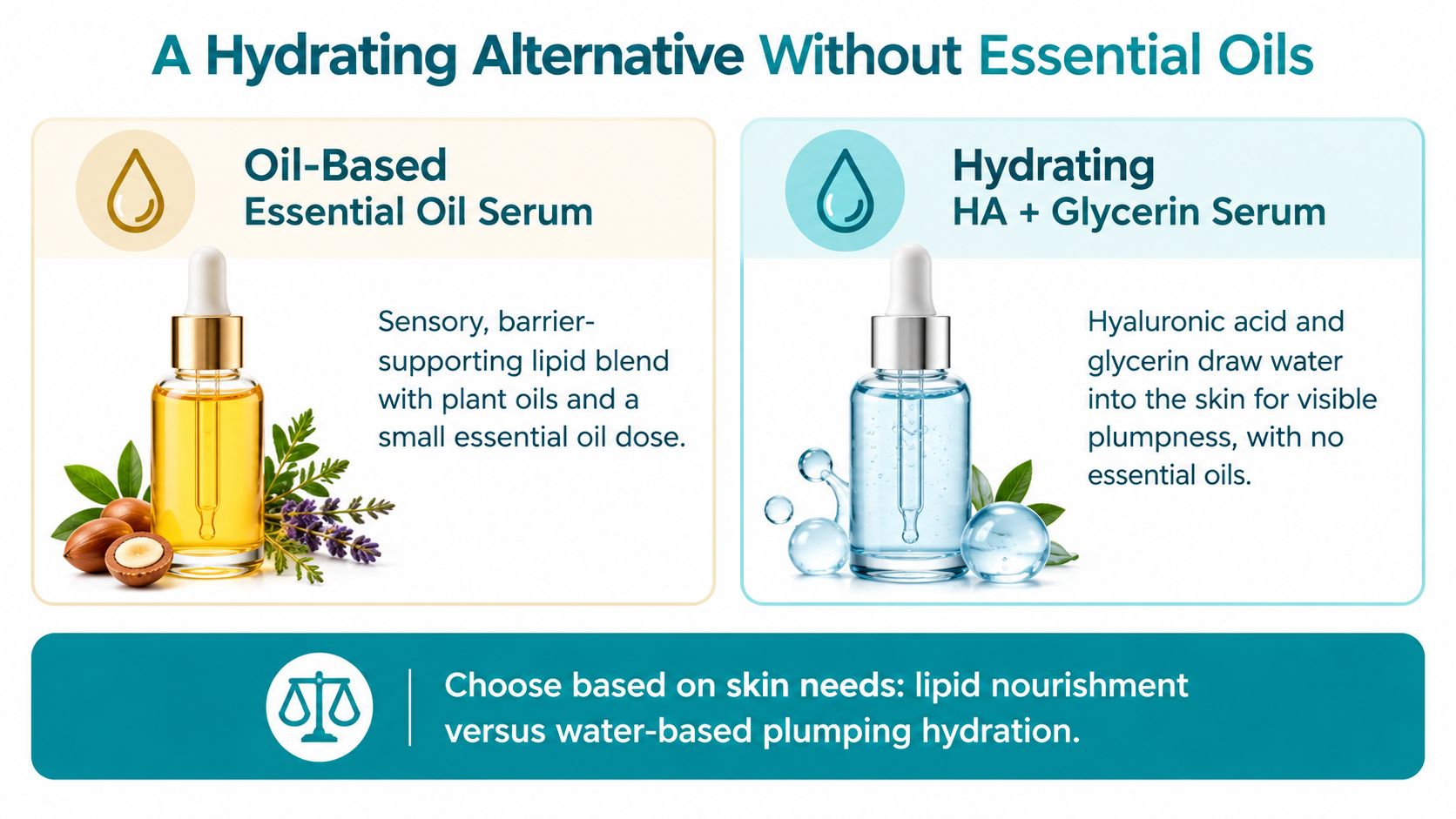
Choose the hydrating route if you have sensitive skin, dislike fragrance, use prescription actives, are pregnant, or want to avoid aromatic ingredients altogether. Choose the oil serum if you enjoy a richer lipid feel, understand its limitations, and have tolerated the finished blend during patch testing.
You can explore this guide to making a DIY hyaluronic acid serum before mixing a water-based product. Either approach works best alongside broad-spectrum SPF 30 or higher, gentle cleansing, and consistent sleep and nutrition. Neither replaces medical dermatology or a clinician's advice for a skin concern.
Storage, Shelf Life, and Quick Fixes
Store the finished anhydrous serum in a dark glass bottle with a tight closure. Keep it somewhere cool and dry, away from direct light and heat. A blend containing only oils doesn't need a conventional water-phase preservative, but it can still oxidize, and essential oils don't make the formula self-preserving.
A practical shelf-life window for a small home batch is six to 12 months, depending on the carriers, packaging, freshness, and storage conditions. Fractionated coconut oil and jojoba generally offer better oxidative stability than more delicate oils such as rosehip or pomegranate seed. Use your senses, but don't rely on appearance alone. A normal-looking product can still be poorly handled or contaminated if water was introduced.
Troubleshooting the finished bottle
- Cloudiness: Temperature changes can make some oils look hazy. Warm the closed bottle in your palm and shake it gently.
- Separation: If the blend won't remix, check whether the ratios were recorded correctly or whether a solid fat melted and later re-solidified.
- Crayon-like smell: This usually points to oxidation in a carrier oil. Discard the batch rather than trying to cover the odor with more essential oil.
- New irritation: A different bottle of essential oil may contain different constituents. Stop use, discard or quarantine the batch, and repeat a cautious patch test with a simpler formula.
- Water exposure: If water, wet tools, aloe, or hydrosol entered the bottle, don't treat the blend as a stable anhydrous serum.
Before remixing, check the formula at a glance: use a dry vessel, weigh the carriers, keep total essential oil within the selected facial dilution, add vitamin E only as an oil-phase antioxidant, package in opaque airtight glass, label the date, and patch test the finished product. For products intended for sale, evaluate odor, color, separation, and microbial safety during storage rather than assuming a home batch has been validated.
The wording on a listing matters too. The FDA explains how intended use determines whether a product is a cosmetic, a drug, or both, and cosmetic claims must be truthful and not misleading. Ordinary cosmetics aren't generally FDA-approved before sale, and Etsy's medical-claims policy prohibits explicit or implied claims that an item treats, diagnoses, mitigates, or cures a disease or medical condition. Describe appearance, feel, hydration, and fragrance, not medical treatment or structural change.
For measured carrier oils, essential-oil materials, and lotion-making supplies, visit Skin Perfection and choose ingredients that fit your formula, skin feel, and safety process. Build your next batch with a scale, a clean container, a complete label, and claims that accurately describe what the product does.