

 Buy with Prime


You've melted mango butter, stirred in water, added fragrance, and poured the mixture into a jar. It looks creamy for a few minutes, then the texture changes. A watery layer appears, the butter settles, and the batch you expected to be a lotion becomes an unstable mixture.
That failure usually isn't caused by mango butter itself. Mango butter lotion succeeds or fails as an emulsion, and the emulsion depends on phase balance, emulsifier chemistry, temperature control, shear, and preservation. The ingredient has a documented history in modern formulation work dating to the 1930s, when researchers evaluated it as an alternative to cocoa butter before its emollient profile and naturally occurring tocopherols, phytosterols, and triterpenes supported cosmetic use. The American Institute of Chemists describes this formulation history and mango butter's established cosmetic role.
This guide treats a batch like a formulator would. You'll get a workable recipe, a reason for every phase, and practical ways to diagnose separation, graininess, excessive drag, and poor skin feel.
Table of Contents
- Why Most Mango Butter Lotion Recipes Fail Before You Start
- Choosing Your Ingredients With Purpose
- The Exact Recipe With Phase Percentages
- Equipment and the Emulsification Method
- Preservation, Stability, and Shelf Life
- Troubleshooting and Adapting for Different Skin Types
Why Most Mango Butter Lotion Recipes Fail Before You Start
A typical first attempt combines melted mango butter with water, blends briefly, adds a few drops of essential oil, and fills a jar. Within 48 hours, the water may pool at the surface while the butter forms clumps below. The maker often blames the butter, but the actual problem is usually the missing formulation architecture.
Oil and water must be heated separately and brought to a matching temperature, commonly around 70 to 75°C. If one phase is much cooler, the butter can begin to solidify as the emulsion forms. The droplets won't distribute evenly, and the mixture may look acceptable while warm but separate during cooling.
A second failure is treating mango butter as though it were an emulsifier. It isn't. Mango butter belongs in the oil phase and contributes richness, body, and slip, but it can't hold water and oil together. A true emulsifier is required, supported by a co-emulsifier or fatty alcohol when the formula needs more structure. The emulsifier guidance for lotion formulation is useful because emulsifier choice affects both stability and the final skin feel.
Why mango butter needs deliberate processing
Mango butter contains a substantial stearic acid fraction, which helps create a firm, elegant lotion with cushion on the skin. That same characteristic raises the melting point and increases viscosity compared with lighter liquid oils. A formula with a meaningful butter load therefore needs enough emulsifier power and enough heat to melt the entire oil phase.
The final stage matters just as much. Pouring immediately after a short blend can leave the emulsion vulnerable, while slow cooling with intermittent stirring encourages the internal structure to develop evenly. Continuous high shear isn't necessary throughout cooling, but abandoning the batch completely can allow droplets and crystals to reorganize unevenly.
Practical rule: Matching phase temperatures solves only one part of the problem. You still need a suitable emulsifier and controlled cooling.
A well-designed mango butter lotion is not just melted butter diluted with water. It's a structured oil-in-water system, preserved because it contains water, and tested for the way it behaves after filling.
Choosing Your Ingredients With Purpose
Choose ingredients by function, not by how attractive the ingredient list looks. Mango butter supplies body and emollience, but the rest of the formula determines whether the lotion feels light, spreads cleanly, and remains stable.
Oil phase decisions
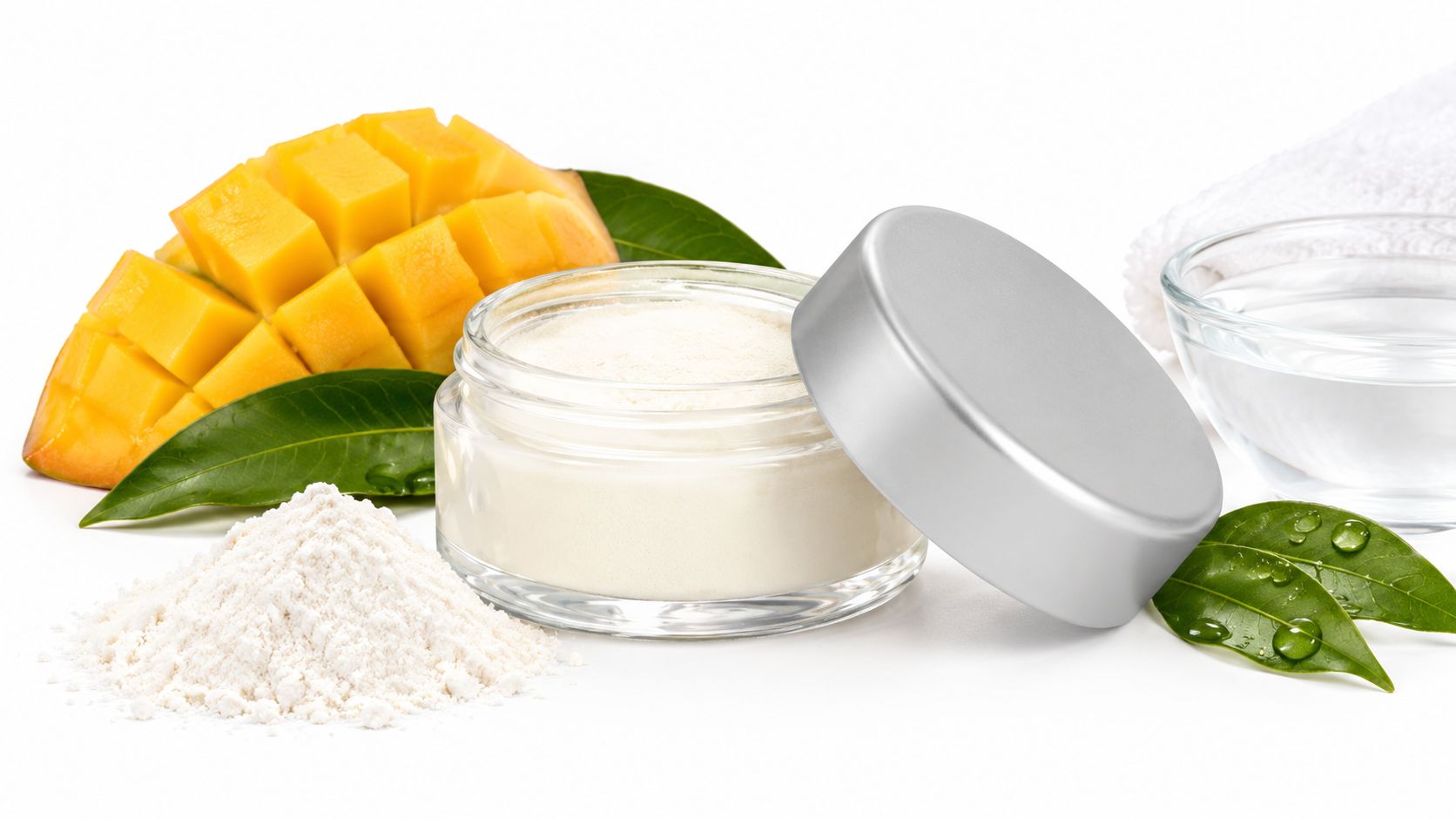
A mango butter level around 5 to 10% gives a lotion body without making the formula behave like a balm. Refined mango butter has a relatively neutral aroma and predictable color, which makes it easier to combine with fragrance or leave unscented.
Supporting oils adjust the finish. Fractionated coconut oil gives quick slip and a lighter after-feel. Jojoba contributes a more substantial, conditioning feel and is often useful when the lotion needs more cushion. Squalane can make a butter-rich formula feel silkier, but it changes the cost and sensory profile. A total supporting-oil range of 5 to 15% gives room to balance absorption against lasting occlusion.
The emulsifier is the structural decision that shouldn't be made by appearance alone. Polyglyceryl-3 stearate and Olivem 1000 are common choices for naturally positioned formulas, while Polawax provides a more forgiving synthetic option. Cetearyl alcohol isn't a complete emulsifier by itself, but it can thicken and reinforce an appropriate emulsifier system. Beeswax with borax is a traditional approach, though it has a different sensory profile and isn't interchangeable with a modern emulsifying wax.
Most emulsifiers fall somewhere around 3 to 6% of the batch, but the supplier's recommended use level and the formula's oil load take priority. A high-butter lotion can need more structural support than a low-oil hand lotion.
Water phase and cool-down ingredients
Use distilled or low-mineral water. Glycerin or propanediol at 3 to 5% can improve the hydrated feel, but too much humectant may make the lotion tacky, especially when paired with a heavy butter phase.
Cool-down ingredients protect heat-sensitive materials. Panthenol, peptide solutions, botanical extracts, fragrance, and preservative should be added at the temperatures specified by their suppliers. A product such as Sodium Hyaluronate Powder Pure Hyaluronic Acid is a water-compatible cosmetic ingredient that can be prepared for creams, lotions, or serums at a stated 0.1 to 2% serum concentration and uses a high-molecular-weight NASHA grade with a stated molecular weight of 800 to 1500 Daltons. It must be properly dispersed and accounted for in the water phase rather than sprinkled directly into finished lotion.
For a broader ingredient-function overview, compare the role of each material with this lotion ingredient formulation guide.
| Ingredient Category | Examples | Functional Role | Typical % of Batch |
|---|---|---|---|
| Butter | Refined mango butter | Body, emollience, slip | 5 to 10% |
| Supporting oils | Fractionated coconut, jojoba, squalane | Adjusts spread, absorption, and richness | 5 to 15% |
| Emulsifier | Polyglyceryl-3 stearate, Olivem 1000, Polawax | Holds oil and water together | 3 to 6% |
| Co-emulsifier | Cetearyl alcohol | Adds viscosity and structural support | Formula dependent |
| Water phase | Distilled water | Continuous phase and hydration vehicle | 60 to 75% |
| Humectant | Glycerin, propanediol | Helps create a hydrated skin feel | 3 to 5% |
| Actives | Panthenol, peptides, extracts | Formula-specific cosmetic support | Supplier dependent |
| Cool-down materials | Preservative, fragrance | Protection and sensory finishing | Supplier dependent |
The Exact Recipe With Phase Percentages
This worked formula makes 100%, or roughly 200 g when weighed as a 200 g batch. It uses Polyglyceryl-3 stearate as the primary emulsifier. If you use Olivem 1000 instead, use the stated substitution and test the revised system rather than assuming the two materials will behave identically.
Formula
Oil phase
- 8% refined mango butter
- 7% fractionated coconut oil
- 4% jojoba oil
- 4% Polyglyceryl-3 stearate, or 5% Olivem 1000
- 2% cetearyl alcohol
Water phase
- 68% distilled water
- 4% vegetable glycerin
Cool-down phase
- 2% panthenol
- 1% peptide solution
- 0.5% stem cell extract
- 0.6% broad-spectrum preservative, such as phenoxyethanol plus ethylhexylglycerin, or a suitable Leucidal system
- 0.4% fragrance or essential-oil blend
The listed percentages total 101.5% if every cool-down amount is added exactly as written. To make a true 100% formula, reduce the distilled water to 66.5% when using the full cool-down phase. If you omit fragrance, replace its percentage with water. This correction matters because percentages must describe the finished batch, not an approximate ingredient list.
Method
- Weigh each phase separately with a calibrated scale. Put mango butter, oils, emulsifier, and cetearyl alcohol into one heat-safe vessel. Put distilled water and glycerin into another.
- Heat both phases to 73 to 75°C, checking with a calibrated thermometer. Hold the phases at closely matching temperatures until the butter, emulsifier, and fatty alcohol are completely melted.
- Add the water phase to the oil phase while blending with a stick blender. Use high shear for 2 to 3 minutes while the mixture remains hot. Scrape the vessel walls so no unmixed oil remains around the edges.
- Continue slow cooling with intermittent stirring for 20 to 30 minutes. Use the stick blender in short bursts at first, then switch to a hand whisk or spatula once the lotion begins to thicken. This reduces unnecessary aeration while maintaining a uniform structure.
- Below 40°C, add panthenol, peptide solution, stem cell extract, preservative, and fragrance. Mix thoroughly, check pH, and fill below 35°C once the lotion has thickened enough to pour cleanly.
For a visual sequence covering the working method, see this body lotion making guide. Any substitution changes the oil phase, emulsifier balance, or preservation demand, so test it in a 50 g trial batch before making a larger quantity.
Equipment and the Emulsification Method
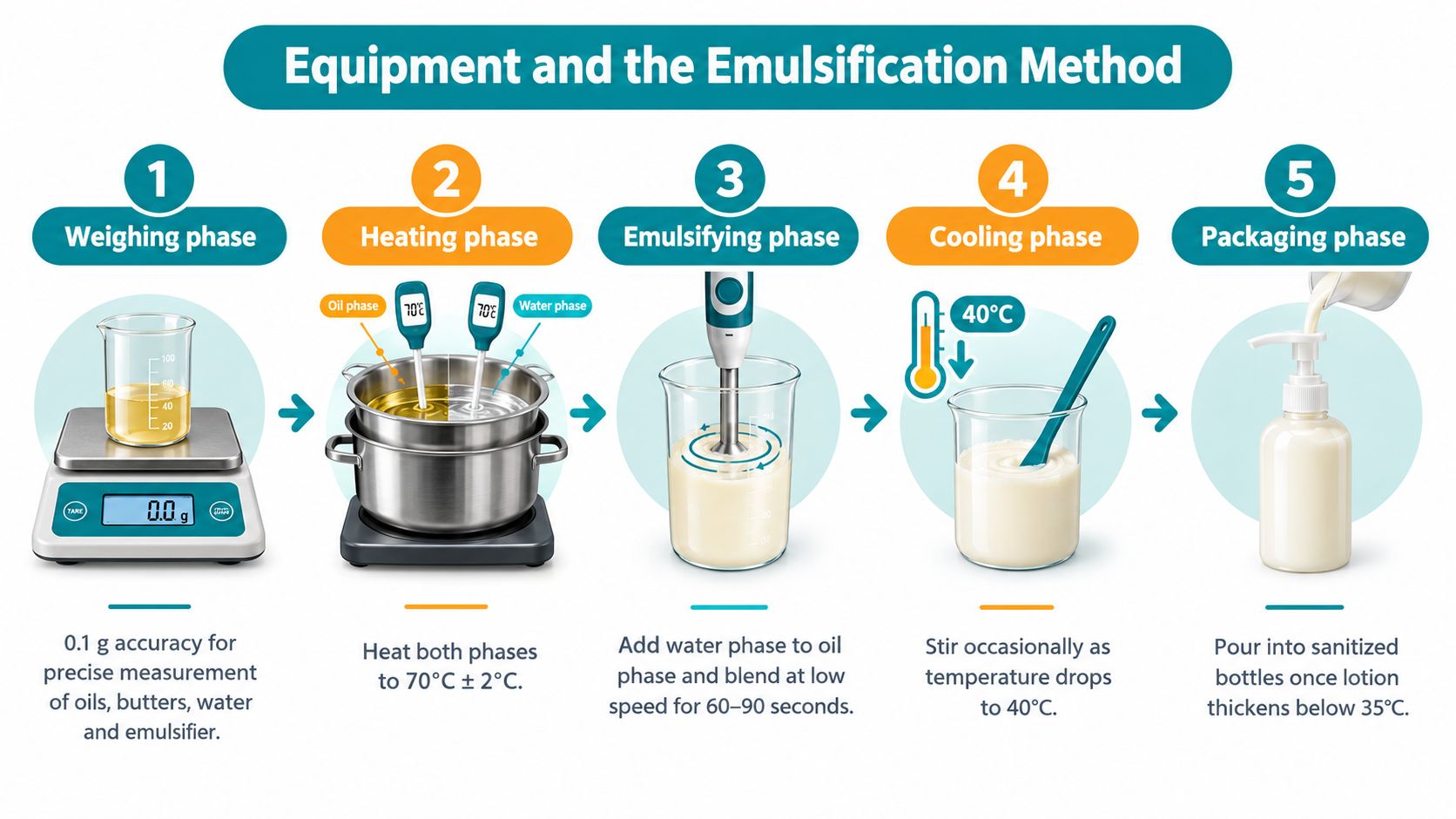
A stable batch starts with measurement and temperature control. A digital scale that reads to 0.1 g is suitable for small experimental batches, while two thermometers let you verify the oil and water phases independently. A single thermometer creates a blind spot because the second vessel may be cooler or hotter than you assume.
Use two heat-safe beakers, a water bath or double boiler, silicone spatulas, a stick blender, a hand whisk, pH-testing equipment, sanitized packaging, gloves, and a clean working surface. The vessels should be tall enough for the blender head to stay submerged. A shallow container encourages splashing and incorporates unnecessary air.
A controlled hot-process sequence
Heat the oil and water phases separately to around 75 to 80°C when following a general hot-process method. For the specific recipe above, keep both phases at 73 to 75°C. The important point is not chasing a single universal temperature. It's ensuring that all solid materials melt and that the phases are close enough to prevent premature butter crystallization.
Pour the water phase into the oil phase while blending. A stick blender supplies the shear needed to break the oil into small droplets and distribute those droplets through the water. Blend for 2 to 3 minutes at temperature, then stop periodically to scrape the sides and check whether the mixture is becoming uniformly opaque.
Watch the texture, not just the clock. A successful early emulsion looks consistently milky and glossy, without a transparent water ring or visible oil beads.
As the temperature falls, blend intermittently rather than continuously. Short bursts help prevent separation, while a whisk or spatula gives better control once the lotion gains viscosity. Slow cooling allows the fatty components and emulsifier to organize without the shock of rapid chilling.
Room-temperature combining, low-shear-only mixing, and a phase mismatch greater than 5°C are poor shortcuts. They can produce a mixture that seems fine immediately but fails after cooling. The oil-and-water emulsification method provides useful process context, but your own formula still needs testing because different emulsifiers have different processing requirements.
Preservation, Stability, and Shelf Life
An anhydrous balm and a lotion have different preservation needs. A balm without water doesn't provide the same environment for microbial growth, although it can still oxidize and become rancid. Mango butter lotion contains water, so it needs a suitable broad-spectrum preservative, sanitary handling, and a packaging system that limits repeated contamination.
The preservative must match the formula and its pH. Common options include Optiphen, Germaben II, and Phenonip, generally used around 0.5 to 1.0%, but supplier documentation controls the final decision. Phenoxyethanol plus ethylhexylglycerin may suit some systems, while Leucidal requires careful validation rather than automatic acceptance as a complete solution.
| Preservative | Usage Rate | Effective pH Range | Best For |
|---|---|---|---|
| Optiphen | 0.5 to 1.0% | Supplier specified | Emulsions needing a widely used preservative option |
| Germaben II | 0.5 to 1.0% | Supplier specified | Broad-spectrum protection in compatible emulsions |
| Phenonip | 0.5 to 1.0% | Supplier specified | Formulas where its supplier conditions are met |
| Phenoxyethanol plus ethylhexylglycerin | 0.5 to 1.0% | Supplier specified | Many lotion systems, subject to compatibility testing |
| Leucidal | Supplier specified | Supplier specified | Formulators choosing a ferment-based preservation approach and validating it |
Test the finished lotion's pH with strips or a calibrated meter. A target around 4.5 to 5.5 can support skin compatibility and the performance of compatible preservatives, but the preservative supplier's range remains decisive. Adjust carefully with diluted lactic acid or sodium hydroxide solution, then recheck after the formula equilibrates.
Mango butter also needs oxidation control. Its fatty-acid profile includes oleic and stearic components, so tocopherol at 0.5% can serve as an antioxidant. Tocopherol doesn't replace a broad-spectrum antimicrobial preservative.
Testing and packaging choices
A published mango butter foot-care cream used an oil-in-water system with a 25% mango butter base and a 60% aqueous phase. It was reported as non-sticky, non-oily, water-washable, and stable for 1 year under room-temperature, refrigerated, and accelerated conditions, including 10±2°C and 45±5°C, without meaningful changes in pH, emulsion stability, microbial resistance, color, fragrance, or viscosity. The published formulation study provides the detailed stability conditions and methodology.
That result belongs to the tested formulation, not automatically to a home batch. Check for separation, odor changes, color shifts, viscosity loss, gas, mold, and unexpected pH movement. Airless pumps reduce finger contact, dark glass helps limit light exposure, and wide-mouth jars introduce more handling and environmental exposure. Use natural cosmetic preservative guidance alongside supplier documentation and actual testing.
Troubleshooting and Adapting for Different Skin Types
Troubleshooting works best when you match the visible symptom to the process failure. Don't add random ingredients to a broken batch and hope the texture improves.
Match the problem to the adjustment
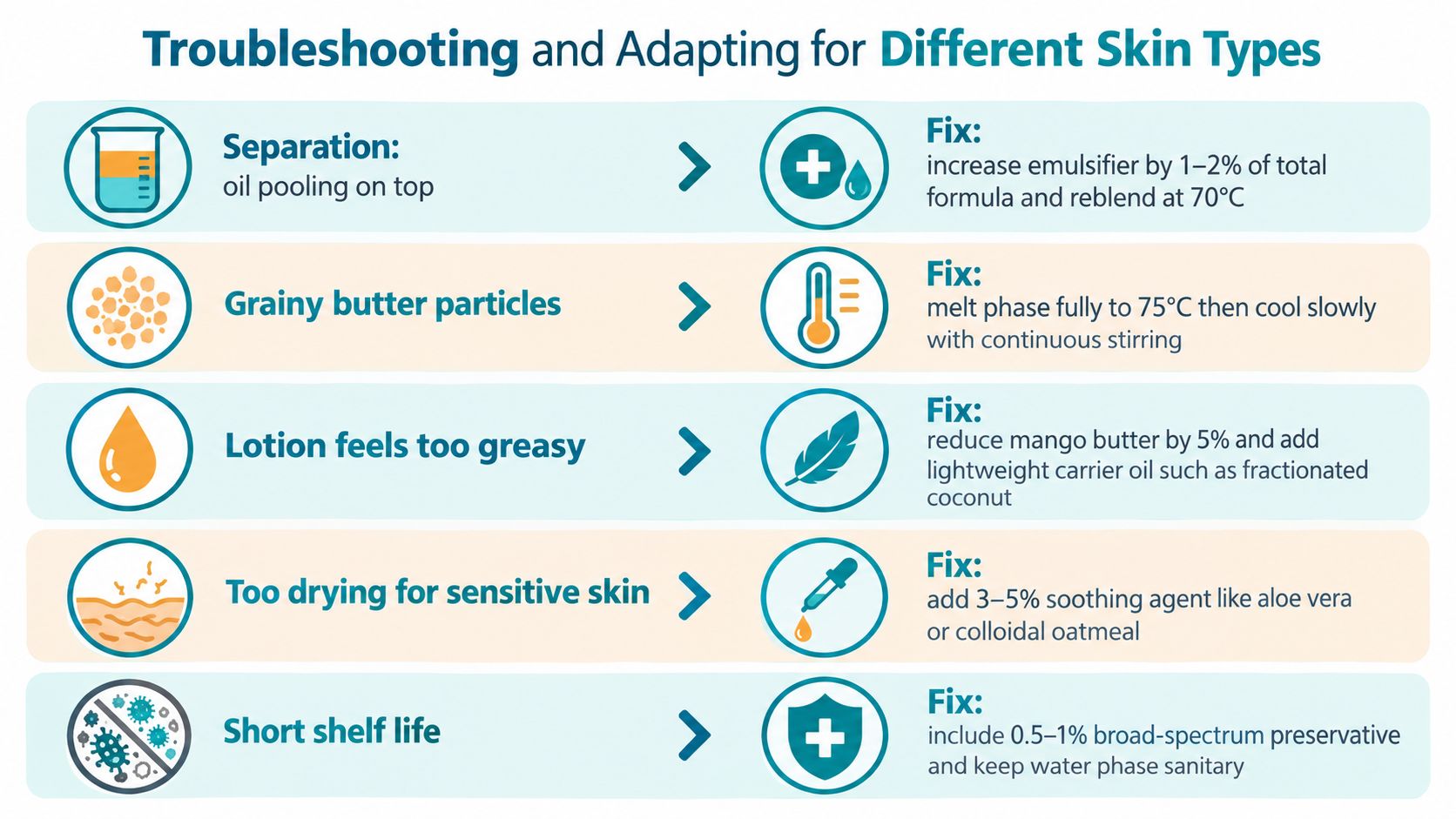
- Oil pooling on top: The emulsion likely lacks sufficient emulsifier, or the phases were too far apart in temperature. Reheat the batch only if the preservation system permits it, increase emulsifier by 1 to 2% of the total formula in a properly calculated trial, and reblend around 70°C.
- Grainy butter particles: Mango butter may have crystallized unevenly during cooling. Melt the oil phase fully to around 75°C, then cool gradually with continuous stirring during the early set.
- Watery lotion: The formula may contain too much water for its structure, or the emulsion may have broken. Confirm the weigh-up, review the emulsifier level, and test a smaller reformulated batch before trying to rescue the whole container.
- Greasy finish: Reduce mango butter by 5% in the next trial and replace that amount with a lightweight carrier such as fractionated coconut oil. This changes the formula balance, so recalculate the water and emulsifier requirements rather than making an untracked substitution.
Adapt the sensory profile
Dry skin usually benefits from more cushion. Increase jojoba or squalane within the formula's oil budget, then assess spread and residual film on the skin. Oily or acne-prone skin needs more caution. Mango butter is often described as a heavier occlusive emollient, and some references assign it a lower comedogenic rating than cocoa butter, but occlusive layering can still aggravate congestion for some people. Healthline's mango butter overview discusses this skin-type trade-off.
Body use and facial use shouldn't be treated as identical. A richer body lotion may feel comfortable on dry limbs but too heavy on an oily face. “Sensitive-skin friendly” also doesn't automatically mean acne-safe, so patch testing and restrained application are more useful than a blanket yes or no.
For sensitive-feeling formulas, consider allantoin or oat extract at supplier-recommended levels. Peptides such as Matrixyl 3000 or argireline can be used around 2 to 5% in cool-down when the supplier allows it, while panthenol is commonly used around 1 to 2%. Keep heat-sensitive actives below 40°C to protect their intended function.
Avoid disease, healing, repair, or treatment language in product listings. Etsy prohibits explicit or implied claims that a cosmetic can treat, mitigate, diagnose, or cure a disease or medical condition, and it also restricts claims equating an item with drugs or drug actions. Etsy's medical-claims policy sets out those restrictions. In the United States, the FDA's cosmetics labeling regulations require compliant identification and net-quantity information, so describe the product as a cosmetic lotion and use appearance, texture, and moisturization language carefully.
Skin Perfection offers skincare products, lotion-making supplies, and cosmetic ingredients for makers who want to build mango butter lotion around a deliberate formula rather than guesswork. Visit Skin Perfection to explore supplies and ingredients for your next measured, tested batch.