

 Buy with Prime



Every lotion label is a list of ingredients doing specific jobs. Some hold water, some soften, some seal, some hold the oil and water together, and some keep the whole thing free of microbial growth. If you want the short list of what every lotion must contain, start with our guide to the essential ingredients for lotion. This page is the reference that sits beside it: each ingredient type, what it actually does in the formula, and the percent range its manufacturer or supplier recommends, so you can read a label or plan a formula with real numbers.
The Master Reference Table
As a cosmetic formulator, I only list a number when it comes from the ingredient's manufacturer, supplier, or Skin Perfection product page. Where no single published range applies, the table says so. Ranges are for the specific grades named in the Sources section; another supplier's grade may differ, so always check your own data sheet.
| Ingredient type | Example | What it does | Published range | Phase |
|---|---|---|---|---|
| Solvent | Distilled water | Carries water-soluble ingredients, gives a light feel | Balance of formula (whatever remains to reach 100%) | Water |
| Humectant | Glycerin | Draws water into the skin; also dissolves some water-insoluble ingredients | 2 to 5% in emulsions | Water |
| Humectant | Sodium hyaluronate | Binds water, adds slip and body | 0.1 to 2% | Water |
| Emollient and occlusive butter | Shea butter | Softens and smooths; forms a protective film | 3 to 100% (can be used pure) | Oil |
| Emollient oils | Jojoba, sweet almond, squalane | Softness, slip, and skin feel | No single published range; the total oil phase drives emulsifier choice | Oil |
| Emulsifier | Polawax (emulsifying wax NF) | Holds oil and water together as a stable emulsion | 2 to 25% | Oil |
| Emulsifier | Emulsifying wax NF (cetearyl alcohol and polysorbate 60) | Same job; supplier guidance by product type | About 3 to 5% for lotions, 5 to 10% for creams | Oil |
| Thickener and co-emulsifier | Cetyl alcohol | Builds body, adds a cushioned feel; co-emulsifier above 5% | 0.5 to 6% | Oil |
| Water-phase thickener | Xanthan gum | Thickens the water phase and helps stabilize the emulsion | 0.1 to 2% (generally 1%) | Water |
| Antioxidant | Vitamin E (tocopherol) | Slows oil rancidity | 0.1 to 1% for stabilizing oils; 0.5 to 2.5% for skin effects | Oil |
| Preservative | Leucidal Complete | Broad-spectrum protection against bacteria, yeast, and mold | 2 to 4% | Cool-down |
| Brightening active | Alpha arbutin | Targets the look of uneven tone | Up to 0.5% in body products, up to 2% in face products | Cool-down, below 40°C |
| Peptide active | Matrixyl 3000 Serum Booster | Amino acid complex for the look of firmer skin | 3 to 8% | Cool-down |
| pH adjuster | Citric acid or sodium hydroxide solution | Brings the finished formula into its target pH range | As needed, a drop at a time; no fixed percent | Final step |
| Fragrance or essential oil | Any | Scent | Set by the fragrance supplier's safety certificate for your product type; no general percent | Cool-down |
When you blend, Skin Perfection's house rule is to work at the top of the recommended range for actives and preservatives. For the structural ingredients above, the range is the working window, and where you land inside it is a texture decision.
Water Phase Ingredients and What They Do
Water
Water is usually the largest single ingredient in a lotion and is listed first on the label for that reason. Use distilled or deionized water. Tap water can carry minerals and microbes into the batch.
Humectants
Humectants pull water toward the skin. Glycerin is the workhorse; its supplier fact sheet gives 2 to 5% in emulsions and lists it as water-soluble, so it goes straight into the water phase. Sodium hyaluronate does a similar job at a much lower percentage, 0.1 to 2% per its product page, and adds a silky slip. At the high end of that range it makes a very thick gel, so in a lotion you will feel it as extra body. Read more about the whole category in our guide to natural humectants for skin.
Water-phase thickeners
Xanthan gum thickens the water phase and gives a lotion more stability against separation. The supplier lists 0.1 to 2%, generally 1%, and warns that it clumps if added carelessly. Sprinkle it into a vortex, or pre-disperse it in glycerin before adding it to the water.
Oil Phase Ingredients and What They Do
Emollients
Emollients are the oils and butters that make skin feel soft and smooth. There is no single published percentage for "oils," because the right amount depends on how rich you want the lotion to be. What the oil total does decide is how much emulsifier you need, covered below.
Butters and occlusives
Shea butter is both emollient and film-forming. Its supplier fact sheet gives a typical use level of 3 to 100%, which tells you it is a texture choice rather than a dose. It goes into the oil phase and must be melted before use.
Fatty alcohols
Cetyl alcohol is not a drying alcohol. It is a waxy fatty alcohol that thickens and adds a cushioned feel. Its supplier fact sheet gives 0.5 to 6%, notes that it works as a co-emulsifier above 5%, and says to melt it into the hot oil phase.
Antioxidants
Plant oils go rancid over time. Vitamin E (tocopherol) slows that. The supplier lists 0.1 to 1% for stabilizing oils, and 0.5 to 2.5% when it is used for skin effects. It is oil-soluble and should be stored away from light.
Emulsifiers: The Ingredient That Makes It a Lotion
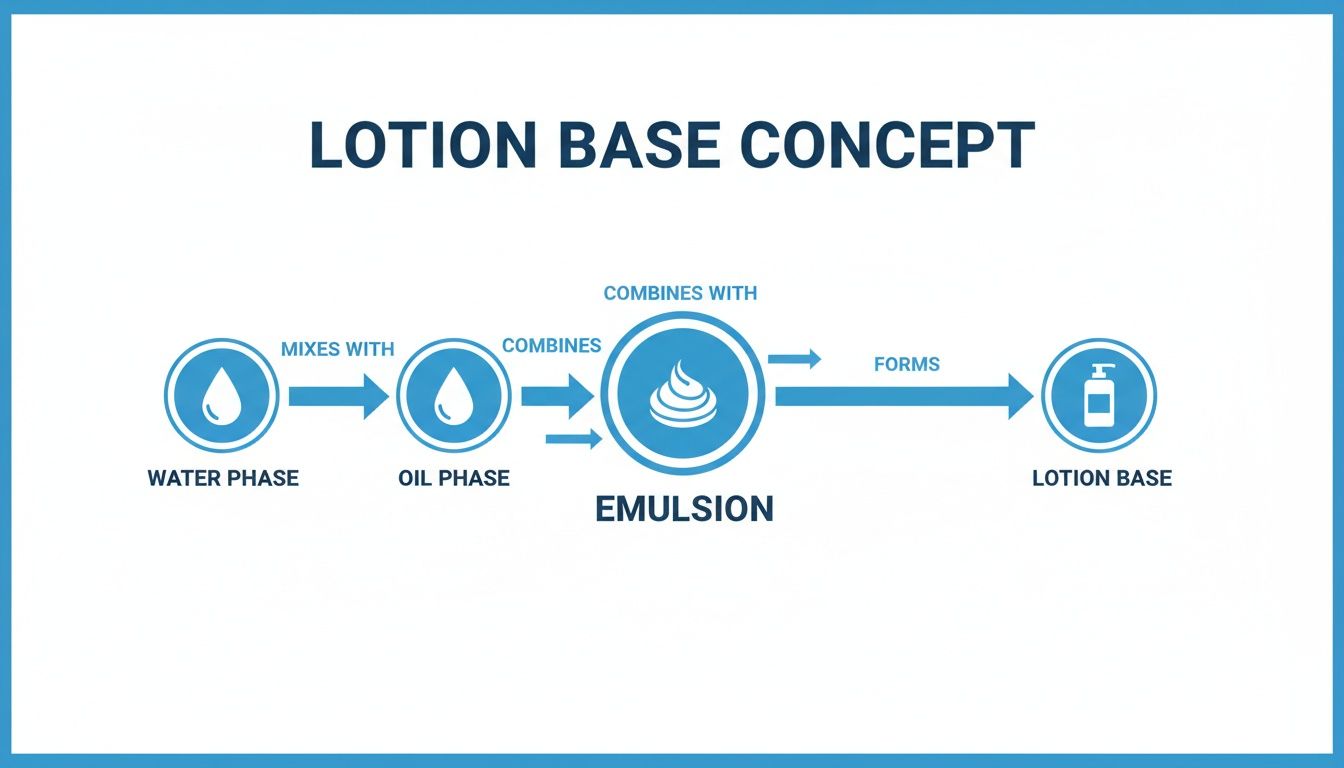
Oil and water separate unless an emulsifier holds them together. Croda gives its Polawax NF emulsifying wax a recommended use range of 2 to 25%. That range is wide because the amount you need depends on how much oil you are emulsifying.
One supplier of emulsifying wax NF gives a practical rule: use about 25% of your oil phase plus 1%, not counting the wax itself. Their worked example is a formula with 24% oils, which needs about 7% wax (24 x 0.25 + 1). The same supplier lists typical rates of about 3 to 5% for lotions and 5 to 10% for creams. For a deeper comparison of emulsifier types, see our guide to choosing emulsifiers for lotion.
| Oil phase (excluding wax) | Emulsifying wax NF at 25% of oils + 1% |
|---|---|
| 8% | 3% |
| 12% | 4% |
| 16% | 5% |
| 20% | 6% |
| 24% | 7% |
Cool-Down Ingredients and What They Do
Preservatives
Any lotion that contains water needs a broad-spectrum preservative. Leucidal Complete is used at 2 to 4% per its product page, and I use 4%, the top of that range. Add it once the emulsion has cooled, and if it looks hazy, the product page suggests warming it to 95 to 104°F before adding it while still fully liquid.
Actives
Heat-sensitive actives go in at cool-down. Two examples with clear published numbers:
- Alpha arbutin: the manufacturer gives up to 0.5% for body applications and up to 2% for face, and says to add it below 40°C. For a body lotion, use 0.5%.
- Matrixyl 3000: its product page gives 3 to 8% and lists lotions as a suitable product type. Use 8%. It is water-soluble, so it belongs in a water-containing lotion, not an oil-only balm.
pH adjusters
pH adjustment has no fixed percent. Check pH after everything is in, then adjust with a dilute citric acid or sodium hydroxide solution a drop at a time, stirring and re-checking between drops.
Reading a Lotion Label With This Table
- Find the water and humectants near the top. Water first, glycerin usually close behind.
- Find the emulsifier. Look for cetearyl alcohol, polysorbate 60, or an emulsifying wax blend. Without one, a water-and-oil product is not a stable lotion.
- Find the preservative. If a lotion contains water and you cannot find a preservative, ask the brand how it is protected.
- Find the actives. Actives are often used at low percentages, so they tend to appear in the lower half of the list.
- Find the fragrance. It is usually listed near the end.
Frequently Asked Questions
What percentage of a lotion is emulsifier?
It depends on the oil phase. Croda gives Polawax a 2 to 25% range. A practical supplier rule for emulsifying wax NF is 25% of your oil phase plus 1%, which works out to about 3 to 5% in typical lotions and 5 to 10% in creams.
How much glycerin should a lotion contain?
The supplier fact sheet used here gives 2 to 5% in emulsions, added to the water phase.
Is cetyl alcohol drying?
No. Cetyl alcohol is a fatty alcohol used as a thickener and co-emulsifier at 0.5 to 6%. It adds body and a soft, cushioned feel.
How much preservative does a homemade lotion need?
Follow your preservative's published range. For Leucidal Complete that is 2 to 4%, and I use the full 4% in lotions that contain water.
Why does my lotion need vitamin E if it already has a preservative?
They do different jobs. A preservative protects against microbial growth. Vitamin E is an antioxidant that slows oils from going rancid, used at 0.1 to 1% for that purpose.
Sources
- Croda Pharma. Polawax NF product page: recommended topical usage 2 to 25%. crodapharma.com
- DSM. ALPHA-ARBUTIN Formulation Guidelines (2017-06). Manufacturer guidelines (PDF)
These statements have not been evaluated by the Food and Drug Administration. These products are not intended to diagnose, treat, cure, or prevent any disease.
About the Author
Written by Kari Thomas, cosmetic formulator and founder of Skin Perfection.