

 Buy with Prime


Natural cosmetic preservatives are simply ingredients sourced from nature that stop microbes from setting up shop in your skincare formulas. They're the unsung heroes for any product that contains water—think lotions, serums, and creams—making sure they stay fresh and stable from the very first pump to the last drop.
Why Preservatives Are a Non-Negotiable for Safe Skincare
Here's the thing: when you craft a beautiful, water-based serum or lotion, you're not just making a skincare product. You're also creating the perfect five-star resort for bacteria, yeast, and mold.
Water is the key to life, not just for our skin but for these invisible little critters, too. Without a solid preservation system in place, your perfect formula can turn into a petri dish in just a matter of days.
Think of it like leaving a fresh piece of fruit on your kitchen counter. For a day or two, it’s perfect. But before long, you'll start to see the tell-tale signs of spoilage as microbes take over. The exact same thing happens inside your favorite cream, though often you can't see it until it's far too late.
At a Glance: Why Preservation Matters
This quick table really drives home the difference between a product that's protected and one that's a ticking time bomb.
| Characteristic | Unpreserved Product | Preserved Product |
|---|---|---|
| Shelf Life | A few days (refrigerated) | Months to years |
| Safety | High risk of contamination | Safe for repeated use |
| Appearance | Can discolor or separate | Stays consistent |
| Smell | May develop an "off" odor | Scent remains stable |
| Skin Risk | Can introduce unwanted microbes | Reduces microbial presence |
As you can see, the choice is pretty clear. A well-preserved product is the only way to guarantee a safe and enjoyable experience for your skin.
Debunking the "Preservative-Free" Myth
You've probably seen "preservative-free" slapped on labels, and while it sounds wonderfully pure, it's incredibly misleading. Let's be crystal clear: any skincare product containing water must have a preservative system to be safe for more than a few days (and that's if you keep it in the fridge).
An unpreserved, water-based product isn't just less effective; it can introduce a host of unwanted contaminants directly onto your skin. This can lead to undesirable effects on the skin's appearance.
This is where natural cosmetic preservatives step in as the true guardians of your formula. They work tirelessly behind the scenes to create an environment where these unwanted microbes simply can't survive, protecting both your product and your skin. It's an absolutely essential step for anyone serious about crafting high-quality, stable skincare.
A well-chosen preservative system doesn’t just prevent your beautiful creation from turning into a science experiment. It ensures the product you made maintains its intended texture, scent, and appearance throughout its entire shelf life.
The Groundswell Towards Natural Preservation
The demand for cleaner, more transparent ingredients has completely reshaped the beauty industry. The global market for natural cosmetic preservatives, valued at a whopping USD 667 million in 2023, is on track to hit USD 1,175.63 million by 2032.
This isn't just a fleeting trend. It's a massive shift driven by consumers who are actively seeking out paraben-free products that align with a more conscious lifestyle.
As a formulator, understanding this landscape is crucial. Sticking to the rules of safe and effective creation is paramount, which is why getting familiar with established cosmetic regulations can give you a rock-solid foundation. By choosing the right natural preservatives, you're not just following the market—you're making a firm commitment to safety and excellence in your craft.
Understanding How Natural Preservatives Work
To really get why natural preservatives are so essential, we need to peek behind the curtain at the science of how they protect your beautiful formulas. Think of your freshly whipped-up cream as a stunning garden. Without a fence, unwanted guests—like bacteria, yeast, and mold—are going to wander in and ruin everything. Preservatives are that fence. They're the gatekeepers that make the environment totally unwelcome for these microbes.
They pull this off through a few clever tricks. It’s less about waging an all-out war and more about subtly changing the landscape of your formula so that unwanted microbes simply can’t get a foothold. This gentler approach is the secret to creating skincare that stays fresh and effective over its entire shelf life.
Creating an Inhospitable Environment
One of the go-to strategies for natural preservatives is to tweak the pH balance of a formula. Let's go back to our garden analogy: think of pH as the type of soil. Most microbes are incredibly fussy and will only grow in a narrow pH range, usually somewhere around a neutral 7.0.
Many natural preservative systems, particularly those built on organic acids, work by pushing the formula’s pH down to a more acidic level, often below 6.0. This simple shift makes the "soil" fundamentally wrong for most bacteria and fungi to reproduce. It effectively stops a contamination party before it even gets started. For anyone making their own products, understanding and measuring pH isn’t just a good idea—it's a core skill.
The real job of a natural preservative isn't just to stop existing microbes; it's to prevent them from ever gaining a foothold in the first place. It’s a proactive game plan that keeps your skincare safe and sound from the moment you bottle it.
Disrupting Microbial Defenses
Another powerful tactic is to interfere directly with the microbes themselves. Some of the most effective natural cosmetic preservatives go right after the outer defenses of bacteria, yeast, and mold.
They work by disrupting or damaging the microbe's cell membrane. This membrane is like the protective wall that holds the cell together and controls everything that goes in and out. When that wall is breached, the microbe can't function, hold its shape, or multiply. It's a precise, targeted way to neutralize threats without needing overly harsh ingredients.
- Bacteria: Their cell walls get weakened, which makes them unstable and fall apart.
- Yeast: The preservative action messes with their reproductive cycle, stopping them from spreading.
- Mold: Their growth is shut down by interfering with their basic cellular structure.
This targeted action is exactly why a well-designed preservative system is so important. It provides broad-spectrum protection by tackling different types of microbes in different ways, making sure no single contaminant can take over your product.
The Power of Teamwork in Preservation
Here’s a pro tip: relying on a single preservative is almost never the best way to go. Instead, smart formulators build a powerful defense system by blending multiple ingredients that work together synergistically. It’s a "hurdle" strategy—creating several smaller barriers that, when combined, are far more effective than one big one. For example, one ingredient might lower the pH while another goes after cell membranes.
This multi-pronged approach allows formulators to use lower concentrations of each individual preservative. The result is a system that's both highly effective against microbes and incredibly gentle on the skin. You can dive deeper into the different types and blends in our detailed guide to natural preservatives for cosmetics.
By understanding these core mechanisms, you graduate from just following a recipe to truly knowing why each ingredient is there. It’s the kind of knowledge that empowers you to create with more confidence, skill, and success.
Exploring Different Types of Natural Preservatives
Diving into the world of natural cosmetic preservatives can feel a bit overwhelming at first. With so many options, it's like standing in front of a giant toolbox, trying to figure out which tool does what. But it’s simpler than it looks. Most natural preservatives fall into a few distinct families—like organic acids, plant extracts, and cool bio-ferments—and once you get to know them, picking the right one for your formula becomes second nature.
This is easily one of the most critical decisions you'll make as a formulator. It's all about keeping your creation safe and stable. This simple flowchart breaks down the very first question you need to ask yourself on any new project.
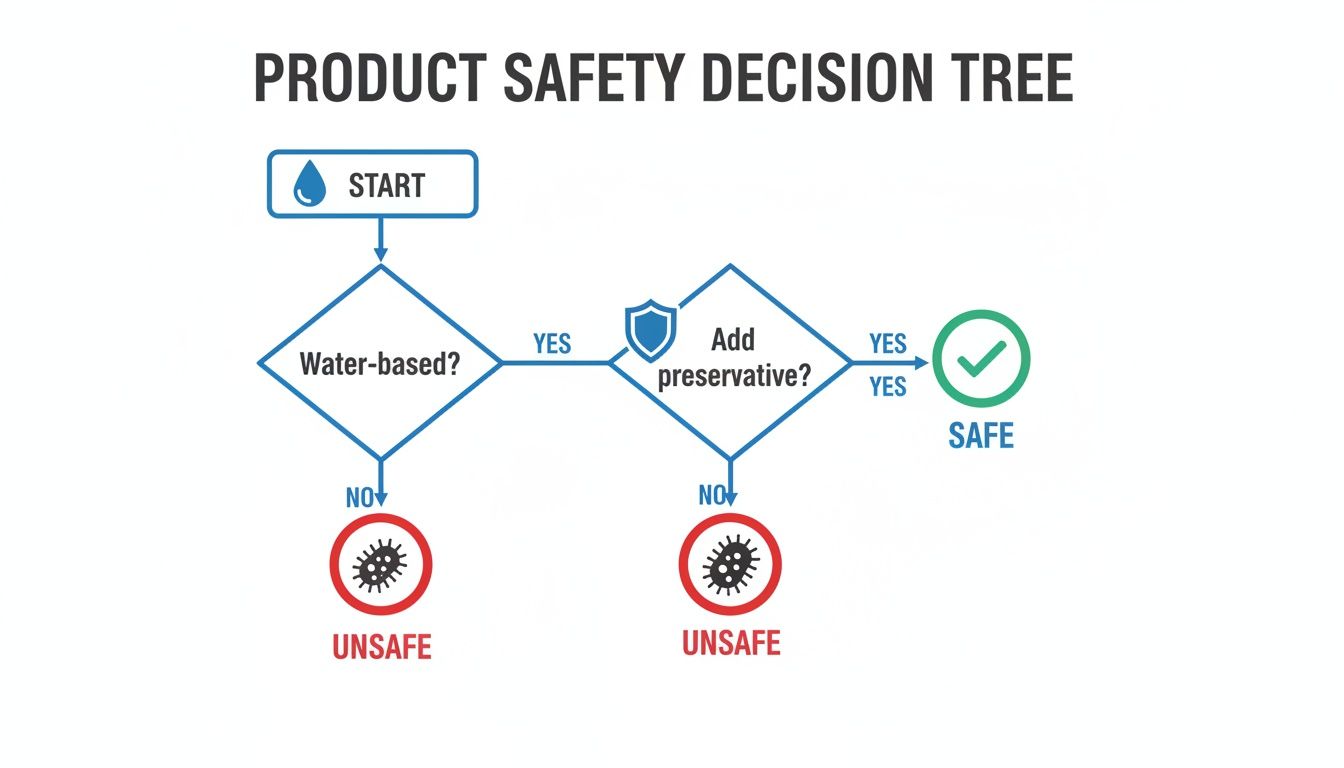
As you can see, the moment water enters the picture, a preservative system isn't just a good idea—it's non-negotiable for product safety.
Organic Acids and Their Salts
Organic acids are the seasoned veterans of natural preservation. Many, like benzoic acid and sorbic acid, have been used safely in the food industry for ages. They work by making the formula slightly acidic, creating an environment where most bacteria and mold just can't thrive.
Here's the catch, though: they are extremely pH-dependent. To do their job effectively, your final product's pH usually needs to be below 6.0. This makes them perfect for acidic formulas like vitamin C serums or certain lotions, but they won't cut it in higher-pH products. You'll often spot them on ingredient lists in their salt forms, like Sodium Benzoate and Potassium Sorbate, which are much easier to dissolve and work with.
Plant Extracts and Essential Oils
This is where preservation gets beautiful, often overlapping with ingredients that can improve the appearance of skin. Many botanicals and essential oils—think rosemary extract, aspen bark, or tea tree oil—are loaded with compounds that have natural properties that deter microbes.
It's super important to remember, however, that these are rarely potent enough to act as the sole preservative in a water-based product. They shine brightest as part of a "hurdle" system, where they act as boosters to beef up the primary preservative. This tag-team approach gives you rock-solid protection without having to use overly high levels of any one ingredient.
The real magic in modern green formulating is creating a synergistic blend of preservatives. This teamwork builds a much stronger defense against a wider range of microbes than any single ingredient could ever manage on its own.
Innovative Bio-Ferments and Peptides
Welcome to the new frontier of natural preservation. This category is all about ingredients created by fermenting good-for-you microorganisms, like those found on radishes or coconuts. This natural process creates powerful antimicrobial peptides that offer broad-spectrum protection.
A classic example is Leuconostoc/Radish Root Ferment Filtrate, which works by affecting the cell walls of unwanted microbes. A huge plus is that these bio-ferments are typically very gentle on the skin's own microbiome. Many even pull double-duty by offering skin-conditioning benefits, making them a smart, multi-functional choice for elegant formulas. You can see this tech in action in our Leucidal Liquid, derived from radish root.
The demand for these kinds of solutions is exploding. The market for natural cosmetic preservatives is expected to jump from USD 1,124.6 million to USD 2,831.8 million by 2034. This shift is happening because of people like you—consumers demanding clean, plant-based cosmetics.
A Practical Comparison for Formulators
To help you navigate the options, we've put together a handy cheat sheet of some of the most popular and effective natural preservative systems available to at-home formulators and indie brands.
Common Natural Preservative Systems for DIY Formulators
A detailed comparison of popular natural and eco-friendly preservative systems to guide your selection.
| Preservative System | Type | Effective pH Range | Typical Use Rate | Best For |
|---|---|---|---|---|
| Sodium Benzoate & Potassium Sorbate | Organic Acid Salts | Below 6.0 | 0.5% - 1.5% | Acidic serums, cleansers, and simple lotions. |
| Leucidal Liquid (Radish Root Ferment) | Bio-Ferment | 3.0 - 8.0 | 2.0% - 4.0% | A wide range of products, including gentle emulsions and serums. |
| Geogard ECT | Broad-Spectrum Blend | 3.0 - 8.0 | 0.6% - 1.0% | Lotions, creams, and surfactant-based products like shampoos. |
| Caprylhydroxamic Acid (and boosters) | Organic Acid / Chelator | 3.0 - 8.0 | 0.5% - 1.5% | High-performance emulsions, especially those with sensitive actives. |
Getting familiar with these different types and their sweet spots will help you confidently choose a preservative system that not only keeps your product safe but also fits perfectly with your formulation goals and brand ethos.
Navigating Industry Standards Like COSMOS and EWG
In the world of clean beauty, it's easy to get lost in a sea of marketing buzzwords. How do you actually know if a product or ingredient lines up with what you believe in? This is where third-party standards come in, acting as your guide to cut through all the noise.
Think of certifications like COSMOS and ratings from the Environmental Working Group (EWG) as your cheat sheets. They give you the power to make genuinely informed choices by providing a clear framework for what "natural" or "clean" really means, offering a level of transparency that goes far beyond a brand's own marketing claims.
When you spot a COSMOS-approved or ECOCERT logo on a natural cosmetic preservative, it means that ingredient has passed a seriously rigorous evaluation. This process looks at its entire life, from where it came from and how it was processed all the way to its environmental footprint.
Understanding COSMOS and ECOCERT
COSMOS (which stands for COSMetic Organic and natural Standard) is a huge international standard for organic and natural cosmetics. For a preservative to get their stamp of approval, it has to meet some very strict rules:
- Sustainable Sourcing: Ingredients must be sourced responsibly in a way that promotes biodiversity.
- Green Chemistry: The way they are made has to be environmentally friendly.
- No GMOs: Genetically modified organisms are a hard no.
These standards don't just guide formulators on what to use; they encourage a bigger-picture view of a product's lifecycle and its impact on the planet, reflecting broader industry sustainability efforts. This push for real transparency is totally reshaping the market.
This consumer-driven demand is a powerful force. Projections are showing a 25% growth in natural cosmetics across the globe in the next five years, mostly because people are demanding vegan, cruelty-free products and eco-certifications. Here in the U.S., plant-based preservatives now hold a 43.2% market share, driven by a desire to avoid certain synthetic options and a shift toward ingredients like potassium sorbate in high-end product lines.
The Role of the Environmental Working Group (EWG)
The Environmental Working Group adds another layer of insight with its EWG VERIFIED™ program and Skin Deep® database. The EWG isn't a certification body; it's a non-profit that digs into scientific studies and data to assess ingredients for safety.
The EWG's goal is to give consumers easy-to-understand safety ratings, helping them pick products formulated with their well-being in mind. Their ratings are on a simple 1-10 scale, where 1 is the best possible score.
For formulators like us, choosing EWG VERIFIED™ ingredients is a powerful way to build trust. It sends a clear signal that you're committed to using materials that have been thoroughly checked out for transparency and safety. This is especially key when picking out natural cosmetic preservatives, as it provides an outside check on an ingredient's profile. Learning about the standards behind EWG VERIFIED™ skincare brands can help you appreciate the high bar these products have to clear.
Ultimately, these standards empower you to look past the label and understand the real story behind your ingredients. They give you the confidence to select components that truly meet the high standards you set for your own skincare creations.
When you start formulating with powerful, high-performance ingredients like peptides and plant stem cells, your choice of natural preservative becomes more critical than ever. These sophisticated actives are the stars of your show, and the preservation system needs to be a supportive partner, not a disruptive one. The whole point is to create a stable, beautiful product where every single ingredient can work in harmony.
Think of it like being a master chef. You wouldn't take a delicate, incredibly expensive saffron and pair it with a harsh, overpowering spice that completely masks its unique flavor. It's the same idea with your formula—the preservative must protect it without getting in the way of your precious actives. This means you have to be smart about potential interactions and stability issues from the very beginning.
The Critical Role of pH Harmony
One of the most common hurdles is managing the formula’s pH level. A lot of high-performance actives, especially peptides, are incredibly finicky. They only stay stable and effective within a very specific pH range. For instance, some peptides need a near-neutral pH to do their job, but many natural preservatives based on organic acids need a lower, more acidic environment to work their magic.
This is a huge formulation puzzle you have to solve. If you crank the pH down just to activate your preservative, you might accidentally deactivate your star peptide, making it completely useless.
- Know Your Actives: First, figure out the ideal pH range for your peptides or stem cells. The supplier usually provides this crucial piece of information.
- Know Your Preservative: Next, check the effective pH range of the preservative system you want to use.
- Find the Sweet Spot: The goal is to pick a preservative that works comfortably within the pH range your active ingredients need to thrive.
This balancing act is everything. When you choose a natural preservative that operates happily in your active's comfort zone, you ensure both ingredients can coexist and perform their jobs perfectly.
Navigating Potential Stability Issues
Beyond just pH, some natural cosmetic preservatives can directly interact with other ingredients and throw off your product's texture and stability. Certain preservatives might carry an ionic charge that causes an emulsion to separate or makes a serum turn cloudy when you add in specific actives.
Creating advanced skincare is like building a winning sports team. Your preservative system is the goalie—its main job is defense, but it has to work seamlessly with everyone else. A goalie that constantly clashes with your star players can tank the whole game.
Have you ever added an ingredient and watched your beautifully smooth cream suddenly become grainy or thin out over a few days? That’s often a red flag for incompatibility between ingredients. It's important to remember that some plant extracts or fermented ingredients, while fantastic as preservatives, have complex profiles that might not play nicely with every active you want to use.
Tips for Successful High-Performance Formulations
To make sure your advanced formulas stay stable, effective, and elegant, you need a thoughtful game plan.
-
Choose Broad-Spectrum, Friendly Preservatives: Go for systems known for their wide pH range and good compatibility. Bio-ferments like Leucidal Liquid are often a fantastic choice for delicate formulas because they work across a broad pH spectrum (3.0-8.0) and are generally non-ionic, which lowers the risk of those unwanted reactions.
-
Introduce Ingredients in the Right Order: When you're putting your formula together, add your preservative during the correct phase (usually the cool-down phase for anything heat-sensitive). Make sure it's fully mixed in before you add your sensitive actives. This little step can help prevent immediate destabilization.
-
Always Do Small Batch Tests: Before you commit to a large batch, always make a small test version first. Watch it for several weeks. Look for any changes in color, smell, or texture. This is hands-down the best way to spot potential problems early on.
By carefully picking a natural preservative that lines up with the specific needs of your high-performance ingredients, you can create sophisticated, effective formulas with confidence. It’s this mindful approach that ensures your star actives are protected and can deliver the beautiful results you and your customers are looking for.
Best Practices for Safe and Effective Formulating
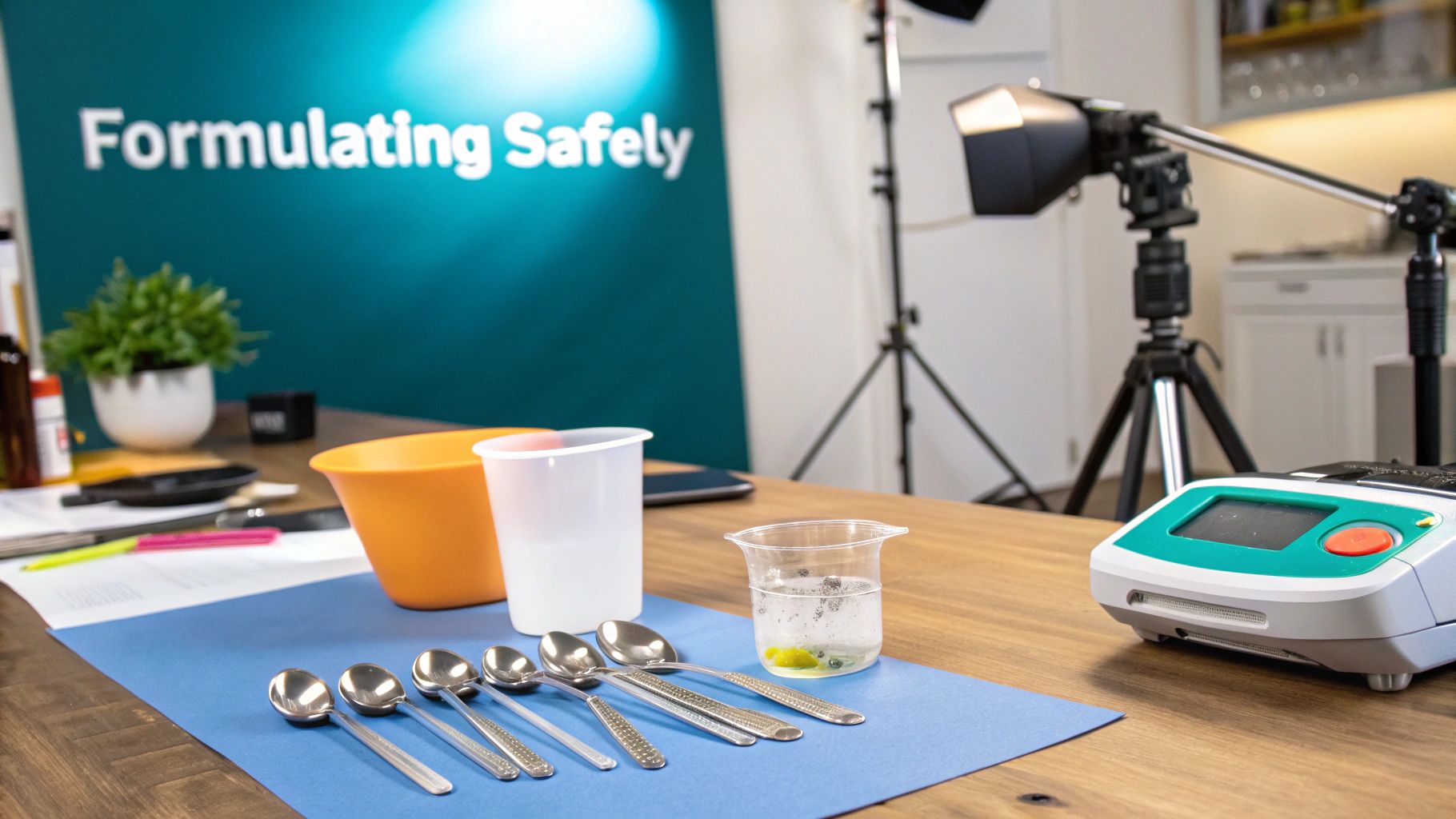
Making gorgeous, effective skincare is definitely a creative outlet, but it all starts with a solid foundation of clean, safe habits. You have to think of your workspace like a pristine lab—even if it's just a corner of your kitchen. Embracing a few key principles, known in the biz as Good Manufacturing Practices (GMP), is the real secret to making sure your products turn out safe, stable, and consistently amazing.
This isn't about being rigid or taking the fun out of it. It’s about setting yourself up for success from the very beginning. A few simple habits can make a huge difference in the quality of your final formula, minimizing any chance of contamination long before your preservative system even gets to work.
Your Clean Workspace Checklist
Meticulous hygiene is the absolute bedrock of safe formulating. Getting a handle on the essential ways to prevent cross-contamination isn't just a good idea; it's a non-negotiable first step. Before you even think about measuring an ingredient, get your environment ready.
- Sanitize Your Surfaces: Give your entire work area a thorough wipe-down with a 70% isopropyl alcohol solution. This quick step is fantastic for zapping any lingering microbes.
- Sterilize All Equipment: Every beaker, mixing rod, container, and spatula needs to be properly sanitized. A good soak in a bleach solution (followed by a very thorough rinse!) or a run through your dishwasher on a high-heat cycle does the trick.
- Wear Protective Gear: Always, always wear gloves. This protects your hands from potent raw ingredients and, just as importantly, protects your beautiful formula from the natural bacteria on your skin.
Good Manufacturing Practices aren't just for huge commercial labs. They are the fundamental habits that empower any creator—from a home DIY enthusiast to a professional esthetician—to produce high-quality, stable products with total confidence.
The Importance of Accurate Measurements
Precision is your absolute best friend when you're formulating. It might be tempting to grab your kitchen measuring spoons, but investing in a digital scale that measures to at least 0.01 grams is a total game-changer. This is the only way to ensure you're adding your natural preservatives at their exact recommended usage rate.
Adding too little preservative leaves your product wide open to contamination, but adding too much can throw off the texture or feel on the skin. Accuracy is the key to creating a perfectly balanced and effective product, every single time. For a deeper dive into techniques, exploring a solid guide on how to create skin care products can give you a fantastic foundation.
Mastering Your Formula's pH
The pH level of your final product is one of the most critical puzzle pieces for your preservative's success. A lot of natural preservatives, especially those based on organic acids, are only effective within a pretty specific pH range. If your formula’s pH is too high or too low, your preservative might as well not even be in there.
This makes pH testing an absolutely essential final step. After all your ingredients are combined, use pH strips or a digital meter to check the level. If it's not quite right, you can gently adjust it. A little citric acid solution can lower the pH, while a touch of baking soda solution can raise it. Just add a drop at a time, mixing and re-testing, until you hit that sweet spot your preservative system needs to do its job.
Frequently Asked Questions
When you start diving into the world of natural preservatives, a few questions always pop up. It's totally normal, especially when you're crafting your own beautiful formulas. Let's tackle some of the most common ones to get you formulating with total confidence.
Can I Use Vitamin E as My Only Preservative?
This is probably one of the most common questions in the DIY skincare community, and it's a super important one. The short answer is no. While Vitamin E (Tocopherol) is an amazing antioxidant, it's not a broad-spectrum preservative.
Think of it this way: antioxidants and preservatives have two completely different jobs. Vitamin E is like a bodyguard for your oils, protecting them from going rancid (oxidation). But it does absolutely nothing to stop bacteria, mold, or yeast from having a party in any water-based parts of your formula, like in lotions and serums. To keep those microbes out, you absolutely need a dedicated, broad-spectrum preservative system.
How Do I Know Which Natural Preservative Is Right for My Formula?
Picking the perfect preservative is a bit like being a matchmaker for your ingredients. You need to find one that fits your product's specific personality and needs.
Here’s what to keep in mind to find "the one":
- Final Product pH: First things first, what's the final pH of your product going to be? As we've covered, every preservative has a pH range where it's happiest and most effective. Make sure they're compatible.
- Ingredient Compatibility: Next, will it play nicely with others? Check for compatibility, especially with your high-performance actives like peptides. Some of those can be pretty fussy.
- Product Type: Finally, what are you making? A thick, creamy body butter will have different needs than a lightweight, watery facial toner.
The whole goal is to find a preservative that not only keeps your product safe but also works in perfect harmony with everything else in the bottle, letting your amazing formula shine.
My Naturally Preserved Cream Changed Color Slightly: Is It Spoiled?
Not necessarily! A slight, gradual shift in color or even scent can be perfectly normal, especially with natural formulas. Some plant-derived ingredients, including a few natural preservatives, can do this over time.
However, actual spoilage is much more dramatic and easy to spot. Be on high alert for any of these tell-tale signs:
- The product looks separated, curdled, or "puckered."
- It has a noticeably foul or "off" smell.
- You can see visible spots of mold growing on the surface or along the sides of the jar.
- The texture has changed in a major way, like becoming runny or grainy.
When in doubt, the safest bet is always to toss it. Sticking to Good Manufacturing Practices when you're creating is your best defense to make sure your product stays stable and beautiful from start to finish.
Here at Skin Perfection, our passion is providing you with top-quality, effective ingredients to help you create skincare that makes you feel confident and amazing. Take a look at our full lineup of lotion-making supplies and high-performance actives to bring your perfect formula to life.
Discover our collection of cosmetic ingredients and supplies at Natural Organic Skincare