

 Buy with Prime



When you're crafting beautiful, water-based skincare like lotions and serums, using an effective preservative isn't just a good idea—it's a critical safety measure. Natural preservatives are ingredients, usually from plants or other natural sources, that stop microbes from setting up camp in your products, keeping them fresh and stable for your customers.
Why Preservatives Are Essential in Cosmetics
Think about what happens when you leave a fresh piece of fruit on your kitchen counter. It doesn't take long for it to spoil, change color, and become a pretty unappealing mess. A cosmetic product made with water, like a face cream, acts a lot like that piece of fruit when it's left unprotected. It becomes the perfect home for all sorts of invisible contaminants.
Anytime you add water to a formula, you're rolling out the welcome mat for bacteria, yeast, and mold. These tiny microorganisms are everywhere—floating in the air, living on our skin, and hanging out on our equipment. Without a preservative, they can quickly turn your gorgeous creation into a contaminated mess.
The Role of a Preservative
A preservative’s job is basically to be a bouncer for your formula. It stands guard, making sure unwanted microbes can't multiply and throw a party. This isn't just about stopping a product from looking or smelling funky; it’s about keeping your customers safe.
The number one job of any preservative system is to protect the person using the product. It ensures the formula you’ve worked so hard on stays exactly as you intended, from the first pump to the very last drop.
This protective role is completely non-negotiable. Good natural preservatives for cosmetics hit several key goals:
- Maintain Product Freshness: They stop ingredients from breaking down, which prevents weird changes in color, texture, and scent.
- Extend Shelf Life: By keeping microbial growth in check, preservatives give your products a much longer, happier life.
- Ensure Consumer Safety: Most importantly, they protect people from putting contaminated products on their skin.
The Growing Demand for Natural Options
As people become more savvy about what they put on their bodies, the demand for effective, natural alternatives has exploded. Consumers want products that fit a cleaner, more transparent beauty philosophy. While keeping cosmetics safe is paramount, it's also smart to choose products that contribute to an overall sense of well-being, like exploring a guide to healthier nail care.
This isn't just a passing trend; it's a major market shift. The Natural Cosmetic Preservatives Market was valued at USD 1.5 billion and is on track to nearly double, hitting an estimated USD 2.8 billion by 2033. This incredible growth shows a clear global preference for cleaner ingredients over some traditional synthetic options. You can read more about these cosmetic industry insights. Getting a handle on this is the first step to picking the perfect preservative for your next creation.
A Practical Guide to Natural Preservative Types
Dipping your toes into the world of natural preservatives for cosmetics can feel a bit like learning a new language. With so many options out there, it's easy to get lost in the technical names and details. The trick is to stop seeing them as just a long list of ingredients and start thinking about them in groups based on how they actually work.
Think of it like putting together a top-notch security team for your new face cream. You wouldn't hire ten people who all do the exact same job. Instead, you’d want a diverse crew—some who are great at guarding the perimeter, some who are experts at internal monitoring, and others who specialize in handling specific threats. Natural preservatives are the same way; different types bring unique skills to the table to protect your formula.
This diagram really drives home why preservatives are a non-negotiable part of cosmetic safety. They are the essential shield standing between your beautiful formula and a world of potential contaminants.
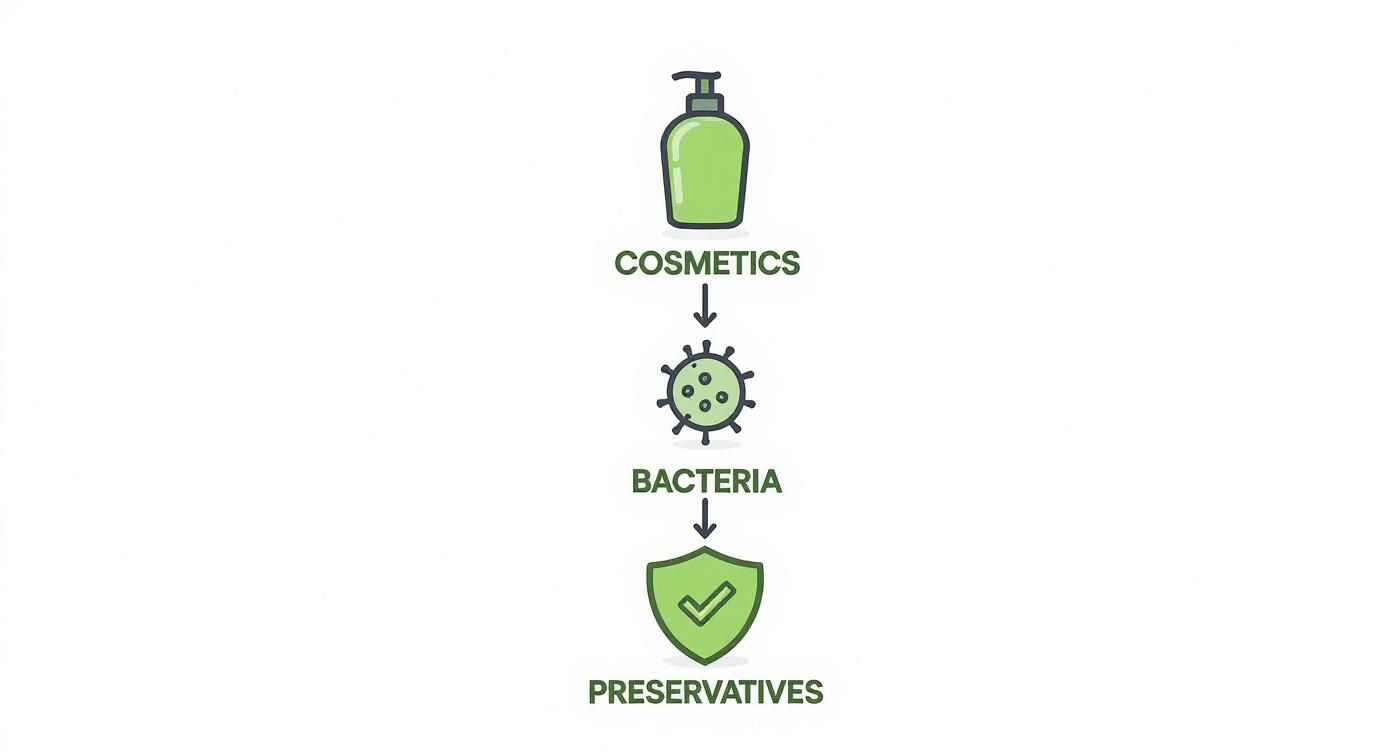
As you can see, preservatives are the barrier that keeps any product containing water safe and stable by stopping microbial growth in its tracks.
Organic Acids And Their Salts
One of the most common and reliable groups of natural preservatives you'll encounter are organic acids. Ingredients like benzoic acid, sorbic acid, and their handy salts (sodium benzoate, potassium sorbate) are absolute workhorses for natural formulators. Their main job is to create an environment where microbes just can't thrive.
Their strategy is pretty simple: they lower the pH of your formula, making it too acidic for most bacteria, yeast, and mold to set up shop. It's like trying to grow a rose bush in soil that’s way too acidic—it just won’t happen. Organic acids do this on a microscopic scale, messing with the internal environment of microbes until they can't function or multiply.
This is a fast-growing market. The demand for natural preservatives, including these acids and alcohols, was valued at around $1.12 billion and is projected to hit nearly $2.83 billion by 2034. It's all thanks to shoppers like you looking for alternatives to some of the old-school synthetic options.
Specialized Alcohols And Glycols
Next up are certain types of alcohols and glycols, like benzyl alcohol, phenoxyethanol (often called 'nature-identical'), and glycols such as caprylyl glycol. These guys work by getting up close and personal with microorganisms, disrupting their cell membranes.
Picture a microbe's cell wall as a protective bubble. These alcohols act like tiny pins, poking holes in that bubble until it falls apart. This approach is really effective against a broad range of bacteria and yeast, which makes them a super valuable part of any preservative system. Plus, many of them pull double duty, also acting as solvents or skin-conditioning agents.
Plant-Derived Extracts And Ferments
Of course, the power of plants extends into preservation, too. Ingredients pulled from botanical sources—think rosemary extract, aspen bark extract, or radish root ferment filtrate (you might know it as Leucidal Liquid)—bring their natural microbial-controlling and antioxidant powers to your formulas.
These extracts are often a complex mix of compounds that work as a team to stop microbial growth. For instance, ferment-based preservatives contain peptides with properties that make them useful against microbes. It’s almost like harnessing a plant's own defense system, refining it, and putting it to work in your cosmetic creations.
For anyone committed to ditching certain synthetic compounds, checking out various paraben-free shampoo options is a great place to start. Understanding these plant-based alternatives is key to making that switch.
Comparing Popular Natural Cosmetic Preservatives
To make things a bit easier, it really helps to see the options laid out side-by-side. The truth is, different natural preservatives are superstars in different types of products. Picking the right one really boils down to the specific details of your formula. You can browse a great selection of preservatives on our site to find the perfect fit for your next project.
To give you a head start, here’s a quick-reference table comparing some of the most popular choices out there.
| Preservative Name | Type (e.g., Organic Acid, Plant Extract) | Effective pH Range | Typical Usage Level | Ideal For (e.g., Lotions, Serums, Washes) |
|---|---|---|---|---|
| Sodium Benzoate | Organic Acid Salt | Below 6.0 | 0.1% - 1.0% | Toners, Gels, Serums, Washes |
| Potassium Sorbate | Organic Acid Salt | Below 6.0 | 0.1% - 0.5% | Lotions, Creams, Washes |
| Benzyl Alcohol | Aromatic Alcohol | Broad (3.0 - 10.0) | 0.5% - 2.0% | Creams, Lotions, Serums |
| Radish Root Ferment Filtrate | Plant-Derived Ferment | 3.0 - 8.0 | 2.0% - 4.0% | Lotions, Creams, Water-based formulas |
| Gluconolactone & Sodium Benzoate | Polyhydroxy Acid & Salt | 3.0 - 6.0 | 0.75% - 2.0% | Emulsions, Shampoos, Conditioners |
This table makes it clear just how much the little details matter. A preservative that’s perfect for a slightly acidic facial serum could be totally useless in a cleanser with a higher pH. Getting a handle on these nuances is the first real step to mastering the art of natural preservation.
How Natural Preservative Systems Keep Your Products Safe

Thinking about how natural preservatives for cosmetics actually work is a bit like learning the defensive strategy for a fortress. It’s never about one single, massive wall. Instead, it’s a smart, layered system designed to stop invaders—in this case, microbes—before they can even think about causing trouble.
These ingredients use some pretty clever tactics to keep your water-based formulas fresh and safe. Some work by changing the environment to make it totally uninviting for unwanted organisms, while others get right in there and mess with the functions of bacteria, yeast, and mold. Once you get the hang of these mechanisms, you can move beyond just tossing in a single preservative and start building genuinely solid protection into your products.
The Goal: Broad-Spectrum Protection
In the world of cosmetic preservation, the gold standard is achieving broad-spectrum protection. Think of it as having a security system that’s ready for any kind of threat. When it comes to your formulas, the main culprits you’re guarding against are bacteria, yeast, and mold.
Each of these troublemakers has different strengths and weaknesses. A preservative that’s a rockstar at stopping bacteria might do absolutely nothing against mold.
A truly protected product is one that’s defended on all fronts. Relying on an ingredient that only targets one type of microbe leaves your formula vulnerable to others, which is why broad-spectrum activity is non-negotiable for any water-containing cosmetic.
This is exactly why so many modern natural preservatives are actually blends of different ingredients. Each component is hand-picked for its specific talents, and together they create a powerful, multi-pronged defense system that covers all the bases. This approach ensures your beautiful creations stay perfect from the very first pump to the last drop.
A Smarter Strategy: Hurdle Technology
One of the most effective strategies we use in natural preservation is something called hurdle technology. Picture an intruder trying to breach a medieval castle. They don’t just face one giant wall; they have to cross a moat, climb an outer wall, get past the guards, and then tackle an inner wall. Each obstacle, or "hurdle," makes their mission progressively harder, if not impossible.
Hurdle technology applies this very same idea to your cosmetic formula. Instead of relying on a single, high-dose preservative to do all the heavy lifting, you create a series of smaller, gentler hurdles that work in tandem to stop microbial growth in its tracks.
This multi-pronged defense can involve several elements working together:
- A Blend of Preservatives: Using multiple ingredients that target different microbes. For instance, some ferment-based ingredients, like those in Leucidal SF Complete, bring a unique approach to broad-spectrum protection.
- Controlling pH: Tweaking the formula’s pH to a level that naturally makes it difficult for microbes to grow.
- Using Chelating Agents: These ingredients are like magnets for the metal ions that microbes need to survive, essentially cutting off their food supply.
- Smart Packaging: Choosing airless pumps or tubes instead of open jars to minimize contamination from fingers and the air every time the product is used.
By combining these hurdles, you create an environment where it's incredibly difficult for any microorganism to survive, let alone thrive. This method lets you preserve your product effectively, often with lower concentrations of preservatives, which leads to milder, more elegant formulas. It’s the perfect example of working smarter, not harder, to keep your products in pristine condition.
Choosing the Right Natural Preservative for Your Formula
Picking the right natural preservatives for cosmetics feels a lot like choosing the right tires for a car. You wouldn't put monster truck tires on a sleek sports car, right? And you definitely wouldn't use racing slicks for a snowy winter road trip. The best choice always comes down to the specific vehicle and the conditions it’s going to face.
It's the same story with your cosmetic formula. The perfect preservative is the one that's perfectly matched to your product’s unique environment. Things like the pH level, the mix of oil and water, and even the jar you put it in all play a massive part in which preservative will actually get the job done.
Why Your Formula’s pH Is a Critical Factor
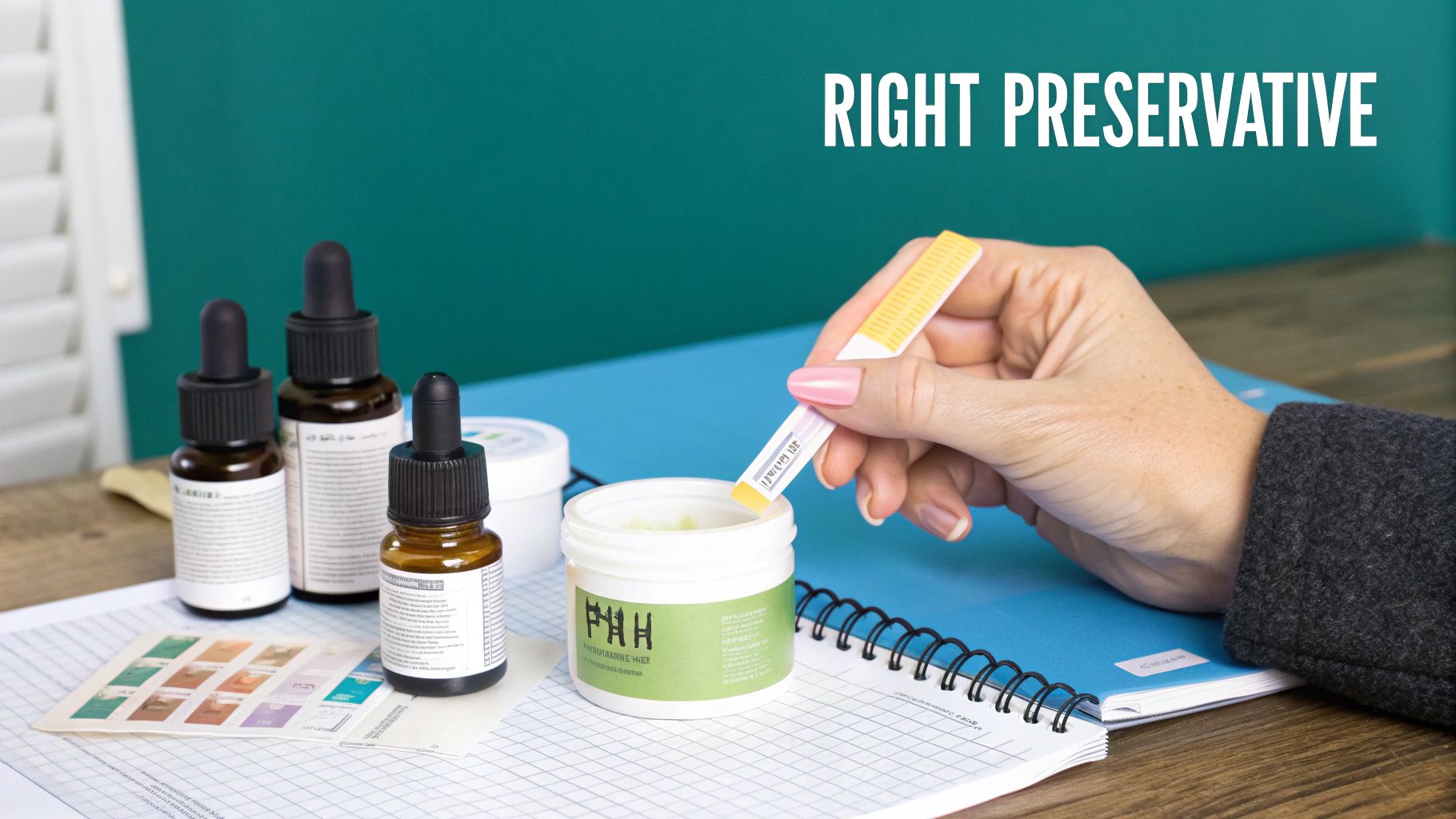
If there's one thing you need to get right, it's the pH of your product. This is probably the single most important factor in your decision. Many natural preservative systems, especially the ones based on organic acids, only work their magic within a very specific pH window. If your formula’s pH is outside that sweet spot, the preservative might as well not even be there.
Think of it like a key and a lock. The preservative is the key, and it’s cut to fit a very specific pH range—that’s the lock. If the pH is too high or too low, the key simply won't turn. The lock won't open, and your product will be left completely unprotected.
A preservative that works beautifully in a low-pH toner (around 4.5) might be completely ineffective in a neutral-pH cream (around 6.5). This is why testing and adjusting your formula's final pH is a non-negotiable step in the creation process.
Always, always check the supplier's info for the recommended effective pH range and make sure your final product lands comfortably within it.
Matching Preservatives to Product Type
The kind of product you're whipping up will heavily steer your preservative choice. The balance of water and oil in your formula creates different battlegrounds for preservation.
Here's a quick guide for common product types:
- Water-Based Serums and Toners: These are mostly water, which is basically a playground for microbes. They are super susceptible to going bad and need a water-soluble, broad-spectrum preservative that’s effective at the product's final pH.
- Emulsions like Lotions and Creams: These are a bit trickier, with their mix of oil and water. Your preservative has to be able to protect the water phase (where microbial growth loves to happen) without being thrown off by the oils or emulsifiers.
- Anhydrous (Water-Free) Products: Things like body butters or oil balms don't really need a traditional preservative because there’s no water for microbes to multiply in. They can, however, benefit from an antioxidant like Vitamin E to keep the oils from going rancid.
For lotions, creams, and any water-based product, you need a strong defense. Many formulators find success using pre-blended preservatives designed for broad-spectrum protection. A popular and really effective choice is a blend of Gluconolactone and Sodium Benzoate. It's a globally-accepted system known for its great performance across a huge range of skincare products. You can learn more about how a GSB Natural Preservative Powder works in our product guide.
The Overlooked Impact of Packaging
Don’t forget about packaging! The container you choose can either help or hurt your preservation strategy. The more a product is exposed to air and fingers, the more of a challenge you're giving your preservative.
- Open Jars: These are the riskiest containers, hands down. Every single time someone dips their fingers in, they're introducing new contaminants. Products in jars need the toughest, most robust preservative system you can find.
- Tubes and Bottles with Pumps: These are a much better choice because they limit direct contact and air exposure. This seriously cuts down on the microbial load you’re asking your preservative to handle.
- Airless Pumps: This is the gold standard. An airless pump almost completely prevents your product from being exposed to outside germs, helping your preservative work more efficiently and keeping your formula fresher, longer.
Choosing an airless pump can be a smart part of your overall "hurdle technology" approach, adding another layer of defense that helps your natural preservative system shine. Taking the time to think through these factors—pH, product type, and packaging—will set you up to make smart, effective choices that keep your creations safe.
Let's cut through the noise. When you're diving into the world of natural cosmetic preservatives, it feels like you're navigating a minefield of misinformation. Well-meaning advice and popular blogs often spread myths that, at best, lead to spoiled products and, at worst, create totally unsafe formulas. It's time to clear the air and tackle these misconceptions head-on.
Getting the facts straight is more important than ever. The demand for natural options has exploded, with the global market for these ingredients currently sitting at around $2 billion. It's projected to grow at a steady clip of about 6% each year for the foreseeable future. Despite the learning curve, ongoing advancements are making these ingredients better and more reliable every day. Discover more insights about the natural preservatives market.
Myth 1: Vitamin E Is a Preservative
This is probably one of the most persistent—and dangerous—myths in the DIY skincare community. While Vitamin E (tocopherol) is a fantastic antioxidant, it is absolutely not a preservative.
Here's the difference: an antioxidant's job is to slow down oxidation, which is what makes the oils in your formula go rancid. Think of it as keeping the fatty parts of your product fresh. But it has zero power to stop the growth of bacteria, mold, or yeast.
Key Takeaway: Use Vitamin E to extend the shelf life of your oils, but never rely on it to protect your water-based products from microbial contamination. A formula containing water that only uses Vitamin E for protection is, plain and simple, an unpreserved product.
Myth 2: Grapefruit Seed Extract Is a Standalone Solution
Grafruit Seed Extract (GSE) has a pretty complicated backstory. For years, it was hyped up as a powerful natural preservative. The problem? Studies eventually revealed that the real microbial-controlling muscle in many commercial GSE products came from synthetic disinfectants that were added during processing—not from the extract itself.
While pure, unadulterated GSE does have some mild properties that affect microbes, it just isn't potent or reliable enough to provide the broad-spectrum protection your cosmetics need to be safe. Leaning on it as your only defense is a huge gamble.
Myth 3: Natural Always Means Weaker
There's a lingering belief that natural preservatives are just inherently less effective than their synthetic cousins. This just isn't true. When you choose the right natural system for your formula's pH and type—and use it at the correct concentration—modern natural preservatives are incredibly effective.
The secret is understanding that natural preservation often uses a "hurdle technology" approach. It's about creating a team of ingredients that work together to make an environment so hostile that microbes simply can't survive. It’s a different game plan, but the end result is the same: a safe, stable product.
- Effective Blends: Many suppliers now offer pre-blended natural preservative systems that have already been challenge-tested for broad-spectrum activity.
- pH is Paramount: Natural options like organic acids are total powerhouses, but only if you keep them within their specific effective pH range. Get the pH wrong, and they won't work.
- Proper Usage: Following the supplier's guidelines on usage rates is non-negotiable. This isn't a place for guesswork.
Dismissing natural options as "weak" overlooks the clever science that makes them work. Once you let go of these old myths, you can start confidently creating products that are both natural and safely preserved.
Burning Questions Answered
Diving into the world of natural preservatives for cosmetics can feel a bit overwhelming. There are so many nuances, especially when your goal is to create products that are both safe and stable. We get it. Let's tackle some of the most common questions we hear from formulators, whether you're just starting out or have been at it for years.
Do Oil-Based Products Need a Preservative?
Generally, no. Anhydrous (that’s the fancy term for water-free) products like body butters, facial oils, or balms don't typically need a broad-spectrum preservative. Microbes—the unwanted stuff like bacteria and mold—need water to multiply. No water, no party.
But, and this is a big but, you have to think about how the product will be used in the real world. Is there any chance water might sneak in? For example, someone scooping out a body butter with wet fingers after a shower. That's all it takes to introduce contamination.
In those situations, while you might not need a full-blown preservative, adding an antioxidant like Vitamin E is a smart move. It won't stop bacteria or mold, but it will keep your beautiful oils from going rancid and developing that off-smell.
How Can I Tell If My Preservative Is Working?
The gold standard, no-questions-asked method is a professional microbial challenge test, often called a Preservative Efficacy Test (PET). This is what the big brands do to ensure their products are 100% safe for the shelf. It's the only way to know for sure.
For those of us crafting at home, our eyes and nose are our best tools. You'll need to be on high alert for the tell-tale signs of a formula gone wrong:
- Visible mold. It might look like fuzzy spots on the surface or creeping up the sides of the jar.
- A weird smell. If your product starts to smell "off" or just plain funky, something's not right.
- Funky changes. Has the color gone weird or the texture changed unexpectedly? That’s a major red flag.
Your best defense is to follow your supplier's guidelines to the letter. Sticking to the recommended usage rates and pH ranges gives your preservative the best possible chance to do its job.
Can I Combine Different Natural Preservatives?
Absolutely! In fact, this is one of the smartest strategies you can use. Blending different natural preservatives is the secret behind what formulators call "hurdle technology."
Think of it like building a fortress. Each preservative creates a different "hurdle" or obstacle that microbes have to overcome. By combining them, you create a much tougher environment for any single type of bacteria or mold to survive in. It's a powerful way to create really robust, broad-spectrum protection.
To make things easier, many suppliers now offer pre-made natural preservative blends that have been expertly mixed and tested, taking a lot of the guesswork out of the equation for you.
Are Natural Preservatives as Strong as Synthetic Ones?
When used correctly, a natural preservative system can absolutely be just as effective as a synthetic one. The game-changer here is knowledge. You have to know your stuff.
Sure, some synthetic options are famous for being incredibly potent at tiny concentrations. But a well-designed natural system—used at the right concentration, in the right pH range, and maybe even combined with other hurdles—provides fantastic protection. Success isn't about natural vs. synthetic; it's about understanding your ingredients and how they all play together in your unique formula.
At Skin Perfection, we provide high-quality lotion-making supplies and skincare ingredients to help you create beautiful, effective products with confidence. Explore our full range of supplies at https://www.naturalorganicskincare.com.