

 Buy with Prime



Choosing a natural or peptide serum isn't enough to protect sensitive eyes. Neither is a paraben-free label. The better way to choose an eyelash growth serum for sensitive eyes is to screen your eye health first, identify the ingredient class, and judge tolerance separately from how your lashes look.
A cosmetic serum may condition lashes and help them appear fuller without providing the same evidence as a prescription treatment. That distinction matters: a more noticeable cosmetic result isn't worth persistent dryness, irritated eyelids, or changes in vision.
Table of Contents
- Check Your Eyes Before Buying a Serum
- Ingredients That Matter for Sensitive Eyes
- How to Patch Test and Apply a Lash Serum Safely
- How Often to Apply and How to Track Results
- Symptoms That Mean Stop and Get Advice
- Gentle DIY Routines, Product Features and Starting a Trial
Check Your Eyes Before Buying a Serum
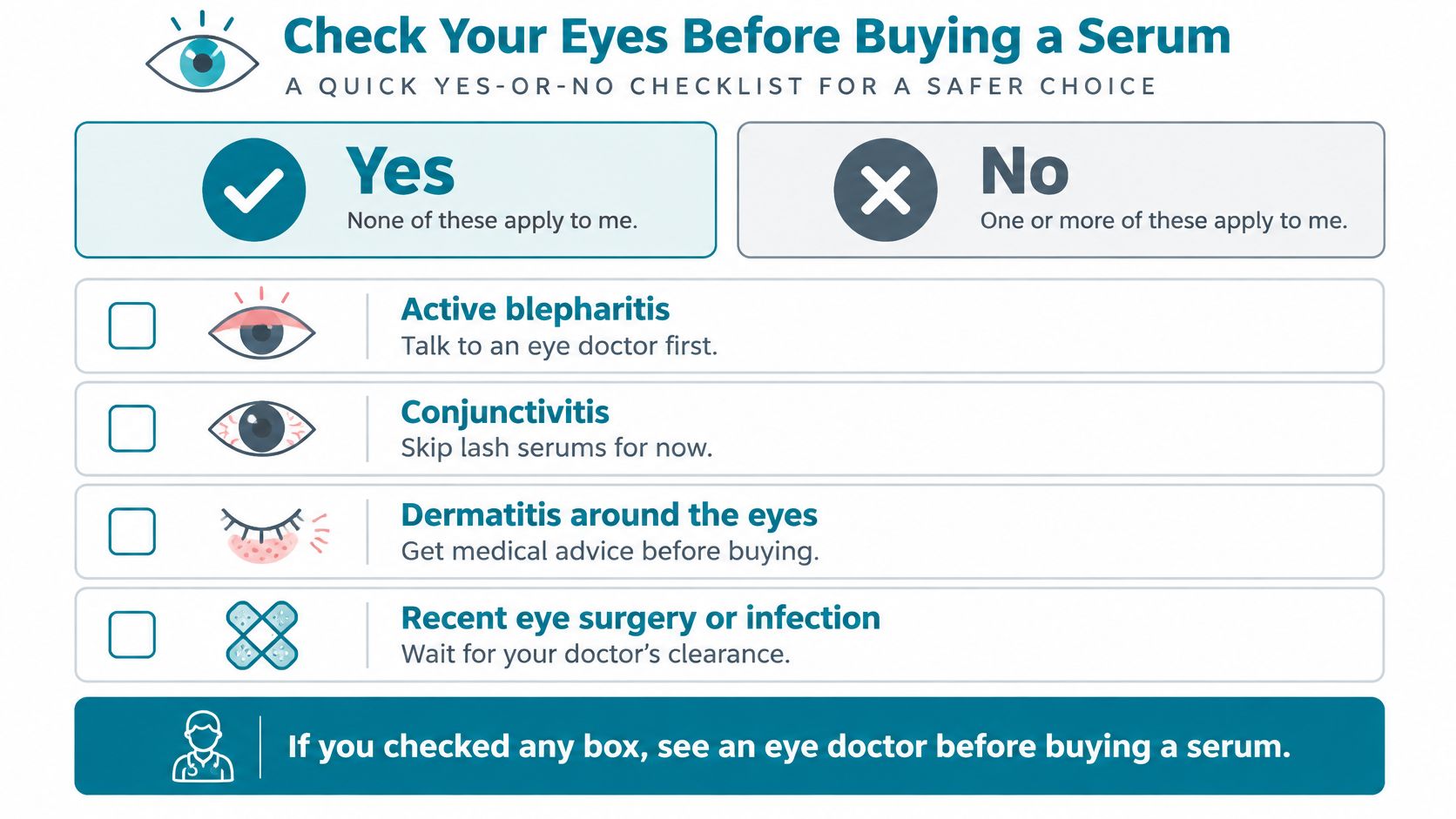
Any yes on this checklist means pause your purchase and get ophthalmic guidance before testing a serum. Don't use a skin patch test to overrule an existing eye problem.
A quick yes-or-no screen
- Current eye conditions: Do you have active blepharitis, conjunctivitis, dermatitis around your eyes, or unexplained redness? Have you recently had eye surgery or an eye infection without clearance to resume eye cosmetics?
- Medications and history: Do you use glaucoma medication, or have a history of uveitis, macular disease, chronic dry eye, or ocular-surface inflammation? Do you wear contact lenses and already struggle with their comfort?
- Symptoms you already have: Are your eyes gritty, itchy, unusually watery, painful, persistently dry, or producing discharge? Have you noticed an unexplained change in vision?
The FDA clinical review of bimatoprost documents reactions including itching, conjunctival redness, irritation, dry-eye symptoms, eyelid redness, and skin hyperpigmentation. These are important considerations when your eyes already feel uncomfortable, not minor details to weigh after buying.
Skin sensitivity isn't the same as eye sensitivity
Skin that reacts to a fragranced moisturizer presents a different problem from an ocular surface that feels dry or inflamed. You can have either problem without the other, and tolerating a facial serum doesn't establish that you'll tolerate a lash-line product.
Our essential skincare tips for sensitive skin can help simplify your surrounding routine. Keep that routine stable while deciding whether a lash product belongs in it, so you're not sorting through several new products if discomfort develops.
For contact-lens wearers, tell your eye doctor which lenses, cleaning solution, and eye cosmetics you use. Lens comfort is part of the decision, not a separate issue to ignore until application day.
Practical rule: Start with comfortable eyes, not with a serum you hope your eyes will learn to tolerate.
If every answer is no, you can consider ingredient screening and a cautious patch test. A clear checklist doesn't certify a product as safe; it means you haven't identified an obvious reason to postpone testing.
Ingredients That Matter for Sensitive Eyes
Use this table before buying, rather than relying on the product name. For a self-directed sensitive-eye routine, I would exclude prostaglandin analogues and assess the complete formula of any remaining option. A natural, peptide, or paraben-free label tells you what marketing claims the brand chose to lead with. It says nothing about how the finished formula will sit on a reactive lash line, so screen by ingredient class instead.
Ingredient groups and how they fit sensitive eyes
| Ingredient group | Examples | Sensitive-eye stance | What to check on the label |
|---|---|---|---|
| Prostaglandin analogues | Bimatoprost, latanoprost, and other names ending in -prost or -prostone | Avoid for a self-directed sensitive-eye trial | Any -prost or -prostone name; don't assume this catches every analogue |
| Peptides | Myristoyl Pentapeptide-17, Myristoyl Hexapeptide-16, Biotinoyl Tripeptide-1 | Lower-risk starting category, still patch test | Full ingredient list and the vehicle the peptides sit in |
| Conditioning bases | Glycerin, panthenol, biotin | Usually gentle, not automatically tolerated | Whether fragrance is also listed |
| Plant extracts and carrier oils | Botanical extracts, plant oils, castor oil | Tolerance differs; oils can migrate toward the eye | Whether oils appear near the top of the list |
| Fragrance and essential oils | Parfum, rosemary, clary sage, bergamot | Avoid near sensitive eyes | Any fragrance or essential oil entry |
| Preservatives | Parabens, phenoxyethanol and similar | Check personal tolerance | Which preservative system is used and whether you've reacted to it before |
Weigh evidence against the ingredient's risks
Bimatoprost is a prescription eyelash treatment with its own studied risk profile. The American Academy of Ophthalmology's Latisse guidance describes relevant risks, including redness, irritation, pigmentation changes, and changes around the eyes.
A cosmetic containing another prostaglandin analogue isn't interchangeable with that prescription product. Don't transfer evidence from a studied medicine to a different ingredient or an unstudied finished formula.
Peptides offer a different cosmetic approach. Treat them as a screening category rather than a certification of safety: comparative trials of popular peptide and botanical serums remain limited, and solvents, extracts, fragrance, and preservatives still shape tolerance. The same logic applies to preservatives. I would choose a formula whose preservative system you can identify and have tolerated before, since packaging and contamination control still matter when a label says the product contains none.
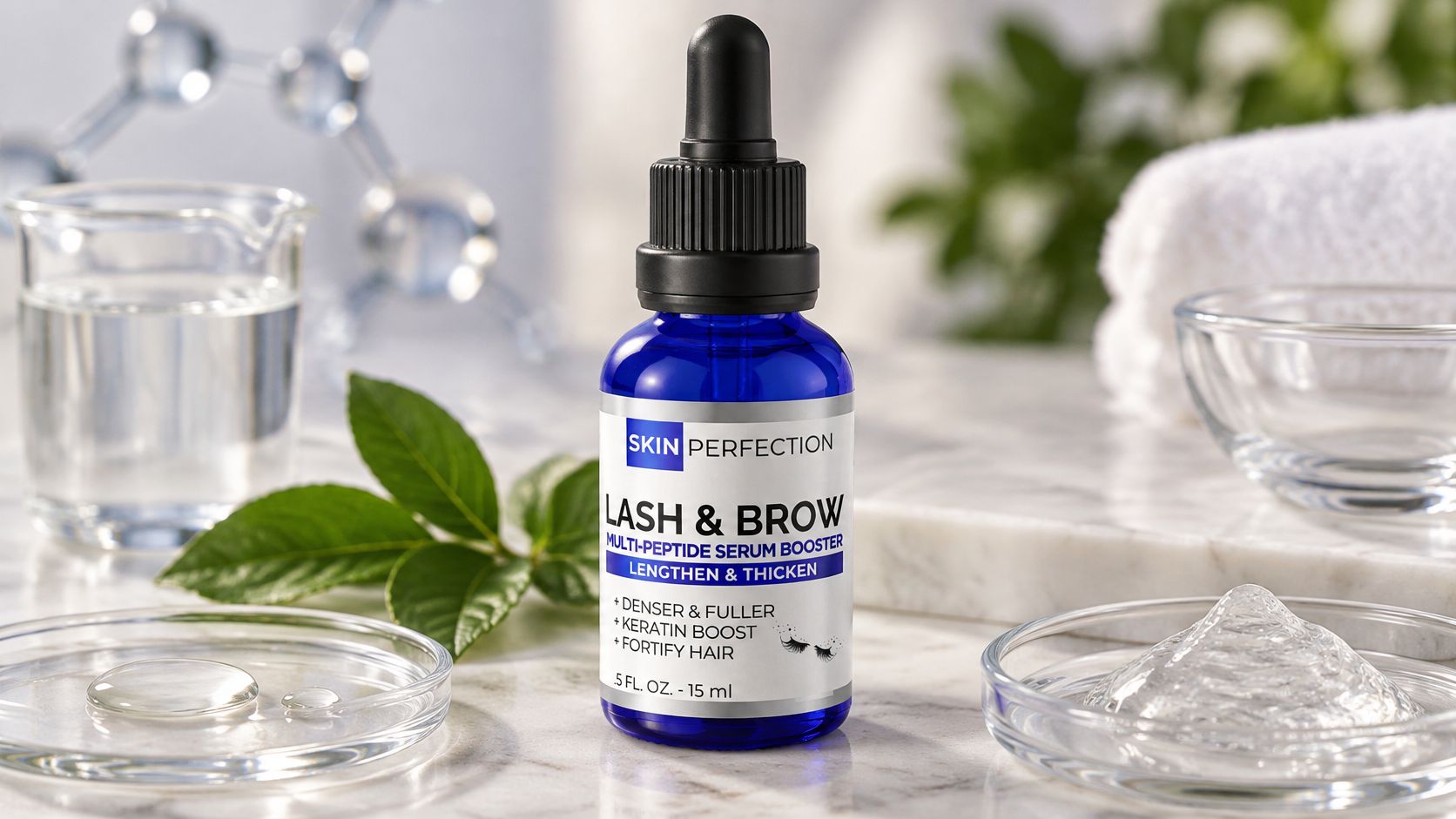
For a concrete example, our Eyelash Peptide for Lashes and Brows is a peptide ingredient for custom lash and brow blends. Read its preparation directions and incorporate it into a suitable base before use, then apply the same label screening to whatever base you choose.
Read beyond the headline ingredient
Ingredients are generally listed in descending order of concentration, with exceptions for lower-level ingredients. Position helps you understand the base, but it can't tell you the exact dose or whether a small amount will trigger a reaction. Our guide to reading an INCI skincare label explains the naming conventions, so entries like -prost endings, parfum, and individual peptide names are easier to spot.
If you wear lenses, Style Site Optical's South Florida guide to gentle contacts offers context for discussing lens comfort with your eye-care professional. A comfortable lens choice doesn't establish serum compatibility, so keep those decisions separate.
How to Patch Test and Apply a Lash Serum Safely
A home patch test checks skin tolerance alone, and a clear result on your forearm leaves the question of eye tolerance open. The American Academy of Ophthalmology's answer on eyelash-serum safety notes the lack of scientific studies establishing the safety or effectiveness of cosmetic eyelash serums generally.
That uncertainty argues for a light hand. Choose a finished product intended for the lash area, or a properly formulated blend with clear instructions.
Keep the application small and controlled
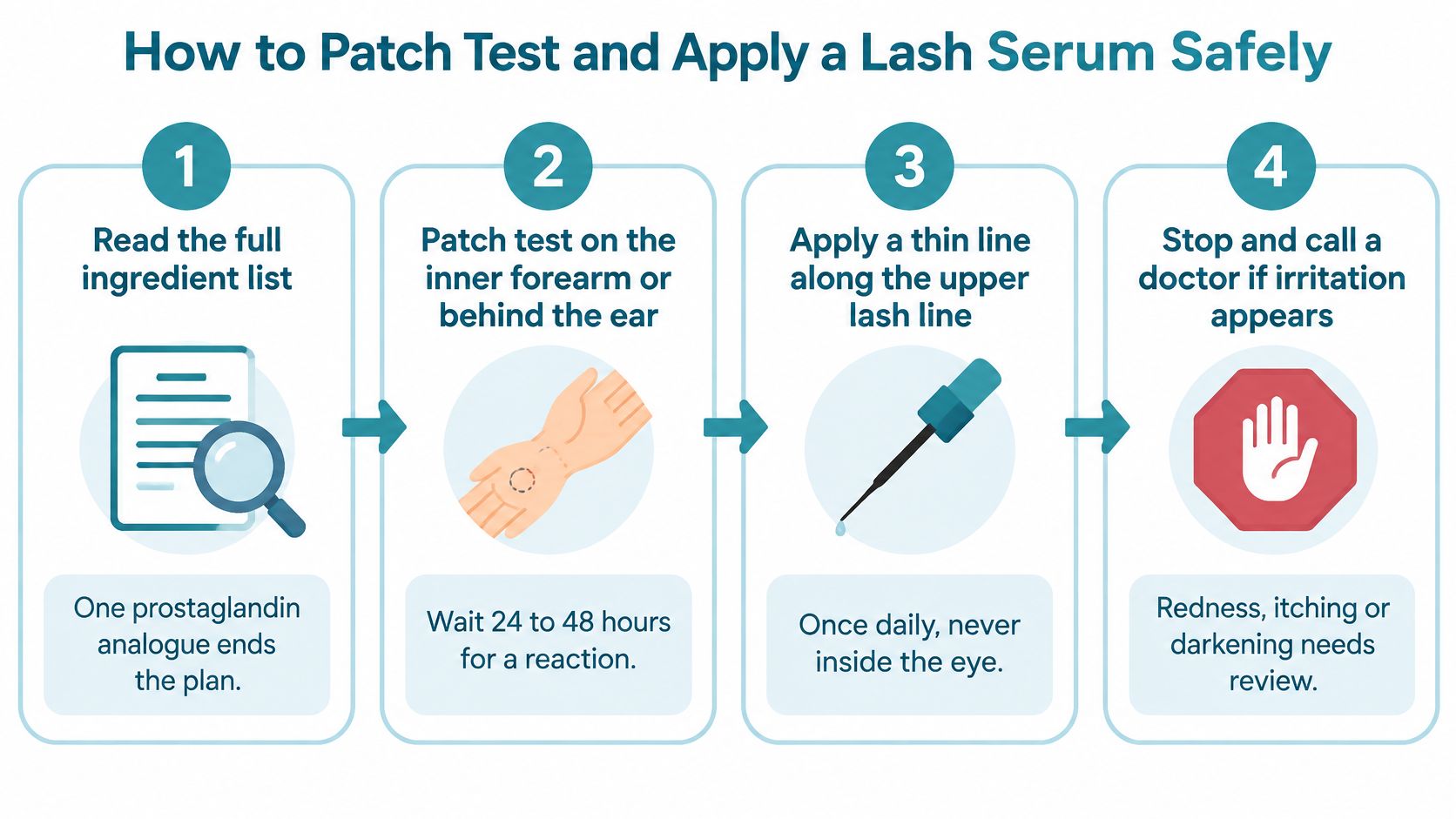
- Read the complete ingredient list before opening. Work each entry through the ingredient checks above, matching it against your history of reactions instead of trusting a peptide, natural, or paraben-free label.
- Patch test on the inner forearm or behind the ear once daily for three to five days, unless the manufacturer specifies a different protocol. Don't advance after an uneventful first application; a clear skin test still says nothing certain about tear-film tolerance.
- Wash your hands, remove makeup, and let the lash line dry completely. Applying over a wet lid or residual cleanser makes the product harder to control and can encourage it to spread toward the eye.
- Use a fine brush to draw a small, thin layer once daily on the skin immediately above the upper lash roots. Keep it off the wet inner lid margin and lower lid; adding another layer won't make the application more effective or more appropriate for sensitive eyes.
- Blot any excess with a clean tissue. Don't leave a visible bead at the inner or outer corner, where blinking or rubbing can move it toward the eye.
- Close the bottle promptly and follow its storage and refrigeration directions. Discard it when it passes its stated date or changes texture, appearance, or smell, rather than trying to salvage it by adding water.
- Stop applying and check the symptom table below whenever anything feels wrong. Keep the bottle and label ready for your eye doctor so they can see exactly what you used.
Avoid the small mistakes that increase exposure
Remove contact lenses before application and follow the finished product's instructions about reinsertion. Don't guess a waiting period, especially if your lenses already feel dry by the end of the day.
Keep the applicator from touching your eyeball, fingers, or bathroom counter. Never share it, and don't return a visibly contaminated brush to the bottle. A clean-looking container isn't proof that its contents remain suitable for use.
A passed patch test still requires watching your eyes.
Our lash-serum application guide provides additional technique guidance. The useful habit is precision: a dry application surface, a controlled amount, and no extra product pooling at the corners.
If serum enters the eye, rinse it out with clean water and stop the application. Seek professional advice if discomfort continues, and don't apply more that evening to replace what you rinsed away.
How Often to Apply and How to Track Results
Keep the routine to one application daily, not repeated applications whenever you remember the bottle. Treat missed use as something to record, not something to compensate for with extra product.
Set a review schedule before starting
Use an eight-to-twelve-week observation window as a practical monitoring plan, not a promised results deadline. Take baseline photographs, repeat them every two weeks, and keep the lighting, camera distance, angle, and absence of mascara consistent.
- Early weeks: Complete patch checks, establish careful application, and log comfort daily.
- First comparison: At week four, look for consistent appearance changes rather than interpreting every loose lash.
- Full review: At weeks eight to twelve, decide whether the cosmetic benefit justifies continuing, provided your eyes remain comfortable.
The FDA prescribing information for bimatoprost warns that iris pigmentation may be permanent. Your monitoring therefore needs to include changes around and within the eye, not just a flattering photograph.
Separate appearance from tolerance
Score redness, itching, dryness, swelling, and pigment change individually. A simple personal scale runs from zero for absent to three for marked; it's an organizing tool, not a diagnostic assessment.
| Date | Applied yes or no | Symptom scores | Photo taken | Notes |
|---|---|---|---|---|
| Baseline | No | Record each symptom separately | Yes | No mascara; note existing discomfort |
| Application day | Yes or no | Redness, itching, dryness, swelling, pigment change | When scheduled | Note rubbing, lens discomfort, or missed use |
| Review day | Yes or no | Compare each symptom with baseline | Yes | Record appearance and comfort separately |
Judge length, thickness, darkness, and overall fullness as separate observations. Conditioning can improve the fuller-looking appearance of lashes without demonstrating biological growth, and another person's photograph doesn't predict your response. Our eyelash-serum before-and-after guide helps make photo comparisons more consistent.
For context, a pooled Phase 3 analysis found that prescription bimatoprost 0.03% produced a 25% mean eyelash-length increase versus 2% with vehicle at week 16. That's a medicine-specific benchmark, not a cosmetic-serum promise.
A 2024 open-label cosmetic trial in the Journal of Cosmetic Dermatology enrolled 30 women and reported, after 12 weeks, increases of 8.3% in length, 5% in lash number, 10.1% in width, and 14.1% in volume, with no adverse effects reported. Without a vehicle control, that small trial can't establish what every user should expect.
Any worsening symptom or visual complaint ends the trial. A modest cosmetic improvement counts only when it doesn't come at the expense of eye comfort.
Symptoms That Mean Stop and Get Advice
Pain, discharge, or any change in vision means stop the serum and contact an eye doctor promptly. Sudden vision loss or severe eye pain warrants urgent assessment; reach an eye doctor or emergency service before messaging a product seller.
Don't assume discomfort means the serum is working. The useful question is what action the symptom requires. Write down when it started and whether it is getting worse, because that timeline is what an eye doctor will ask for first.
Use symptoms to decide your next action
Symptoms, likely meaning and the action to take
| Symptom | Likely meaning | Action |
|---|---|---|
| Pain, discharge, or any vision change | Possible eye injury or infection; the cause needs assessment | Stop the product and contact an eye doctor promptly |
| Redness or itching that does not settle after stopping | Irritation or reaction to the vehicle or an active | Stop; see an eye doctor if it persists |
| Gritty or persistently dry eyes | Possible tear-film disturbance | Stop; have the eyes checked before any restart |
| Lashes growing toward the eye | Lash misdirection | Stop and consult an eye doctor |
| Darkening of the eyelid skin | Pigment change, reported with prostaglandin analogues | Stop and report it to an eye doctor; don't assume it will fade |
| Sunken or hollow look under the eye | Reported periocular change with prostaglandin analogues | Stop and consult an eye doctor |
These are possible explanations; a proper diagnosis needs an examination. A gritty eye may have more than one cause, and a new symptom deserves attention even when the formula is prostaglandin-free.
Distinguish eyelid pigmentation from iris changes
The prostaglandin-analogue risk profile is covered in the ingredient screening above. One distinction within it matters here: a change in eyelid skin color and a change in iris color are different findings. Iris darkening has been reported and may be irreversible, so treat any shift in eye color as a reason for examination while it is still recent.
A randomized bimatoprost study indexed by PubMed followed post-chemotherapy participants and measured eyelash response over months; growth is judged on that timescale. Discomfort during use is a safety issue in its own right, and pushing through it gains nothing.
Don't wait for a second application to confirm a reaction that already involves pain or changed vision.
A hollow-looking eye area also needs review. Concealer, a thinner application, or alternate-night scheduling changes how it looks; none of them explains why it happened.
Make the consultation useful
Keep the bottle, carton, ingredient list, and any batch information. Tell the eye doctor when you started, where you applied it, whether you wear lenses, and which other products touch your eyelids.
Bring your symptom log and unfiltered photographs if you have them. Record whether symptoms began immediately after application or developed during continued use; describing the sequence accurately helps more than guessing at a cause.
Don't restart without medical advice after a significant reaction. An examination may identify a problem that a product change can't address, and a lash serum never replaces that examination.
Gentle DIY Routines, Product Features and Starting a Trial
Start with the option that adds no new lash-line product. Use a mild, oil-free eye-makeup remover, allow it to loosen makeup, and wipe gently rather than scrubbing the roots.
Brush clean, dry lashes with a clean spoolie without pulling. Skip waterproof mascara on irritated days so removal doesn't demand repeated rubbing.

Choose a controlled formula over a kitchen recipe
I wouldn't start sensitive eyes on castor oil or a homemade lash-line oil blend. Oil can migrate, and repeatedly dipping into an open jar adds avoidable contamination opportunities. If you're considering that route, read our castor-oil eyelash guide before deciding whether it belongs near your eyes.
For peptide blending, use the stated dilution, clean tools, a suitable preserved base, and a sealed container. Refrigeration when directed doesn't replace preservation or justify improvising a water-based recipe.
Check these purchase criteria:
- Non-negotiable: A complete INCI ingredient list, no prostaglandin analogue, and fragrance-free labeling.
- Helpful packaging: A small sealed dispenser or single-use tip, plus a batch or date code.
- Clear directions: Application instructions, dilution information when relevant, storage guidance, and a visible eye-contact warning.
Extension wearers also need compatibility guidance. Bonna Beauty's discussion of lash serum for extension wearers offers questions to raise with your lash technician; adhesive compatibility isn't evidence of eye safety.
Buy cautiously and start deliberately
Choose the smallest suitable size and read the return policy before opening it. At Skin Perfection, returns aren't accepted for skincare products, DIY items, or Serum Boosters due to health and safety concerns, so don't assume a patch-test reaction makes an opened item returnable.
Complete your eye-health screen and ingredient review before purchase. If testing is appropriate, begin carefully, keep the tracking log, and apply the stop rules without negotiating around a cosmetic result.
A serum supports the appearance of lashes only. It doesn't replace an eye exam or explain sudden, patchy lash loss.
Skin Perfection offers skincare products, lotion-making supplies, and Serum Boosters that let customers customize their skincare with anti-aging peptides. Visit Skin Perfection to review ingredient lists and formulation directions, and choose lash-and-brow options only after checking your eye health, dilution requirements, and tolerance.