

 Buy with Prime



The common advice on peptide serum vs retinol for aging is tidy: peptides in the morning, retinol at night, and everyone wins. It is easy to follow, it sounds reasonable, and it skips the only question that decides whether a bottle does anything for you.
Retinol is one molecule with a shared mechanism and a long published record. "Peptide serum" is a shelf category holding signal peptides, carrier peptides, copper tripeptide-1 and chains designed to mimic neurotransmitter activity, each with a different proposed job and a very different amount of evidence behind it. A category average tells you nothing about the bottle in your hand.
The comparison worth making is narrower and harder: a named peptide, at a printed concentration, measured on a named endpoint over a stated number of weeks, set against a named retinoid. Every conclusion below is built on that standard.
Table of Contents
- Peptide Serum and Retinol at a Glance
- How Each Ingredient Works and Why Peptides Vary
- Retinol Forms, Strength and Gentler Options
- Comparing the Evidence for Wrinkles and Texture
- Matching Each Option to Your Skin and Situation
- How to Combine Retinol and Peptides Safely
- Choose Your Starting Routine Today
Peptide Serum and Retinol at a Glance
Every side-by-side table flattens an uneven comparison, and this one starts uneven. Retinol formulas differ in strength and packaging, yet they share an active endpoint and a published record deep enough that one well-run trial directly informs the next. A peptide serum might contain Argireline, a copper peptide or a collagen-signaling blend, and each of those molecules carries a different target, a different stability profile and a different trial history behind it.
Read the rows as category tendencies, not as a verdict on the bottle in your hand.
Peptide serum and retinol compared by key criteria
| Criterion | Retinol | Peptide Serum |
|---|---|---|
| Mechanism | Converted in skin to retinoic acid, which speeds cell turnover | Short amino acid chains that signal collagen and hydration pathways |
| Wrinkle evidence | Strongest of the two for fine wrinkles | Promising, but the clinical literature is thinner |
| Typical irritation | Stinging, redness and dryness, especially at the start | Generally lower, though it varies by formula |
| Sun sensitivity | Increased, so daily sunscreen is needed | Not a typical concern |
| Time to notice change | About 12 weeks for meaningful change | Set by each peptide's own trial length and endpoint |
| Best fit | Texture, pigment and wrinkle goals with good tolerance | Sensitive skin, hydration and steady routines |
Two rows do most of the practical work. Irritation settles more routines than evidence does, because a retinol abandoned in week three delivers nothing no matter how strong its trial data; the gentler profile is what makes daily peptide use realistic for reactive skin. Sun sensitivity is the second filter, since retinol makes daily sunscreen part of the commitment while peptide serums add no typical photosensitivity concern.
The short answer: retinol carries the stronger published evidence for visible wrinkles and texture; a peptide serum is usually the gentler option for reactive skin and works best as a complement to retinol rather than a replacement.
How Each Ingredient Works and Why Peptides Vary
The useful question is which molecule reaches which target, and what the trial measured.
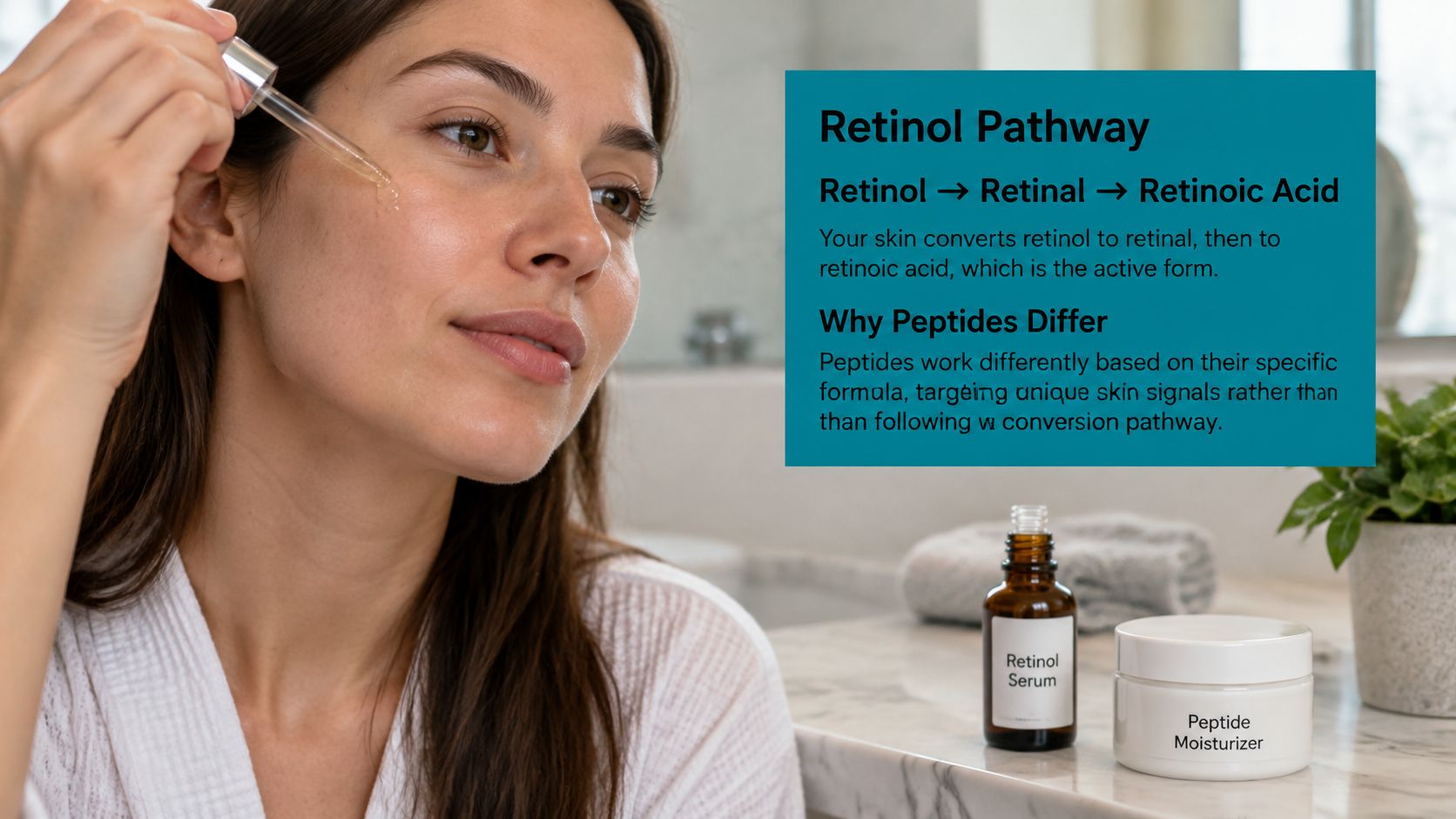
Retinol: potency depends on conversion and tolerance
Retinol arrives inactive. Its effect depends on how much retinoic acid the skin generates and how well the surface tolerates that signal while turnover speeds up. Prescription tretinoin stays the reference point because it is active on arrival, and the 2025 systematic review of topical tretinoin keeps it central to the photoaging evidence base.
That gives retinol a predictable failure mode. When a routine breaks down, it is usually because stinging, dryness or redness made the user stop before turnover had time to show in grading.
Why peptide is a category, not an ingredient
Peptides are short amino acid chains. A formulator chooses a sequence to signal a pathway linked to collagen, elastin, hydration or barrier support, and the result depends on the sequence, its concentration, the vehicle and delivery. Three families show up on labels:
- Signal peptides such as Matrixyl 3000 and Matrixyl Synthe-6, aimed at the look of fine lines and wrinkles.
- Carrier peptides such as copper tripeptide-1, written GHK-Cu, which delivers copper into the skin.
- Neurotransmitter-inhibiting peptides such as Argireline and Snap-8, aimed at the look of expression lines around the eyes and forehead.
This is why the evidence feels uneven. A review in Aesthetic Surgery Journal Open Forum found only 3 assessed studies reporting improvement in the appearance of fine lines and wrinkles, and the wider peptide literature still has limited in-vivo cosmetic aging trials. Many positive studies are short, grade wrinkles subjectively, test combination products or enroll small groups, so the peptide's own contribution is hard to isolate.
The label test: a named peptide, a printed percentage where given, the concern it targets, stability or preservation information, and a cited study long enough to match the claimed endpoint. If two of those are missing, the formula is hard to evaluate.
For the concerns people bring to this decision, the names are specific. Crow's feet point to Argireline, Snap-8 and eye peptides; fine lines and wrinkles point to Matrixyl 3000, Matrixyl Synthe-6 and peptide blends. Our guide to what a peptide serum actually is shows how those actives are typically built into a formula.
The practical split is simple. Retinol tends to fail through irritation; peptide products tend to fail through vague labeling. Judge retinol by the form and your tolerance, and judge peptides by molecule, concentration, endpoint and study length.
Retinol Forms, Strength and Gentler Options
Retinoid labels form a conversion ladder, and the rung you choose sets both the expected strength and the irritation you're likely to meet.
Retinol, retinyl esters and retinaldehyde are the cosmetic forms; tretinoin is the prescription one. Retinaldehyde sits one conversion step from retinoic acid, retinol two, and retinyl esters need more work still, while tretinoin is already the active molecule. That ordering is the most useful thing on a label because it predicts how much your skin has to do before anything happens.
Recent reviews describe cosmetic retinoids as effective and generally well tolerated, while still positioning topical retinoids as an accessible strategy for photoaging (2024 review of cosmetic retinoids). A well-formulated retinol or retinaldehyde product is therefore a reasonable nonprescription starting point.
Reading a label takes three checks: the retinoid name, the percentage where one is given, and whether the directions specify evening use. The percentage belongs to the molecule named beside it, so the same printed number delivers less active acid next to "retinyl palmitate" than next to "retinaldehyde," because the ester requires more conversion before the skin can use it.
Steady beats strong. A lower-strength retinoid applied on a fixed evening schedule tends to outperform a higher-strength one used twice and abandoned; results track consistency rather than concentration.
One caution belongs here. Classical retinoids may be inappropriate during pregnancy or lactation and immediately after a procedure, and gentler esters are a conversation for a clinician rather than a label claim.
A single-molecule peptide product shows why naming matters.
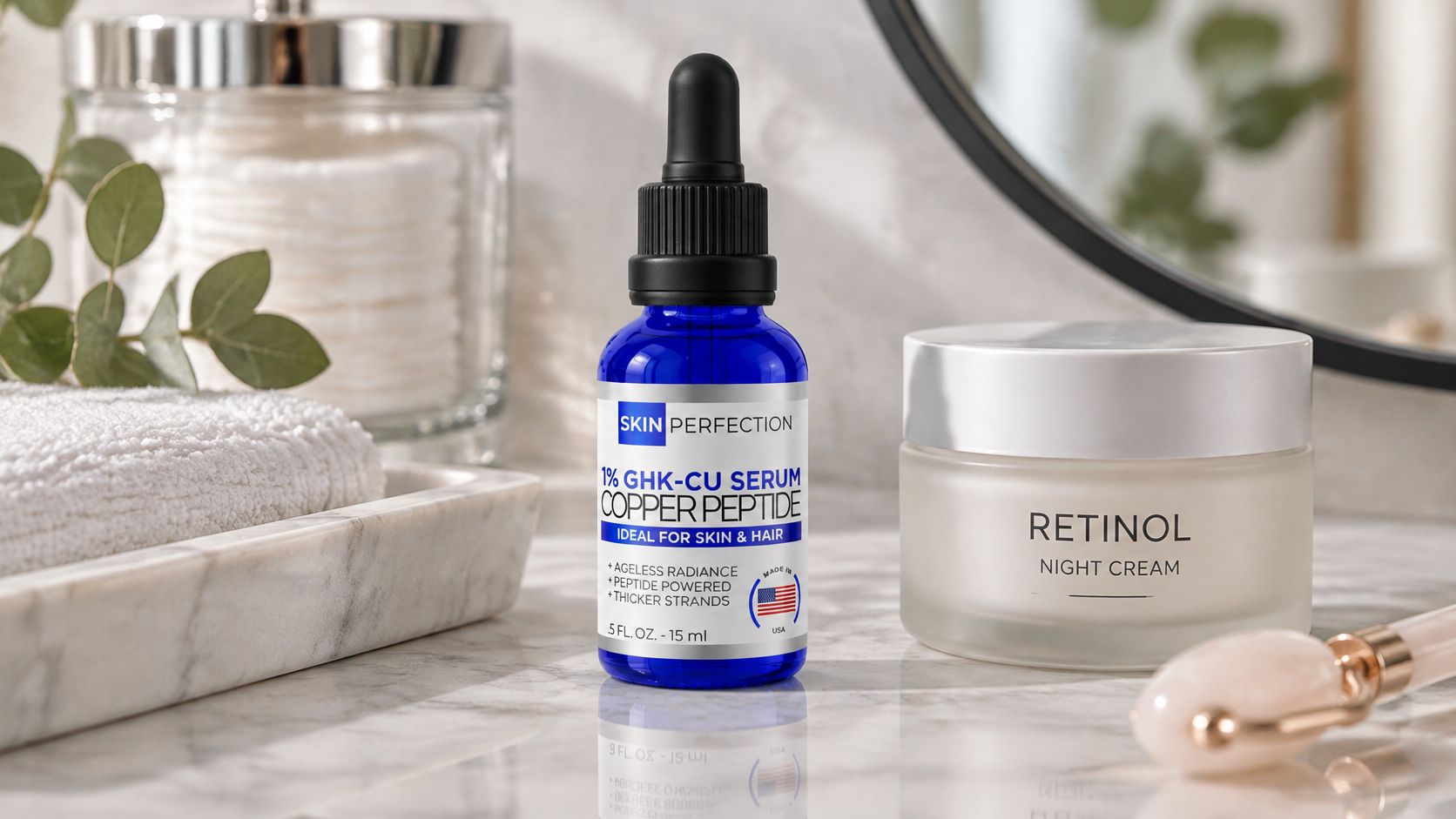
GHK-Cu Copper Peptide Serum | Face, Hair + Scalp | 1% Pure GHK-Cu | 0.5 oz prints its 1% copper tripeptide-1 concentration and 0.5 oz size in the product name itself. That level of specificity is worth expecting from any peptide serum you're asked to weigh against a retinoid.
The retinol serum guide breaks down each form in more detail if you're still deciding between retinol and retinaldehyde.
Comparing the Evidence for Wrinkles and Texture
The strongest claim in this comparison belongs to tretinoin, and its numbers deserve to be seen in full before any peptide result is weighed against them.
Eight clinical trials, 1,361 participants, follow-up from 16 weeks to two years. That is the scope of the systematic review of topical tretinoin trials, which found statistically significant improvement versus vehicle for both fine and coarse wrinkles.
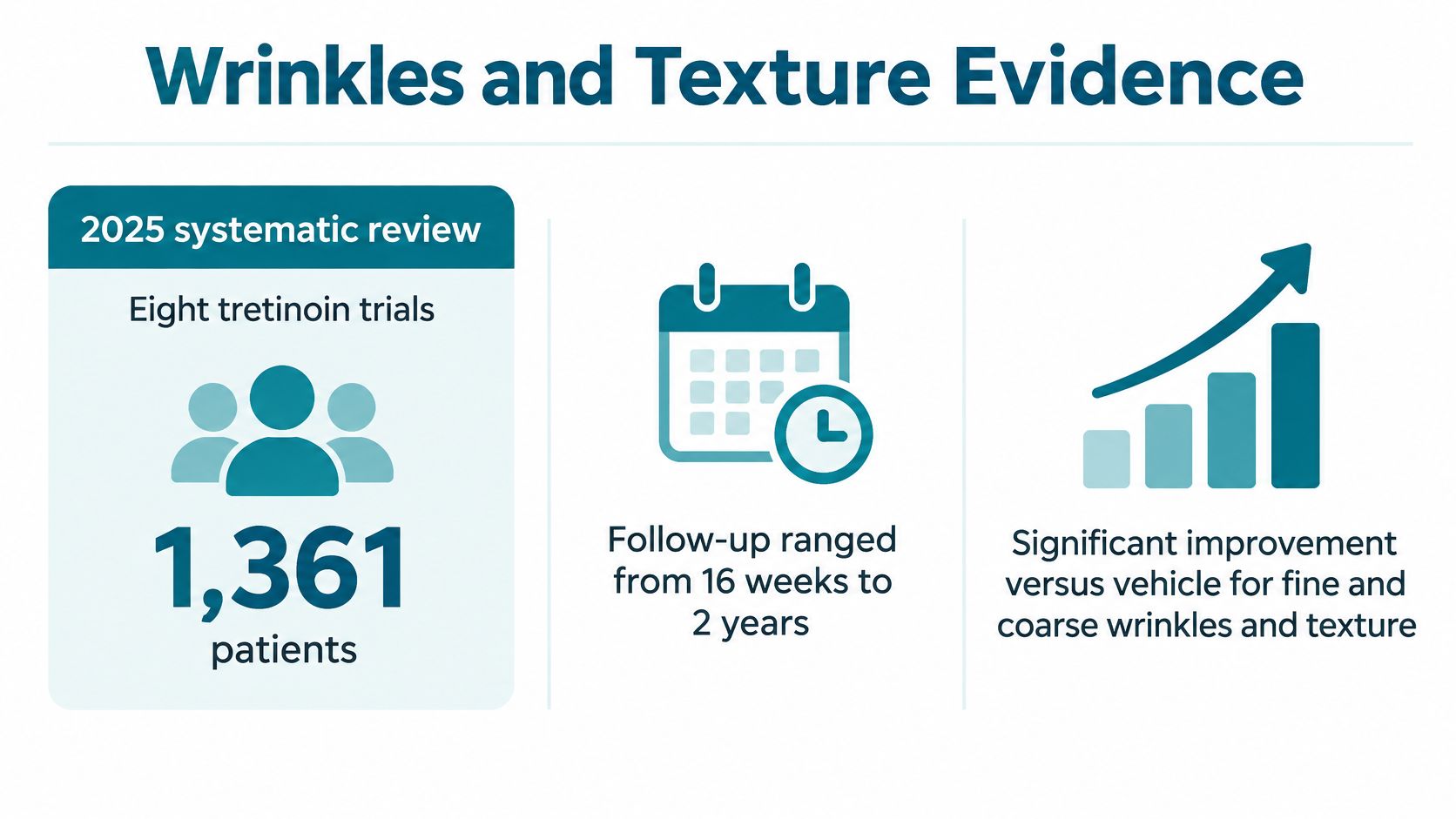
Key trial and review figures for wrinkles
| Evidence | Sample | Finding |
|---|---|---|
| Topical tretinoin review, fine wrinkles | 8 trials, 1,361 patients | Mean difference vs vehicle 0.412 (95% CI 0.233–0.590; P<0.001; I² 35.4%) |
| Topical tretinoin review, coarse wrinkles | 8 trials, 1,361 patients | Mean difference vs vehicle 0.245 (95% CI 0.119–0.370; P<0.001; I² 0%) |
| Network meta-analysis, retinoids | 23 trials, 3,905 participants | Comparatively strong evidence for fine wrinkles; effective for hyperpigmentation |
| Hexapeptide-9 0.002% serum vs retinol serum | Randomized, double-blind, vehicle-controlled; healthy volunteers; 56 days twice daily | Outperformed retinol on crow's-feet and forehead-wrinkle outcomes |
| Topical peptide review, 2024 | Small set of assessed studies | A minority reported improvement in fine lines and wrinkles |
The tretinoin effect sizes are modest in absolute terms and unusually consistent. Retinoid evidence also spans a far wider pool of studies: a 2025 comparison of peptide and retinoid trial evidence pooled 23 randomized trials and 3,905 participants, finding comparatively strong evidence for retinol and prescription retinoids on fine wrinkles plus effectiveness against hyperpigmentation, and within the same analysis a randomized, double-blind, vehicle-controlled trial reported that a 0.002% cyclized hexapeptide-9 serum applied twice daily for 56 days outperformed a retinol serum on crow's-feet and forehead-wrinkle measures.
That hexapeptide result doesn't travel. It tested one novel molecule, over eight weeks, in healthy volunteers, and it says nothing about the signal peptides, copper peptides or collagen-supporting blends sitting on a shelf. Read it as evidence that a specific molecule can perform in a specific trial, and nothing wider than that.
Endpoints decide most of these arguments, and marketing blurs them. Wrinkle depth, pigmentation, roughness, elasticity and barrier comfort are five distinct measurements, and an ingredient can move one while leaving the others untouched. Our breakdown of how long peptides take to work covers the timelines those measurements follow.
The verdict: retinol holds the broader record for measurable wrinkles. A peptide claim is only as strong as the molecule named, the concentration printed, the endpoint measured and the length of the study behind it.
Matching Each Option to Your Skin and Situation
Both products can be a sensible first purchase. What separates them is how much irritation your skin will accept in exchange for a faster visible change.
Starting point by skin type and situation
| Situation | Usual starting point | Why it matters |
|---|---|---|
| Reactive or easily irritated skin | Peptide serum first | Lower irritation risk; add retinol later at low frequency |
| Texture and pigment as the main goal | Retinol, introduced slowly | Broader evidence for surface change and hyperpigmentation |
| Recent cosmetic procedure | Wait for provider clearance | Classical retinoids may irritate freshly treated skin |
| Pregnancy or breastfeeding | Ask a clinician first | Classical retinoids may be inappropriate in this period |
| Heavy sun exposure | Either, with daily sunscreen | Retinol raises sun sensitivity; peptides do not share this issue |
| Low routine tolerance or busy schedule | Peptide serum for consistency | Easier to keep up for 8 to 12 weeks |
Reactive, easily irritated skin is the clearest case for a peptide serum first. There's no single standardized peptide active or clinically validated concentration that would let you line up one peptide serum against another the way you can compare two 0.3% retinol formulas, so peptides get positioned as lower-irritation adjuncts, particularly for sensitive skin or for alternating with a retinoid (review of peptide and retinoid positioning). The trade is speed for tolerance, and for many people that's the right trade to make first.
Texture and pigment goals point the other way. Retinol has the deeper record on surface change and hyperpigmentation, and the cost is a slow build measured in months rather than weeks.
One question sorts most of it: what will my skin tolerate every week for the next three months? The product you keep using is the only one with time to show a visible change.
A recent cosmetic procedure changes the answer temporarily. Classical retinoids may be inappropriate on freshly treated skin, so the first question for your provider isn't which serum to buy but when either product can restart.
Pregnancy and breastfeeding move the decision to a clinician. Retinoids may be inappropriate during that period, and gentler retinoid esters are a selective option for a professional to weigh, not a default substitution.
Heavy sun exposure tilts the routine toward sunscreen discipline rather than product choice. Retinol raises sun sensitivity; peptides don't carry that concern, and a daily broad-spectrum sunscreen belongs in the routine either way.
If your skin sits in the reactive category, our anti-aging skincare for sensitive skin guide is the natural next read.
How to Combine Retinol and Peptides Safely
Combining them works when the two never compete for the same evening, and when retinol frequency climbs on a schedule rather than on enthusiasm.
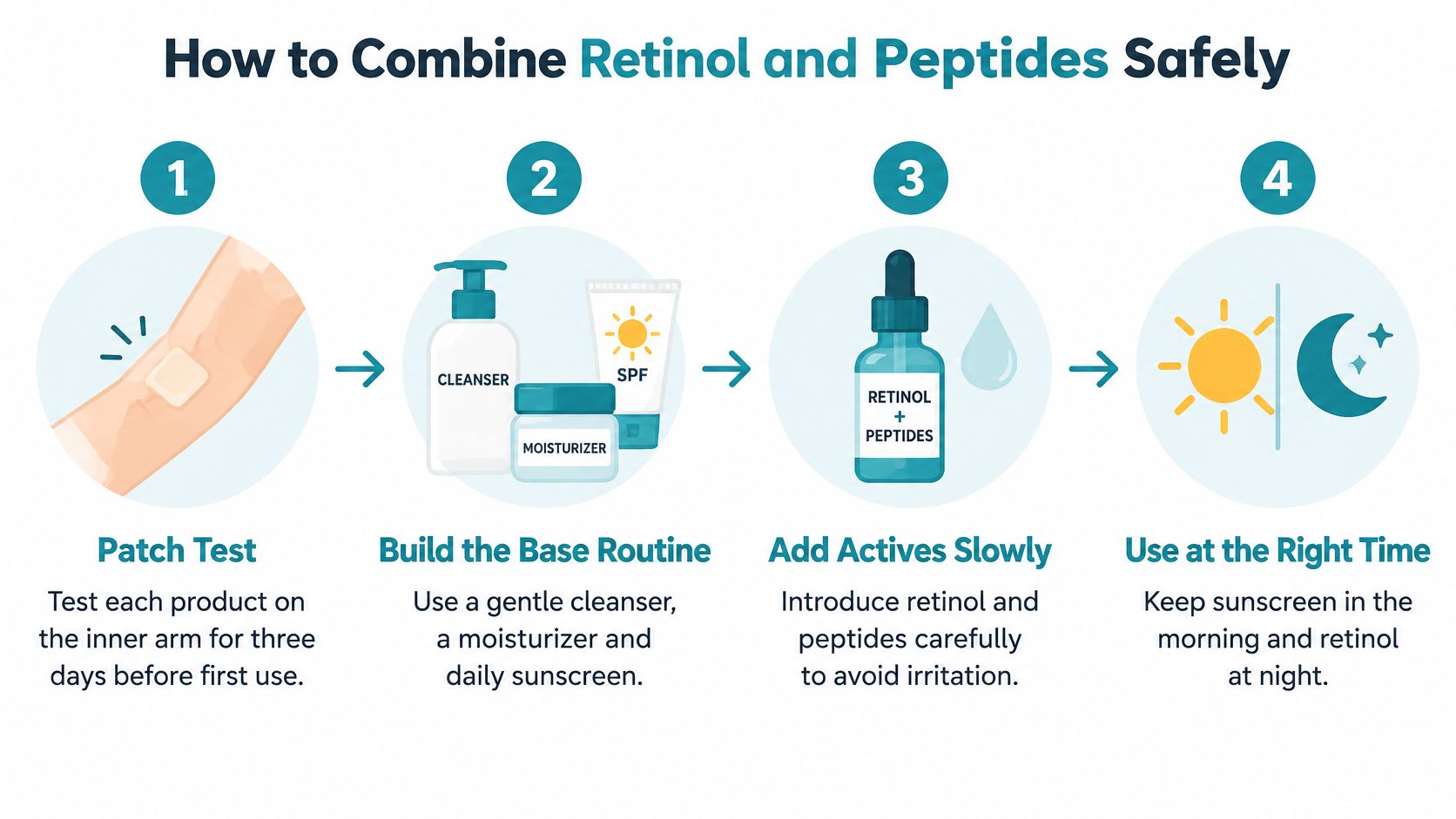
- Patch test each product for three days. Apply a small amount to the inner arm and leave it alone. Reactions surface there faster than on the face, and you can stop before a week of retinol has gone onto your cheeks.
- Build the base routine first. Gentle cleanser, moisturizer and daily sunscreen, for two weeks before any active. When something stings later, you'll know which product caused it.
- Start retinol twice a week, on fully dry skin. Cleanse, wait a few minutes, then apply; if your face still feels damp, wait longer. Retinol nights go better when skin starts dry.
- Keep peptides on the other nights, or in the morning. They don't carry the same sun-sensitivity concern, so a morning application is the simplest way to keep the two apart.
- Raise retinol frequency every two weeks, and only if skin is calm. Irritation lags application by several days, so a jump you tolerate on Monday can show up on Thursday.
- Pause retinol for several days if redness persists. Keep the moisturizer and sunscreen going, and restart at the last frequency that worked.
- Reassess after the schedule has had time to work. Save the verdict for the photo check rather than the bathroom mirror, and keep frequency unchanged until then.
Eight-week schedule for combining retinol and peptide serum
| Weeks | Morning | Evening |
|---|---|---|
| Weeks 1-2 | Cleanser, moisturizer, sunscreen | Cleanser, peptide serum, moisturizer |
| Weeks 3-4 | Cleanser, moisturizer, sunscreen | Retinol on 2 nights, peptide serum on the others |
| Weeks 5-8 | Cleanser, moisturizer, sunscreen | Retinol on 3 nights, peptide serum on 1 to 2 nights |
| Week 9 onward | Same base routine | Retinol every other night, or more if skin stays calm |
Peptide serum is a category, not a single molecule, so read the INCI name and judge the product by the endpoint you care about. The timing rules above stay the same either way: retinol owns the nights it is scheduled for, and the peptide product fills the spaces around it.
Our routine advice keeps the base deliberately plain: a gentle cleanser, a moisturizer and a daily sunscreen, plus one targeted serum or eye cream for the main concern, used morning and night. The schedule above is that base with a single active swap built in, which is the easiest version to maintain when you're also watching for irritation.
Mild dryness and a little tightness in the first two weeks are an ordinary adjustment, not a reason to quit. Stinging that lasts well past application, swelling, or flaking that cracks and bleeds are stop signals, and they call for fewer nights rather than more willpower.
If your skin feels stripped, our guide to keeping the skin barrier comfortable covers what to add before you push retinol further.
Choose Your Starting Routine Today
Three rules cover nearly every case. Start with retinol if texture or pigment is your main concern and your skin has tolerated new actives before. Start with a peptide serum if your skin reacts easily, your routine is minimal, or you want a step you will still be using months from now. Use both only once skin stays calm through the opening weeks, and let the schedule do the separating: peptide serum in the morning, retinol on the evenings it assigns.
Pick the peptide the same way this article judged the trials, by named molecule rather than label promise. For fine lines and wrinkles, the ingredients to look for are Matrixyl 3000, Matrixyl Synthe-6 and peptide blends. For crow's feet, Argireline, Snap-8 and eye peptides. For sagging neck and jowls, Relistase, Progeline and Pepha Tight. A bottle that names its peptide gives you something to evaluate. "Peptide complex" does not.
Choose one primary concern and one product this week, then keep a two-line note on stinging, dryness and how many nights you used it. That record tells you whether to hold frequency or step it up, and it is far more reliable than memory.
If you're pregnant, breastfeeding or recently treated, pause and speak to a clinician before starting either product.
If you'd rather control the peptide strength yourself, our Serum Boosters let you customize your skincare with anti-aging peptides instead of accepting whatever percentage a finished formula happens to use. For the routine around it, this look at ingredients that support collagen renewal from Beverly Wilshire Aesthetics is a useful companion read.
One boundary matters if you write product copy: describing the look of smoother, hydrated skin stays in cosmetic territory, while claiming a product changes the skin's structure can push it toward drug status under FDA guidance on wrinkle treatments and anti-aging products. Keep the wording on visible appearance, and the peptide serum vs retinol for aging question stays a question about texture and comfort.
Skin Perfection sells serums, moisturizers and lotion-making supplies for people who read an ingredient list before they buy. If this comparison has narrowed your choice to one peptide step, a Serum Booster lets you add a named peptide to a routine you already trust. Visit Skin Perfection to see the full range and start with a single product rather than a shelf of them.