

 Buy with Prime



You're standing in front of the bathroom mirror at night, one hand on a tub of shea butter and the other on a jar of coconut oil, wondering which one belongs on your face and which one you'll regret by morning. That's exactly where many start with the shea butter vs coconut oil question, and it's the right place to start. The answer isn't a universal winner. It's about where you're putting it, what texture you want, and what you're making.
Table of Contents
- The Two Jars Sitting on Your Bathroom Shelf
- Fatty Acid Profiles and What They Mean for Skin Feel
- Moisturizing Behavior, Comedogenicity, and Texture Compared
- What the Research Actually Shows About Each Ingredient
- Best Matches by Use Case
- DIY Formulations and Smart Ingredient Swaps
- Making the Right Call for Your Routine
The Two Jars Sitting on Your Bathroom Shelf
Both jars earned their place for good reason. Shea butter is the fat pressed from shea kernels, and at room temperature it's a soft, scoopable solid that melts on contact with warm hands. Coconut oil comes from coconut flesh, and it's famously indecisive about its state, solid and white in a cool kitchen, clear and liquid in a warm bathroom. If you've ever scooped coconut oil in January and poured it in July, you've already felt its defining trait.
DIY makers keep both around because they're simple, single ingredients that slot into balms, body butters, lotions, hair blends, and lip products without complicated processing. You can melt them, whip them, blend them with other oils, and predict how they'll behave once you understand their personalities. That predictability is what makes them staples instead of passing trends.
The Questions That Actually Decide It
Skip the better-or-worse framing. Ask these instead:
- Where is it going: Face, body, hair, lashes and brows, and lips all tolerate richness differently, and a texture that feels lovely on elbows can feel heavy on cheeks.
- How long should it stay: Do you want a film that's still noticeable in an hour, or something that spreads, softens, and mostly sinks away?
- What are you building: A whipped body butter needs structure. A massage oil needs slip. Those are opposite jobs.
- How does your skin usually react: If you're prone to congestion on your face, the choice you make for a facial product deserves more caution than the choice for a foot balm.
Practical rule: Pick the ingredient for the job and the body part first. Preference and scent come second.
One more thing before you scoop anything. Both ingredients are emollients, meaning they soften and smooth the surface feel of skin and help it feel moisturized. They're at their best described in cosmetic terms, softening, conditioning, beautifying the look and feel of skin. Neither jar on your shelf is a medical product, and treating either one that way sets expectations no simple oil or butter can meet.
Keep that framing in mind and the rest of the comparison gets straightforward. You're not crowning a champion. You're matching a texture to a task.
Fatty Acid Profiles and What They Mean for Skin Feel
The texture difference you feel between these two ingredients isn't a mystery. It's chemistry you can read right off their fatty acid profiles, and once you see the numbers, the way each one spreads and sits on skin stops being surprising.
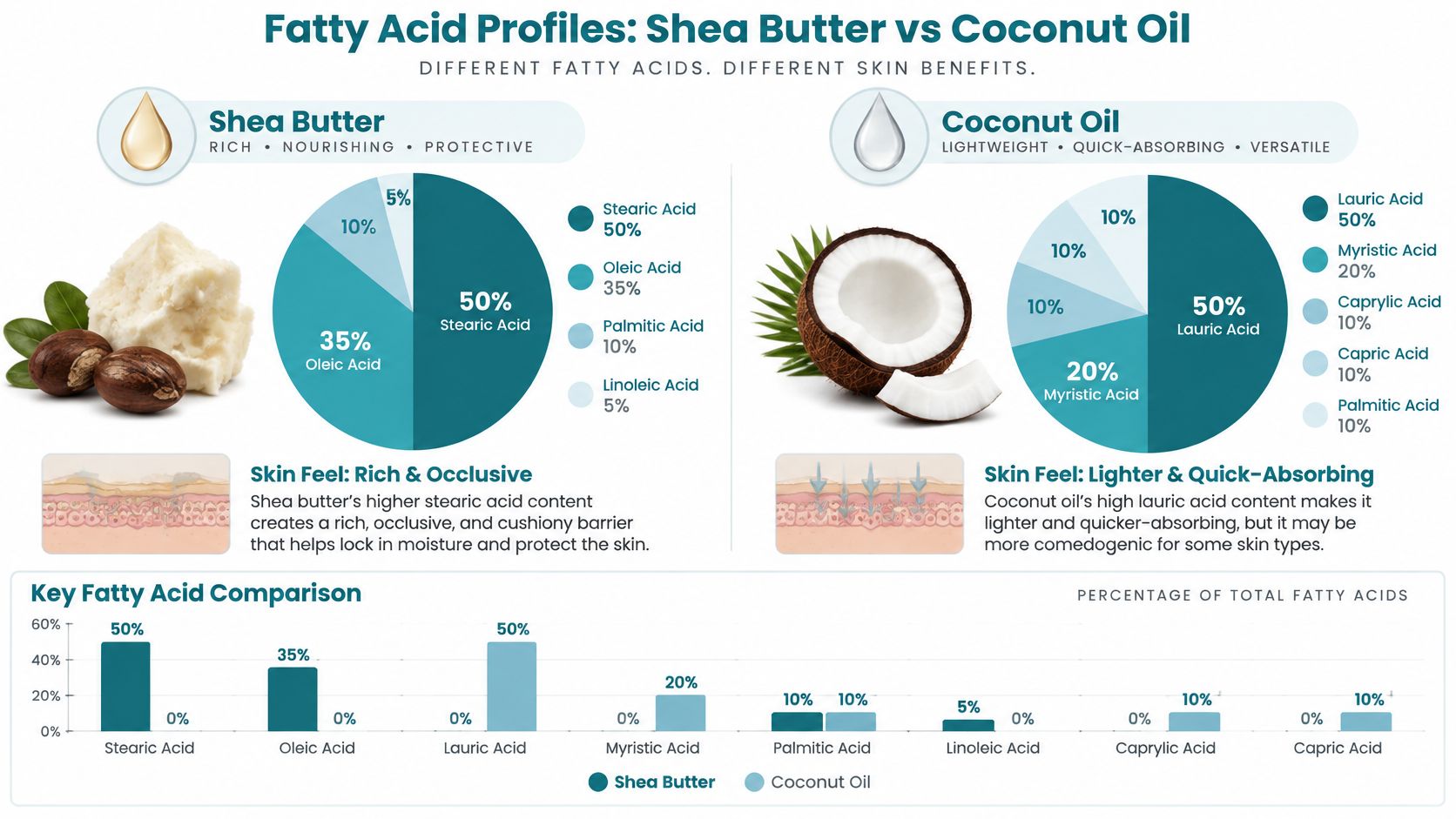
Shea butter is built from long-chain fatty acids. In a 2013 analysis of traditionally processed shea kernels, oleic acid accounted for approximately 45% of shea butter's fatty acids and stearic acid for roughly 42 to 44%, so together they represented about 87 to 89% of the total. Stearic acid is firm and structural, oleic acid is fluid and cushioning, and that pairing is why shea butter holds a semi-solid shape in the tub yet melts down into a dense, rich layer on skin.
Coconut oil is a different animal. It's about 92% saturated, with lauric acid representing roughly 50 to 53% of its fatty acids, and a large share of its chains are shorter, in the C8 to C12 range. Shorter chains mean a lighter, more mobile oil once it warms up. That's why coconut oil liquefies against skin quickly and glides with very little drag.
Translating Chemistry Into Feel
Those profiles mean in your hands:
- Shea butter feel: Slower to spread, noticeably cushioning, and it leaves a longer-lasting film you can still feel after application. Think structure and staying power.
- Coconut oil feel: Fast-spreading with easy slip, lighter on contact, and it tends to feel like it has soaked in sooner, though it can read as greasy if you overapply.
- Temperature behavior: Shea butter stays fairly consistent across seasons, while coconut oil shifts between solid and liquid with room temperature, which matters when you're measuring for a formula.
If you want to dig deeper into how coconut oil behaves across skin and hair routines, there's a useful overview of virgin coconut oil for skin and hair uses worth reading alongside this comparison.
Neither profile proves superior performance on its own. The numbers tell you what each ingredient is built to do. Shea butter brings body and barrier feel. Coconut oil brings spread and slip. Every recommendation that follows comes back to that split.
Moisturizing Behavior, Comedogenicity, and Texture Compared
Both ingredients are semi-occlusive emollients. They sit on the surface, slow water escaping from the outer skin layer, and make skin feel softer and more moisturized. What they don't do is add water themselves. Oils reduce water loss rather than supply water, which is why a complete moisturizer pairs them with humectants and a proper emulsifier system instead of relying on oil alone.
Where they part ways is persistence. Shea butter's heavier film lingers, so skin tends to feel cushioned for longer after one application. Coconut oil spreads thin and fast, feels lighter at first, and may need reapplication sooner on very dry-feeling areas like shins and heels.
Shea Butter vs Coconut Oil at a Glance
| Attribute | Shea Butter | Coconut Oil |
|---|---|---|
| Texture in the jar | Soft solid, scoopable | Solid when cool, liquid when warm |
| Spread on skin | Slower, richer drag | Quick, easy glide |
| Film left behind | Heavier, longer-lasting | Lighter, can feel greasy if overdone |
| Scent | Mild, nutty, sometimes earthy | Sweet coconut unless refined |
| Best formulation role | Body, structure, richness | Slip, carrier phase, spreadability |
| Facial caution | Rich for oily-feeling skin | May not suit acne-prone users |
Comedogenicity and Facial Use
It is understandable that readers feel uneasy. Coconut oil spreads easily, making it tempting as a facial oil, but it may feel greasy and may not suit acne-prone users as a leave-on facial product. Shea butter is also rich, and while many dry-feeling faces tolerate it in small amounts, a thick layer can overwhelm skin that prefers lighter textures. If pore concerns are your main worry, it is worth reading about whether squalane is comedogenic to understand how different emollients compare on that front.
Formulators lean on shea butter for exactly the richness described above. It's no accident that it's our vegan lotion's key ingredient in Fillaree's everyday formula, chosen there for the body and cushion it gives a lotion meant for daily use.
Two practical quirks round out the picture. Raw shea butter can turn gritty if it melts and cools slowly, which is a texture issue, not a quality failure, and gentle remelting with a quick cool-down usually smooths it. Coconut oil's melting habit means a balm that's firm in winter can slump in summer, so plan your ratios for the warmest room the product will live in.
What the Research Actually Shows About Each Ingredient
It's tempting to ask which ingredient the science crowns as the winner. The honest answer is that the published evidence doesn't set up that contest, because the two ingredients haven't been studied in the same way or at the same scale.
Coconut oil has the more direct controlled-trial support. A randomized, double-blind study summarized in a 2022 peer-reviewed review compared virgin coconut oil with mineral oil on the legs of 34 participants, applied twice daily for two weeks. Skin condition improved in both groups, stratum-corneum hydration and sebum levels increased significantly, and transepidermal water loss decreased in both groups, with the coconut oil group showing a significantly greater reduction in that measure. That's a clean, specific result about moisturization-related measures.
Shea butter's published picture is smaller and harder to isolate. One formulation study followed 10 volunteers who applied a preparation containing shea butter, coconut oil, almond oil, and rose powder to the forearm daily for two weeks. Hydration and elasticity improved significantly, reported at p < 0.05, but because four ingredients were blended together, the design can't tell you what shea butter did on its own. The result supports the finished formula, not the single ingredient.
Reading the Evidence Without Overreading It
A few guardrails keep you honest here:
- Direct head-to-head trials are limited: There's no strong published trial pitting shea butter against coconut oil alone, so claims that one outperforms the other go beyond the data.
- Both are emollients first: The evidence supports moisturizing and softening roles, which is how both should be described in cosmetic terms.
- Neither replaces established actives: If you're building a routine around peptides or other targeted ingredients, these oils play a supporting, texture-driven role rather than the lead.
If you're sorting through ingredient claims more broadly, browsing plant-based skincare ingredients and how they're positioned helps put both of these staples in context.
So the research verdict is narrow but useful. Coconut oil carries stronger published support for dryness-related measures, shea butter carries reasonable formulation-based evidence, and your actual choice still comes down to texture, placement, and what you're making.
Best Matches by Use Case
The comparison earns its keep. Walk body part by body part and the right answer changes, sometimes more than once. The through-line is simple. Coconut oil typically contains approximately 48 to 52% lauric acid and behaves as a fluid, fast-spreading emollient at warm skin temperatures, while shea butter contains roughly 30 to 45% stearic acid and 40 to 60% oleic acid and produces a heavier, longer-lasting film, as detailed in the fatty acid and barrier-function comparison.
Face and Body
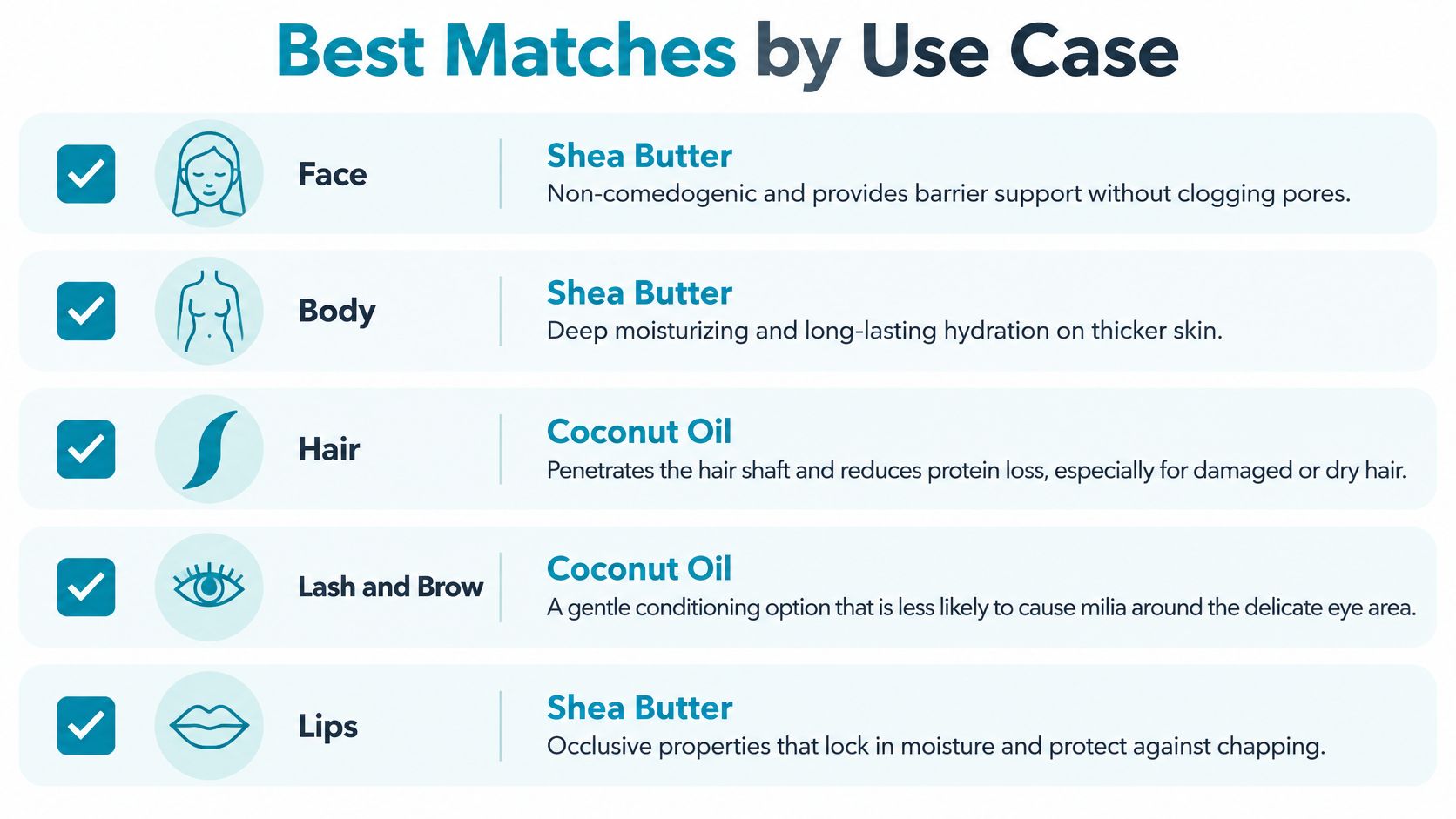
For facial moisturizing on dry-feeling or mature-looking skin, a small amount of shea butter usually wins on feel. It cushions without the slick finish coconut oil can leave, and a pea-sized amount warmed between your palms presses on more evenly than you'd expect. If your face tends toward congestion, keep either ingredient away from a leave-on facial routine until you've patch tested carefully, and consider confining them to body use.
For the face, shea butter's cushion beats coconut oil's slickness, but only in small amounts and only if your skin tolerates richness.
On the body, shea butter is the dependable default for elbows, knees, hands, and shins, anywhere you want a film that lasts past getting dressed. Coconut oil earns its place where slip is the job, massage blends and shaving routines, where its glide reduces drag and a little goes a long way. For a deeper look at facial and body placement, the shea butter for skin guide walks through amounts and layering in more detail.
Hair, Lash and Brow, and Lips
Hair flips the recommendation. Coconut oil's smaller, lauric-rich profile lets it spread along strands easily, and it's a popular pre-wash treatment and shine-boosting finisher in small amounts. Shea butter works better as a sealing styler for coarse, curly, or very dry-feeling hair, smoothed over ends after water-based products. Fine, straight hair usually finds shea butter too heavy except as a tiny touch on the very ends.
Hair shortcut: Coconut oil for slip and pre-wash use, shea butter for sealing coarse or curly hair after you've added moisture.
For lash and brow conditioning, restraint matters most. Anything leave-on near the eyes should be patch tested first, applied sparingly, and kept out of the eye itself. Lighter coconut-oil-based blends tend to feel less heavy along the lash line than a dense butter, which can migrate and blur. Tolerability depends on you and the complete formula, not the oil alone.
Lips are shea butter territory. Its firm, occlusive-feeling film holds up in a balm stick, stays put through coffee, and gives that smooth, cushioned glide people expect. Coconut oil in a lip product feels pleasant at first swipe but melts soft quickly, so it needs wax support and still wears off faster.
DIY Formulations and Smart Ingredient Swaps
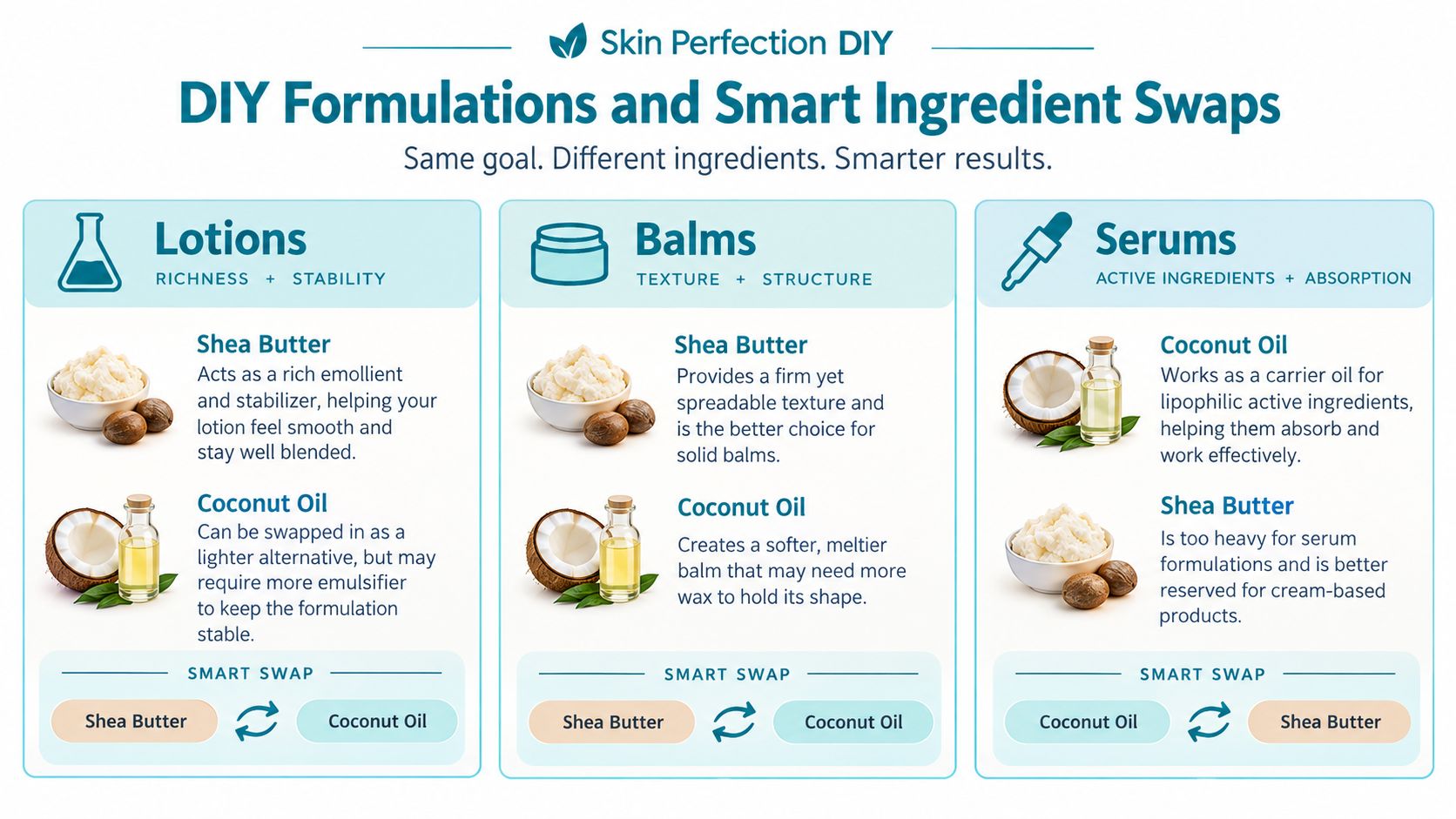
In a formula, these two ingredients hold different jobs, and swapping them carelessly is the fastest way to wreck a batch you loved. Shea butter is structure. It's the body of a whipped body butter, the firmness in a balm, the richness that keeps a cream from feeling thin. Coconut oil is movement. It loosens a blend, adds slip to an oil phase, and helps a product spread without dragging.
When a Swap Works and When It Doesn't
| Starting Formula | Swap | Likely Result |
|---|---|---|
| Whipped body butter | Coconut oil for shea butter | Softer, meltier, less scoopable |
| Massage oil blend | Shea butter for coconut oil | Too thick, drags instead of gliding |
| Firm lip balm | Part coconut oil for shea butter | Softer stick, needs more wax |
| Body lotion oil phase | Small part either way | Usually fine, adjust emulsifier feel |
If you're new to building these textures, starting with a tested method for how to make body butter saves you the grainy, separated first batches most of us made. Even hospitality buyers think about texture and stability this way when choosing amenities, as this guide for hotels and Airbnbs shows from the bulk-supply side.
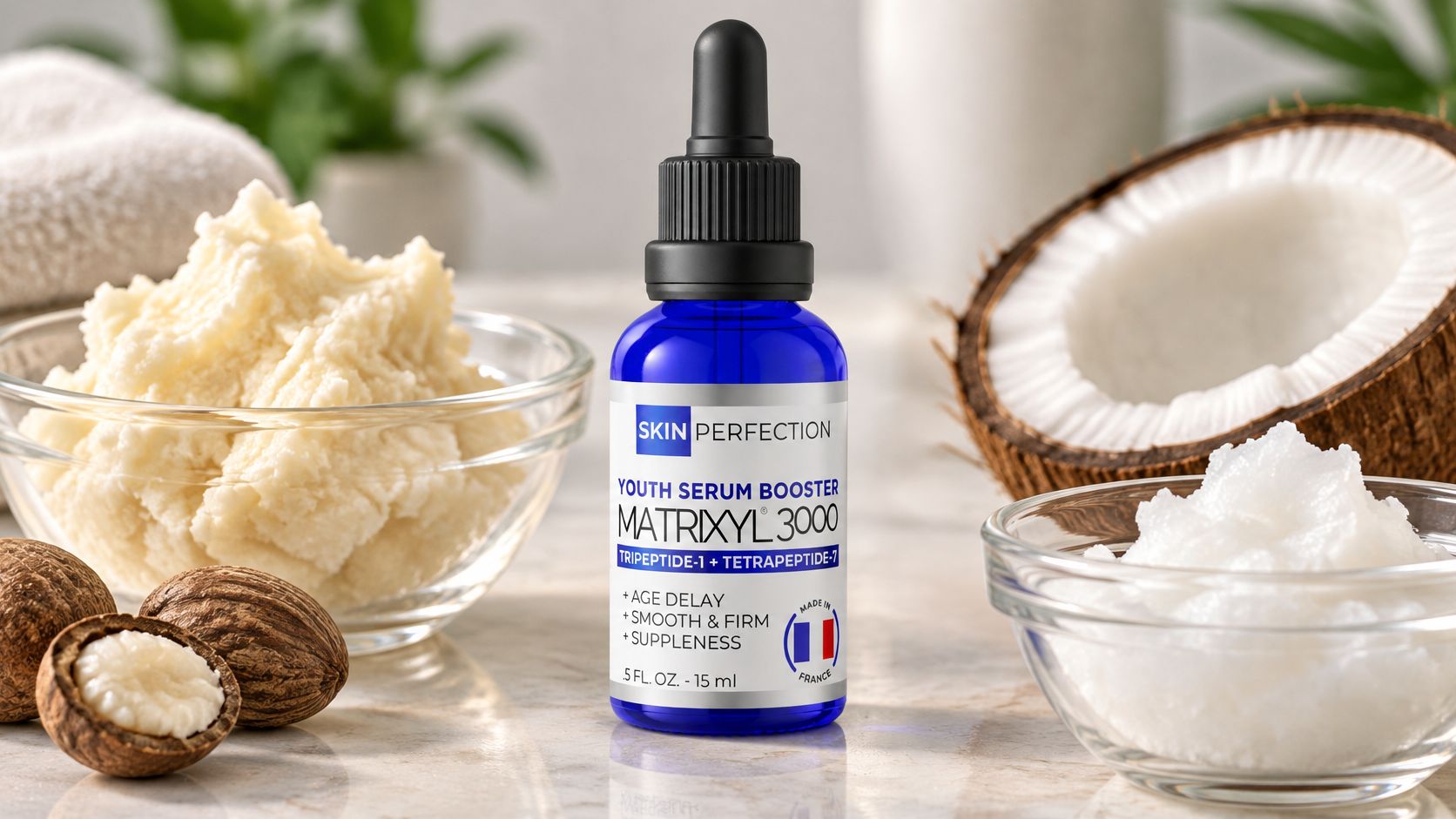
Serum work needs a lighter hand. In a base like the Rejuvenate Anti-Aging Serum Base, oils belong in small amounts only, because the whole point of that format is a lightweight, fast-absorbing feel. Loading a serum base with shea butter defeats it. This is also where ingredient format matters. The Matrixyl 3000 Serum Booster sold by Skin Perfection is a water-soluble, undiluted peptide complex in a blue glass dropper, blended into a water-based base at 3 to 8 percent and never applied directly to skin. Because it's water-soluble, it won't incorporate into oil-only blends of coconut oil or shea butter, so keep your peptide work in water-based serums and your butters in creams and balms where each behaves properly.
Making the Right Call for Your Routine
You don't need a flow chart. You need three rules of thumb you can apply at the bathroom shelf.
- Reach for shea butter when you want staying power: Body butters, lip balms, nighttime hand and foot care, and small-amount facial use on dry-feeling skin.
- Reach for coconut oil when you want movement: Massage and shaving slip, pre-wash hair treatments, and oil blends where spread matters more than structure.
- Reach for neither on your face if richness bothers you: A purpose-built option like the Clear Skin Oil-Free Moisturizer suits faces that don't tolerate either oil, while the Rejuvenate Anti-Aging Serum Base suits readers who'd rather build a lightweight custom serum than layer on a heavy butter.
Whatever you choose, patch test any new leave-on product on a small area first and give it time before you commit your whole face or lash line. Tolerability is personal, and it depends on the complete formula sitting on your skin, not a single ingredient in isolation.
Keep your language honest too, especially if you sell what you make. Under FDA guidance on cosmetic versus drug classification, a product's status depends on its intended use and claims, so describing these ingredients as moisturizing, softening, conditioning, or beautifying keeps you in cosmetic territory. The Etsy medical claims policy separately prohibits explicit or implied claims that an item prevents, treats, or cures a condition, and that applies to your listing titles, descriptions, and images regardless of what may be permissible elsewhere.
Quick Answers
- Can I blend both together: Yes. A shea base loosened with some coconut oil is a classic body butter structure, firm yet spreadable.
- Which one for a first DIY project: A simple whipped shea body butter is forgiving, useful, and teaches you texture control fast.
- What if both feel too heavy: Use less, apply to damp skin, or move them to body and hair only and choose a lighter facial moisturizer.
If you're ready to put this comparison to work, you'll find lotion-making supplies, serum bases, and clearly labeled formulation ingredients that let you control exactly what goes into your blends. Visit Skin Perfection to stock your bench with the bases and boosters mentioned here and start building textures matched to your skin, your hair, and your routine.