

 Buy with Prime



GHK-Cu has a striking research story, but a result in cultured cells does not show what a serum does on intact skin. Copper tripeptide-1 is used in cosmetics for the appearance of skin, while research discusses biological activity. Those are different kinds of claims.
A stronger copper-peptide serum is not automatically more effective. The key formulation question is whether the finished product can deliver the ingredient to the place where the proposed activity would occur. A lab result is one piece of the story; the bottle on your shelf has to cross the barrier of intact skin.
Table of Contents
- Skin Biology Copper Peptide at a Glance
- How the Copper Signal Is Described
- What the Human Studies Counted
- Why Intact Skin Changes the Story
- Pairs to Separate and Words to Avoid
- How to Blend and Apply a 1% Formula
- Copper Peptide Beside Other Actives
- Choose Powder or a Finished Serum
Skin Biology Copper Peptide at a Glance
A cosmetic label and a laboratory result describe different things. GHK-Cu can be discussed in research about skin biology, while a cosmetic product is described in terms of its effect on appearance.
GHK-Cu combines glycine, histidine, and lysine with a copper(II) ion. On a cosmetic label, the ingredient name is copper tripeptide-1.
Skin biology copper peptide in one scan
| Question | Plain answer |
|---|---|
| What is it? | GHK-Cu, copper tripeptide-1: glycine, histidine, and lysine with copper(II) |
| Where the name comes from | The name refers to the peptide and its copper complex |
| Lab activity range | About 1–10 nanomolar in foundational research, a laboratory concentration rather than a jar strength (peer-reviewed review of GHK biology) |
| Cosmetic blend used here | A water-phase preparation at 1%; the powder-to-liquid amount depends on the formula |
| Why is it blue? | The copper contributes to the color, which rinses off with water |
| What a listing can describe | Moisturized feel, smoother-looking texture, softened look of fine lines |
| What a listing should not say | Removes wrinkles, increases collagen, FDA approved, or treats a condition |
Nanomolar and percentage measure concentration in different ways. Nanomolar describes molecules relative to a solution's volume; a percentage describes an ingredient's share of a cosmetic batch. One is a laboratory measurement, the other a formulation amount.
For a plain-language discussion of GHK-Cu effects on skin biology, keep the proposed biological activity separate from what a finished cosmetic can claim. A listing can describe moisturized feel and visible appearance, but a research discussion of matrix biology does not establish that the product delivers the same effect through intact skin.
The practical distinction is simple: the ingredient name identifies what is included, while the formula and its use shape what a person may notice. Cosmetic wording stays focused on appearance, such as smoother-looking texture or more even-looking tone.
How the Copper Signal Is Described
GHK-Cu acts more like a delivery vehicle than a moisturizing film. The peptide binds copper, forming a complex researchers study for its biological activity. That distinction helps explain why laboratory findings about GHK-Cu concern cell processes rather than hydration alone.
In foundational laboratory work summarized in a peer-reviewed review of GHK biology, GHK-Cu showed activity at approximately 1–10 nanomolar, including effects on both the synthesis and breakdown of collagen and glycosaminoglycans. The extracellular matrix is the material surrounding cells: collagen provides structural support, while glycosaminoglycans help create a water-holding environment. Its organization depends on ongoing production and turnover.
A cell-culture result has a specific setting. A scientist can expose fibroblasts directly to GHK-Cu in a controlled medium, then measure a biological response. That observation can help explain a mechanism, but it does not measure facial appearance.
A review of GHK-Cu's biological effects describes increased collagen and elastin production in cultured human dermal fibroblasts exposed to 0.01, 1, and 100 nanomolar concentrations. It also describes irradiated fibroblasts recovering proliferation closer to untreated controls.
These findings make GHK-Cu interesting to researchers. They do not establish that doubling the concentration in a cosmetic doubles a visible effect. Cell exposure, the measurement being taken, and the surrounding formula all shape what a result means.
The evidence supports a focused conclusion: GHK-Cu has a mechanistic research literature. A cosmetic listing, however, describes appearance and feel; cell-culture findings alone do not establish what a finished serum will visibly do.
What the Human Studies Counted
A biopsy result and a mirror result answer different questions. Biopsy measurements can describe collagen production; they do not automatically show changes in wrinkle depth or how smooth someone thinks their skin looks.
A biopsy summary of GHK-Cu, vitamin C cream, and retinoic acid is often repeated as a direct ingredient comparison. The figures describe one measured endpoint, while a separate randomized trial examined outcomes after carbon-dioxide laser resurfacing. Neither result alone establishes broad anti-aging performance for a cosmetic serum.
Copper peptide human findings and their limits
| Source of the number | What was counted | Reported result | What it does not prove |
|---|---|---|---|
| One-month biopsy summary | Share of women with a collagen-production increase | GHK-Cu 70%; vitamin C cream 50%; retinoic acid 40% | Not a percent change in wrinkle depth or overall look |
| Laser-resurfacing randomized study | Redness timeline and blinded wrinkle and quality scores | No statistically significant objective difference | Not proof that every formula changes the look of lines |
| Same laser-resurfacing randomized study | Satisfaction with overall skin quality | Higher in the GHK-Cu group, P = .04 | Not the same as a blinded or instrument result |
The biopsy figures describe the proportion of women who showed an increase, not the size of that increase. They do not mean participants looked that much younger or had an equivalent reduction in wrinkles.
A comparison on one biopsy endpoint cannot rank copper peptides, vitamin C, and retinoic acid as cosmetic ingredients overall. It answers a narrower question about the specific measurement reported.

Satisfaction and blinded assessment can disagree
The randomized trial after carbon-dioxide laser resurfacing found no statistically significant between-group difference in redness resolution or blinded wrinkle and skin-quality assessments. Patient-reported satisfaction with overall skin quality was higher in the GHK-Cu group, P = .04.
That probability value does not measure the size of the cosmetic benefit. It does not say how much smoother skin looked, or turn a satisfaction result into an objective difference.
A person can prefer how their skin looks or feels even when blinded graders do not record a clear advantage.
Both endpoints matter, but they capture different things. Patient satisfaction reflects the user's experience; blinded assessment reduces the influence of knowing which regimen someone received.
The setting also shapes what a result can support. Post-procedure skin differs from untreated facial skin, and a complete regimen is not the same as an isolated ingredient. For a broader view of peptide serum benefits, keep the distinction clear: research may measure matrix biology, while a cosmetic claim stays focused on appearance.
Why Intact Skin Changes the Story
A cell-culture result can show what copper peptide does when cells are directly exposed. Intact skin adds a barrier: the stratum corneum, the outer layer that a topical formula first encounters. The difference is like testing a key on an open desk versus asking whether it can pass through a locked door.
That distinction matters when advice moves from fibroblast findings straight to a conventional serum. Cell exposure and application to intact skin are different conditions; the ingredient must first reach the cells being discussed.
Ask whether the ingredient arrives
A systematic review of topical GHK-Cu delivery describes a handful of small human studies, mostly involving cosmetic creams, and reports no published full-text randomized controlled trial using dissolvable, hollow, or solid microneedle arrays. It also describes increased measured peptide and copper passage after microneedle pretreatment of human skin, compared with no comparable delivery through untreated skin.
Delivery is therefore part of the question. The review's contrast does not show that every ordinary topical is ineffective. It does show why results from directly exposed cells cannot, by themselves, establish what happens after routine application.
What sits in the doorway
Several formulation variables shape the delivery question:
- Molecular size and chemistry: Dissolving in a formula does not show that an ingredient passes through the barrier.
- Vehicle: A watery serum, gel, and cream create different formulation environments.
- Concentration and pH: These describe the preparation, but do not independently establish how much reaches a particular skin layer.
- Barrier condition: Findings from altered skin do not automatically apply to intact skin.
The guide to skin layers and what skincare actually reaches helps distinguish the surface from deeper structures. That distinction matters when an advertisement places a diagram of dermal cells beside an ordinary dropper bottle.
Enhanced-delivery methods remain investigational in this context. Don't use microneedling to improvise a delivery system for a cosmetic serum. A product made for surface application is not thereby suitable for use through a disrupted barrier.
A finished cosmetic can still offer an appealing texture, moisturized feel, and smoother-looking finish. Those are appearance and sensory benefits; matrix biology discussed in research is a separate question.
Pairs to Separate and Words to Avoid
Copper peptides and vitamin C are a pairing to handle carefully in formulation. For the reasons behind that separation, see this guide to copper peptides with vitamin C.
Before describing a new copper-peptide blend, check its color, odor, pH, physical stability, and preservative performance. A blue appearance alone says little about those checks, and refrigeration does not establish microbial safety.
Patch test on the inner arm for several days before facial or scalp use. Stop if stinging, burning, redness, or itching appears. Keep the product away from the eyes, mouth, and broken skin, and don't assume a face or scalp serum is suitable for the eyelash line.
Keep cosmetic descriptions on appearance
The FDA's guidance on wrinkle treatments and anti-aging products distinguishes moisturization that makes lines appear less noticeable from claims to remove wrinkles or increase collagen production. Cosmetic wording can describe visible appearance; claims about changing structure or function go further.
- Appearance language: Skin looks moisturized, texture looks smoother, or fine lines look less noticeable through moisturization.
- Drug-style language: Avoid claims about treating disease, changing biological function, or matching a drug in an ordinary cosmetic listing.
- Platform language: Etsy also prohibits specified explicit or implied disease claims, prescription-drug equivalence, analgesic or antimicrobial comparisons, anti-inflammatory comparisons, and suggestions of FDA approval, as set out in its cosmetics and medical claims policy.
The FDA explains that cosmetic claims must be truthful and not misleading, and that cosmetics generally don't require premarket approval. Its labeling regulations prohibit suggestions of FDA approval, including implications based on voluntary registration. A disclaimer doesn't cancel an inappropriate claim. Statements that a product hasn't been evaluated by the FDA don't make disease-treatment claims suitable for a cosmetic listing.
How to Blend and Apply a 1% Formula
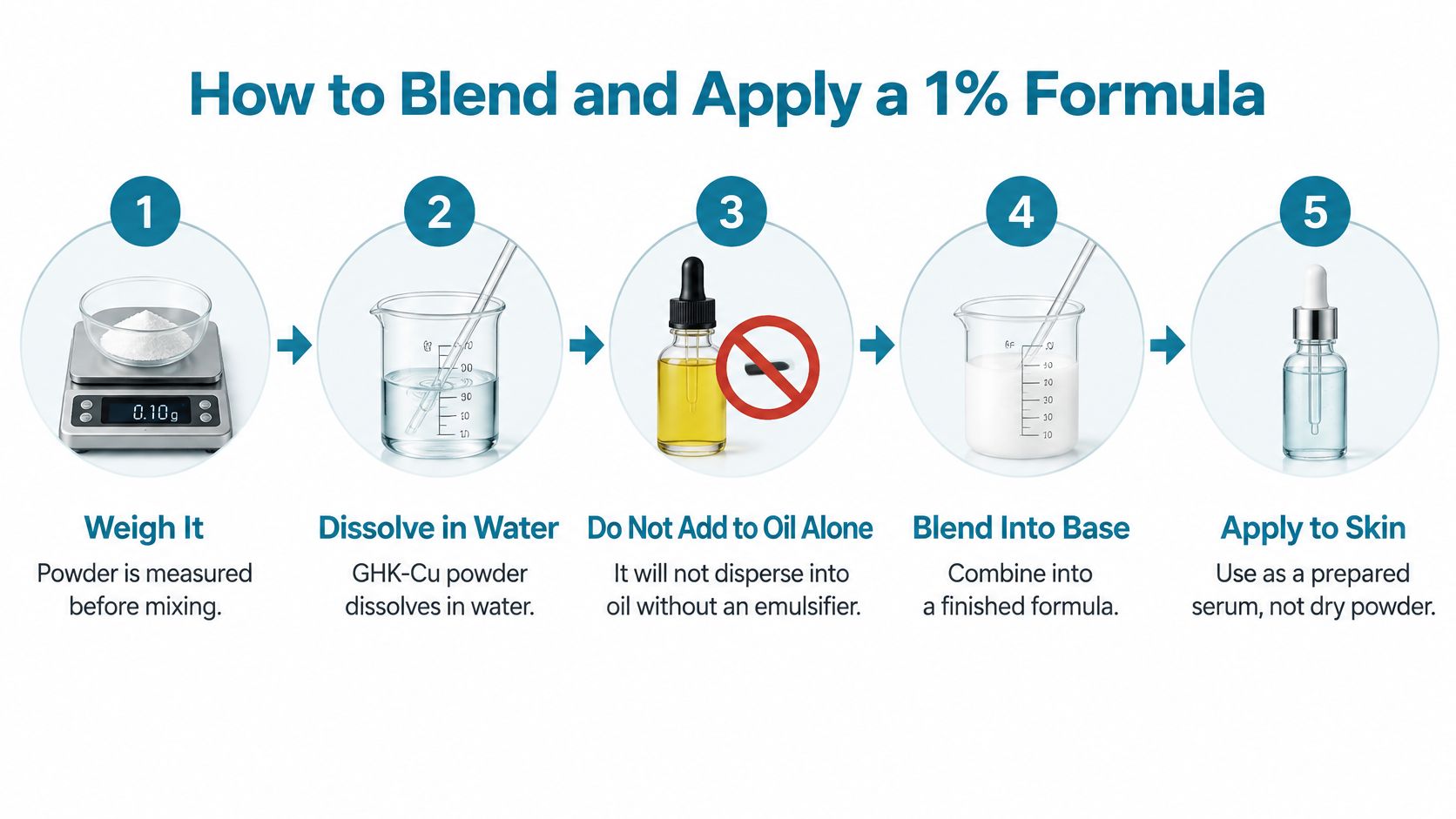
GHK-Cu powder belongs in a formulated base, not directly on skin. It dissolves in water-based preparations; oil alone will not disperse it. An oil-containing product needs an appropriately designed emulsion.
Use a small digital scale to weigh the powder. Drops measure liquid, and kitchen spoons are too imprecise for a small addition.
Powder weight for a 1% GHK-Cu blend
For a true 1% formula by weight, GHK-Cu should make up 1% of the finished batch's total weight. These examples show the calculation for batches weighed in grams:
| Finished batch weight | GHK-Cu powder at 1% |
|---|---|
| 50 g | 0.5 g |
| 100 g | 1.0 g |
A 50 ml or 100 ml volume does not automatically weigh 50 g or 100 g. Serum density varies, so weigh the complete batch rather than treating millilitres and grams as interchangeable.
A hyaluronic acid serum path
Choose a hyaluronic acid base whose supplier allows active additions. Adding powder to a finished retail serum can affect its stability or preservation, even if the powder appears to dissolve.
- Prepare the workspace. Clean and sanitize the glass mixing vessel, utensils, and suitable airless container. Weigh the powder and base separately.
- Add the powder to the water-based serum and allow it time to dissolve. Do not apply a mixture with undissolved granules.
- Blend evenly. Use a small homogenizer or suitable hand blender, taking care not to whip unnecessary air into the batch.
- Transfer the mixture to the container, seal it, and label it with the ingredients and preparation date. Check the finished pH and compatibility with the base's preservation system.
Treat a scalp tonic as formulation development
A rose hydrosol, witch hazel, and apple cider vinegar can make a scalp tonic sound simple. Each ingredient still affects the formula: vinegar changes pH, hydrosols raise preservation considerations, and essential oils need proper solubilization.
Calculate the percentage from the weight of the entire finished batch, including every liquid and additive. Then select a compatible preservative, measure the pH, dissolve the GHK-Cu in the water phase, and assess the formula's stability and preservation before packaging.
Shaking essential oil into water does not solubilize it. Refrigerating a homemade tonic does not establish that it is adequately preserved.
Leave out essential-oil drops unless the formula has a suitable solubilization system and safety assessment. The cosmetic formulation guide covers batch calculations and base selection.
Store dry powder tightly closed in a cool, dry place. Home blending requires control of the formulation checks, not making the powder disappear into water.
Copper Peptide Beside Other Actives
Serums can share a cosmetic goal while using ingredients with different roles. GHK-Cu is a copper tripeptide; expression-line peptides are another peptide category, while hyaluronic acid is commonly used for hydration and slip. The finished formula matters too: the same peptide name in two bottles can sit in different bases, such as a water serum or an emulsion, with different instructions and ingredient disclosures.
GHK-Cu next to other common cosmetic actives
| Active | What people choose it for | Typical form | How it differs from GHK-Cu |
|---|---|---|---|
| GHK-Cu | Look of firmness, fine lines, even tone, hairline and scalp | Water-based serum or powder to blend | Copper tripeptide |
| Argireline, SNAP-8, SYN-AKE | Look of expression lines | Leave-on peptide serum | Peptides used for a different cosmetic goal |
| Hyaluronic acid | Surface hydration and slip | Water serum or gel | Often used for hydration and texture |
| Vitamin C | Brighter-looking tone | Serum or other leave-on formula | A different active with a different cosmetic role |
| Retinol | Look of texture over time | Leave-on product | A different active with a different cosmetic role |
These are common cosmetic selection goals, not findings from a head-to-head trial. Research may examine matrix biology in cell culture, but that does not establish delivery through intact skin or show that a cosmetic produces the same result.
Compare the bottle, not the category
The ingredient list and product directions give the comparison practical context. A serum containing hyaluronic acid may offer slip and a comfortable application texture, but that does not make every hyaluronic acid serum a suitable base for adding copper peptide.
Check the details:
- Concentration: An active name without an amount gives limited formulation information.
- Base: Identify whether the product is a water serum, emulsion, or another format.
- Instructions: Check the application area and storage directions.
- Claims: Cosmetic wording should describe the finished product's appearance-related purpose.
Two bottles can list the same peptide name yet use different bases and provide different concentration or storage information. Price alone cannot show those differences.
The comparison of copper peptides and retinol can help clarify which cosmetic role you want in a routine. Choose based on the intended use and the product's formulation details, rather than assuming that adding more actives will improve the result.
Choose Powder or a Finished Serum
A powder suits someone prepared to formulate by weight and assess pH, stability, and preservation. The GHK-Cu Copper Peptide Powder, 99% Pure (1 Gram) is the raw-material option, without a carrier or preservative.
A finished serum is the simpler format if you want a prepared cosmetic rather than a formulation project. The GHK-Cu Copper Peptide Serum | Face, Hair + Scalp | 1% Pure GHK-Cu | 0.5 oz is sold as a serum for the face, hair, and scalp.
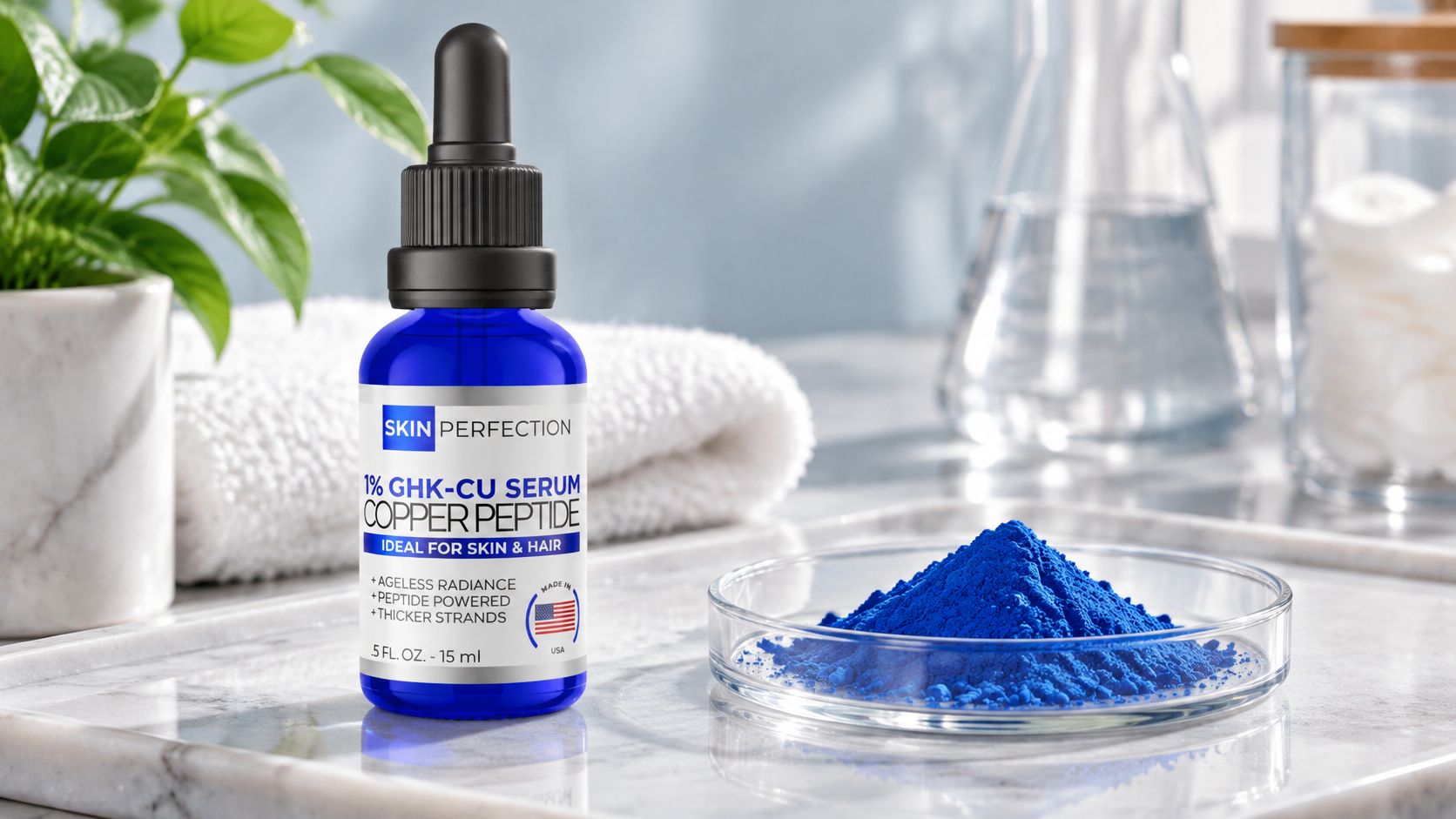
Match the format to your routine
For a finished serum, use the product's directions and check its guidance on application area, storage, and use. Patch test first and avoid direct eye contact. A powder requires a suitable formula around it; adding the peptide alone does not address the batch's pH, stability, or preservation.
Assess a cosmetic by its feel, application comfort, and the appearance of skin texture or fine lines. Blue color is a visual property, not a measure of how the formula performs on intact skin. Cell-culture findings about matrix biology do not, by themselves, establish what a cosmetic will do when applied to skin.
If weighing and preservation checks are not part of the routine you want, choose a prepared format. If formulation is the goal, choose the raw material and take responsibility for the whole batch.
Skin Perfection offers ready-made skincare and lotion-making supplies for people considering a prepared copper-peptide cosmetic or ingredients for formulation. Visit Skin Perfection to compare the formats and review product details before choosing what fits your routine and mixing experience.