

 Buy with Prime



You've probably seen citric acid on the ingredient list of your favorite skincare products, and for good reason. Sourced from fruits like lemons and oranges, it’s a popular alpha hydroxy acid (AHA) that gently exfoliates and brightens the skin's surface. It's a true workhorse, improving the appearance of skin texture and tone while also keeping the product formulas themselves stable and effective.
What Makes Citric Acid a Skincare Staple
When you spot citric acid on an ingredient label, it’s usually playing one of two key roles. Think of it as having a dual personality: it's both the spotlight-stealing performer and the hardworking stagehand, and both are essential for a flawless production. Understanding these two functions makes it clear why it pops up in everything from cleansers to serums.
Its popularity isn't just anecdotal. The global demand for citric acid, a major player in personal care, was valued at around USD 4.36 billion and continues to climb. This growth is largely thanks to its multi-functional use in cosmetics. You can find more details on this trend in the full market research.
A Gentle Exfoliator
First and foremost, citric acid is known for its role as an Alpha Hydroxy Acid (AHA). In this capacity, it acts as a gentle exfoliant. Imagine the surface of your skin is like a mosaic of old, dull tiles held together by a kind of "grout." Citric acid works to dissolve that grout, allowing the dead skin cells to slough away more easily.
This exfoliation process helps reveal the newer, fresher-looking skin hiding underneath. With regular use, this can lead to a more radiant and even-toned complexion. To get the full picture of why this step is so crucial for any routine, check out our comprehensive guide on why you should exfoliate your skin.
Key Takeaway: As an active ingredient, citric acid's main job is to promote surface exfoliation. This helps diminish the look of dullness and supports a smoother, more vibrant complexion.
The Behind-the-Scenes Stabilizer
Beyond its exfoliating duties, citric acid is a formulator's best friend. This is its second, more subtle role. It's often used in small amounts to adjust a product’s pH.
Why does pH matter so much? A product's pH needs to be within a specific range to be both effective and compatible with your skin's natural acidity. Citric acid helps formulators strike that perfect balance.
Its functions as a "behind-the-scenes" hero include:
- pH Adjuster: It ensures the final product has a pH level that’s gentle on the skin and allows other active ingredients to perform at their peak.
- Chelating Agent: It binds to metal ions that can be present in water, preventing them from degrading the formula. This extends the product's stability and shelf life.
So, when you see citric acid near the end of an ingredients list, it's likely working hard as a stabilizer, keeping the lotions and serums you love effective from the first drop to the last.
How Citric Acid Works to Enhance Skin Appearance

You don't need a chemistry degree to understand the magic behind citric acid for skin care. The concept is actually pretty straightforward. Imagine the surface of your skin is a beautiful mosaic that's gotten a bit dull over time. Citric acid goes to work on the "grout" holding the old, lifeless skin cells together.
As a member of the Alpha Hydroxy Acid (AHA) family, it gently dissolves that intercellular glue. This simple action allows the dull, dead cells to lift away, revealing the fresher, more vibrant skin waiting just beneath the surface. It's a gentle renewal process that helps promote a smoother texture and a much brighter, more even appearance.
A Gentler Approach to Exfoliation
The world of AHAs is diverse, and each acid has its own unique personality. Citric acid really stands out because of its molecular structure. When you put it next to other popular AHAs like glycolic or lactic acid, you'll find that citric acid has a much larger molecular weight.
What does that mean for your skin? A larger molecule can't penetrate the skin as deeply or as quickly. Instead, it works its magic primarily on the skin's surface. This often translates to a gentler exfoliating experience, making it a fantastic choice if you're starting your journey with chemical exfoliants or for use in multi-acid formulas.
If you're curious about different exfoliating options, our collection of Alpha Hydroxy Acid products is a great place to start looking for the perfect match for your routine.
Comparing Common Alpha Hydroxy Acids (AHAs)
To really see where citric acid fits in, it helps to compare it to its well-known AHA cousins. Each one has a different molecular size that dictates how it interacts with the skin.
| AHA Type | Primary Source | Molecular Size | Key Skincare Focus |
|---|---|---|---|
| Citric Acid | Citrus Fruits | Large | Gentle surface exfoliation, pH balancing, antioxidant support |
| Glycolic Acid | Sugarcane | Smallest | Deeper exfoliation addresses uneven texture and tone |
| Lactic Acid | Milk | Medium | Exfoliation with added hydrating properties |
As you can see, while they all exfoliate, citric acid’s larger size makes it a valuable and often milder player in the quest for a radiant complexion.
Key Insight: Citric acid's larger molecular size confines its action mostly to the skin's surface. This results in a gentle exfoliation process that helps to brighten and smooth the skin's appearance with a lower likelihood of irritation compared to smaller-molecule AHAs.
More Than Just an Exfoliant
Beyond its talent for sloughing away dead skin cells, citric acid has another trick up its sleeve: it's an antioxidant. Our skin is constantly up against environmental stressors like pollution and UV rays, which can generate pesky free radicals. These unstable molecules are known to contribute to premature aging, such as fine lines and a loss of vibrancy.
Antioxidants act like your skin's personal bodyguards, helping to neutralize these free radicals and support its natural resilience. By adding citric acid to your routine, you're not just getting a brighter surface—you're also helping to maintain a healthy, youthful look.
While citric acid works its wonders by exfoliating, other ingredients take different routes to get results. For example, you can explore how other popular peptides like Matrixyl signal the skin to boost collagen and reduce wrinkles to see another approach to formulation. This combination of exfoliation with antioxidant support is what makes citric acid such a versatile and beloved ingredient for formulators and skincare lovers alike.
Why Formulators Rely on Citric Acid
When you pick up a skincare product, you’re usually focused on the star ingredients—the retinols, the vitamin Cs, the hyaluronic acids. But there are unsung heroes working diligently behind the scenes, and citric acid is one of the most important. While its exfoliating properties are excellent, formulators often add it for completely different, more technical reasons.
Think of it as the support crew for your favorite serum. Citric acid is what helps the product feel right, perform correctly, and stay fresh on your shelf. If you've ever thought about making your own skincare, understanding these foundational roles is the secret to crafting something that’s not just effective, but also stable and elegant.
The Master of pH Balance
Ever made a salad dressing? A little too much vinegar and it's sharp and unpleasant; too little and it's just oily and bland. That perfect balance is everything. Skincare formulation is a lot like that, and pH is the key to getting the recipe just right.
Your skin is naturally acidic, with a pH that usually sits somewhere between 4.7 and 5.75. For any product to work with your skin instead of against it, its pH needs to be in a similar, compatible range. Citric acid is the formulator's secret weapon for achieving this harmony.
If a formula is too alkaline (a high pH), it can strip your skin and disrupt its protective barrier, leaving it feeling tight and vulnerable. If it’s too acidic (a low pH), it can cause irritation. As a weak organic acid, citric acid lets chemists gently nudge the formula's pH down into that sweet spot where it feels comfortable on your skin and lets the other active ingredients shine.
A Guardian Against Spoilage
Have you ever noticed an old cream turning a weird shade of yellow or separating in the jar? One of the culprits behind this is often invisible metal ions. Citric acid is a master at stopping this kind of degradation because it's a powerful chelating agent.
Picture citric acid as a tiny magnet. Tap water and many botanical extracts contain trace amounts of metal ions, such as iron and copper. You can't see them, but they can wreak havoc in a formula, kickstarting oxidation and causing the product to break down. This leads to all sorts of problems:
- Discoloration: Your beautiful white cream might turn brownish.
- Texture Changes: A silky lotion could become grainy or separate into oil and water.
- Reduced Potency: The active ingredients can degrade, reducing the product's effectiveness over time.
Citric acid’s "magnetic" ability lets it grab onto these troublesome metal ions and hold them tight, neutralizing them completely. By locking them up, it prevents them from causing chaos, which protects the formula and extends its shelf life. For anyone making a lotion, this is a non-negotiable step for creating a stable, high-quality product.
Formulator's Insight: By neutralizing destabilizing metal ions, citric acid acts as a preservative booster. It helps safeguard the product's intended texture, color, and overall performance from the first use to the last.
This chelating function is just one of its many hats. In skincare, citric acid can be an acidulant, antioxidant, preservative, and sequestrant (another term for a chelating agent). In fact, its role as an acidulant to control pH makes up a considerable slice of the citric acid market, as it’s fundamental to creating effective formulas.
Ensuring Formula Stability and Feel
Ultimately, citric acid's two main jobs—adjusting pH and chelating metals—work in tandem to create a product you'll actually love using. A perfectly balanced pH doesn't just feel better on the skin; it also helps keep emulsions stable, stopping the oil and water in your creams from separating.
At the same time, its chelating action prevents the oxidation that can make a product smell off or feel weird. It’s a simple, humble ingredient that delivers incredibly sophisticated results, making it an essential tool for both DIY crafters and professional formulators aiming to build a reliable product that stands the test of time.
Safely Using Citric Acid in Your Routine
Now that you know all the fantastic things citric acid can do, you should jump in and add it to your skincare lineup. But hold on a second. Like any active ingredient, the real secret to getting those beautiful results is to introduce it to your skin smartly and safely. A slow, steady approach lets your skin get used to it, making sure you have a great experience right from the start.
Before you slather any new product all over your face, a patch test is an absolute must. It’s a super simple check to see how your skin will react to a new formula before you go all in. Think of it as a fundamental rule of responsible skincare.
Start with a Patch Test
To do a patch test, dab a small amount of the product on a hidden spot, such as the inside of your wrist or behind your ear. Give it 24-48 hours and keep an eye on the area. If you see any redness, itching, or weird irritation, it's a sign that this product isn't for you. This tiny bit of patience can save you a world of trouble.
Decode the Ingredient List
Where citric acid sits on an ingredient list is your biggest clue to what it's actually doing in the product. Ingredients are always listed from highest concentration to lowest, so a quick scan tells you everything you need to know.
- For Exfoliation: If you spot "Citric Acid" pretty high up on the list, often hanging out with other active ingredients, it’s there to exfoliate.
- For pH Balancing: If it’s hiding way down at the bottom, after things like preservatives, it’s being used in a minuscule amount just to get the formula's pH right.
Knowing the difference helps you set your expectations and figure out how to work the product into your routine. If you're curious about stronger exfoliating treatments, you can learn more in our guide on whether an at-home facial peel is right for you.
Go Slow and Be Consistent
When you’re starting a product where citric acid is one of the main exfoliants, the "less is more" philosophy is your best friend. Your skin needs a little time to get acquainted with this new active.
Begin by using the product just two or three times a week. Really pay attention to how your skin looks and feels the next day. If everything is looking good after a couple of weeks, you can slowly start using it more often. This slow and steady method helps you get all the glowy benefits without freaking your skin out.
Important Reminder: Listen to your skin. Seriously. Everyone's skin is different, and what works for your best friend might not work for you. Tweak how often you use a product based on what your own skin is telling you.
Sun Protection is Essential
This last step is probably the most important one. Alpha Hydroxy Acids (AHAs), like our pal citric acid, work by sloughing off old skin cells to reveal the fresh, new ones underneath. This is fantastic for getting that radiant look, but those new skin cells are more delicate and way more vulnerable to the sun.
Using products with AHAs can make your skin more sensitive to sunlight. That means applying a broad-spectrum sunscreen with an SPF of 30 or higher every single morning is non-negotiable. This isn’t just a good idea—it’s a critical step to protect your skin and keep the great results you're working so hard for. Think of sunscreen as the final, protective seal on all your skincare efforts.
Mastering Citric Acid in DIY Formulations
For the true DIY skincare formulator, citric acid is more than just another ingredient on the shelf—it's a critical tool for getting your homemade lotions and serums just right. Working with it at home demands a bit of precision and care, but once you get the hang of it, you unlock a whole new level of control over your creations. It all starts with safe handling and accurate measurements.
First things first: protect yourself. Always wear gloves to keep potent citric acid powder off your skin, and pop on some safety glasses to prevent accidents. You’ll be working with tiny, powerful amounts, so a digital scale that measures down to 0.01 grams is an absolute must-have for accuracy.
Preparing Your Citric Acid Solution
Here’s a pro tip for home formulating: never add citric acid powder directly into your final product. It’s nearly impossible to control the pH that way, and you can end up with pockets of high acidity that you definitely don't want on your skin. The secret is to create a stock solution first.
A 50% citric acid solution is the standard and is super easy to manage. Here’s how you make it:
- Measure Equal Parts: On your digital scale, weigh out equal amounts of distilled water and citric acid powder. A good starting point is 10 grams of water and 10 grams of citric acid.
- Combine and Dissolve: Add the citric acid powder to the water.
- Stir Gently: Keep stirring until the powder completely dissolves and the solution is clear.
- Label and Store: Pour your new solution into a labeled dropper bottle and keep it in a cool, dark place. Now you're ready to make precise pH adjustments like a pro.
A Real-World Example: Creating a pH-Balanced Toner
Let's walk through this with a simple project: a basic hydrating facial toner. Imagine you've mixed your main ingredients—maybe some distilled water, rosewater, and a touch of glycerin for hydration. You're at the final, crucial step: balancing the pH.
You'd start by testing your mix with a pH strip or a digital pH meter. Let's say it comes in at a pH of 6.5, which is a little too high for an ideal toner. Your goal is to bring it down to a more skin-friendly pH, around 5.0.
This is where your 50% citric acid stock solution comes in. You’ll add just one single drop to your toner, stir it in well, and test the pH again. You'll see a noticeable drop. From here, you repeat the process—one drop at a time, mix, and test—until you hit your target. This careful, step-by-step method ensures you don't overshoot the mark and make your product too acidic.
Looking for some great projects to practice these skills? You can find plenty of inspiration from these DIY skincare recipes that rival luxury brands.
This simple infographic sums up the core safety steps you should follow with any new ingredient or homemade formula.
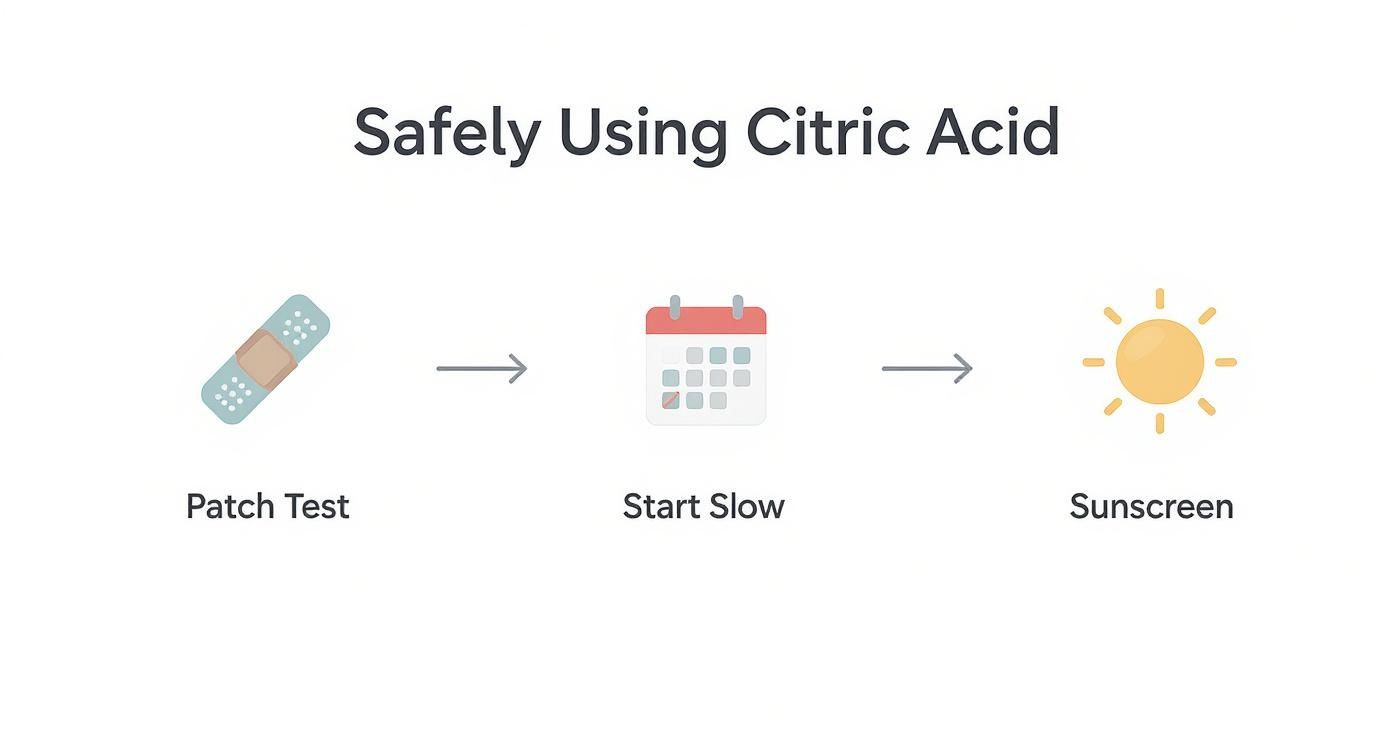
It’s a great visual reminder that patch testing, starting slow, and always using sunscreen are the building blocks of a safe and happy skincare journey.
A Handy Reference for Ideal pH Levels
Nailing the right pH is what separates a good homemade product from a great one. It's vital for making sure your creations are stable and work in harmony with your skin. Different products feel and function best within specific pH ranges.
Key Takeaway: The final pH of a DIY product influences its feel, stability, and interaction with the skin's natural barrier. Adjusting it correctly with a citric acid solution is a hallmark of thoughtful formulation.
Getting the pH right helps produce formulations that are balanced, stable, and feel beautiful on the skin. Below is a helpful table listing target pH ranges for common DIY skincare creations.
Recommended pH Ranges for DIY Skincare Products
| Product Type | Target pH Range | Reason for Range |
|---|---|---|
| Daily Cleanser | 5.0 – 6.0 | Aligns with the skin's natural acidity to cleanse gently without stripping the protective barrier. |
| Exfoliating Serum (AHA) | 3.5 – 4.0 | Low enough for the acids to be effective at exfoliation but high enough to minimize irritation. |
| Hydrating Toner | 4.5 – 5.5 | A slightly acidic pH helps to balance the skin after cleansing and prepares it for other products. |
| Lotion or Cream | 4.5 – 6.0 | Ensures the emulsion remains stable and the preservatives used are effective. |
By using a precise scale, preparing a stock solution, and adjusting your formulas drop by drop, you can elevate your creations from simple mixtures to sophisticated, pH-balanced skincare you can be proud of. It’s this attention to detail that truly makes all the difference.
Your Questions About Citric Acid Answered
When you start digging into the world of citric acid for skincare, it's natural to have questions pop up. This powerhouse ingredient wears many hats, from gentle exfoliant to behind-the-scenes pH balancer. To help clear things up and get you comfortable with it, we’ve put together answers for some of the most common questions we get.
Think of this as your go-to guide. It’s here to give you clear, simple information so you can make the best choices for your skin.
Can I Use Lemon Juice on My Face Instead of Skincare Products?
While lemons are the original source of citric acid, putting pure lemon juice straight on your face is a big no-no. The amount of citric acid in a lemon is a total wild card, and its pH is incredibly low—usually around 2.0.
That kind of acidity can disrupt your skin’s delicate protective barrier, which likes to hang out at a much happier pH of 4.7 to 5.75. Using straight lemon juice is practically asking for major irritation and redness.
On the flip side, professional skincare products use purified citric acid in very specific, controlled amounts. These formulas are expertly balanced to a pH that your skin will love, ensuring they are both effective and gentle. For results you can count on, always stick with products made for your face, not your salad.
How Is Citric Acid Different From Vitamin C?
This is easily one of the most common mix-ups, and it makes sense since both are famous for being in citrus fruits. The simplest way to remember the difference is to think about their main jobs in your skincare routine.
- Citric Acid: This is your Alpha Hydroxy Acid (AHA). Its primary gig is exfoliation—it helps loosen and slough off dead skin cells from the surface, revealing a brighter, smoother complexion underneath.
- Vitamin C (L-Ascorbic Acid): This one is a superstar antioxidant. Its main purpose is to shield your skin from environmental damage and help promote a firm, even-toned look.
Sure, citric acid has some antioxidant abilities, but its real claim to fame in skincare is exfoliation and pH balancing. You’ll often see them both in the same product because they work so well together, each playing to its own strengths.
Key Distinction: Think of citric acid as the exfoliator, working on your skin’s surface. Vitamin C is the protector, working deeper as a powerful antioxidant.
Is Citric Acid Suitable for Sensitive Skin?
The real answer here is: it depends on the concentration and the rest of the formula. Citric acid has a larger molecule than other AHAs, like glycolic acid. This means it can't penetrate the skin as quickly, which often makes it a gentler option.
If citric acid is way down at the bottom of an ingredient list, it’s likely just there to adjust the product's pH. In these tiny amounts, it’s usually perfectly fine for most skin types, including sensitive ones. However, if it’s a star player meant for exfoliation at higher concentrations, it’s more likely to cause a reaction.
The golden rule for sensitive skin is always the same: patch test first. Introduce any new product slowly, maybe just once or twice a week, to see how your skin handles it before you make it a regular thing. For any other general questions, you can always visit our main Frequently Asked Questions page.
How Can I Tell a Product's Purpose for Citric Acid?
The biggest clue is hiding in plain sight on the ingredient list. Ingredients are always listed from the highest concentration to the lowest, so where you find "Citric Acid" tells you almost everything you need to know.
If it's listed near the very end, after all the main actives and preservatives, its job is as a pH adjuster or a chelating agent. This means it's there in a tiny, functional amount to improve the formula's performance.
But if you spot it higher up on the list, maybe hanging out with other acids or key brightening ingredients, you can bet it's there for its exfoliating benefits. The product's description will give you more clues—if you see words like "resurfacing," "brightening," or "peel," that's another dead giveaway. If you need personalized advice on adding citric acid to your routine or tackling specific concerns, you might want to consult with an online dermatologist for tailored recommendations.
At Skin Perfection, our goal is to empower you with the knowledge and top-notch ingredients you need to get your best skin ever. Whether you're after expertly formulated products or the best lotion-making supplies to create your own magic, we're here to support your journey to a glowing, healthy-looking complexion. Explore our collections today at https://www.naturalorganicskincare.com.