

 Buy with Prime


You're washing your face after a long day, leaning toward the mirror, and noticing a faint line that wasn't obvious before. Maybe it appears when you raise your eyebrows, smile, or squint at your phone. That moment can feel alarming, but a few fine lines in your 20s don't mean you've aged unusually fast.
The more useful question is not whether you need an aggressive anti-aging routine. It's which habits deserve a permanent place in your routine, which actives have a clear reason to be added, and when doing less will keep your skin looking smoother. The answer begins with daily sun protection, gentle care, and a realistic threshold for introducing retinoids or peptides.
Table of Contents
- Why Wrinkles Start Earlier Than You Think
- Daily Sun Protection That Actually Prevents Lines
- Your Simple AM and PM Prevention Routine
- Retinoids Peptides and When to Start Them
- Lifestyle Habits That Speed Up or Slow Down Early Lines
- Mistakes to Avoid and DIY Hydration Tips That Support Smoother Looking Skin
Why Wrinkles Start Earlier Than You Think
A 26-year-old client once told me she only noticed her forehead lines when she was tired. In the morning, her skin looked smooth. By evening, after hours of squinting at screens, commuting outdoors, and making the same expressions she'd made all day, the lines looked more defined. Her first instinct was to buy several strong products at once.
That's where many routines go wrong. Early lines aren't caused by one bad week or one missed moisturizer application. Cumulative photoaging, repeated facial movement, dehydration, and irritation can gradually make expression lines more noticeable, even when the skin still looks youthful overall. Genetics influence how someone's skin behaves, but they don't make daily habits irrelevant.
Dynamic lines and early static creases
A dynamic line appears mainly during movement, such as smiling, frowning, raising the eyebrows, or squinting. At this stage, it may fade when the face relaxes. A static crease remains more visible when the face is still, often because repeated movement and environmental exposure have gradually changed the way the surface looks.
Some expression lines in your 20s are completely normal. Your face moves, and movement is part of looking like yourself. Prevention isn't about freezing every expression. It's about reducing avoidable stressors so normal movement doesn't combine with years of unprotected ultraviolet exposure and a persistently irritated skin barrier.
UV exposure deserves particular attention because photoaging accumulates. A landmark Australian randomized trial published in 2013 and followed for 4.5 years found that daily broad-spectrum sunscreen users were 24% less likely to show increased skin aging than people who used sunscreen at their discretion, with relative odds of 0.76 and a 95% confidence interval of 0.59 to 0.98 (Nambour trial report). The daily-use group also showed no detectable increase in skin aging over the study period.
Why prevention beats late correction
The practical implication is simple. Preventing repeated UV exposure in your 20s is more reliable than waiting for established lines and trying to soften them later. That doesn't mean you need a complicated shelf of products. It means the routine you can repeat on ordinary mornings matters more than the expensive product you use occasionally.
If you want broader context about professional options and how they differ from home care, Dream Body Clinic's guide to anti-aging therapies can help you understand the treatment options without treating procedures as a requirement. For a topical perspective on habits that support the look of firmer skin, you can also explore this natural ways to increase collagen guide.
Start with the basics. If your skin is comfortable, your sunscreen use is consistent, and your lines only appear with expression, sunscreen alone may be enough for now. Add targeted actives because your skin gives you a reason, not because your age has triggered a deadline.
Daily Sun Protection That Actually Prevents Lines
If you're asking how to prevent wrinkles in your 20s, daily broad-spectrum sunscreen is the highest-impact answer. It's also the step people apply too little, skip in winter, or reserve for beach days. That inconsistency matters because photoaging reflects repeated exposure over time, not only dramatic sunburns.
UVA is especially relevant to visible aging because it penetrates deeper into the skin and is associated with collagen and elastin breakdown. UVB protection still matters, but a product labeled broad-spectrum is designed to cover both types of ultraviolet exposure. Sources commonly cite SPF 30 as blocking about 97% of UVB rays, which is one reason an SPF number alone isn't enough when choosing a product (sunscreen and photoaging guide).
The morning protocol
Apply a broad-spectrum SPF 30 or higher every morning to your face, neck, and ears. Use enough product to create the labeled level of protection, and spread it evenly rather than rubbing most of it into your palms before it reaches your skin.
Make sunscreen the final step of your morning skincare routine. If you wear makeup, let the sunscreen settle before applying it. If you're outdoors for a prolonged period, swimming, sweating, or wiping your face, reapply rather than assuming the first application lasts indefinitely.
A practical routine looks like this:
- Cleanse gently: Remove overnight oil and residue without leaving your skin tight.
- Apply optional antioxidant support: A compatible antioxidant serum can complement, but it doesn't replace, sunscreen.
- Moisturize if needed: Dry or easily irritated skin often applies sunscreen more comfortably over a light moisturizer.
- Protect exposed areas: Cover the neck and ears, not only the center of the face.
- Add physical protection: Hats, sunglasses, and protective clothing reduce the amount of exposure your sunscreen must manage.
Practical rule: If you can't maintain a product every morning, simplify the routine until sunscreen becomes automatic.
A review of wrinkle risk summarized that frequent sun exposure was associated with sharply higher wrinkle prevalence, with wrinkles reported at 10% among people exposed to under 30 minutes of daily sun and 80% among those exposed to more than 2 hours. The same review associated regular SPF 30+ use with about 40% lower prevalence of hyperpigmentation and wrinkles (review of photoaging prevention). Those figures shouldn't be treated as a personal prediction, but they illustrate why “only when sunny” is a weak prevention strategy.
You can find more ingredient-focused guidance in this facial sunscreen and zinc oxide guide. For evening hydration after a consistent protective morning, the HydroGlow Anti-Aging Night Mask is a leave-on cosmetic mask formulated with hyaluronic acid, polyglutamic acid, jojoba, squalane, aloe, glycerin, triglycerides, sea silt ferment, and algae extract. Think of it as a moisture-focused step, not a substitute for UV protection or a promise to reverse established lines.
Your Simple AM and PM Prevention Routine
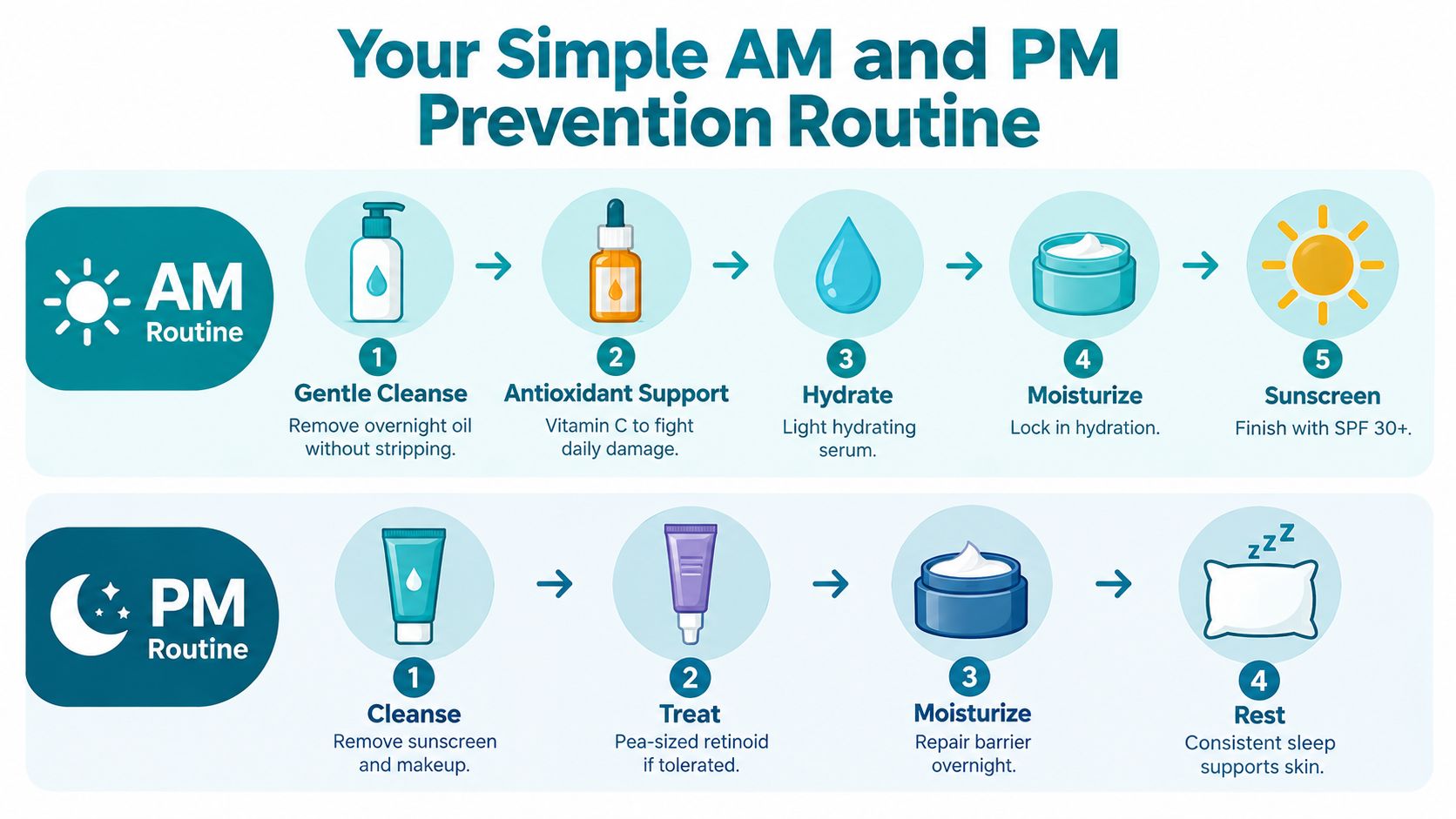
A good routine should survive real life. You'll sometimes wear makeup, come home from the gym late, or fall asleep before completing every step. The answer isn't to create a longer routine that you'll abandon. It's to identify the few steps that protect the appearance of your skin, then make the optional steps flexible.
For a beginner-friendly structure, this skincare routine guide offers a useful starting point. The sequence below keeps hydration and comfort central while leaving room for targeted ingredients if your skin needs them.
Morning
Start with a gentle cleanse, or rinse if cleansing in the morning makes your skin feel dry. The right choice depends on how your skin feels, not on a rule that everyone needs the same wash twice daily.
Apply an antioxidant serum if you tolerate one, then use a hydrating layer and moisturizer as needed. A light serum can reduce the tight feeling that makes fine lines look more prominent, while moisturizer helps maintain a comfortable surface. Finish with broad-spectrum SPF 30+ on the face, neck, and ears.
If you're rushing, don't skip sunscreen because you can't complete every earlier step. Cleanse, moisturize if needed, and protect. A gym day may call for cleansing after exercise before reapplying sunscreen, while a makeup day may require more careful evening removal.
Evening
Remove sunscreen and makeup thoroughly but gently. Harsh scrubbing, repeated cleansing, and very hot water can leave the skin uncomfortable, which makes it harder to tolerate any targeted active you might add later.
Follow with hydration and moisturizer. If you use a retinoid, apply it only on nights assigned to that product, after the skin is completely dry, and use a small amount across the whole face rather than concentrating it on visible lines. Sensitive skin may benefit from applying moisturizer before and after the retinoid, a buffering approach that reduces direct contact without requiring you to abandon the ingredient.
The rest of your evening can stay simple:
- After a late night: Cleanse, moisturize, and go to bed. Missing an optional serum is less harmful than irritating your skin with a rushed routine.
- After exercise: Remove sweat and sunscreen residue, then replenish comfort with moisturizer.
- When skin feels reactive: Pause exfoliating acids, scrubs, and retinoids until the surface feels normal again.
- When skin feels dry: Use a humectant under a moisturizer so the hydrating layer has support at the surface.
For formulators and informed DIY users, Sodium Hyaluronate Powder Pure Hyaluronic Acid is a cosmetic-grade, high-molecular-weight NASHA ingredient with a stated molecular weight of 800 to 1500 Daltons. The product snapshot describes use in water-based serums at 0.1% to 2%, as well as creams and lotions. Any DIY formula still needs appropriate preservation, sanitation, and accurate weighing. Freshness alone doesn't make a water-based product safe.
Retinoids Peptides and When to Start Them
Sunscreen belongs in almost everyone's morning routine. Retinoids and peptides need a more personal decision threshold.
Topical retinoids are the best-studied active category for early wrinkle care, but the evidence is stronger for photoaged skin than for completely wrinkle-free skin in the 20s. In a 6-month randomized, double-blind, vehicle-controlled study of 346 people with photoaged skin, once-daily 0.05% isotretinoin used with sunscreens produced significant improvement in fine wrinkles compared with vehicle control (clinical isotretinoin study).
That doesn't create an evidence-based rule that every 20-something should start prescription tretinoin. Long-term randomized data specifically testing preventive tretinoin use in wrinkle-free people in their 20s are lacking, and there's no universal age at which everyone should begin. A reasonable threshold is existing photodamage, acne, or early dynamic lines that remain visible more often, provided you're willing to introduce the product slowly.
Peptides sit in a different category. Cosmetic options such as Argireline Amplified, SNAP-8, and SYN-AKE are generally considered support for the appearance of expression lines, with tolerability often making them appealing to people who don't want the irritation profile of a retinoid. They're optional, not a replacement for sunscreen, and they shouldn't be framed as equivalent to a prescription drug.
For ingredient background, PepFlow's skin peptide guide can help you compare peptide terminology and product positioning. If you're considering combining products, this guide to combining retinol and peptides safely at home is a useful reference point, especially if your routine already contains exfoliating ingredients.
| Option | Best For | How to Use | Watch Out For |
|---|---|---|---|
| Retinoid | Visible photodamage, acne, or early lines that justify targeted treatment | Start 2 to 3 nights per week on completely dry skin, using a pea-sized amount for the whole face. Increase only as tolerated. | Dryness, dermatitis, and increased sunlight sensitivity can lead to discontinuation if you advance too quickly. |
| Peptide serum | People seeking cosmetic support for the appearance of expression lines with a gentler routine | Apply according to the product directions, usually after cleansing and before moisturizer. | Peptides are optional, and a peptide product doesn't compensate for inconsistent sunscreen use. |
| No targeted active yet | Comfortable, largely clear skin with no meaningful photodamage or persistent lines | Keep morning protection and evening cleansing, hydration, and moisturizing consistent. | Don't mistake “doing less” for neglect. A simple routine still needs daily protection. |
If you start a retinoid, introduce only one new active at a time. Apply it to dry skin, use a pea-sized amount, buffer with moisturizer if needed, and keep daytime sunscreen essential because retinoids can increase sunlight sensitivity.
Lifestyle Habits That Speed Up or Slow Down Early Lines
Skincare can't compensate for every exposure. Smoking deserves the clearest warning because its relationship with wrinkling is stronger than the evidence for many popular lifestyle theories. One source reports that heavy cigarette smokers were 4.7 times more likely to be wrinkled than non-smokers, while heavy smokers with high sun exposure had risk reported as 11 to 12 times higher (smoking and facial wrinkling research).
Smoking also combines chemical exposure with repetitive facial movements around the mouth and eyes. If you smoke, reducing exposure and seeking appropriate cessation support is more meaningful for long-term skin appearance than adding another serum.
Sleep, food, and hydration without perfectionism
Sleep supports how rested and comfortable your skin looks, but sleep position is a weaker and more mixed wrinkle factor than sunlight or smoking. A PubMed-cited study found no statistically significant correlation between a person's preferred sleep side and the side showing more wrinkles or facial descent (sleep position study). Repeated facial compression may still contribute to sleep-related creases for some people, but it isn't worth losing sleep trying to force yourself into an unfamiliar position.
Focus on habits you can sustain:
- Protect recovery: Keep a regular sleep schedule where possible instead of treating skincare as compensation for chronic late nights.
- Eat broadly: Include water-rich produce, varied protein sources, and healthy fats rather than chasing one “beauty food.”
- Drink normally: Hydration supports overall comfort, but drinking excessive amounts won't replace moisturizer or sunscreen.
- Notice tension: If you constantly squint because your vision needs attention, correcting that habit may reduce repeated expression. Sunglasses can also make bright outdoor conditions more comfortable.
- Avoid fear-based expression control: Laughing and smiling aren't mistakes to eliminate. Prevention should reduce avoidable stress, not police your face.
For people who enjoy optimizing their nighttime environment, you can browse the beauty sleep kit from Sleep All Nite as one comfort-focused option. Treat it as part of a restful routine, not as a substitute for the higher-impact habits already discussed.
Mistakes to Avoid and DIY Hydration Tips That Support Smoother Looking Skin
The most common mistake I see in 20-something routines is treating irritation as proof that a product is working. Layering a retinoid, exfoliating acid, scrub, strong cleanser, and several fragranced actives can leave the barrier stressed. Irritation and paradoxical pigmentation can make skin look less even and more lined, which defeats the purpose of the routine.
Collagen supplements are another shortcut that deserves skepticism. A recent dermatology summary says oral collagen is not currently recommended as a skin-aging treatment, despite consumer enthusiasm (dermatology summary on cosmetic skincare claims). Your money and attention are better directed toward consistent photoprotection, a tolerable routine, and products with a clear cosmetic purpose.
A careful DIY hydration approach
Sodium hyaluronate can be useful for formulators who want to create a water-based hydrating serum or cream. The product snapshot for Skin Perfection's ingredient describes a cosmetic-grade NASHA powder with a stated molecular weight of 800 to 1500 Daltons, intended for typical serum concentrations of 0.1% to 2%. Use accurate measurements, clean equipment, compatible ingredients, and an appropriate preservative system for any water-containing formula.
Keep the first batch small, and don't assume a DIY product is safe because the ingredient is familiar. Apply a finished cosmetic formula conservatively, and stop using it if your skin becomes uncomfortable. Pair a humectant serum with a gentle moisturizer so hydration isn't left exposed to a dry environment.
This DIY hyaluronic acid serum guide can help you think through formulation choices. For a concise prevention plan, use this checklist:
- Every morning: Broad-spectrum SPF 30+ on the face, neck, and ears.
- During prolonged outdoor exposure: Reapply sunscreen and add a hat or protective clothing.
- Every evening: Remove sunscreen and makeup without scrubbing.
- If your skin is comfortable: Consider one targeted active, not several at once.
- If irritation appears: Simplify, moisturize, and rebuild tolerance gradually.
- Always: Treat smoking cessation, rest, and realistic routines as more valuable than skincare hype.
Skin Perfection offers ready-made skincare products alongside lotion-making supplies and cosmetic ingredients for people who want a straightforward routine or enjoy formulating their own hydrators. Visit Skin Perfection to explore appearance-focused options that fit your prevention plan, then choose the few products you can use consistently.