

 Buy with Prime


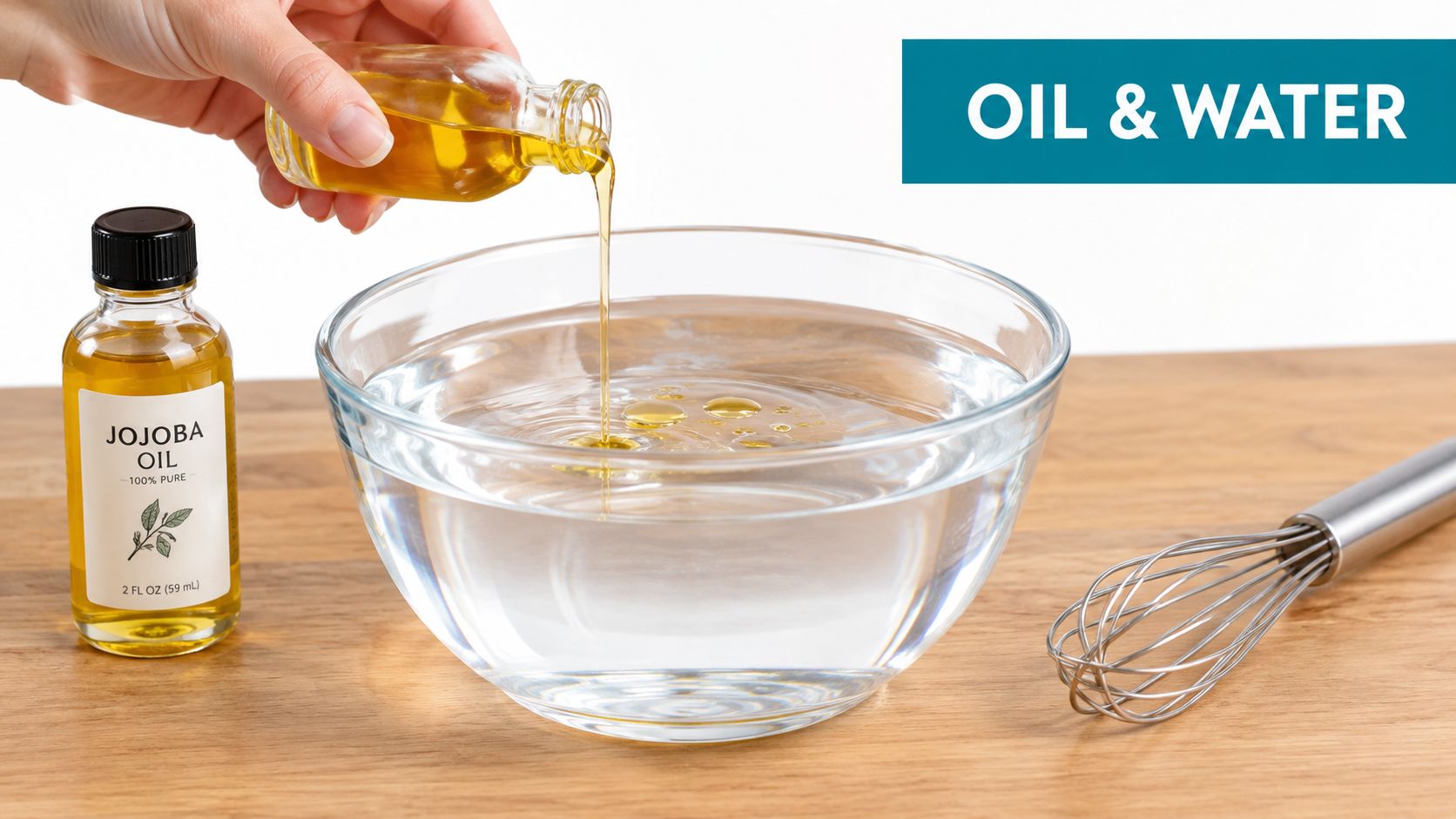
You mixed jojoba oil with water, gave it a hopeful whisk, and for a few minutes it looked like lotion. Then it turned into two layers by the evening, or worse, a curdled mess with an oily ring at the top. That failure is common, and it usually has nothing to do with jojoba itself.
The problem is that jojoba oil lotion is an emulsion, not a casual blend. Water and oil need structure, the right emulsifier, and enough process control to stay together after the mixer stops. The glossy jar on the shelf is the easy part. The hard part is what happened before bottling.
At Skin Perfection, we sell skincare products and lotion-making supplies designed to beautify the skin. We also stay strict about product language. The FDA explains that a product's legal category depends on intended use, so cosmetic products shouldn't be presented as fixing, repairing, or healing skin. We follow that standard in our listings. We also follow Etsy's policy, which says sellers may not claim an item can treat, mitigate, diagnose, or cure serious disease or medical conditions, sexual dysfunction, or function like a drug or FDA-approved product.
Table of Contents
- Starting With Jojoba Oil Lotion and Why It Matters
- How Jojoba Oil Actually Behaves in a Lotion
- Building the Formula Around Jojoba Oil
- Making the Lotion Step by Step
- Preserving and pH Balancing the Lotion
- Stability Testing Before You Trust the Batch
- Using and Adjusting Your Finished Lotion
Starting With Jojoba Oil Lotion and Why It Matters
A lotion fails fast when the maker treats it like salad dressing. Oil floats, water separates, and the batch looks broken before you even think about preservation. A stable jojoba oil lotion needs an emulsifier to hold tiny droplets in suspension, plus enough fatty structure to keep the texture from thinning out later.
Why Jojoba Earned Its Place
Jojoba isn't a trendy add-on that showed up last year. Commercial interest in jojoba oil expanded during the 1970s, after the 1971 U.S. ban on importing whale oil accelerated the search for plant-based alternatives, and jojoba became known as a vegan replacement for sperm whale oil according to the historical background on jojoba oil. That matters because jojoba entered cosmetics for practical reasons, not just branding.
In a lotion, jojoba brings a skin feel many formulators want but struggle to get from heavier vegetable oils. It's known for a smooth, quick-absorbing finish and a sebum-like feel that makes it useful in both face and body moisturizers. Trade literature also describes jojoba as mimicking human sebum by 25%, which helps explain why it shows up so often in moisturizers and lotions according to Cosmetics & Toiletries coverage of jojoba performance data.
Practical rule: If a lotion feels elegant on the skin but splits on the shelf, the ingredient choice may be fine. The structure is what failed.
What Usually Goes Wrong
Most DIY recipes skip the plain, unfashionable decisions that keep a batch stable:
- Emulsifier mismatch: The oil phase is too large for the emulsifier system.
- Weak preservation: The maker assumes vitamin E is enough. It isn't an antimicrobial preservative.
- No stability check: The batch looks fine warm, then separates after cooling or storage.
A professional jojoba lotion formula also rarely means “jojoba plus water and nothing else.” One supplier example shows lotion as a full emulsion system with water at 50 to 70%, canola seed oil at 20 to 35%, jojoba seed oil at 10 to 40%, plus cetyl alcohol at 2 to 5% and stearic acid, as shown in this jojoba lotion formula sheet. That's the reality of lotion making. Each part has a job.
How Jojoba Oil Actually Behaves in a Lotion
Jojoba changes the feel of a lotion more than people expect. It doesn't behave quite like the triglyceride oils many DIYers start with, and that difference shows up in rub-in, afterfeel, and how the oil phase behaves during emulsification.
What It Contributes Inside the Emulsion
Jojoba is valued in lotion systems because it gives slip without the heavy drag some richer oils leave behind. In use, that often reads as a drier touch and cleaner finish. It can make a formula feel more polished even when the rest of the base is fairly simple.
There's also some measured performance behind the ingredient. One report found jojoba oil increased hydration by 30% within the first 30 minutes after application, and another found that adding 10% jojoba oil to a moisturizing retinol formula increased retinol permeation nearly 40-fold, according to the same Cosmetics & Toiletries jojoba summary. A separate report in that source also noted a 23% reduction in sebum secretion after 28 days of regular application.
That doesn't make jojoba a cure-all. It means jojoba can contribute to hydration, feel, and delivery in some formulations.
What It Does Not Do
Jojoba doesn't preserve a lotion. It doesn't replace an emulsifier. It doesn't turn an unstable cream into a stable one by goodwill alone. It also shouldn't be framed as a guaranteed acne fix or a magic barrier ingredient for every skin type.
The nuance gets lost in consumer writing. A broader review notes promise, especially around barrier-supportive systems and jojoba-derived esters, but also points out that study results vary and some evidence is limited or methodologically narrow in this review of jojoba in dermatology and skincare.
For readers who want a broader overview of where jojoba fits in skincare categories, this jojoba oil guide and uses article is a useful companion.
How It Compares in Lotion Systems
| Property | Jojoba Oil | Sweet Almond Oil | Fractionated Coconut Oil |
|---|---|---|---|
| Skin feel | Dryer, more sebum-like | Softer, richer | Light, slippery |
| Typical role in lotion | Slip, conditioning, elegant finish | Cushion and emollience | Lightweight spreadability |
| Oxidative behavior | Commonly valued for stability | More prone to going stale than jojoba | Generally light and stable-feeling |
| Best use case | Face and body lotions that need less grease | Body lotions that need comfort | Lighter body and facial emulsions |
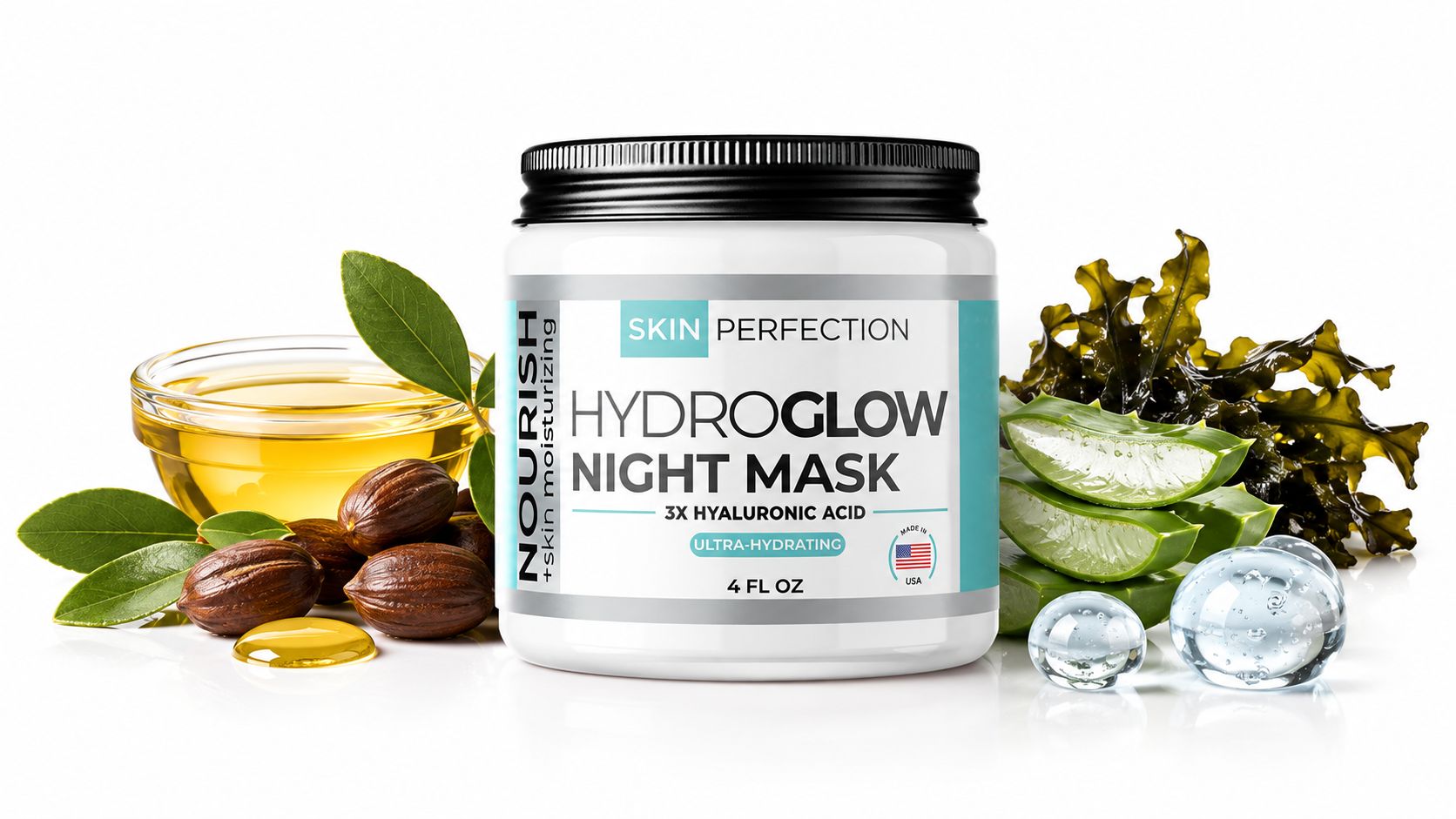
A finished product can show this logic clearly. HydroGlow Anti-Aging Night Mask uses jojoba and squalane as oils that mimic natural skin oils, alongside glycerin and triglycerides for moisture support, which is a good example of jojoba working as one part of a broader moisturizing system rather than carrying the whole formula by itself.
Building the Formula Around Jojoba Oil
A good jojoba oil lotion starts with restraint. If every ingredient sounds useful, the formula gets crowded fast. Lotions hold together when each component earns its place.
Start With the Water Phase
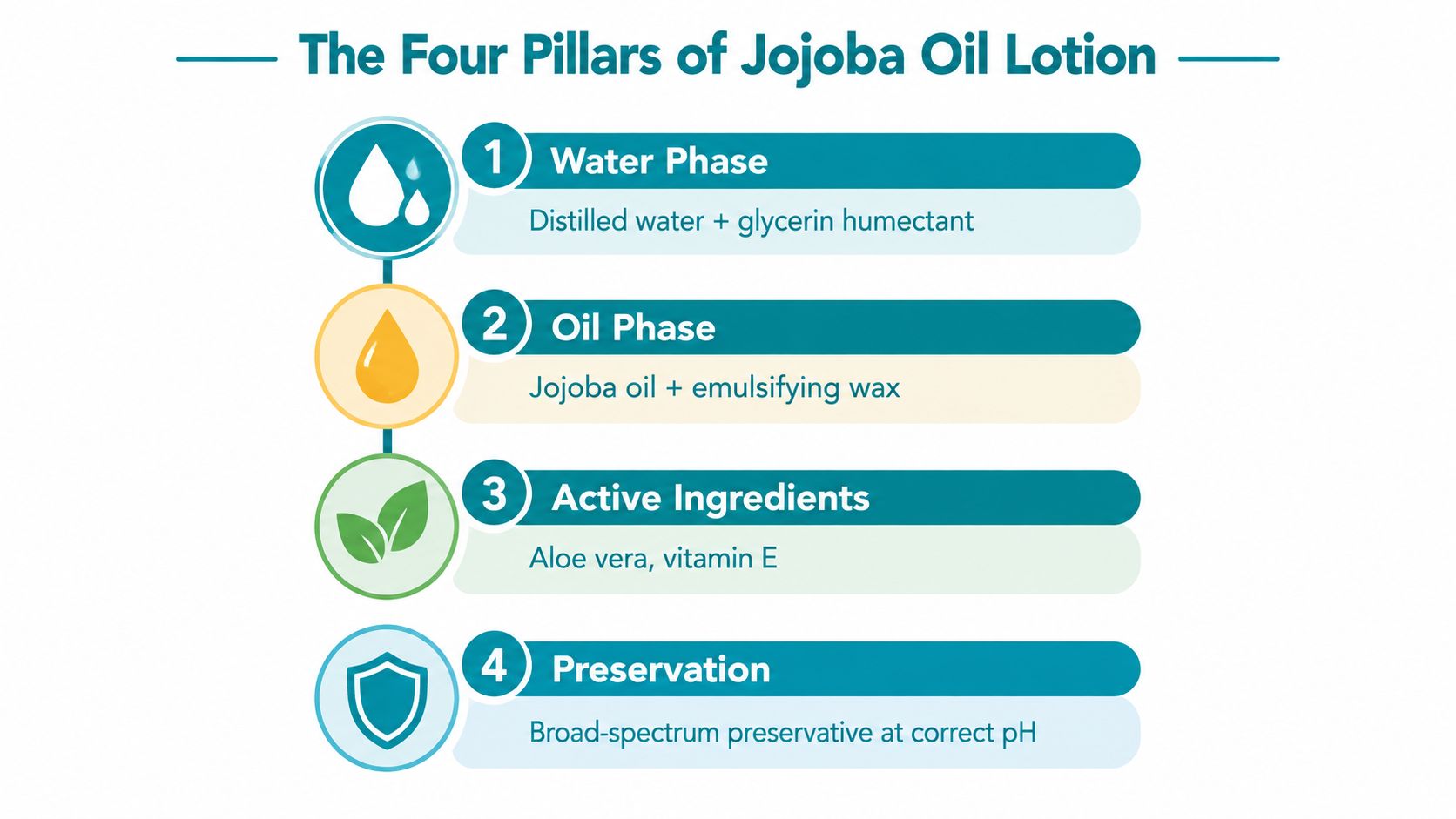
The water phase does more than fill space. Distilled or deionized water gives you consistency, and a humectant such as glycerin or propanediol changes how the lotion performs on the skin. Without a humectant, many beginner lotions feel nice for a minute and then dry down flat.
If you want extra water-binding support, a powder form of hyaluronic acid can fit cleanly into this phase. Sodium Hyaluronate Powder Pure Hyaluronic Acid is a cosmetic-grade ingredient intended for creams, serums, and lotions, with a stated molecular weight of 800-1500 Daltons and typical DIY use at 0.1–2%. That kind of ingredient makes more sense in a water phase than trying to push hydration work onto the oil phase alone.
Build the Oil Phase on Purpose
Jojoba is usually better as a lead oil than as the only oil. In practice, many body and facial lotions do well with jojoba around the middle of the oil phase rather than at an extreme level. Pair it with a richer oil or butter if you want more cushion, or keep the rest of the oils lighter if you want a cleaner finish.
A simple decision path works well:
- For a lighter lotion: Keep the oil phase streamlined and let jojoba carry more of the sensory feel.
- For a richer lotion: Add a small amount of shea or a softer emollient oil, but don't let them bury jojoba's glide.
- For faster absorption: Use fewer waxy co-emollients and avoid overloading fatty alcohols.
Choose an Emulsifier That Matches Your Goal
If you're still learning structure, a more forgiving emulsifying wax is easier to live with than a temperamental natural system. That's not glamorous advice, but it saves batches. A basic nonionic emulsifying wax often tolerates small measuring drift and household equipment better than fussier systems.
If you want a closer look at how emulsifying wax works in cosmetic formulas, this guide to what emulsifying wax is lays out the basics well.
A lotion can feel luxurious and still fail if the emulsifier is underbuilt for the oil load.
Thickeners Decide the Finish
Thickness is not just about viscosity. It also changes glide, pickup, pumpability, and whether the lotion pills on the skin.
- Xanthan gum: Useful for water-phase support and suspension, but too much makes the lotion feel stringy.
- Cetyl alcohol: Improves slip and body with a silkier finish.
- Cetearyl alcohol: Adds more structure and a creamier, denser feel.
The cleanest formulas usually aren't the shortest. They're the ones where nothing is there by accident.
Making the Lotion Step by Step
The mixing stage is where a promising formula either becomes lotion or turns into expensive waste. Good process can rescue a modest formula. Bad process can break a strong one.
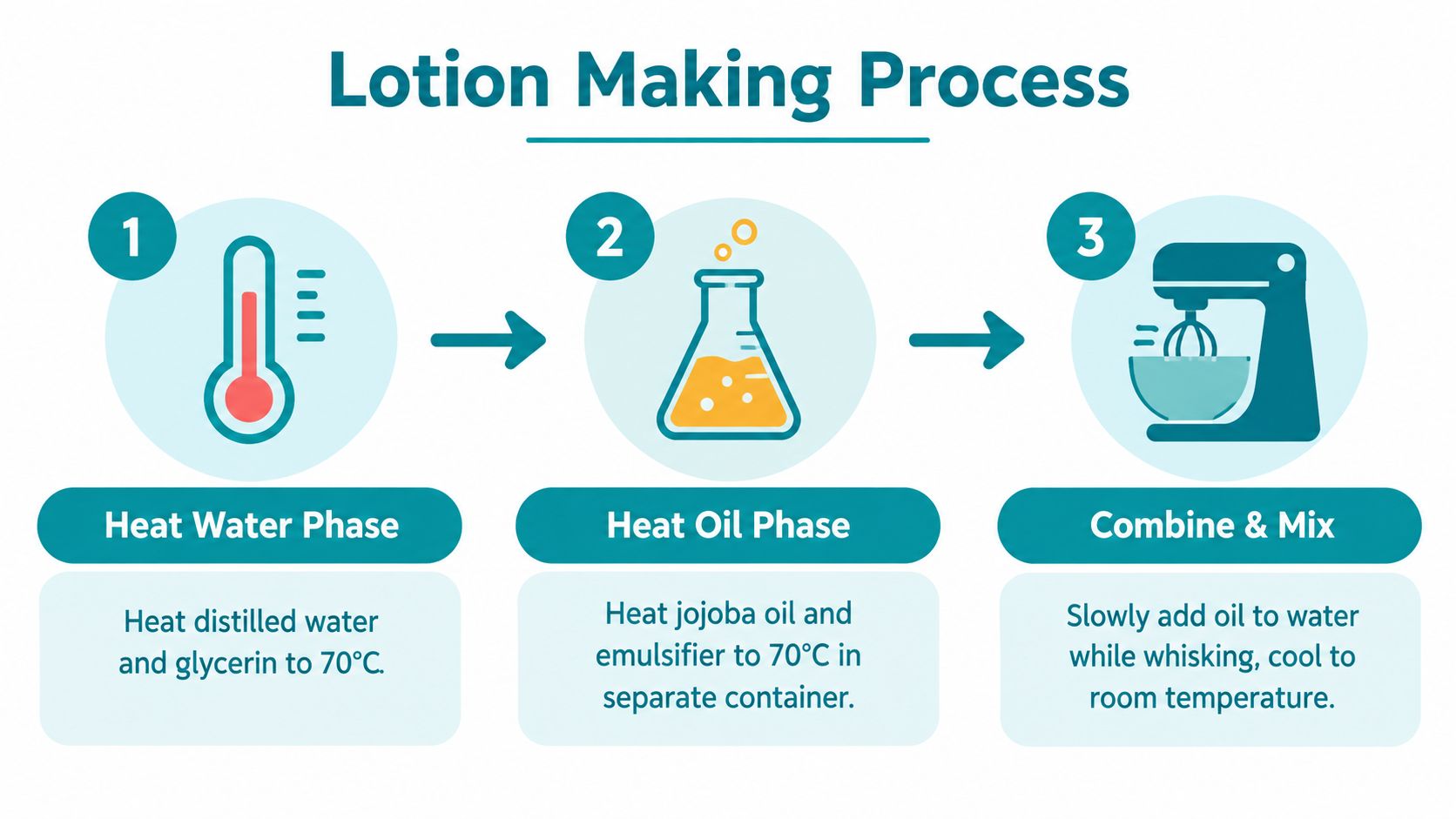
Prep the Bench Before You Heat Anything
Sanitize the work surface. Set out your scale, immersion blender, spatulas, thermometer, beakers, and final containers before you start. If you begin hunting for a clean stir rod while both phases are hot, the batch gets sloppy fast.
Use a 0.1 g scale for small batches. Label one beaker as A for the water phase and one as B for the oil phase. A typical A beaker might hold distilled water, glycerin, and any water-soluble additives that tolerate heat. B holds jojoba oil, your emulsifier, and any butters or structural fatty materials.
Heat Both Phases Evenly
Set both beakers into a water bath and bring them up to 70-75°C. The exact look matters here. The water phase should be clear and uniform. The oil phase should be fully melted, with no waxy flecks clinging to the glass.
Don't rush this part. If the emulsifier hasn't fully melted into the oil phase, you can blend hard and still end up with a weak emulsion.
For a more detailed primer on process mechanics, this article on how to emulsify oil and water is worth keeping nearby.
Combine With Intent
When both phases are at temperature, pour water into oil in a steady stream while blending. Some formulators prefer the reverse order depending on the system, but for small-batch home workflows, consistency matters more than dogma. Pick one method that works with your emulsifier and repeat it the same way every time.
Blend for 2-3 minutes until the mixture turns glossy and starts to thicken. You're looking for early emulsion structure, not whipped foam. If the blender head keeps pulling in air, tilt the vessel slightly and keep the blade submerged.
Bench note: A good emulsion doesn't just get thicker. It also starts looking smoother and more reflective across the surface.
Watch for Trace and Cool Properly
As the lotion cools, it reaches a stage where a ribbon drizzled from the spatula holds on the surface briefly before sinking back in. That's your sign the structure is taking hold. At this point, stop aggressive blending.
Below 40°C, add heat-sensitive ingredients such as preservative, fragrance, or a pre-dissolved soothing additive. Stir by hand or with very gentle mixing. Too much shear during cool-down can thin some emulsions and load the batch with bubbles.
Look for these cues as you go:
- While hot: Uniform, glossy, no oil ring.
- At warm trace: Slightly thicker, creamy, ribbon visible for a moment.
- Fully cooled: Smooth, even color, no watery seepage, no wax grains.
Package for Real Use
Pump bottles and airless containers are better than open jars for most homemade lotions because they reduce hand contact. If you use a jar, use clean, dry fingers or a spatula every time.
The finished lotion should smell like the formula you built, not burnt wax or old nuts. If it smells stale, looks shiny with free oil, or develops watery weeping around the edge as it cools, catch that now and don't label it a success just because it thickened.
Preserving and pH Balancing the Lotion
A lotion with water is a preservation problem first and a skincare product second. Many batches look beautiful on day one and become risky because the maker trusted an antioxidant, skipped pH testing, or used a preservative outside its working range.
What Preservation Actually Covers
Vitamin E can help support oil stability, but it is not a broad-spectrum preservative. Rosemary extract has the same limitation in this context. If the formula contains a meaningful water phase, you need a preservative system designed to control microbial growth.
The broad idea is simple. Match the preservative to the formula's pH, water content, and ingredient load. Sugar-rich extracts, botanicals, proteins, and aloe-heavy blends usually need even more caution because they make the water phase more inviting.
This guide to natural skincare preservatives is a good starting point when you're comparing options.
Preservative Options for Jojoba Oil Lotion
| Preservative | Usage Rate | Effective pH Range | Best For |
|---|---|---|---|
| Phenoxyethanol with ethylhexylglycerin | Follow supplier documentation | Commonly used in skin care formulas around skin-friendly pH ranges | Straightforward broad use in many lotions |
| Liquid Germall Plus | Follow supplier documentation | Typically used within supplier-stated cosmetic ranges | Easy-to-use small-batch emulsions |
| Potassium sorbate paired with a chelator | Follow supplier documentation | Needs an appropriate acidic range to perform well | Formulas already designed for lower pH |
pH Is Part of Safety and Performance
Check pH after the lotion has fully cooled and settled. A warm reading can mislead you. A calibrated meter is better than guesswork, though narrow-range strips can help if that's what you have.
Make adjustments slowly. Raise pH with a diluted sodium hydroxide solution. Lower it with lactic acid. Add tiny amounts, stir thoroughly, and recheck after the batch equilibrates.
If the preservative needs a certain pH window and your lotion sits outside it, the label may say “preserved,” but the formula isn't protected in practice.
Realistic Shelf Life
Small-batch lotion makers often get into trouble by assuming a homemade batch has commercial durability. It usually doesn't unless you've tested it thoroughly and packaged it well. Date every batch, store it cool and dark, and be ruthless about discarding anything that changes in odor, color, texture, or pH.
Stability Testing Before You Trust the Batch
A lotion that survives the mixing bowl hasn't proven much yet. Fresh emulsions often look perfect because they haven't been stressed. Separation, thinning, graininess, and weeping usually show up later, after time and temperature do their work.
Start With the Failures You Can See
The first check is simple. Leave the batch at room temperature for 24 hours and look at the surface, sides, and base of the container. If you see an oil halo, watery pooling, or obvious collapse, the formula isn't ready for gifting, selling, or scaling.
The discipline matters because real studies on jojoba-containing moisturizers and natural-oil cream systems used longer evaluation windows and temperature-based stability work rather than judging success on day zero. A xerosis moisturizer study reported that jojoba significantly increased hydration after 2 weeks and performed comparably to white petrolatum, with the protocol using repeated measurements rather than a one-application conclusion in this randomized jojoba moisturizer study. Separate stability research on natural-oil creams also stressed screening under 4°C, 25°C, and 40°C before extended storage confirmation in this cream stability study.
Stress the Emulsion on Purpose
Repeatable temperature cycling teaches more than wishful storage. Move the lotion through cold and warm conditions and watch what changes after each round.
A practical checklist looks like this:
- Room observation: Check for separation after standing still.
- Cold exposure: Watch for excessive thickening, graininess, or water release.
- Warm exposure: Look for thinning, sweating, or structural collapse.
- Return to room temperature: See whether the lotion recovers to a uniform texture.
If you use a centrifuge, even a gentle one, it can expose a weak emulsion quickly. That won't replace long storage, but it does help catch formulas that were never structurally sound.
You can also explore tools used for contamination screening and batch checking through this bacterial test kit category page.
Read the Failure Correctly
Not every broken batch broke for the same reason. Graininess often points to crystallization or poor cool-down handling. A watery layer can signal weak emulsifier structure. A lotion that gets thinner after warm storage may need better fatty support or a better-matched emulsifier.
Bad luck rarely separates lotion. Formulation choices do.
Using and Adjusting Your Finished Lotion
The best jojoba oil lotion still needs the right use pattern. Apply it to slightly damp skin after bathing so the humectants have water to hold and the emollients have something to seal in. A thin layer spread evenly over the forearms, legs, or torso usually performs better than a heavy swipe that just sits on top.
Tweak the Formula by Skin Feel
If the lotion feels too rich for oily skin, reduce jojoba within the oil phase and shift some of that space to lighter esters or squalane. If the lotion disappears too fast on dry skin, increase the cushion with a richer supporting oil or a small amount of shea or ceramide-containing support ingredients.
The evidence around jojoba in dry-skin care is useful here, but it's not a blank check. A randomized pilot study in xerosis found jojoba oil, almond oil, and coconut oil increased hydration after 2 weeks and were as effective as white petrolatum as daily moisturizers, while users preferred the natural oils, as summarized in the clinical discussion of jojoba and xerosis. That's a practical reminder that the decision often comes down to feel, formula context, and user preference rather than a miracle effect from jojoba alone.
Keep the Routine Simple
Patch test new facial use on the inner forearm for a day before applying broadly. If irritation shows up, stop using it. Store the finished lotion in a cool, dark cupboard, and if you chose a jar, keep fingers clean and dry.
A final maker's checklist helps more than another fancy ingredient:
- Label the batch: Include the product name and the date you made it.
- Track every change: New fragrance, new oil, new emulsifier. That means re-test stability.
- Watch texture over time: If it gets runny, gritty, or starts weeping, retire it.
- Respect packaging: Pumps stay cleaner than jars in everyday use.
A lotion that stays stable, feels good, and survives real storage beats an impressive ingredient list every time.
Skin Perfection offers both finished skincare and the raw materials DIY formulators need to build better emulsions, from hydrating actives to lotion-making supplies. If you want ingredients and products that fit a practical formulation approach, visit Skin Perfection.