

 Buy with Prime



In the skincare world, you hear a lot of buzzwords. But every so often, an ingredient comes along that really shakes things up. L‑Argireline is one of those ingredients.
Scientifically, it’s known as acetyl hexapeptide-8. For the rest of us, it’s a powerhouse peptide that’s become the go-to for anyone wanting a non-invasive way to soften the look of expression lines. It’s all about achieving a smoother, more relaxed complexion without needles.
Demystifying L‑Argireline in Skincare
So, let's break down what this ingredient actually is. L-Argireline is a synthetic peptide. Peptides are just short chains of amino acids—the same building blocks your skin uses to create essential proteins like collagen and elastin. Its fame comes from its very specific and unique cosmetic action.
It’s designed to target wrinkles that pop up from repetitive facial movements, what we call expression lines. Think about the crow's feet from smiling, the "11s" between your brows from frowning, or the horizontal lines on your forehead from raising your eyebrows. Over the years, these muscle contractions can etch permanent-looking creases into the skin.
The Gentle Messenger Analogy
To get a feel for how L-Argireline works its magic, picture this: your brain sends a message down a pathway telling your facial muscles to contract. L-Argireline acts like a gentle gatekeeper, intercepting and softening that signal before it makes the muscle clench so tightly.
It doesn't freeze the muscle. It simply dials down the intensity of the contraction signal right at the skin's surface. This subtle cosmetic effect is why it’s famous for giving the face a smoother, more serene appearance.
This whole process is completely topical and cosmetic. The peptide works on the outermost layers of the skin, helping to ease the look of tension and soften the appearance of expression lines you already have.
Why Is It So Popular?
The appeal of L-Argireline really boils down to its targeted approach and the fact that it's not an invasive procedure. It gives you a way to specifically address dynamic lines without jumping to more intensive options. Its popularity has exploded for a few key reasons:
- Targeted Action: It specifically helps improve the look of lines around the eyes (crow's feet), forehead, and mouth.
- User-Friendly: As a water-soluble ingredient, it’s incredibly easy to formulate into serums, lotions, and creams for DIY projects or at-home use.
- Complementary Ingredient: It plays beautifully with other skincare actives. For more on that, you can check out our guide on combining powerhouse ingredients like Matrixyl 3000 and Argireline.
Understanding L-Argireline is the first step toward creating truly sophisticated and effective skincare. It sets the stage for a routine that visibly supports a youthful, smooth, and relaxed-looking complexion.
The Cosmetic Science of Smoothing Expression Lines
So, how does L-Argireline work its magic on the skin? Let's break it down with a simple analogy.
Think of your brain sending a message to your facial muscles every time you smile, frown, or raise your eyebrows. This message travels along a pathway, telling the muscle to contract. Over the years, these countless repeated contractions eventually etch expression lines into your skin—like crow's feet and forehead furrows.
L-Argireline acts like a gentle signal jammer right at the end of that pathway, just beneath the skin's surface. It doesn't shut down communication entirely, but it subtly softens the message that tells the muscle to tighten up. This encourages a more relaxed and serene facial appearance without freezing your natural expressions. The goal is simply to dial down the intensity of those contractions.
By doing this, skincare formulas with L-Argireline help to visibly soften the look of lines and wrinkles. This is a purely cosmetic and temporary effect that happens on the outermost layers of the skin, making it a fantastic, targeted approach for anyone concerned about lines from facial movements.
A Closer Look at the Cosmetic Action
The real strength of this peptide is in addressing what we call dynamic wrinkles—those lines that show up when you move your face. It's especially good at improving the appearance of skin in areas that get a lot of action.
- Forehead Lines: Those horizontal lines that pop up when you're surprised.
- Glabellar Lines: You might know them as the "eleven lines," the vertical creases between your brows.
- Crow's Feet: The fine lines that fan out from the corners of your eyes when you smile or squint.
This targeted action is what makes L-Argireline such a prized ingredient in skincare for mature complexions or for anyone who's naturally very expressive. The result is skin that appears smoother and less defined by the daily patterns of facial movement.
By softening the look of muscle-driven skin creasing, L-Argireline provides a non-invasive way to promote a smoother skin surface. It is a key ingredient for anyone looking to cosmetically address the most visible signs of facial expressions.
It's a smart addition to any routine focused on maintaining a youthful look. Because its mechanism is so specific, it provides a focused benefit that beautifully complements other skincare ingredients. For formulators, it offers a way to create sophisticated products that deliver visible, targeted results.
The Visual Impact on Skin Texture
With consistent use, the cumulative effect of L-Argireline is a noticeable improvement in the skin's surface texture. When the skin isn't creasing as intensely day after day, it naturally maintains a smoother appearance. This process is gradual, of course, and requires consistent application since the cosmetic effect is temporary.
Think of it like gently smoothing out a piece of fabric. If you keep folding it sharply in the same spot, a deep crease will form. L-Argireline essentially discourages that sharp fold, allowing the fabric of your skin to lie flatter and look less wrinkled. This is exactly why so many people see it as an essential part of their skincare regimen.
If you're interested in peptides with similar cosmetic actions, our exploration of SNAP-8™, an improved version of Argireline, provides more detailed insights into this fascinating category of ingredients.
L Argireline's Cosmetic Effects at a Glance
To make it even clearer, here’s a quick summary of what you can expect from consistently using L-Argireline. This table breaks down its cosmetic actions and the visual outcomes on the skin.
| Cosmetic Action | Visual Outcome | Best For These Areas |
|---|---|---|
| Softens the look of muscle contractions. | A smoother, more relaxed facial appearance. | Forehead, between brows. |
| Reduces the visual severity of dynamic lines. | Less prominent-looking crow's feet and smile lines. | Around the eyes and mouth. |
| Improves the appearance of skin texture. | A more uniform and less creased skin surface. | All areas with expression lines. |
Ultimately, L-Argireline provides a targeted, non-invasive way to achieve a smoother-looking complexion by focusing specifically on the expression lines that tell the story of our daily movements.
The Market Rise of L-Argireline in Cosmetics
Argireline's journey from an obscure peptide to a cosmetic powerhouse is a perfect example of what happens when consumer demand meets smart science. When it first hit the scene, it was a highly specialized ingredient. Today, it’s a staple active in countless products aimed at smoothing the appearance of wrinkles.
Its rise mirrors a huge shift in the beauty world toward effective, non-invasive options that deliver visible results. This isn't just a trend; it's a reflection of consumers wanting more from their skincare.
A Growing Global Footprint
The love for L-Argireline isn't just a local phenomenon. It’s making serious waves in key markets like Europe and the Asia-Pacific, where consumers are savvy and actively hunt for sophisticated skincare solutions. In these regions, customers appreciate the science behind their products and expect elegant, effective formulations.
This peptide’s popularity isn't just a coincidence. Its growing presence in the global market shows it’s more than just a passing fad. It shines as a star ingredient in high-end serums and creams, but you won't find it sold like a bulk commodity. Instead, it’s a high-performance additive—a potent ingredient formulators add to give a product a specific, targeted punch.
L-Argireline's consistent growth points to one clear trend: people want intelligent, targeted ingredients in their skincare. Its success is proof of its reputation for delivering a specific cosmetic effect that you can actually see and feel.
Quantifying the Market Impact
To really get the picture, let's look at the numbers. L-Argireline, technically known as acetyl hexapeptide-8, popped up in the late 1990s. While it started out small, recent market research shows a small but steadily expanding market for it as a standalone ingredient.
For example, some reports have pegged the global Argireline market at around USD 36.8 million. Europe is a huge player, holding a significant 29.6% of that revenue, with the Asia-Pacific region not far behind at 23.1%. You can dive deeper into these trends and explore the detailed Argireline market report.
While those numbers might seem modest compared to massive commodity ingredients, they are substantial for a specialty peptide. They really highlight its value as a premium, high-impact active.
Why Its Popularity Continues to Soar
So, what's keeping L-Argireline in the spotlight? A few key things are driving its sustained growth:
- The Rise of 'Prejuvenation': More and more, people are being proactive about their skin. They're looking for products that address the very first signs of aging, especially expression lines. L-Argireline fits perfectly into this mindset.
- DIY and Customization Culture: The boom in DIY formulation and personalized skincare has created a huge demand for high-performance actives like L-Argireline. Home formulators and professionals alike seek it out because it’s reliable and easy to work with, especially in water-based serums.
- Smarter, More Educated Consumers: As people learn more about ingredients, they actively look for proven peptides. L-Argireline's focused cosmetic action makes it easy to understand and a desirable component for anyone wanting to tackle the appearance of dynamic wrinkles.
How to Formulate With L Argireline
Alright, let's get to the fun part—how to actually work with L-Argireline in your skincare creations. Whether you're a seasoned formulator or just diving into the world of DIY, a few key pointers will help you make effective, elegant products that let this peptide shine.
The first rule of formulating is knowing your usage rates. For L-Argireline, you’ll want to stick to a concentration between 2% and 10%. A lower concentration, around 2-5%, is perfect for daily use or for products aimed at those just starting to see expression lines. For a more targeted treatment serum, like for crow's feet or forehead lines, pushing it up to 5-10% will give you more cosmetic punch.
Because L-Argireline is water-based, it plays nicely in many formulas, integrating seamlessly without adding any greasy or heavy feeling. This makes it incredibly versatile.
Choosing the Right Product Format
The best way to deliver L-Argireline is in formulas that let it get up close and personal with the skin. Think light, hydrating, and quick-to-absorb.
- Water-Based Serums: This is the most popular choice, and for good reason. A simple serum puts the peptide front and center, delivering a concentrated dose right where you want it.
- Light Lotions and Emulsions: Adding L-Argireline to a lightweight lotion gives you a two-for-one benefit: smoothing and moisturizing in a single step.
- Gels: A cool, refreshing gel is another fantastic option, especially for oily or combination skin types who want that weightless feel.
Since it's a peptide, you'll want to steer clear of heavy, occlusive bases that could block its path to the skin. The goal is to create a clear runway for the peptide to do its cosmetic work.
The soaring popularity of L-Argireline, particularly in Europe and Asia, shows just how much demand there is for effective peptide skincare across the globe.
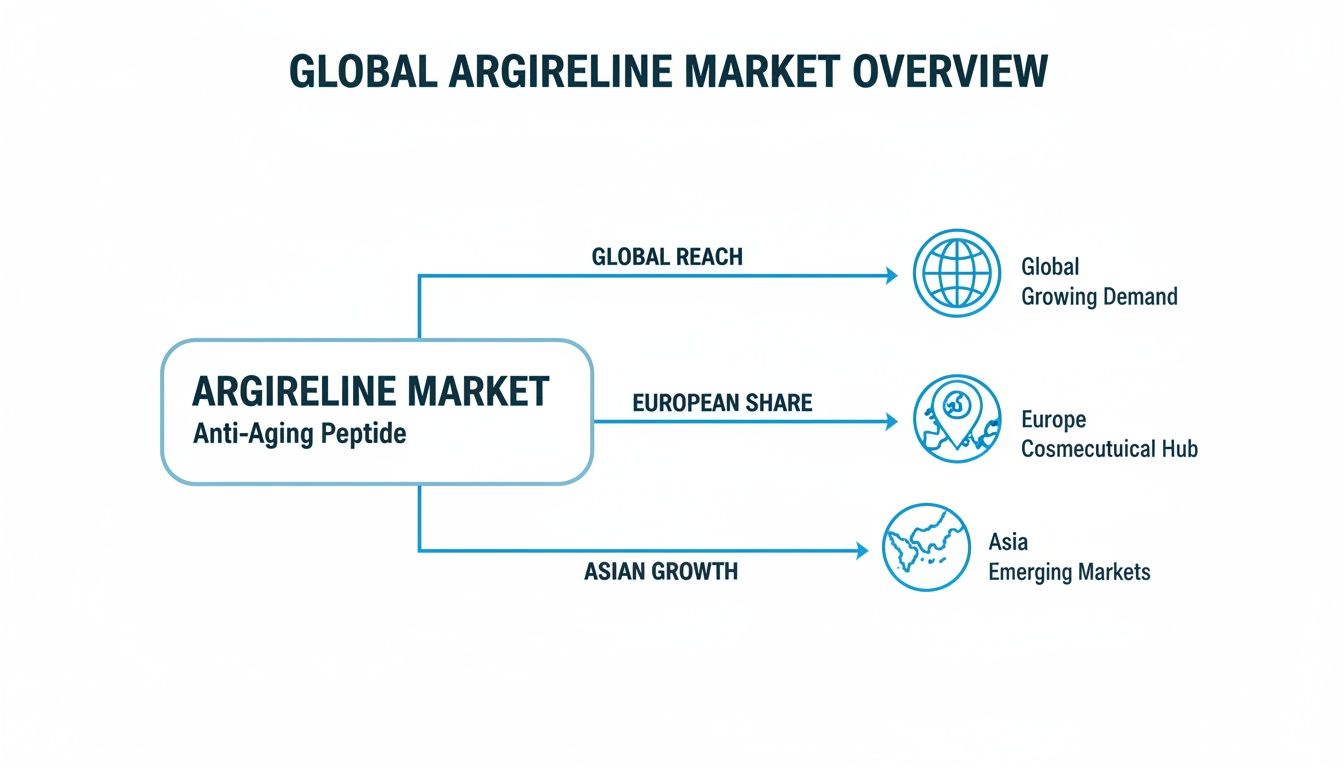
This visual really drives home the point that international markets are key players in pushing forward the innovation and availability of sophisticated ingredients like this one.
Critical Formulation Tips for Stability
Like any high-performance active, L-Argireline has a few needs to stay stable and effective. Get these wrong, and you might as well not have used it at all.
First up, pH is crucial. L-Argireline is happiest in a formula with a pH between 6.0 and 7.5. If things get too acidic or too alkaline, the peptide can start to break down. Always, always test the pH of your final product and adjust it to stay in that sweet spot.
Temperature is the other big one. L-Argireline is a bit of a diva when it comes to heat. You must add it during the cool-down phase of your process, when the temperature is safely below 40°C (104°F). Tossing it into a hot mixture will destroy its delicate structure.
For anyone looking to get deeper into the nuts and bolts of creating stable, effective products from scratch, our resources on cosmetic formulation are a great place to start.
Ingredient Synergy: Powerful Pairings
L-Argireline is a real team player and works beautifully with other ingredients to create a more well-rounded cosmetic effect. Pairing it smartly can take your formula from good to truly exceptional.
-
Hyaluronic Acid: This is a classic power couple. Hyaluronic Acid is a humectant that pulls moisture into the skin, plumping it up from the surface. When you combine it with L-Argireline, you get a dual-action effect that hydrates and softens the look of expression lines at the same time.
-
Matrixyl 3000: This peptide complex works on the skin's appearance in a totally different way, focusing on improving the look of firmness and texture. Using Matrixyl 3000 and L-Argireline together gives you a multi-pronged approach for a more youthful-looking complexion.
Follow these guidelines, and you can confidently use L-Argireline in your formulations. You'll be able to create products that are stable, feel great on the skin, and are perfectly designed to deliver the cosmetic benefits you're aiming for.
Setting Realistic Expectations for Visible Results

Before you add any new active to your lineup, it's smart to know what to expect. L‑Argireline is a fantastic peptide celebrated for its ability to visually soften expression lines, but knowing what it can—and can't—do is the key to being happy with your results.
Think of L‑Argireline as a "dimmer switch" for your expression lines, not an "off switch." It works by gently reducing the appearance of creases caused by facial movements, which leads to a smoother, more relaxed look. It's not, however, an eraser for deep-set, static wrinkles that are there even when your face is perfectly still.
The Typical Timeline for Cosmetic Improvements
When it comes to L‑Argireline, patience and consistency are everything. The visual effects are both cumulative and temporary, which means you have to apply it regularly to see and maintain those improvements.
Most people start to see a difference in the look of their expression lines with consistent, twice-daily use. This is a powerful tool, but it's just one piece of a much larger skincare puzzle.
Based on manufacturer data and supplier information, visible improvements often show up within 15 to 30 days of using a product with a typical 5% to 10% concentration. You can dig into some of the market data in studies about the L-Arginine market for a broader view. This window gives the peptide enough time to work its magic on the skin's surface.
What Kind of Results Can You Anticipate?
So, what does "visible improvement" actually look like on your skin? The goal here is a softening of dynamic lines, not a total disappearance. The results are subtle, aiming for a more serene and less tense facial appearance.
The most important takeaway is that results with L‑Argireline are purely cosmetic and temporary. It beautifies the skin by addressing the look of expression lines, but consistent use is required to maintain the effect.
Cosmetic studies and supplier technical info often point to a short-term reduction in the appearance of wrinkle depth by about 10% to 30% after several weeks of use. That percentage might not sound huge, but it can make a real visual difference, especially around the eyes and forehead.
Factors That Influence Your Results
It’s also crucial to remember that everyone's skin is different, and results will vary. A few key things can influence how well your skin responds to a formula with L‑Argireline.
- Skin Type and Condition: Your skin's current texture and health play a big role.
- Concentration: A product with a 10% concentration will naturally give you more noticeable cosmetic effects than one with just 2%.
- Consistency: If you skip applications, you'll slow down and lessen the visible benefits. Simple as that.
- Overall Routine: Pairing L‑Argireline with hydrating ingredients like hyaluronic acid can create a plumper, smoother canvas, making the peptide's effects look even more pronounced.
By keeping these practical benchmarks in mind, you can appreciate L‑Argireline for what it truly is: a sophisticated, non-invasive way to improve your skin’s appearance for a smoother, more youthful look.
Safety and Best Practices for Topical Use
When you're adding any powerful new active to your cosmetic creations, safety is always priority number one. The good news? L-Argireline has a fantastic safety profile and is usually very well-tolerated when used on the skin. Its action is localized right where you apply it, making it a gentle and non-invasive choice for formulators and skincare lovers alike.
Because it works topically, the peptide's effects are temporary, and the risk of adverse reactions is incredibly low. This track record makes it a reliable go-to for all sorts of products aimed at softening the look of expression lines. Its job is to beautify the skin, not fundamentally change its structure.
Understanding Potential Side Effects
While L-Argireline is considered safe for most, it's worth knowing that side effects, though uncommon, can happen. The most frequent reaction is mild, temporary skin irritation or a bit of redness. This is most likely to pop up if you have highly sensitive or reactive skin.
These minor reactions typically fade as your skin gets used to the new ingredient. Still, they're a good reminder to always test properly and pay attention to how your skin is feeling.
The real secret to using powerful actives like L-Argireline with confidence is to introduce them thoughtfully. A safety-first mindset ensures you get all the cosmetic perks without the irritation, making your skincare journey a happy one.
The Importance of Patch Testing
The single most critical step for any new ingredient or formula is patch testing. It's a simple process that can save you from widespread irritation by letting you check for compatibility on a small, hidden patch of skin before you go all in.
How to Perform a Patch Test:
- Select a Spot: Pick a small, out-of-the-way area, like behind your ear or on your inner wrist.
- Apply the Product: Dab a tiny amount of your L-Argireline formula onto the chosen spot.
- Wait and Observe: Leave it on for at least 24 hours. Keep an eye out for any signs of redness, itching, or irritation.
- Evaluate: If your skin looks and feels normal, the product is likely safe for you to use on your face.
This responsible approach is a must for both DIY formulators and anyone trying a new store-bought product.
Finally, remember that in any formulation, the entire system needs to be stable and safe. This means using an effective preservation system to stop microbes from growing. For a deeper dive, check out our posts on selecting the right natural cosmetic preservative. Following these best practices ensures that every product you create or use is not just effective, but truly skin-safe.
Common Questions About Using L‑Argireline
Diving into the world of skincare peptides can definitely bring up a few questions. As you start thinking about adding L‑Argireline to your routine or even your own formulations, it's totally normal to wonder how it plays with other ingredients and what kind of results you can realistically expect.
This section is all about giving you clear, straightforward answers so you can use this powerhouse peptide with confidence. We’ll break down how L‑Argireline stacks up against other popular actives, the best ways to layer it, and a realistic timeline for seeing visible changes.
How Is L‑Argireline Different From Retinol?
This is a fantastic question, and one we hear all the time. Both are famous for helping skin look more youthful, but they go about it in completely different ways. Think of them as specialists with unique jobs.
L‑Argireline is a peptide that specifically targets the appearance of dynamic lines—those creases that form from repeated facial movements like smiling, squinting, or frowning. Its job is very focused: to help soften the look of these specific expression lines, making the skin's surface appear smoother and more relaxed.
Retinol, on the other hand, is a form of Vitamin A that works by encouraging skin surface cell turnover. This process helps improve the look of fine lines, uneven skin texture, and overall skin tone over a longer period. It’s tackling a much broader range of cosmetic concerns related to the skin's texture, not just expression lines.
Key Takeaway: L‑Argireline is your go-to for the appearance of expression lines caused by movement. Retinol is for improving the look of overall texture and static lines. They aren't mutually exclusive and can actually be a powerful duo in a well-rounded skincare routine.
Can I Combine L‑Argireline With Other Actives?
Yes, absolutely! L‑Argireline is known for being a real team player in skincare. It pairs exceptionally well with many other ingredients, which is great news whether you're a DIY formulator or just a skincare lover.
One of the most effective and popular combos is L‑Argireline with Hyaluronic Acid. Hyaluronic Acid is a master hydrator, a humectant that pulls moisture into the skin's surface, giving it that plump, dewy look. When you use them together, you get a beautiful dual effect: Hyaluronic Acid hydrates and plumps up the skin, while L‑Argireline works its magic on softening the look of expression lines.
You can also use it with Vitamin C, but it takes a little more planning. A simple and effective approach is to use your Vitamin C product in the morning—to take advantage of its brightening and antioxidant benefits—and then apply your L‑Argireline product in the evening. This separation ensures each ingredient gets to work without any formulation conflicts getting in the way.
How Long Until I See Visible Results?
Patience and consistency are everything when you're using products with L‑Argireline. The cosmetic effects are cumulative and temporary, which simply means you need to apply the product consistently to see and maintain those visible improvements.
With a twice-daily application of a product formulated at an effective concentration (usually 5-10%), many people start to notice a smoother appearance in their expression lines within 15 to 30 days.
It’s really important to have realistic expectations. The goal here is a visible softening of dynamic lines for a more serene appearance, not a complete erasure of wrinkles. Results can vary depending on your skin type, the product's concentration, and how consistently you use it. For those formulating your own products, starting with a high-quality peptide is crucial. You can explore options with our Argireline™ Acetyl Hexapeptide-8 to ensure potency.
Is L‑Argireline Suitable For All Skin Types?
L‑Argireline is generally very well-tolerated and is considered suitable for all skin types, including sensitive, oily, dry, and combination skin. For the vast majority of users, its cosmetic action is completely non-irritating.
Because it's a water-based peptide, it slips easily into lightweight serums and gels that feel comfortable even on oily or acne-prone skin. If you have dry skin, it layers beautifully under richer moisturizers without any issues.
That said, as with any new skincare product or ingredient, we always recommend doing a patch test. Just apply a small amount to a discreet area of skin before slathering it all over your face. This simple step helps you check for personal compatibility with the formula and minimizes any risk of potential irritation.
At Skin Perfection, we are dedicated to providing high-quality ingredients and expertly formulated products to help you achieve your skincare goals. Explore our full range of peptides and DIY supplies to create a routine that beautifully enhances your skin's appearance.