

 Buy with Prime


The most popular advice about natural skin care for aging skin is often the least useful: find a rare botanical, add several “clean” actives, and expect visible transformation. That approach turns a routine into an ingredient treasure hunt. It also overlooks the part of aging skin that usually needs the most practical attention, the skin barrier.
A better routine is less dramatic. It protects against ongoing damage, adds water and lipids, introduces carefully chosen actives, and gives each formula enough time to show what it can do. Natural ingredients can support hydration, elasticity, tone, and texture, but they aren't magic replacements for sunscreen, sensible formulation, or patience.
Table of Contents
- Why the Most Effective Natural Anti-Aging Routine Is Slower Than the Marketing
- What Natural Skin Care Actually Means and How Aging Skin Changes
- The Natural Actives Worth Your Attention
- Building a Daily Routine That Stacks the Right Actives
- Ready-Made Products Versus DIY Formulation
- Reading Clean Beauty Labels Without Falling for the Hype
- Sticking With What Works and Tracking Real Progress
Why the Most Effective Natural Anti-Aging Routine Is Slower Than the Marketing
Novelty isn't the same as evidence
Natural ingredients are now a major force in anti-aging skincare. One industry report estimates that natural-source anti-aging ingredients held 45.2% of the market in 2025, while the broader anti-aging ingredients market was valued at $5 billion in 2025 and is projected to reach $9.45 billion by 2034, at a 7.2% CAGR. Skincare represented 58.3% of application share, and Asia Pacific led with 42.1% of revenue, according to the global anti-aging ingredients market report.
Those figures describe commercial demand, not proof that every plant extract works. A growing market can contain excellent formulas, weak formulas, and products whose strongest feature is an appealing story. “Rare,” “wildcrafted,” and “fermented” may describe sourcing or processing, but they don't automatically tell you whether an ingredient improves the concern you care about.
The modern evidence base for wrinkle-focused skincare grew around retinoids, not exotic botanicals. Vitamin A was identified in 1909, the retinoid drug project began in 1968, and tretinoin has been used in dermatology since the 1960s. Its anti-aging potential became recognized in the 1980s, while a documented cosmetic use of retinoids appeared in 1983, when ATRA was reported to reduce wrinkles and improve skin texture, as summarized in the history of anti-aging products.
A barrier-first framework
A longevity-oriented routine asks a more useful question than “What is the newest active?” It asks, “What can I use consistently without making my skin more reactive?”
That means starting with:
- Damage reduction: Daily broad-spectrum SPF 30+ matters more than adding another decorative extract.
- Water retention: Humectants such as glycerin and hyaluronic acid make dry skin feel more comfortable and look temporarily fuller.
- Lipid support: Emollients and barrier-friendly moisturizers reduce the rough, tight feeling that makes fine lines look more pronounced.
- Selective treatment: Antioxidants, peptides, gentle exfoliants, or botanical actives can earn a place when they match a clear goal.
- Routine discipline: Fewer changes make it easier to identify what helps and what irritates.
A 2024 systematic review and meta-analysis found that plant-based topical products significantly improved skin hydration and elasticity and reduced melanin and erythema, with the strongest elasticity gains appearing during short-term use of 8 weeks or less. The same analysis found no convincing evidence that botanicals reduce transepidermal water loss, or TEWL, on their own, as reported in the systematic review of plant-based topical products.
Practical rule: Choose the least complicated routine that addresses your main concern, then give it time before adding another active.
What Natural Skin Care Actually Means and How Aging Skin Changes
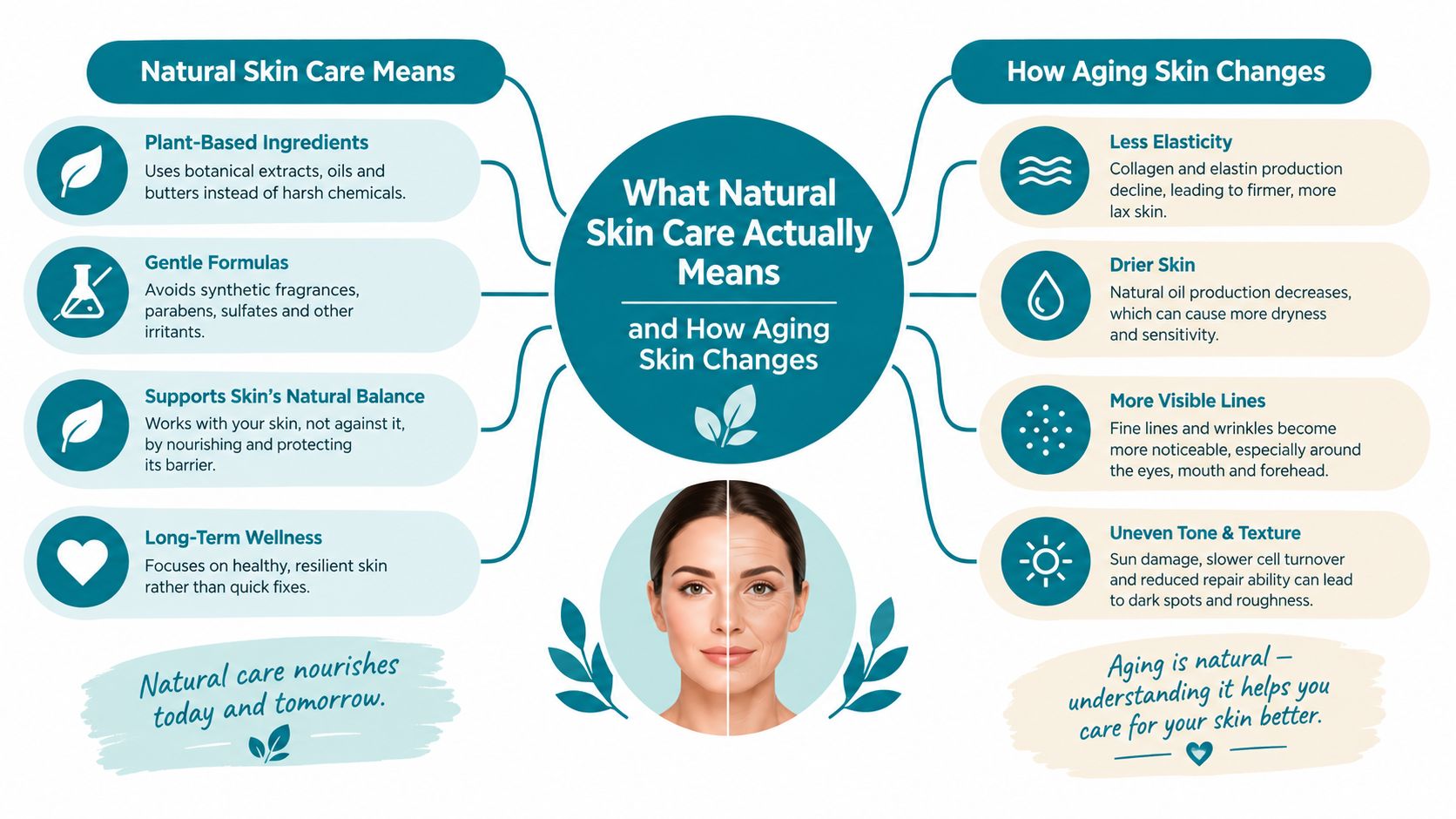
“Natural skin care” usually means a formula includes ingredients sourced from plants, minerals, or other natural materials. “Clean beauty” is broader and less precise. It often refers to a brand's chosen ingredient standards, exclusions, sourcing values, or formulation philosophy. Neither phrase, by itself, tells you how stable, gentle, concentrated, or useful a product will be.
Think of skin as a building
A helpful analogy is a brick wall. Corneocytes act like bricks, while lipids such as ceramides, cholesterol, and fatty acids act like mortar. When the mortar becomes less effective, water escapes more easily and outside irritants can enter more readily. Older skin also takes longer to recover after barrier disruption. In one published study, the characteristic diffusion time for TEWL recovery was 176 ± 59 minutes in young subjects and 360 ± 76 minutes in older subjects, a difference that was statistically significant, as reported in the study of age-related skin barrier recovery.
Collagen and elastin are more like the building's internal frame. They help provide structure and resilience, but a stronger frame won't solve a wall with failing mortar. That's why a moisturizer can make skin look smoother and feel more comfortable without changing deeper structural aging.
Cell turnover also tends to slow with age. Surface cells can linger longer, contributing to dullness and uneven texture. Glycation, the binding of sugars to proteins, can affect the quality of structural proteins over time. You don't need to memorize the biology to make a useful choice. Match the ingredient to the job.
- Dryness and tightness: Choose glycerin, hyaluronic acid, squalane, jojoba, or richer emollients.
- Uneven tone: Consider carefully formulated vitamin C, botanical antioxidants, or products with evidence for melanin reduction.
- Rough texture: Use gentle exfoliation rather than aggressive scrubbing.
- Fragility and sensitivity: Simplify cleansing, moisturize regularly, and introduce actives one at a time.
For a broader discussion of ingredient choices and mature skin routines, see this guide to natural skin care for mature skin.
A product such as HydroGlow Anti-Aging Night Mask illustrates this hydration-focused category. Its listed ingredients include three types of hyaluronic acid, polyglutamic acid, jojoba, squalane, aloe, glycerin, triglycerides, sea silt ferment, and algae extract. That profile is best understood as a moisture and conditioning approach, not as a promise to alter the underlying structure of aging skin.
The Natural Actives Worth Your Attention
The best natural actives are the ones you can connect to a specific concern. Humectants draw and hold water near the skin surface. Emollients fill gaps between surface cells and make rough skin feel smoother. Antioxidants help formulas address oxidative stress, while peptides and exfoliants serve different, more targeted roles.
Botanicals deserve neither blind trust nor blanket dismissal. The 2024 meta-analysis found meaningful improvements in hydration and elasticity from plant-based topical products, but it also found no convincing standalone reduction in TEWL. In plain language, a botanical may improve how skin looks and feels without replacing a properly designed moisturizer.
Niacinamide deserves special attention, even though it's a vitamin rather than a botanical extract. Reviews report that 2-5% topical niacinamide can increase ceramide synthesis by 34-67%, reduce TEWL by about 24%, and raise stratum corneum hydration by about 35%, as detailed in this review of niacinamide's barrier-related effects. Those findings make it especially relevant when fine lines appear alongside dryness or a fragile-feeling barrier.
| Active | Primary Anti-Aging Benefit | Realistic Timeframe | Watch Out For |
|---|---|---|---|
| Glycerin | Surface hydration and comfort | Often noticeable quickly | Can feel tacky in some formulas |
| Hyaluronic acid | Water binding and a temporarily plumper appearance | Hydration may feel noticeable quickly | Needs a moisturizing layer over it in dry conditions |
| Squalane | Softening and reduced rough feel | Usually noticeable through regular use | It supports feel and moisture, not deep structural change |
| Vitamin C | Antioxidant support and brighter-looking tone | Gradual, with consistent use | Unstable formulas may discolor or irritate |
| Niacinamide | Barrier support, hydration, and more even-looking tone | Gradual and dependent on formulation | Higher concentrations may feel irritating for some users |
| Bakuchiol | A retinoid-alternative option for visible texture concerns | Gradual | “Natural retinol” is a marketing shortcut, not an identity |
| Resveratrol and green tea | Antioxidant support | Gradual and formula-dependent | Extract quality and stability matter |
| Copper peptides and plant-derived peptides | Conditioning and visible firmness support | Gradual | Peptide claims vary widely by formula |
| Lactic acid and PHAs | Smoother surface texture and tone | Often gradual, with early softness possible | Overuse can increase sensitivity |
| Fermented ingredients | Formula-specific conditioning or antioxidant support | Depends on the complete formula | Fermentation alone doesn't prove efficacy |
Hyaluronic acid, glycerin, and squalane are practical starting points because they address the visible effects of dryness without requiring an aggressive schedule. Peptides can complement that base. Bakuchiol may suit someone who wants a botanical treatment option, but it shouldn't be treated as identical to a retinoid.
For further ingredient comparisons, use this resource on natural anti-wrinkle ingredients. The useful habit is to ask what the active does, how the formula delivers it, and what evidence supports that specific product.
Building a Daily Routine That Stacks the Right Actives
A routine works best when each layer has a job. Apply the thinnest water-based products first, then creams and oils that reduce water loss. You don't need to wait for an arbitrary number of minutes between every layer. Let each product settle enough that it doesn't pill, and separate irritating treatments when your skin feels vulnerable.
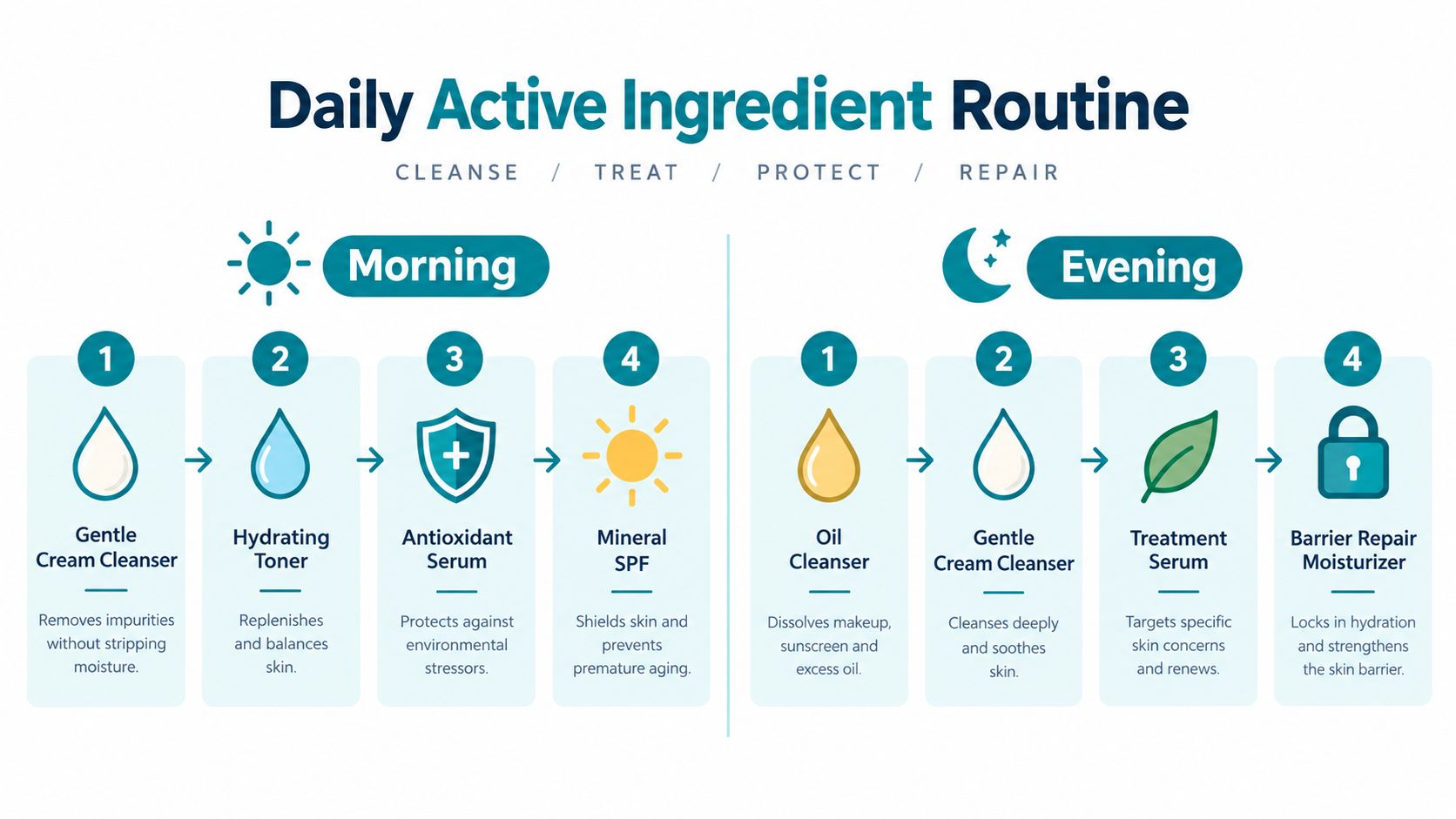
Morning structure
Start with a gentle cream or milk cleanser. If your skin isn't oily or sweaty on waking, rinsing with water may be enough. Follow with a hydrating toner or serum containing glycerin or hyaluronic acid.
Next, apply an antioxidant serum. A vitamin C formula using kakadu plum or a rosehip-derived source may fit a natural-leaning routine, but judge the finished formula rather than the source story. Add niacinamide or a peptide serum if your skin tolerates the combination.
Finish with a moisturizer containing barrier-supportive lipids, ceramides, or squalane, then use broad-spectrum SPF 30+. Sunscreen is the protection step that keeps the rest of the routine from working against continued environmental damage.
Evening structure
Use an oil cleanser to dissolve sunscreen and makeup, then follow with a gentle water-based cleanser. On two or three nights each week, use a PHA or low-strength lactic acid product. Don't exfoliate because the product is labeled natural. A dry, stinging face is giving you useful information.
On other nights, choose bakuchiol or a peptide treatment. Finish with a richer cream containing shea butter and botanical oils. Water-based serums go before oils because oils are primarily emollient and occlusive, while applying them first can make later water-based layers spread unevenly.
Read this practical guide to layering skincare serums when products have different textures or treatment goals.
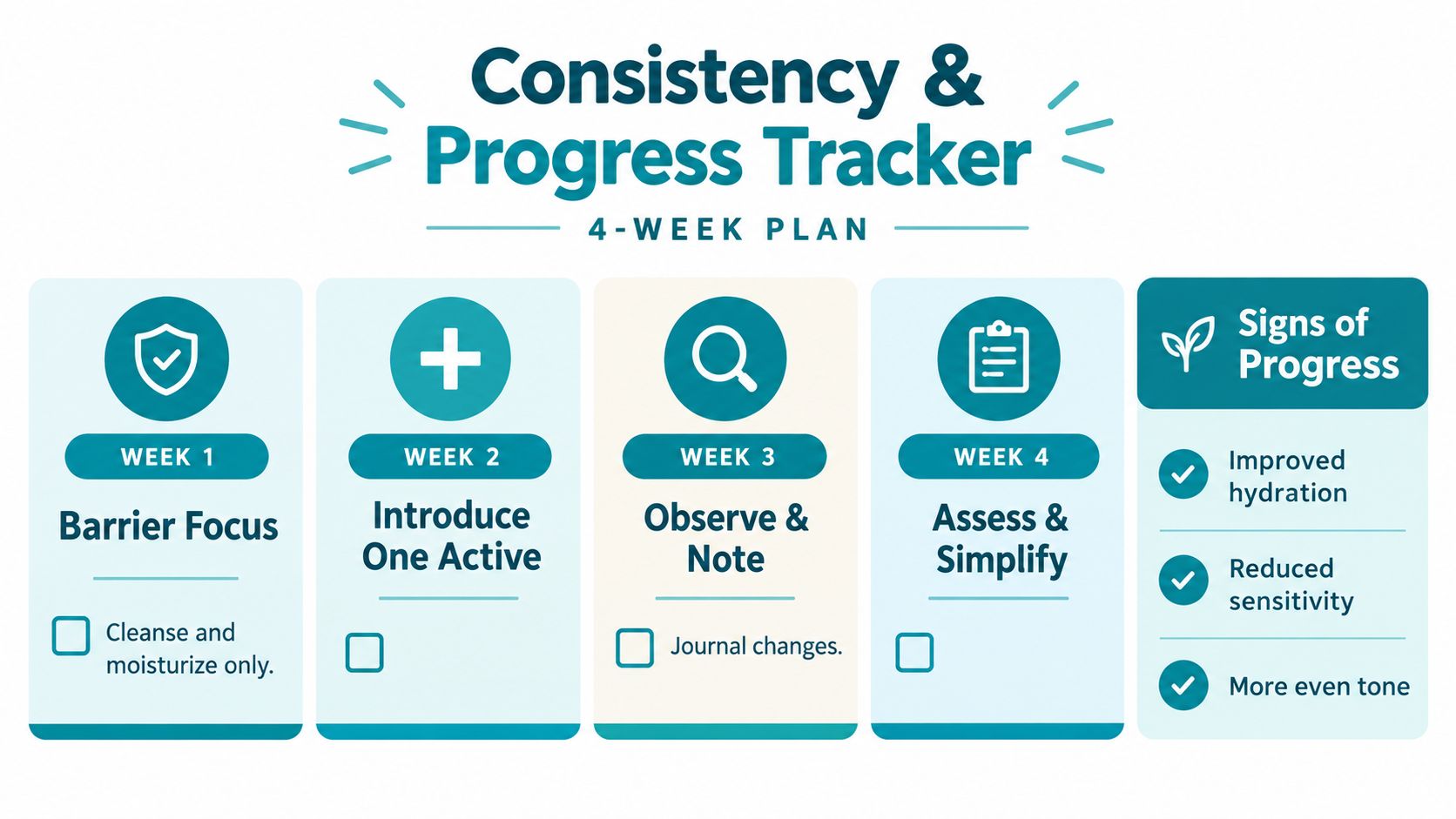
Simple introduction plan: Add one new ingredient, keep the rest of the routine stable, and observe your skin before adding another. A two-week gap between new products makes reactions easier to trace.
Patch testing can reduce surprises, though it can't guarantee that a product won't irritate the face. Stop using a product if burning, swelling, or persistent redness develops, and seek professional advice for ongoing or severe reactions.
Ready-Made Products Versus DIY Formulation
DIY skin care sounds simple until water, botanicals, and preservation enter the picture. A dry powder or an oil-only blend has different formulation demands from a water-based serum or cream. Once water is present, microbes can grow unless the product uses suitable sanitation, preservation, packaging, and testing.
Ready-made formulas generally offer more predictable texture and stability. They may use preservatives and airless packaging to protect sensitive ingredients. DIY products offer control over ingredient selection and batch size, but that control comes with responsibility for pH, preservation, weighing, mixing, and storage.
| Factor | Ready-Made Products | DIY Formulation |
|---|---|---|
| Cost | Higher upfront price may reflect testing, packaging, and preservation | Can reduce ingredient cost, especially for simple blends |
| Freshness | Designed for shelf stability when stored correctly | Small batches can be freshly prepared |
| Customization | Limited to the finished formula | Concentrations and compatible ingredients can be selected |
| Skill | Requires label reading and patch testing | Requires formulation knowledge, accurate measurement, sanitation, and preservation |
| Best fit | Serums, emulsions, and sunscreen where stability matters | Simple oil blends, dry masks, and carefully managed basic preparations |
Vitamin C and botanical infusions can be especially demanding because freshness and oxidation affect the finished product. Commercial formulas may offer more dependable handling for these ingredients. By contrast, an oat-based soak or a dry powder mask can be more approachable, provided you make only what you can use promptly and avoid contaminating the mixture.
A sensible hybrid approach
Buy products where stability is difficult, particularly serums, emulsions, and SPF. Make simple, short-lived preparations only when you understand the ingredients and can keep tools and containers clean. Don't put an unpreserved water-based mixture into eye-area packaging, and don't assume refrigeration makes an inadequately preserved formula safe.
People interested in professional perspectives can also review this resource on skin rejuvenation for healthcare pros, while DIY learners can explore make-your-own skin care products for formulation-oriented education. Product making is rewarding, but the safest formula is the one whose risks you understand before you apply it.
Reading Clean Beauty Labels Without Falling for the Hype
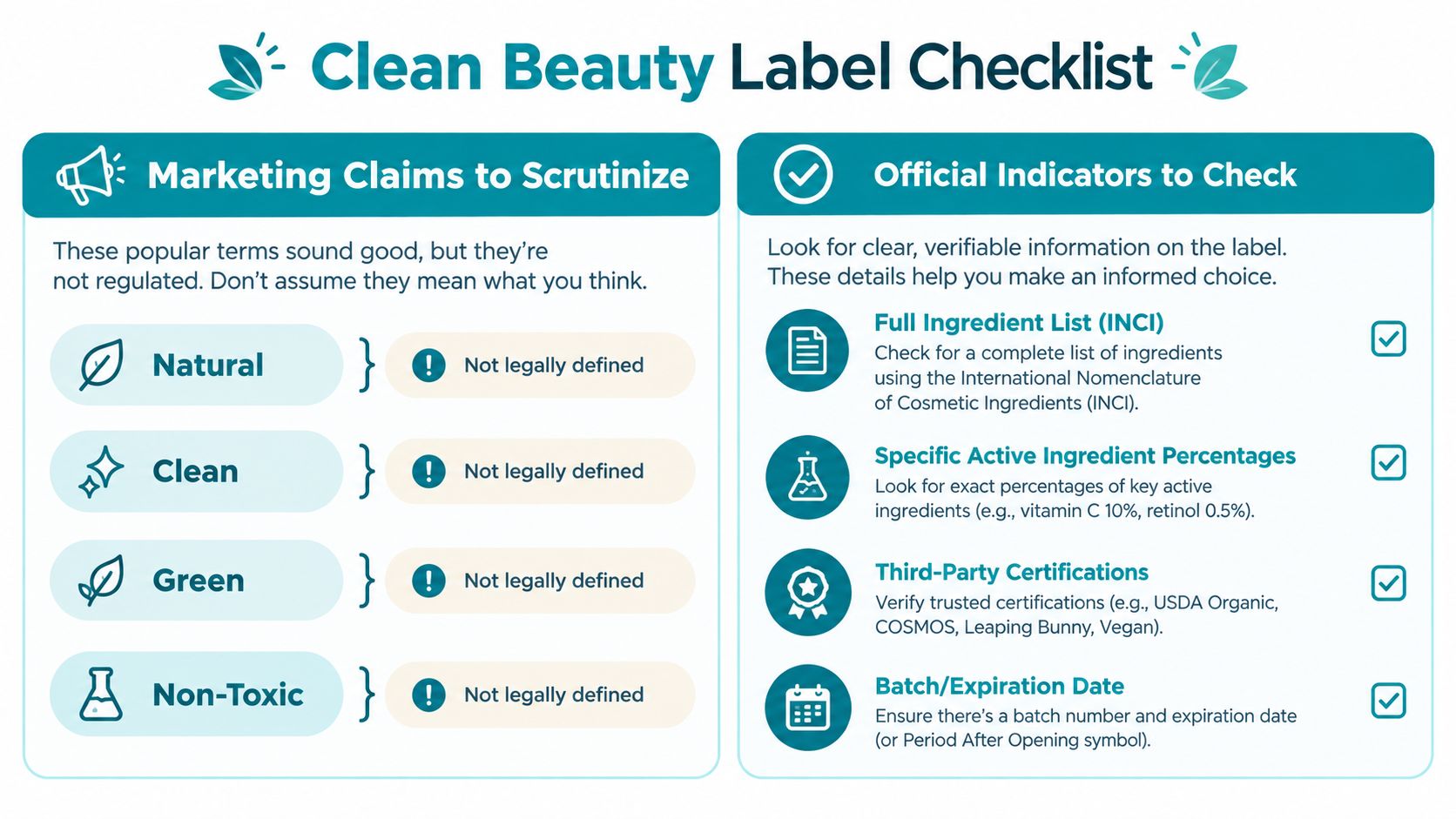
A clean-looking label can still tell you very little about performance. Terms such as “natural,” “clean,” “green,” and “non-toxic” aren't legally defined cosmetic categories in the United States, so treat them as brand language rather than proof of safety or efficacy.
The FDA states that cosmetics sold in the United States don't require premarket FDA approval, and the agency doesn't maintain a list of approved or accepted cosmetic claims. Labels must be truthful and not misleading, however. If a product claims to treat or prevent disease or affect the structure or function of the body, including the skin, it may be regulated as a drug under the law, according to the FDA guidance on cosmetic labeling claims.
A label-reading checklist
- Find the full ingredient list: Look for INCI names instead of relying only on front-label stories.
- Question absolute language: “Chemical-free” is not meaningful because every ingredient is a chemical.
- Demand specificity: “Dermatologist recommended” is less useful without an identifiable basis or published product data.
- Treat free-from lists carefully: A list has limited value if it highlights ingredients the product category wouldn't normally contain.
- Check the order: Ingredients generally appear in descending concentration, though labeling conventions have exceptions.
- Look for verification: Certifications such as USDA Organic, EWG Verified, COSMOS, or Leaping Bunny can address particular standards, but each certification covers a different issue.
- Check packaging information: A descriptive product identity and accurate net quantity statement are required on the principal display panel under FDA cosmetic labeling rules, as explained in the FDA cosmetics labeling guide.
Etsy sellers face an additional marketplace constraint. Etsy's medical claims policy prohibits listings from claiming that an item treats, mitigates, diagnoses, or cures serious disease, and it also prohibits claims that an item is as effective as an analgesic, antibiotic, antiseptic, antiviral, anti-inflammatory, steroid, vaccine, decongestant, or prescription drug. Listings also can't claim that an item is FDA-approved.
That distinction matters when evaluating product pages. A responsible cosmetic listing should describe appearance, feel, cleansing, moisturizing, conditioning, or other cosmetic functions without implying that the product fixes a medical condition. For another perspective on advertising language, see this overview of South African skin care ads, then compare marketing language with the actual ingredient list and the brand's published evidence. You can also read more about what clean beauty means before deciding which standards matter to you.
Sticking With What Works and Tracking Real Progress
A crowded shelf creates a measurement problem. If you add a new botanical every few days, you won't know which product improved hydration, which one caused irritation, or whether the visible change came from better moisturization rather than a deeper treatment effect.
Use a simple record instead. Take photos every 4-6 weeks in similar lighting, at a similar distance, with a neutral expression. A weekly log can track texture, how tight your skin feels after cleansing, the depth of fine lines as they appear to you, midday dry patches, makeup application, and any stinging or redness.
Keep the routine measurable
Give a product an 8-12 week trial window when the formula and your skin tolerate it, unless irritation appears earlier. Keep it if your skin feels more comfortable, looks more even, or applies makeup more smoothly. Swap it when the product offers no meaningful benefit after a fair trial. Discontinue it when discomfort persists or the formula clearly conflicts with your routine.
Don't use dramatic wrinkle reversal as your only success measure. More useful markers include reduced tightness after cleansing, fewer dry patches, a smoother surface, improved hydration, and a more even-looking tone. These changes reflect the barrier-first approach and are easier to observe consistently.
The four-part checklist: Protect the barrier, choose actives for a defined purpose, layer from water-based products to creams and oils, and question claims that the ingredient list can't support.
Natural skin care for aging skin works best as a long-term practice rather than a race toward novelty. Start with gentle cleansing, moisturization, and SPF. Add one evidence-informed active, monitor your response, and let consistency reveal whether it deserves a permanent place.
Skin Perfection offers natural and organic skin care products alongside lotion-making supplies for people who want ready-made options or prefer to formulate thoughtfully at home. Visit Skin Perfection to explore products and ingredients that can support a simple, hydration-centered routine for aging skin.