

 Buy with Prime



Your next client arrives with a bag of serums, a screenshot of a peel, and skin that feels tight after washing. They want smoother texture and fewer visible marks, but they're already using several exfoliating products. Before you recommend anything, you need to understand what they're applying, what their skin tolerates, and whether the service they want belongs in today's appointment.
Table of Contents
- What Skincare for Estheticians Really Means Today
- Reading the Skin Before You Recommend Anything
- Ingredient Logic for the Modern Esthetician
- Designing a Layered Treatment Protocol
- Staying Inside the Cosmetic Lane
- When More Active Treatment Backfires
- Running the Client Conversation
- DIY Formulation Guardrails for Working Professionals
What Skincare for Estheticians Really Means Today
Popular skincare advice often starts with an ingredient. Professional skincare starts with a decision: What's appropriate for this person, on this skin, today? That difference matters when a client's wish list doesn't match what you observe.
Consider that consultation as a teaching example, not a documented case study. The client asks for a stronger peel because their complexion looks uneven. You notice flaking, hear that moisturizer sometimes stings, and learn they recently added another exfoliant. Your professional contribution isn't choosing the strongest available service. It's recognizing when to change direction.
The responsibilities behind the recommendation
A useful working definition of skincare for estheticians combines assessment, sequencing, and communication:
- Read the skin: Record visible characteristics alongside the client's history, without turning observations into a medical diagnosis.
- Design the sequence: Connect an appropriate service with manageable home care rather than recommending disconnected products.
- Explain the cosmetic goal: Describe improvements in appearance, texture, hydration, and feel without promising medical outcomes.
These responsibilities require different kinds of knowledge. Skin science helps you ask better questions. Ingredient literacy helps you evaluate a formula. Regulatory awareness helps you describe it accurately. Client communication determines whether the person understands what to do after leaving your room.
Professional judgment: A sound recommendation includes a reason to proceed, a reason to postpone, and a clear boundary for referral.
Education should match the service
Advanced equipment requires more than familiarity with skincare ingredients. Before expanding your menu, check your local scope of practice, insurance requirements, and the training appropriate to the device and service. For an education search, you can browse laser training options for beauty therapists through Omega Lasers, then independently evaluate course content and local requirements.
Keep that same discipline with everyday facials. A polished treatment menu doesn't replace a documented assessment, and a confident explanation shouldn't conceal uncertainty. Sometimes the most professional answer is that you need more information before proceeding.
Reading the Skin Before You Recommend Anything
Read the skin like a map. Texture and tone are the topography; hydration and oil distribution suggest where conditions vary; pigmentation patterns, scars, and sensitive areas are landmarks. The map helps organize your observations, but it doesn't establish a diagnosis.
Begin with the client's description before offering your interpretation. Ask what bothers them most, when it began, and what makes it better or worse. Then compare that account with what you can see and with the products and services they've recently used.
Build an observation record
Document texture, visible flaking, shine distribution, uneven tone, and areas the client identifies as uncomfortable. Ask about medications, allergies, previous reactions, recent procedures, outdoor exposure, and instructions from a medical provider. The skin analysis education library can support a more consistent consultation vocabulary.
Keep observations separate from conclusions. “Client reports stinging after cleansing” is a useful record. Naming a disorder without the authority or evidence to diagnose it isn't.
Skin Assessment Quick-Reference
| Observation | Likely Primary Concern | Suggested Service Direction | Referral Flag |
|---|---|---|---|
| Tightness with visible flaking | Hydration and tolerance concerns | Simplify cosmetic care and postpone intensive exfoliation | Persistent burning or suspected dermatitis |
| Shine alongside dry-feeling areas | Uneven comfort and oil distribution | Assess each area rather than treating the whole face identically | Unexplained or worsening symptoms |
| Marks following blemishes | Uneven-looking tone | Review pigment history and choose a conservative approach | Deep painful lesions or developing scars |
| Uneven texture after frequent exfoliation | Possible treatment intolerance | Reassess current products before adding another active | Ongoing pain, swelling, or suspected infection |
Turn the map into a priority
Select a primary concern, a secondary concern, and a contraindication check. For example, a client may prioritize visible lines, while your immediate service priority is comfort because they report persistent stinging. The lines remain a valid cosmetic concern, but they don't automatically determine today's treatment.
Finish by reading the proposed plan back to the client. This catches misunderstandings before treatment begins and gives them an opportunity to disclose something they initially forgot. Document uncertainty as carefully as certainty, especially when you postpone a service or recommend medical evaluation.
Ingredient Logic for the Modern Esthetician
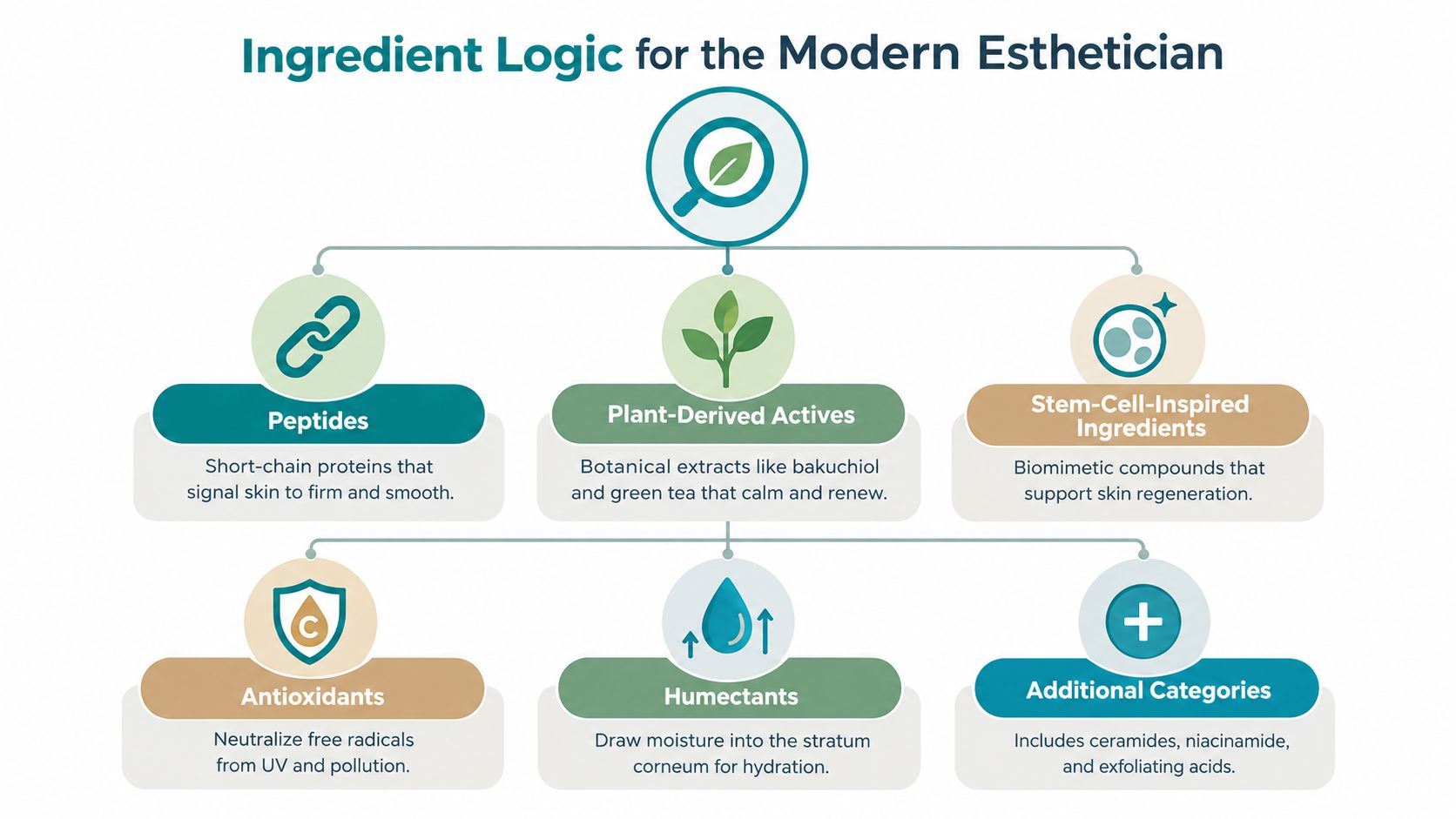
An ingredient name isn't a complete recommendation. Start with the cosmetic outcome, then evaluate whether the finished formula supports that description. A useful ingredient discussion connects what's in the product, how it's formulated, and what you can truthfully say about its appearance benefits.
Translate categories into cosmetic questions
Treat ingredient categories as a research starting point, not proof of performance. The anti-aging ingredient terminology library is a useful companion when comparing supplier descriptions with client-facing language.
| Ingredient category | Appearance-focused discussion | What to verify |
|---|---|---|
| Peptides | The look of firmness, elasticity, and expression lines | Evidence for the specific formula and intended use |
| Plant-derived actives | Radiance, softness, or a more even-looking complexion | Exact ingredient identity and supported cosmetic claims |
| Stem-cell-inspired ingredients | Cosmetic appearance benefits supported by product evidence | What the material actually contains, rather than what its name implies |
| Antioxidants | A role within a cosmetic routine addressing environmental exposure | Formula-specific support, without implying sunscreen equivalence |
| Humectants | Hydration and a plumper-looking surface | Finished-product directions and suitability |
| Emollient-rich formulas | A softer, smoother feel | Texture, client preference, and tolerance |
The diagram is an organizing aid, not approved listing copy. Biological language about signaling, renewal, or regeneration requires particular care. Don't transfer a mechanism described in technical material into a promise about what a cosmetic will do to someone's body.
Distinguish raw materials from finished products
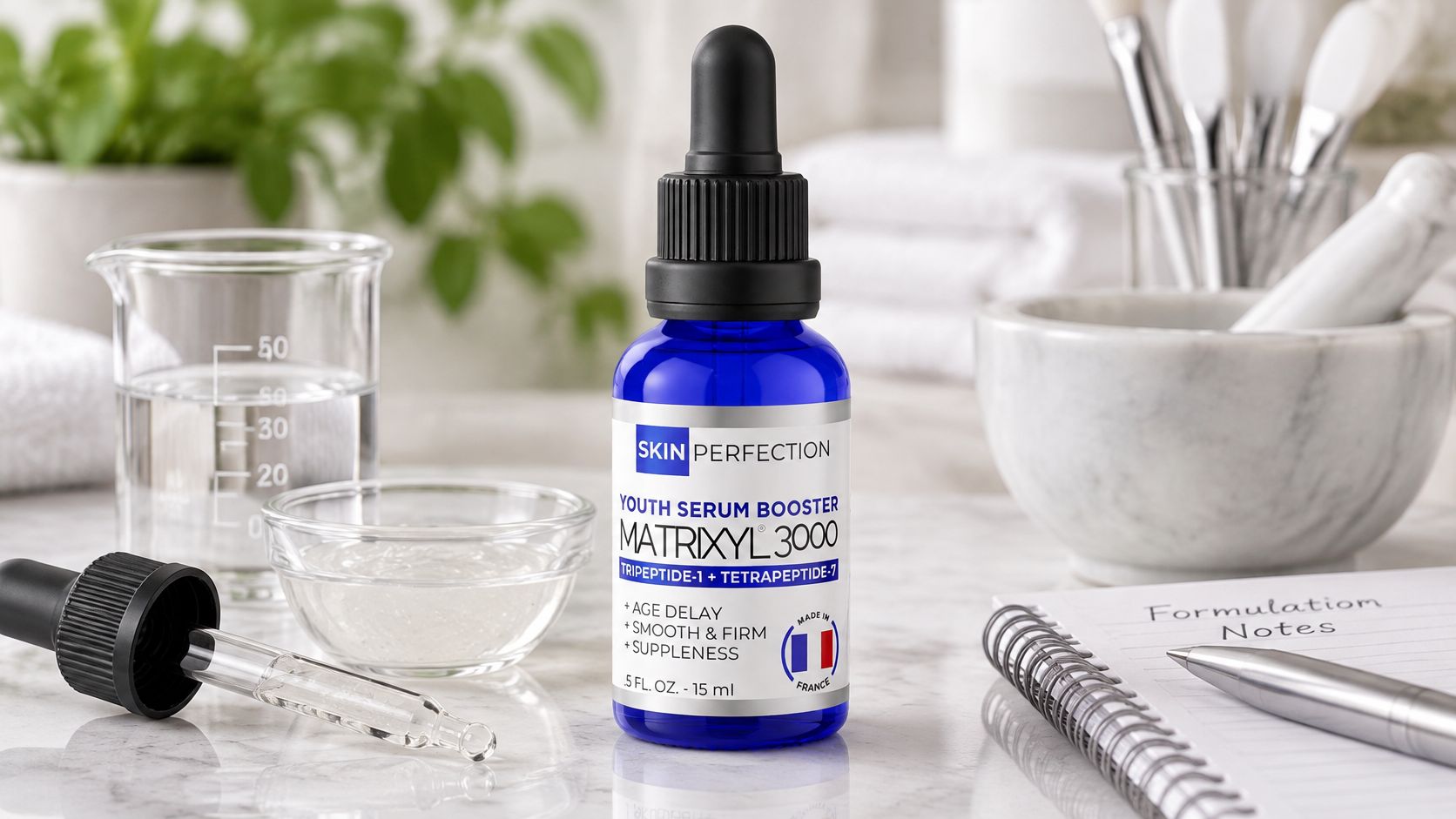
For a concrete example, Matrixyl 3000 Serum Booster is a water-soluble raw peptide complex supplied in a blue glass dropper, with a stated blending range of 3 to 8 percent. It's a formulation ingredient, not a finished serum, and must not be applied directly to skin, according to its product directions.
That distinction is central to ingredient literacy. A raw material's name doesn't tell you the final concentration, suitability of the base, or quality of the finished preparation. Peptide cosmetics also shouldn't be presented as interchangeable with injectable treatments.
For a radiance-focused plan, investigate formulas with appropriate appearance evidence. For a client whose priority is dryness and comfort, begin by evaluating hydration and emollient options. Choose the product because its complete formulation fits the assessment, not because a fashionable ingredient appears on the front label.
Designing a Layered Treatment Protocol
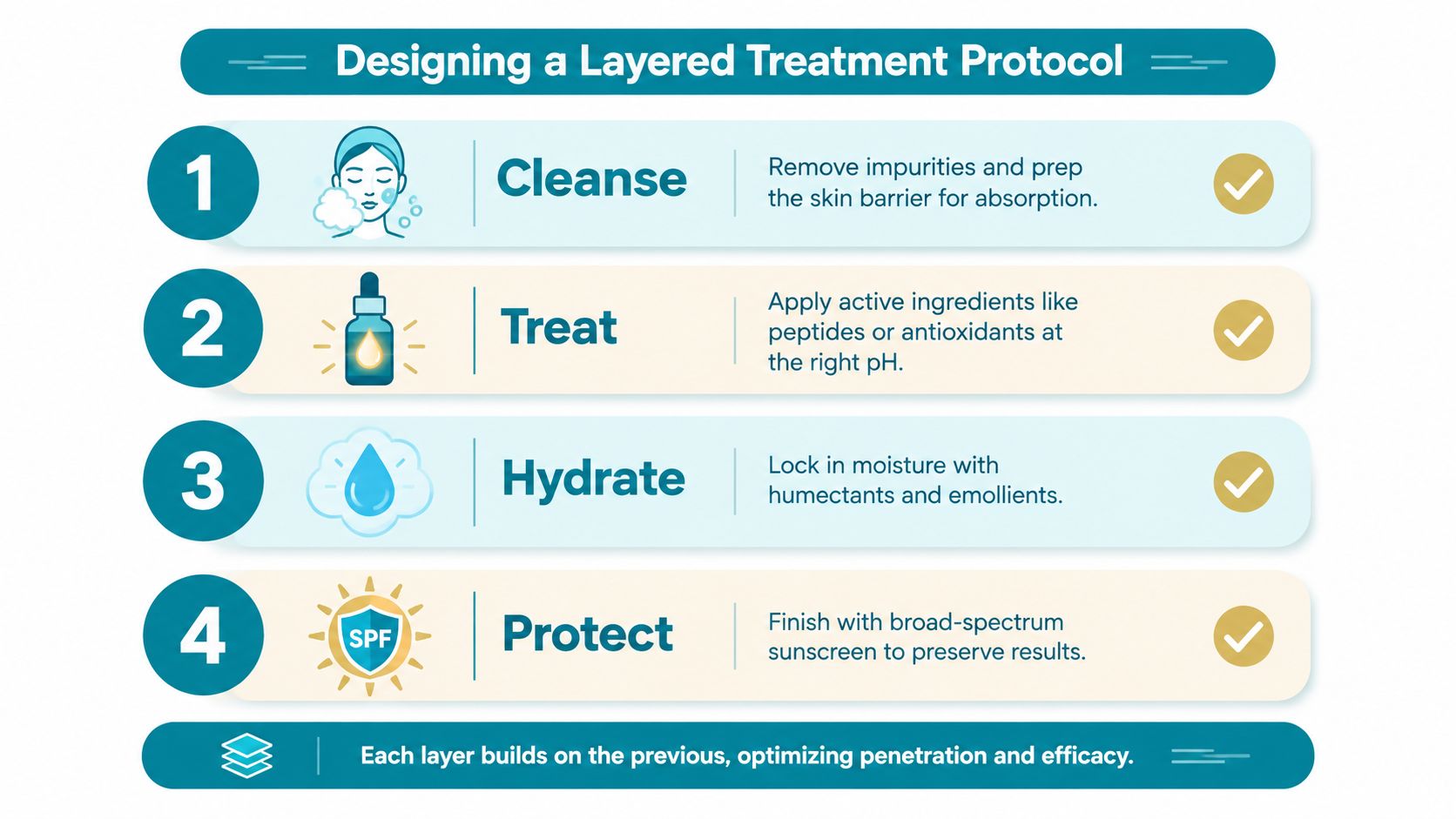
Think of protocol design as preparing a surface and selecting compatible materials. You need an appropriate starting condition, a targeted cosmetic step, hydration, and protection. Adding more layers doesn't automatically make the structure better.
Give every step a job
Cleanse to remove surface impurities according to the cleanser's directions. Treat only when the targeted product fits the assessment. Hydrate with a suitable moisturizer, and protect exposed skin during the day. This is a planning framework, not permission to disregard product-specific application instructions.
Photoprotection deserves explicit teaching. The American Academy of Dermatology recommends broad-spectrum SPF 30 or higher, with water resistance relevant to swimming or sweating, and reapplication approximately every two hours outdoors, including after swimming or sweating, as explained in its sunscreen selection guidance. Demonstrate application and discuss shade, clothing, and hats rather than treating sunscreen as the whole plan.
Schedule for tolerance, not intensity
Retinoids illustrate why sequencing matters. A systematic review of seven randomized controlled trials found that prescription tretinoin improved several signs of photoaging, but those findings aren't proof that every cosmetic retinol product performs identically. Prescription use belongs under medical oversight.
When retinoids are appropriate, coordinate with the prescriber's instructions and avoid placing them immediately alongside aggressive exfoliation. Alternating exfoliation and retinoid nights may be a scheduling option, but it isn't a universal prescription. Procedure-specific instructions should determine how home care fits around peels, microneedling, or other permitted services.
Build the calendar around what the client tolerates, not around how many actives you can fit into a week.
Use an initial stabilization phase to establish manageable cleansing, moisturization, and protection. Progress toward targeted appearance goals only after reviewing tolerance; don't promise a fixed deadline for visible change.
Before adding an active, ask:
- Purpose: What distinct cosmetic goal does it serve?
- Overlap: Is another product already doing that job?
- Timing: Does a planned procedure require a different schedule?
- Exit plan: What should the client stop, record, and report if discomfort develops?
Staying Inside the Cosmetic Lane
A consultation can be thoughtful while the product listing beside it makes an inappropriate promise. Review both. Your website, packaging, advertising, images, and marketplace descriptions need the same attention as your treatment-room language.
Under the FDA's cosmetic labeling guidance, intended use helps determine classification. Cleansing, beautifying, and altering appearance generally fit cosmetic positioning; claims to treat disease or affect body structure or function can bring drug requirements into play.
Describe the appearance, not a medical outcome
A peptide moisturizer described as supporting the look of firmer skin uses appearance-focused language. Describing that cosmetic as reducing inflammation makes a different kind of claim. Neither scientific-sounding wording nor a disclaimer removes the need to evaluate the intended-use message.
| Wording to avoid for cosmetic positioning | Appearance-focused direction to substantiate |
|---|---|
| Regenerates cells | Skin looks smoother |
| Changes melanin production | Promotes a more even-looking tone |
| Works like an injectable treatment | Softens the appearance of expression lines |
| FDA-approved cosmetic | Describe the cosmetic function without an approval claim |
These alternatives aren't automatic approvals. Every statement still needs to be truthful and supported. The FDA's cosmetic claims guidance explains that it doesn't preapprove cosmetic products or maintain an approved list of cosmetic claims.
Marketplace rules require a separate review
Etsy's prohibited-items policy applies to explicit and implied medical claims, even when a seller believes them accurate or legally permissible. Its restrictions include claims concerning:
- Serious conditions: Treating, mitigating, diagnosing, or curing conditions such as cancer or heart disease.
- Sexual dysfunction: Treating, mitigating, diagnosing, or curing sexual dysfunction or impotence.
- Medical equivalence: Being, or being as effective as, an analgesic, antibiotic, antiseptic, antiviral, anti-inflammatory, steroid, vaccine, or decongestant.
- Prescription equivalence: Being, or performing as effectively as, a prescription drug.
- FDA approval: Representing an item as approved by the FDA.
Use a dedicated cosmetic regulations reference when auditing your copy. Check titles and image text as closely as descriptions, and keep the overall message focused on beautifying the skin.
When More Active Treatment Backfires
A stronger peel isn't necessarily a better recommendation for a client with post-acne marks. If that client also reports irritation, escalating intensity may work against the appearance goal. The important question is whether your proposed service adds avoidable inflammation.
This deserves particular care in skin of color. An international expert consensus on photoprotection and aesthetic care identifies persistent education and evidence gaps, reporting that only 5% of sunscreen studies published from 1988–2022 focused on skin of color, with few being clinical trials. The same consensus supports considering tinted formulations for visible-light protection alongside its photoprotection recommendations.
Investigate pigment history before intensity
Ask whether blemishes, friction, previous peels, or irritation have left lasting marks. Record the client's experience instead of assuming their risk from appearance alone. For Fitzpatrick IV–VI skin, a history of treatment-related pigmentation should weigh heavily in service selection.
Use a conservative decision framework:
- Choose comfort first: When the client reports stinging or ongoing sensitivity, postpone escalation and simplify the plan.
- Review pigment triggers: Identify what happened before previous marks appeared and whether similar exposures are still occurring.
- Assess practical protection: Discuss tint match, finish, application habits, and whether the client will wear the product.
- Refer beyond cosmetic scope: Suspected nodulocystic acne, developing scars, or persistent inflammatory symptoms need medical evaluation.
A tinted sunscreen that the client dislikes may sit unused. Product selection therefore includes cosmetic acceptability, not just a label check. Broad-spectrum labeling alone also shouldn't be interpreted as a complete answer to visible-light-related pigmentation.
Measure restraint as a professional skill
The skin barrier education library can help frame discussions about simplifying a routine. Keep the language grounded in tolerance and comfort rather than promising a biological outcome from a cosmetic.
A useful pause: When the proposed treatment could intensify the client's existing irritation, postponing it is an active clinical decision, not a failure to deliver a service.
Research gaps don't justify improvised intensity. They call for careful documentation, realistic expectations, and a willingness to collaborate with a medical provider when the concern exceeds cosmetic care.
Running the Client Conversation
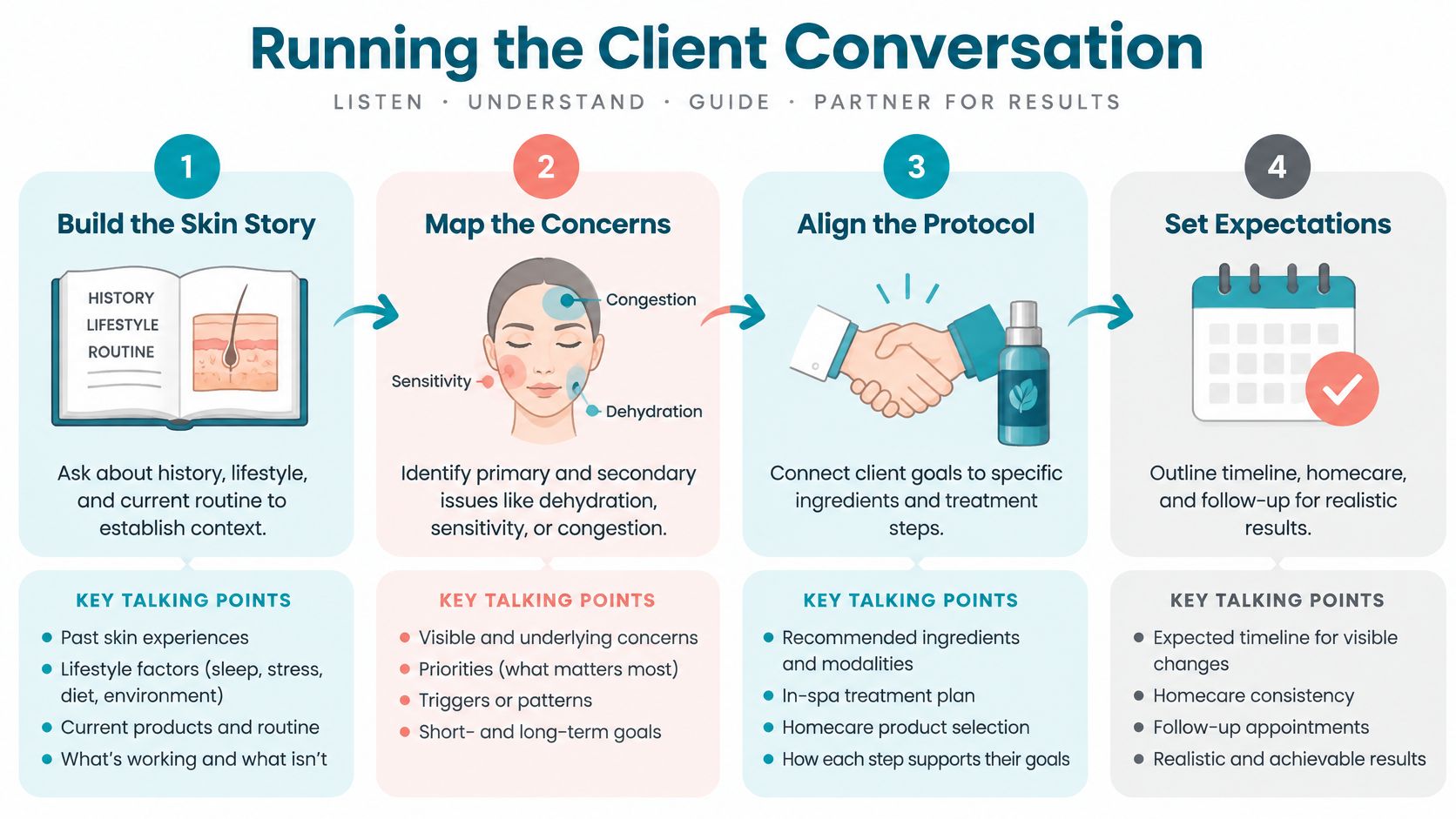
A consultation works better as a structured dialogue than a product pitch. Your client should understand why you chose the plan, what they're responsible for at home, and which changes should prompt contact. Agreement matters more than a long shopping list.
Ask questions that change the plan
Build the skin story by asking what changed and what the client has already tried. Invite them to describe the actual routine, including products used occasionally. A product photograph is often more useful than an incomplete recollection of a brand name.
Map lifestyle and exposure next. Ask about outdoor work, swimming, sweating, travel, and the practical time available for skincare. Then screen for sensitivity history, medications, recent procedures, and any instructions they've received from a licensed medical professional.
Align expectations before discussing retail. Ask which appearance concern matters most and what routine the client can realistically maintain. Clarify the distinction between a cosmetic goal and a concern that requires medical assessment.
Turn answers into a manageable agreement
Suppose a client describes tightness, occasional redness, and marks after blemishes. Rather than selling a separate active for every complaint, explain why you're beginning with a simpler plan. Describe the conditions you'd want to see before considering an additional targeted product.
A focused home-care trio might comprise an appropriate cleanser, moisturizer, and sunscreen. Demonstrate the products' textures and application directions in the treatment room, then ask the client to explain the sequence back to you.
Use a written follow-up agenda:
- Comfort: Ask about tightness, stinging, and products they stopped using.
- Consistency: Find out which steps fit their day and which they skip.
- Appearance: Compare the agreed concern without promising a predetermined result.
- Next decision: Maintain, simplify, cautiously adjust, or refer.
Choose follow-up appointments around the service, product directions, and client needs. Don't use a scheduled review as a guarantee that visible results should have appeared by then. A useful follow-up changes the plan when the client's experience warrants it.
DIY Formulation Guardrails for Working Professionals
Customization changes your responsibilities. Selecting a finished cosmetic is different from changing its composition, and blending a raw ingredient into a base requires more than knowing the ingredient's marketing story. Treat formulation as documented work, not an informal treatment-room experiment.
Start with the supplier's technical directions and a defined purpose for the finished cosmetic. Don't assume that adding a compatible-looking liquid preserves the original product's stability, preservation, or suitability. The cosmetic preservation education library is a useful starting point for understanding why water-containing preparations need contamination controls.
Keep a usable formulation record
- Usage rate: Follow the stated range and document how you measured the ingredient.
- Traceability: Record ingredient names, suppliers, lot numbers, quantities, and preparation dates.
- Preservation: Evaluate the complete formula rather than assuming the original base remains adequately preserved after modification.
- Packaging and storage: Follow documented requirements and label the preparation clearly.
- Tolerance checks: Use appropriate patch-testing procedures, while recognizing that a tolerated spot test doesn't establish overall product safety.
- Adverse events: Keep a process for documenting complaints, stopping distribution when appropriate, and escalating serious concerns.
“Natural” and “plant-derived” aren't substitutes for this work. Sensitization, oxidation, contamination, and measurement errors still need consideration. Neither client consent nor a pleasing texture establishes that a preparation is suitable.
Know which obligations belong to you
Requirements vary by jurisdiction and business role. In the United States, MoCRA requirements described by the FDA include safety-substantiation records and reporting serious cosmetic adverse events within 15 business days for responsible persons. Facility-registration and product-listing obligations also require review for applicability; don't assume every salon activity has the same legal status.
Decline customization when the client needs medical evaluation rather than another cosmetic experiment. Referral triggers include active dermatitis, suspected infection, severe acne, unexplained hair shedding, or other unexplained changes. Keep a clear handoff process that records what you observed, what the client reported, and why you deferred the service.
Skin Perfection offers skincare products and lotion-making supplies for appearance-focused routines and cosmetic formulation projects. Visit Skin Perfection to compare finished products and formulation ingredients, then review their directions, ingredient lists, and intended uses against your professional protocol.