

 Buy with Prime



You're at the workbench with a jug of golden oil, a recipe open on your screen, and one deceptively simple question: Is sunflower seed oil a good choice for skin? The answer depends on more than the name on the bottle. Cultivar, fatty-acid profile, intended use, packaging, and storage can change how the oil behaves in a formula.
For a DIY maker, sunflower seed oil is best understood as a category of related plant oils, not one perfectly uniform ingredient. A high-linoleic oil may suit a lightweight facial emulsion, while a high-oleic grade may make more sense when oxidation resistance matters most. The evidence also supports careful claims about emollience, hydration, and barrier-related measurements, but it doesn't justify presenting every sunflower oil as universally soothing or as a treatment product.
Table of Contents
- What Sunflower Seed Oil Actually Is
- Fatty Acid Profile and Vitamin E in Plain Language
- What the Skin Research Actually Shows
- How Sunflower Seed Oil Compares to Other Carrier Oils
- Using Sunflower Seed Oil in Lotions, Serums, and Body Care
- Keeping Sunflower Seed Oil Fresh in Your Workshop
- A Quick Reference for Choosing and Using Sunflower Oil
What Sunflower Seed Oil Actually Is
Sunflower seed oil begins with the seeds of Helianthus annuus, but the plant on today's ingredient shelf has a long agricultural history. Sunflower was domesticated in eastern and central North America roughly 5,000 years ago, where Native American farmers selected plants with one large flower head and larger, oil-rich seeds. After the plant reached Europe in the late 1500s, it spread mainly as an ornamental before becoming an important oil crop.
Modern commercial sunflower oil owes much of its identity to breeding in Russia during the late nineteenth century. Russian selection for high-oil varieties began around 1860, increasing seed oil content from approximately 28% to nearly 50%. That development shifted sunflower from a decorative garden plant into a crop selected for seed size, oil yield, and reliable agricultural performance, as described by the University of Wisconsin sunflower crop overview.
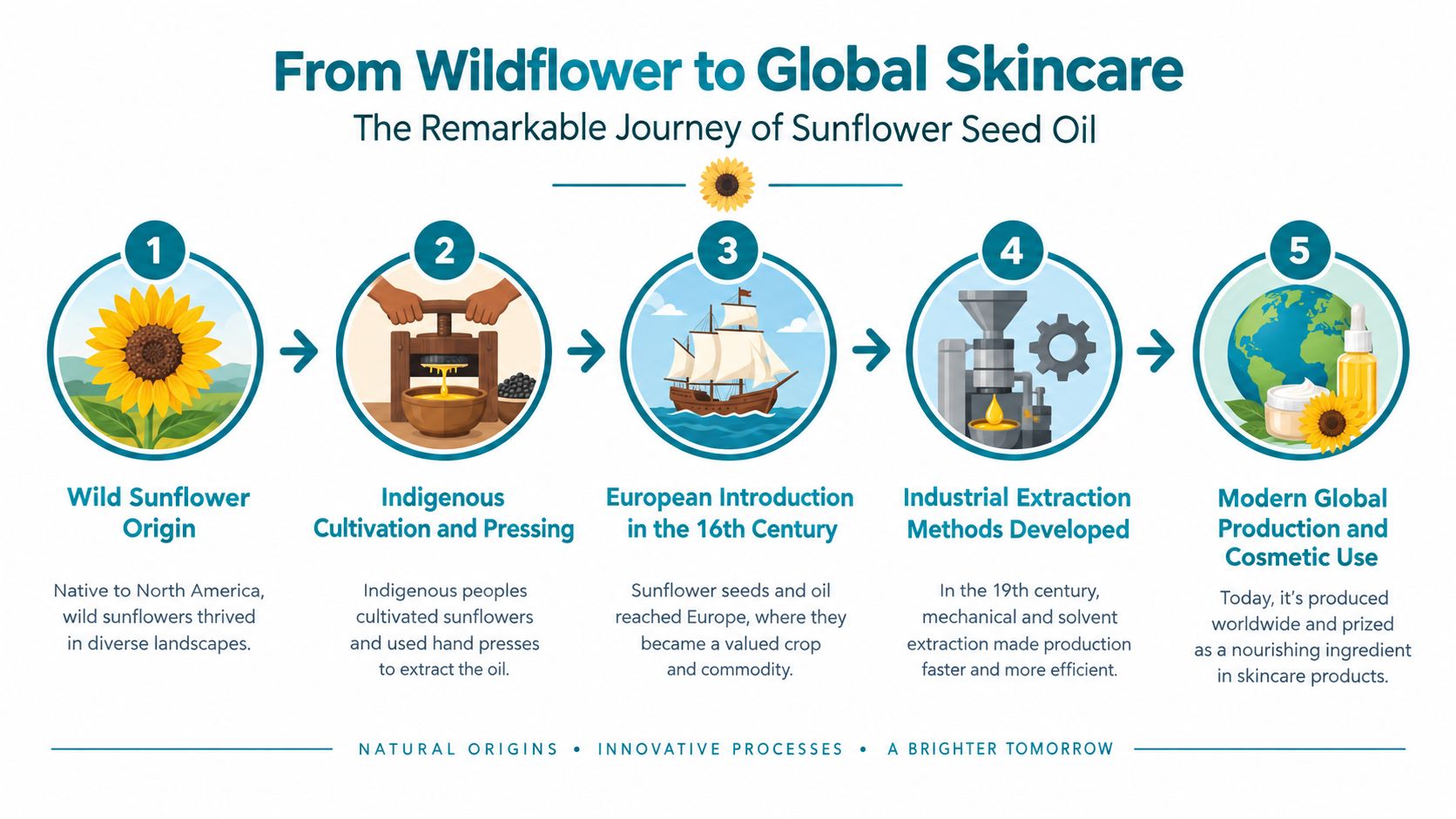
That history matters because “natural” doesn't mean untouched. The oil in a cosmetic bottle is the result of domestication, breeding, cultivation, seed processing, and quality control. The final profile can vary depending on the cultivar and how the oil was produced.
A globally important ingredient
Sunflower oil is also far from a boutique raw material. World sunflower-oil production reached approximately 20.3 million metric tons in 2022, with Russia producing about 30% and Ukraine about 23%. Together, those countries represented roughly 53% of global output, according to the sunflower oil production overview.
That concentration affects more than food markets. Agricultural conditions, processing capacity, trade routes, and regional disruptions can influence availability and raw-material costs for skincare manufacturers. For a home formulator, the practical lesson is simpler: two bottles labeled sunflower seed oil may come from different cultivars, regions, and specifications.
Before buying a bulk ingredient, browse the supplier's cosmetic raw ingredients collection and look for the oil's cultivar description, fatty-acid profile, processing method, lot information, and oxidation indicators. The name tells you the plant source. The specification tells you what you're formulating with.
Fatty Acid Profile and Vitamin E in Plain Language
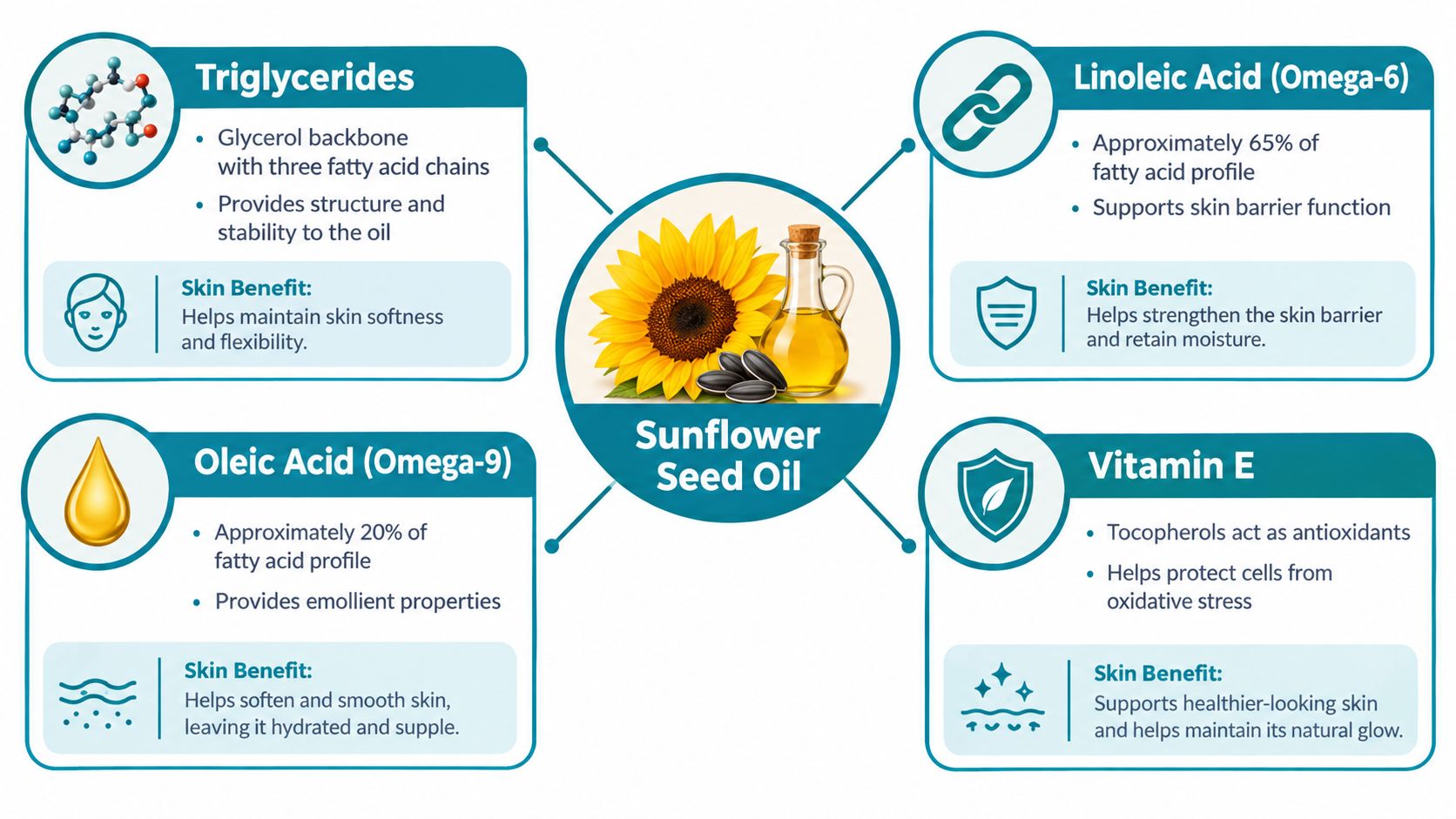
A bottle of sunflower seed oil contains mostly triglycerides. Each triglyceride has a glycerol backbone attached to three fatty-acid chains. Those chains determine much of the oil's texture, absorption profile, oxidative behavior, and usefulness in a finished product.
Two fatty acids dominate the conversation:
- Linoleic acid, abbreviated LA, is an omega-6 polyunsaturated fatty acid.
- Oleic acid, abbreviated OA, is an omega-9 monounsaturated fatty acid.
Conventional sunflower cultivars commonly contain approximately 55% to 70% linoleic acid and 20% to 25% oleic acid, while reported total tocopherol concentrations range from approximately 440 to 1,520 mg/kg. Alpha-tocopherol often represents about 91% to 95% of the total, according to the review in Sunflower Oil Composition and Its Applications.
Linoleic versus oleic
Linoleic acid has two carbon-carbon double bonds. Those double bonds make it more chemically reactive with oxygen, but they also give a high-linoleic oil a profile that many formulators find useful in lightweight, barrier-oriented products.
Oleic acid has one double bond. A high-oleic sunflower oil generally offers greater oxidative stability because it contains less oxidation-prone polyunsaturation. It may also feel somewhat different on the skin and can be a more practical choice when a formula's main constraint is shelf stability.
The label high-linoleic therefore isn't interchangeable with high-oleic. High-linoleic sunflower oil is often selected when the formulator wants a light, fluid oil with substantial linoleic acid. High-oleic sunflower oil may be selected when the formulator wants a sunflower-derived emollient with better resistance to oxidation.
What to request from a supplier
A certificate of analysis should help you answer practical questions rather than confirm the ingredient's botanical name. Look for:
- Fatty-acid profile: Does the batch specify linoleic and oleic acid levels?
- Cultivar or oil type: Is it conventional, high-linoleic, or high-oleic?
- Peroxide value: Does the result indicate whether oxidation has already begun?
- Tocopherol content: Is the natural antioxidant content documented?
- Lot and production details: Can you connect the container to a specific batch?
Tocopherols can contribute antioxidant protection within the oil, but they don't make every sunflower oil indefinitely stable. The fatty-acid profile still matters, and packaging and storage can change the result. If you want a broader reference for naturally sourced antioxidant materials, the 100% pure vitamin E oil collection is a useful place to compare ingredient options.
Formulation rule: Treat “sunflower seed oil” as the beginning of a specification, not the end of one.
What the Skin Research Actually Shows
The strongest skincare evidence for sunflower seed oil concerns barrier-related outcomes, not sweeping claims about every skin concern. A surface oil can reduce the feeling of dryness by leaving an emollient film, but topical sunflower oil has also been studied for changes in the stratum corneum, the outer layer of the epidermis.
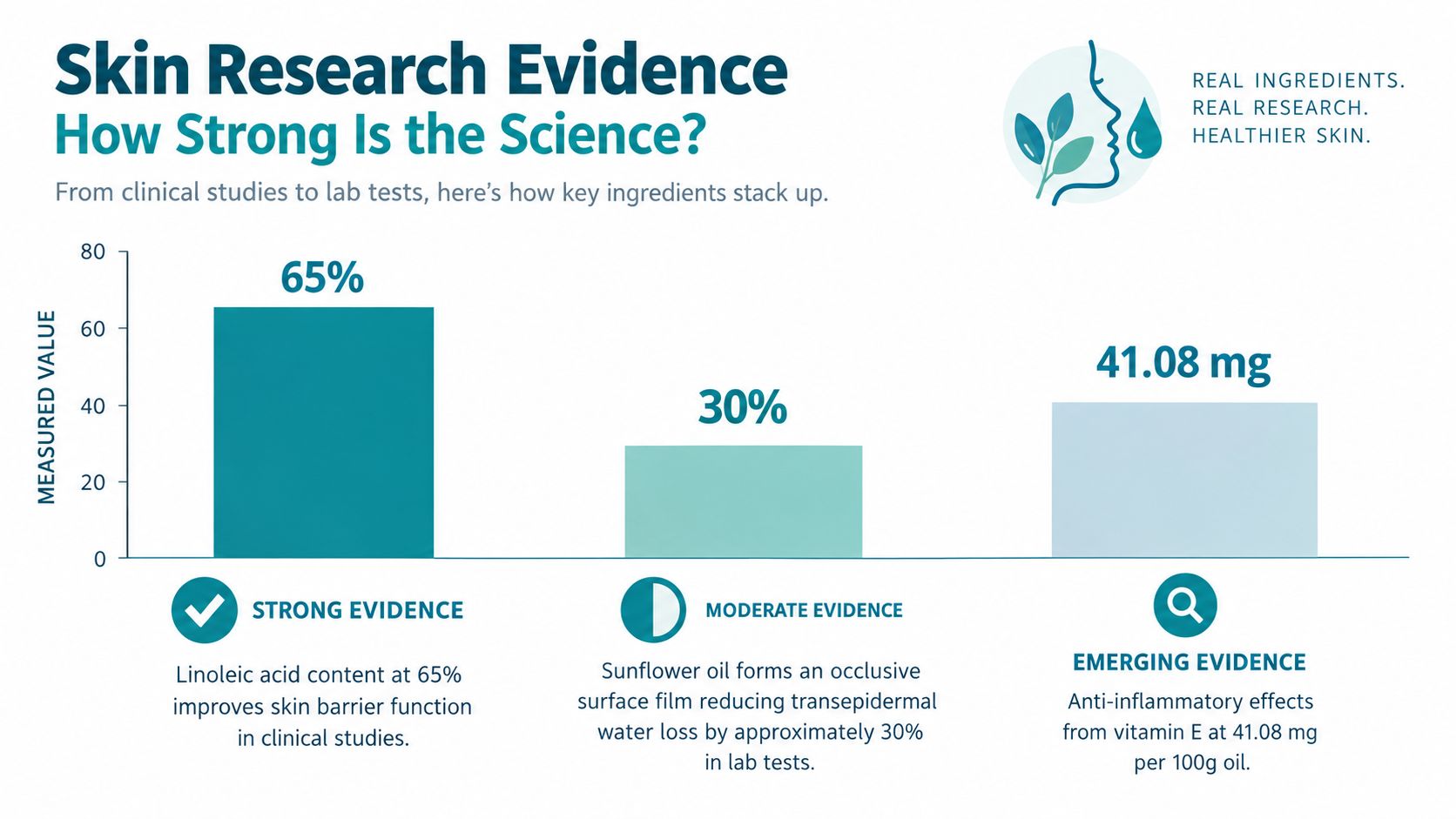
In a human forearm study, participants applied 250 mg of sunflower oil daily for two weeks. The application increased epidermal linoleic-acid content, normalized transepidermal water loss, and reduced skin scaliness, as reported in the clinical evidence review on topical sunflower oil. That finding is important because it points beyond simple surface slip. The researchers observed changes associated with the skin's outer lipid environment.
What the pediatric research adds
Independent clinical evidence comes from a randomized controlled study involving 212 children aged 2 to 24 months with severe acute malnutrition. Researchers evaluated topical sunflower oil in relation to barrier function, infection risk, and inflammatory markers, with reported improvements in barrier performance and reductions in nosocomial-infection risk in relevant age groups.
That research supports interest in sunflower oil as a lipid-phase emollient where dryness and elevated water loss are concerns. It doesn't prove that one bottle of sunflower oil will produce the same result for every adult, every skin type, or every finished formula. The pediatric study also involved a specific clinical context, and the available evidence has limitations, including short application windows, a relatively small sample in the pediatric work, and an unblinded design.
Match claims to measurements
The studies measured epidermal linoleic acid, transepidermal water loss, scaling, and barrier performance. They did not establish that sunflower seed oil alone is an anti-aging active or that it produces broad wrinkle reduction.
A professional listing can accurately focus on appearance and sensory benefits such as softening, conditioning, moisturizing, and helping skin feel less dry. Product wording should remain separate from disease or body-function claims. A serum base such as Rejuvenate Anti-Aging Serum Base can provide a lightweight, fast-absorbing foundation for custom formulas and separately purchased boosters, but its presence doesn't turn sunflower oil into a treatment ingredient.
For a DIY project, that distinction protects both the customer and the maker. Use the research to guide ingredient selection, then test the finished product for stability, irritation, texture, and preservation rather than assuming the raw oil determines the entire result.
How Sunflower Seed Oil Compares to Other Carrier Oils
The right carrier oil depends on the formula's job. Sunflower seed oil may be a sensible choice when you want a fluid, plant-derived emollient with meaningful linoleic acid, but another oil may perform better if you prioritize oxidation resistance, a wax-like feel, or a richer sensory finish.
Reported composition varies by cultivar. Across 20 sunflower cultivars, linoleic acid averaged 53.12% and oleic acid averaged 28.42% of total fatty acids. A separate assessment reported approximately 64.35% linoleic acid and 19.81% oleic acid, illustrating why a supplier's batch specification matters, as discussed in the cultivar composition study.
| Oil | Dominant Fatty Acid | Oxidation Stability | Best Formulation Role |
|---|---|---|---|
| Sunflower seed oil | Linoleic and oleic acids, depending on cultivar | Variable, with high-oleic grades generally more stable | Lightweight emulsions, body products, facial oils, and cleansing blends |
| Jojoba | Wax esters rather than a typical triglyceride profile | Generally strong | Protective-feeling facial oils, balms, and formulas needing a less greasy finish |
| Argan | Predominantly oleic and linoleic acids | Moderate, depending on grade and storage | Nourishing facial oils and richer conditioning products |
| Sweet almond | Mainly oleic acid with additional linoleic acid | Moderate | Massage oils, body lotions, and creamy emollient blends |
| Rosehip | Often rich in polyunsaturated fatty acids | More oxidation-sensitive | Small-batch facial blends where a delicate botanical oil is used intentionally |
Reading the trade-offs
Sunflower seed oil often feels lighter than richer botanical oils and can spread easily across a larger area. It may work as the main liquid oil in a lotion or as one component of a facial blend. Jojoba is a different material altogether, with a more cushiony, less conventional oil feel. Rosehip can add a distinctive botanical character, but its oxidation sensitivity makes careful storage especially important.
Comedogenicity shouldn't be treated as a fixed score that predicts every person's experience. The finished formula, application amount, cleansing routine, and individual skin response all matter. A low-oil gel and a rich balm can contain the same carrier oil while feeling completely different.
For more ingredient-by-ingredient comparisons, the best carrier oils for skin guide can help you choose based on texture and project goals rather than popularity.
Using Sunflower Seed Oil in Lotions, Serums, and Body Care
Sunflower seed oil works best when you choose its role before adding it to a recipe. Decide whether you want a lightweight emollient, a soft body feel, cleansing slip, or a supporting oil within a more complex blend.
Facial moisturizers
For a lightweight facial emulsion, sunflower seed oil can sit at approximately 3% to 8% of the oil phase. That range isn't a universal prescription, but it gives a formulator room to create a lotion that feels soft without making the oil the entire sensory story.
Pair it with an emulsifier suited to the formula, a humectant such as glycerin, and a complete preservative system for the water phase. The oil phase percentage should be calculated against the full formula, not guessed by adding oil to a finished lotion. For guidance on combining aqueous and oil phases, use a reliable oil and water emulsification guide.
Body butters and creams
A body butter can use a higher proportion of sunflower seed oil to create a soft, spreadable cushion. Because the oil is fluid, it can balance harder butters and waxes that otherwise feel draggy. A high-oleic grade may be worth considering if the product will be stored for a long time or exposed to frequent air exchange.
A body lotion can use sunflower oil alongside richer oils, fatty alcohols, and a structured emulsifier. The objective isn't to make the formula as oily as possible. It's to create the desired after-feel, spread, absorption, and surface softness.
Serums and cleansing oils
In an anhydrous facial serum, sunflower seed oil can provide slip and help dissolve or disperse other oil-soluble ingredients. It won't deliver water-soluble actives by itself, so ingredients such as peptides or hyaluronic acid require a compatible water-based system.
A cleansing oil uses the ingredient for glide and makeup-dissolving comfort, but a complete cleansing oil often needs an appropriate self-emulsifier so it rinses rather than leaving a heavy film. Test the formula on waterproof makeup, sunscreen, and the intended packaging before making a larger batch.
A practical test: Make a small pilot batch, record the exact oil grade and lot, then assess spread, absorption, odor, color, and rinse behavior before scaling up.
Choosing an oil-free alternative
Not every routine needs added oil. A gel-style, oil-free moisturizer such as Clear Skin Oil-Free Moisturizer serves a different formulation purpose from an oil-rich lotion. If a user prefers a fresh, water-based texture, sunflower seed oil may be unnecessary rather than automatically beneficial.
Keeping Sunflower Seed Oil Fresh in Your Workshop
“Cold-pressed” and “natural” describe sourcing or processing. They don't guarantee long shelf stability.
High-linoleic sunflower seed oil contains more oxidation-prone polyunsaturation than a high-oleic grade. As oxidation progresses, the oil may develop an unpleasant odor, a darker or altered color, a different texture, and a greater chance of becoming irritating. Recent research found that storage duration, light exposure, bottle color, and added ingredients such as retinyl palmitate significantly affected oxidative stability, with light accelerating degradation and packaging conditions changing quality outcomes for sunflower oil formulations, as reported in the sunflower oil storage study.
Protect the bottle before you protect the recipe
Use an opaque or UV-protective container when possible. Keep the bottle cool and dark, close it promptly after dispensing, and avoid leaving a large amount of air above the oil.
Useful workshop habits include:
- Reduce headspace: Choose packaging that fits the batch instead of storing a small amount in a large bottle.
- Limit air exposure: Pour only what you need and avoid repeatedly opening the main container.
- Track the batch: Record the purchase date, lot number, oil grade, and first-use date.
- Consider tocopherol: Added tocopherol can slow lipid oxidation when used appropriately for the formula.
- Inspect before use: Check odor, color, clarity, and texture against a known-fresh sample.
Tocopherol is an antioxidant, not a preservative. It can help protect oils from oxidation, but it doesn't replace a suitable preservative system in a lotion, cream, or serum that contains water.
For water-containing products, review a dedicated natural skincare preservative guide and follow the supplier's usage instructions, compatibility guidance, and testing requirements. Discard an oil when it smells sharply stale, develops an unexpected color shift, becomes unusually sticky, or no longer matches the original batch profile.
A Quick Reference for Choosing and Using Sunflower Oil
Use this short checklist before you formulate:
- Choose the grade: Select high-linoleic when the fatty-acid profile suits your project, or high-oleic when oxidative stability is the stronger priority.
- Read the specification: Check fatty acids, peroxide value, tocopherols, lot information, and packaging.
- Start modestly: Use a measured amount in a pilot emulsion, serum, body product, or cleansing oil rather than improvising in a finished product.
- Protect the oil: Store it cool, dark, and tightly closed, with minimal headspace.
- Separate claims from evidence: Describe the product as moisturizing, conditioning, softening, or supporting a comfortable skin feel. Don't market it as a product that treats or changes a medical condition.
- Check every listing: The FDA cosmetic claims guidance states that cosmetic labeling must be truthful and not misleading, and FDA doesn't maintain a list of approved or accepted cosmetic claims. A cosmetic product shouldn't be described as FDA approved.
If you're expanding beyond carrier oils into aromatic plant compounds, the terpene skincare guide from Gold Coast offers additional background for evaluating how botanical components fit into topical formulation.
Skin Perfection offers skincare products and lotion-making supplies for makers who want control over ingredients, texture, and finished-product design. Explore the Skin Perfection collection to find sunflower seed oil-compatible bases, formulation supplies, and appearance-focused skincare options for your next carefully documented batch.